
T.L.L.
Arcade Game: Action · ZX-Spectrum 48K · 1 players
Vortex Software · 1984 · Pound sterling 5.95
Also known as Tornado Low Level (English)

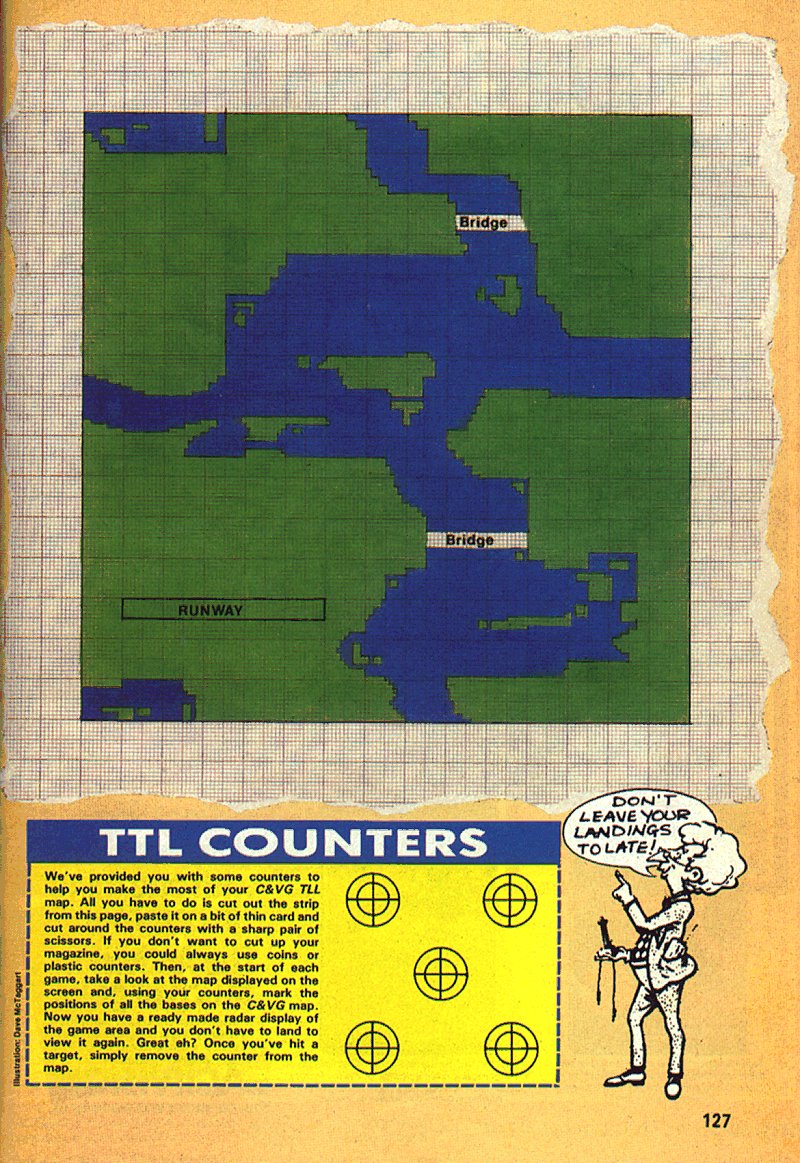
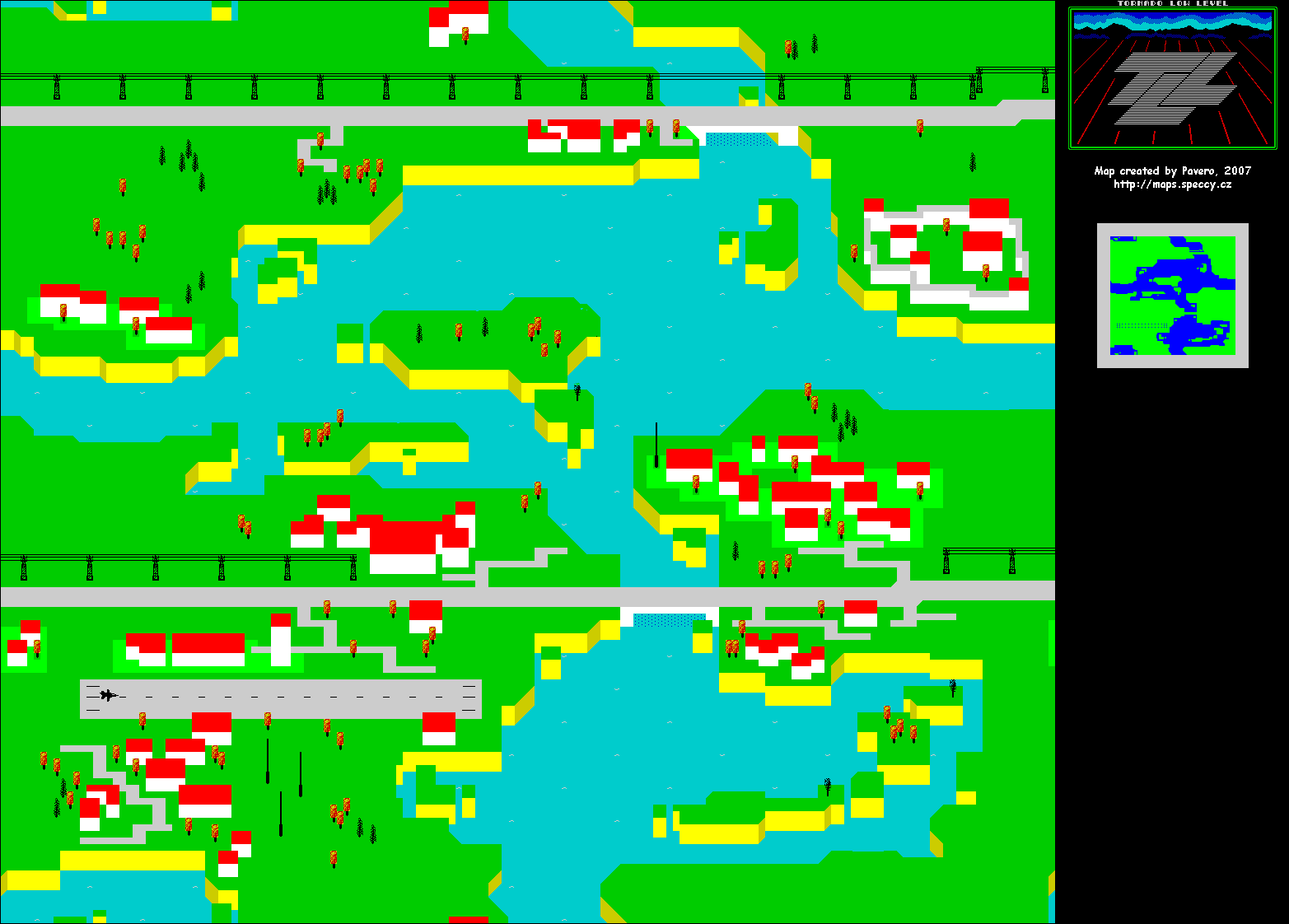
_Back.jpg)
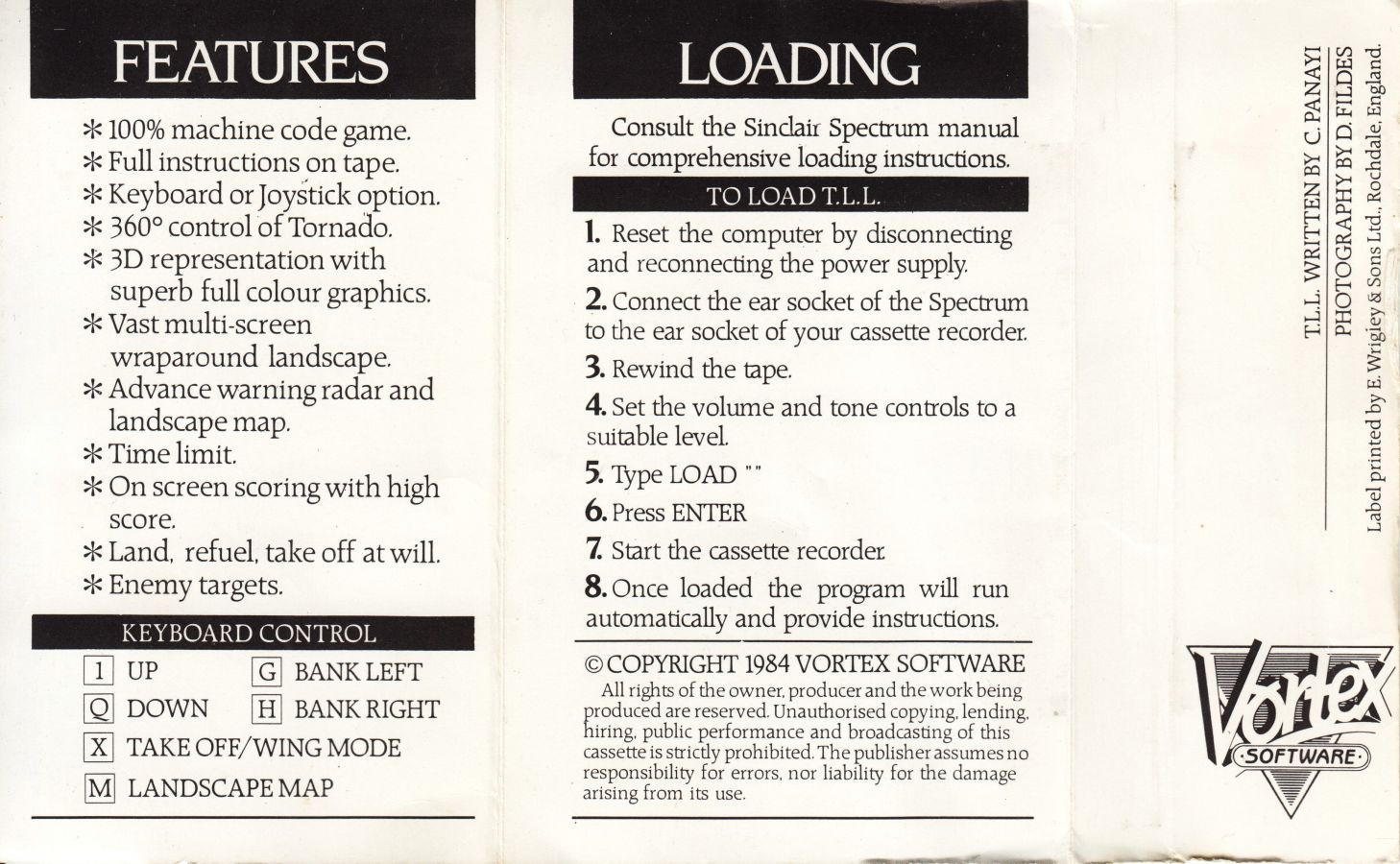
.jpg)
.jpg)
_Media.jpg)
Discussion
Nobody has started a thread about this yet.
Awards
Rank #36 - 1984 Sinclair User Top 50 Spectrum Software Classics
- Control Option
- Interface 2 (right)
Releases
- 1984Vortex Software Sold as Tornado Low LevelPound sterling 5.95
- 13 Oct 19862.99 Classics
- 1984ABC Soft
- 1984Microbyte [ES]Spanish peseta 1700.00
- 1984Ventamatic
Play
- tll.zipRZX playback file
- T.L.L..tzx.zipTape image English31 KB
- T.L.L..tap.zipTape image English19 KB
- T.L.L.(2.99Classics).tzx.zipTape image English16 KB
Documents
- T.L.L..txtInstructions English1 KB
Other files
- T.L.L. (1984)(Vortex Software).pokPOK pokes file 0 KB
Files and rights
Distribution permission is on record, granted to another archive rather than to this one. Screens and pictures are copied here; everything else links to the archive that holds it.
- AllowedVentamatic → WorldOfSpectrum
- AllowedVortex Software → WorldOfSpectrum
Credits
- Costa Panayicredited
- Des FildesInlay/Poster Art
Sign in to credit somebody, or say what these people did.
Awards
Scores
In the magazines
- Sinclair User #301984 · Gilbert Factor8/10
- Your Computer #101984 · Overall4/5
- Crash #71984 · Overall81%
- Personal Computer Games #101984 · Overall8/10
- Personal Computer News #691984 · Overall Value3/5
- ZX Computing #161984 · Overall4/5
- Your Sinclair #231987 · Tornado Low Level7/10
- Crash #511988 · Overall76%
Elsewhere on the web
- WorldOfSpectrum 121 votes8.16
In the magazines 70
Crash #51Apr 1988 · p.8476%76%
Overall 76%
Will Brooker 76%
LOOKING FOR AN OLD ANGLE From Ultimate's classics to the cute and quirky Head Over Heels, we've had our arcade adventures in the strange 3-D of isometric perspective. But, says WILL BROOKER, some of those first tentative steps in the new dimension work better than today's glossy games. Way, way back when Hungry Horace was still a national hero, 3D Ant Attack sneaked out under the Quicksilva label. Its Softsolid graphics of the walled desert city Antescher were hailed as astounding, and 3D Ant Attack wedged itself firmly into Spectrum history as the first game with truly three-dimensional views. The next isometric blockbuster was Vortex's Android 2, released in the spring of 1984. In gameplay it's just a 3-D version of the old arcade game Berserk, but the graphics (which CRASH gave 96%) brought it up to this magazine's Game Of The Month standard. Programmer Costa Panayi followed this up with the impressive TLL - a fighter-plane simulation with a carefully worked-out dynamic playing area. There's not a lot of game behind it, but the flying is enough. The Softsolid technique was soon followed by the first 3-D 'adventure movie' - Hewson Consultants' The Legend Of Avalon. Its adventure element is a bit dubious, and the term 'arcade adventure' would be disputed for years after its release, but the game was a great success with its colourful, pseudoisometric graphics. In 1985 the spate of high-quality isometric games continued: Ultimate's classic Knight Lore was followed by another Vortex game, Highway Encounter, and the next technical advance was Filmation 2. An Ultimate invention, this allows graphics of Knight Lore's quality to be scrolled smoothly over a large playing area. Filmation 2 was used for Ultimate's Nightshade, but was soon knocked into a cocked hat by The Edge's Fairlight. Even back in the golden year of 1986 there were unimaginative clones which sometimes threatened to swamp all the review pages with their identical, and by then extremely boring, isometric screens. But some games brought a breath of fresh air to the already tired genre: the humorous Sweevo's World from Gargoyle Games, Ocean's surprise hit M.O.V.I.E, and Hewson's Quazatron. A Spectrum version of the Commodore 64 hit Paradroid, Quazatron amazed everyone by being superior to the original. Not so original but also well-implemented was Ocean's Batman, and Quicksilva's Glider Rider deserves a mention along with Design Design's Rogue Trooper for taking a gamble and nearly succeeding. Last year Ocean had a megahit with Head Over Heels, M.A.D. had a budget Smash with Amaurote, and Gargoyle brought out the first (and probably last) Hydromation game, Hydrofool - the sequel to Sweevo's World. CRL's 3D Gamemaker utility now enables everyone to rewrite Knight Lore, and last November saw the first real isometric adventure, Incentive's Karyssia. Of course, whether isometric perspective presents a 'true' 3-D view is arguable - the player in these games is 'positioned'somewhere up in the air, outside the playing area, so any game using the technique looks forced, like a technical drawing. Though its representation of object and rooms may be highly effective, if we're going to nit-pick we can't say isometric perspective gives a realistic view. But the technique has proved perfectly satisfactory for countless games, and it's pointless to damn them all for lack of realism. More significantly, it will be interesting to see if the market for isometric graphics ever dries up, and if the public will one day reject the genre as outdated and overused, just as it once refused to accept any more Pacman clones. 3D ANT ATTACK Quicksilva 87% Issue 1 'One day, one year, one hour,'says the introduction. He and She arrived in the walled city of Antescher, 'the signature of a long dead race, the city lost from the world of men for days without number'. But the Ants of Antescher now have your partner (either He or She - unfortunately, this admirably nonsexist feature is undermined by the program's always calling you a 'hero'), and your job is to rescue him or her with the help of some heavy-duty grenades. Complete one level and the foolish girl (or boy) goes and gets herself (or himself) captured again, but this time further away from the starting position. Well, that's life... Back in late 1983 when nobody worried about glaring white backgrounds, UDG-sized graphics and poor sound, 3D Ant Attack was a wonder to behold. But even if you overlook these faults the fact remains that there isn't much gameplay, and what there is soon grows repetitive. Next to modern software, 3D Ant Attack looks rather dismal. TLL Vortex 81% Issue 7 TLL involves navigating a landscape sprinkled with houses, pylons, cliffs and bridges in order to eliminate 'enemy dots'. This top-priority procedure (you don't know how dangerous enemy dots can be if you let them get out of hand) is carried out by swooping low over the ground (hence the title - Tornado Low Level). You always run the risk of crumping your fighter against an obstacle, and once five of the dastardly dots have been wiped out a new mission begins - it's on the same landscape, but this time those devils are hiding below bridges and in the water and all sorts of underhand places. TLL was seen as a masterpiece when it first appeared, and its appeal has hardly diminished since. The landscape is described in effective, clean washes of colour and the fighter is well-drawn, rotating smoothly. The whole thing handles really well and though destroying evil dots is a bit of an artificial exercise the dynamics of the game come together perfectly. Perhaps more a simulation than an arcade game, TLL would, I'm sure, still do well at a budget price. HEAD OVER HEELS Ocean 97% Issue 39 'The best Ritman/Drummond game yet - it's even better than Batman!' said Crash. We read on: 'cuddly',' cute'. I agree; and that's probably what puts me off Head Over Heels. I can do without poisonous Marmite jars, stuffed rabbits, reincarnation fish and doughnuts, especially when their purpose in the game bears no relation to their appearance (why should stuffed rabbits give you extra abilities?). The scenario is unoriginal (two spies from the planet Freedom are out to destroy the Evil Empire), and the graphics look like something you see on early-teatime children's ITV (not that I watch it). Yes, they're detailed and well-animated; yes, they're cute if you like that sort of thing; but there's nothing to link them all together. As isometric arcade adventures go this is probably the best of its kind - there are lots of features, and the graphics are technically the best yet - but no way is it 'the ultimate game'. I like mine a little less silly and with a lot more logic behind them. KNIGHTLORE Ultimate 94% Issue 12 'Sheer perfection,' enthused the anonymous CRASH reviewers of way back at the sight of Knight Lore's Filmation graphics. The Filmation technique allows your sprite to physically interact with onscreen objects in almost any way, and with Knight Lore, the tenuously-related sequel to Underwurlde and Sabre Wulf, Ultimate's programmers surpassed themselves. In this thrilling instalment Sabreman (the player) must brave the castle of the wizard Melkhior to find the ingredients of the potion that will cure his sudden lycanthropy (Ultimate's instructions take the form of an epic poem, but manage to say nearly the same thing). Fail, and you must remain the werewolf forever - but so what? He's a dam sight cuter than Sabreman. Melkhior's castle is divided into rooms full of traps, structures and useful objects, all of which can be manoeuvred using Filmation. The avalanche of isometric games in this style has lessened the impact of Knight Lore's graphics. Today they seem rather plain and simple, though the old Ultimate touches still stand out (the sprite looking warily over his shoulder, for example). The game itself is a little unsophisticated for our times, too: essentially it's just a set of Manic Miner-type problems of timing, jumping and avoiding, and Filmation only comes in useful for making higher leaps. Still, Knight Lore deserves some recognition for having started off the isometric-arcade-adventure genre proper - it's just a pay the subsequent deluge was so heavy. BATMAN Ocean 93% Issue 28 Crash's Overall comment described this as 'a neatly finished game which does Batman proud'. But Ocean took all the Batman mythos and promptly forgot about it in an (admittedly commercially successful) attempt to cash in on Alien 8 etc - this game has nothing to do with Batman. Even the main character graphic shows a squat little figure who looks more like a Smurf than the Caped Crusader. And the Batcave has become some sort of architectural monstrosity furnished with conveyor belts and spiked floors and populated by creatures ranging from puppy dogs to lion-headed mutants. Maybe he's had it redone, but it never looked that way in the comics, the TV series, the films and the graphic novels. All that aside, Batman is quite a good game. The graphics and animation are superior to Ultimate's, and the Bat Devices and Batpills which give Fatman extra abilities add interest to the gameplay. In fact, leave out the pseudoBatman scenario and title and I'm quite content with this. NIGHTSHADE Ultimate 91% Issue 21 Nightshade just scraped into the Smash bracket, and the autumn 1985 release is now generally considered to have marked the beginning of the end for the former masters of Spectrum software at Ultimate. The gameplay is similar to Atic Atac's: wandering around the playing area (in this case a medieval town) destroying materialising nasties and collecting 'super antibodies' to kill off the four major villains. But the real star of Nightshade is the Filmation 2 technique, which scrolls the highly - detailed buildings about and lets you effectively see through the walls in a cut-away view whenever you pass behind them. It's become a cliche that 'the trouble with Ultimate's games is that they have great graphics but no game bolted on', but in this case it's undeniably true. Though the pseudomedieval atmosphere is strong and the characters are well-animated, Nightshade is extremely boring. It eventually bolls down to searching in vain for the major villains, just for the dubious thrill of getting killed by them instead of by lesser monsters for a change. HIGHWAY ENCOUNTER Vortex 95% Issue 20 You're a lone Vorton droid, pushing a highly brainfrying explosive device to the far end of an alien highway to blow up an enemy base. The road is populated by various aliens resembling anglepoise lamps and other dangerous household items (I gave them all names once but that was ages ago), and floating mines weave across the tarmac in dances of death. Your only strategy is to block up or kill off the nasties on your first run, and then go back to get your slave droids and the bomb. Highway Encounter's graphics are still impressive today; as in TLL, the combination of flat background colour and detailed monochrome overlays works very effectively. All the roadside scenery is beautifully drawn, from the crops in the fields to the golden sands of the beach. The only trouble with the game is its difficulty. I still wonder at Crash's comment of the time 'it will be easy to complete and I will probably get bored with it' - after 2.5 years I still can't clear the 30 zones and get the bomb to its destination within the time limit. But Highway Encounter looks great (better, in fact, than it s sequel - Vortex's Alien Highway, 88%/Issue 29) and would probably still sell as a budget game. QUAZATRON Hewson 94% Issue 29 As Klepto, a psychotic young droid with a penchant for taking things apart, you have been volunteered to get the mutant droids out of Quazatron, a multilevelled underground citadel of ramps and lifts. Klepto starts with a measly pulse laser but can collect extra weaponry by ramming other droids and entering a grapple sequence - really a subgame. A test of strategy and reflexes decides who wins the grappling duel. If you successfully grapple another droid you can take any available weapons; if you lose, the consequences are usually fatal. As you upgrade your weapons you can take on ever more powerful opponents, till you become the top dog -and then it's time to move on to the next citadel. 'Quazatron is a true masterpiece,' said Crash at the time, and the comment is still valid. Apart from the rather jerky scrolling everything is faultless: the graphics, the music, the FX and the gameplay. Quazatron is a successful fusion of strategy and arcade and deserves all the recognition it's had. ROGUE TROOPER Piranha 79% Issue 36 This licence is based on the early Rogue trooper stories from the comic 2000AD. Rogue is, as usual, trudging around Nu Earth, this time looking for the eight vid-tapes which show how the Traitor organised the destruction of the rest of the GIs (you have to know the strip to follow the scenario, really). Nu Earth, which seems to have shrunk a little in conversion from comic to computer, is patrolled by Norts and littered with ammo, med-packs - and, of course, the tapes. And Rogue's biochipped buddies Gunnar, Helm and Bagman give onscreen advice which isn't always particularly useful (Gunnar rarely says anything more inspiring than 'Let's grease some more Nort scum'). When all the evidence has been collected Rogue can return to the shuttle and wait for Cam Kennedy to draw him some more identical stories (oops! that just slipped out). Despite the extremely tacky presentation, this is an enjoyable game. It's not hard to win, which may put some off, but it provides relaxing therapy when you need your confidence boosted a little. The graphics are detailed, varied and recognisable, and though the colour washes are used simply they add interest. Perhaps Rogue Trooper's strongest point is the atmosphere generated by the graphics and the comments; it is, surprisingly, the most faithful 2000A0 conversion yet.
Paying off old dots: despite an unlikely dot-destroying scenario, TLL flew well along the border of arcade and simulation
Crash #17Jun 1985 · p.110
Ben Stone
Robin Candy
Use of Computer: 83% Graphics: 79% Playability: 85% Getting Started: 70% Addictive Qualities: 84% Value for Money: 84% Overall: 81% TLL was one of the first games where you operated a plane but it wasn't a simulation. The idea behind the game was to fly low over the landscape and destroy the enemy targets, the lower you flew the more likely you were to destroy. At the beginning of the game you are given a quick glimpse of the whole of the playing area and the locations of the targets. The whole game is presented in 3D and you saw the action from slightly above your craft. Once you have destroyed the first six targets another six appear but in places that are harder to get to. At any time during the game you can land and refuel but you must have sufficient space on the runway to be able to stop the plane. I was never really kean on TLL because I aIways thought there wasn't much to it. Today TLL seems just as boring. The graphics are good but the sound is poor. Playability-wise TLL is good but there isn't enough to the game to make me want to come back after a few goes. Undoubtedly some people like it (that has been proved with its success in the Hotline charts) but to me the graphics are the best things in the game. RC I really enjoyed TLL and it still looks good today. It's not a very hard game to play and it only takes a few days to complete (once you've got used to the keys). It hasn't got the lasting appeal that most of today's games have so TLL becomes unplayable and a little monotonous after a few goes.The 3D effect was good but 3D games recently have had a far superior effect. BS (Rob) As far as its ratings are concerned the one that would suffer the most would be its Addictive qualities which would go down by about 20 to 25% (Ben) I wouldn't really quarrel with any of the ratings, except addictiveness and playability, these would go down by 5 and 4% respectively
ZX Computing #16Dec 1984 · p.15380%82%4/54/5
Presentation 80%
Zapability 82%
Overall 4/5
Jim Watson 4/5
Vortex Software [redacted] £5.95 Nice one Vortex! A neat flying game, but not a flight simulator I hasten to add, where you control a little swingwing Tornado fighter plane. You see the plan on screen and the scenery, land, city and sea, is done in a sort of 3D perspective, this tends to be a bit "blocky" but is nonetheless effective. A great effect is the plane's shadow which appears relative to the plane's height and is your main frame of reference when estimating your height above ground. Your mission, Biggles, is to destroy targets by flying low over them, not low enough = failure, too low = disaster! I didn't really find that the joystick made the game appreciably easier, and the keys were easy to use for effective control. It's not easy, in fact quite frequently I found myself going round and round the target until I finally got lined up and then failed to get low enough in time, so I ended going round and round again! A competent game which would be flyers will love, but somehow for me it seemed to be lacking something. Perhaps if you could have shot or bombed the targets it would have helped. Hypermania I have not got!
Sinclair User #32Nov 1984 · p.38
A masterpiece of 3D graphics programming in which you fly a swing-wing Tornado fighter a few feet from the ground to eliminate a series of targets. The graphics are solidly drawn houses, trees and telegraph lines. The Tornado casts a show which even climbs the walls of buildings. You can fly under bridges and phone lines with nary a flicker on the screen. It is not the most difficult of games, but the large wraparound playing area and superb graphics give it the edge over most rivals, and make it a real pleasure to play. Position 36/50
Your Computer #10Oct 1984 · p.474/5
Overall 4/5
Spectrum 48K £5.95 Vortex Software A terrain hugging mission in which you control a swing-wing fighter bomber charged with obliterating enemy ground targets. Shadow graphics are what make this game. The screen picture shows an aerial view of the craft below you moving across the terrain. This is the viewpoint that, in reality, would probably be shared by defence aircraft carrying the look-down radar tat would aid in the destruction of a Tornado engaged in such a fool-hardy low-level penetration mission. Nevertheless, this is a tough exercise in co-ordination and judgment, even though there are no ground defences or enemy aircraft to obstruct you in your mission. First, you must fuel up. Then you scoot off the runway - it is possible to land and refuel at any time so you can prolong the action for as long as you wish. By pressing the fire-button it is possible to sweep your wings back for supersonic speed. When attacking targets, which appear as small circles with a central dot, all you have to do is descend to the right altitude, make a low pass directly over the target zone and it will be destroyed automatically. Not as easy as it sounds; you must watch out for power-pylons, trees, houses and other assorted ground clutter which traditionally do little to enhance the aerodynamic qualities of an aeroplane flown directly into them. Program options include advance warning radar and landscape map; there is also a keyboard or joystick option. The multi-screen wrap around landscape is vast. Challenging, but in view of the lack of defences, to be viewed more as an acrobatic exercise, Excellent graphics and it would make sense for Vortex to imporvise on this theme in future programs. Perhaps they should join the helicopter craze!
Sinclair Programs #24Oct 1984 · p.28
June Mortimer
WE LOOK AT THE LATEST SPECTRUM RELEASES TO DISCOVER JUST WHAT JACK WAS DOING UP THAT BEANSTALK. TORNADO LOW LEVEL Just when you thought it was possible to use your computer to do something other than fly around and bomb things Tornado Low Level screamed up to the top of the charts, and we are all back where we started. Not quite back, of course. The graphics of the game are extremely good. Your plane flies over trees, houses, pylons and sea at different heights. Your height is apparent due to the distance your plane is from your shadow. This is a very good way of depicting three-dimensional scenes on screen, and has also been used by Psion in Match Point. The game is also very difficult, for swooping low over your target at exactly the right point is not as easy as it appears at first sight. Hitting all targets before you run out of time or fuel is virtually impossible without hours of practice. There is a tendency these days for manufacturers to rely heavily upon excellent graphics, which will make a game attractive in the shops, and to skimp upon other aspects of the game. Tornado has a very eye-catching screen display, but its plot shows little originality. Tornado Low Level is produced for the 48K Spectrum by Vortex Software, [redacted] and costs £5.95.
Your Spectrum #8Oct 1984 · p.43
Dave Nicholls
Ross Holman
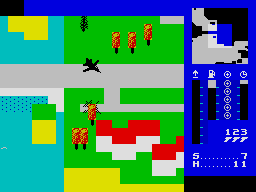
YS announces the last call for flight TLL. Your captains are Ross Holman and Dave Nicholls. We hope you have a smooth flight... Imagine you're in a swing-wing fighter bomber on a training mission to seek out and destroy enemy targets around an air base. That's right, if you've ever fancied being a Tornado pilot, now's your chance to start training. The aim of Tornado Low Level (TLL) is to swoop in low over the 'enemy targets' (seen to you as ground markers) and destroy them. Sounds pretty easy, eh? But think again, because your eyes and hands have to work overtime making sure you're on target, at the right height, and that you're not going to hit any of the many hazardous objects which have an annoying habit of getting in your way. FLIGHT OF FANCY TLL doesn't go for the in-flight realism of Fighter Pilot, but rather it's a cross between an arcade game and a simulation. Whichever category it falls into there's no denying that it's graphically superb. Author Costa Panayi has carried on developing the graphic techniques he used in Android 2; now, with new heights of perfection, you'll find the area of land over which you fly is simulated in incredible detail. An isometric perspective is used to depict the scenery - the player seeing only a part at any one time. We look down on a landscape of trees, buildings and cliffs which plunge into large areas of water... and the plane is superimposed over them. Clever use of colour - normal and bright - gives the buildings, walls and cliffs a feeling of width, depth and height. The view below scrolls continuously as you fly, wrapping around in all directions; cursor control has been used, presumably to alleviate attribute corruption problems and maintain speed. And there's more, for not only can your plane bank in either direction, but it can also climb and dive. You don't so much fly over the landscape as through it. The best visual clue to your height is the shadow of your plane on the ground - which behaves very realistically, climbing walls and passing over roofs as you jet over them. TLL is a slickly-presented piece of software; it's both nicely packaged and offers reasonable instruction options from loading. One minor irritation is that it only caters for keyboard and Interface 2 control, and violently objects to Kempstons and some other peripherals. Vortex reminds everyone to remove these, not on the cassette sleeve but (rather irritatingly) by interrupting loading and sticking up a suitable message. CHOCKS AWAY The instructions are brief and to the point - you're given your mission and a rundown of the instruments. Start the game and for a few seconds you'll see a complete map of the playing area, showing the runway and five flashing blocks that indicate the positions of the targets. The view cuts to the main screen where a region of 22 by 23 cursors act as your window on to the world. Offset to the right are the instruments. Top right is the radar which actually shows a larger area than you'll see through the playing window; here any targets will appear as single pixels. The area currently under surveillance is depicted by a bright square and the whole region scrolls in unison with the main map. Below the radar is an altimeter which shows height above ground level, and completing the gadgetry line-up there's a fuel guage, 'targets destroyed' counter, and current and high scores. Controlling the plane is simple - just up, down, left and right, plus another key that doubles as a take-off and swinging wings control. The 'M' key can be used to re-examine the map showing your targets, but only while you're sitting on the runway. Pressing a swing-wing key and 'P' together will abort the current game. To begin with your plane sits at the end of the runway waiting for take-off. Power on and, as it starts to accelerate down the runway, you'll hear the roar of the engines (simulated by a fairly standard beep) which changes in pitch to indicate that you've reached take-off speed and it's time to leave terra firma. Once in the air, you'll delight in your new-found freedom - climbing, banking and diving; in fact, the plane will only line up on 45 degree bearings, though it animates through 16 phases in rotating through 360 degrees. The keyboard response is very good, allowing the fighter to turn in comically tight circles; it may not be realistic, but it's necessary if you want to avoid the obstacles. Pixel by pixel height adjustment allows you to skim at zero feet above the ground - if you dare! For a while, I was quite happy to just get a feel for the controls and learn how to judge the height of buildings; then I got a bit more adventurous and swung the wings back. This makes things move much more quickly and, although the plane is just as manoeuvrable, your fuel tank runs dry in what seems like no time. The sensation of flying in three dimensions is even more incredible and the shadow thrown by your plane dramatically adds to the visual impact. This really is a very clever piece of programming - disappearing behind buildings, breaking up over trees and dropping down to. appear on the water surface as you go over cliffs. WHAT GOES UP... Once you've marvelled at all these wonderful effects and discovered (the hard way) the height at which you can skim the rooftops or dive under the power cables, it's time to try a mission proper. Here's how my first sortie went. Having first mentally noted the positions of most of the targets I set off down the runway - tally ho! Pulling back on the stick, I took off, made a sharp bank right over the pylons and saw an enemy target at one o'clock. I needed some practise at swooping in low, circling and lining up on target... finally, I got it right, and my great achievement was marked by an appropriate explosive sound effect. You really do have to be low to destroy them, and the lower you get the more points you score. The targets on level one stay in much the same place each time and gradually I discovered the best way of approaching each of them. If you begin to run short of fuel - or can't find one of the targets - then you'll need to land; you automatically get refuelled and, of course, you can use 'M' to look at the map again. Landing is tricky and requires some practise. Rule one is never try and land (or take off for that matter) with the wings swept back or you'll crash for sure. Secondly, line your shadow up with the centre of the runway; because of the wrap-around effect, you'll re-appear before in the starting position if you carry on. Don't forget though that precious time is ticking away - so don't hang about, you've got five targets to destroy before you can return to base successfully. As you get more proficient and progress to new levels, the targets are laid in more difficult positions - near trees or even on the water (which demands some rapid manipulation of the controls). By level four it starts to get really tough, and route planning is necessary if you're to get anywhere near the target. In one instance, you have to fly low over a large lake, zoom under a bridge, bank sharp left between the coast and a small island - and there, at close hand, is the objective. For later levels, targets are placed under pylons, closer to trees and houses, and even in narrow channels between cliffs; for some reason, it all gets easier after level eight or nine. Last thing, beware the objects that you can't fly over... a tower and some tall thin poles are strategically placed to catch the unwary. TLL not only shows that British software leads the world in quality and innovation, it's also a salutory lesson on just what can be done on the not-so-humble Spectrum.
This area of the screen contains a cut-down version of the main map shown at the beginning of the game. Once you've got the lay of the land, you probably won't refer to this much, except to find out when you're approaching a target. The main playing area of the game. Each time you destroy one of the five targets, a symbol is blanked out. An indicator of time - you must destroy all five targets before the level sinks to zero. Your fuel gauge - you can re-fuel your Tornado by landing back on the runway. You have three lives to complete your task; as you lose a life, one of these symbols is blanked out. The current score. The high score of the day. An altimeter, giving you an indication of your height above land. You'll need to watch this closely when you're swooping low over targets. Confusing at first, after a few hours in the air you'll soon get the hang of the gauges on the right of the screen.
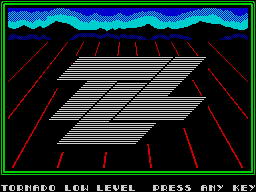
When you start each level of the game, you'll be presented with a full-size map, showing the positions of the five targets you must destroy. Be quick though, it's only on-screen for a few short seconds!
TLL AIRSPACE The map of TLL is in fact square, so we've squashed it up a little to fit our page. Isometric perspective has been used to give an impression of the scenery. You look down on a landscape of trees, buildings and cliffs which plunge into areas of water. The view below you scrolls continuously as you fly, wrapping around in all directions. 1. Don't take off straight away - it'll take a few moment for your Tornado to fuel-up. When you're ready, press the 'X' key and fasten your seat-belt. 2. Once you're at take-off speed you'll notice a subtle change in the sound of the engines - ease back on the joystick and you're away. Whatever you do now, don't press the 'X' key again to swing your wings back or it'll be the shortest flight in history. 3. Banking left for the first target, you can now engage swept back wings for extra speed. You can almost feel the G-force on turns like this. 4. You've got to dive in low to destroy a target - not so easy with all these trees around. That post isn't much help either; the flagpole is one of the few objects that you can't fly over. 5. On one of the later levels in the game, you'll find one of the targets placed on an island at the base of a single tree - it's probably the most difficult to destroy in the whole game. 6. Pressing the '#X' key again puts your wings back to normal and decreases your air speed. Well, you wouldn't want to annoy the neighbours with a sonic boom now would you? 7. Landmarks like these pylons can be very useful if you get a bit lost - you can also use them to help locate targets. 8. Tricky manoeuvres like this should only be attempted by those with a few flying hours already notched up... Otherwise you'll be frying tonight! 9. Slowing down to destroy the first target - skillful pilots out there should be able to get both in one go! 10. You don't need to worry too much on the first few levels, but as you progress with the game, you'll find some of the targets are placed on the water's surface. Best to try and sort out some tactics in the early levels of the game - or bring your water-wings! 11. Watch you altimeter carefully when you approach the cliffs - you don't want to erode the shoreline do you? 12. If you're running out of fuel at this stage, don't panic. TLL's universe keeps scrolling around - so if you fly north at this point you'll be able to land your Tornado on the runway and re-fuel ready for another flight. 13. Another target dead-ahead, again shrouded by trees. If you think this is difficult, just wait until later levels when the targets are completely surrounded by trees! 14. Once you've destroyed a target it's best to climb to a comfortable height as soon as possible so that you can get your bearings again - it's very easy for your concentration to sag for just a few moments and then you'll end up in the nearest tree. 15. If you line yourself up early enough and get to just the right height above the water, you'll be able to fly underneath the bridges. Strictly for aspiring Biggles!
Sinclair User #30Sep 1984 · p.378/108/10
Gilbert Factor 8/10
Chris Bourne 8/10
LOW LEVEL HIGH-FLYER Memory: 48K Price: £5.95 Joystick: Sinclair Why any self-respecting pilot should want to fly a jet fighter at high speed through a built-up area a mere 10 or so feet from the ground is difficult to understand but that is the premise behind TLL from Vortex Software. You are the idiot who has opted for the mission, of course, and your aircraft is the Tornado. You have to take off from a runway and seek six enemy targets represented by small discs. Unfortunately for your health the only way to destroy the targets is to skim above them, thus putting you in the embarrassing situation of risking collision with trees or telegraph poles. Vortex claims to have produced the best-ever graphics. Such claims should be disregarded on principle but the picture of the town in which the game takes place is beautifully detailed in quasi-3D perspective; the representations of the buildings solid and attractive; and the screen scrolling is absolutely smooth and flicker-free. The Tornado is less impressive but casts a shadow on the ground which, while irritating at first, becomes very useful as a guide to your altitude and precise position. There is the mandatory display of fuel gauge, altimeter, time elapsed and so on, as well as a map of the playing area and a small outline of your position and any targets or solid objects nearby. Because the graphics are so highly-developed, the operating system for the Tornado is simple and cannot be described as a simulation. You cannot accelerate or decelerate except by changing the attitude of your swing wings, and take-off and landing is a matter of pressing the appropriate button at the proper time, although obtaining a good approach to the runway for landing is more difficult. Fuel is limited and there is usually only sufficient time to destroy two targets at most before being forced to land and refuel. It all adds up to an exciting game, requiring fast reflexes and cool nerve, and if you think you are made of the right stuff, try flying under the telephone lines without panicking. TLL is no picnic.
Personal Computer Games #10Sep 1984 · p.54PCG Hit8/104/107/108/108/108/10
Personal Computer GamesPCG Hit
Graphics 8/10
Sound 4/10
Originality 7/10
Lasting Interest 8/10
Overall 8/10
Bob Wade 8/10
MACHINE: Spectrum 48K CONTROL: Keys, Curs, Kemp, Sinc FROM: Vortex Software, £5.95 This is the first game from Vortex since their blockbuster Android 2 and has been eagerly awaited, not least at PCG. The action takes place in a small wrap-around landscape interspersed with lakes. On the ground are buildings, trees, electricity pylons, poles and walls The buildings though are unconvincing and are just red and white blobs. Your Tornado starts on a runway and after fuelling can take off into the scrolling scenery in search of five enemy bases which you have to destroy. The fighter moves as in Zaxxon with left and right banking but you can explore the landscape in any direction. At its flight ceiling the plane can avoid all but the tallest buildings and the poles. But to destroy the five bases you must descend to a very low level and fly directly over the disc that passes for a base. The plane has two flight modes with the wings either forward for landing and slow or swept back for faster and higher scoring flight. There is smooth movement and an excellent shadow of your plane zooms over the ground as you fly. You are shown a radar screen, altimeter, fuel gauge, time limit and the number of enemy bases remaining on the right of the display. The fuel can be replenished by landing on the runway again and the time limit's no problem. Some nice touches are the lakes which are below the land level, so surface skimmers must beware of cliff walls. There is also a bridge to fly under which is great fun to have a go at. On the second mission a base is placed in the water, which makes it a lot harder to get at. On later missions the awkward positioning of discs makes things even trickier. There are no bullets and bombs in this game but once you get familiar with the controls it's a great program.
Crash #7Aug 1984 · p.1483%79%85%70%84%84%81%
Use of Computer 83%
Graphics 79%
Playability 85%
Getting Started 70%
Addictive Qualities 84%
Value For Money 84%
Overall 81%
Unknown
Unknown
Unknown
Producer: Vortex Memory Required: 48K Retail Price: £5.95 Language: Machine code Author: Costa Panayi Tornado Low Level (TLL) is from the same programmer who brought us Android and Android 2 and it bears a family likeness to the graphics of Android 2. Again, we have a rapidly scrolling series of three dimensional graphics which will move across the screen in any direction. The Tornado of the title is a swing wing jet fighter which you control in a mission to eradicate a series of evil dots on the landscape. In this respect all the missions can be seen as training, since the 'enemy' dots in question are spattered around the very buildings which make up the township around your base. The total playing area is about 36 times the size of the screen display which consists of a square, offset so that to the right are the instruments. These include 'radar' view some 4 times the screen area on which targets appear as white dots, an altimeter, fuel gauge, targets destroyed status and time. The landscape is seen, as in Android 2 from a severe birds eye view perspective. Ground level is approximately one third of the way up the altimeter as features included are sea and cliffs, which means sea level is way below ground level. On the ground features include low and tall buildings, pylons and electric lines, trees, roads and bridges over rivers. The game commences with a glimpse of the total playing area map, before cutting to the base with the Tornado ready at the end of the runway. Visually, height above the surface is indicated by the shadow of the aircraft which alters accurately depending on the terrain being flown over. Targets are destroyed quite simply by flying over them at virtually zero feet. There are five targets to destroy and when these have gone, more are provided in different positions. Some targets are randomly placed, even in the water, which may mean underflying the bridge. If your fuel runs low it is possible to land and refuel, turn around and take off again. COMMENTS Control keys: 1/Q up/down, G/H bank left/right, X = take off or change wing mode, M = map (on the ground) Joystick: ZX 2 Keyboard play: responsive Use of colour: very good Graphics: mixed opinions from 'brilliant' to 'fair, needed more detail' Sound: average Skill levels: 1 Lives: 3 Screens: continuously scrolling Originality: very original
"Scramble TLL - 5 enemy dots at zero feet..."
TLL's shadow - a graphic that really works.
C&VG (Computer & Video Games) #34Aug 1984 · p.369/109/109/109/10
Getting Started 9/10
Graphics 9/10
Value 9/10
Playability 9/10
MACHINE: Spectrum SUPPLIER: Vortex PRICE: £5.95 Tornado Low Level and games like it are the reason why software pundits are beginning to say that British computer games are the best in the world. It's only a pity that great Spectrum games like TLL and countless others won't sell abroad in any vast quantities because there simply aren't vast numbers of Spectrum owners. TLL's manufacturers are claiming "the finest graphics yet to emerge from a Spectrum". That's an overstatement - but they are extremely good. You are at the controls of the swing wing jet fighter. Your mission is to fly low over enemy targets and take them out. For what is basically an air-attack flight simulation, TLL is surprisingly easy to play and get into. There are only six keys to worry about. Your jet can bank left, right, move up and down and there is one key to operate the swing wings and another to view the battle map. The immediate scenery is viewed through a window which takes up three quarters of the screen. Enemy targets are represented as black dots on the surface - to eliminate them you fly a low pass, being careful not to collide with the ground or any buildings. To make just one criticism of TLL, I would have preferred to be able to shoot up the enemy installations and I felt a bit cheated that my super-fast, swing-wing jet did not have any fire power on board. That said, let me put TLL properly in perspective - this is the best flight game for the Spectrum. I rate it even higher than Fighter Pilot and Night Gunner.
Personal Computer News #69Jul 1984 · p.432/53/53/53/53/5
Lasting Appeal 2/5
Playability 3/5
Use Of Machine 3/5
Overall Value 3/5
Harriet Arnold 3/5
NAME: Tornado Low Level SYSTEM: 48K Spectrum PRICE: £5.95 PUBLISHER: Vortex, [redacted] LANGUAGE: Machine code OUTLETS: Retail ZOOM INTO DANGER Take the hot seat in a Tornado in this low-key version of the fighter pilot favourite. OBJECTIVES Your mission is to take out six enemy bases by dipping over them for low-level passes. Not that they are sitting ducks since they are in tricky locations and you must watch out for buildings, trees, pylons and strange poles. And you are limited by time and fuel. IN PLAY After briefing you examine the targets on a map, which can be viewed at any time. Wait for the tanks to fill up, taxi along the runway and take off. Your birds-eye view of the Tornado shows it to be flying over land so flat it must be Holland, minus the windmills. The plane's shadow gives a 3D' effect and changes its size and shape accurately to suggest height and direction. You can climb, drop, turn, sweep and use the Tornado's swing-wing feature to fly at supersonic speed. On the right of the main screen is a radar map, and instrument indicating the time, fuel and bases remaining, as well as an altimeter and the score. Flying dangerously low all the time earns extra points. The radar screen is essential since it displays a wider area than appears on the main screen, warning when you are approaching a target and whether you are on-course for a hit. Without this the bases loom up and flash by before you've time to say 'blue leader', especially if you've swept back your wings. The landscape is uninspired but the plane's nimbleness is impressive, with smooth movement up and down and through 360°. There's a heart-stopping moment every time the bomber swoops down to meet its shadow since you must go very low for a hit. As the area in view is so small, it's difficult to line up, so part of the skill is judging where the enemy's installations will be. Also, you may find yourself in a tight corner where, for instance, you have to fly under overhead wires. The test was simple, but I found it difficult to stay intact. VERDICT Although piloting the Tornado required skill. I had no problem falling asleep at the controls. It's just not exciting enough for addictive play, more a game for the single-minded.
The Best of 3D carries this game and has 4 references of its own.
Advert15
- Your Sinclair #10Oct 1986 · p.7
- Crash #33Oct 1986 · p.2
- C&VG (Computer & Video Games) #60Oct 1986 · p.11
- Your Computer #5May 1985 · p.98
- Your Computer #4Apr 1985 · p.8
- Sinclair User #37Apr 1985 · p.123
- Your Spectrum #12Mar 1985 · p.51
- Big K #12Mar 1985 · p.55
- Popular Computing Weekly #8Feb 1985 · p.2
- Your Spectrum #11Feb 1985 · p.15
- Sinclair User #34Jan 1985 · p.94
- Sinclair User #33Dec 1984 · p.50
- Your Computer #12Dec 1984 · p.42
- Your Spectrum #10Dec 1984 · p.15
- Popular Computing Weekly #45Nov 1984 · p.2
Full-page ad15
- Computer Gamer #1Apr 1985 · p.74
- Your Spectrum #13Apr 1985 · p.74
- Sinclair User #32Nov 1984 · p.140
- Sinclair User #31Oct 1984 · p.161
- Sinclair User #30Sep 1984 · p.132
- Computer ChoiceSep 1984 · p.61
- Crash #7Aug 1984 · p.25
- Sinclair User #29Aug 1984 · p.97
- Crash #6Jul 1984 · p.4
- Home Computing Weekly #71Jul 1984 · p.32
- Home Computing Weekly #69Jul 1984 · p.40
- Sinclair User #28Jul 1984 · p.97
- Crash #5Jun 1984 · p.58
- Popular Computing Weekly #21May 1984 · p.4
- Home Computing Weekly #62May 1984 · p.11
Feature6
- Crash #51Apr 1988 · p.83
- MicroHobby Especial #1Nov 1985 · p.30
- Personal Computer Games #14Jan 1985 · p.121
- ZX Computing #16Dec 1984 · p.153
- Sinclair User #32Nov 1984 · p.138
- Your Spectrum #8Oct 1984 · p.43
Review5
- Your Sinclair #23Nov 1987 · p.64
- Sinclair Answers #2Jan 1985 · p.27
- MicroHobby #3Nov 1984 · p.15
- Home Computing Weekly #83Oct 1984 · p.20
- Sinclair Answers #1Sep 1984 · p.32
Tips4
- Personal Computer Games #14Jan 1985 · p.132
- Crash #9Oct 1984 · p.87
- Popular Computing Weekly #40Oct 1984 · p.52
- Popular Computing Weekly #32Aug 1984 · p.37
News/Note4
- Popular Computing Weekly #48Nov 1984 · p.43
- ZX Computing #15Oct 1984 · p.16
- Popular Computing Weekly #30Jul 1984 · p.35
- Crash #5Jun 1984 · p.45
Hack/Poke3
- YS Smash TipsAug 1988 · p.57
- Crash #12Jan 1985 · p.147
- Your Spectrum #8Oct 1984 · p.47
Map2
- C&VG (Computer & Video Games) #39Jan 1985 · p.127
- Your Spectrum #8Oct 1984 · p.44
Information1
- SSD-IISep 1999
CoverGame1
- Sinclair User #111May 1991 · p.6
Offer1
- Crash #33Oct 1986 · p.75
Solution1
- C&VG (Computer & Video Games) #39Jan 1985 · p.126
Related
- Compilations
- The Best of 3D, Sinclair User issue 111: Ten Pack, Load 'n' Run issue 10, Spectrum Load'n'Run v1 issue 06
- Ports
- (Amstrad CPC), TLL: Tornado Low Level (Commodore 64)
- Elsewhere
- Speccy Screenshot MapsWikipediaFRGCBSpectrum +2A/+3 IncompatibilityCentre for Computing HistoryMobyGamesRZX ArchiveThe TipshopUVLRZX Archive - YouTubeModern ZX-Retro Gaming
- Same entry at
- Spectrum ComputingZXInfo
Reviews from people here
Sign in to write about this, or make an account. It takes a minute and lets you correct the catalogue too.
No language recorded.
Sign in to correct or add to this.
Hold the rights to this and want it taken down?