Spectrum Voice Chess
Game: Board · ZX-Spectrum 48K · 1 players · English
Artic Computing Ltd · 1982 · Pound sterling 9.95
Also known as Voice Chess (English)
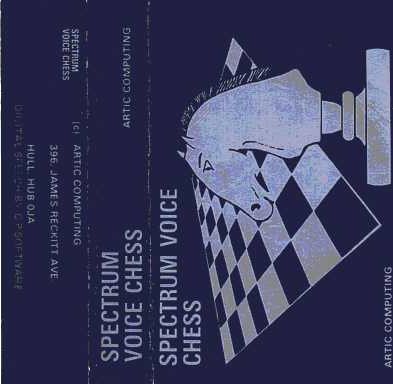
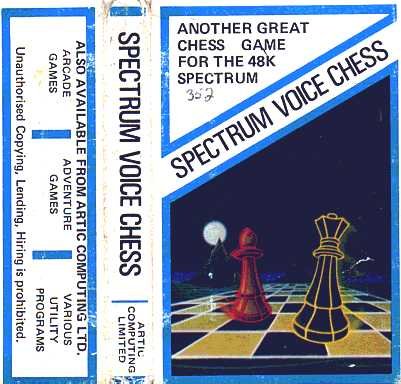
.jpg)
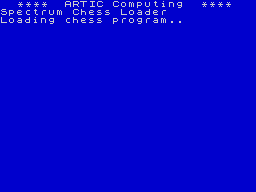
(Aackosoft)_Tape.jpg)
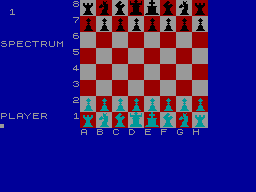
Discussion
Nobody has started a thread about this yet.
Releases
- 1982Artic Computing LtdPound sterling 9.95
- 1983Aackosoft Sold as Voice Chess
- 1982Hansesoft GmbH
Play
- spectrumvoicechess.rzxRZX playback file
- SpectrumVoiceChess.tzx.zipTape image English20 KB
- SpectrumVoiceChess_2.tzx.zipTape image English20 KB
- SpectrumVoiceChess(FullerOrator).tzx.zipTape image English8 KB
- SpectrumVoiceChess.tap.zipTape image English20 KB
- SpectrumVoiceChess(HansesoftGmbH).tzx.zipTape image English20 KB
- SpectrumVoiceChess(VoiceChess)(Aackosoft).tzx.zipTape image English22 KB
Documents
- SpectrumVoiceChess.txtInstructions English4 KB
- SpectrumVoiceChess(VoiceChess)(Aackosoft)(NL).pdfInstructions Dutch163 KB
Files and rights
No permission is on record either way. Screens and pictures are copied here on a take-down basis: if you hold the rights and want something removed, say so and it goes.
Credits
- Chris A. Thorntoncredited
- Stuart HughesInlay/Poster Art
Sign in to credit somebody, or say what these people did.
Scores
In the magazines
- Sinclair User #161983 · Gilbert Factor9/10
Elsewhere on the web
- WorldOfSpectrum 7 votes7.43
In the magazines 40
Crash #4May 1984 · p.65
Producer: Artic, 48K £9.98 With similar specifications to the 'Chess' program from Artic, this version will talk you through your game and make comments. Seven levels of play, save, recommended moves, set up board. A good solid game.
Personal Computer News #51Mar 1984 · p.57
Bob Chappell
GAME TALK Bob Chappell proves that the art of conversation has not been killed by the dreaded micro games. Since the Currah speech box arrived on the market, a number of software houses have taken the plunge and incorporated speech in their programs for the Spectrum 48K. This group could turn into an army as publishers realise the potential of the device. Here is a clutch of programs showing the pioneer spirit. VOICE CHESS II (£8.95) Artic Computing, [redacted] Artic have an excellent range of chess programs. Including one that speaks without the use of any add-ons. Its existing Voice Chess program was an obvious candidate for conversion. As chess is a game normally played between people, what could add more realism to computer chess than having your electronic opponent speak? Every time you or the computer makes a move, the voice makes an announcement. A capturing and/or checking move is spoken: 'D5 takes F6 check'. An illegal move gets the response 'Invalid move'. Castling is voiced as 'Castles' and mate as 'Checkmate'. It can be a little disconcerting to suddenly hear 'Mate in two' when you were not expecting it - fortunately, the voice has no trace of smugness. If you type in 'M' when it is your move, the computer announces 'I recommend E6 E7' if it thinks that is your best move. Having done as told, you will hear, not unreasonably, 'I expected that'. The speech is clear and certainly adds that extra something to a program that plays a very good game of chess. Excellent. BIRDS AND BEES (£6.95) Bug-Byte, [redacted] This is a super little game to be used with or without the speech facility. The game commences with the rousing 'Flight of the Bumble Bee' (what else) and a spoken 'The Birds and the Bees'. A point to note here, for all games, is that any sound effects generated by the program are output through your TV if the Currah box is connected. Playing Boris Bee, you buzz across the meadows in your hunt for nectar. The sun rolling across the sky, drifting clouds and a passing plane (towing a Bug-Byte advert!) adds to the animation. Swaying flowers beckon and when alighted on, open their petals to 'Nectar'. Boris faces many hazards, these include: nectar overload, flying ducks, blackbirds, centipedes, and many more. Spoken announcements include 'Oh dear' (when Boris gets duffed up). 'Game over', 'New high score' and, to warn Boris of approaching danger, something like 'Full alert'. An addictive game with a good scenario. LUNAR JETMAN (£5.50) Ultimate Play The Game, [redacted] The follow-up to Ultimate's successful Jet Pac, has you jetting about a planet with the assistance of a Moon Rover - not a dog but a buggy. The Rover is used to carry various strange objects, you must discover their use as part of your mission to destroy the enemy defence installations. With sideways scrolling screens and brilliant hi-res animation, this is a worthy inheritor of Jet Pac's fame. A drawback with the speech unit is that it cannot be used with a joystick. Jetman is hard enough with a joystick - use of keyboard alone makes it more so. Speech is used randomly and frequently, and is a mixture of statements, commands and threats. They include 'Oh, no!', 'I'll get you, Jetman', 'Exterminate', 'Destroy enemy missile base', 'Pull yourself together' and 'Missile fired'. Although control of Jetman is complex, this is a superb game which benefits by the extra dimension of speech - the taunts generate a psychological obstacle to add to the challenge. BLASTERMIND (£5.50) Martech Games, [redacted] This is the most talkative of all the programs and the only one that attempts to use the voice as a personality. The objective is to guess the computer's code (colours or digits) before it guesses yours. The fun part comes in the computer's comments. To start with, halfway through the loading of the program, you hear 'Keep your hands off my keyboard!' Once loaded, it declares. "My name is Howard but you may call me Sir.' It continues by referring to you in a variety of insulting terms. Not only that but, if given suspect information following one of its guesses at your code, it says, 'You cheated. I suppose I must expect that sort of thing from you humans.' When you decide to finish, the computer begs 'Please don't switch me off. I'll let you win a game if you let me live.' If you agree, it says 'Thank you', but it doesn't honour the promise. I never managed to beat it - judging by its megalomania. I suspect it cheats. I found it amusing - fellow masochists will, too. Most of the pleasure came from waiting to see what it would say next. If you want one program to show off your speech box to your friends, this could be the one. THE ISLAND (£7.50) Crystal Computing, [redacted] An interesting text adventure in the classic mould, the program makes use of speech to repeat your commands ('Inventory', 'go east', etc) and for some responses ('I don't understand'). A unique feature of this program is the ability to switch the speech on and off during the game (the commands are SPEAK and SHUT UP!). An interesting adventure in its own right - as is the case I with some graphics adventures, the speech adds little to the enjoyment but, if you've got the unit, it's an added. Optional bonus. LUNAR RESCUE (£5.95) Lyversoft, [redacted] This is a competent version of rescuing humans from the planet surface by guiding your craft down from a mothership, gathering them up and returning from whence you came. The spoken items include such phrases as 'Chocks away' and 'Rockets fired'. An old favourite, the speech here is more a question of gilding the lily than adding a real bonus.
Crash #1Feb 1984 · p.60
Producer: Artic, 48K £9.98 With similar specifications to the 'Chess' program from Artic, this version will talk you through your game and make comments. Seven levels of play, save, recommended moves, set up board. A good solid game.
Sinclair User #16Jul 1983 · p.1039/109/10
Gilbert Factor 9/10
Quentin Heath 9/10
CHECKING THE BEST MOVES IN GROWING CHESS MARKET Quentin Heath emerges from the dungeons to return to the boards. In the last few months I have been stuck underground in the Sinclair User dungeons with a variety of man-eating monsters, so this month I thought I would seek some fresh air and talk about chess. In later articles I want o say something about the structure of chess programs but for now I will introduce you to what is available for Sinclair machines. Most of the early ZX-81 games were, more or less, copies of a famous American chess program called Sargon. Many manufacturers used the Sargon basic structure and re-wrote the printing routines so that they would be compatible for the ZX-81 screen format. After a few months of copying, manufacturers began to alter programs to make them play better and run faster. Out of the first batch of games to arrive on the scene, the Attic Computing ZX-81 Chess was acclaimed the best by the critics. The original Artic chess, and its upgraded version, Chess Two, have sold well and with good reason. The games include all legal moves, with castling and en passant, and can be played at six levels. The easiest level has a response time of about one second and the most difficult, level six, takes several minutes to make a move. Chess Two plays a good entertaining game for anyone with a slight knowledge of the laws of chess and when I played with it the game did not make an incorrect move, even on the simplest level. It is the game I would recommend for the average player who wants to try to beat a computer at chess. Some people may argue that a computer can play only a mechanical game with no invention or luck but playing a computer will give you some practice if no partner is available. Artic also produces a technically-excellent game which fits into the 1K ZX-81. It may not play brilliantly but it is fascinating to watch the computer scan the moves available to it graphically on the screen. The computer makes moves very quickly, although it will not allow the usual en passant and castling which are available on the bigger games. The game loads very quickly and at £2.95 it is worth the money. Artic has upgraded its ZX-81 chess games to the Spectrum. There are at present three versions but only one is for the 16K Spectrum. So far as I know it is the only chess program for the 16K machine. Its playing standard is similar to that of ZX Chess Two. The most interesting of the chess programs from Artic is Voice Chess. It not only plays as well as Spec Chess, the other game in the trio, but each move made is announced by a voice which is generated by the Spectrum loudspeaker. Some people have asked if the amount of memory used to store the voice affects the quality of the game. So far as I can tell, it does not do so noticeably. Most chess programs occupy a great deal less room than 48K and the voice is just filling the space which is not used. My own feeling is that if you want a game with novelty you should buy Voice Chess but if you just want to buy a good game with no frills, 48K Spec Chess and 16K Micro Chess are choices. Master Chess, from Mikro-Gen, also provides a formidable game. It runs on a 48K Spectrum and has 10 levels of play which are numbered from zero to nine. If you do not know which move to make the computer will suggest one for you. The game also includes an analysis option which can be used to solve chess puzzles. The Masterchess program is capable of all legal moves, including en passant and castling. To see how the games compete with a real chess machine I played a game between the Quicksilva Chess Player and a Sci-Sys chess computer. The results were interesting. Sci-Sys was slower in making moves than the Quicksilva game on level one but the dedicated chess computer earned checkmate in 67 moves. What was also interesting was that the Sci-Sys system often anticipated the moves of the Chess Player. That may indicate that most structures are similar. The final game I want to examine is the best available, in my opinion. Superchess Two is from CP Software and is a chess player's dream. The range of options includes 10 levels of play, a recommended move option, self-play, analyse and technical information. The self-play mode pits the computer against itself so that you can see how it solves game problems. You can also provide it with problems to analyse and solve. The most advanced level is level 10. At that level the computer can take several hours to make up its mind about a move. The game also includes an option which I have never seen in other chess programs. The technical information option will tell you how the program is structured and which techniques are used for the computer to find its next feasible move. Explanations of tree searches and data structures is provided to give the player a chance to further the computer's 'mind'.
Advert33
- Computer ChoiceJan 1984 · p.39
- Computer ChoiceDec 1983 · p.35
- Personal Computer Games #2Dec 1983 · p.100
- Your Computer #12Dec 1983 · p.80
- Your Computer #11Nov 1983 · p.280
- Your Computer #10Oct 1983 · p.24
- Sinclair Projects #5Aug 1983 · p.52
- Sinclair Programs #9Jul 1983 · p.60
- Sinclair Projects #4Jun 1983 · p.52
- Your Computer #6Jun 1983 · p.18
- Sinclair User #15Jun 1983 · p.75
- ZX Computing #7Jun 1983 · p.81
- Home Computing Weekly #12May 1983 · p.8
- Sinclair User #14May 1983 · p.70
- Home Computing Weekly #10May 1983 · p.33
- Your Computer #5May 1983 · p.123
- Sinclair User #13Apr 1983 · p.24
- Home Computing Weekly #6Apr 1983 · p.8
- Home Computing Weekly #8Apr 1983 · p.8
- Your Computer #4Apr 1983 · p.12
- ZX Computing #6Apr 1983 · p.50
- Personal Computing Today #8Mar 1983 · p.100
- Home Computing Weekly #2Mar 1983 · p.9
- Home Computing Weekly #4Mar 1983 · p.8
- Your Computer #3Mar 1983 · p.156
Review2
- ZX MagazínMar 2001 · p.7
- Home Computing Weekly #4Mar 1983 · p.41
Feature1
- Sinclair User #16Jul 1983 · p.103
Licensed from
- ChessBoard/Tabletopunofficial
Related
- Versions
- Currah MicroSpeech (Supports), Fuller Orator (Supports)
- Compilations
- ZX-Spectrum Vega
- Tags
- Beeper Speech
- Same entry at
- Spectrum ComputingZXInfo
Reviews from people here
Sign in to write about this, or make an account. It takes a minute and lets you correct the catalogue too.
No description recorded.
Sign in to correct or add to this.
Hold the rights to this and want it taken down?