War 70
Strategy Game: War · ZX-Spectrum 48K · 1 players · English
CCS · 1983
Also known as Napoléon (French), Napoleon (English)
(PRISMMicro-informatiqueSA)_Back.jpg)
(PRISMMicro-informatiqueSA)_Front.jpg)
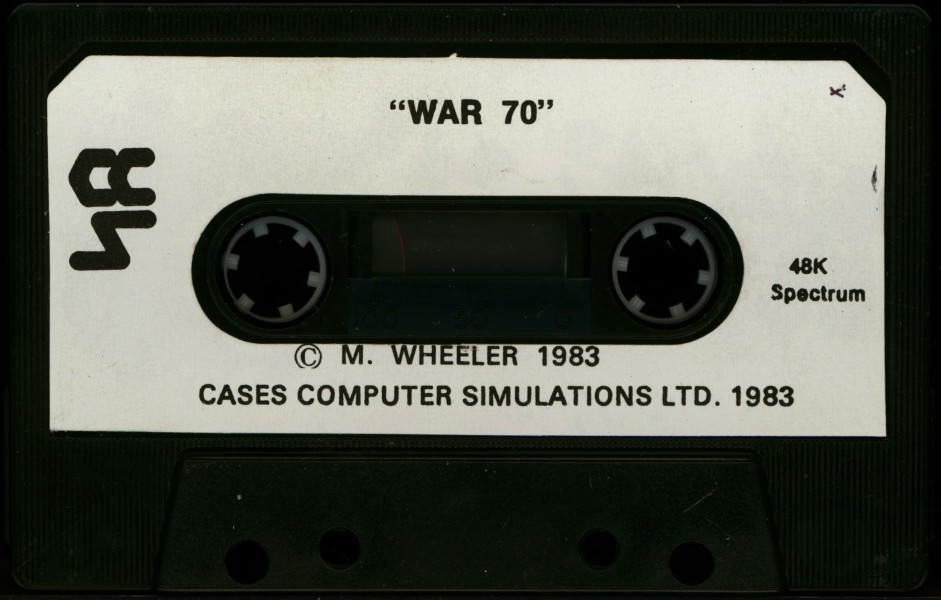
Discussion
Nobody has started a thread about this yet.
Releases
- 1983CCS Sold as Napoléon
- 1983PRISM Micro-informatique S.A. Sold as Napoleon
Play
- War70.tzx.zipTape image English16 KB
- War70.tap.zipTape image English16 KB
- War70(Napoleon)(PRISMMicro-informatiqueSA).tap.zipTape image French16 KB
- War70(Napoleon)(PRISMMicro-informatiqueSA).tzx.zipTape image French16 KB
Documents
- War70.pdfInstructions English115 KB
Files and rights
Distribution permission is on record, granted to another archive rather than to this one. Screens and pictures are copied here; everything else links to the archive that holds it.
- AllowedCCS → WorldOfSpectrum
Credits
- Martin Wheelercredited
Sign in to credit somebody, or say what these people did.
Scores
In the magazines
- Personal Computer Games #61984 · Overall7/10
Elsewhere on the web
- WorldOfSpectrum 2 votes5.00
Awards and competitions
Cambridge Awards 1983
- 2ZX Spectrum Game
In the magazines 20
Crash #10Nov 1984 · p.134
Angus Ryall
FRONTLINES From our correspondent at the front Angus Ryall. Allo mes petits sossions! I was much disappointed by the lack of libel suits, threats against life and limb, etc, resulting from the last FRONTLINE, so this issue I'm going to be tightening up and telling the real truth about some more strategy turkeys. Actually, I must tell you that CRASH has been told that its review of a certain game, should have been upgraded and we have risked losing the advertising from the company that produces it (money we get from advertising pays a large proportion of running costs, so it keeps the cover price down). I'd just like to point out to these cowboys that this kind of petty blackmail produces, if anything, an even more negative approach from writers. It's about time some of these people realised that a reviewer is paid to write what he or she feels about a game, and not what the game producer feels about it. For the record, as I didn't write the review, I've reviewed this particular game again and found myself in agreement with the previous reviewers. You'll have to guess which one it is, but I expect that even those of you with really short memories will get it. And while I'm having a gripe, I spent a knackering couple of days at the PCW show recently, and were there any decent strategy games there? In a word, no. Good old Lothlorien were there, of course, and there was one other excellent strategy game which I can't tell you anything about (ahh, conflict of interest...) but I was very rapidly reduced to discussing the moribund state of the industry with a nubile you cocktailperson in leopardskin shorts. Actually, I can't stand exhibitions you know, but when duty calls... WAR 70 Producer: CCS Author: Mark Wheeler Retail Price: £5.95 I'm supposed to be nice to CCS because they've invited me to lunch at the Ritz - but in fact they didn't have to bribe me, because I actually like War 70. The great thing about it is that it takes in both the strategic and the tactical, by operating in two distinct phases - in the first, you regroup and move your armies, and in the second you fight battles with individual armies against each other. This is a two-player game, which some might call a bit of a drawback; unlike some other wargames it is difficult to play on your own as a purely military exercise. Once you're playing with someone else, though, it becomes quite a teaser. The game starts off with the 'Campaign Map Scenario'. This is a map of two countries, showing their capital cities, eight other cities, and the roads that connect them. Each side has nine armies/groups, and there are 32 locations on the map where the armies can be. Each player moves his armies around the map using a set number of moves, attempting to engage (or avoid) the enemy. Once the enemy is engaged, the game switches to its battle sequence. Each location has its own battlefield map, which shows trees, rivers and buildings: I moaned a lot last month about the poor standard of graphics in games like Confrontation, and the battlefield maps in WAR 70 are certainly an improvement on that, although still pretty basic. The battle runs horizontally, and features a bizarre method of moving pieces - you have to type in the co-ordinates of the location you want the piece to move to. I found that after a hard night's reviewing my eyes just couldn't handle this, and I had to keep checking the screen with a ruler! Apart this obvious shackle, the battle moves fairly smoothly; each army (at full strength) has eight units, of four different types. Each unit has a certain number of men in it, and the number of men killed determines when a unit goes 'out of action' (they're effectively strength points). The game benefits from having a concrete objective - the control of your opponent's capital city - and is almost as good as Red Shift's stuff I it was apparently runner-up to Battle 1917 in 1983s 'Cambridge Awards' (that's the bash I got to go to at the Ritz) but deserved to hands down (CCS must be laughing all the way to the bank).
Your Spectrum #4Jun 1984 · p.537/107/108/10
Dilwyn Jones 7/10
Gerralt Jones 7/10
Ieuan Davis 8/10
Your Spectrum is continuing to scour the country's computer clubs to get the undiluted thoughts, feelings and impressions of dedicated games enthusiasts - in order to provide our readers with unbiased evaluations. Any club wishing to offer its reviewing services should contact Ron Smith, Spectrum Soft, [redacted]. We sent this month's batch to the Bangor Computer Club of North Wales, where their expert reviewers got to work; their plaudits and barbs can be seen over the following pages. First, let's have a look at the club and what it offers its members. The Bangor Computer Club was formed 18 months ago by noted author, Dilwyn Jones. He wanted to meet the needs of local home computer users, and holds meetings in member's homes on a spur-of-the-moment basis. There are currently 25 to 30 members whose ages range from 13 to 30 and, although there's no longer a fixed membership fee, those attending are expected to splash out towards the cost of the evening. Its members have the chance to try out each other's software and exchange ideas. Members can always call upon their colleagues to help solve problems. Anyone in the area who's thinking of joining the club should contact Dilwyn on [redacted], outside office hours. THE LINE-UP This month's reviewers are Ieuan Davis (25), Gerralt Jones (22) and Brian Pedlar (31); all three are long-standing members of the club and avid games enthusiasts to boot. They represent the 'Old Gold' strata of Speccy users, so we won't be expecting starry-eyed reactions to our selection of new games. WAR 70 CCS £5.50 A Napoleonic wargame set in the 18th Century for two players. The object is to capture your opponent's capital city by occupying it with your army for three days. This game took second prize at the Cambridge awards back in '83.
Personal Computer Games #6May 1984 · p.787/104/107/108/107/107/10
Graphics 7/10
Sound 4/10
Originality 7/10
Lasting Interest 8/10
Overall 7/10
Steve Mann 7/10
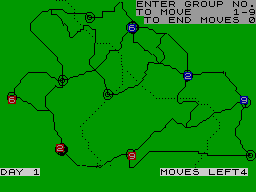
MACHINE: Spectrum 48K JOYSTICK: No SUPPLIER: CCS PRICE: £5.95 Another in the series of Cases Computer Simulations War 70 is a two-player game set in the Napoleonic Wars and is written by M Wheeler. The cassette inlay boasts that this game received the second prize in the 1983 Cambridge Awards, and I must say that this was well deserved,. The program explains that the year is 1810, the place is Central Europe and England and France are about to go to war over an alleged territorial infringement. Each country has 1,500 troops, comprising line infantry, cavalry, artillery and light infantry. To win the war it is necessary to capture your opponent's capital city. You achieve this by occupying it for three successive days. A map of the campaign area is drawn on-screen and is displayed until the opposing forces actually meet. Strategy consists of deciding which of your troops to move (you have nine groups in your army) and play alternates between the two players, with the border colour indicating whose turn it is. If a group moves into a location occupied by the enemy, 'contact' occurs and play switches to a map of the battlefield. There are various rules governing the movements of various sections of each army. And because each game may take a long time to complete, the current situation may be saved on tape at any time. Lack of space precludes any detailed analysis of War 70, but I found it challenging and absorbing - and certainly infinitely more interesting than most of the arcade clones.
Micro Adventurer #6Apr 1984 · p.24
Noel Williams
IMPROVING TACTICAL SKILLS MICRO: Spectrum 48K PRICE: £6.00 FORMAT: Cassette SUPPLIER: Cases Computer Simulations Ltd, [redacted] If you want an introduction to computer wargaming here it is. War 70 is not a game against the computer but against another player. That is both its strength and its weakness. It is a good feature because it means no complex logic is needed to control the computer's decisions, moves and strategy, thus leaving a fair amount of memory free, which other games have to use. Against this is the fact that you do not really need a computer to play. Much better games of the same kind can be played between two players using conventional boardgame or figure game rules. However, I would recommend this game to anyone wanting to learn the basics of wargaming, with or without a micro computer. It contains both a strategic campaign game and a tactical battlefield game. A great deal of the game has had to be formalised to fit it into the available space (all armies are initially the same size and composition, most units cannot cross hills, initial formations in battle are arbitrary and so on), but even so it gives a first-class flavour of both the nature of campaign and battle games. You control up to nine groups of up to two armies each, each army being a miniscule 167 men. These groups are marched across a stylised geographical map showing the cities of the two opposing countries and the routes between them. Each turn you may reorganise groups or move up to four groups. (Actually you can move one group four times if you wish, which is a peculiar quirk of the program because it allows a 'forced march' of extraordinary proportions). When one of your groups contacts an opposing group, a battle results and display is transferred to the tactical map. The tactical map shows a random arrangement of trees, hills and buildings, together with the units of the opposing armies. Commands are given to each army alternately a unit at a time, with all the standard commands allowed. One feature I particularly liked was that you could give a unit orders it could act on in successive moves, or you could change the orders each move. This allows either realistic wargames in the Wargames Research Group style, or more free-flowing battles of the 'he shot at me so I'm shooting at him' type. All calculations are handled by the computer but experienced wargamers will find the combat system a little absurd. Nevertheless it produces an entertaining game, which is the main purpose of a program like this. One feature I definitely did not like was the obvious built-in bias against players with the initials NW. Somehow the program always chooses the wrong player to be kind to. It can't be anything to do with my strategy...
Advert9
- Sinclair User #31Oct 1984 · p.45
- Sinclair User #30Sep 1984 · p.64
- Micro Adventurer #11Sep 1984 · p.30
- Sinclair User #29Aug 1984 · p.62
- Personal Computer Games #7Jun 1984 · p.44
- Crash #5Jun 1984 · p.6
- Sinclair User #26May 1984 · p.58
- Personal Computer Games #6May 1984 · p.52
- Crash #4May 1984 · p.6
News/Note4
- Crash #3Apr 1984 · p.45
- Home Computing Weekly #50Feb 1984 · p.3
- Sinclair User #22Jan 1984 · p.18
- Sinclair User #21Dec 1983 · p.77
Review3
- Games ComputingJul 1984 · p.40
- Home Computing Weekly #58Apr 1984 · p.27
- Popular Computing Weekly #9Mar 1984 · p.61
Related
- Ports
- (Commodore 64)
- Same entry at
- Spectrum ComputingZXInfo
Reviews from people here
Sign in to write about this, or make an account. It takes a minute and lets you correct the catalogue too.
No description recorded.
Sign in to correct or add to this.
Hold the rights to this and want it taken down?