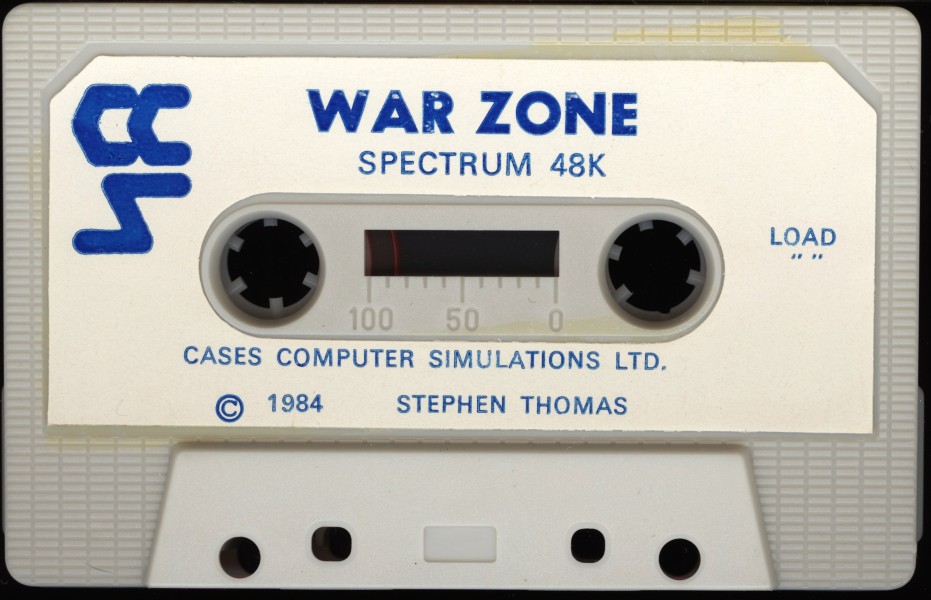
War Zone
Strategy Game: War · ZX-Spectrum 48K · 1 players
CCS · 1984 · Pound sterling 5.95
.png)
Discussion
Nobody has started a thread about this yet.
Play
- WarZone_2.z80.zipSnapshot image English12 KB
- WarZone.tzx.zipTape image English12 KB
- WarZone.tap.zipTape image Spanish14 KB
Documents
- WarZone.txtInstructions English6 KB
Files and rights
Distribution permission is on record, granted to another archive rather than to this one. Screens and pictures are copied here; everything else links to the archive that holds it.
- AllowedCCS → WorldOfSpectrum
Credits
- Steve P. Thomascredited
Sign in to credit somebody, or say what these people did.
Scores
In the magazines
- Big K #101985 · Overall3/3
Elsewhere on the web
- WorldOfSpectrum 7 votes7.14
Awards and competitions
Cambridge Awards 1984
- 2placed
In the magazines 13
C&VG (Computer & Video Games) #42Apr 1985 · p.113
Mike Singleton
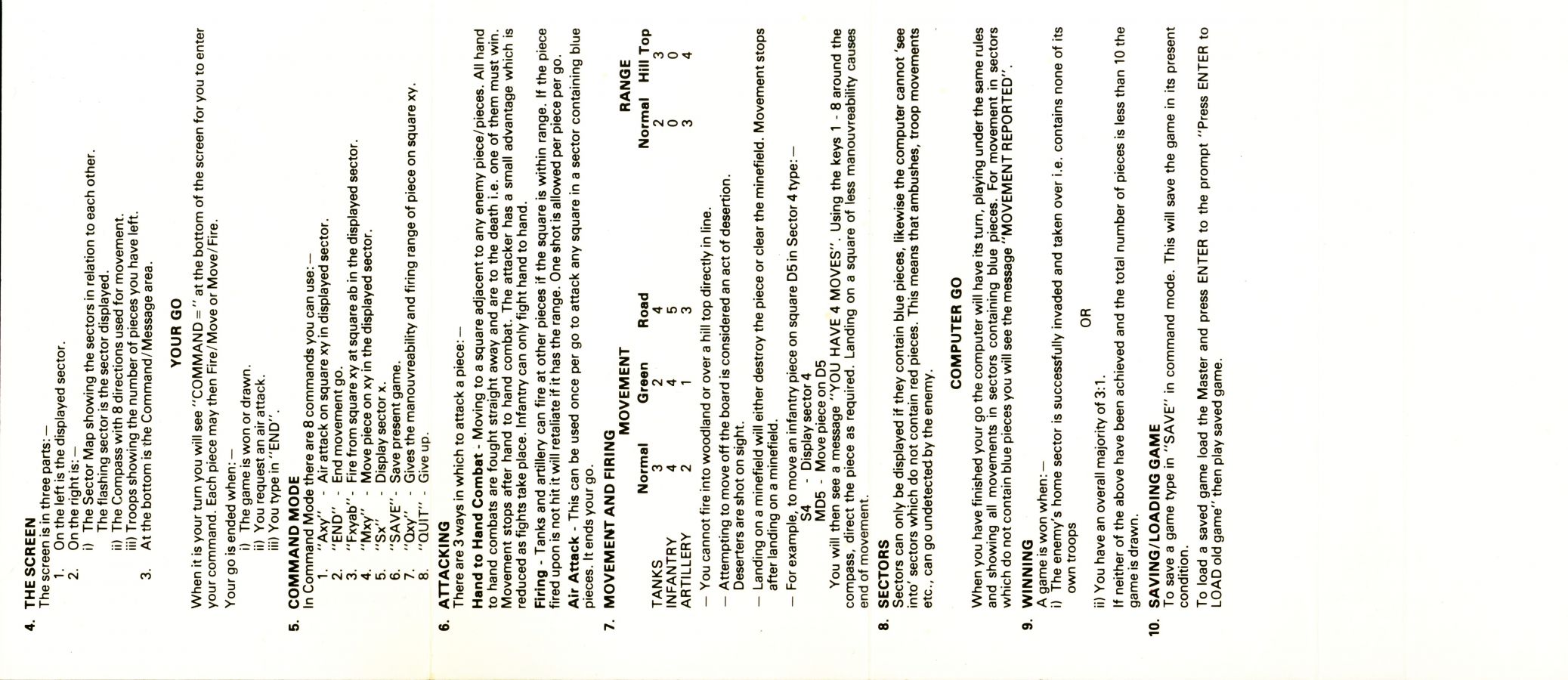
LESS WAR MORE GAME It just so happens that the next game I decided to dip into after poor old Air Defence was another CCS product, this time called War Zone. I loaded it with some trepidation. So, it was with gurgles of glee (and lashings of poetic licence) that I realised, after a few minutes' play, that War Zone was a little gem. War Zone makes no pretence at being an ultra-realistic simulation - the pieces are actually called pieces in the rules, rather than the usual units or divisions wargamers are by now accustomed to, squares are squares, not hexes, and turns are turns rather than battle phases or whatever. War Zone makes a virtue of simplicity. The board consists of nine 10x10 sectors. The three types of piece at your disposal - tanks, infantry and artillery - all have their clearly defined functions. Somewhat illogically, infantry move faster than tanks but this works well in game terms. The artillery moves slowly but has a long range for firing, the tanks move at a medium pace and have a medium range for firing while the infantry move swiftly but can only engage in hand-to-hand combat. When it is your turn, you can move all your pieces. Those that can fire can do so before or after movement. If you score a hit, the enemy piece is removed immediately. If you don't, it gets the opportunity to fire back. If you move a piece next to an enemy piece, hand-to-hand combat immediately starts and there will only be one survivor. There are no in-betweens, no damaged or resting units - it is simply life or death. Finally, when the computer takes its turn, you can sit back and watch the enemy tanks, infantry and artillery tramp across the sectors you are allowed to see, looking on helplessly as your own pieces get cruelly zapped. Nothing works up a good rage better than having to watch your carefully deployed lines being reduced to tatters. War Zone is not a game that will appeal to fans of realistic simulation, but for those of you who like strategic problems, without distraction massive tactical fuss and detail, I can recommend War Zone highly. It's for the 48K Spectrum - watch out for it!
Micro Adventurer #16Feb 1985 · p.31
Cath Bilgora
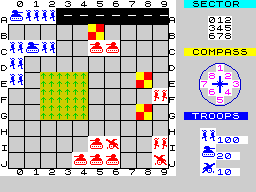
MICRO ARMY MICRO: Spectrum 48K PRICE: £5.95 FORMAT: Cassette SUPPLIER: Cases Computer Simulations, [redacted] Warzone is very much a link between conventional abstract boardgames and computer wargame simulations. This solo game features very crisp graphics and a clear, understandable uncluttered screen. The player may choose to construct his army from infantry, tanks and artillery, picking 15-50 of each; the computer will allocate itself a mirror image (as far as I could make out). Having done this the game may begin. The map is made up of 10 sectors with 100 boxes, gridded and referenced; this gives a total map area of 1,000 boxes. There are four types of terrain - normal, hills, road and forests. The latter are generally the best terrain for infantry and hiding your artillery. There are minefields liberally dotted around, which have the irritating habit of flashing continuously in red and yellow for some obscure reason. Tanks and artillery may move/fire or fire/move, and infantry may only be used for close combat. Movement is carried out by entering the coordinates of the box preceded by M, then using the compass directions shown on the screen to move the appropriate distance. Deductions for terrain are automatic, infantry oddly suffering virtually no penalties. Moving off a road regardless of how many more movement points you have left means the end of that unit's turn! Firing is also easy. You enter the grid references of the firing unit prefixed by an F, and then the coordinates of the target. A simple hit or miss result is flashed up, and if the target is able to fire back it will. Close assault takes place when you contact an enemy unit. Again win or lose is flashed up, with seemingly no real criteria applied. Not even having supporting units helps. Firing, hand to hand combat and air attacks (the latter you may launch at one target at the end of your turn) appear to be a complete lottery. The irritating aspects are moving large numbers of troops from one sector to another. By moving one out into the next, you leave the first sector, and then the computer requires you to enter the ,Loriginal sector's number to go back to move the next unit! The computer's troops never accidentally move onto a minefield, neither do they move off the map (if the player moves one off the map area the unit is lost). The computer instinctively knows your weak points, whilst the player can never look into a sector where he has no troops. You cannot fire from one sector to the next, although you can melee across a sector border. In conclusion, Warzone is a nice simple game, relying on graphics rather than anything else to make you want to play it. The display on the screen tells you almost everything you need to know. The sector display, compass and a total of your remaining troops are always on screen to help you play, once you've learnt the few key commands. I would have preferred the option to play against a live player as well as the computer, as the latter's tactics are limited. Otherwise I recommend this abstract simulation.
Crash #12Jan 1985 · p.160
Angus Ryall
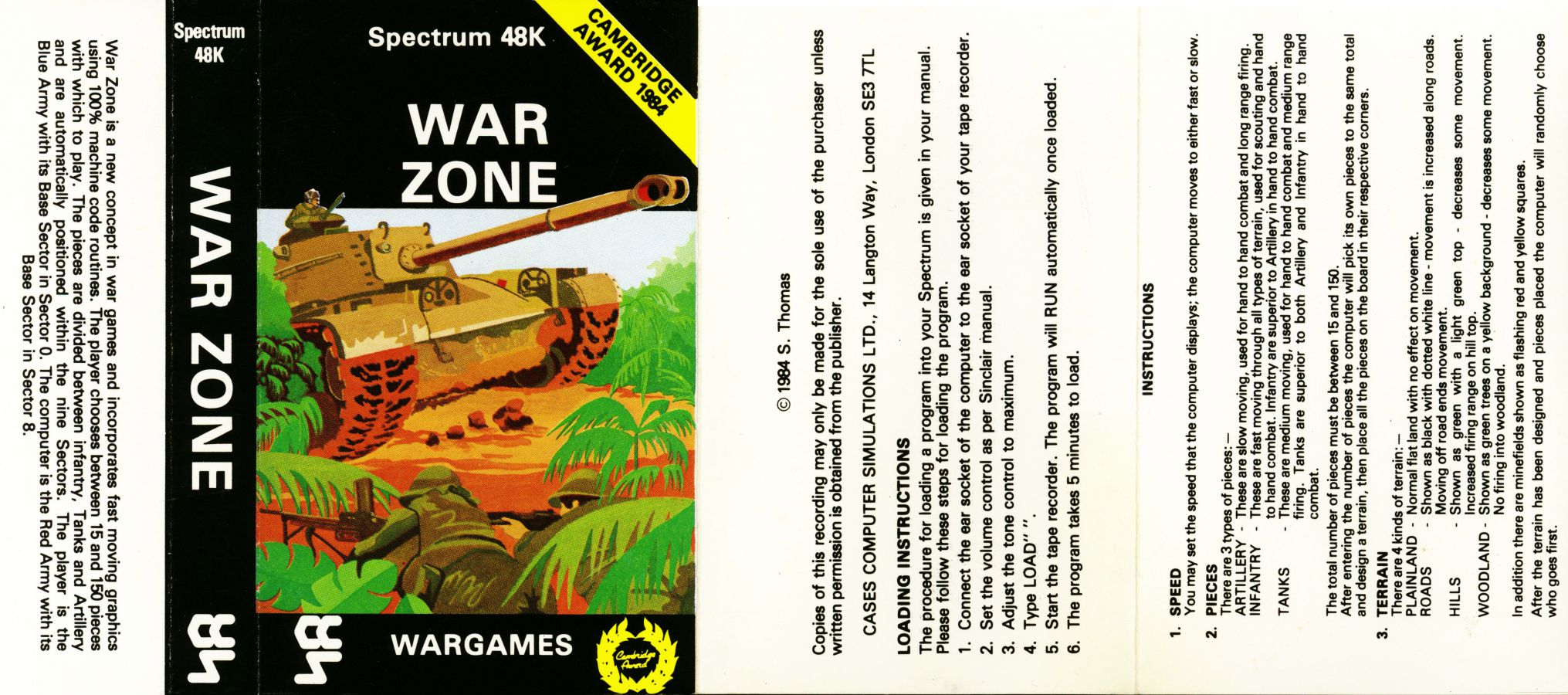
FRONTLINES From our correspondent at the front Angus Ryall. Direct response! I've finally done it! Two issues ago I bemoaned the fact that the software industry was so complacent - it seemed that no matter what I wrote or said, I couldn't get through the thick skins of the people who need to buck their ideas up. But - over the last month it seems to have worked. First of all John Merry (of Reichswald fame -now of Scorpio Gamesworld) rang up to say that not only was Reichsweld a brilliant game (a point which I obviously missed when reviewing it) but that my remarks about his girth were totally unfounded and libellous. Quoth he: 'This kind of petty slander makes my blood BOIL!' Me: 'Sorry John, I was only trying to liven up a really tedious subject.' I was hoping that John would send in a couple of 'before and after' pics as irrefutable proof, but instead he burbled on about withdrawing all Scorpio's advertising from Crash (ho-hum, here we go again) which is probably why Roger is refusing to pay me. My apologies also go out to Argus Specialist Press, whose representatives threatened me with legal action and/or severe bodily dismemberment - I didn't really mean to say anything horrible about your wonderful magazines chaps, I was of course talking about EMAP (at this point the editor grasps me firmly round the windpipe. As I feel the life-force draining from my limbs I manage to scrawl ONLY JOKING PEOPLE, I LOVE YOU ALL)! THE CRASH SANDINISTAS STRIKE A BLOW IN THE CITADEL OF CAPTILISM Or, to put it another way, this month's report comes to you direct from the Ritz Hotel in Picadilly, London. Unfortunately this does not mean that Crash has seen the light and started treating its reviewers with the respect they deserve - we'd be lucky to get a room in the Red Cow in Ludlow. It means that I went along to the 'most prestigious award for amateur programmers' ceremony, the Cambridge Award. Funnily enough, I've only recently reviewed last year's winner and runner-up, Battle 1917 and War 70, so I thought I had an idea of what to expect: but in the event I was pleasantly surprised. There were four 'finalist' games, which I've reviewed below. They can all be loosely described as 'strategy games. But first I must tell you a little about the actual event itself, since I feel morally obliged under the freeloaders' code of honour. As I entered the Ritz in my rainbow-striped jumper and my hardware jeans, I sensed that something was not quite right - why wasn't I being thrown out on my ear for not wearing a tie? Well, apparently if you are going to a private function then you don't have to. Great, I thought; let's just head straight for the bar in my usual manner. Having located the 'Marie Antoinette' suite, I made the mistake of asking the barman for a drink. I say mistake because the man was fairly well blasted by the time I arrived and he could only understand the kind of 'tourist' French that the waiters oil heff to spik, (Was he on a percentage from Beefeater?) Anyway, I got a gin big enough to farm salmon in, topped up with about two millimetres of tonic water. Now I'm not actually that keen on neat gin, so I asked one of the floating French penguins to fetch mea bitter lemon so that I could mix it with the half-pint of gin. A minute later he returned with a slice of lemon on a stick: 'Your beet urv limon monsieur,' he said! Things went from bad to worse. RUSSELL AND Carol from White Dwarf arrived, already half cut, and pounced on a QL chap, hoping to have a meaningful discussion about artificial intelligence. The man was so scared he ran away. The waiters wrested our half-empty glasses from our hands and topped them up with yet more neat gin. By now I had started to acquire a taste for neat gin, and when I was accosted by the Argus heavies I was able to fend them off with a bottle of (yes, you guessed it) gin. Julian Fuller from Micronet got very earnest with a man from Telecom about Multi-User Dungeon. I think that if ever a nuclear war is imminent I shall book myself into the Ritz, because it's the only place I know where you can get drunk in under eight minutes without even trying! Then the buffet lunch arrived, consisting of a load of raw, minced meat on what looked like pieces of Ryvita (I have since learned that this is in fact a great delicacy known as 'Steak Diane') and some kind of Scampi - or was it Pork Balls? (The kind you get at a Chinese take-away, I mean!) Then the speeches began, greeted with thunderous applause. The sponsors of the awards were C.C.S., Sinclair User magazine and Sinclair Research Ltd. I think that most of us who'd managed to stay sober were hoping to have a word with Sir Clive about his plans for world domination and whether we'd be able to buy shares in Sinclair in 1985 (ha-ha). But alas, it was not to be because he didn't show up. Instead we had to make do with Nigel Searle who is (only) the Managing Director. He spoke about how Sinclair had been responsible for getting computing off the ground in the U.K., and how pleased they all were to be British and all that sort of thing. My associates Russell and Carol kept making distinctly negative comments at particularly high volume, which made one feel slightly conspicuous. The Chairman of C. C. S, made a rather rambling speech and seemed a little overwhelmed by the whole situation; but then, if he had drunk as much as I had then I wouldn't be at all surprised. John Gilbert of Sinclair User made a punchy but totally vaccuous speech about what a brilliant magazine he works for. John Sherry from Keele received the award from Nigel Searle for his program The Prince, and looked understandably pleased with himself since he'd just won £2,000. WARZONE Producer: C.C.S. Memory Required: 48K Retail Price: £5.95 This is an impressive game, certainly the best wargame that C.C.S. have released so far. Even my girlfriend liked it, so it must be good! Warzone is a straight battle between the blue and red armies (the computer controlling the red armies of course) over a sectored map measuring thirty units square. The player has a choice of infantry, artillery and tank units and can choose up to one hundred and fifty units in total - which is matched by the computer's side. The computer generates a new landscape for each game and deploys the units automatically. The physical features of the map are a little on the simple side, but incorporate some nice touches such as giving longer range when firing from a hilltop. The map does not scroll, but is selected by sector - this causes some problems, as you cannot look at a sector where you do not have pieces (I suppose this may echo real-life military intelligence, but it can be very frustrating) and you also cannot fire from one sector into another, which is definitely not realistic. The program is all machine code, and responds fast, though I greatly prefer the cursor selection type of piece movement to the 'J3 to H6' type of input as found in Warzone.
Big K #10Jan 1985 · p.202/33/33/33/33/3
Graphics 2/3
Playability 3/3
Addictiveness 3/3
Overall 3/3
John Conquest 3/3
ARMOURED SCOREFARE MAKER: CCS FORMAT: cassette PRICE: £7.95 A very worthy, if rather simple-minded, computerisation of H.G. Well's style Little Wars, stripped down to the basics. You pick a combination of infantry, armour and artillery totalling between 15 and 150 units. The Spectrum then picks its own hand, shuffles its deck of roads, woods, hills and minefields to make up the battlefield and places both sides. The map is divided into nine sectors, top left being your home base, bottom right the computer's, and the side that takes over the other's base, or gets a 3:1 superiority, wins. You only get to see one sector at a time and then only if you have at least one unit in it. So, with every map completely different, you have to switch back and forward between sectors to keep the overall picture clear before committing units. The cap is divided into squares, with eight-way movement which, as any pre-hex wargamer can tell you, puts tremendous emphasis on the use of diagonal movement. Infantry moves four squares at a time, armour three, artillery two, though hills and woods slow movement while roads speed it up. Artillery has a longer firing range than armour, both getting an advantage from hilltops. Watching the computer take its turn, it sure seems like it's giving itself plenty of the best of it, but I guess it evens out. After taking a couple of hammerings I found a surefire technique or winning - does the name J.F.C. Fuller mean anything to you? Nudge, nudge, wink, wink, say no more. Good, clear graphics, smooth action, simple and straightforward control systems. Not for the hardened wargamer, but good fun in the true Wellsian spirit.
Advert3
- Sinclair User #36Mar 1985 · p.56
- Crash #14Mar 1985 · p.123
- Micro Adventurer #16Feb 1985 · p.41
News/Note2
- ZX Computing #17Feb 1985 · p.83
- Micro Adventurer #14Dec 1984 · p.6
Review2
- TV GamerJan 1985 · p.47
- Home Computing Weekly #90Nov 1984 · p.27
Feature2
- Your Computer #12Dec 1984 · p.65
- Sinclair User #32Nov 1984 · p.93
Related
- Compilations
- OTAN Alerta! + War Zone
- Ports
- (Amstrad CPC)
- Same entry at
- Spectrum ComputingZXInfo
Reviews from people here
Sign in to write about this, or make an account. It takes a minute and lets you correct the catalogue too.
No language, description recorded.
Sign in to correct or add to this.
Hold the rights to this and want it taken down?