
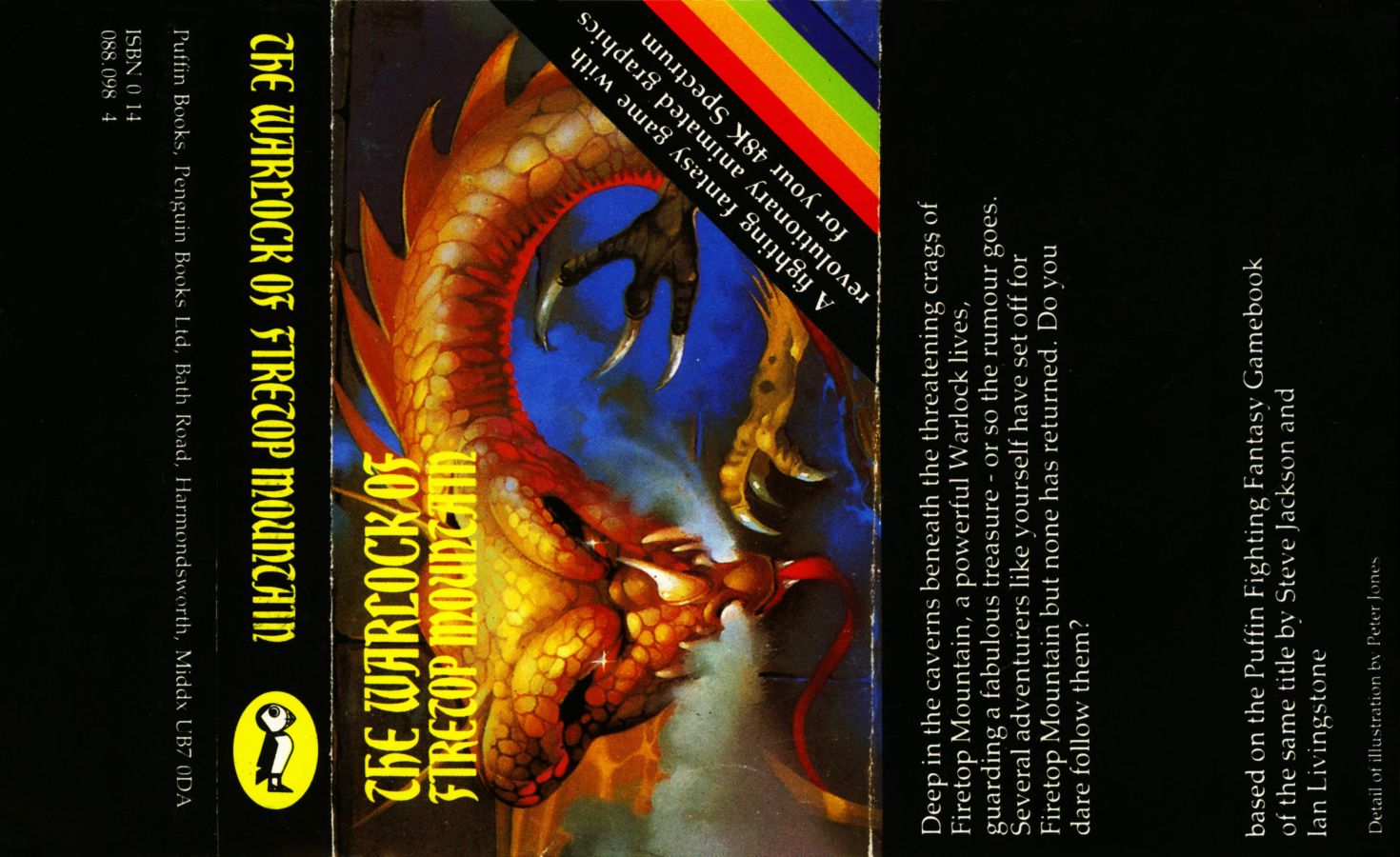
The Warlock of Firetop Mountain
Arcade Game: Maze · ZX-Spectrum 48K · 1 players · English
Puffin Books · Dec 1983 · Pound sterling 6.95
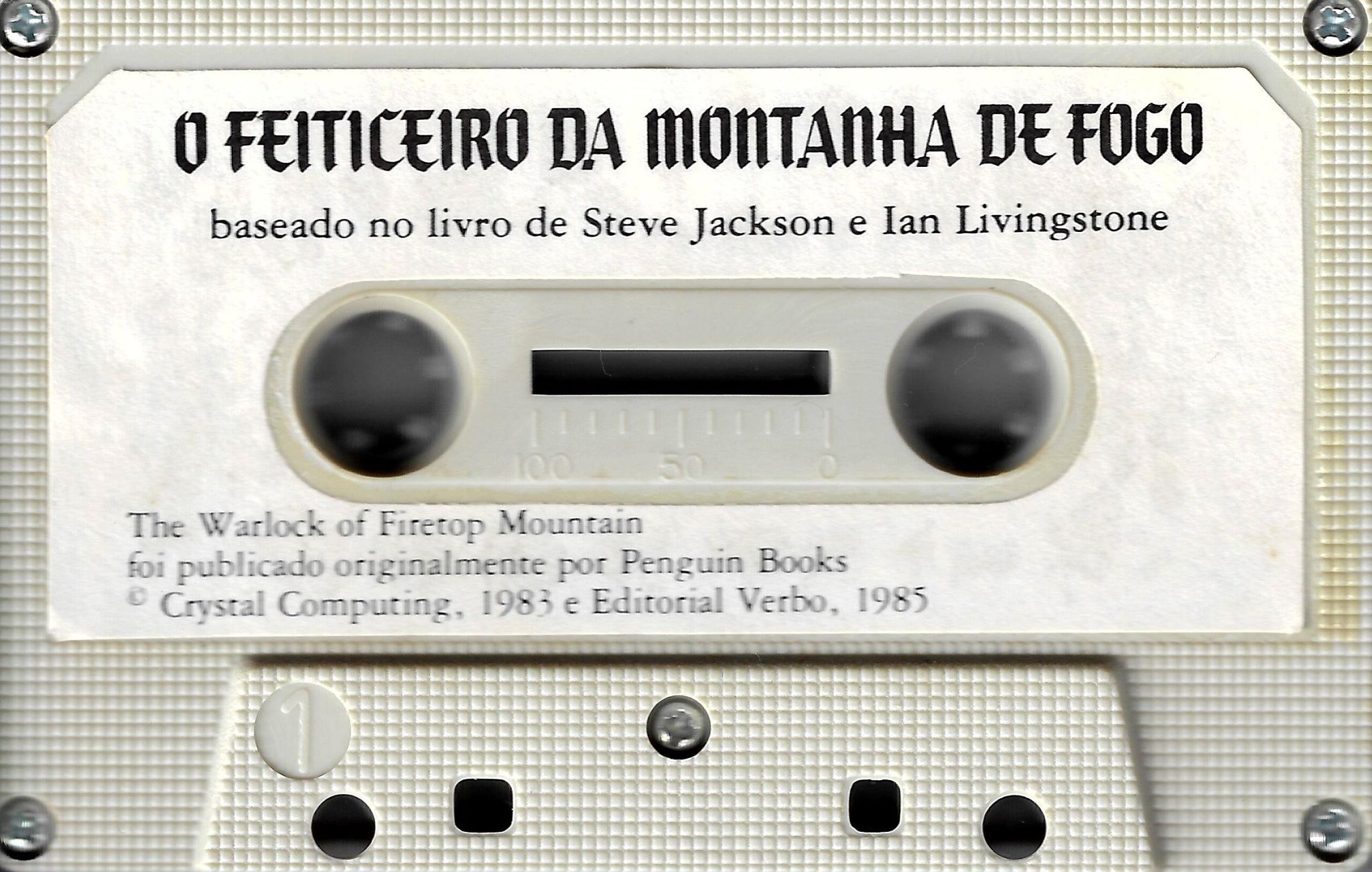
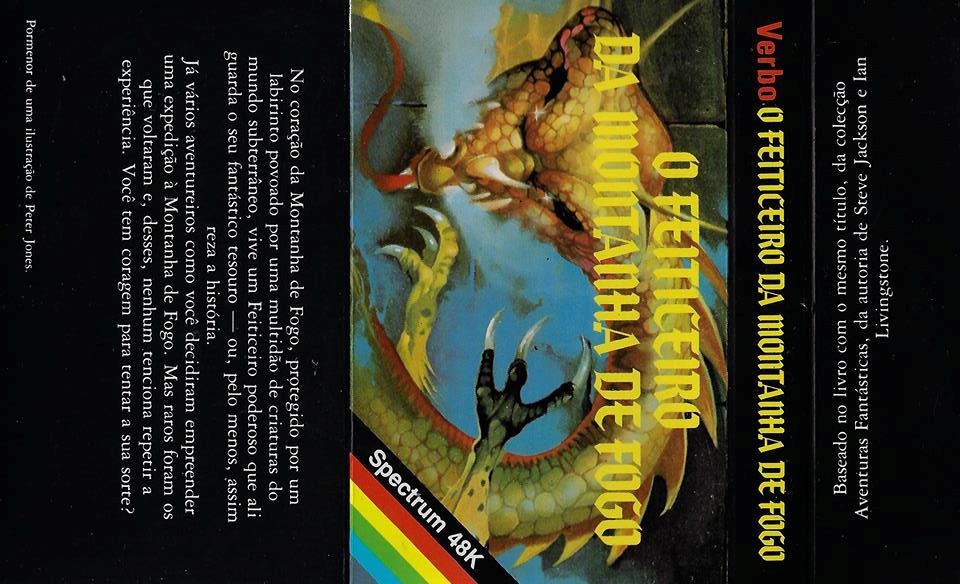
Also known as O Feiticeiro da Montanha de Fogo (Portuguese)
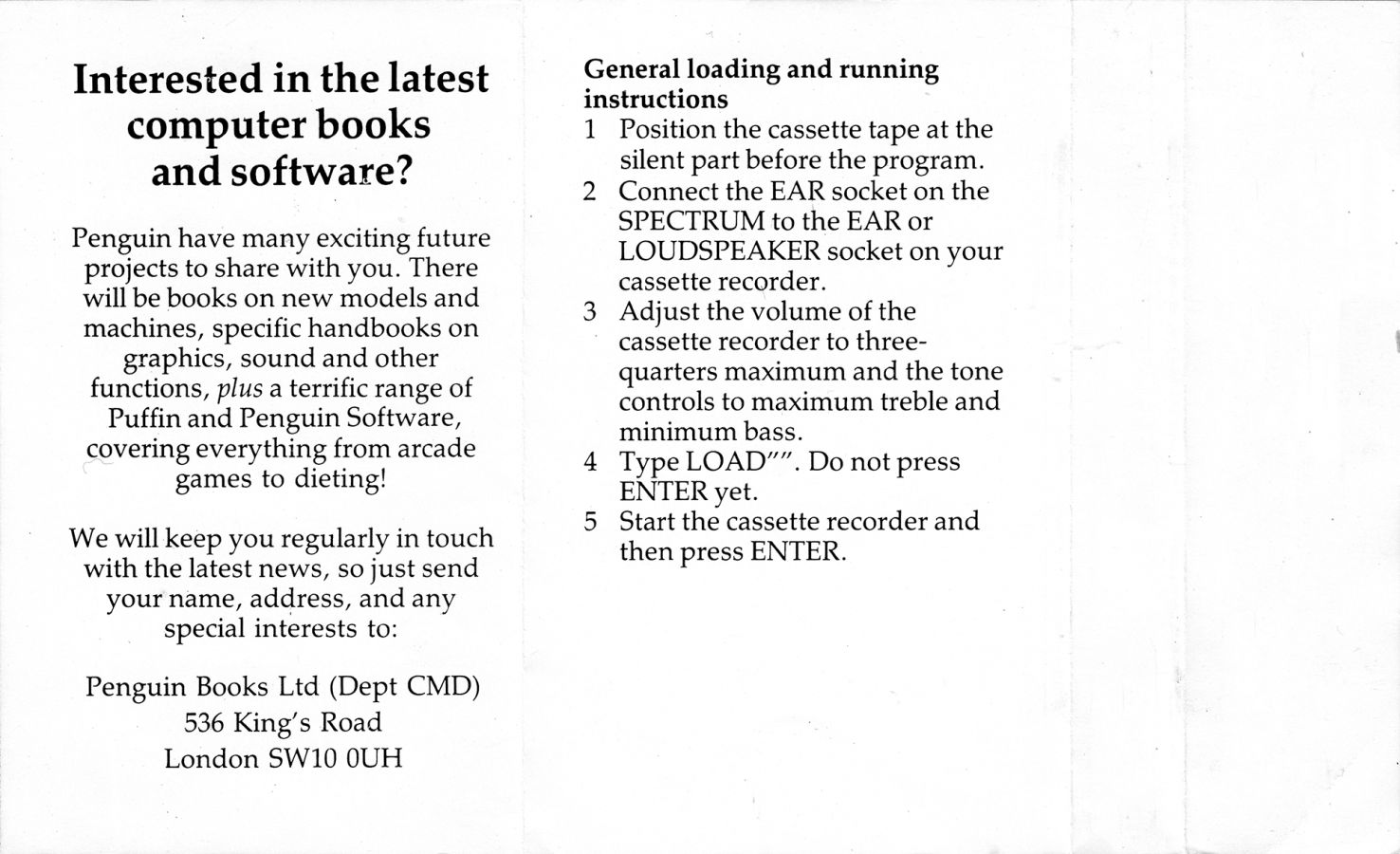
(EditorialVerbo)_Back.jpg)
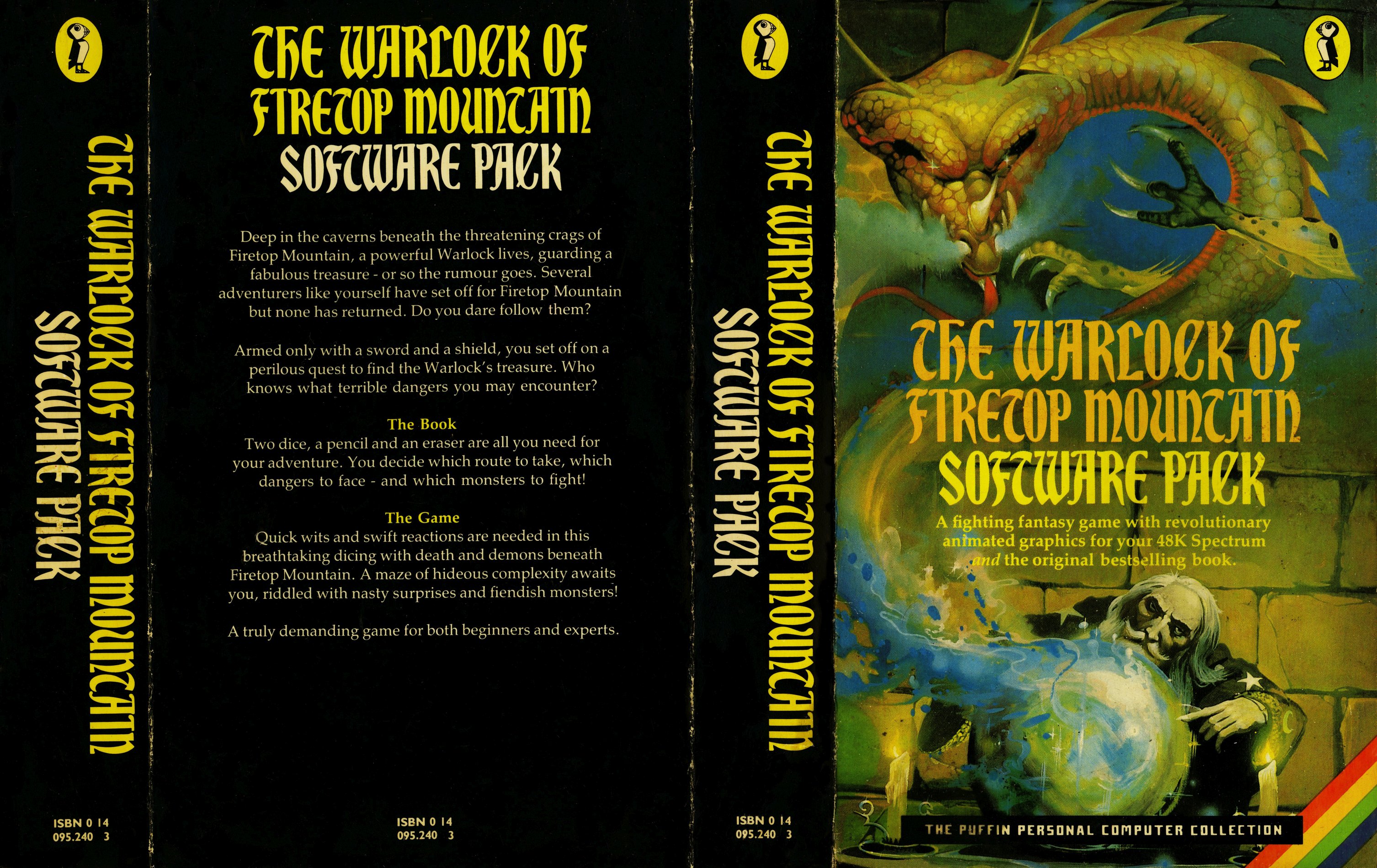
(EditorialVerbo)_Front.jpg)
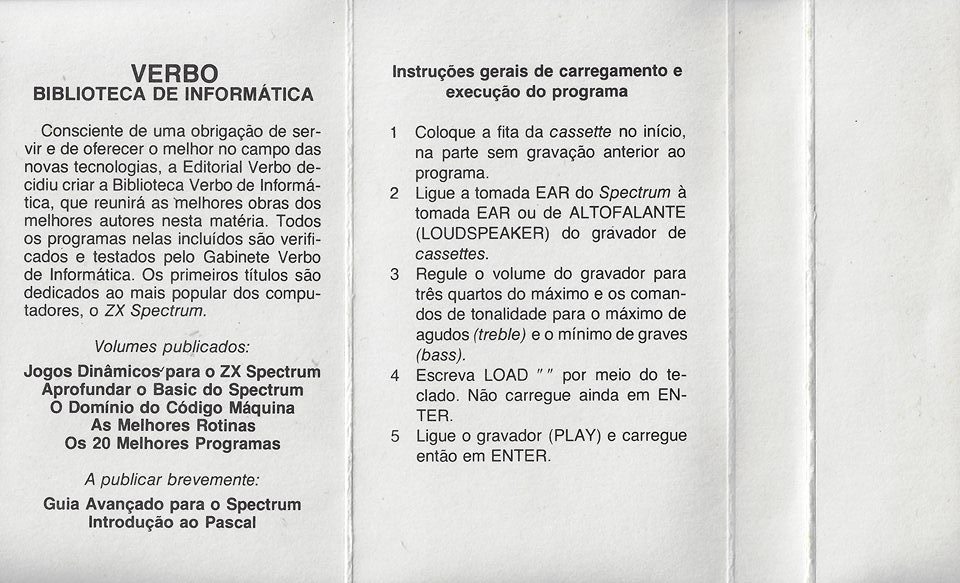
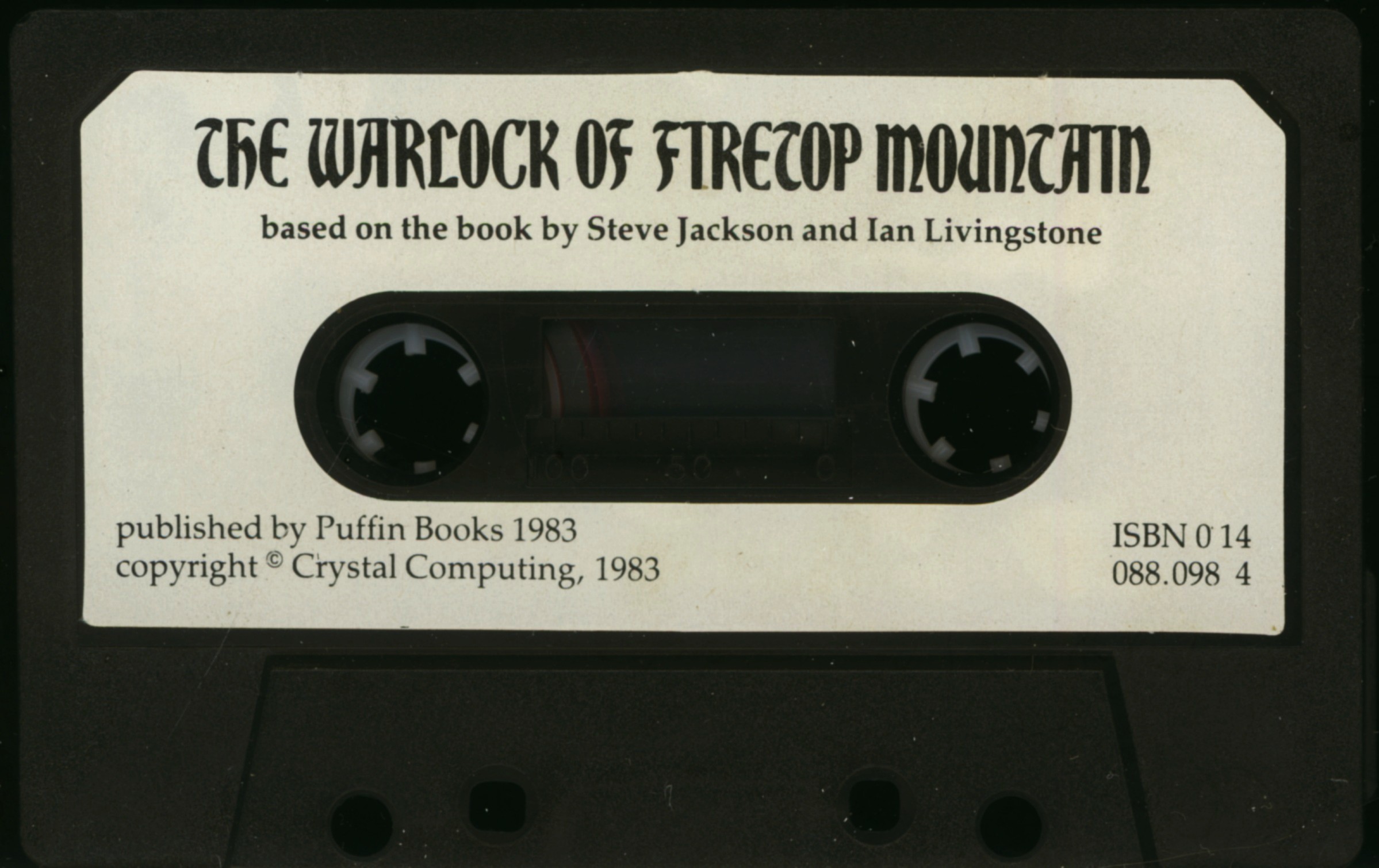
Discussion
Nobody has started a thread about this yet.
Remarks
ZXSR: Could also be bought with the Fighting Fantasy book of the same name (but priced at 6.95)
prices with/without book
SPOT: Based on {Halls of the Things|Crystal Computing|0002209}, bears no relation to the book.
Releases
- 8 Dec 1983Puffin BooksPound sterling 6.95
- 1985Editorial Verbo Sold as O Feiticeiro da Montanha de Fogo
Play
- WarlockOfFiretopMountainThe.tzx.zipTape image English14 KB
- WarlockOfFiretopMountainThe.tap.zipTape image English14 KB
- OFeiticeiroDaMontanhaDeFogo.tzx.zipTape image Portuguese14 KB
- WarlockOfFiretopMountainThe(PT).tzx.zipTape image Portuguese14 KB
Documents
- WarlockOfFiretopMountainThe(EN).txtInstructions English2 KB
Other files
- Warlock of Firetop Mountain, The (1984)(Puffin Books).pokPOK pokes file 0 KB
Files and rights
No permission is on record either way. Screens and pictures are copied here on a take-down basis: if you hold the rights and want something removed, say so and it goes.
Credits
- Neil Mottersheadcredited
- Simon Brattelcredited
- Peter Andrew JonesInlay/Poster Art
Sign in to credit somebody, or say what these people did.
Scores
In the magazines
- Crash #11984 · Overall73%
- Personal Computer News #671984 · Overall Value4/5
- Crash #21984 · Overall73%
- Crash #31984 · Overall73%
Elsewhere on the web
- WorldOfSpectrum 29 votes6.63
In the magazines 21
Micro Adventurer #8Jun 1984 · p.32
John Fraser
BOOKING-UP SOFTWARE GAMES John Fraser evaluates the book and software packages currently available. "You've read the book, now play the game" seems to becoming an increasingly popular slogan in advertisements for adventure games. Since the spectacular success of The Hobbit several other companies have moved into producing bookware, books combined with software cassettes in one package. Sometimes, however, the games bear little resemblance to the books on which they are supposed to be based and the attractive packaging can be quite misleading. Indeed, the diversity of approaches, not only to the games but even to the books, makes choosing a suitable package all rather confusing for the new enthusiast. Almost all the currently available bookware falls into the general categories of science fiction or fantasy, which raises several interesting questions. For example how suitable are these genres for translating into micro adventures? How closely do the games follow the books? What are the advantages and disadvantages of these to mediums? Are such packages all that they claim to be? First of all there are several obvious but nevertheless fundamental differences between books and software which concern their physical formats alone. For one thing a book is portable. You can read a book anywhere, whereas you cannot - at least not yet - take your micro on a train journey and play adventure games, except with printed versions such as The Warlock of Firetop Mountain and subsequent titles. ESCAPE Nor do you have to wait before you can read a book. A long adventure like The Hobbit takes several minutes to load and even then you may experience loading difficulties or find that the game does not always do what it should. My copy of The Hobbit for example, crashes when I try to escape through the trap door in the Elvenking's cellar and this has been known to happen with other copies. It is easy, too, to keep your place in a book. If you wish to return to a particular page you can do so almost instantaneously. Although you can save your current game position in many adventures, the process is time consuming and much less convenient. Nevertheless, it is a useful option if you have just spent several hours exploring the farthest reaches of Middle Earth and dread the thought of having to start all over again the following night. For those with printers, The Hobbit enables you to obtain print-outs of the adventure windows so that you can examine your progress at any time. Effectively, you have your own program-generated story in which you decide the course of the action. One wonders whether fiction writers will eventually be churning out best selling novels with special novel-writing programs? With the memory limitations of home micros full length novels or, for that matter, text adventures of a similar size, are out of the question, although Gilsoft's new adventure-writing program The Quill, now means that anyone can write their own adventures without any previous experience of programming. From what has just been said it might appear that adventure games are too much of a hassle to be worth playing. As I hope to show, however, this is certainly not the case since the different formats that the games can take are extremely varied. The book may be a straightforward novel or story such as Colin Kapp's The Pen and the Dark or may be arranged, as in The Warlock of Firetop Mountain, in the manner of a programmed learning course whereby the reader selects different options at each stage of the narrative and so becomes an active participant in the adventure. On the other hand, the games may be pure text adventures which follow the story closely (The Pen and the Dark); text and graphic adventures (The Hobbit); arcade maze games which bear little resemblance to the book (Warlock); or adventures offering selected incidents from the story with strategy or arcade type games (Korth Trilogy). The imaginary worlds of science fiction and fantasy are natural choices for software writers. One of the advantages of producing a game based on a previously published novel or story is that you have a ready-made scenario and here there is no shortage. The Hobbit was an early classic which has inspired fantasy writers ever since. Originally published in 1937, the book appeared well before the first mainframe computer became operational, but if ever there was a ready-made scenario this was it. HEROES The plot is virtually a blueprint for fantasy adventures: a journey across a vast and often inhospitable land in search of precious gold. Along the way Bilbo, a hobbit, in the company of dwarfs meets all sorts of creatures - goblins, elves, trolls and ultimately the evil dragon, Smaug. Warlock concerns a similar quest, although in this case you take on the role of the hero and have to locate the Warlock's treasure, hidden deep within the dungeons of Firetop mountain. The Pen and the Dark and the Korth Trilogy represent two ends of the science fiction spectrum. The Pen and the Dark is the only one to be based on a strictly scientific premise and is one of five stories by Colin Kapp, about the various anomalies investigated by Fritz Van Noon of the Unorthodox Engineers. In this story he attempts to solve the mystery of the Dark, a vast mushroom-shaped artefact left by an alien intelligence. The Dark appears to be indestructible, absorbing all the energy that the Unorthodox Engineers can unleash. Surrounding the Dark itself is the Pen, the region which negates all energy. The Korth Trilogy tells of how three young heroes eventually save the earth from repeated attacks by the mighty Korth empire. This is sheer space opera, cowboys and Indians among the stars following in the wake of Star Wars and the kind of simple scenario one finds in so many arcade games. Even though all these books are quite different from each other they nevertheless have one common feature. They describe imaginary worlds that are subject to the same laws that govern our own or else possess an internal consistency which the reader can believe in. Even in Middle Earth, where magic rings and fire-breathing dragons are taken for granted, logical limitations are imposed. Bilbo has very human weaknesses and emotions, and is the sort of reluctant hero the readers can readily identify with. There are several factors which ought to be considered whether you are setting out to convert your favourite book into a mammoth adventure or merely trying to decide which package to spend your money on first. Clearly, if you happen to be familiar with any of the books you are on surer ground. Although these considerations inevitably overlap to some degree, they fall roughly into three main areas which I shall look at in turn. ATTACK Believability: is the fictional world so credible that the reader becomes thoroughly immersed in the events, characters and places in the book? The Hobbit is one of those rare books that people read again and again, and yet the story remains the same each time. So does the game add anything to the reader's enjoyment of the book? And what about those games which only portray selected incidents from a story? if the book is not essential to playing the game is it of any value? Interest: are some games so complex that you would rather just sit down with the book and passively absorb the story, leaving the game alone? In The Hobbit events proceed slightly differently each time you play the game. There is an element of the unexpected, with the possibility of being attacked at any moment. It is also possible to interact with the main characters so that the story becomes more your own creation. The Pen and the Dark, in contrast, is a fixed adventure, but the problems raised in the game are sufficiently complex to sustain your interest for hours. Warlock and the Korth Trilogy are graphic adventures only and cannot really be compared to the text from which they are derived. Ease of Play: this overlaps to some extent with the need to capture the player's interest. Without clear and complete documentation you are only going to find the game too frustrating to play. With some packages fairly comprehensive booklets are included that offer advice on such things as communicating with the other characters, crossing rivers and so on. With others you can obtain a sheet of hints for solving most of the problems that you encounter, although without giving too much away. The graphic adventures such as Warlock and the Korth Trilogy are self-contained, with full instructions appearing on the screen. Having now established some criteria for assessing bookware, let us take a closer look at each package in turn and see how the software writers have tackled the problem of converting a book into an adventure game. Each combination of book and software cassete illustrates different features which I shall focus on. The obvious example to begin with is The Hobbit, since the game has been a bestseller for some time and is often regarded as the adventure by which all others should be judged. It also contains several innovations which are either difficult or quite impossible to reproduce in book form. It is not difficult to see why The Hobbit has been so highly praised, even though more recent examples, such as Valhalla, have extended the possibilities of adventures still further, so that you can now actually see the characters moving in accordance with your instructions. But The Hobbit was revolutionary because it not only combined a text adventure with high-resolution graphics, but also displayed some degree of artificial intelligence. The player could communicate with the characters in the story using plain English, or Inglish, as the publishers have chosen to call it. Naturally there were limitations to the Inglish language but this novel feature was a considerable advance. The ability of the characters to lead independent lives also enhanced the appeal of the game enormously. Elrond invariably gives you different directions each time you ask him to read the map. Often Thorin refuses to co-operate when you ask him to help you escape from the goblin's dungeon. And, on rare occasions, you may be captured in Beorn's house and find yourself in the Elvenking's Hall. In fact, there is no one solution to The Hobbit. As anyone who claims to have finished the game will know, you may still be making new discoveries each time you play it. REPRODUCED The textual descriptions are concise and, unlike pure text adventures, there are no lengthy descriptive passages. You are not told what Gollum or a vicious warg looks like because all that is in the book. What you do get is a basic description of your location, such as "You are in a dark dungeon in the Elvenking's Hall. To the south west there is a red door..." and there is an attractive picture of the dungeon on the screen. The book fills you in on the atmosphere of the place and describes Bilbo's predicament and his reactions to it, in a way which no text and graphics could hope to do. The real time element, however, cannot be reproduced in book form. As you ponder over your next move all the other characters are going about their business, which means you cannot spend too long hanging around. Thorin will soon tell you to hurry up or he will sit down and start singing about gold. The game also allows you to explore various locations. You may look through doors and windows to see what lies beyond or who might be waiting for you. You can follow characters, examine objects, eat and drink. In fact live out a surprisingly real existence. There are some slight departures from the book, though the sequence of events are much the same. One significant difference is that Bilbo has lost 13 dwarfs and only has the chief dwarf, Thorin, and the wizard, Gandalf, to accompany him. Another is that the answer to Gollum's riddle is not the same as it is in the book. Then again, you may find objects which do not appear in the book at all, such as the golden key in the Misty Valley. OPTIONS The success of the game has a good deal to do with how much it involves the player in the action. But it is equally due to Tolkien's own fertile imagination which created the evocative land of Middle Earth and its host of characters in such convincing detail. Tolkien's world has long had a steady stream of visitors and now newcomers, or already hardened travellers, have the opportunity to become in a sense part of that creation. With The Warlock of Firetop Mountain we are on somewhat different ground, although the invented worlds of Middle Earth and the Warlock's lair have a good deal in common. It was first published in 1982 and since then more than one million copies have been sold. The book offers a comparatively cheap means of adventure gaming, which has more in common with dungeons and dragons type role-playing games: your initial characteristics are determined beforehand by rolling die and recording the results on an adventure sheet. You start with the minimum of equipment - a sword, rucksack with food and drink and a shield. You may find other objects along the way. To restore your skill, stamina or luck points you can take a magic potion at any time. Whenever you have to fight a creature there is an elaborate combat system and escape options are sometimes provided. The book attempts to simulate a degree of randomness by continually providing different options for the player and facilities whereby he can test his luck and so on. While this is a demanding and time-consuming adventure, you do get the satisfaction of being able to deal with all sorts of nasty creatures yourself and, should you succeed, the additional enjoyment in having discovered the treasure. Unlike Bilbo's quest there is only one route to your journey's end, although it can take you several attempts before you find the correct one. As a marked contrast the game is an arcade type in which you manoeuvre a figure through a complex maze and have to collect 15 keys to unlock the treasure chest and find the way out. All manner of creatures may attack you, but you have to react quickly for this is a very fast game. Often, there are lengthy periods when little happens at all. The book conveys far more of the atmosphere of the place than the game does. You cannot really imagine the dark dungeons and slimy walls when zapping around the maze; nor do you have much time to think things over. The book does not fall victim to the memory limitations of many home micros and so can afford to devote far more space to description. As in an exciting novel you feel compelled to read on, only here you take on the role of the hero which adds greatly to the suspense. Will some loathsome creature be waiting for you behind the door? Will you manage to cross the fast-flowing river? Will you even survive the journey to the Warlock's treasure? The element of suspense is lacking in the game. The emphasis falls more on fast reactions and good co-ordination. For the experience of being involved in a fully realised world of fantasy you need the book, but at least the combination offers a choice of formats for less than the price of many adventures. The Korth Trilogy consists of three book/software packages. There are three games on each tape representing episodes from the narrative. While some of the games are of the arcade variety, others are strategic with layouts that resemble board games on which the player moves his men around usually in an attempt to infiltrate the alien base. The inside cover of each book gives notes on the accompanying programs, together with page references to the incidents in the story. But the games can quite easily be played without having to read the books. Sufficient information is provided on the screen. It is best, though, to make notes before trying to play them because there is a good deal to remember. In the first book, Escape from Arkaron, the heroes test-fly a newly developed ultra light ship. When tests prove successful they venture out to an inner planet of the Sirius system, where they make their first contact with the Korth empire. The related games tape contains Testrun, an uninspiring game which shows the simulator developed after the first test run. The object is to fly either to Sirius or Pluto, avoiding the continuous stream of meteors that scroll jerkily down an oblong window in the centre of the screen. There is a similar simulation game on the second tape, which is a lunar lander type and adding little to your enjoyment of the book. There are other games which allow the player to participate in the more exciting incidents, such as Prisoner in which your mission is to rescue one of your men from the Korth prison and have to fight your way along a maze of corridors to free him from the cell. In Alpha, on the second tape, you must find and reprogram the computer responsible for sending unmanned Korth ships towards the solar system. You can move up the floors via lifts or stairs, though you do have to watch out for unfriendly guards along the way. One game even portrays events which supposedly occurred before the story opens. In Empire you must have to run the empire while the computer is being repaired. You must deal with uprisings, shortages, overproduction and so on. This is perhaps the most interesting game in the trilogy although, as the situation does not arise in the story, the books are of no help at all. CONTRIVED For your children these packages are worthwhile. The games will doubtless encourage the child to read the books and vice versa. Sometimes, however, the pace of the story momentarily slackens. When the trio is testing the revolutionary space drive, for example, the reader is bombarded with technical data which might have been better relegated to an appendix for all the good it does in advancing the plot. It is almost as if the stories were written after the games and the incidents slotted into place around them. Books written specifically for computer games are more likely to be contrived, because the writer has written to a predetermined formula rather than sought inspiration from his imagination. In the case of the Korth Trilogy the same writer was responsible for the books and the games. But effective characterisation, literary style makes for entertaining fiction which can so easily be discarded as the player presses on with the action. An exciting story, though, is what children generally want to read and, on the whole, this is just what the Korth Trilogy, with its intergalactic battles and desperate missions and character development, provides in abundance. FRUSTRATING For a more intellectually demanding adventure you may prefer The Pen and the Dark, which follows the main events in Colin Kapp's ingenious story: the engineers' investigations of the Pen and their attempts to gain entry into the Dark. The game introduces new problems concerning how to obtain and use the equipment necessary to complete your objective. Fortunately a hints sheet is available from the publisher, although even then, you may well find yourself in extremely frustrating situations. You can spend much of the time trying to open doors which cannot be opened until you have completed some other task, if only you knew what that other task was. At least there is no real time element to contend with, so you can take as long as you like over a problem without feeling threatened. The instructions recommended that you read only the first section of the story before playing the game, otherwise your enjoyment of finding out the secrets of the quest and perhaps the conclusion of the story for yourself may be considerably reduced. Like The Hobbit the text is minimal, but often the program will respond to meaningless inputs in a rather more humorous vein. At the same time the responses can be irritating when you have tried everything you can think of and do not seem to be making any headway. While The Pen and the Dark lacks the innovative features of The Hobbit, it certainly throws out a challenge to anyone who delights in problem-solving. It is very much a matter of personal taste which sort of game is to be preferred. And, of course, as with literary awards, no two players will agree on what they consider to be the best package. COMPLEMENT In any case it is not a question of whether one is better than another; the games are simply different. Which is not to say that book/software packages cannot be evaluated at all. At least we can affirm a general principle: that adventures, whether text, graphics or both, should not be a substitute for the book, but that one should complement the other. Ideally, playing the game will lead to a greater appreciation of the book, while reading the book at the appropriate stage leads to a greater understanding of the game. Book/software packages are becoming increasingly popular with software writers and publishers. While taking plots from existing books may be less work for programmers short on original ideas, established book publishers are recognising the enormous potential that such packages can have. REVOLUTION Numerous projects are reported to be under development, among them Harry Harrison's Stainless Steel Rat from Mosaic, a Tolkienesque fantasy from Century and, for the BBC micro, The War of the Worlds from CRL. And Quicksilva's recent release based on Raymond Briggs children's book The Snowman is bound to be a great success. Like the Korth Triology this is not an adventure game, although it does involve the child in ways that are unusual. Whether we are heading for the software revolution that some writers are forecasting remains to be seen. But certainly bookware shows all the signs of being a growth area, and the sort of combinations likely to be dreamed up over the next few months is very much open to speculation. ((c) Sunshine Books for UK magazine rights - otherwise ((c) John Fraser).
Personal Computer News #67Jun 1984 · p.454/53/54/54/54/5
Lasting Appeal 4/5
Playability 3/5
Use Of Machine 4/5
Overall Value 4/5
Mike Gerrard 4/5
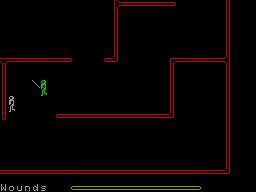
NAME: The Warlock of Firetop Mountain SYSTEM: 48K Spectrum PRICE: £6.95 PUBLISHER: Penguin Books, [redacted] FORMAT: Cassette and paperback (cassette only £5.50) LANGUAGE: Machine code OTHER VERSIONS: None OUTLETS: Mail order/retail BEAT THE WARLOCK At first glance this appeared to be Halls of the Things without the Things. This version of the Crystal game is tied in with a paperback for the new Puffin Personal Computer Collection. OBJECTIVES Your purpose in both book and game is to get through the maze hiding the Warlock's fabulous treasure, while battling off Orcs, Spiders, Slime Moulds and other creatures. You must also collect 15 keys randomly hidden about the enormous maze, then escape again with the treasure chest they unlock. IN PLAY You won't be surprised to learn that you need 19 fingers to cope with the controls. A joystick option would have been very welcome, but the keyboard must cope with facing or moving in four directions, drawing or sheathing your sword, firing your bow, opening and closing doors, pausing the game, turning music on and off, and plenty more. Lots of work to do, but you can't get back to the instructions for reminders once you've started playing, so perhaps they should have been printed out on the cover. The vast maze offers simple graphics for corridors and large chambers while well-designed creatures wander around the place at random. As soon as they get a glimpse of you, they come after you. The best defence is often to run like mad before the spiders, as getting in the right position to fire an arrow or hack with your sword can be tricky. The base of the screen displays the extent of your wounds, and obviously you can only suffer so much before ascending (or not) to that Great Hall of Fame in the Sky. You score 100 points for each key you collect, and different points for any monsters you kill. Or at least I've been given 100 points for each of the paltry few keys I've managed to collect so far. Even although there's only the one fast-moving skill level, it will take a very good player to collect all the keys, the chest, and escape again. VERDICT If you've already got Halls of the Things then you won't be interested in this, and although it's rather a contrived way of linking a book with a computer game at least they've both already proven their quality.
Crash #3Apr 1984 · p.6973%
Overall 73%
Producer: Puffin Books, 48K £6.95 (1) Author: N Mottershead & S Brattel Put together by Crystal for Puffin, this is a simpler and more playable version of Hall of the Things, and adapted from a successful book. You must enter the labyrinth beneath the crags of Firetop Mountain to get the Warlock's treasure. This is guarded by Orcs, Spiders. Slime Mould and other horrors. Your weapons are a sword and a bow. To get to the treasure you must collect 15 keys. Most doors open and shut at command and the maze scrolls smoothly as you move. As in HOTT there are a lot of control keys - 18 in all, and practice is essential to stay alive. Good looking monsters, which home in on you as soon as they spot you, loads of speed in the fights, and for the price you get a copy of the book as well. Puffin have a winner with this one. Overall CRASH rating 73% M/C.
Crash #2Mar 1984 · p.5373%
Overall 73%
Producer: Puffin Books, 48K £6.95 (1) Author: N Mottershead & S Brattel Put together by Crystal for Puffin, this is a simpler and more playable version of Hall of the Things, and adapted from a successful book. You must enter the labyrinth beneath the crags of Firetop Mountain to get the Warlock's treasure. This is guarded by Orcs, Spiders. Slime Mould and other horrors. Your weapons are a sword and a bow. To get to the treasure you must collect 15 keys. Most doors open and shut at command and the maze scrolls smoothly as you move. As in HOTT there are a lot of control keys - 18 in all, and practice is essential to stay alive. Good looking monsters, which home in on you as soon as they spot you, loads of speed in the fights, and for the price you get a copy of the book as well. Puffin have a winner with this one. Overall CRASH rating 73% M/C.
C&VG (Computer & Video Games) #29Mar 1984 · p.151
Keith Campbell
A THING IS A THING IS A THING The Warlock of Firetop Mountain, from the Puffin Personal Computer Collection, comes in a card sleeve, complete, as might be expected with a name like Puffin behind it, with a full-length paperback. The package is billed as "A fighting fantasy game with revolutionary animated graphics... AND the original best selling book." Well, forgive me for associating a fantasy game with Adventure, and for assuming there would be a connection between the book and the accompanying Spectrum cassette. The book is best described as a 'multiple choice' Adventure, where, by use of a dice and selecting the next move from a choice of two or three, the player proceeds from paragraph to paragraph, moving on to the paragraph indicated by his selection. This means constant and rapid page-turning, as there are 400 numbered paragraphs and the result can perhaps be described as an Adventure story read in random order. Not so the software, which, not unreasonably, I anticipated would be a computerised version of the book. It is not. The game is almost identical to Halls of the Things from Crystal Computing. Guess who wrote the program? Messrs Mottershead and Brattel of Crystal Computing. Phew! What a coincidence! And you bought both? Ever been had? Warlock of Firetop Mountain for 48k Spectrum from Puffin at £6.95.
Crash #1Feb 1984 · p.1260%75%78%75%65%85%73%
Use of Computer 60%
Graphics 75%
Playability 78%
Getting Started 75%
Addictive Qualities 65%
Value For Money 85%
Overall 73%
Unknown
Unknown
Unknown
Unknown
Producer: Puffin Books Memory Required: 48K Recommended Retail Price: £6.95 Language: machine code Author: N Mottershead & S Brattel A number of book publishing houses are now moving into games software publishing none so famous perhaps as Penguin, who have released this new game under their Puffin name. An interesting aspect of this program is that it has been produced for Penguin by Crystal (Halls of the Things) and adapted from the amazingly successful novel of the same name written by Steve Jackson and fan Livingstone. The novels (there is a series) are really computer program flow diagrams in book form. Basically D&D format, the book keeps facing you with options where you can, say, pick one of three doors to go through. Whichever you choose, you will be given a page number to turn to, where the story continues, and it's quite different for each door. The idea here is that the computer game supports the book and you may buy either the tape on its own for £5.50 or the combined pack of tape and novel for £6.95. Either way round it represents very good value. Crystal are famous for the notoriously difficult Halls of the Things, and Dungeon Master. The Warlock of Firetop Mountain is actually similar to HOTT but somewhat easier to play and in some ways much better. THIS IS WHAT YOU DO After a two minute load, a set of beautifully written instructions fill you in on the scenario and tell you the control keys. You are about to enter the vast and complex labyrinth beneath the gruesome crags of Firetop Mountain. Created by the evil Warlock to guard his fabulous treasure, the labyrinth is crawling with vicious monsters like Orcs, Spiders, Slime Mould and others which will prevent your return to the surface. All you have is a bow and a trusty sword. The idea is to roam the maze and collect 15 keys, find the Warlock's treasure chest, and escape with the lot. There are 18 control keys, which may seem like a lot, but fortunately not all of them are needed at once! The screen only shows a small fraction of the actual maze, switching to the next section as you go. Here and there doors are shut in your way. These you can open and close, and in fact you can close many of the door-sized open spaces to keep the monsters at bay. The sword and your arrows can only be used in the direction you are facing, which is important because altering directions does not mean you are facing in that way. In the normal course of events, it's possible and as easy to walk backwards, but if an enemy threatens, you have to use the cursor keys as well as the direction keys to be sure of facing the monster. GENERAL There are four directional keys, Z/X for left/right and N/M for up/down, plus the cursors which make you face in the four directions. Additionally A fires arrows, S sheathes or draws the sword, O and C open and close doors, SPACE centres your man on the screen, 1 displays score and number of keys held, 2 pauses the game, 3 turns the sound on and 4 turns it off and zero makes your man face in the direction of movement. COMMENTS Keyboard positions: complex but masterable Use of colour: simple but very effective Graphics: excellent and clear, but the man isn't fully animated Sound: average, more could have been made of it, though the on/off facility is useful Skill levels: one Lives: one but with a percentage of wounding allowed
Sword at the ready and the nasties are gathering. THE WARLOCK OF FIRETOP MOUNTAIN.
Micro Adventurer #4Feb 1984 · p.24
DD
WARLOCK CASTS HIS SPELL MICRO: Spectrum 48K PRICE: £6.95 FORMAT: Cassette SUPPLIER: Puffin Books, Penguin Books Ltd, [redacted] Penguin Books starts with a distinct advantage over most software companies: experience. This is evident in the excellent packaging of Warlock of Firetop Mountain. It comes in a custom-designed package including the best-selling fighting-fancy game book which inspired it. The game loads easily and comprehensive instructions are displayed. These are a little formidable, since it takes no less than 19 keystrokes to control the action. When you think you have them memorized you can proceed to the animated adventure. Your task is to collect 15 keys with which to unlock the warlock's treasure chest, and to escape alive. To do this you control the swift, smooth actions of a little stick-man as you search a vast maze, which is different each time you play. Armed with a sword and a bow you combat the spiders, warriors and slime monsters which try to bar your way. Action is very slick and well animated. The game is compulsive and highly entertaining. It is also, as some of you may have noticed, rather similar to the popular Halls of the Things. Indeed it is so similar that it would be pointless buying both games. The great advantage of Warlock is that you get the book as well. It bears scant resemblance to the game, being a kind of solo Dungeons and Dragons type of adventure. You play it using pencil, paper and dice, with the book providing all the scenarios and problems. The experience is very similar to playing a traditional text adventure. All in all, Warlock of Firetop Mountain is highly recommended.
Sinclair User #23Feb 1984 · p.50
FANTASY LABYRINTH FULL OF COMPLEXITY The Warlock of Firetop Mountain for the 48K Spectrum is the computer version of the popular Penguin Books fantasy adventure of the same name. You can buy the two together in a smartly-presented pack or choose the book or the cassette separately. The cassette offers a fast and unusual game in which you must imagine you are lost in a vast labyrinth created by the evil warlock to protect himself and his treasures. The labyrinth is haunted by a variety of unspeakable monsters, against which you have only a bow and your sword to defend yourself, and scattered around it are the 15 magic keys you need to open the treasure chest, should you ever manage to locate it. Even then, your troubles are not over, as you will have to find the exit somewhere in the maze to depart with the treasure. The unusual feature is the way in which the screen scrolls in four directions, presenting you with a change of scene each time. The computer generates the maze randomly and the number of keys needed to move about, open doors, draw the sword and fire arrows adds to the complexity. Mastering the controls and improving the speed with which you move around the maze make for an addictive pastime and there is the lure of the magic keys, which increase your score dramatically whenever you pick one up. The lack of incident in the game, with the monsters and keys appearing only rarely, might make it seem monotonous after a time. It is also a pity that whenever you lose a battle with one of the monsters, which as all too easily done, the game is finished and you have to start again. Some way of recovering from an encounter or of replenishing one's strength along the journey might have added interest to the adventure. The Warlock of Firetop Mountain is produced by Penguin Books, [redacted]. It costs £5.50 on its own or £6.95 in the software pack containing the book and cassette.
News/Note6
- Micro Adventurer #10Aug 1984 · p.6
- ZX Computing #12Apr 1984 · p.119
- Games ComputingMar 1984 · p.6
- Personal Computer Games #3Feb 1984 · p.5
- C&VG (Computer & Video Games) #27Jan 1984 · p.9
- Micro Adventurer #2Dec 1983 · p.7
Feature2
- Micro Adventurer #12Oct 1984 · p.41
- Micro Adventurer #9Jul 1984 · p.8
Advert2
- Crash #1Feb 1984 · p.7
- Sinclair User #22Jan 1984 · p.16
Review2
- Popular Computing Weekly #49Dec 1983 · p.68
- Popular Computing Weekly #51Dec 1983 · p.53
Letters1
- Crash #17Jun 1985 · p.58
Licensed from
- The Warlock of Firetop MountainBookIan Livingstone [1], Steve Jackson
Related
- Same entry at
- Spectrum ComputingZXInfo
Reviews from people here
Sign in to write about this, or make an account. It takes a minute and lets you correct the catalogue too.
Everything ZXDB can hold about this is here.
Sign in to correct or add to this.
Hold the rights to this and want it taken down?