Waterloo
Strategy Game: War · ZX-Spectrum 48K · 1 players · English
KW Software · 1985 · Pound sterling 11.50
Also known as Battle of Waterloo (English)
Austerlitz, 2 of 2
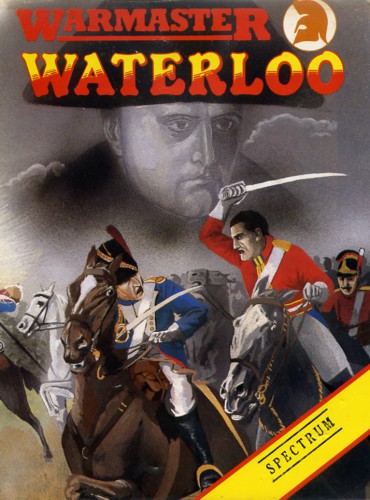
.png)
Discussion
Nobody has started a thread about this yet.
Releases
- 1985KW Software Sold as Battle of WaterlooPound sterling 11.50
- 1985MC Lothlorien LtdPound sterling 9.95
Play
- Waterloo.rzx.zipRZX playback file 105 KB
- Waterloo(MCLothlorienLtd).tzx.zipTape image English16 KB
- Waterloo(MCLothlorienLtd).tap.zipTape image English24 KB
Documents
- Waterloo.zipInstructions English20 KB
- Waterloo(MCLothlorienLtd)(EN).pdfInstructions English925 KB
Files and rights
No permission is on record either way. Screens and pictures are copied here on a take-down basis: if you hold the rights and want something removed, say so and it goes.
Credits
- Ken WrightCode
- Ken WrightGame Design/Concept
- Ken WrightLoad Screen
- The Art companyInlay/Poster Art
Sign in to credit somebody, or say what these people did.
Awards
- Crash SmashCrash23 · 1985
Scores
In the magazines
- Crash #231985 · Overall92%
- Sinclair User #461986 · Overall4/5
- ZX Computing #231986 · Overall4/5
Elsewhere on the web
- WorldOfSpectrum 10 votes7.20
In the magazines 17
ZX Computing #23Feb 1986 · p.974/54/5
Overall 4/5
Clive Smith 4/5
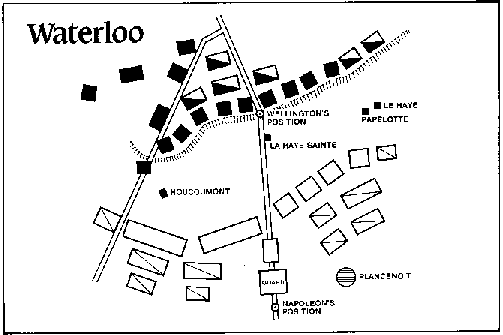
M.C. Lothlorien £9.95 Ever since I saw Rod Steiger storming around as Napoleon I've been interested in this battle. Unlike most wargames for the computer you do not command the British side or the historical winners, yep, you get lumbered with being Napoleon. Although cast as the underdogs, a few liberties have been taken in order to enhance the playability of the game, the French army has been increased to five corps of infantry instead of four, and the Prussian army will arrive earlier than in reality to make your task a little more difficult. Purists may not approve. The game is played by means of graphics and single key presses form a series of option menus. This allows for an unexpected variety of actions to be taken be taken quickly and easily. The playing area was a little small and at first I was confused due to the booklet map being printed with the French army at the bottom and the English at the top, but onscreen the map is rotated 90 degrees clockwise. I spent quite a while trying to move the wrong army. Once I began to play properly I soon mastered the first, and easiest, of the three levels and achieved a decisive victory on my second play. For what appears a simple, slow, intellectual exercise I found it unaccountably gripping and addictive. Not tonight Josephine, I'm going to have another whack at Wellington.
Sinclair User #46Jan 1986 · p.1184/54/5
Overall 4/5
Chris Bourne 4/5
Publisher: Lothlorien Price: £9.95 Memory: 48K Wargame specialist Lothlorien is back again with an exciting simulation of the battle of Waterloo. The game is for one player only against the computer, and you've no choice about whose side you're on - stuff you hand in your shirt and put on a funny hat. You're Napoleon. Napoleon, of course, was the loser, so this is one of those change-the-course-of-history games. The playing area is not large, about three screens in all, with a single battle involving less than 100,000 troops. The map is unsophisticated but scrolls smoothly and is very clear, as are the units, cavalry and infantry. Artillery does not enter into the game. As Napoleon, you must launch an effective assault on Wellington's strong defensive lines, occupying two chateaux and a series of ridges. Terrain features vary in their effect on movement and combat, and the essence of the game is to maintain maximum manoeuvrability. An excellent feature of the game is the option to delegate command of the six French army corps to their individual commanders. In such situations a commander will take advantage of particular details of his position, and may advise against your orders. Alternatively, you can move each unit individually. The option means that beginners can play swiftly and simply, commanding only a few units, and sending reinforcements when required, taking fuller control when they understand the game better. At the learning level the game is reasonably easy to win, while we also scored one easy victory at the standard level. At the highest level the English get better morale and higher strength units making victory very difficult. Four different strategies have been programmed into the game, so you cannot rely on the same tactics twice, and our victory was probably lucky as Wellington seemed to have little stomach for a fight on the day. In the rematch, Napoleon was slaughtered. Waterloo plays fast and a game lasts no more than an hour or so. While wargame fanatics may find it too simple for purist tastes, it's nevertheless lots of fun, fairly realistic in its results, and ideal for inexperienced wargamers.
C&VG (Computer & Video Games) #51Jan 1986 · p.366/103/108/109/10
Graphics 6/10
Sound 3/10
Value 8/10
Playability 9/10
MACHINE: Spectrum SUPPLIER: Lothlorien PRICE: £9.95 Waterloo is a one player wargame, smartly packaged in a video wallet and includes a well-presented booklet, which contains all the necessary information to play the game together with some tactical hints and historical information, While not as detailed as Crusade in Europe, the booklet is easy to use and does include a printed map. Set in one of the most interesting of all wargame periods, the game is for one player only, giving you command of the French army and will appeal mainly to those seeking a challenge and to experienced wargamers rather than arcade game players. Unlike Lothlorien's last war game, The Bulge, the graphics are not to arcade standard but have been based upon wargaming symbols. While cannons and horses would have looked nice on the screen, there were definite advantages to receiving clear information about units without having to use the cursor to distinguish one unit from another. Control is by keyboard inputs giving a wide range of command options and there is always a screen prompt to remind you of your current options. Movement is quick and simple. With every computer wargame the essential elements stand or fall by the "skill" of your computer opponent and the variability of the game. There are three levels of play and the computerised British fight a demanding game at level three, I was unable to score a significant victory. The game also allows for the computer to take control of some of the French army corps or to split up the corps into individual units each under its own set of orders. Both of these options in different combinations give great scope for interesting replays of the game and add greatly to the overall playability. The map itself is clear and concise being somewhat larger than the full screen, but sound is rudimentary. Overall, I felt that Waterloo is a welcome addition to the current crop of computer war games which seem to be a fast growing part of the market. While the game is sufficiently demanding for the experienced wargamer, the facility to give partial control of your army to the computer could make this a good buy also for the novice to "cut his teeth on". Definitely a game I shall continue to play.
Crash #23Dec 1985 · p.138Crash Smash90%85%87%92%87%95%92%92%
Presentation 90%
Rules 85%
Playability 87%
Graphics 92%
Authenticity 87%
Value For Money 95%
Overall 92%
Sean Masterson 92%
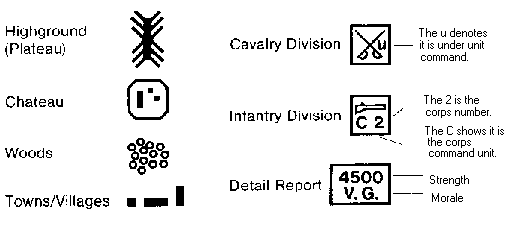
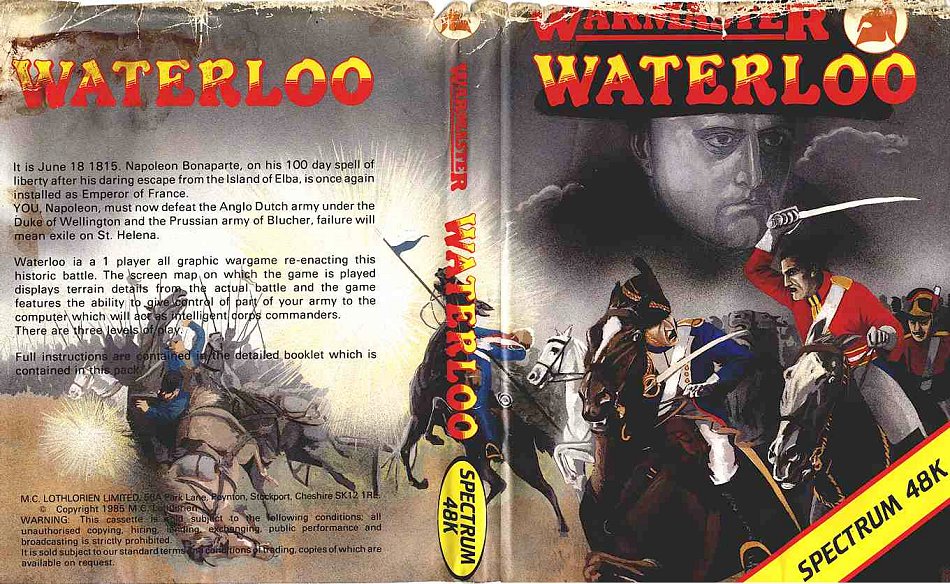
FRONTLINE Mr Masterson, the new Strategy and Wargaming minion on Crash reflects on the fluff that has been gathering in his navel since last he wrote FRONTLINE, pauses to ponder what a strategy game about the Falklands war could have in store for us (conveniently ignoring penguins) and gets stuck into a good Napoleonic dust up. Since someone on our sister magazine for the Amstrad, AMTIX!, roped him into reviewing strategy games on that machine and then called him a leprechaun into the bargain, our Sean has had a bit of a downer on Amstrads and just about everything to do with them. So don't hold too much store with his inability to write the word Amstrad in full. He's only sulking. Anyway, enough of this, on with the show. Over to you, SEAN MASTERSON. (Rah! Rah!). GET YOUR FILTHY HANDS OFF MY DESERT It would appear that I'm getting noticed. That isn't necessarily a good thing for a poor, Crash minion. It's hard to tell whether you are achieving popularity or notoriety, sometimes. Still, the world will go on regardless, and while it does, so shall this column. I'm glad last month's comments on morality in wargaming went down well (as far as I could tell). I shall try not to be too provocative in future. No news is good news after all. Recently, I dealt with PSS's Battle of Britain for the A****** computer, in another magazine. (Oh all right then AMTIX!) It's a superb game. When I see the Spectrum version, I shall let you know. Of course, there is now news that PSS are doing a Falklands '82 scenario. Some people are saying that this is a little too close to the knuckle. Bad taste. I would say perhaps the issue was being prejudged. It may even point out some interesting details presently unknown to interested parties. It all depends on how well the simulation is done. Perhaps it will put you in full command of the task force - unlike the commanders of the actual battle. It may allow strategic decisions to be made that were not made available to the officers of the force in the conflict. High level bombing of enemy mainland airstrips before the arrival of the task force, for example. I wonder what effect that could have had on ship and personnel losses? I honestly think that everybody should give PSS the benefit of the doubt until the game is published. Then we will see. WATERLOO Producer: Lothlorien Retail Price: £9.95 This must be the most popular period enjoyed by the traditional wargamer (with the possible exception of Ancient) and so it was a pleasure to find a new Napoleonic game released - on the classic battle itself. I was doubly impressed to discover Lothlorien were the publishers. They got off to something of a dodgy start but The Bulge was a classic and my respect for them has been far higher since. The packaging of their products has certainly improved since the early days. Waterloo comes beautifully packaged in a large format cassette holder with excellent artwork and a slim but excellent manual which many conventional wargames companies would do well to examine before they released their next title. The game is a strategic simulation on divisional level of the battle that finally brought Napoleon to his downfall. Napoleon was on his way to Brussels to gain support for his forces from Brussels. However, he must first defeat the Anglo-Dutch force commanded by the Duke of Wellington from the Seventh Coalition. Napoleon had a stronger force than his opponent but Wellington had superb defensive positions that cut across his adversary's front lines. Plus, he knew that if he fought a defensive strategy long enough, reinforcements would soon arrive in the form of General Blucher's Prussian army. And so the stage is set for a one player game with the human participant playing Napoleon. The game has has a smooth scrolling 'plan' of the battlefield as a display. The scrolling really is smooth on this game - far superior to other games of this nature that boast the same feature. Units are displayed as divisional markers, each unit coloured according to nationality. Displayed on the markers is information pertaining to the nature of the unit such as whether it is cavalry or infantry. On the French units the Corps number and command status is also shown. On requesting a detailed report of a unit, the marker widens to twice its original length and the units strength in terms of fighting men and its morale are displayed. On enemy units however, only the strength is displayed. Handling the units is accomplished by using a straight-forward mini-menu at the bottom of the display area in conjunction with cursor control. Units can be commanded as a Corps (by giving a general command to the leading division) or individually. It's possible to alter the level of difficulty of the game by varying the number of unit orders that may exist simultaneously. Units may actually leave their set positions to follow commanding units if they leave the immediate vicinity. One of the interesting features of the game is the way a unit may be prevented from achieving its orders because of enemy resistance (or maybe just presence) but after the threat is passed, the unit will continue on its original course of action. This isn't a totally original feature to computer wargaming but rarely is it used so realistically. One up for Lothlorien. Movement is affected by type of unit and terrain, as you would expect but terrain also affects combat strength to varying degrees, depending on whether they are attacking or defending. Combat strength is also (logically) affected by how many active men exist in the unit and its morale. Combat takes place between any two adjacent enemy units. Combat losses are displayed as they occur, over the relevant unit. This is only brief but you can study the situation more fully at the end of the game turn. Combat can, of course, result in one of the divisions involved retreating or routing. Routing units are removed from play immediately. Retreating units may be eliminated of their paths of retreat are not clear. Because such units are considered to be at least in partial disarray, they will inflict fewer casualties when fighting. When orders have been issued to all the units for that turn, the computer carries out all the movements and combat actions in a clearly defined manner. During this time, various commanders will communicate with you and explain that the orders you have given them are problematical because of a change in the unit's situation. They will suggest a course of action as an alternative and you answer the question depending on your strategy. The manual contains detailed explanations of the victory conditions and they, themselves offer a challenging game for the player whilst remaining balanced. On the subject of which, Lothlorien have made one omission and two alterations to details of the battle in order to make it more playable. Firstly, there is no consideration taken of artillery (a shame considering all the trouble Napoleon took to get it there), so there is no indirect fire phase. Secondly, Napoleon has been given an extra Corps, to balance numbers, whilst Blucher's minions arrive on the scene earlier to add to the difficulty. Lothlorien really have come a long way since those early days. This wargame is fast, playable and deceptively complicated. Designed with a care rarely encountered in computer wargaming, it employs some of the best features of the purists' hobby - and to good effect. A classic game for a classic subject.
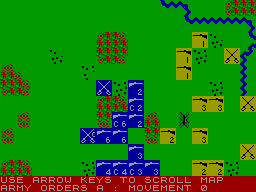
French infantry (on the left) push the English troops back towards Waterloo. Cavalry units guard against any outflanking attempt by Wellington's forces.
Advert8
- Sinclair User #47Feb 1986 · p.19
- Crash #24Jan 1986 · p.52
- Sinclair User #46Jan 1986 · p.141
- Sinclair User #45Dec 1985 · p.16
- C&VG (Computer & Video Games) #49Nov 1985 · p.37
- Crash #22Nov 1985 · p.63
- Sinclair User #44Nov 1985 · p.4
- Popular Computing Weekly #25Jun 1985 · p.26
News/Note2
- ZX Computing #27Jul 1986 · p.7
- Crash #25Feb 1986 · p.109
Review2
- MicroHobby #65Feb 1986 · p.14
- Popular Computing Weekly #38Sep 1985 · p.9
Letters1
- Crash #27Apr 1986 · p.85
Related
- Ports
- (Amstrad CPC), (BBC Micro)
- Same entry at
- Spectrum ComputingZXInfo
Reviews from people here
Sign in to write about this, or make an account. It takes a minute and lets you correct the catalogue too.
No description recorded.
Sign in to correct or add to this.
Hold the rights to this and want it taken down?