
Welltris
Puzzle Game: Action · ZX-Spectrum 48K · 1 players · English
Infogrames · 1991 · Pound sterling 10.99 · Pound sterling 15.99 disk
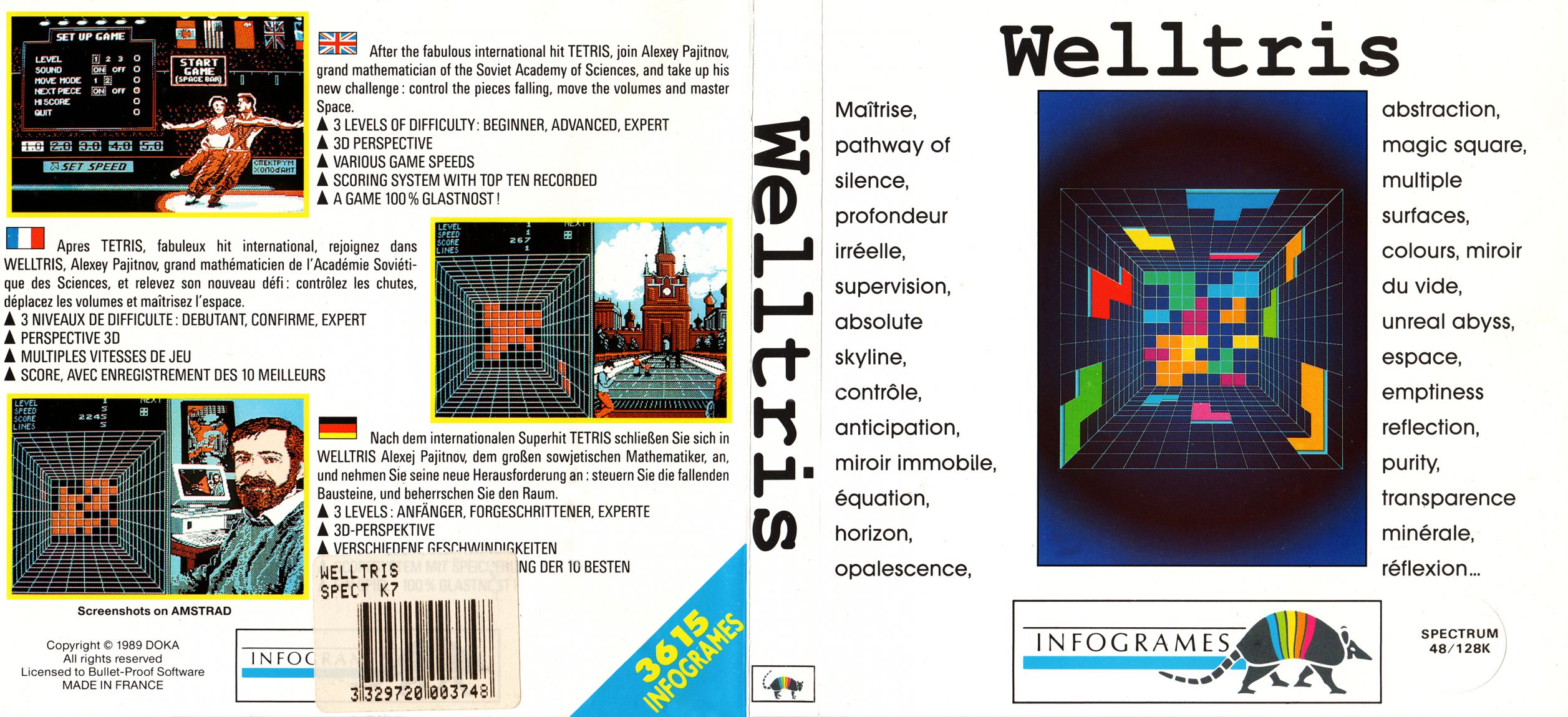
_Back.jpg)
_Front.jpg)
Discussion
Nobody has started a thread about this yet.
Releases
- 1991InfogramesPound sterling 10.99 · Pound sterling 15.99 disk
- 1991Erbe Software S.A.Spanish peseta 1100.00
Play
- Welltris.dsk.zipDisk image English32 KB
- Welltris(ErbeSoftwareS.A.).dsk.zipDisk image English30 KB
- Welltris.tzx.zipTape image English29 KB
- Welltris.tap.zipTape image English35 KB
Documents
- Welltris.txtInstructions English37 KB
- Welltris(ErbeSoftwareS.A.).pdfInstructions Spanish394 KB
- Welltris(MULTI-LANG).pdfInstructions Multi-language: English, French, German, Italian928 KB
Other files
- Welltris (1991)(Infogrames).pokPOK pokes file 0 KB
Files and rights
No permission is on record either way. Screens and pictures are copied here on a take-down basis: if you hold the rights and want something removed, say so and it goes.
Credits
- Alexey PajitnovGame Design/Concept
- Andrei SnegovGame Design/Concept
- Peter BallaCode
- Imre Kovats, Jr.Code
- Ildiko SomosIn-game Graphics
- Dan GuerraIn-game Graphics
- Jody SatherIn-game Graphics
- Matt CarlstromIn-game Graphics
Sign in to credit somebody, or say what these people did.
Scores
In the magazines
- Sinclair User #1101991 · Overall45%
- Your Sinclair #641991 · Overall79%
- Crash #871991 · Overall79%
Elsewhere on the web
- WorldOfSpectrum 11 votes6.36
In the magazines 14
Sinclair User #110Apr 1991 · p.2845%32%47%47%45%45%
Graphics 45%
Sound 32%
Playability 47%
Lastability 47%
Overall 45%
Andrea Walker
Chris Jenkins 45%
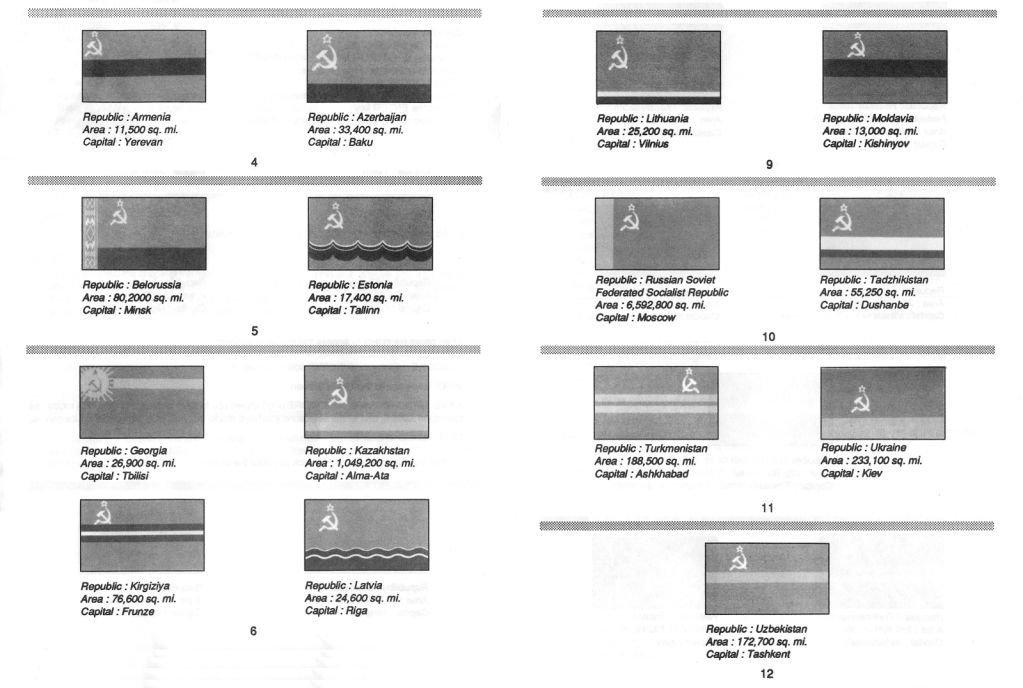
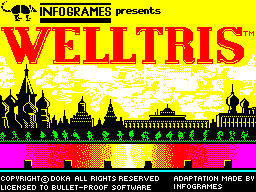
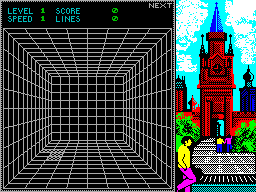
Label: Infogrames Memory: 48K/128K Price: £10.99 Tape, £15.99 Disk Reviewer: Chris Jenkins If you're going to pinch someone else's idea, and not even go to much effort to hide the fact, the least you can do is improve on the original, in which case your caddish behaviour might be forgiven. Welltris, which if you haven't guessed is a shameless rip-off of Tetris perpetrated by the game's original inventor. In case you've forgotten, Mirrorsoft's Tetris, supposedly developed by Russian academic Alexey Pajitnov, involved coloured blocks falling down a tube. You rotate the blocks so that they fall in such a way that the tube fills up as slowly as possible; fill a level and the blocks disappear, and there are various bonuses for lining up blocks of the same colour and so forth. Sounds like a recipe for boredom to me, but thousands thought it was riveting. Pajitnov's sequel, Welltris, has exactly the same basic idea - it even has groovy Russian style on-screen artwork, for heaven's sake - but this time you're looking DOWN the tube, into four-sided WELL - geddit?! Blocks of different shapes fall down the four sides of the well, theoretically multiplying the excitement by a factor of four. Well... Before starting you can set the difficulty level, 1-3, the speed at which the blocks move, and choose whether or not the shape of the next block is displayed at the top of the screen. The set-up screen has a picture of a pair of ice-skaters, for some unfathomable reason. As you play, displays show your score and the number of lines you have completed and removed from the bottom of the well. Using the joystick or key commands you can rotate the blocks as they fall, move them horizontally or drop them to the bottom of the well. Of course, the direction in which the joystick moves a block changes according to which wall it's on - if you get what I mean. When a piece comes to a stop with one or more of its sections still on the wall, not on the floor of the well, that wall changes colour and becomes blocked. When they're all blocked, you lose. Alternatively, you can lose if pieces stack right to the top of any of the walls. Now this all sounds as if it could add up to heaven on earth for the sort of demented dingbats who enjoyed Tetris - trouble is, unlike other versions of the game, in the Spectrum version the blocks are monochrome, not coloured. Since the grid is white-on-black too, the whole thing looks as boring as a Siberian landscape in the middle of winter. The artwork on the side of the screen - showing various Russian scenes and Pajitnov in his 'dacha' - isn't enough to liven things up, and on the tape version you're stuck with a picture of the Kremlin all the time anyway. The sound is absolutely minimal, you have to go into +3 Basic to load the disk version, and there's a ridiculous protection system by which you have to type in the names of Russian republics from the handbook, after identifying from monochrome pictures of their flags. You try typing "Tadzhikistan" without making a mistake after three pints of vodka (and don't forget the capital letter!). The program thumbs its nose at you, and crashes after the second mistake - in fact, it even crashed once when I was utterly, utterly convinced I had typed the code-word in correctly. Even allowing for the fact that Welltris is not my kind of game, this is a pretty poor effort which will do nothing to contribute to glasnost. Phil Fisch.
And Boris is still waiting for that woman whilst he plays Welltris.....
Here's Boris waiting for an impulsive woman to give him flowers...
Here's the menu.. Notice the lack of cabbage fritters and independent states.
What does he expect when he doesn't use a spray deodorant?
Your Sinclair #64Apr 1991 · p.6477%76%56%82%79%79%
Life Expectancy 77%
Instant Appeal 76%
Graphics 56%
Addictiveness 82%
Overall 79%
James Leach 79%
Infogrames £10.99 cass/£15.99 disk Reviewer: James Leach What was the biggest thing to come out of the USSR in the last 50 years? Correct! it was the Red Army, heading for Germany during World War 2. And the second biggest thing? Correct again! Tetris! This brilliantly addictive game was (as if you didn't know) all about building 2-dimensional walls using bricks. The aim was to create lines of about 8 or 10 bricks each (with no holes in) so that they'd disappear. It was written by an egg-headed guy called Alexey Pajitnov at the Soviet Academy of Sciences, who obviously had a jolly good time doing it because now he's come up with a brand-new game. It's called Welltris, and it's just like Tetris. Only it's in 3D. Spook! Let's investigate. VERTIGO AHOY! Actually, it's probably called Welltris because you're looking down (a rather square) well. What you see are the four sides of the well, and the bottom. Strangely-shaped pieces fall down these sides at random. They reach the bottom, then slide across it to come to rest up against the wall on the other side. During the time they're dropping down wall, you can do Tetrissy things like twist them around and move them from side to side. You can actually move them round from wall to wall too, if you're fast enough. The idea is to make them fit together in lines, but only on the floor of the well. If you start getting loads of holes in your lines and they start piling up the walls, then the use of those walls (for more blocks to tumble down) is blocked out until you can free them. You lose the game when all 4 walls are blocked out, which happens sooner than you think (if you're as crap as me!). SOUNDS PRETTY SIMPLE, EH? Well, after all, the idea isn't much more complicated than Tetris. The only trouble is it's a lot harder to play! just imagine - your poor overloaded brain's got to think about 4 sides where the shapes can fit, instead of just one! There are only a certain number of different shapes, so eventually you get to recognise them and also how often they crop up. That is unless you complete more than 2 lines in one go, because then you get a bonus piece. This is usually an extremely awkward shape (so it isn't really a bonus at all!) and up really naffing you off because you've just cleared the screen really neatly, and you're feeling dead chuffed with yourself! The big thing with Tetris was that as you reached certain scores it speeded up. So you'd be in control one minute, then, once you passed the magic score threshold, you'd be snowed under with the little Lego-like chunks. Believe me, Welltris is worse. It has the same system, but makes you suffer a whole lot more because if you much up one piece then it might block out an entire wall. It's murder! EXCITING! Because the well itself looks rather, er, boring (let's be brutally honest here!), Infogrames have put 'amusing' little 'cameos' of modern Russian life to the side of the screen. Oh dear. Well, they certainly look Russian - they're about 50 years out of date and done in really pinkish colours! Every time the game speeds up the picture changes, say from a stupid ice cream van or something to someone playing a '70's-style guitar! P'raps we'd better ignore these scenes of Marxist bliss and hop back to the well after all, eh? (They're probably there to put you off anyway. Fiendish Johnnies, these Sovs!) YEAH, WELL... Welltris is a worthy successor to Tetris in that it plays well. The only trouble is that it doesn't quite have a quality feel anout it. Perhaps it's simply those ill-making graphics. Anyway, it's different enough to make it worth buying if you forked out for the original. But if you didn't like Tetris, forget this 'un. It requires the same kind of reactions, logic and concentration.
As the game goes on the speed of the falling pieces increases. (Beat 10,000 and you're doing jolly well, matey).
Once all the side walls have been piled up with bits of the blocks then the game is well and truly over.
Sometimes a lucky piece will fit perfectly, almost emptying the bottom of the well. It soon fills up again though.
The screen is filling up. The block falling is going to be difficult to fit in somewhere.
FAMOUS RUSSIAN THINGS The emergence of Tetris from behind the Iron Curtain was something of a surprise to those of us in the West who thought the USSR used valve-computers the size of small moons to work out very simple sums. Welltris didn't surprise us as much (mainly because we'd seen Tetris). But we figured there must be plenty of other famous Russian things. We looked into it... VODKA This tastes and smells exactly like water, so you can drink gallons of it with little effect (apart from wanting to use the toilet). In Russia, it is actually cheaper than water, which is why they drink it. LADA CARS Style and reliabilty. These cars really get you there. More than that, they make sure everybody else knows you're getting there. And they're dirt cheap, too. RUSSIAN DOLLS These hide inside each other to save space. When you open up the biggest one, hey presto! - there are loads more, exactly the same but smaller, inside it. Hours of fun guaranteed. CAVIARE This looks revolting. It's a mass of little black squishy balls. It's very, very expensive, especially when you find out that it's just a load of stupid fish eggs. NUCLEAR FALL-OUT (That's enough Famous Russian Things. Ed)
Crash #87Apr 1991 · p.4076%68%N/A80%79%79%80%79%
Presentation 76%
Graphics 68%
Sound N/A
Playability 80%
Addictivity 79%
Overall 79%
Mark Caswell 80%
Nick Roberts 79%
Infogrames £10.99/£15.99 Welltris is another challenge from the creator of Tetris, Alexey Pajitnov. Alexey is a famous Soviet mathematician, member of the Soviet Academy of Sciences and all-round dude when it comes to creating brain-busting games. Anyone who's played Tetris should have a fairly good idea what Welltris is all about. Geometric shapes are manipulated as they fall down the sides of a square well, so that they slot in with the pieces already at the bottom. Whereas Tetris was in 2D, Welltris has been created in 3D, so you have four sides of the well to contend with. Pieces can be moved from side to side and rotated to find the best fit. Once a vertical or horizontal line has been created at the bottom, the line disappears, giving you more room to fit new pieces in. Careful positioning is needed: if part of a piece sticks up the side of the well, that side is temporarily out of action. When all four have been wiped out, it's game over. Welltris caters for all skills by having a multitude of skill options: the higher the level, the more complex the shapes you have to manipulate. You can also speed up the rate at which the pieces fall. But there are ways to 'cheat'. By moving a shape onto a corner, you create two new shapes on either wall, thus giving you another way of fitting the shape in. Playing Welltris isn't a pleasurable experience - unless you're gifted with the patience of a saint. The control keys are so clustered together you need the flingers of a toddler to be able to use them and there's no redefine option! It's the layout of the keys that really lets Welltris's playability down. If you can cope with the keys you may be able to have some fun with the game, because it's a pretty spiffy puzzle game and can be hellishly addictive. NICK 79%
Another Welltris piece descends, move it into the blank squares to score.
Review4
- FIFO #19Dec 1992 · p.24
- BiT #3Dec 1991 · p.30
- MicroHobby #207Feb 1991 · p.28
- ACE (Advanced Computer Entertainment) #36Sep 1990 · p.40
Preview3
- Crash #86Mar 1991 · p.14
- The Games Machine #32Jul 1990 · p.12
- ACE (Advanced Computer Entertainment) #27Dec 1989 · p.18
News/Note2
- Your Sinclair #63Mar 1991 · p.14
- C&VG (Computer & Video Games) #104Jul 1990 · p.13
Advert2
- ACE (Advanced Computer Entertainment) #39Dec 1990 · p.24
- ACE (Advanced Computer Entertainment) #38Nov 1990 · p.73
Licensed from
- TetrisSoftwareunofficialAlexey Pajitnov
- WelltrisSoftwareBullet-Proof Software Inc
Related
- Ports
- (Amstrad CPC), (Commodore 64), (Amiga), (Atari ST), (Macintosh)
- Elsewhere
- WikipediaMobyGamesThe TipshopUVL
- Same entry at
- Spectrum ComputingZXInfo
Reviews from people here
Sign in to write about this, or make an account. It takes a minute and lets you correct the catalogue too.
No description recorded.
Sign in to correct or add to this.
Hold the rights to this and want it taken down?