
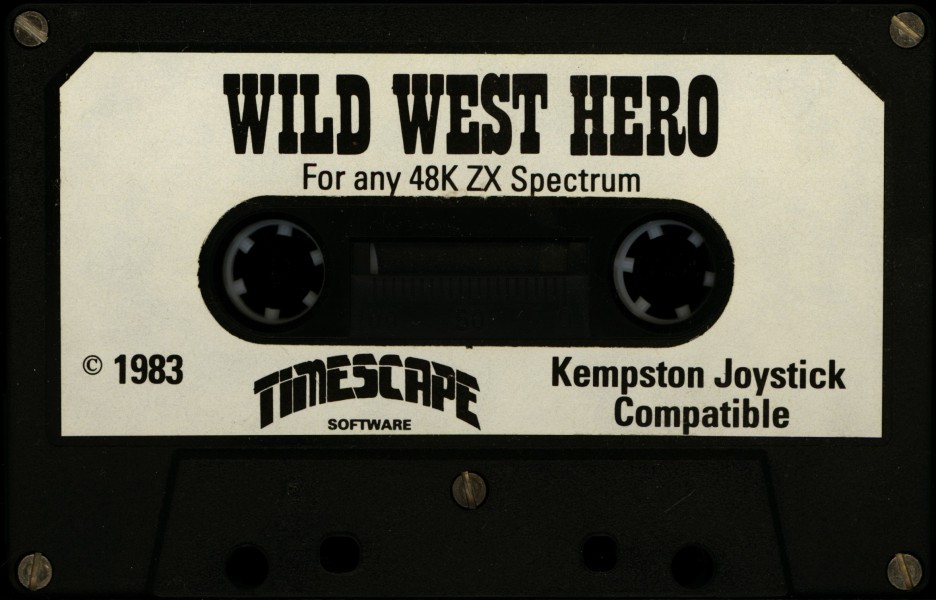
Wild West Hero
Arcade Game: Shoot-em-up · ZX-Spectrum 48K · 2 players · English
Timescape Software · 1983 · Pound sterling 5.90
Discussion
Nobody has started a thread about this yet.
- Control Option
- Kempston Joystick
Play
- wildwesthero.zipRZX playback file
- WildWestHero.tzx.zipTape image English12 KB
- WildWestHero.tap.zipTape image English15 KB
Documents
- WildWestHero.pdfInstructions English160 KB
- WildWestHero.txtInstructions English2 KB
Other files
- Wild West Hero (1983)(Timescape Software).pokPOK pokes file 0 KB
Files and rights
No permission is on record either way. Screens and pictures are copied here on a take-down basis: if you hold the rights and want something removed, say so and it goes.
Credits
- Mike Stockwellcredited
- Paul Holmescredited
- David John RoweInlay/Poster Art
Sign in to credit somebody, or say what these people did.
Scores
In the magazines
- Your Computer #121983 · Overall3/5
- Crash #11984 · Overall82%
- Personal Computer Games #31984 · Overall7/10
- Crash #21984 · Overall83%
- Crash #31984 · Overall83%
- Personal Computer News #451984 · Overall Value3/5
Elsewhere on the web
- WorldOfSpectrum 18 votes7.56
In the magazines 23
Crash #3Apr 1984 · p.8083%
Overall 83%
Producer: Timescape, 38K £5.90 (1) Author: Silicon Kid(?) Step out into the cacti-strewn desert and fight it out with rampaging gangs of banditos in this good 'Berserk' type game. Instead of maze walls there are cacti and treacherous trees, which kill on contact. You're armed with a continuous repeat firing Colt 45 - and just as well, the bandits are numerous. One of the best 'Berserk' games yet with large graphics, smooth movement, sensible control keys, joystick: Kempston. Good sound, increasingly difficult screens. Overall CRASH rating 83% M/C. Recommended.
ZX Computing #12Apr 1984 · p.10280%70%70%80%70%80%
Lasting Appeal 80%
Graphics 70%
Originality 70%
Playability 80%
Use Of Machine 70%
Value 80%
James Walsh
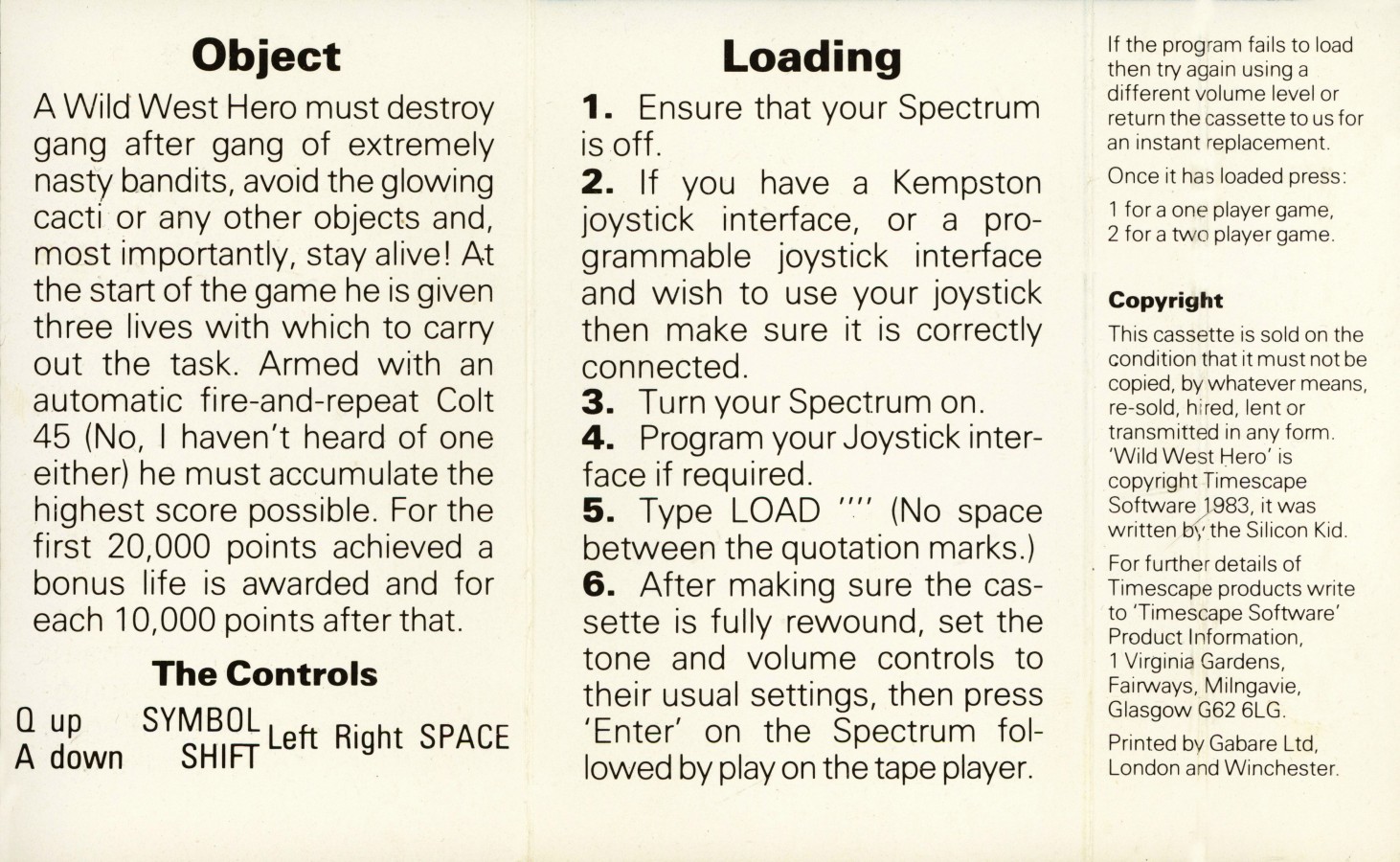
A wild west hero (you, of course) must destroy gang after gang of extremely nasty bandits, whilst avoiding the glowing cacti or any other objects, and most importantly, stay alive! At the start of the game, the hero is given three lives with which to carry out his task. Armed with an automatic, he must accumulate the highest score possible (surprise, surprise). For the first 20,000 points scored, a bonus life is awarded and for every 10,000 points after that. It is playable with one or two people (or aliens I suppose!) and is compatible with the Kempston joystick interface. There are only four controls - up, down, left, and right. Firing is done by moving in the desired direction. Verdict: Wild West Hero is definitely fast and furious, at times rather too fast and not a game for the faint hearted! The graphics are fast and reasonably smooth. The only main criticism of the game itself is the lack of further screens or alterations. Apart from that, it is thoroughly enjoyable if not 100% original and very good value indeed. An excellent pub/party-type game.
Crash #2Mar 1984 · p.6183%
Overall 83%
Producer: Timescape, 48K £5.90 (1) Author: Silicon Kid(?) Step out into the cacti-strewn desert and fight it out with rampaging gangs of banditos in this good 'Berserk' type game. Instead of maze walls there are cacti and treacherous trees, which kill on contact. You're armed with a continuous repeat firing Colt 45 - and just as well, the bandits are numerous. One of the best 'Berserk' games yet with large graphics, smooth movement, sensible control keys, joystick: Kempston. Good sound, increasingly difficult screens. Overall CRASH rating 83% M/C. Recommended.
Personal Computer Games #3Feb 1984 · p.467/105/108/103/107/107/107/10
Graphics 7/10
Sound 5/10
Ease Of Use 8/10
Originality 3/10
Lasting Interest 7/10
Overall 7/10
Wensley Dale 7/10
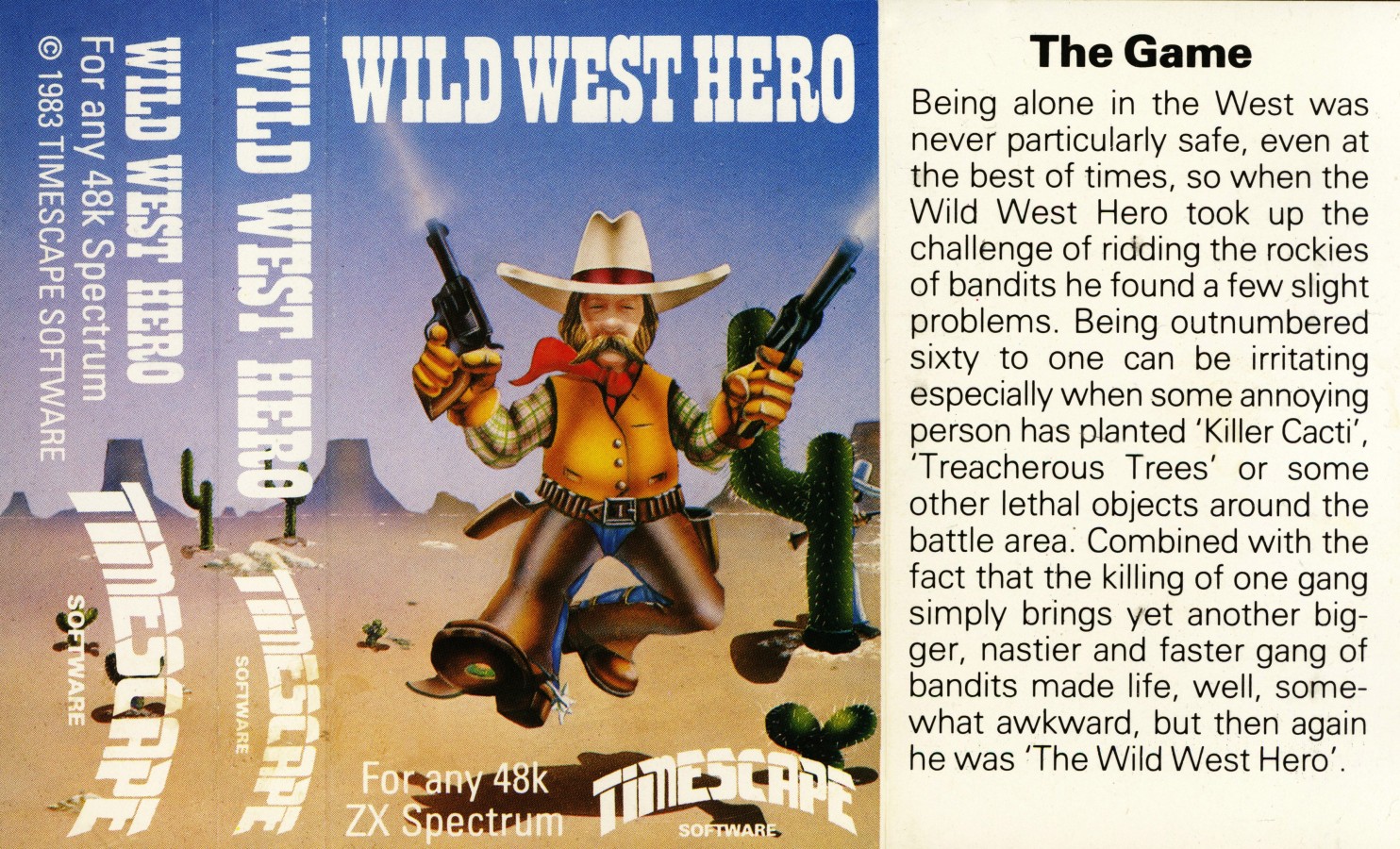
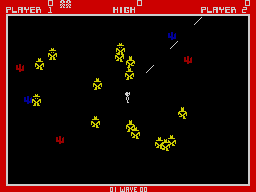
MACHINE: Spectrum 48K JOYSTICK: Kempston, Optional CATEGORY: Arcade SUPPLIER: Timescape Software PRICE: £5.90 Wild West Hero has one of the best cover illustrations on any current game. It shows a freshly-laundered cowboy blasting away with two six-shooters while a bandit lurks behind a cactus in the sun-drenched desert. It's a smooth picture, and it's a smooth game inside. Machine code graphics techniques beam you into the centre of the screen, where you find yourself amidst randomly placed killer cacti and bandits. A killer cactus is pricklier than a normal cactus, killing you on contact, and bandits do the same. The difference is that the cacti stay still while the bandits home in on you. Luckily the bandits don't shoot, while you can shoot in the direction of motion, including diagonally, and you carry on shooting even when you stop. Movement is by keyboard or Kempston joystick. You have three lives and an extra one every 10,000 points after 20,000 which is moderately difficult to reach. The game is similar to Spectron, reviewed in this issue, both being variations on the arcade game Robotron. Wild West Hero offers no variation in the waves of bandits it pits against you, unlike Spectron's mixed waves of robots, and the scoring system is less exotic. However, the graphics are good, the game plays fast, and it's easy to play. It probably boils down to a matter of taste - is it robots or bandits that you want to cut down?
Crash #1Feb 1984 · p.8385%80%80%80%83%83%82%
Use of Computer 85%
Graphics 80%
Playability 80%
Getting Started 80%
Addictive Qualities 83%
Value For Money 83%
Overall 82%
Unknown
Unknown
Unknown
Producer: Timescape Memory Required: 48K Recommended Retail Price: £5.90 Language: machine code Author: Silicon Kid with help from M Stockwell & P Holms Step out into the cacti strewn desert and shoot it out with rampaging bandits. In most respects this game resembles the robotic Frenzy type, where you find yourself surrounded and heavily outnumbered by the enemy. Instead of maze walls there are clumps of cacti, treacherous trees and other obstacles which mean instant death when touched. The hero himself is assembled in the centre of the screen rather as he is in Virgin's Spectron, out of little bits which whizz on from the top, bottom and sides. COMMENTS Keyboard positions: sensible, Q/A up/down, SYMBOL SHIFT/SPACE left/right Joystick option: Kempston Keyboard play: responsive, smooth, 8-directional Use of colour: good Graphics: very good Sound: good Skill levels: increasing difficulty by screen Lives: 3
'Howdee folks! Just step this way, mind the cacti, and become a WILD WEST HERO.'
Your Spectrum #1Jan 1984 · p.47
Ron Smith
SPECTRUM SOFT Ron Smith takes a slightly jaundiced look at all that's latest and greatest in games and leisure software for the Spectrum. Ever since the time home computing became big business, software producers have been writhing away in ever greater paroxisms of effort in their attempts to evolve games that are innovative, compulsive and exciting. Child geniuses have been dragged out of suburban housing estates and brutally hounded into the 20th Century equivalent of sweeping chimneys - all in pursuit of the computer game fast buck. The first waves to appear were, predictably, blatant copies of the great old arcade favourites - destroy the invading aliens, and probably your own brain cells in the process. This, of course, requires a keen eye and grand prix reactions. But for those without souped-up senses, the result is usually one of boredom and frustration. Fortunately, for those like me who would get more fun out of destroying the tape cassette than the alien invaders, other more pleasurable varieties of computer game are increasingly coming to hand. This issue we take a random stroll through a cross-section of all that's new and fantastic (it says in the press release) starting with... THEY CAME FROM OUTER SPACE The first title to fall into this category is Galactic Abductor from Anirog Software. It's not too hard to handle, and even I managed to put together a reasonable score while attempting to stem the relentless attack of invading armoured space hawks. I particularly like the fact that only three keys are used, so you don't have to keep glancing down to see where your fingers are. Unfortunately, one can't say the same for Missile Defence, also from Anirog. This uses no fewer than seven keys, four of which are the cursor control keys - which in my experience are the worst possible choice. Positioned as they arc (it's rather like the old chestnut of rubbing your stomach and patting your head at the same time) everything gets out of sync and the game's over before you can shout "Nukes away". However, after a good deal of practice (assuming you have the patience) the poor old aliens who've come to attack your cities gradually begin finding themselves in a weaker and weaker position as your skill increases. No fewer than three fire buttons are provided to wipe out the monster meanies, before they either destroy you or disappear off the edge of the screen. It's all familiar stuff. The last game doesn't fit in this section at all - but never mind. It comes from Timescape and is entitled Wild West Hero. Predictably, the hero's job is to rid the West of the gun-totin' bandits and this, with your help, he tries to do by hurtling around the screen blasting out in all directions as the gruesome gang closes in. Control, on the pre-production version, is via the keyboard, and uses four keys (two fingers per hand being the maximum for a reasonable response for most of us) - theoretically making for an easy-to-play game. However, the combatants are nothing if not fast moving - even though Timescape has already slowed down this (version 3) over the previous (version 2). Consequently, with bullets flying thicker than a hail storm and goodie and baddies moving at lunatic pace, this little number is certainly not one for those of slow or nervous disposition; even a rapidly plugged-in joystick did little to help me catch up with the action. For the record, by the way, the first two games mentioned were also joystick compatible. GRAPHIC ADVENTURES 'Ask a silly question, get a silly answer' - is a maxim that might well be seen as the basis for most adventure games with their thin plots, limited vocabulary and text-only approach. Interestingly though, the latest releases are beginning to move away from this. Two of the better new titles are Xadom and Smugglers Cove, both from Quicksilva. Xadom is a 3D hi-res arcade quality adventure where you, as SOL agent MM have to disappear off in search of some artefact that is stashed away in one of 20 rooms. Every time a room is entered, naturally, a new challenge awaits and each must be overcome before it is possible to move on to the next room. Differing slightly, and more like a traditional adventure, is Smugglers Cove. This offers text with the delights of hi-res graphics, while you visit 27 locations, somehow or other picking up 65 objects along the way (without so much as a sack). One point here is the game's lightning response to your directions, something which many previous adventure game incarnations have been less than famous for. Both of these are well worth a spin. CRL's Woods of Winter, however, is a new release that still suffers the perils of being text-only. It also has a slow response time - so much so that on several occasions I was left scratching myself and deliberating the state of the universe before - eventually - the program decided it was good manners to respond. To be fair, it does plot your progress (should you make any) through the cold woods of winter, which presumably can be quite useful at times. Should you ever manage to come in from the cold, you'll find sanctuary in a warm castle. Actually it's a good game for those with plenty of patience and an over-active imagination. Velnor's Lair, from Quicksilva, is yet another text-only adventure, but one with a faster response time that doesn't tax the patience to quite the same degree. As an adventurer you can choose to be a wizard, warrior or priest, depending on your inclination. For no particular reason I chose to be a wizard, despite my ineptitude at casting either spells or enemies into oblivion. Naturally I soon met an untimely end. But where this game triumphs over other text-only adventures is in its use of vocabulary. Often it can take aeons to get into the swing of adventure games - understanding the individual programmer's own peculiar logic and choice of words, etc. Here, for some reason not immediately apparent, I found the game responding easily to my instructions. Overall, the category contained an above average selection with one semi-adventure (Xadom), one text and graphics mixed (infinitely better in my opinion) and two giving text only. In truth, though, the big worry with all adventures is their great similarity and the obvious restriction on use of vocabulary. FUN & GAMES "Look at my wonderful new clothes!"" boasted the emperor. Everyone remained silent except the little boy who gave the straightforward opinion that the silly fool wasn't wearing any. This showed a certain degree of naivety and lack of cynicism - just the kind of qualities you might find ideal to survive the offerings ahead. Bugaboo (Quicksilva) features a likeable little flea (if that's not a contradiction in terms) which, due to some unfortunate time warp perhaps, has fallen through the inky spaces between worlds and ended up somewhere rather unpleasant. What will our micro nipper find there... will it ever survive? I had several goes at the game, reacting differently each time to it. Sometimes I felt sympathetic as the poor creature tried desperately to escape from its pursuers, sometimes an evil grin and a wicked heart triumphed as the poor fool smashed its head for the hundredth time. Love or loathing, there's always a strong feeling for the flea! Pathos, however, is unlikely to raise its tragic head in the case of Manic Miner from Bug-Byte; it's more a case of frustration and panic as you guide Willy the miner through the underground caverns to the surface, and riches. Starting off in the central cavern, he has to be helped past numerous obstacles on his way to the next. As ever, though, it's a case of one step forward, any number back, as you master the first hazard only to fail dismally at understanding the complexity of the second. LIFE'S LITTLE PLEASURES There's no real reason why computer games should always be difficult; sometimes it's fun to switch to something where success comes easily - if only to restore a damaged ego. Slap Dab from Anirog Software is just such a game, and it involves helping Sam the Painter splash around with his oversized brush so that he can get the job finished. Of course it's not quite that simple, because no sooner has he started slapping on the paint then he disturbs the woodworms - who don't fancy the idea of changing colour this week. They decide to seek revenge by chasing Sam as he works. But fortunately for him, our slimy friends can only travel on the part that's been painted, so one way of him avoiding capture is to leave by an unpainted escape route. Sounds like the stuff of which nightmares are made! Another conceptually simple game is Traxx, from Quicksilva. It opens with a large yellow grid consisting of 30 squares, and in essence it's similar to the hoary old children's pencil and paper game of 'dots', where the idea is to join the points up into squares. The game starts with one side of one square coloured red, and your spaceship (what else?) in the red sector. From then on you must move around, colouring as many squares as you can. But be warned, you are being pursued, although exactly how many enemies and at what speed they chase is entirely up to you. Choosing the fastest speed with the maximum number of pursuers (nine) makes for a near impossible task, although as usual it's easier with a joystick. Rabbit Software's Quackers is virtually identical to a shooting gallery at the fair. Ducks and rabbits glide across the screen so slowly that it's almost impossible to miss them, although it's almost more fun if you try. Slightly more difficult is the last part of the game where, having gunned down all the targets, you're given the chance to 'keep the turtle hopping' by shooting at it as it moves quickly across the screen. A few moments of gratuitous violence for all concerned. Slap Dab and Traxx are both joystick compatible, but surprisingly, Quackers isn't. It does, however, let you define your own keys. OTHER STUFF The three titles lumped together here have little in common, other than the fact that they are somewhat unremarkable - and also rather difficult. Quicksilva's 3D Strategy is a 3D noughts and crosses game that the maker claims is virtually unbeatable. Those into mind-bending puzzles will probably enjoy it. But away from strategy and on to games requiring fast reactions, there's Escape MCP from Rabbit Software and Gridrunner from Quicksilva. The first of these finds you de-atomized by a chip (Z80 in this case) and trapped in a maze. There's also something called the MCP (male chauvinist pig, perhaps?) that apparently knows your escape plan and, armed with this information, is not only going to prevent you from getting away, but is also hell bent on securing your prompt destruction. The usual, friendly, stuff. A little less strange may be Gridrunner, although it's hard to say when there's no instructions to tell you what's going on. However, it seemed safe to assume that I'd better start destroying something before it destroyed me. The screen is covered by a red grid, along the top of which moves a blue wormlike 'something' - presumably the enemy. It progresses across the screen, then down a line, and so on. But as each part of the 'something' is hit. It starts flapping about and moving much faster than before. Interesting - I can't wait to read the instructions! STIMULATING SIMULATIONS I must own up to a predilection for the kind of games that simulate 'real life' in some way. After all, how many of us get the chance to drive a racing car, fly an airliner, or practice being a brain surgeon? Well, courtesy of Psion, Rabbit Software and Protek Computing, we can indulge in renewed fantasy, over the first two at least. First of all from Psion comes Chequered Flag - a game that will find you lapping away on some of the world's most famous motor racing circuits - from the relative safety of your own living room. It also features a choice of three cars, and for those who feel a little uneasy about gear changing, an automatic has been included. Intrepid participants will have to watch the dashboard instruments carefully to make sure they're not going too fast, running out of fuel, overheating, or about to encounter any of the other hazards involved in grand prix racing. As well as watching out for mechanical failure you'll need to keep an eye out for oil, water and glass, any one of which is likely to lure you into untimely disaster. But the most impressive feature of Chequered Flag is the view from the car as you hurtle like a maniac around the track. Still behind the wheel, but not this time a simulation, is Race Fun from Rabbit Software. It's your chance to prove what a crazy driver you are, by speeding down a narrow country lane at 120mph. The faster you drive, the more points you'll make, but of course the more chance there is of crashing. Airliner, from Protek Computing, is a realistic simulation of what it's like flying a commercial aircraft. All the normal controls are present, enabling you to take off, manoeuvre, navigate and land; it's also compatible with Protek's joystick, which does add to the fun. Flying the plane successfully requires a good amount of practice - in fact I wouldn't be surprised if it was almost as complex as the real thing. A map is included to show the aircraft's position, and this can be turned on or off at the touch of a key. It's a well written and sophisticated program, but the lack of a view from the cockpit is disappointing, especially when you consider the popular Flight Simulation from Psion. However, Protek's program fits into 16K, while Psion's needs 48K. WE LOOKED AT... Galactic Abductor (16/48K), Anirog Software, £5.95 Missile Defence (16/48K), Anirog Software. £5.95 Wild West Hero (48K), Timescape, £5.90 Xadom (48K), Quicksilva, £6.95 Smugglers Cove (48K), Quicksilva, £6.95 Woods of Winter (48K), CRL, £5.95 Velnor's Lair (48K), Quicksilva, £6.95 Bugaboo (48K), Quicksilva, £6.95 Manic Miner (48K), Bug-Byte, £7.95 Ant Attack (48K), Quicksilva, £6.95 Slap Dab (16/48K), Anirog Software, £5.95 Traxx (48K), Quicksilva, £6.95 Quackers (16/48K), Rabbit Software, £5.95 3D Strategy (16/48K), Quicksilva, £6.95 Escape MCP (16/48K), Rabbit Software, £5.99 Gridrunner (16/48K), Quicksilva, £6.95 Chequered Flag (48K), Psion, £6.95 Race Fun (48K), Rabbit Software, £5.99 Airliner (16/48K), Protek. £5.95
WILD WEST HERO from Timescape
Personal Computer News #45Jan 1984 · p.582/54/54/53/53/5
Lasting Appeal 2/5
Playability 4/5
Use Of The Machine 4/5
Overall Value 3/5
Mike Gerrard 3/5
NAME: Wild West Hero SYSTEM: Spectrum 48K PRICE: £5.90 PUBLISHER: Timescape Software, [redacted] FORMAT: Cassette LANGUAGE: Machine code OTHER VERSIONS: None OUTLETS: Mail order PRICKLY PROBLEMS What more natural setting for a shoot 'em up game than the Wild West, even if it has been used before? OBJECTIVES The aim is to avoid the glowing cactus, to stay alive, and to shoot all the baddies. I thought at first the cassette's instructions had omitted to mention which key you fire with, but they've saved you the bother of pressing any key as your Colt 45 rapid fires automatically in whichever direction you're facing. IN PLAY The game can be plated with a Kempston joystick, or any programmable joystick interface, while keyboard users will be firing on all four cylinders: Q, A, SYMBOL SHIFT and SPACE for up, down, left and right. There are both one and two player games, with three lives at your disposal, and those quick on the draw will earn an extra life at 20,000 points. The program has certainly been written with style, and there's hardly a moment when the screen isn't changing colour. But all that glitters isn't gold, so what of the game inside all the razzamatazz? Well you find yourself in the centre of the screen which fills with a number of bandits and cacti. Your task is to simply blast your way out by shooting both. Your character moves with as much speed and zip as I've seen in any game. The bandits start to move towards you, though they looked a little like Al Capone, in their suits with padded shoulders. They'll try and force you into a corner, which is usually fatal as it's very difficult to shoot your way out with the bandits being so numerous on some waves. As you slide across the screen at such a speed it's quite difficult to avoid brushing the occasional cactus. These plants have an unusual defense system, the slightest contact with one results in instant and spectacular disintegration. You don't need to clear the screen of cacti, but as soon as you've wiped out the last gunslinger there's an explosion of graphics and you're on to the next screen. Apart from all the zap-pow surrounding the game. I wasn't too impressed with the graphics, particularly the Wild West Hero himself who looks more like a deep-sea diver than Billy the Kid. The sound is never-ending and adds to the feel of the game, but I have my doubts about whether I'd return to it again and again as it's very repetitive once you've had your bit of fun with it. VERDICT Worth seeing for its speed and presentation, but low on long term appeal.
Your Computer #12Dec 1983 · p.893/5
Overall 3/5
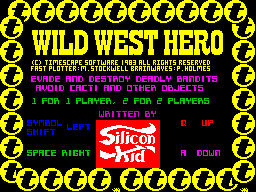
48K Spectrum Shoot-'em-up Timescape Software £5.90 Like all good Westerns this has a good opening visual and the controls are clearly explained beneath the Wild West saloon bar-type writing. A brief kaleidoscopic display transports you to the Arizona desert where you are suddenly surrounded by tough gun-toting hombres and rather volatile cacti which blow up and kill you when you bump into them. You automatically shoot in the direction you are moving. Once you have made a name as a fast draw, more tenderfeet appear on screen.
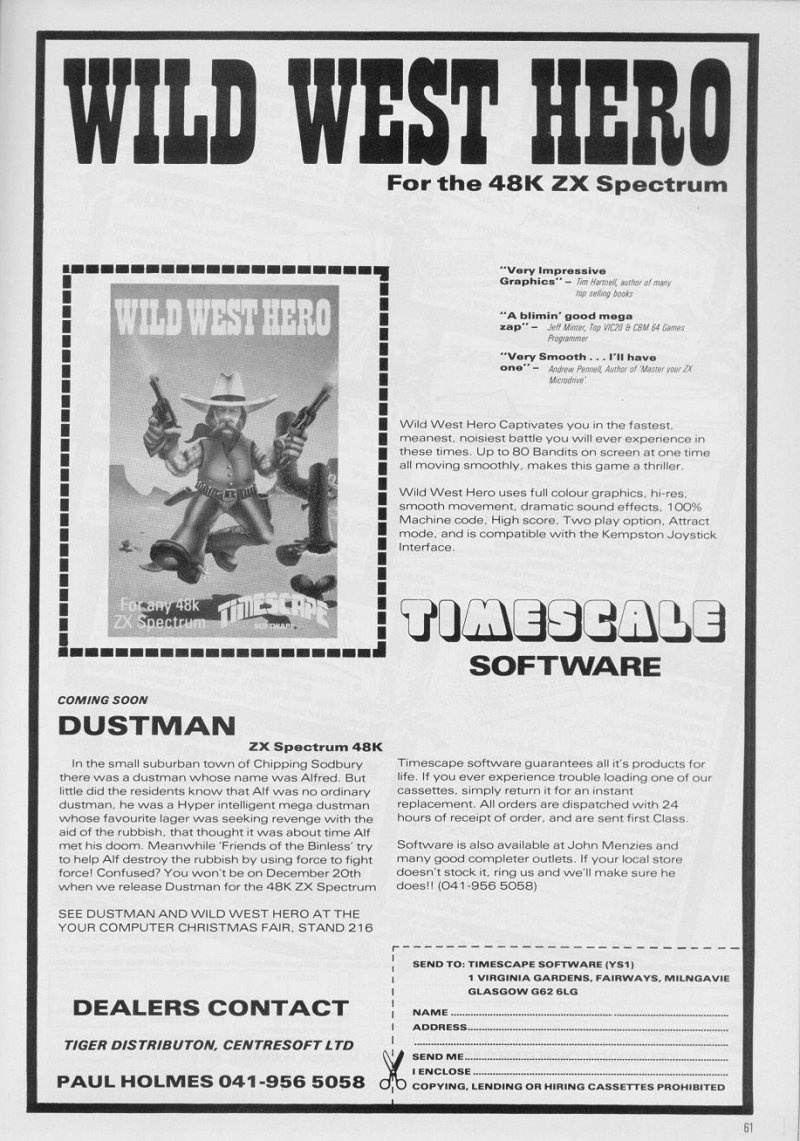
Full-page ad7
- Personal Computer Games #5Apr 1984 · p.68
- Your Spectrum #2Mar 1984 · p.87
- Personal Computer Games #4Mar 1984 · p.153
- Personal Computer Games #3Feb 1984 · p.148
- Your Spectrum #1Jan 1984 · p.61
- Personal Computer Games #2Dec 1983 · p.3
- Your Computer #12Dec 1983 · p.90
Advert3
- Crash #2Mar 1984 · p.58
- Your Computer #2Feb 1984 · p.138
- Personal Computer News #35Nov 1983 · p.11
Feature1
- Computer ChoiceFeb 1984 · p.48
Review1
- Home Computing Weekly #47Jan 1984 · p.8
News/Note1
- Home Computing Weekly #32Oct 1983 · p.10
Licensed from
- Robotron: 2084Arcade coin-opunofficialWilliams Electronics Inc
Related
- Tags
- Western, Alternating
- Same entry at
- Spectrum ComputingZXInfo
Reviews from people here
Sign in to write about this, or make an account. It takes a minute and lets you correct the catalogue too.
No description recorded.
Sign in to correct or add to this.
Hold the rights to this and want it taken down?