
The Winged Avenger
Arcade Game: Shoot-em-up · ZX-Spectrum 16K · 1 players · English
Work Force · 1982 · Pound sterling 5.00
Also known as Winged Avenger (English)
.jpg)
Discussion
Nobody has started a thread about this yet.
Releases
- 1982Work Force Sold as Winged AvengerPound sterling 5.00
- 1983Profisoft [1]
Play
- WingedAvengerThe.tzx.zipTape image English3 KB
- WingedAvengerTheMkII.tzx.zipTape image English5 KB
- WingedAvengerThe.tap.zipTape image English6 KB
- WingedAvengerTheMkII(Profisoft1).tzx.zipTape image English4 KB
Other files
- Winged Avenger, The (1982)(Work Force).pokPOK pokes file 0 KB
Files and rights
No permission is on record either way. Screens and pictures are copied here on a take-down basis: if you hold the rights and want something removed, say so and it goes.
Scores
Elsewhere on the web
- WorldOfSpectrum 7 votes4.14
In the magazines 55
Crash #3Apr 1984 · p.63
Producer: Workforce 16K £5.00 Something of a cult among galaxian fans, with two options (2-part load) for the 'brave' and 'also-rans'. Six skill levels, laser, forcefield barrier and simple but effective graphics. This is a fast game for the experts - novices might not even realise they've lost all their lives. Disappointing graphics and ultimately not of lasting appeal.
Crash #2Mar 1984 · p.47
Producer: Workforce 16K £5.00 Something of a cult among galaxian fans, with two options (2-part load) for the 'brave' and 'also-rans'. Six skill levels, laser, forcefield barrier and simple but effective graphics. This is a fast game for the experts - novices might not even realise they've lost all their lives. Disappointing graphics and ultimately not of lasting appeal.
Crash #1Feb 1984 · p.47
Producer: Workforce 16K £5.00 Something of a cult among galaxian fans, with two options (2-part load) for the 'brave' and 'also-rans'. Six skill levels, laser, forcefield barrier and simple but effective graphics. This is a fast game for the experts - novices might not even realise they've lost all their lives. Disappointing graphics and ultimately not of lasting appeal.
Crash #1Feb 1984 · p.4050%35%40%
Use of Spectrum 50%
Addictive Qualities 35%
Value For Money 40%
Chris Passey
Lloyd Mangram
Memory Required: 16K RRP: £4.95 It's got eggs, birds and eventually the mothership, but with the exception of the birds flapping their wings, the graphics are boring. It is a reasonable copy, but by today's standards rather poor. The laser shield is almost too effective. There are several game/speed variations to experiment with, but on the whole uninspiring. CHRIS PASSEY The speed of this phoenix version always takes my breath away, but I learned sometime back that it's actually easier to get better scores by playing the higher speeds. In the slower speeds you try to be accurate (never a good idea!) but faster you seem to get a better rhythm going. Sadly the graphics are small and dull and the overall impression is disappointing. LLOYD MANGRAM
C&VG (Computer & Video Games) #17Mar 1983 · p.88/106/104/10
Getting Started 8/10
Value 6/10
Playability 4/10
Pat Norris
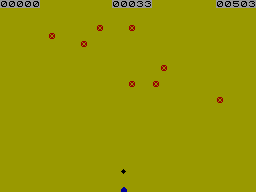
For sheer frenetic action it's hard to beat conflict with the hordes of Winged Avenger from Workforce. These outer-space fleets dive out of the sky, scattering bombs in all directions and challenging you to match their fearsome fire. You are represented on the screen by a small laser base, with left and right controls plus fire and shield. A timer ticks down from 500 and you have to get rid of wave after wave of aliens. This can be done in two ways, by shooting them or by running into them while they spend time on the ground. Both are equally effective. But as the aliens have a tendency to swoop down at your position regularly. It is possible to build up quite a score by merely staying still and letting them crash against you - I have wiped out whole waves without touching the controls. There are speed levels from a sedate 0 to a hectic 6 and the aliens come in three waves. First the small round variety, then as large green birds which can lose wings without being affected. And finally in a mothership which contains a fuel cell. If this is blasted successfully the timer resets and you can start all over again. Guaranteed to give you an aching wrist, Winged Avenger, unfortunately, doesn't leave much scope for tactics. It costs £6.95 for the ZX Spectrum.
GAMES GLOSSARY If you can tell a Pacman from a Defender and a Galaxian from a Space Invader you probably know your way around computer games. But if some of the game terms we have used in this supplement, or in the issue itself, are new to you, then this page should supply the answers. In it we take some of the best known types of computer game and describe how they are played and what features these games normally incorporate. So, if we claim that Penetrator is a "Scramble-type game" and that leaves you just as much in the dark about what to expect, then below there is a full description of Scramble to put you in the picture. ASTEROIDS The Asteroids came into the arcades courtesy of Atari. It features a small dart-shaped craft controlled by the player which can rotate left or right and thrust or fire in the direction it is facing. There is one further control, the panic button (hyperspace) which lets you travel to another part of the screen chosen by the computer. The enemy is mainly made up of large asteroids which sweep across the screen in large deadly groups of rock. When blown up these break into smaller fragments worth extra points. There is extra danger supplied by two UFOs. The first larger creature you'll meet fairly early on. It tends to spray shots in all directions and often crashes into an asteroid. The smaller variety is far more deadly in its own shooting and also more difficult to hit. Each cleared screen means you start again with extra asteroids. DEFENDER You can't expect to keep a finger on every control button in Defender or you'd end up in knots. The action, which takes place above an alien landscape, involves some seven control buttons and takes patience to gain proper mastery of your lone craft. That patience can be rewarded though, as Defender is challenging from the word "Go". The Defender craft can go: up, down, thrust forward, reverse direction, fire, smart bomb and hyperspace. Ten humanoids wander on the landscape and these may fall prey to raiding alien creatures known as Landers. Landers pick up the humanoids and take them to the top of the screen. If they succeed in getting there the Landers turn into fearsome mutants hellbent on your destruction. In all there are six alien opponents. On top of Landers and Mutants, these are: Pods are quite harmless but contain the small and persistent Swarmers; Bombers seed space with white bombs and Baiters only appear if you take too long clearing a screen of the rest of the aliens. If all 10 humanoids are captured, the planet explodes and all remaining alien life attacks your craft at once. Defender games usually feature a small radar screen which shows what is going on at all parts of the planet surface. FROGGER Frogger has spawned a whole host of computer games with a similar theme. This game features a frog hero who must jump across a road and make his way across a river torrent to five frog-holes in the bank. The busy road usually features live streams of traffic travelling in both directions at varying speeds, between which the player must hop his frog without wrapping it around any fenders. Once across the road, the river can be crossed by leaping onto floating logs and onto the back of swimming turtles, until our frog can enter a vacant spot in the far bank. Turtles have a habit of diving though so don't let a frog dally too long on one. Being carried off the edge of the screen (by log or turtle) also results in a note in the funeral column of Amphibians' Weekly. When all five frog-holes have been filled, the game becomes more difficult with extra traffic being added to the road, snakes traversing the bank between road and river and alligators appearing instead of logs in the river. A timer running down on each frog also adds to the difficulties. The arcade original also featured a small lady frog who could be "picked up" on the logs and offered a lift home for a bonus. Other bonuses can be scored by entering a frog-hole in which a tasty fly meal has come to rest. DONKEY KONG Donkey Kong is the strange name for a climbing and jumping game which features a starlet-grabbing monster gorilla. Often referred to as Crazy Kong or Crazy Climber in the computer circles, it has only just found its way onto the home screen. The game features a gorilla holding a girl captive at the top of the screen and an intrepid hero (Mario the carpenter), who starts at the bottom of the screen. Between the two is a connecting network of platforms and ladders up which Mario must run to achieve his rescue. Kong hurls barrels down the screen and Mario makes use of his "jump" button to leap over them. He can also grab a hammer and smash the barrels as they approach him. Once at the top of the screen a new complex is built with Mario, again starting from the bottom with a view to rescue. This time the screen features a series of conveyor belts and deadly fires which travel around on the ladders and belts. GALAXIANS The Galaxians were the sons of Space Invaders. Instead of proceeding down the screen at a leisurely pace, they wavered at the top of the screen before swooping down in batches of two or three (or more often on a solo mission) firing bombs. The player has the usual left, right and fire controls on his laser base and must take care not to get trapped in a corner. He scores double points for a galaxian hit in mid-swoop and there are bonus points for taking out the red fleet commanders, who usually descend flanked by their generals, dispersing bombs at such a rate that the first instinct is to flee for cover. That is the essence of Galaxians but with each destroyed platoon, new waves appear at screen top and their attacks become more frequent, more accurate and, all too often, more deadly! PACMAN The ghostly world of Pacman is made up of a dot-filled maze, a hungry dot-eater and four pursuing spectres. Pacman variations can be found under a whole range of titles from Vic-men to Gobbleman, Snapper to Super Glooper and many others. Most dot-eating games are related to it. The main character is the dot-eater, which travels around the maze, eating every dot he touches. His objective is to clear the screen of dots. He is hampered in this by the four chasing ghosts whose touch is lethal. The Pacman's main defence against the ghosts, who usually number four, are energiser dots. These pulse in the four corners of the maze and, upon being eaten, reverse the roles for a short while. This means that Pacman can turn the tables on the ghosts and eat them for bonus points. He is allowed only a few seconds of dominance before the usual hunter and hunted rules come back into operation. It is also usual for fruits to appear on the screen occasionally and these too can be consumed by Pacman for bonus points. When Pacman has cleared the screen, it refills with dots and the game restarts except that this time the ghosts are a little livelier and a new fruit, worth extra points, appears at this level. SCRAMBLE Scramble should have a big one-way sign on its cabinet. The screen rolls from right to left, taking the player's craft along it into ever-increasing danger. Scramble variations often contain the word "Mission" or "Attack" but there are some weird and wonderful titles about. The player controls a craft heading right across the screen over hilly terrain His craft can never turn around and opt out of its mission but he does have some control over his destiny. His controls are up and down, fast and slow and he can both bomb and fire at his enemies. The Scrambler is not usually equipped with enough fuel to complete his task, but it is normal to obtain more fuel by bombing fuel tanks on the ground and so (mysteriously) replenish his own stocks. The enemies come in all shapes and sizes. Most common are missiles which fire up from the ground as your craft passes overhead and alien invader creatures which frequently inhabit caves and fly at the player's craft. The original Scramble game sent the player through a series of different terrains with new challenges in each section. And most computer Scrambles attempt to duplicate this with a number of different stages. Scramble requires a cool head which can find the right control in a crisis, but it makes an ideal computer game as success naturally leads to new and more difficult stages. INVADERS Space Invaders started the whole computer game craze back in 1977 and most gamers know the format backwards. Still, just a brief resume... The invaders come in waves above the ground and move in rows across the screen one step at a time, firing missiles earthwards. When one row of the aliens reach an edge of the screen, the whole platoon jump down a line and return back the way they came. When they achieve their slow progression to the bottom of the screen, the game ends. The player controls a laser base which moves left to right and fires directly up from its position. His aim is to blow up the entire fleet before it reaches the bottom of the screen. Flying saucers move across the top of the screen in both directions and can be hit for a mystery bonus score. In the arcade original, top saucer scores of 300 were achieved by firing 22 shots before shooting at the first saucer, then firing 14 shots in between each subsequent saucer. Some computer versions have copied this technique.
THE METEOR STORM Science fiction buffs have explored the galaxies from the comfort of their armchairs for decades thanks to authors like Michael Moorcock, Arthur C. Clarke and Frank Herbert. Now there is an even easier way to stretch your imagination out into the stars - through the medium of home computer space games. You are now the space hero battling against evil forces intent on the destruction of the earth or even the universe. Pit your wits against alien beings with powers beyond imagination. In fact imagination is only limited to the type of program that you can obtain for your micro. In this article we tell you some of the things to look out for when buying a computer space game. Whatever type of micro you own, you may be sure that there will be a number of space programs to choose from. Buying software by post means that you have to rely an advertisements when making your choice, but you can also choose from the ranks of cassettes on display in local computer shops. And don't forget that magazines, like Computer and Video Games publish games. It is not possible to recommend a set type of space game program as many of the features are matters of individual choice. Straight forward attack games in the Space Invader vein still have a lot of appeal and some of the latest versions based on this theme are excellent. Programs are available to take you into the realms of space adventure where deduction, strategy, memory and planning are as much a requirement as quick finger on the fire button. Micro versions of arcade games like Defender and Galaxians, to name but two from a vast selection, are fast, colourful, highly playable, and in some recent cases extremely authentic versions of their arcade counterparts. With the advent of the new generation of low priced computers, high standards are expected with this type of program. So look for good presentation with clear instructions. Where applicable the program should have high score facilities as well as good use of colour and sound. But the main points to look for are excitement and enjoyment without which the games will not hold your attention for long. Pat Norris
C&VG (Computer & Video Games) #12Oct 1982 · p.21
PIRATE WITH A VAST EVIL ARMY The Winged Avenger has countless Drones and an Invasion Force to send out to do battle with you before he is drawn into the fight himself. The Drones attack relentlessly and their purpose is to soften you up for the more superior Invasion Force. The Invasion Force are the elite of the fleet - and they will fight on to the very end, often necessitating more than one direct hit. The Assailants also attack in three waves and combine a tendency to fly direct at your missile base Kamakazi style - with very heavy fire power. You have limited energy to fire your laser, which is capable of rapid fire, and to power your base shield which will protect you from flying debris and from those of your opponents who wish to die in a blaze of glory by crashing into your laser base. If you survive these attacks the Winged Avenger must concede that you are a worthy opponent and will engage you himself. He is armed with powerful Smart Lasers that lock onto your base and are guided for the kill. Your only hope of vanquishing this seemingly unbeatable space pirate is to damage his central control and force him to withdraw. Winged Avenger is based on the popular arcade game Phoenix and runs on a Sinclair Spectrum. The game is available from Luton based Work Force at £6.95 inclusive.
Sinclair User #7Oct 1982 · p.7
AVENGERS TAKE WING Being bombed by a flock of alien birds from the depths of space can be an experience and it is in a new game for the Spectrum called Winged Avenger, which is based on the arcade game Phoenix. Your laser base is at the bottom of the screen and you can switch-on a defence shield to protect it from the evil aliens. The first three assaults on your base are carried-out by drones in an effort to soften you for the main attack by the big birds. The avengers flap about the screen in formation trying to destroy your base with laser and bomb. You can return fire but the aliens are really difficult to hit. Winged Avenger is available from Work Force, [redacted]. It costs £6.95.
Your Computer #9Sep 1982 · p.28
Boris Allan
SURVEY SPECTRUM SOFTWARE Boris Allan examines the first software offerings designed specially for your Spectrum. Although the Spectrum was announced in April the machine has only become available in large numbers recently. For software suppliers it is still early days. We were therefore relieved to find that most of the programs we received worked first time and reasonably well even if some of them lacked originality. Most of the software we sampled was based on ZX-81 or arcade games but we also tried out some educational and utility programs. Loading the Spectrum was far less frustrating than the ZX-81. The machine performed well, producing particularly good colours but disappointing sound. The limitations of the internal speaker can at least be bypassed by taking the cassette out of the recorder, connecting the two Mic sockets and switching on the recorder. Tone and volume can then be controlled with the recorder's own controls. Games programs are strange things. Long complex programs can be much less enjoyable than a short snappy one incorporating a good idea. So long as the programs are relatively bug-free, as most of these Spectrum games were, then evaluation of any particular cassette is bound to be subjective. To give as objective an assessment as possible we tried out the games on all age groups - even a class of five-year olds. Both Bug-Byte's Spectral Invaders and Quicksilva's Space Invaders approach the standard of real arcade games. Spectral invaders is almost an exact copy of Space Invaders, complete with four different colours for invaders, a flying saucer and high score. Some effects are slightly slower than the Atari original but the graphics quality and the use of colour and sound is excellent. Quicksilva's Space Intruders also had a mutant invader that wobbled and was worth extra points and a hold facility to allow you to stop the game at any point. While the invader programs were written in machine code, Alien Command was written in Basic and was too slow and crude for a space game. Winged Avengers from Work Force is a Galaxian-type game in which waves of attackers move down the screen towards the player's missile firer, break formation, circle about and then attack again. Six speeds are offered and the action is fast. But with the exception of a formation of birds, which appear in the second attack phase flapping their wings very effectively, the display is a little dull. Chromasoft's three programs varied from the sublime to the ridiculous. Worm is a simple but clever idea. A worm on the screen has four segments, and the player has to direct the worm around the screen, eating up numbers. Each time a number is eaten, they flash up randomly, the length of the worm increases by that amount. As the worm gets longer, it becomes more difficult to navigate, because you are not allowed to leave the screen or to cross over yourself. One player reached about 125 segments, and could not find any space. The program is as simple as the display but the idea worked. Defined colours and graphics for the segments would be improvements but only cosmeticBomber is an uninspired rendering of Blitz. Golf is not only unexciting but bug-ridden. Amongst other things the game was unwilling to play the right number of holes. AVC's Fortune could be a useful stand-in for the crystal ball at children's parties. The company's Tables has a more educational objective. The tests of multiplication tables are quite competent but the program would be more useful as a means of generating interest and enthusiasm for mathematics rather than for teaching the tables themselves. Whoever designed it has a keen appreciation of the minds of primary school children, although AVC is stretching a point when it claims the program can be used to the age of 16. One clever ploy to generate interest was the use of the ZX-Printer to give each child a permanent record of its achievement. One kid described it as 'space-age paper'. This theme is reinforced by a countdown to the launch of a rocket each time you play. Time Bandits from Newsoft comprises six separate games on side 1 all combined in an Adventure-style game on side 2. Most of the games have pretty graphics but are rather elementary. Minotaur's Labyrinth is a matter of collecting objects in a maze and Napoleon's army is similar - but without the maze. In Titanic you rely on luck to avoid being sunk by an iceberg while Tower of London is at least distinguished by the appearance of random Beefeaters. Combination is just a matter of remembering a number but Castle of Evil is a little more out of the ordinary. You have to work out the best strategy to cross a web with hostiles converging on you - rather like the Adventure game which used to be shown on BBC 2. Most of the games had not been carefully thought out. It was sometimes possible for instance to offer bribes of minus amounts of money, and thus become richer. Backgammon from Keith Archer worked well enough but was easy to beat and again vulnerable to cheating. There was nothing to prevent you putting more than five counters on a point for instance. Richard Altwasser's Cambridge Colour Collection costs £9.90 for a book of 64 pages and a cassette. Though some of the programs are original, in that they use specific features of the Spectrum, many are not: Maze is marred by a poor algorithm. There is also Breakout, Nim, and most others, including a version of King called Kingdom. The cassette was unfortunately unloadable - the company has had to replace many of the cassettes. We reviewed two graphics packages. Phantasmagraphics plots 2D and 3D patterns and allows you to modify the patterns by entering height, width, perspective and distortion variables. The program is written in Basic and takes up to six minutes to draw a shape. The program contains a bug which causes it to be interrupted by an 'integer out of range' error message for large height and width values. Superdraw 16 is an exceptional program. For £5 you are supplied with an instruction booklet, a pad of screen design pads, and a cassette with a spoken commentary on one side, all in a polythene bag. No other program gave such value for money. The program is written in Basic and allows the user to design screens which can then be saved for incorporation in other programs, which make use of high- and low-resolution graphics, text, and user-designed alphabets of large letters. The 'slide-show' option automatically toads successive screens. High-resolution pictures of a bicycle and southern England among others flash up in turn very much like a slide-show for the unemployed. Two simulation games are available from Case Computer Simulations. Autochef allows you to work your way up as manager of a small catering company. At first you have to avoid being taken over by Trust House Forte - later if you survive you can try to take over Forte yourself. Airline is exactly the same as Autochef except that you are running a small airline.- The two assemblers were useful because they save you money by not buying at inflated prices books which disassemble the Spectrum ROM. Of the two the Campbell version is more attractive as it is written in Basic, and one can learn from studying the program listing - warts and all. The Artic version was difficult to follow, as the documentation had not been prepared, but if the Spectrum documentation is as good as the ZX-81 documentation then it will be terrible. Given the incomplete nature of both offerings, the cheaper price, and the ability to convert from hex to dec and vice versa, sometimes with amusing results, the Campbell Systems offering may be better value.
Advert41
- Sinclair User #21Dec 1983 · p.111
- Your Computer #12Dec 1983 · p.150
- Sinclair User #20Nov 1983 · p.51
- Your Computer #11Nov 1983 · p.182
- Sinclair User #19Oct 1983 · p.14
- Your Computer #10Oct 1983 · p.140
- Sinclair User #18Sep 1983 · p.90
- Your Computer #9Sep 1983 · p.6
- Your Computer #8Aug 1983 · p.8
- Popular Computing Weekly #22Jun 1983 · p.30
- Sinclair User #15Jun 1983 · p.52
- Your Computer #5May 1983 · p.40
- Popular Computing Weekly #18May 1983 · p.16
- Popular Computing Weekly #20May 1983 · p.30
- Popular Computing Weekly #21May 1983 · p.36
- Sinclair User #14May 1983 · p.52
- Your Computer #4Apr 1983 · p.134
- Popular Computing Weekly #15Apr 1983 · p.6
- Popular Computing Weekly #17Apr 1983 · p.34
- Sinclair User #13Apr 1983 · p.32
- Popular Computing Weekly #13Mar 1983 · p.18
- Popular Computing Weekly #11Mar 1983 · p.20
- Popular Computing Weekly #9Mar 1983 · p.16
- Sinclair User #12Mar 1983 · p.60
- Your Computer #3Mar 1983 · p.92
Review3
- Home Computing Weekly #1Mar 1983 · p.40
- Personal Computing Today #7Feb 1983 · p.34
- Popular Computing Weekly #22Sep 1982 · p.10
Feature2
- Crash #1Feb 1984 · p.38
- Your Computer #9Sep 1982 · p.28
News/Note1
- C&VG (Computer & Video Games) #12Oct 1982 · p.21
Related
- Compilations
- Winged Avenger + Cowboy
- Elsewhere
- MobyGamesThe TipshopUVL
- Same entry at
- Spectrum ComputingZXInfo
Reviews from people here
Sign in to write about this, or make an account. It takes a minute and lets you correct the catalogue too.
No credit, description, tag recorded.
Sign in to correct or add to this.
Hold the rights to this and want it taken down?