
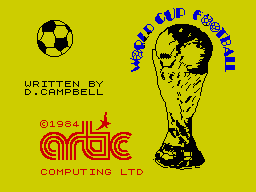
World Cup Football
Sport Game: Action · ZX-Spectrum 48K · 9 players
Artic Computing Ltd · 1984 · Pound sterling 6.95
Also known as Copa do Mundo (Portuguese), Mundial de Futbol (Spanish)
.jpg)
(MultisoftInformaticaLtda).png)
Discussion
Nobody has started a thread about this yet.
Remarks
Re-released by U.S. Gold as the infamous {World Cup Carnival|U.S. Gold Ltd|0005733}.
SPOT: aka. World Cup; aka. World Cup Soccer
- Control Option
- Interface 2 (left), Interface 2 (right), Kempston Joystick
Releases
- 1984Artic Computing LtdPound sterling 6.95
- 1984Dixons
- 1984Investronica S.A. Sold as Mundial de FutbolSpanish peseta 2050.00
- 1984Paxman Promotions
- 1985Multisoft Informatica Ltda Sold as Copa do Mundo
Play
- worldcupfootball.rzxRZX playback file
- WorldCupFootball.tzx.zipTape image English18 KB
- WorldCupFootball.tap.zipTape image English19 KB
- WorldCupFootball(Dixons).tzx.zipTape image English18 KB
- WorldCupFootball(CopaDoMundo)(MultisoftInformaticaLtda).tap.zipTape image Portuguese17 KB
- WorldCupFootball(PaxmanPromotions).tzx.zipTape image English18 KB
Documents
- WorldCupFootball.txtInstructions English1 KB
Files and rights
No permission is on record either way. Screens and pictures are copied here on a take-down basis: if you hold the rights and want something removed, say so and it goes.
Credits
- Donald J. Campbellcredited
- JJCcredited
Sign in to credit somebody, or say what these people did.
Scores
In the magazines
- Crash #71984 · Overall71%
- Personal Computer Games #91984 · Overall3/10
- Sinclair User #291984 · Gilbert Factor7/10
Elsewhere on the web
- WorldOfSpectrum 33 votes6.26
In the magazines 40
C&VG (Computer & Video Games) #56Jun 1986 · p.70
Simon Inglis
FITBA CRAZIE! Two, four, six, eight, who do we appreciate? Well, C+VG, of course. As the world is gripped by football fever, Simon Inglis proves to be on the ball with a special round-up of all the computer football games available. With so much attention lavished on this month's World Cup in Mexico you might think there's enough football on our screens at the moment without harping on about football computer games. But the fact is that although games manufacturers continue trying to milk the national sport - another three this year takes the total to over 20 - most of them aren't much more fun than a goalless draw at Arsenal. And very often the ones that are worth trying are the ones least pubicised. Take managerial games for instance. Everyone has heard of Kevin Toms' Football Manager, mainly because Addictive Games has a strong marketing instinct. Reported sales of over 150,000 make it easily the best seller in this field. Yet its lesser known rivals are actually more challenging and amusing. The Boss from Peaksoft, for example, with claimed sales of over 90,000. You must tackle realistic financial problems familiar to any soccer buff - like repairs from riot damage, rate demands from the council and so on, while favourable comments from pundits like Jimmy Hill play havoc with your team's morale. But then the game spoils itself by allowing you to buy any player you want from your next week's opponents, a gambit not even tried by Malcolm Allison in his heyday! The trickiest managerial game is United from C.C.S. which has horribly inflated prices for players - £2 million for a sweeper would deter even Ron Atkinson these days - but allows you to play clean or dirty on a scale of 1-10, and you pitch in apprentices and sell them off for a quick profit. Big League Soccer from Viper, which arrived last year, has clearer graphics but goes to the other extreme by undervaluing players - Gary Bailey for £25,000! Surely he's not that bad? And what a tedious format. Playing 42 games per season may be realistic but a takes an age to play, especially as you have to select each team from scratch for every match. Football Manager scores because it has a good balance of challenge and reward. If we're honest, no one would play any game for long if, like most football managers, you end up nowhere having won nothing all season. With Football Manager you have to be pretty awful not to do well at beginner's level. Alone amongst the managerial games each match has its own graphic display. Others just show minute by minute scores. The trouble with this however is that you can only sit back and watch the action - like a real manager - and after the first few matches it's tempting to keep nipping out for a Bovril or a pee. None of the players ever get sent off or fined for drunken driving, which makes it all horribly idealistic. The latest managerial game on the market is Virgin's Official F.A. Cup Game, which is great for a crowd to play - well, eight people anyway - but on your own is somewhat less demanding than finding room on the terraces at Torquay. Once you've selected ten teams to manage, the only other decisions to make are to choose between three sets of tactics and in later rounds answer a few fatuous questions. Meanwhile, in between rounds, the computer churns out a load of ridiculous newsflashes which are supposed to affect your teams morale. Flashes such as "There is no news about your team in the press this week" and 'The club's oldest surviving player is 100 years old today'. Big deal! Unless of course the centenarian is still playing. But the biggest anti-climax is the Final itself. Having teased you with a rendition of Abide With Me and a picture of Wembley, once the Final is over the game stops - no cheering, no presentation, no wildly ecstatic graphics Now if you really wish to avoid excitement buy Liverpool (mail order only), possibly the slowest and least rewarding game on the entire market and an insult to the name of that great football club. If, like Tommy Docherty, you can't cope with managerial games for very long, Rothman's Football Quick Quiz, wityh questions by the yearbook's editor Peter Dunk is packed full of toughies, although the version I played had somehow managed to get all the categories mixed up. The non-League section was all about the FA Cup, and the European section was full of soccer trivia. For sheer enjoyment I much preferred Answer Back Sport from Kosmo, which not only includes questions on cricket rugby, boxing, golf and tennis as well as soccer, but also has two action games of soccer and tennis in between quiz rounds. For this reason I can just forgive them for misspelling the name of Liverpool's immortal manager Bill Shankly. A cheapie quiz game available by mail order from Marksman Software, The Ultimate Soccer Quiz, is ultimately rather simple and dull, which might explain why the makers felt bound to slip in totally irrelevant scoreflashes from a fictitious game between Spurs and Everton. Of course the hardest part of soccer to simulate is the actual game itself - hard enough for real professionals nowadays - and in this respect some of the software houses have come closest to scoring own goals. Glenn Hoddle's Soccer from Amsoft offers routine entertainment but little more. It was far too easy to walk the ball into the opponents net - not one of Glenn's specialties. For no discernible reason the goalkeepers wore the same shirts as the rest of the team, a practice which was banned a mere 77 years ago. The ball in Bobby Charlton's Soccer created by D.A.C.C. was so tiny, control was so hard and the instructions so lacking in one vital point that I had to turn to Bobby's very self-conscious message on the other side of the cassette for encouragement, before ringing the makers to find out how to proceed. If you too get stuck the way out is by Pressing Q twice. World Cup Football, like the FA Cup game, is good for a whole crowd, especially those old enough to remember Bobby Moore, who is still featured on the cover. Hasn't anyone told Artic that Bryan Robson is the current England captain? Or that great footballing nations like Portugal and Hungary deserve inclusion rather more than Guyana and Tasmania. A quick scan of the rule book would also inform Artic that a player cannot throw the ball in to himself. Which is where Andrew Spencer comes in. He apparently knew nothing about football until he read the rule book and then proceeded to write International Football from Commodore which outscores its rivals in almost every respect. You can really hurl your keeper about the goalmouth, as well as getting your men to head the ball. The graphics and sound are outstanding and the player's movements easily recognisable. My only criticism is that both teams wear black shorts. International Soccer's closest rival is Match Day from Ocean which also sports good graphics and the Match of the Day theme tune. Unfortunately the computer seems to play some odd tricks, the oddest being to make its players turn away from open goals and kick the ball into touch. The might just be sour grapes on my part however, since I seemed to be totally incapable of beating the computer in the tackle. If you don't have a Commodore for International Football, Match Day for the Amstrad, BBC or Spectrum is the best of the rest. Not all of us see soccer as a mere game however. There are some of us who delight in pouring over statistics and records, and some who use computers to help run their own leagues. Yes, people do still actually play the real game. For such people two Spectrum programs from the Spartan Sports Association - Club File and Tables - are valuable aids. I also liked League Table and Champions, both from Football Follower, which work out past form and list winners (useful for pools punters) and another Spectrum home-produced program called Tables which enable you to keep up-to-date records for the entire Football League and Scottish League, from Football Software. I fear that none of these information packages will help you win a fortune on the pools, and I'm pretty sure none of them will make their creators very rich either. We'll leave that side of soccer to ourboys in Mexico. Long may they be needed to endorse the next crop of football computer games. MANAGERIAL GAMES FOOTBALL MANAGER Addictive Games, [redacted] BBC, Electron, Dragon, Amstrad, C64, Vic 20, Spectrum, ZX81 THE BOSS (also The Champions) Peaksoft, [redacted] C64, 16, Amstrad, MX, BBC, Electron Dragon, Tandy, Spectrum £6.95-£8.95 UNITED CCS, [redacted] Spectrum £6.95 BIG LEAGUE SOCCER Viper Software, [redacted] Amstrad £6.95 LIVERPOOL P. M. Corbishley, [redacted] Spectrum, Atari £8.45 (£14.95 Atari disk) OFFICIAL FA CUP GAME Virgin Games, [redacted] Tel: 01-717 8070 Amstrad,C64/128, Spectrum £7.95 ACTION GAMES WORLD CUP FOOTBALL Artic Computing Ltd, [redacted] C64, Amstrad, Spectrum £6.95-7.95 KICK OFF Bubble Software, [redacted] C64 £1.99 INTERNATIONAL FOOTBALL Commodore, [redacted] C64 £14.99 MATCH DAY Ocean Software, [redacted] Tel: 061-832 6633 LEAGUE TABLE/CHAMPIONS Football Follower, [redacted] Spectrum £6.95, £4.95 (or £9.50 both) Amstrad, BBC, Spectrum £7.95-£9.95 BOBBY CHARLTON SOCCER D.A.C.C. Ltd., [redacted] BBC, Electron £11.95 inc p&p GLENN HODDLE SOCCER Amsoft, [redacted] Amstrad £8.95 (£12.95 disk) SPOT THE BALL Thorn EMI, [redacted] Atatri £9.95 FIVE-A-SIDE FOOTBALL Anirog Software, [redacted] C64 £5.95 (£8.95 disc) FIVE-A-SIDE SOCCA IJK Software, [redacted] BBC, Electron FOOTBALL QUIZZES ANSWER BACK SPORT Kosmo Software, [redacted] BBC, Electron £9.95 ULTIMATE FOOTBALL QUIZ Marksmen Software, [redacted] Spectrum £6.95 ROTHMANS FOOTBALL QUIZ Cassell Ltd., [redacted] Spectrum £9.95 CLUB FILETABLES Spartan Sports Association, [redacted] Spectrum TABLES J. Moore, Football Software, [redacted] Spectrum £5.95 Simon Inglis writes on football for the Guardian and Observer. He has written three books on football and is currently the official historian for the Football League's Centenary History. His second book, The Football Grounds of England and Wales, has sold over 20,000 copies to date and has been widely acclaimed. His latest book, a history of British football scandals, has also aroused great interest. Both are published by Collins Willow. He writes on a BBC computer and his record score at Hopper is 28,540.
ZX Computing #17Feb 1985 · p.94
Colin Young
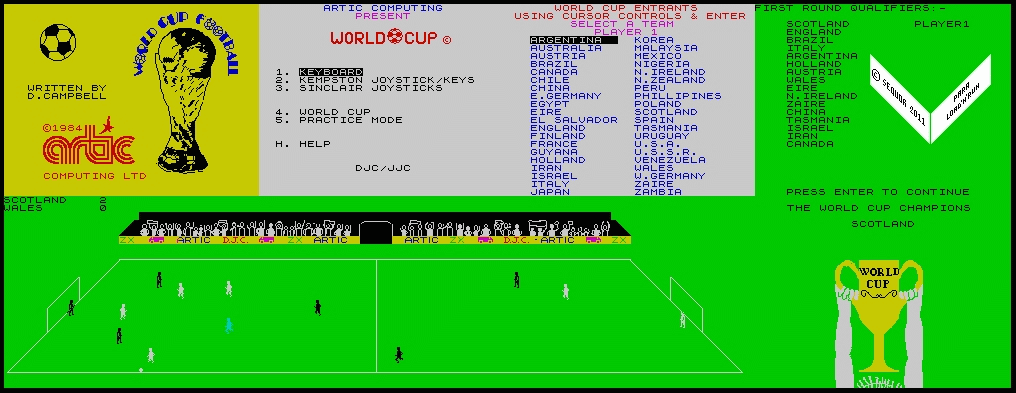
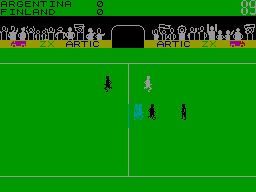
READERS REVIEWS Taking pen in hand, you tell us what the public really think about the goods on sale. WORLD CUP FOOTBALL Artic Computing Colin Young For those of you who cannot wait two years for the World Cup, Artic's latest release is ideal. Called World Cup Football it is for the 48K Spectrum and costs £6.95. Up to 9 people choose from a pool of 40 teams from England or Brazil to Tasmania and the Philippines. World Cup Football is the first of its kind for the Spectrum. It is unlike the strategy type football games eg. "Football Manager", it is more like an arcade game, as you control the players. On selecting world cup mode from the initial menu, you are given a choice of the number of people taking part (1 -9) and the teams each will represent. Then the first round begins. The teams run onto the pitch and take up their positions to the tune of "Match of the Day". There are only six a side which although unrealistic, is less crowded. The game starts when player one's Centre Forward runs up to take the centre kick and the whistle blows. You control the player, on your side, nearest the ball, who turns a different colour so he is easier to recognise. One problem is that you lose control of that player if another in your team gets closer. But, once you are used to this, the teams are easy to control using either the keyboard or a joystick (Kempston or Sinclair). The animated running action of the players is good but unfortunately there are problems with the clashing of the colours if players overlap, leading to a confusing mess. This is not really a fault of the program, more a fault of the computer. The screen scrolls left and right with the play, the whole field being about three screens in length. A clock in the corner counts down from 90 minutes. Each minute lasts 4 -5 seconds, giving a total playing time of about 7.5 minutes. Throughout the game the computer plays different football songs, "You'll Never Walk Alone", "We're Forever Blowing Bubbles" and, when someone scores, "Nice One Cyril". These can be turned off thankfully. In the background the crowd in the stand wave their arms and at Half-time the teams change ends while Artic adverts scroll along the top of the stand. Throw ons and goal kicks are taken automatically and apparently aimlessly. There is also a practice mode for one or two players. In conclusion, the game is a little easy when playing the computer and even easier when playing little sisters! However if you can find someone with some enthusiasm to play against it will be more exciting. There is more to it than just winning the cup. For example it would be easy to set up a league with a few friends using the practice mode game. If you are not keen on football I would not recommend this game but if you do enjoy football and it is raining outside, "World Cup Football" is well worth the money.
ZX Computing #16Dec 1984 · p.42100%95%95%90%9/109/10
Instructions 100%
Presentation 95%
Addictability 95%
Value 90%
ZXC Factor 9/10
David Harwood 9/10
Now for all you football fanatics, World Cup by Artic Software the game that you have waited for and no doubt had many sleepless nights, hoping that it would appear soon. The game is for up to nine players and is a simulation of real soccer. Having selected the number of players and the desired teams out of a choice of 40, the action begins with either a practice mode or the full league. As the players run onto the pitch, the cheering crowd are serenaded with various tunes - Match of the Day, I'm Forever Blowing Bubbles, When The Saints, Nice One Cyril (but only after a goal), which also play through the game. I was grateful for the sound off key as Spectrum sound can sometimes get a bit grating. The game starts with player 1 kicking off, which is taken automatically, as are the goalie movements and throw-ins. If you play against the computer, be warned as it plays a good game and is very hard to beat. Unfortunately, you do not have control of all your men on the pitch, only the man nearest the ball. This seems to be a great disadvantage at first, but the computer is generally quite good in controlling the rest of your side, so it is not too much of a problem. Unfortunately also there is no key-select option, which would have been welcomed as found the keys slightly uncomfortable to use. 1 for up, Q down, S right and A left with the bottom row for shooting. You are allowed to use either the Sinclair or Kempston joystick, which would be of great advantage as quicker action and movement will improve your game. I found that both goalies were a little thick in that they just felt 'Lets get rid of the ball and kick it over the line' instead of passing to a specific player (remind you of any teams - I could name a few). The speed of my players was not always as fast as they could have been. My footballer moved faster running at a diagonal than in a straight line. In spite of this, I thoroughly enjoyed all the games in the league and although the computer won and got his hands (hands?) on the Cup at the end of it all, my wife was knocked out in the first round (At least I got her to play at all!) I did find a little bug: where the player had just been after a throw in, there was a gap on the line, which was refreshed quite soon afterwards. I would have thought that by the time the final version arrives in the shops this error will not occur. Another polished game from Artic software, who managed to sneak in a couple of adverts above the crowd for their range of software and right at the end that wonderful phrase appeared 'and many more'. Well keep 'em coming as they can only get better.
Crash #7Aug 1984 · p.8768%72%73%70%77%68%71%
Use of Computer 68%
Graphics 72%
Playability 73%
Getting Started 70%
Addictive Qualities 77%
Value For Money 68%
Overall 71%
Unknown
Unknown
Unknown
Producer: Artic Computing Memory Required: 48K Retail Price: £6.95 Language: Machine code Author: D. Campbell Since Kevin Toms and Addictive Games proved how popular football game simulations can be, there have been several contenders for the cup. Most concentrate on the strategy angle - the management of a team. Only once has a game been released which is actually a graphic representation in which the player(s) control the actions of the team on the screen, and that was Star Soccer by Watson (no longer available). Now Artic have released World Cup. This game has no strategical element, no selection of players according to their strengths, skills, temperaments etc., no juggling with banks or balancing books. World Cup is just football, the game. Owing to the difficulty of coping with a number of large characters on the screen with the Spectrum, there are not eleven members in the opposing teams, only five plus the goalkeeper. World Cup may be played by one player against the computer or two players simultaneously against each other. The program also allows between 1 and 9 players to select teams they want to represent and will keep score and run the championship. A pool of 40 World Cup teams is provided to choose from. The screen shows only a portion of the playing pitch, approximately the centre third, but scrolls left or right with the action to either end's goal. In the background, atmosphere is provided by a wildly waving, cheering crowd, while the continuous soundtrack plays all those Favourites! old football crowd favourites! As with Star Soccer, the computer constantly monitors the action and will take control now and again, moving the influence of action from one player to another on the field as appropriate, taking corners, goal kicks and throws automatically. Otherwise the player has full control over the actions of a player in possession of (or fighting for) the ball. COMMENTS Control keys: well placed for two players - (1) 1/0 up/down, A/S left/right - player (2)0/O up/down, J/K left/right and bottom row to fire for both Joystick: ZX 2, Kempston Keyboard play: responsive Use of colour: used well with control players altering colour for indication Sound: very good, continuous tunes with on/off facility, whistle effects Skill levels: 1 Originality: as far as the Spectrum goes, very original
Real live action on the scrolling screen of World Cup.
C&VG (Computer & Video Games) #34Aug 1984 · p.389/108/107/108/10
Getting Started 9/10
Graphics 8/10
Value 7/10
Playability 8/10
MACHINE: 48K Spectrum SUPPLIER: Artic PRICE: £6.95 Bobby Robson has no need to worry about the standard of football in this game. I don't think that these players pose much of a threat to England's chances in their next game. This is the first attempt at an arcade version of football on the Spectrum. We've had games like the excellent World Cup Manager from Addictive Games, but that was mostly about typing names and numbers into the computer. There was also some real action in the game, but it only served to highlight the choices you made. Now, Artic has brought out a full arcade football game. It's a simulation of the World Cup. You can start with anything from one to nine teams and, through the process of semi finals and elimination matches, one will eventually emerge as champion of the world. You start by selecting how many teams you want. You then choose them from a list of 40. Everyone from Argentina to Zambia is in there, including England, Eire, Scotland, Wales, America and Russia. Careful selection of countries can result in some very interesting matches. Once you've selected the teams then it's time for the first match. The game is for one or two players, so you can either play with a friend or against the computer. The players are controlled with either a joystick or the keyboard and both the Kempston and Sinclair joysticks will work. The game starts with the two teams trooping on to the pitch. There are only five players in each team, which isn't very realistic, but the screen is less crowded. The whistle blows and we're off. I was using the keyboard for control and found the teams easy enough to control. You have control of the member of your team who is nearest to the ball. He turns a strange shade of blue when under your control, so that you know where you are. The only problem I found is that you suddenly lose control of your player if another member of your team becomes closer to the ball. Once you're used to this, you can get down to some serious football. The game is split into two halves and a clock at the top of the screen tells you how much time remains. Once the game is over, it's time for the next match and the computer updates a scoreboard automatically. The graphics are better than many I've seen in this type of game. The movement works quite well, with the players moving their legs realistically as they run. They even slow down as they approach where they happen to be running to. If you like football, then you'll probably enjoy this game. It's a good way to spend a rainy afternoon, especially if you've got a friend to play against. If you're not a football fan, though, then this is not the best way to get into the game.
Personal Computer Games #9Aug 1984 · p.544/101/105/103/103/103/10
Graphics 4/10
Sound 1/10
Originality 5/10
Lasting Interest 3/10
Overall 3/10
Chris Anderson 3/10
MACHINE: Spectrum 48K CONTROL: Keys, Kemp, Sinc FROM: Artic, £5.75 Football is an extremely difficult game to simulate on a Spectrum, and this isn't a very successful attempt. The setting is a World Cup tournament, and you start by deciding what team you want to represent, and whether you're playing against the computer or against other players. So far so good. But when the players make their appearance on the pitch accompanied by a horribly out-of-key rendering of the Match-of-the-Day signature tune you begin to have doubts. The players are tiny stick figures, black for one team, white for the other. Their animation isn't very convincing, consisting mainly of a rather jerky run. And when two opposing players overlap, the black one momentarily disappears, making it hard at times to keep track of play. But the biggest draw-back is the play itself. You can't, of course, control all your team's players at once (there are six per side) - you simply control the one nearest the ball. If your opponent has possession, you must try to run your man into the man with the ball in the hope that the 'tackle' leaves you with the ball. If it does, then your best tactic is simply to weave your way toward the goal using the single player - this is far more successful than trying to pass, but unfortunately it results in a rather boring game. Similarly the easiest technique for scoring is not to shoot - the computer-controlled goal-keepers are too agile. Just dribble the ball right into the net...! Unfortunately I couldn't see what the nicely drawn spectators were getting excited about.
Sinclair User #29Aug 1984 · p.567/107/10
Gilbert Factor 7/10
John Gilbert 7/10
SOFTWARE FOR THE SPECTRUM SPORTSMAN John Gilbert goes for gold in a bid to find the best computer sports simulations. OLYMPIMANIA Memory: 48K Price: £6 OLYMPICS Memory: 48K Price: £6.95 WORLDCUP FOOTBALL Memory: 48K Price: £6.95 FOOTBALL MANAGER Memory: 48K Price: £6.95 UNITED Memory: 48K Price: £6 TROON Memory: 48K Price: £6.95 NEW BIRKDALE Memory: 48K Price: £6.95 ROYAL BIRKDALE Memory: 48K Price: £5.90 SUPER SOCCER Memory: 48K Price: £7 SUPER-LEAGUE Memory: 48K Price: £6.50 ASHES Memory: 48K Price: £1.99 CRICKET CAPTAIN Memory: 48K Price: £4.95 HOWZAT Memory: 48K Price: £6.95 TEST MATCH Memory: 48K Price: £5.95 GOLF Memory: 16K Price: £5.95 Summer is here, or so we are told by the weathermen, and instead of spending hours in front of a television set watching the Olympics or a Test match, why not spend hours creating your own little piece of history with one of the Spectrum sports packages on the market? The Olympic Games have always brought with them a mass of souvenirs, ranging from flags to cuddly toys. This year is the same but there is an added dimension as computer software companies have tried to cash in with high-pressure selling of their sports programs, including ones which simulate Olympic events. Automata, of Pimania fame, has a spoof version of the Games with the Pi-man working his way to gold in five events. The events include the Pi-Jump, Alpi-Skiing, Steepi-Chase, the Pitathlon, and the Butter-Pi, which is the swimming contest. Each contest is animated smoothly and the graphics are detailed down to the last member of the crowd. After every contest has been lost or won the awards are given on the familiar three-position pedestal. If the Pi-man wins he takes a bow but if he loses he runs round the stadium shaking his fist at the crowd. Pi-man may have learned to be an athlete but he is certainly no sportsman. Olympimania, being from Automata, is a joke but should provide the usual hours of fun if you can suffer the inane humour of the Pi-man. You might also like to try the experience of listening to the soundtrack of the Pi-Land International Anthem on the reverse side of the cassette. The game should also appeal to people who find the real Olympics dull but if you take a more serious interest you will want to run Olympics, which is another spin-off from CRL. The program includes 14 events and is LOADed in two 48K parts. Side one of the cassette includes events such long jump, discus, shot putt and javelin. The other side contains six events which are held outside the stadium. They include cycling, swimming, canoeing and yachting. A marathon has also been included, run in five sections, each part between the other events. In the standard game you will take the part of the British team. The computer will challenge the might of three other teams consisting of the United States, the Soviet Union and the Rest of the World - this might be the only opportunity you have to see the Soviet Union compete in the Games. Once you have been through the first half of the Games the medals your team has won will be added to the score you accumulate in the second half. Unfortunately, only gold medals are awarded and you receive no points for being second or third. That detracts from authenticity as the Olympics are not the same without silver and bronze. The graphics which show the events taking place are not so good as those of Olympimania but the ways in which the athletes compete in terms of skill and energy levels have been well thought out. Sufficient realism has been incorporated into the program that athletes will start to slow during the events if you over-stretch their limits. The games are written in Basic with a corresponding slowness in the speed of graphics and the way in which results are calculated. Olympics will interest fans who buy anything to do with the Games but will disappoint others who are looking for good sporting software. The World Cup is to football enthusiasts what the Olympics is to athletics fans. Artic Computing has decided to produce its own World Cup Football for the Spectrum two years early. You take the part of one of the teams playing in the cup and take it through a series of games to reach the final. Each game has the usual time-scale, including injury time if necessary, but the time factor is scaled-down so that each game takes about five minutes to play. The graphics representation of play shows part of the field and the life-like actions of the players. The players even return to the dressing rooms at half-time. Your control is limited to the footballer who is nearest to the ball in your team. That player will light up when in possession of the ball. World Cup Football can be played at nine levels and there are 40 teams in contention. The game is addictive and should even be of interest to people who know nothing about football. United, from CCS, on the other hand is a poor relation of the Addictive Games Football Manager and has none of the thrills of the Artic game. The four league tables are there, you can pick your team, and you can spy on the other teams to find their weak spots. The only people who will like it, however, are those who like looking at tables of figures, as the graphics displayed when games are taking place are appalling, having a green background with little pin-men making a brave effort to keep contact with the ball. United is so uninteresting that it cannot be recommended, even to beginners. If you want a good game buy Football Manager, which is still the best value for money. Super Soccer is much the same as United. It is poorly-presented, slow, and we also had difficulty in LOADing our copy, which could point to the use of low-quality cassettes for reproduction. Winters is a small company which exists solely because of its range of sports programs. Super Soccer is not one of its better efforts, which is a pity, as some thought appears to have been put into the game. It can be obtained from Winters Ltd, 24 Swannington Close, Cantley, Doncaster, South Yorkshire DN4 6UA. Super-League, for the 48K Spectrum, is from Cross Software and, thankfully, different from the other play-and-get-to-the-top-of-the-league games. At the start you have to decide the skill level at which you are to play. That is based, as ever, on the league position but, in the case of Super-League, you have either to finish in the top six, in the top half, or avoid relegation. Unfortunately the game is limited, as there is only one division in which to play. If you are relegated you join the losers and the game finishes. Like many other football games on the market, the program is just a database which manipulates numbers to produce the league results. It would not be half so bad if the players were shielded from all the calculations by more varied methods of input but numbers have to be balanced on the skill sheets to provide marks for dribbling skill, strength of kick and supporting energy in attack and defence. Everything is entered as numbers and the computer then plays the game for you. That is followed by a 30-second wait for results, which would deter the strongest of us from football for life. It is obvious that the major criticism of the game is that you are not given sufficient involvement during play. Although Super-League will become tedious for hunters for action, there are sufficient aspects in it to hold the attention of a fanatic. It is pity that most of the game is played by the computer but if you prefer to plot strategy quietly and slowly, Super-League is for you. The cricket season is in full swing and there are many games for the Spectrum which will support fans when their teams have walked off out of the rain. Ashes, from Pulsonic, is the cheapest in the range at £1.99. It provides a good graphic simulation of the game for the 48K Spectrum. At the start you are given a choice of venues. There are 10 of them, five in England and five in Australia. Your choice will, of course, affect the type of bowlers you can select. Each team has 11 players you can choose, or you can use the two teams which are already in the computer. You can specify the type of bowler you require as fast, swing/seam or spin. The toss is made and the winner automatically bats first. If you are not batting you will have to field your players to take advantage of the ground and particular batsmen. Positioning is limited as you can choose only from those positions indicated by the computer. Like so many sports games, Ashes relies heavily on numeric input. If you are batting you have to match your stroke with the way the bowler pitches at you by entering a numeric option. The same is true of bowling. You must press a number to signify your choice of line and length. Howzat, from Wyvern Software, is one of the best cricket games available. The graphics display is freer than Ashes, as you can decide where you want to put your players without restriction on field areas. You can also change the field if you think it is necessary at most points in the game. Wyvern has opted for realism as it has included 17 first-class county squads and seven Test squads with which you can play. As with Ashes you can choose a standard team or select one of your own. Howzat, however, has an edge over Ashes as you have a wider range of teams from which to select your 11 players. Details of matches and information about the state of players is given quickly and efficiently. Wyvern has even included a realistic scoreboard to show the events while play is taking place. Its depth of play and proximity to the real thing could not be beaten even by such games as Test Match, from CRL, or Cricket Captain, from Allanson Computing, which aim to produce the same effect. If your game is golf rather than cricket, there are many simulations of courses round Britain, including the Troon and New Birkdale classics from Hornby Software. Among the newer releases Royal Birkdale, from Ocean, is one of the best. The game takes you to the famous course which has hosted the Open championship and has been the haunt of many famous players. At the start you are given the opportunity to alter the wind speed conditions. You then select your club and take a position at the first tee. There are 10 clubs in all, the first being a driver and the last a sand iron. Directions are entered using a clock-face technique in which 0 and 360 degrees point north. That is the method used by all computer golf games, although some vary the directions round the clock. The instructions on the cassette insert are more than adequate and provide hints on how to play in the rough and which clubs to use on any occasion. The course is laid out hole by hole and when your ball hits the green a close-up of the hole is given so that you have a better chance of holing the ball. The only criticism is that the graphics representing the course are too detailed and the different areas of the course tend to clash with each other. If you can tolerate the cluttered screen display, Royal Birkdale should give you many hours of pleasure. Like any of the other sports games on the Spectrum it can be just as much fun for a non-sports player as for an enthusiast. Virgin has recently issued its version of Golf but, unlike most of the other companies specialising in sports, it has aimed its program at the 16K Spectrum. The game, for one to four players, scores points on graphics display, which is more inviting and easier to read than that of Ocean, but it does not have the same feel of a real course Royal Birkdale offers. The Virgin version offers play at a varying number of holes, from one to 18, and will allow you to use one of six clubs for each shot. Wind direction and speed are not taken into account so noticeably during the game but the names of the clubs and strength with which you hit the ball are important factors. Golf uses the same direction input system as Royal Birkdale but is more precise as to the points of the compass in relation to the player. It is certainly a match for Royal Birkdale but the Ocean game wins for its authenticity. If we were to apply a rule that all sports games had to be representative of reality, none of those reviewed would be worth playing. The best, such as World Cup Football, Troon and Royal Rirkdale, are just barely simulations. A fairer rule to apply would be that all the games provide entertainment for people who enjoy real sports, and most of those reviewed clearly do. Games using soccer, golf or cricket for their basis are not meant as full simulations and they are more likely to be played by computer users and sporting computer owners than sports enthusiasts. Undoubtedly few Spectrums have been bought solely to play sports games and if they have that is a sad prediction for the future of the sporting world, which relies heavily on co-operation and team spirit. Computer games can go nowhere near to simulating that type of experience. Most sports are outdoor activities and, like nothing else, lose much in translation to computer. Computers are limited in the way they store information and cannot take all the variables of game play into account. Most sports programs are, therefore, very limited in what they achieve. Players using computers to play football or golf may be trying to ind a substitute for the real thing. If you are satisfied with that substitute, the games available for the Spectrum should keep you entertained. None of the so-called simulations on the market, however, is anywhere near the real thing.
Olympics
Olympimania
Royal Birkdale
Test Match
World Cup Football
Now Games 2 carries this game and has 14 references of its own.
Sports Pack carries this game and has 2 references of its own.
Full-page ad10
- Your Sinclair #3Mar 1986 · p.79
- C&VG (Computer & Video Games) #36Oct 1984 · p.126
- Sinclair Programs #24Oct 1984 · p.60
- Your Spectrum #7Sep 1984 · p.74
- Personal Computer Games #10Sep 1984 · p.32
- C&VG (Computer & Video Games) #35Sep 1984 · p.134
- C&VG (Computer & Video Games) #34Aug 1984 · p.60
- Your Spectrum #6Aug 1984 · p.82
- C&VG (Computer & Video Games) #33Jul 1984 · p.141
- Your Spectrum #5Jul 1984 · p.90
Advert10
- Sinclair User #47Feb 1986 · p.25
- Computer Gamer #11Feb 1986 · p.17
- C&VG (Computer & Video Games) #51Jan 1986 · p.56
- Your Computer #12Dec 1985 · p.132
- Computer Gamer #9Dec 1985 · p.56
- Personal Computer Games #12Nov 1984 · p.54
- Your Spectrum #9Nov 1984 · p.90
- Your Spectrum #8Oct 1984 · p.82
- Personal Computer Games #11Oct 1984 · p.106
- Sinclair Answers #1Sep 1984 · p.103
Review5
- MicroHobby #9Jan 1985 · p.25
- Sinclair Answers #2Jan 1985 · p.27
- Sinclair Answers #1Sep 1984 · p.38
- Home Computing Weekly #71Jul 1984 · p.5
- Popular Computing Weekly #25Jun 1984 · p.56
Feature4
- Your Sinclair #54Jun 1990 · p.53
- MicroHobby Especial #7Dec 1987 · p.21
- Crash #16May 1985 · p.41
- Sinclair User #29Aug 1984 · p.56
News/Note3
- ZX Computing #15Oct 1984 · p.15
- Big K #5Aug 1984 · p.4
- Personal Computer Games #8Jul 1984 · p.13
Letters1
- Personal Computer Games #11Oct 1984 · p.19
Related
- Compilations
- Now Games 2, Sports Pack, Load 'n' Run issue 11, ZX-Spectrum Vega
- Ports
- (Amstrad CPC), (Commodore 64), (Commodore Plus/4)
- Tags
- Soccer, Turn based
- Elsewhere
- Speccy Screenshot MapsCentre for Computing HistoryMobyGamesRZX ArchiveThe TipshopUVLUVLModern ZX-Retro GamingSpectrum Computing RZX - YouTubeRZX Archive - YouTube
- Same entry at
- Spectrum ComputingZXInfo
Reviews from people here
Sign in to write about this, or make an account. It takes a minute and lets you correct the catalogue too.
No language recorded.
Sign in to correct or add to this.
Hold the rights to this and want it taken down?