
Into the Unknown
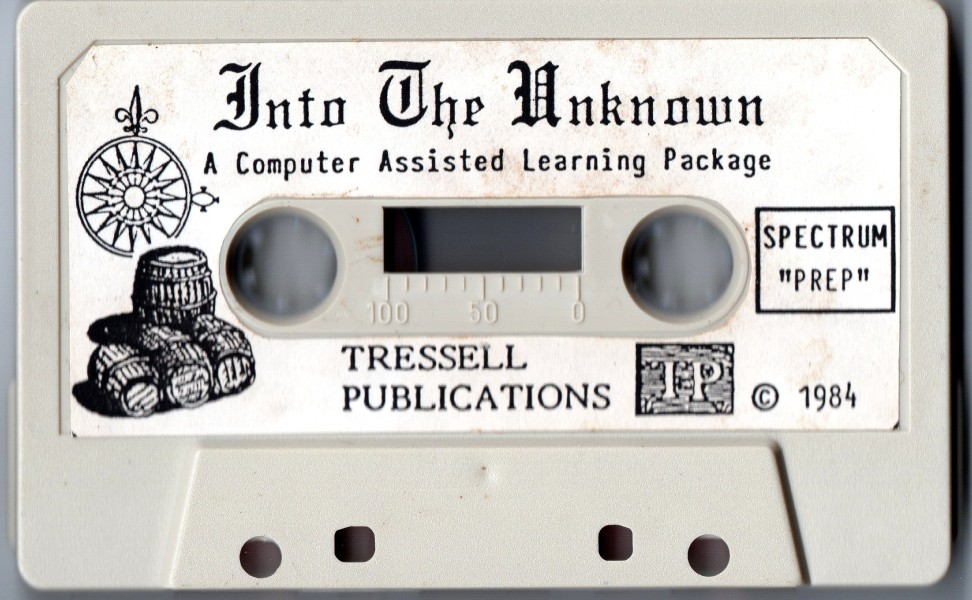
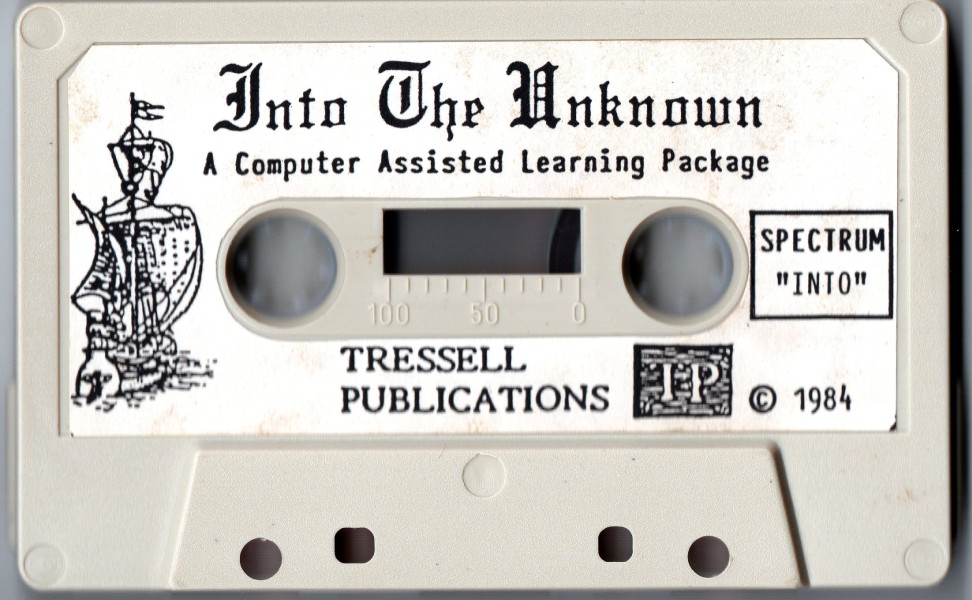
Game: Educational · ZX-Spectrum 48K · 1 players · English
Tressel Publications · 1984 · Pound sterling 22.56
Discussion
Nobody has started a thread about this yet.
Play
- IntoTheUnknown.tzx.zipTape image English15 KB
- IntoTheUnknown(EN)(2).tzx.zipTape image English10 KB
Files and rights
No permission is on record either way. Screens and pictures are copied here on a take-down basis: if you hold the rights and want something removed, say so and it goes.
Scores
In the magazines
- Personal Computer News #801984 · Overall Value5/5
In the magazines 1
Personal Computer News #80Sep 1984 · p.484/55/54/55/55/5
Features 4/5
Documentation 5/5
Performance 4/5
Overall Value 5/5
Mike Gerrard 5/5
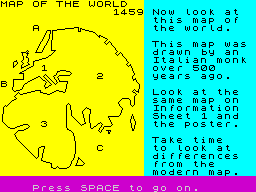
VINTAGE VOYAGE The best educational software comes from the educationalists. So says Mike Gerrard, who voyaged into the Unknown. NAME: Into the Unknown SYSTEM: 48K Spectrum PRICE: £22.56 PUBLISHER: Tressell Publications [redacted] FORMAT: Cassette LANGUAGE: Basic OTHER VERSIONS: BBC, Commodore 64 (disk versions available) OUTLETS: Mail order (£2 postage) You don't have to be Longman, Penguin or Macmillan to produce excellent educational software, as 'Tressell Publications' Into The Unknown proves. The package pulls its weight to set standards of excellence - which were sadly lacking before computer assisted learning fell into the hands of educational publishers, where it belongs. Tressell already produces worksheets on historical subjects for schools: now they've produced a computer simulation of a 15th century voyage of discovery. DOCUMENTATION The package comes in an A4-size plastic wallet containing a handbook for teachers or parents, 12 information sheets covering different aspects of the voyage, and 20 blank exploration charts -for a small class or a very large family. GETTING STARTED With such a wealth of background material at hand it might seem daunting, but in fact you could simply load the program straight off. Side one of the cassette contains the Preparations program, covering five topics (The Unknown, Travellers Tales, The Ship, Supplies and Navigation). At this stage you could get by without looking at the other material, but it's more interesting to go the whole hog. A little preparation before embarking on Side two into the Unknown is essential. IN USE Preparations allows you to run through any of the topics, each of which presents you with several screens of information, using text and graphics. At the end of each is a quiz in which you earn points for the voyage itself - a measure of how prepared you are before embarkation. The section on The Ship, for example, shows the construction of a typical ship of the time, labelling the types of sail and so on, informing you that your ship for the voyage is a Caravel. You then answer ten questions on what you have just learned. At this point you might want to refer to the several wall posters, including a map of the known world in the 15th century. To head out on your voyage into the Unknown, you need one of the blank grid sheets, 25 x 33 in size, and you can start on any square from A1 to H1. When you input the grid reference, the computer tells you what is in that square, then you input an adjacent square to move into. Instructions are given on how to fill in the grid to record the progress of the journey, the discoveries you make and the hazards encountered. The program makes amusing use of graphics. Your vessel is Portuguese, and if you find yourself near a Spanish island you're bombarded by a cannon, while in another square you might be confronted with a body: 'Burial at sea: A crew member has died of scurvy, yellow fever, or malaria. It is your duty to bury him without delay.' Elsewhere you might get chased by a Spanish ship, or discover an island and claim it for your country, earning yourself points towards your final total. For parents or teachers there is a master chart that shows which squares bring storms, islands, Spanish ships, shipwrecks: 19 likely items in all, including many randomly scattered about the map. When the armchair voyagers reach a coastline, they must plot it on their map, then perhaps try to follow the coast to discover a harbour or landing place. Plotting the coastline reveals where it is that they are exploring, but without the master chart the simulation really is like a voyage of discovery as you do not know what will be over the horizon in the next square. If you find yourself crossing a desert, you must decide whether to continue or to return to the safety of your ship and sail on. What is unfortunate is that many squares are necessarily marked just 'open sea.' Since nothing happens in these, the graphics routine to depict them should be one of the briefest, but it is, in fact, lengthy, and involves your ship sailing from one side of the screen to the other, followed by a seagull fluttering about for a few seconds. The graphics are not spectacular by games standards, but they're reasonably well done, mostly animated, and the use of sound adds to the interest. For many activities - dealing with diseases, trading with natives and so on - you're referred to the information sheets: all in all, this is a comprehensive package. VERDICT This is how a micro should be used as an educational aid, and the mass of background material adds to the authentic feel of the voyage. Though expensive by home software standards, Into The Unknown is a more worthwhile investment than three or four below-average pieces of so-called educational software.
Related
- Ports
- (BBC Micro), (Commodore 64)
- Same entry at
- Spectrum ComputingZXInfo
Reviews from people here
Sign in to write about this, or make an account. It takes a minute and lets you correct the catalogue too.
No credit, description, tag recorded.
Sign in to correct or add to this.
Hold the rights to this and want it taken down?