Yankee
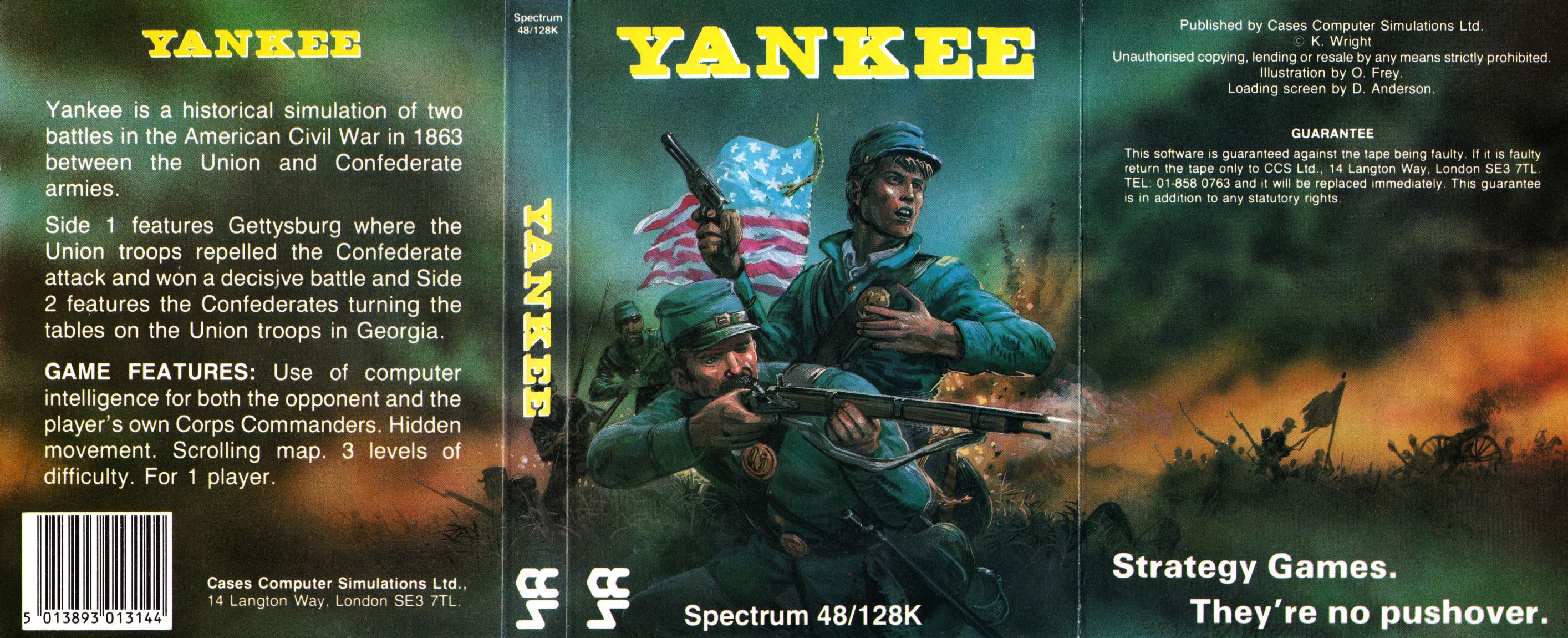
Compilation · ZX-Spectrum 48K · 1 players · English
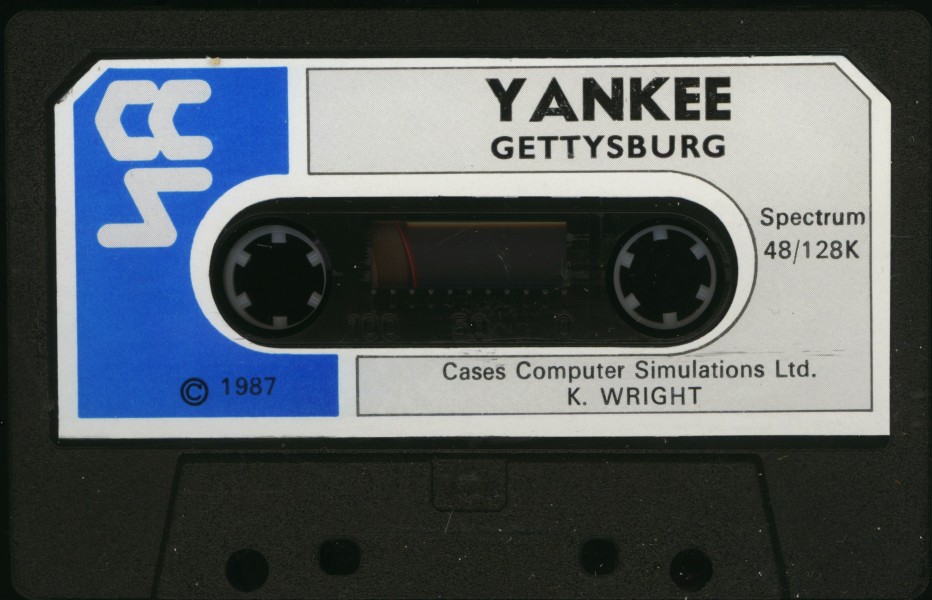
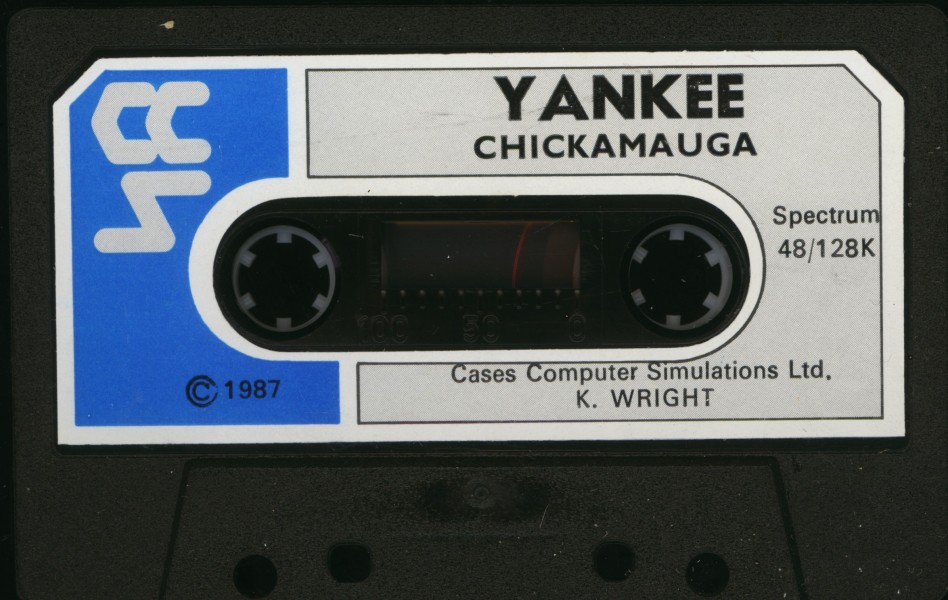
CCS · 1987 · Pound sterling 9.95
Discussion
Nobody has started a thread about this yet.
Play
- Yankee.tzx.zipTape image English49 KB
Documents
- Yankee.pdfInstructions English370 KB
- Yankee(EN).pdfInstructions English867 KB
Files and rights
Distribution permission is on record, granted to another archive rather than to this one. Screens and pictures are copied here; everything else links to the archive that holds it.
- AllowedCCS → WorldOfSpectrum
Credits
- Ken Wrightcredited
- Oliver FreyInlay/Poster Art
Sign in to credit somebody, or say what these people did.
Scores
In the magazines
- Sinclair User #631987 · Overall4/5
- Your Sinclair #191987 · Overall6/10
- Crash #421987 · Overall87%
- ACE (Advanced Computer Entertainment) #31987 · Ace Rating895/1000
Elsewhere on the web
- WorldOfSpectrum 4 votes7.50
In the magazines 12
ACE (Advanced Computer Entertainment) #3Dec 1987 · p.905/76/74/74/7895/1000895/1000
ACE (Advanced Computer Entertainment)
Opposition 5/7
Display 6/7
Ease Of Use 4/7
Game Depth 4/7
Ace Rating 895/1000
Andy Smith 895/1000
Spectrum, £9.95cs This single player wargame set during the American Civil War of the 1860s comes with two scenarios taken from the war. The first and most famous is the battle of Gettysburg where the Union troops repelled the Confederate attack and won a decisive victory. The second scenario features the battle at Chickamauga (Georgia) where the Confederates managed to defeat the Union troops after a long and bloody battle. The sequence of play involves the player issuing orders either to individual units or to the Corps Commanders, who can, if you desire, act on their own initiative. A very well designed screen display makes for an enjoyable game that is also a testing challenge.
C&VG (Computer & Video Games) #70Aug 1987 · p.585/104/102/104/10
Graphics 5/10
Playability 4/10
Realism 2/10
Value 4/10
Steve Badsey
MACHINES: Spectrum SUPPLIER: CCS PRICE: £9.95 Yankee is a grand tactical game for one player set in the American Civil War and offering two optionsthe player may either take the Union side at Gettysburg or the Confederates' at Chickamauga. This is the fourth game produced on essentially the same system by Ken Wright, who has previously used it for his Waterloo, Austerlitz and Napoleon at War. Overall, Yankee is the best of these four games. Sadly, it is still not very good. The thinking behind the games-playing program is in itself a sensible one. The author argues that an Army commander should have little direct control over formations below him in 19th-century warfare. Instead he issues generalised directions to his Corps commanders. The computer makes these commanders "intelligent" so that they will query their orders, offer suggestions which from a better viewpoint they consider more likely to succeed, and can even be given full control of their forces when in the presence of the enemy, to act as they think fit. All this sounds marvellous. Unfortunately, the program is in no respect powerful or sophisticated enough to make this system work. In a single testing game I saw the following all happen: a Corps ordered to attack an enemy of its own strength send forward a single division (a third of its strength) to be massacred while the rest just shuffled around; a Corps commander ordered to hold requesting permission to retreat, and when this was granted attacked with half his force while the rest moved sideways; a Corps ordered to attack query its orders and say that instead it wanted to attack (?!), and a Corps ordered to advance north-east promptly set off south-west. The combat mechanism also remains very crude - units simply hack chunks off each other in units of 500 men, with no attempt to advance, retreat or respond to what is happening to them. The very large random factors which made the earlier games so confused have been reduced, making it at least possible to judge an attack properly. But the combat mechanism still favours the attack very much over the defence, particularly as, if attacked, the computer opponent tends to draw into a defensive huddle which is easily outflanked or by-passed. All this makes Gettysburgh, particularly at the hardest of the three levels of difficulty offered, virtually unwinnable, and Chickamauga virtually unlosable.
THE WARRIOR RT Smith is generally held to be the best British computer wargames programmer around. He's the man responsible for Arnhem, Desert Rats and now Vulcan. But who is the mysterious RT Smith? C+VG's Man of War Steve Badsey yomped his way down to deepest, darkest Surrey to confront this unknown warrior. Advance and be recognised, he ordered. The rest, as they say, is history. Wherever serious wargamers gather and discuss computers, the name of R.T. Smith is mentioned with respect and admiration. The author of Arnhem, of Desert Rats, and now of his latest offering, Vulcan - covering the Tunisian campaign in the Second World War is perhaps the only British computer wargame designer whose work can be compared with the best American and Australian games. The "common sense" command and control system which is the distinctive feature of his work enables the player to concentrate on a winning strategy, rather than fussing over game mechanisms, and his judgement in modelling historical probabilities is second to none. All of this made me rather apprehensive when I asked to meet R. T. Smith. He clearly knew too much about history, and about wargaming, to be just one of the mathematically brilliant writers in their teens who provide the bulk of computer games. So who was I going to meet? Was he perhaps an elderly civil servant with a lifelong interest in military history who had taken to computers late in life? Or did those initials hide a beautiful young lady with a rare interest in warfare? Perhaps I would simply be confronted with the sort of person who knew everything about everything, and in his spare time wrote games like Vulcan for fun. As it happened, I needn't have worried. Bob Smith turned out to be a polite, impeccably mannered 23-year-old living quietly in a Surrey village. Bob learned about computers first at school, with the old mainframe language Fortran using punched cards to input the data. He taught himself BASIC while still at school, and his parents bought him a Spectrum for Christmas. Meanwhile, he got interested in wargaming in the Ancient period, using the almost universal Wargames Research Group rules. Yes - in answer to my question - he read campaign histories before writing his wargame programs, but more important was that early knowledge of conventional figure wargaming. Having grown up with wargames and computers, he knows if his program "feels right" in recreating history. Bob's first game was written while he was still at school, and vanished more or less without trace. Called Confrontation, it was a twentieth century, battalion tactical level game which allowed the player to design his own scenario before playing. He wrote it for the Spectrum only and approached Lothlorien, who published it in their Warmaster series. He wrote a conversion for the BBC while at Birmingham University reading physics, and decided to become a full-time programmer. So began an attempt to write a two-player expanded version of Confrontation which was intended to be an arcade-style game. But, between the wargaming and reading A Bridge Too Far something happened, and the result was the solo game Arnhem, finished in 1984. Bob wasn't happy with Lothlorien by now, and so offered the game first to PSS, and then to CCS who accepted it. Arnhem proved a major popular success, reaching number 10 in the W.H. Smith best sellers, and remains one of my own favourite games. The five-scenario Arnhem was one of the best games of its year, and Bob was given an Amstrad to write a conversion for it. He agreed with me that he was missing out a large number of people, but the conversion to 64K for the Commodore and the Atari would involve a great deal of re-writing, and I get the feeling he doesn't like writing conversions much. His next game was Desert Rats, which took more than six months to write and appeared at Christmas 1985 in Spectrum, 128K Spectrum and Amstrad versions. The appeal of Desert Rats is that the advice given to all armoured commanders - press on as rapidly as possible, a punch protects itself - really works, except for those infuriating moments when your master plan grinds to a halt on empty petrol tanks. Desert Rats, as Bob put it to me, got much better reviews than Arnhem but didn't actually sell as well. I thought that the only thing which stopped it being perfect was that lack of aircraft, and the ability of an opponent to see all the forces all the time. Vulcan, which has both air power and hidden movement, appeared before Christmas and is probably the outstanding British computer wargame of the year. His next work will probably be the lively arcade game that he always meant to write. Going back to the days of figure wargaming, when he commanded armies of Selucids and the Macedonians of Alexander the Great, there is also the idea in the back of his head of a game covering ancient warfare, which has been surprisingly neglected by computer game designers. Vulcan, I remembered as I left, is in ancient mythology the Smith of the Gods!
Your Sinclair #19Jul 1987 · p.655/105/106/107/106/106/10
Graphics 5/10
Playability 5/10
Value For Money 6/10
Addictiveness 7/10
Overall 6/10
Peter Berlin 6/10
CCS £8.95 Reviewer: Peter Berlin I have to admit that my heart sank when I finally managed to get Gettysburg, one of he two battles that make Yankee, the new game from CCS, up on the screen. Not because it looks almost identical to Napoleon At Waterloo and Borodino, coincidentally by the same designer. And what's more, it plays exactly the same as these two too. I guess there's nothing really wrong with sticking to a system that works, but I'm not really sure that it's fair to ask someone to pay out another nine quid for a game that, to all intents and purposes, is identical to ones they may already own. Those unfamiliar with the two Napoleonic games will find this an enjoyable traditional wargame, but for those of you who are used to complicated hexagon based games, or to some of the recent games such as Arnhem, then Yankee is very basic. The game recreates two battles from the American Civil War - Gettysburg, where Lee's drive on Washington was held up by Union forces, and Chickamuga, where the Confederates halted, for a short while, the Yankee march on Atlanta. The forces are divided up into divisions, and these are represented on screen by little coloured squares, showing whether they're artillery, cavalry or infantry. The trick, as it has been for Generals throughout the ages, is to exploit the terrain and concentrate your forces for attack or defence. As such, the game accurately recreates the strategic considerations of command. On the other hand, the battles here feel no different from those in the wargames Borodino or Waterloo, even though, as the rules point out, warfare had changed completely in the intervening 60 years. Unfortunately, it's easy to imagine the same system being rehashed yet again for the English Civil War or Caesar's campaigns. It's a clean simple strategic game and I'd really have enjoyed playing it - if I hadn't played it a few times already in different guises!
Crash #42Jul 1987 · p.7290%91%89%85%87%70%87%87%
Presentation 90%
Rules 91%
Playability 89%
Authenticity 85%
Value For Money 87%
Graphics 70%
Overall 87%
Philippa Irving 87%
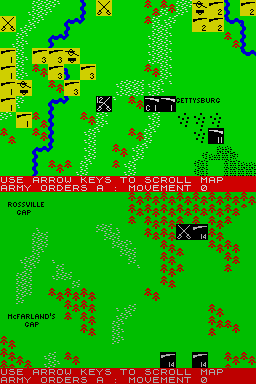
FRONTLINE With Philippa Irving FIGHTING ON TWO FRONTS I'm hanging over the precipice of exams, but I've found time to start writing the ZZAP! wargames section too (it's called MANOEUVRES). Even when the Commodore looked like it was going to outstrip the Spectrum, I bought a Spectrum because I preferred the software. On the, whole I still do, though there's been a decline recently in the overall content standard of software. There's a type of Spectrum software which is artistically superior to most things written and conceived for the Commodore. Or can be, or was. The Commodore is a superior machine, yet most innovative and exciting games were developed on the Spectrum. It's partly because the Spectrum was there first, and absorbed the first enthusiasm and creativity; and because the very limitations of the hardware impose restrictions on the programmer and force him to work harder at other, 'deeper' elements of the game. The Commodore is like a big budget for a glossy science-fiction film, and produces games like the Star Wars masterpieces. The programmer, free to spend millions on spectacular graphics and special effects, concentrates on making a surface impression. Star Wars satisfies on that level; it was fascinating to see REAL spaceships and space stations at last, just as fractal graphics are amazing to behold and thrilling to move around inside. But the Star Wars series has a simple, stylised plot which doesn't matter because the films are a vehicle for the effects; and this is the case with a lot of Commodore games. Eidolon is beautiful, but the game evaporates to the touch. The Spectrum is like a low budget for a TV series. Often it'll produce dry, tatty programs, but just as often the very lack of resources will inspire talented programmers to compensate and produce a game which satisfies the imagination. And a Spectrum game can have a visual restraint and artistry preferable to the Commodore look. Drab low-budget sets can build up a claustrophobic atmosphere on TV; the monochromatic wash of classic 3-D games like Alien 8 and the elegant pencil-drawing animation of the Dun Darach games pleases me more than flying sprites and multicoloured explosions. Despite the inevitable tackiness when the Spectrum programmers try to pretend it's an arcade machine, there can be spectacular moments of visual imagery. But this inventiveness, innovation and artistry have only given wargamers the Midnight games and R T Smith. And everything I've said refers to cassette-based games. Commodore disk-based games are in a different class, and I'd be glad to see some of the Spectrum spirit exercised on a larger database! YANKEE Producer: CCS Author: K Wright Price: £9.95 This historical simulation from the author of Napoleon At War is set in the American Civil War, and recreates the practical difficulties of the battlefield. Using much the same system as Napoleon At War, Yankee focuses on two battles, loaded as separate programs - Gettysburg and Chickamauga. The American Civil War is probably best known through Gone With The Wind and other popular romantic portrayals: as a war, fought over issues and principle. It's probably not alive in the British imagination. This detachment means a computer warp me based on the war could easily be reduced to an exercise without atmosphere - particularly when, by presenting small-scale battle simulations, the game gives no sense of the overall shape of the war. Yankee avoids this by taking a literal historical approach and backing itself up in the rules with detailed descriptions of the battles (I would have liked to see some general background as well). The Battle Of Gettysburg took place over four days in July 1863 and Chickamauga over two days in September. Unfortunately there's no two-player option, and the gamer must take the Union side in Gettysburg and the Confederate side in Chickamauga. (The program's artificial-intelligence routine extends to the player's units too, so I can't see why there's no choice of sides.) Landed with being General George Meade in Gettysburg, the player has command of six corps. The corps, of three divisions each, are under the command of generals with names like Sickle and Sedgwick. Corps command is central to Yankee, as it was to Napoleon At War. You can give separate orders to each division, but the game really works through the command unit; the other two units in the corps mimic its movement orders and throw themselves untidily into the fray. But it's difficult to predict where all three units are going to end up if one of the divisions gets bogged down in difficult terrain or collides with another unit. And when there are two or three corps trying to attack a block of enemy units they're unlikely to arrange themselves sensibly. This can be very frustrating - but war really was frustrating. The map isn't large - about three times the size of the TV display, the author claims - but it's clear and detailed, and fills the screen without the clutter of extraneous information. There are eight types of terrain, making up an interesting landscape which seems to be to the correct scale. It's easy to relate the size of the square 'counters' to the terrain features, which are helpfully illustrated in the rules. Terrain is important to the gameplay, and most features of the landscape give an advantage to the defender (in Gettysburg the best place to defend is a wooded hill). This increases the variety and sophistication of tactics enhances the realism and so helps generate that important and indefinable quality, atmosphere. There are only three types of troops available: infantry, cavalry and artillery. The cavalry can move faster than the infantry units, but don't seem to have a dramatic advantage in combat. This lack of variety is doubtless historically justified. Artillery units are not under the command of any corps leader and have to be moved independently; they're difficult to manoeuvre and fire, but the computer opponent is disturbingly adept at using them. They're also vulnerable to enemy attack and can be wiped out in a few turns. The game operates on a simple two-stage turn structure. You give orders at leisure via a series of option menus, and there's then an action phase in which the orders are executed and combat is resolved. Combat occurs automatically between adjacent enemy units, and as in Napoleon At War strength is (crudely) knocked off 500 men at a time. It's possible to work out how many strength points any unit will take into combat, from their numbers, which can be checked in the orders phase, and their morale, which gives bonuses in seven stages of cheerfulness from Excellent to Abysmal. But you can't be certain which square or terrain your units will end up fighting from, or whether they'll be defined by the computer as attacking or defending. This element of uncertainty is nicely judged, between chaotic randomness and boring certainty. The combat is shown unit by unit, and it lacks in impact - 500 men go to their deaths in unspectacular silence. Before the action phase starts, the player may get messages from the corps commanders in a touch of atmosphere-building (again, as in Napoleon At War). But soon the generals, whining for advice, become irritating and one's tempted to send them in against impossible odds just because they keep complaining about any odds at all! Enemy units are hidden from view till they come within reconnaissance distance of the player's units. I find hidden movement disconcerting and unreal, and Yankee made me realise why: when the enemy side moves, the program doesn't show the 'out of sight' units but still scrolls to where they are on the map - so you watch the map shifting meaningfully about in blankness. True, a real general wouldn't know where the enemy was, but he wouldn't have an omniscient view of the surrounding landscape either. The programming gaffe in Yankee underlines this. But on the whole hidden movement is used effectively here; the reconnaissance scope of the units is wide enough to make sure you don't end up planning attacks against invisible regiments. The rules are of a high standard, of content if not of presentation; the instructions explain them well, the two battles are described and set in context: and the designer gives an account of himself - which might make you more sympathetic to the game's Idiosyncrasies! Yankee has a deceptive complexity beneath a simple command structure and onscreen appearance. If you have sufficient self-control to restrict yourself to giving corps commands the game is very difficult - I was wiped out twice on the easiest level - but there is hope of improvement with practice. The play is perfectly paced, and the two scenarios are very different - Gettysburg is defensive and Chickamauga is offensive, for a start. Though you can't choose sides, which is a limitation, Yankee should have lastability. It's certainly one of the best battlescale simulations I've seen, and all wargamers - particularly those who like a traditional approach - should enjoy it.
Sinclair User #63Jun 1987 · p.984/54/5
Overall 4/5
Gary Rook 4/5
Label: CCS Author: In-house Price: £1.95 Memory: 48K/128K Reviewer: Gary Rook This is the latest title from CCS, which seems to have given up publishing anything except wargames. As a dedicated wargamer, that's fine by me. Yankee is two games in one - Gettysburg on Side A of the tape, Chickamauga on Side B. Both use the same game mechanics - the only differences are the map layouts and the names and strengths of the forces involved. The brace of engagements you can refight are both famous names from the American Civil War. At Gettysburg, the North smashed the South's last hopes of capturing Washington and getting a quick victory. Chickamauga was much the same, only the other way round - the Confederates wiped the floor with the Federals, and the war dragged on for a couple of years longer. In both battles you control the side that won historically, so you're the Union in Gettysburg and the Rebels in Chickamauga. The computer will play the other side - and it's a tough and very dangerous opponent. The maps are fairly attractive, if a bit garish to anyone who hates clashing wallpaper. The usual sort of standard wargames terrain features are marked on - towns, woods, hills, rough ground, rivers etc. The units are large squares, about four characters to a side. The Yankees are blue, the rebels are yellow (damn right!) and each counter has a silhouette showing what type of unit it is in black - the different sorts are infantry, cavalry and artillery. Also marked on the counters is the unit's corps designation - three or four counters make up a corps, and you can give orders to the whole lot by telling the corps headquarters unit, marked with a 'C', what to do. To give units orders, you move the cursor over them and choose what you want them to do from a menu. This menu varies according to the troop type and whether or not the unit you are ordering is in command of a corps or not. You can find out information about your units by moving the cursor over them and asking for details. You get told how many men they have and what their morale level is. If a unit's morale gets too low, then it will run away - not much use! Combat is simple: units which are adjacent to enemy counters attack and are attacked by them: the more men your unit has. and the better its morale is, the more enemy it will kill. Losses are taken in multiples of 500. Artillery can kill people at a distance. Both game variants work well and are challenging. The immediate feel you get, controlling the destiny of thousands of men, is one of absolute desperation - especially as the game uses hidden movement, so half the time you don't know where the enemy's units are until they come charging out of the nearest wood. You actually begin to sweat wondering just where the computer's forces are. While the movement system is a bit of a bore at times, and takes quite a while, combat is quick and bloody which makes up for it. An exciting touch is the way your corps commanders will send you messages mostly to tell you they can't hold out much longer and can they retreat? They effectively say 'to hell with this for a game of soldiers, I'm off home' if you don't look after them properly - it happened to me a lot. Great fun, and even educational (sorry about that) CCS is to be applauded for this one - even if the computer did chop me up into very fine pieces and fricassee the results. I will be back into the fray - once I recover from the last one.
Feature2
- Crash #47Dec 1987 · p.48
- ACE (Advanced Computer Entertainment) #3Dec 1987 · p.85
Advert2
- Sinclair User #63Jun 1987 · p.7
- Crash #40May 1987 · p.103
News/Note2
- Popular Computing Weekly #18May 1987 · p.53
- Sinclair User #60Mar 1987 · p.20
CompoEntry1
- Your Sinclair #19Jul 1987 · p.65
Contains
Related
- Elsewhere
- UVL
- Same entry at
- Spectrum ComputingZXInfo
Reviews from people here
Sign in to write about this, or make an account. It takes a minute and lets you correct the catalogue too.
No description, tag recorded.
Sign in to correct or add to this.
Hold the rights to this and want it taken down?