
Zulu Wars
Strategy Game: War · ZX-Spectrum 48K · 1 players · English
CCS · 1987 · Pound sterling 8.95
Also known as Zulu War (English)


Discussion
Nobody has started a thread about this yet.
Remarks
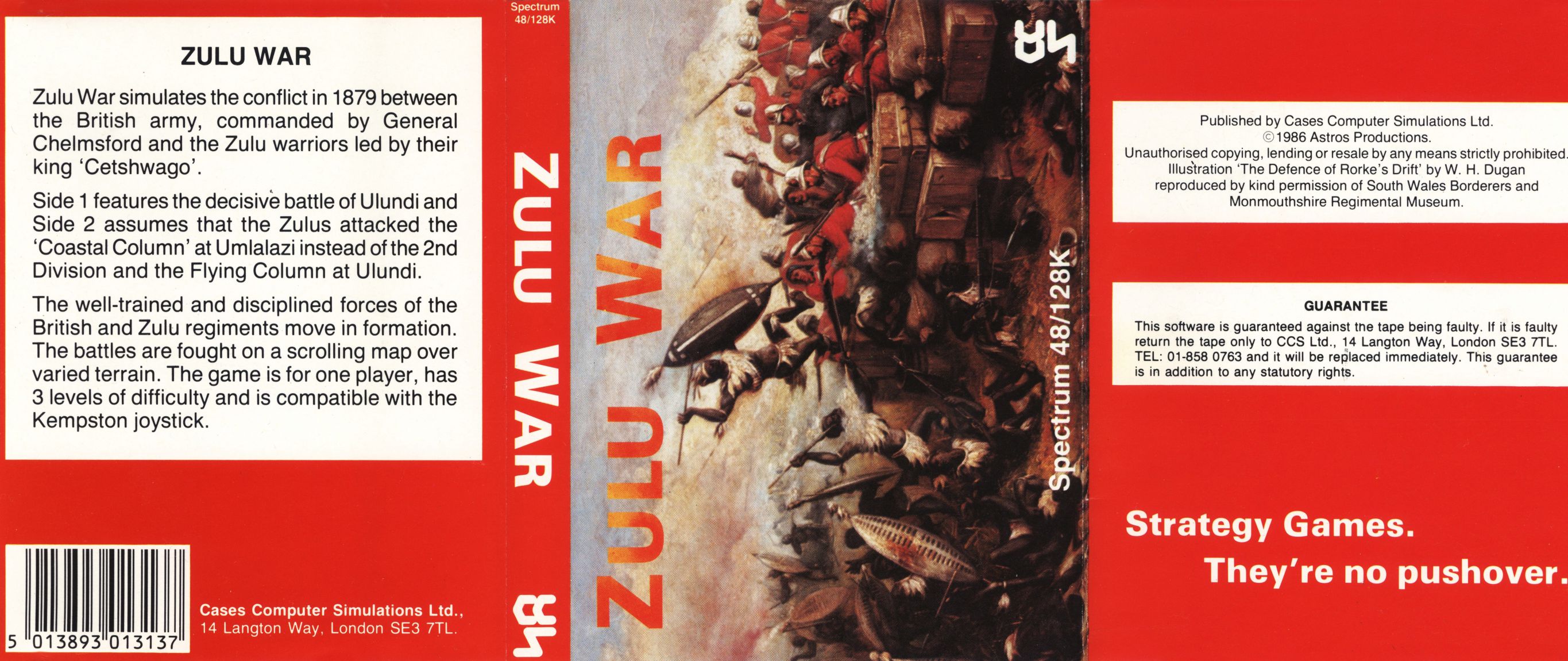
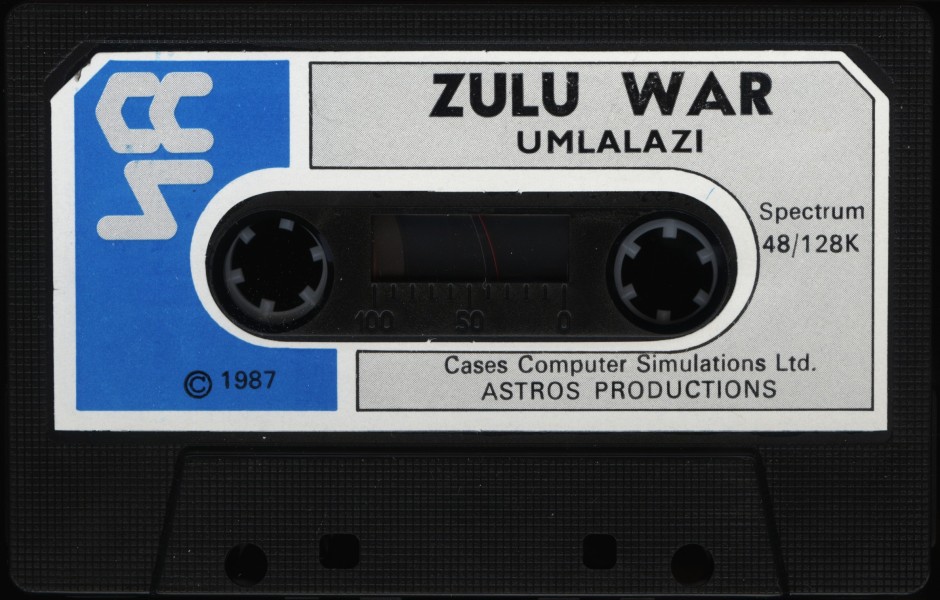
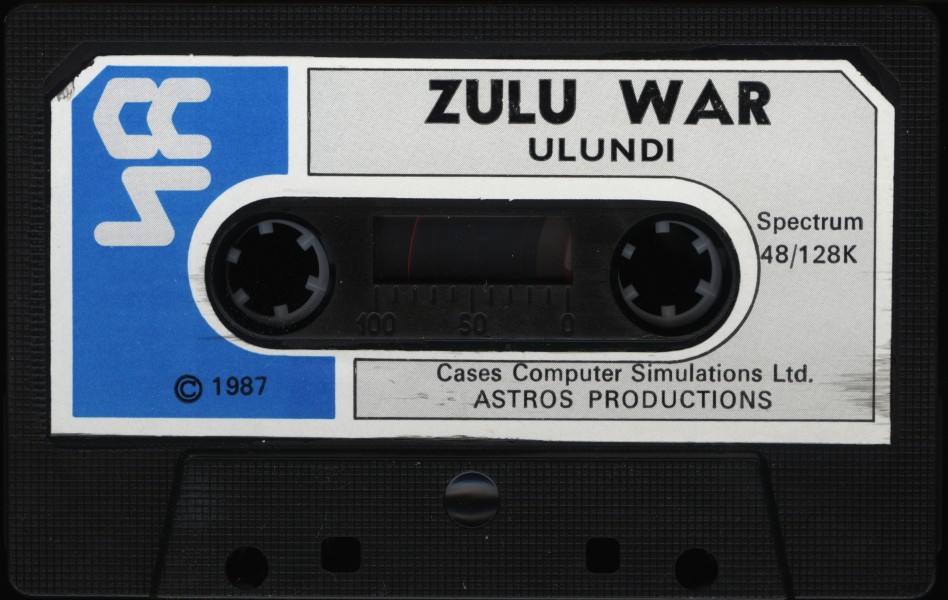
Came in two parts: Ulundi and Umlalazi
A 128K version was also planned.
Play
- zuluwars.rzxRZX playback file
- ZuluWars.tzx.zipTape image English40 KB
- ZuluWarsPart1-Ulundi.tap.zipTape image English23 KB
- ZuluWarsPart2-Umlalazi.tap.zipTape image English23 KB
Documents
- ZuluWars(EN).pdfInstructions English416 KB
Files and rights
Distribution permission is on record, granted to another archive rather than to this one. Screens and pictures are copied here; everything else links to the archive that holds it.
- AllowedCCS → WorldOfSpectrum
Credits
- Peter Karbouloniscredited
- George Karbouloniscredited
- I.W.A.credited
- William Henry DuganInlay/Poster Art
Sign in to credit somebody, or say what these people did.
Awards
Scores
In the magazines
- Sinclair User #621987 · Overall3/5
- Your Sinclair #181987 · Overall7/10
- ZX Computing #381987 · OverallGreat
- Crash #411987 · Overall61%
Elsewhere on the web
- WorldOfSpectrum 68 votes8.16
In the magazines 11
C&VG (Computer & Video Games) #70Aug 1987 · p.576/108/105/106/10
Graphics 6/10
Playability 8/10
Realism 5/10
Value 6/10
Steve Badsey
MACHINES: Spectrum SUPPLIER: CCS PRICE: £9.95 Zulu War, for the Spectrum only, is a single-player tactical level game against the computer. This is itself a pity. The real Zulu War of 1879, like all the 19-century colonial wars, was a struggle between a small regular force with little local knowledge and manoeuvrability, but devastating firepower, that could virtually guarantee a win a major set-piece battle, and a large number of highly mobile native forces, with less firepower but far greater hand-to-hand fighting ability, that could inflict a major defeat on any unprepared or divided force. A far more interesting game could be made of the Zulu War by a two-player strategic program, with plenty of scope for hidden movement. This game offers two scenarios - the final battle of Ulundi, in which the power of the Zulu was broken, and a hypothetical battle against the British second column, which was never seriously attacked, taking place at Umlalazi. That the game needs a fictitious battle shows just how difficult the writers found selecting a battle in which the Zulu have a chance. In the real battles the British stood shoulder-to-shoulder behind temporary defences of carts and mealie-bags. With their new longer-range breech-loading Martini-Henry rifles they were able to devastate the Zulu rushes before they ever closed to contact. Only at Isandhlwana, where the British were surprised with half their forces elsewhere, deployed with too wide a gap between units, and failed to keep up the ammunition supply, did the Zulu break through to contact. At Ulundi, with many Zulu already dead from the earlier battles, the British deliberately chose not to fight from behind defences, but formed a hollow square of infantry with cavalry inside it, and blasted any Zulu coming near before unleashing the cavalry for a final charge. I tried these tactics in the game's Ulundi scenario and was massacred. The game allows the British rifles such a limited range that they got only one volley before the far faster Zulu are upon them, and in hand-to-hand they stand little chance. The game shows the British forces as square blocks, at first five figures by five, then shrinking to four by four and so down. This works very well, producing gaps in formations and forcing the British to close towards the centre each time. But the only way to even survive the Zulu rush is take up cover behind walls in a nearby abandoned village. The Zulu advance apparently at random, but in such a way that they maintain a broad general direction towards the enemy. So, this is probably the wrong game to play for the Zulu War, and even as a representation of Zulu War tactics it isn't good. But the game mechanism is a wonderful one for showing a disciplined army, used to fighting in formation, against an irregular force of higher mobility. CCS have here the basis of a really excellent series of games set in the ancient period, with say Romans against Ancient Britons or Alexander the Great against the Persians. The ability of the irregular force to create gaps in the regular lines and infiltrate through them is offset by the higher regular firepower and stability with heavy losses.
Zulu War.
THE WARRIOR RT Smith is generally held to be the best British computer wargames programmer around. He's the man responsible for Arnhem, Desert Rats and now Vulcan. But who is the mysterious RT Smith? C+VG's Man of War Steve Badsey yomped his way down to deepest, darkest Surrey to confront this unknown warrior. Advance and be recognised, he ordered. The rest, as they say, is history. Wherever serious wargamers gather and discuss computers, the name of R.T. Smith is mentioned with respect and admiration. The author of Arnhem, of Desert Rats, and now of his latest offering, Vulcan - covering the Tunisian campaign in the Second World War is perhaps the only British computer wargame designer whose work can be compared with the best American and Australian games. The "common sense" command and control system which is the distinctive feature of his work enables the player to concentrate on a winning strategy, rather than fussing over game mechanisms, and his judgement in modelling historical probabilities is second to none. All of this made me rather apprehensive when I asked to meet R. T. Smith. He clearly knew too much about history, and about wargaming, to be just one of the mathematically brilliant writers in their teens who provide the bulk of computer games. So who was I going to meet? Was he perhaps an elderly civil servant with a lifelong interest in military history who had taken to computers late in life? Or did those initials hide a beautiful young lady with a rare interest in warfare? Perhaps I would simply be confronted with the sort of person who knew everything about everything, and in his spare time wrote games like Vulcan for fun. As it happened, I needn't have worried. Bob Smith turned out to be a polite, impeccably mannered 23-year-old living quietly in a Surrey village. Bob learned about computers first at school, with the old mainframe language Fortran using punched cards to input the data. He taught himself BASIC while still at school, and his parents bought him a Spectrum for Christmas. Meanwhile, he got interested in wargaming in the Ancient period, using the almost universal Wargames Research Group rules. Yes - in answer to my question - he read campaign histories before writing his wargame programs, but more important was that early knowledge of conventional figure wargaming. Having grown up with wargames and computers, he knows if his program "feels right" in recreating history. Bob's first game was written while he was still at school, and vanished more or less without trace. Called Confrontation, it was a twentieth century, battalion tactical level game which allowed the player to design his own scenario before playing. He wrote it for the Spectrum only and approached Lothlorien, who published it in their Warmaster series. He wrote a conversion for the BBC while at Birmingham University reading physics, and decided to become a full-time programmer. So began an attempt to write a two-player expanded version of Confrontation which was intended to be an arcade-style game. But, between the wargaming and reading A Bridge Too Far something happened, and the result was the solo game Arnhem, finished in 1984. Bob wasn't happy with Lothlorien by now, and so offered the game first to PSS, and then to CCS who accepted it. Arnhem proved a major popular success, reaching number 10 in the W.H. Smith best sellers, and remains one of my own favourite games. The five-scenario Arnhem was one of the best games of its year, and Bob was given an Amstrad to write a conversion for it. He agreed with me that he was missing out a large number of people, but the conversion to 64K for the Commodore and the Atari would involve a great deal of re-writing, and I get the feeling he doesn't like writing conversions much. His next game was Desert Rats, which took more than six months to write and appeared at Christmas 1985 in Spectrum, 128K Spectrum and Amstrad versions. The appeal of Desert Rats is that the advice given to all armoured commanders - press on as rapidly as possible, a punch protects itself - really works, except for those infuriating moments when your master plan grinds to a halt on empty petrol tanks. Desert Rats, as Bob put it to me, got much better reviews than Arnhem but didn't actually sell as well. I thought that the only thing which stopped it being perfect was that lack of aircraft, and the ability of an opponent to see all the forces all the time. Vulcan, which has both air power and hidden movement, appeared before Christmas and is probably the outstanding British computer wargame of the year. His next work will probably be the lively arcade game that he always meant to write. Going back to the days of figure wargaming, when he commanded armies of Selucids and the Macedonians of Alexander the Great, there is also the idea in the back of his head of a game covering ancient warfare, which has been surprisingly neglected by computer game designers. Vulcan, I remembered as I left, is in ancient mythology the Smith of the Gods!
Your Sinclair #18Jun 1987 · p.397/107/107/108/107/107/10
Graphics 7/10
Playability 7/10
Value For Money 7/10
Addictiveness 8/10
Overall 7/10
Richard Blaine 7/10
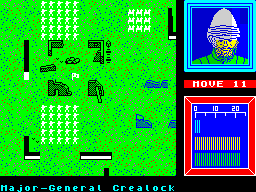
CCS £8.95 Reviewer: Richard Blaine If you've never played computer wargames before, this'd make a great game to start with - its easy to understand, the graphics are simple and colourful and it's an interesting subject. The game's set in the 1800s and the action takes place just after the gallant defence of Rourkes Drift by the Brits. It's a one player game, and you take the part of the commander of the British army, fighting against the computer-controlled Zulu hordes. Part of the attraction of this game is that it looks like one of those table top wargames. The troops of each side are shown on the map as if they were model figures, seen from above, and when they fire, little bullets streak out to hit the target (or not, depending on your aim). Giving your troops orders is dead easy. The computer goes through each of your units in turn and you can order them to move, or fire in a particular direction. If one of your units ends up next to some Zulus, you get a round of hand-to-hand combat. Your units are shown by a square of soldiers - five by five for the larger units, going down to one by one. As your men get injured the squares shrink, and when they get below one figure they're destroyed altogether. A status display to the right of the map window gives you information on the strength of each unit, how brave it is and how efficient it is. As the game goes on, and the situations change, these levels change too. Once you've slaughtered all the Zulus you can find, and won through to the Zulu capital, the game's over and you've won. That's really all there is to it - it's simple and zips along quite speedily. Not an easy game, but challenging and absorbing and definitely a good buy for the beginner.
ZX Computing #38Jun 1987 · p.57ZX Computing GlobellaGreat
ZX ComputingZX Computing Globella
Overall Great
THE BRITISH EMPIRE ATTEMPTS TO STRIKE BACK. CCS £8.95 In 1879 General Chelmsford, commanding the British forces in Africa decided that the only way to stop the disputes between the Boers and the Zulus was to take over their two countries and govern them. The resulting "police" action was one of the worst massacres in British history as the highly trained British troops gunned down the Zulu warriors. This latest wargame from CCS has biased the action in the Zulu favour to produce a challenging wargame with a difference. Two separate scenarios are included on either side of the game tape in which between 20,000 and 48,000 Zulus attack unprepared British regiments. The British begin both scenarios arranged in their rigid square formations that you must manoeuvre between the broken walls and trees that form this barren landscape. The size of a square that is made up from soldier icons indicates the size and strength of the regiment and range from the strongest 5x5 down to a single soldier, although even this represents 60 trained soldiers. The Zulus swarm at you in their famous horned beast formation with the main body supported by two flanking horns. This tramples the enemy under a wave of spears. Even though the figures are little more than UDGs which shuffle along at a snail's pace, they make a refreshing change from the usual wargaming symbols and remind me of my old figure wargaming days. The game itself is a fascinating clash between two totally different but well organised armies. The British have the advantage of fire power and can gun down the Zulus from a distance and have the formidable lancer and cavalry regiments. These key soldiers can not only shoot from a distance but can also break Zulu lines with charges and fight ferociously with their swords. The Zulus outnumber the British by thousands and use this advantage effectively as they attack in massive waves. They are faster than the armed British and are formidable hand-to-hand fighters. As British commander you'd better not let them get too close or you'll quickly lose troops and firepower and face an Alamo style defeat. Three levels of play ensure that there is a scenario that you can win, one where you just get beaten and one that's a total disaster. This forms a highly addictive formula that will drive you back for more.
Crash #41Jun 1987 · p.8839%70%72%70%65%59%66%61%61%
Presentation 39%
Rules 70%
Playability 72%
Authenticity 70%
Opponent 65%
Value 59%
Graphics 66%
Overall 61%
Philippa Irving 61%
FRONTLINE With Philippa Irving THE STATE OF THE ART Trinity term has arrived, and in the glorious spring weather the returning students are spreading themselves out on college lawns in a determined effort not to do any work. Meanwhile, those who have Finals in - ulp - seven weeks are contemplating the attractive properties of Magdalen Bridge as they finally realise that the last bit of work they did was to read half a Penguin introduction in their second term three years ago. Oxford rings to the gentle sound of Finalists plunging into the Isis and Japanese cameras clicking. One thing at least that won't be keeping me from my wonderful revision timetable (and I've got a new one now, I got fed up with the old one) is the pastime which distracted me constantly in my second year two years ago; playing the latest computer game releases. I may still load up an old one, but I know what my tried and tested favourites are like so the compulsive interest and urgency isn't there. Elite, Doomdark's Revenge, Uridium and others aren't going to go away and are there to play when I have more time. As for games like Marsport, Dun Darach and Heavy on the Magick, I've come close to solving these after many dedicated and absorbing hours of play. But in the last six months I haven't bought a single Spectrum game. I intend to get Starglider sooner or later, and I'll be buying The Professional Adventure Writer when I have enough money to spare, but two pieces of software in six months when I used to buy three a month isn't an impressive total. The reason is simple: almost nothing I've seen recently has interested me enough to part with my limited financial resources. It's hardly worth re-iterating what every Spectrum gamesplayer must be well aware of these days, that the amalgamation of smaller, innovative companies into big multi-nationals has resulted on a collapsing of standards from underneath. By that I mean that the programming of a game may be as excellent as a 48K machine with attribute blocks trying to look like a dedicated arcade machine can be, but the content - the game and the ideas underneath the on-screen appearance - has drained away. Someone, I suppose, must buy these film and TV licensed games. I presume, in fact, that they must be a really commercial concern for the producers or there would be no point in making them. Occasionally a media licence has resulted in a good game, but on the whole these types of product are being armed into marketing exercises. The cynicism of the big companies is appalling; they must know there's nothing artistically or intellectually satisfying about these pieces of software, but I should imagine that it they shift a reasonable number of units then such considerations are irrelevant. There were always naff games, but in the past one found honestly bad products like the classic among turkeys, The Great Space Race, and weedy platform games with improbable scenarios produced from someone's back bedroom. It used to be much more common, two years ago, for a game to fall down on presentation and programming rather than imaginative input. I am interested in computer games as self-justifying entertainment: works of art, if you use the word in a broad, unpretentious sense. Part of the art is entertaining the player - the plays of Shakespeare are judged not only on the beauty of their poetry but their ability to entertain an audience in the theatre - a part of it is the visual design and something of the quality of imagination in the coding itself. Starglider is a game with imaginative coding, and so were Elite and Knight Lore in their day. 'Elegance' is the word I would use to describe the aesthetic effect of programming like we see in Marsport and the Mike Singleton games. Unless a game is designed from the start with the Spectrum in mind, and with an idea which is going to be a computer game and not anything else, we will not see software with these qualities. Theoretically there should be nothing to stop designers taking a theme from a film or television programme and using it to build a computer scenario, but in practice this seems to paralyse the creative abilities. Wargames are the last bastion of the old-style bad games. I am unlikely ever to find myself reviewing a film license in Frontline, despite the popularity of warfilms recently. This would be a good thing if the standard of presentation and programming of wargames was higher! In the meantime, I ought to be grateful. My purse and leisure time (which ought to be revising time) are now freer than they used to be. ZULU WARS Producer: CCS Retail Price: £8.95 This latest game from CCS takes a little-exposed conflict between the British and the Zulu tribes towards the end of the nineteenth century for its scenario, which I can't help welcoming as a change from the endless re-enactments of the Second World War which, after four months of editing Frontline, are beginning to make me feel as if I'm trapped in a recurring time loop. On the other hand, there's little point in novelty for its own sake. Each game must stand on its own merits, independent of previous releases. Zulu Wars uses its scenario to work some interesting and novel elements into the gameplay, and with two separate programs, one on either side of the tape, it would seem to offer value for money too: but it's let down, as far too many wargames are, by shoddy unprofessional programming. There are two scenarios which must be loaded separately, and one - the easier, Umlalazi - is based on a battle which just might have happened, but didn't. Although I'm all for speculative wargaming, this suggests to me that the potential of the historical material is limited somewhat; particularly when it turns out that the start-up conditions of the battle on the first side of the tape have had to be tweaked considerably to give the Zulus any chance at all. Zulu Wars might be more accurately titled 'Variations on the Zulu Wars'! Still, it's an academic exercise anyway to believe that little boxes on a computer screen bear anything more than a numerical resemblance to what really happened on the battlefield, and although I'm strongly in favour of as much historical backing in the packaging as possible to assist this act of faith, an approximation is always inevitable. The leaflet that comes in the standard double cassette box describes the political situation in Africa which led up to the outbreak of the wars, and the specific conditions of each scenario, in a concise but adequate way. The Zulu Wars were caused by British imperialistic ambition in the twentieth century, or rather the curious British belief prevalent then that only they were competent to 'keep the peace' in Africa; on this occasion, between the Boers of The Transvaal and the Zulus of Zululand, which was recognised by Britain as a sovereign state. In 1879, the British moved into annexe Zululand and met a well-organised native army which, despite its strength and tactics, ended up as cannon-fodder to the technological might of the Empire. This outcome was entirely predictable and although, as I say, the balance has been un-historically redressed, this is still one of those wargames it's difficult to lose. For reasons which become apparent once play has started, and is for once excusable, there is no two-player option or choice of side. The player takes command of the British forces, under General Chelmsford in Ulundi and Major-General Crealock in Umlalazl, against the computer, which controls the Zulus. Play takes place on a small scale, the screen representing, in curiously distorted perspectives, individual buildings and foliage on the battlefield. The units themselves are shown not as traditional, symbolic boxes but as a matrix of little stick men which dwindle, rather alarmingly, as damage is incurred. In the first scenario the player has 13 blocks of stick men to march against the Zulus, and they're often difficult to manoeuvre through closely-placed obstacles, or indeed past each other. The clumsiness of the British movement is irritating only before it becomes apparent that it's part of the gameplay: historically, it represents the regimentation and rigid formation of the British troops, and in game terms it gives the Zulu forces an advantage to compensate for the player's superior firepower. The units have a fixed efficiency rating and a fluctuating morale rating, and a number of movement points based on their efficiency. When each unit is highlighted in turn by the computer the name of the regiment is displayed along with a bar-chart of these simple statistics, and reference to a list in the rules gives the exact number of men in it. This list, which even tells the curious what the regiment's present designation is, is the sort of helpful, easy-reference feature that I'm always glad to see in a rulebook. Three difficulty levels are offered, which simply determine how many hundreds and thousands of Zulus you get thrown at you. At Full Battle level the figure is 40,000 spear-waving warriors against 5,300 infantry and 900 cavalry! Once the difficulty level has been selected, the games start automatically; and so do the Impressions of tackiness and awkward programming. The player is treated to a demonstration of the appalling scrolling routine, which chums the map laboriously back and forth across the screen in the most incompetent and flickering way I've see on a recent game. But this is a wargame, not Uridium, and so, generously recognising this is trivial - a matter of aesthetics, really - the player might be annoyed to discover this ugly routine is the only way of viewing the map available. It cannot be scrolled under the player's control, only by a single keypress which gives a repetition of the guided tour. Movement and combat for the British is combined into the same phase, and the computer selects units in turn for attention. Fortunately, a selected unit can be passed until later. The units are all crowded together and getting in each other's way at the start of the scenario, so this system becomes laborious and fiddly, but also creates an atmosphere of inflexibility which no doubt reflects the battle tactics of the British forces at the time; and the system itself is quick enough to operate once you've got used to its idiosyncracies. All units can fire once in a round, and can engage in close combat as they come into contact with the enemy. As the game progresses, the physical size of the units diminish because of losses and this affects directly - in a visible way - how much damage they can do by firing into the Zulus. Gunfire is the player's most effective weapon against the Zulu hordes, because they have no guns themselves and so no way of retaliating in the same combat. Close combat can prove dangerous, although the British still have the advantage over the Zulus; the morale of a unit starts to decrease if they take more losses than their opponent, and the lower the moral, the more likely defeat becomes. Once movement and combat is completed to the player's satisfaction, the return can be ended and the Zulus begin to move. This is when it becomes obvious why the game is one-player only, with no choice of sides; the Zulu movement is radically different from the British. Instead of attacking in clumsy rectangles, they swarm individually onto the screen and around the British regiments like ants; they start in struggling waves but soon break up to envelope the player's units, one stick man at a time. This is the novel element of Zulu Wars, and it represents a fair attempt at figures wargaming on the computer in a limited, one-sided way. It would be difficult for a human player to move these large numbers of figures individually unless the overall standard of game design were very much better than this. But Zulu Wars has to be noted as one of the few games which makes use of the computer's abilities to do something a bit more imaginative than calculating damage. The British victory conditions are simply to kill all of the Zulus, and it is supposedly the Zulu's aim to kill the leader in each scenario. This is something they do not pursue, however, with any enthusiasm and the only threat to the British lies in the sheer numbers of the enemy. The Zulu pattern of attack is predictable and always identical - they come in from three sides of the map in an attempt to envelope the British, then move into surround each regiment - and, after a few attempts, I came to realise that there's little scope for variety of tactics. The battle formation of the troops is predetermined and there's too little space to move imaginatively, for within three moves of the start you're so overwhelmed by the Zulus that it's just a case of wearing them down. The programming is unacceptably inconsiderate in places - for instance, in the Zulu combat phase the program solemnly scrolls around to each British unit to decide whether it's under attack or not - and although it's never actually slow enough to make me reach for the plug, I am beginning to get depressed by the standard of some software turned out professionally packaged by respectable companies. A computer-literate friend hacked into Zulu Wars for me on the suspicion that it was in BASIC, and came out with the conclusion that it looked like it had been put through a BASIC compiler. It's playable enough, but has little depth and nowhere to go. The higher levels offer no extra complications, just more and more swarming Zulus to outlive. This game would have been more acceptable at a budget price.
Sinclair User #62May 1987 · p.893/53/5
Overall 3/5
Jack Daniel 3/5
Label: CCS Price: £9.95 Joystick: various Memory: 48K/128K Reviewer: Jack Daniel Stiffen those upper lips and cover those table legs* because here we have a simulation that goes back to the glorious days of the Great British Empire - Zulu Wars from CCS. As British commander General Chelmsford, you have to hold the lines against the massed hordes of uncivilised natives in an attempt to raise the imperial flag over this particular piece of Southern Africa. So with the order 'joysticks fixed lovely boys', away you go. And with natives to the North, South and East, things start out looking a bit grim. Your army is split up into regiments of footsoldiers, mounted infantry and cavalry (all dressed in brilliant red) which you manouevre via joystick or keyboard around a scrolling map, which shows one twelfth of the playing area. The Zulus are controlled by the computer (making this a one-player only game). They aren't into complex strategy - and instead seem to make a bee-line for wherever your commander seems to be positioned. Rather they have ferocity and weight of numbers on their side... yes, there are lots of them. There are three levels of difficulty, each with more assagi-wielding dervishes than the last, the final level making things look really desperate. Combat is by shooting (which the Zulus can't do) or close combat, at which they turn out to be much better. So pretty quickly you develop a strategy consisting of attempting to keep the massed hordes at rifle range without resorting to fisticuffs. Hardened veterans might find the system and the graphics a little too simplistic but it's not bad for beginners though. Or for warped personalities that want to recreate rush-hour Victoria Line experiences. *Victorians reckoned table legs - just like ladies legs - should be kept covered at all times. Those were wierd times...
Advert2
- Sinclair User #63Jun 1987 · p.7
- Crash #40May 1987 · p.103
CompoEntry1
- Your Sinclair #19Jul 1987 · p.65
Preview1
- Your Sinclair #17May 1987 · p.8
Review1
- Computer Gamer #26May 1987 · p.22
News/Note1
- Sinclair User #60Mar 1987 · p.20
Related
- Versions
- MCoder II (Authored with)
- Compilations
- ZX-Spectrum Vega
- Elsewhere
- Speccy Screenshot MapsMobyGamesRZX ArchiveThe TipshopUVLRZX Archive - YouTubeModern ZX-Retro Gaming
- Same entry at
- Spectrum ComputingZXInfo
Reviews from people here
Sign in to write about this, or make an account. It takes a minute and lets you correct the catalogue too.
Everything ZXDB can hold about this is here.
Sign in to correct or add to this.
Hold the rights to this and want it taken down?