
The Secret of Arendarvon Castle
Adventure Game: Text-Only · ZX-Spectrum 48K · 1 players · Dutch
Addison-Wesley [NL] · 1985
Also known as Het Mysterie van Arendarvon Castle (Dutch)
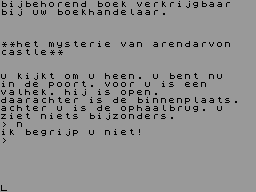
Arendarvon Castle, 1 of 2
(Addison-WesleyNL).png)
Discussion
Nobody has started a thread about this yet.
Remarks
The adventure that was published as type-in in the book {The Secret of Arendarvon Castle|Addison-Wesley Productions|2000321}, as well as sold as ready to use tape.
SPOT: book £5.95
Releases
- Unknownpublisher not recordedPound sterling 5.70
- 1985Addison-Wesley [NL] Sold as Het Mysterie van Arendarvon Castle
Play
Files and rights
No permission is on record either way. Screens and pictures are copied here on a take-down basis: if you hold the rights and want something removed, say so and it goes.
Credits
- Hal Renkocredited
- Sam Edwardscredited
- Arend Rensinkcredited
Sign in to credit somebody, or say what these people did.
Scores
In the magazines
- Crash #181985 · Overall Value7.5/10
Elsewhere on the web
- WorldOfSpectrum 1 votes4.00
In the magazines 3
Crash #18Jul 1985 · p.1028/106/109/107/107.5/107.5/10
Atmosphere 8/10
Vocabulary 6/10
Logic 9/10
Addictive Quality 7/10
Overall Value 7.5/10
Derek Brewster 7.5/10
DEREK BREWSTER'S ADVENTURE TRAIL A WALK IN THE PARK For some time now one aspect of adventuring has become ever more prominent in my mind as I've walked through a local park. This park has a river flowing through it, buildings of some interest, both genuine historical structures and more fanciful follies, alongside the traditional embellishments of a city park - layers of flowers of every hue lining sinuous pathways. What struck me on my stroll was the realisation that every device needed to fill an adventure lay not in a darkened room festooned with the latest bits of microcomputer hardware, but out there in the sunshine and sudden summer rain. Why not base an adventure on this very park? This got me thinking about adventuring and microcomputing and where it was all going. Why indeed had adventures come to be based upon myth, legend and fantasy when they could concern themselves with the real world and all its infinite variety and natural abundance. I noticed a little while ago an artist featured in Crash went to all the trouble of obtaining a real specimen before attempting to draw an ant. Rightly, the artist judged no better feel for the subject could be infused into his work than that derived from the real thing. So it is with novelists. Authors, even when they can't visit the real location which provides the backdrop to their book rely upon the most authentic second-hand accounts they can find, such as tourist guides, street maps and other novels, and by so doing, enrich the final draft. Adventures, until greater memory and perhaps finer resolution can produce more meaningful graphics, are closely related to the short novel and it is nothing short of amazing that no-one has attempted to write an adventure which deals with a real life structure or situation. Surely there is an area between frivolous amusement and erudite education where microcomputing can play a part in broadening our whole perception of where studying and work finish and leisure and relaxation begin? It seems only fair that microcomputers should cushion the bumps along the road of social upheaval which leads to the revolutionary world of computers and robots (remember them? They were all the rage on Afternoon Plus about two years ago when discussing the future seemed like a good idea). How about an adventure where the subject matter concerns itself with a real Scottish castle and a story which gives an authentic rendition of its history? Or perhaps it could traverse a real park (say Hyde Park in London, Central Park in New York or your local Jesmond Dene) whereby at the end of the adventure the player has not only enjoyed an entertaining game but has also picked up the rudiments of some tourist spot. Two games this month had me thinking even more about the possibilities. Although I do not know for certain, I think an Arendarvon Castle does not truly exist in NW Scotland, and when considering the layout of the submarine in Sub Sunk I find it hard to believe the author has consulted any reputable works on the subject of submarines or their internal design. It is hard to imagine indeed any author embarking on a novel concerning submarine warfare without first consulting the facts so freely available to anyone with the time and tenacity to unearth them. By and large, considering the high standard of published novels, most authors look on research as an essential prelude to writing itself. It is my hope that adventure authors will consider carefully their subject matter and what relevance it might have. ARENDARVON CASTLE Producer: Addison-Wesley Productions Company Retail Price: £5.95 (Book), £5.70 (Cassette) Language: Machine code Author: Hal Renko, Sam Edwards & Arend Rensink Playing adventure games can become quite monotonous at times when each has the same ingredients and, in some cases, the same problems. So it was with a certain especial relish I loaded up this game which promises something a little different from the rest. The point is this game is so different that for £5.95 you don't load it up - you type it in! It is a book (or just a book if you want to be derogatory about it). However, should the thought of typing machine code listings into your Spectrum fill you with horror, you can additionally buy a cassette with the programming already done for you. Hence we have a Micro-world Adventure for the ZX Spectrum from the book publishers Addison-Wesley with an International Standard Book Number. This game is a noble attempt to totally immerse the player in the world of Arendarvon Castle supposedly situated in the far NW of Scotland. You play the role of a journalist who has disappeared while investigating the strange past of the castle. At your disposal are the numerous newspaper cuttings and magazine articles detailing its mysterious past along with a guide which includes detailed pictures of both the inside and outside of the fortress. Set against the desolate, barren but wildly beautiful highlands the castle is at once imposing, impregnable and invincible. The rather substantial and crisply produced book contains a great deal to keep the player occupied for some time. A brief introduction leads you on into the journalist's article itself which tells of how the journalist, speaking aloud a timeless riddle, finds himself transported to the castle within a world of magic and wondrous happenings. A tall man dressed in a fantastic cloak and tall hat speaks to the journalist with a rich musical voice. It is Zazar the Great, most powerful of the ancient Order of Magicians. He relates how by uttering the riddle aloud the journalist has committed himself to a quest beyond his imagining. 'Your task is this,' he goes on, 'to retrieve the all-powerful cube of magic and the subtle spells associated with it'. The balance in equilibrium between the simple laws of Earth Science and the higher laws of alchemy can only be restored by regaining the cube of magic. A Guide to Arendarvon Castle follows detailing its history along with the pertinent facts concerning The Library, The Armoury. The Bedroom, The Great Hall, The Chapel and The Sitting-Room. Reading these sections is vital for your understanding of this game as within is much that will help you distinguish those areas most helpful to your quest. A whole section is devoted to James Douglas, a most celebrated sorcerer and instrumental alchemist, who once inhabited the castle and created the magic sign and alphabet where the letters themselves are a reservoir of The Force. The second part of the book concerns itself with playing the adventure and begins with a super summary of the difficulties crafting an adventure game can present, the chief one being communication. This project has chosen a sensible solution to the user-friendliness problem: it lists very precisely which words can be used and how and when they are most useful. A definitive list of 8 spells (eg Reveal, Charm, Disclose) is followed by the commands listed under subheadings such as Door-Handling Commands (Open, Close, Lock, Unlock, Strike) and Object-Handling Commands (Take, Drop, Give, Put, Strike, Use). Each of these words is given the full treatment in order to dispel! any remaining ambiguity. How about this description for TAKE. Syntax: Object-class, Effect: The object comes into your possession, on condition it is not too heavy for you to carry, if it is a fluid, you drink it; if the object can be worn you put it on, Examples: take sword, take the coat. This detail is shown for each and every word which can be used in this adventure and although it may seem at first long-winded proves in practice to add considerably to its playability. If you know anything of my views of adventuring you might guess that I most welcome this kind of detail. It releases the players from hours of tedious word-matching and gets them straight into the more enjoyable aspects of exploring the fantasy world before them. It is some indication of the thought put into this game when the authors have tackled the absurdity of being able to pick up objects of varying weights with the same ease. Here this problem is tackled by insisting on a considerable forfeit of strength whenever a heavy object is picked tip. On buying this book a far more pressing problem may surpass all others. The task of typing in the program is an onerous one but is made more bearable by splitting the workload up into 7 sections, one for each day of the week, and an error-check which is better then that for BASIC. But of course, if you feel flush enough to pay Addison-Wesley the additional £5.70 for the tape, you can enter the world of Arendarvon Castle immediately and in the normal way. Incidentally, although the book is sold on its own, the cassette is not; this is, after all, an attempt to involve the adventurer in the process as well as the game. But the radical approach of this game and its unrivalled documentation may just make the program inputting labours worthwhile as the game has a special flavour and atmosphere all of its own. Arendarvon Castle is only available direct from Addison-Wesley Publishers Limited, [redacted]. COMMENTS Difficulty: moderate Graphics: none Input facility: verb/noun Response: instant Special features: program typed in from hook (optional)
News/Note1
- ZX Computing #18Apr 1985 · p.95
Review1
- Home Computing Weekly #96Jan 1985 · p.42
Related
- Listed in
- The Secret of Arendarvon Castle
- Ports
- (BBC Micro), Mysterie van Arendarvon Castle, Het (Commodore 64)
- Same entry at
- Spectrum ComputingZXInfo
Reviews from people here
Sign in to write about this, or make an account. It takes a minute and lets you correct the catalogue too.
Everything ZXDB can hold about this is here.
Sign in to correct or add to this.
Hold the rights to this and want it taken down?