AGF Protocol 4
Hardware: Joystick
AGF Hardware · 1985 · Pound sterling 30.95
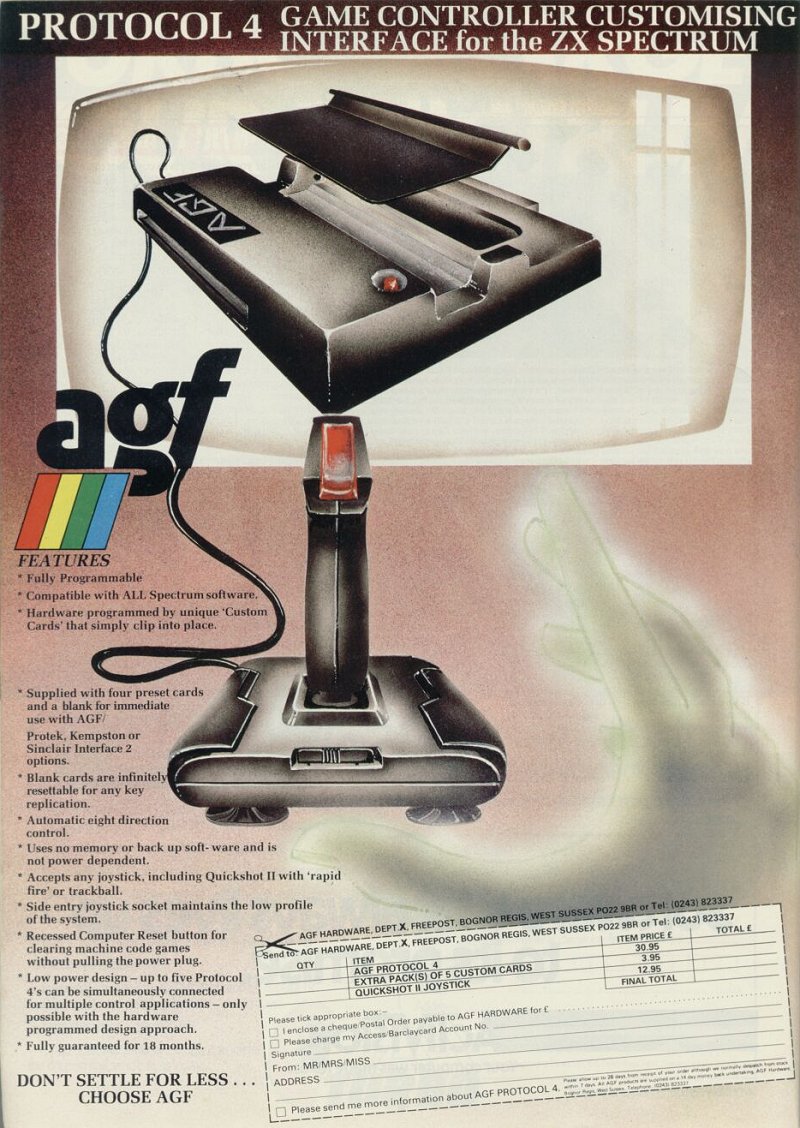
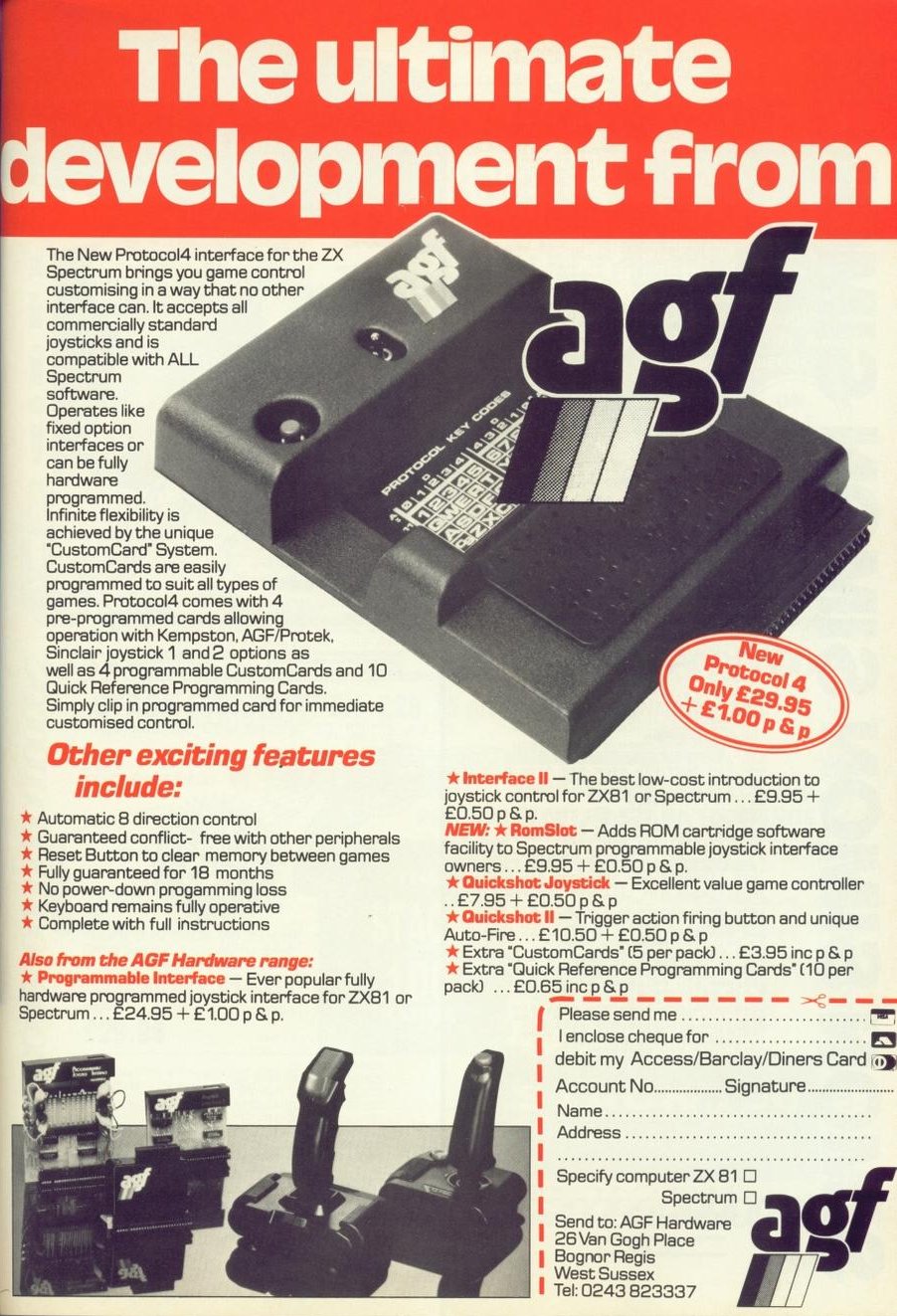
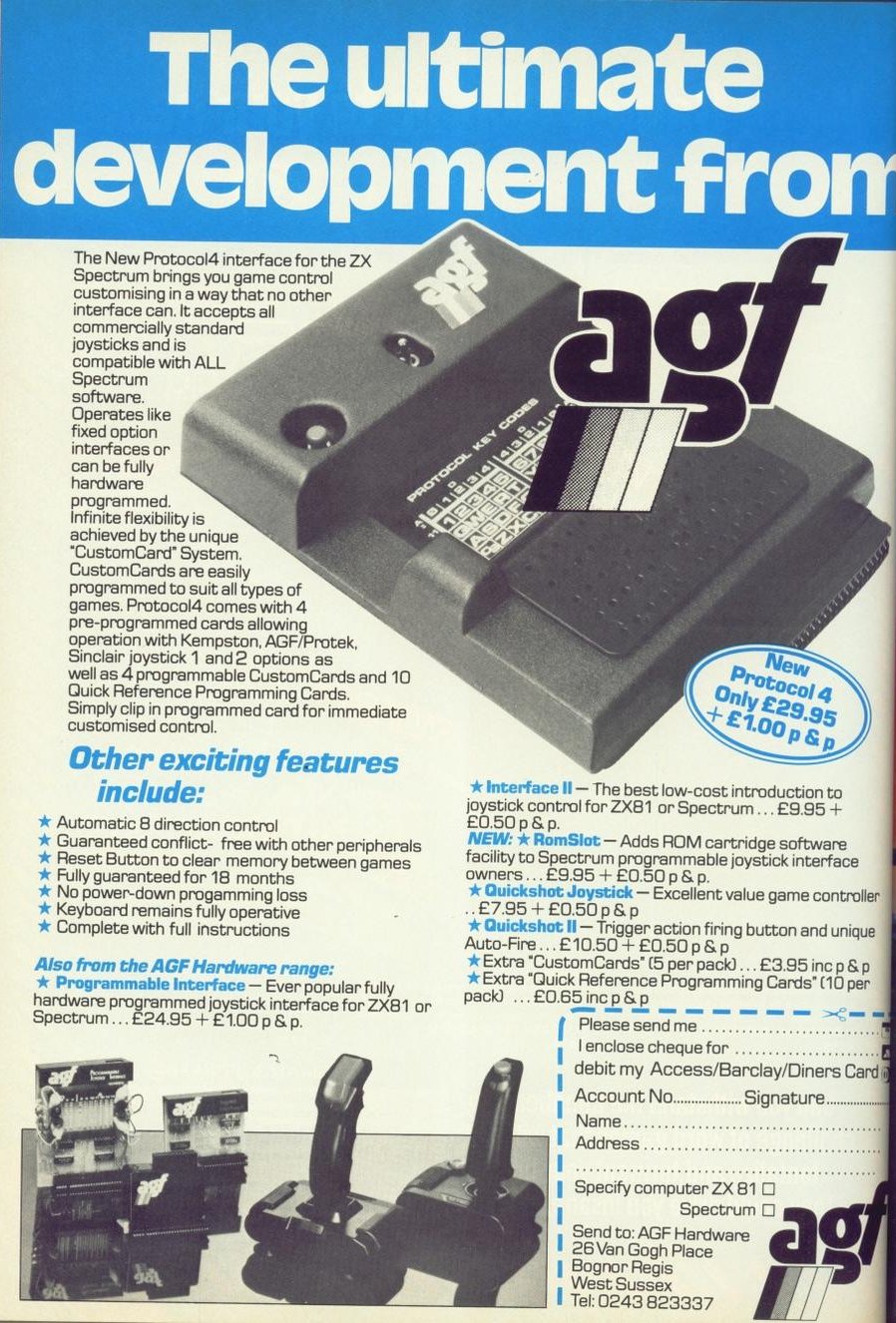
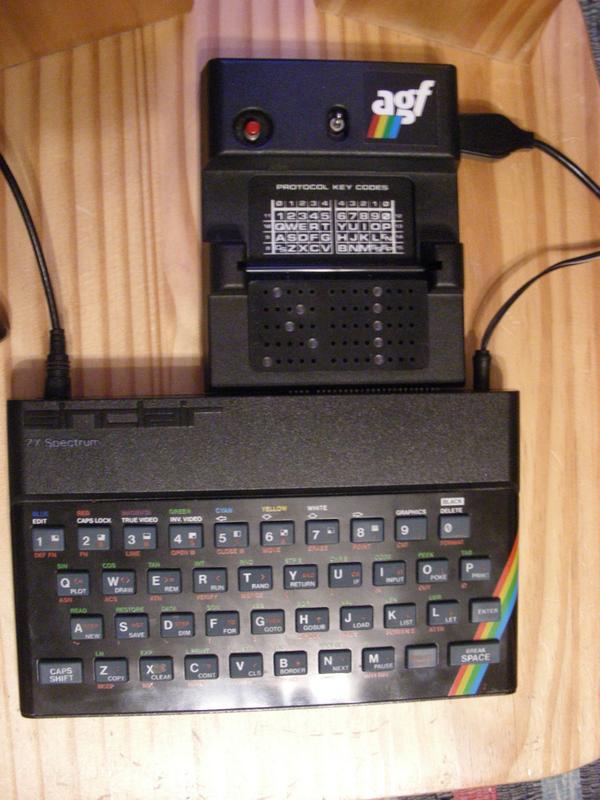
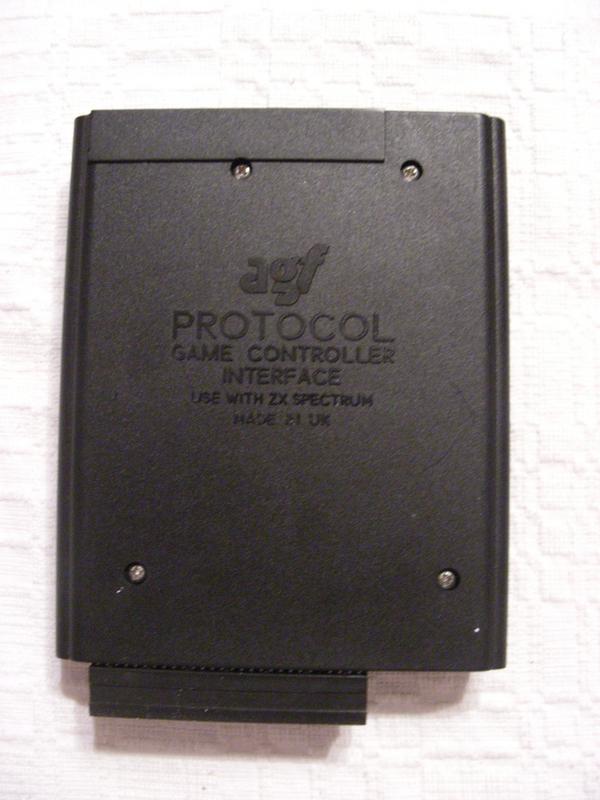
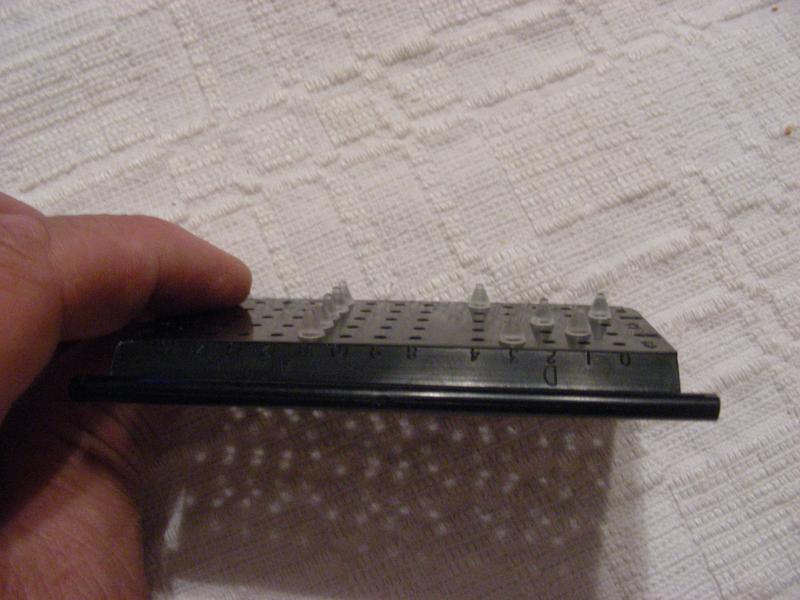
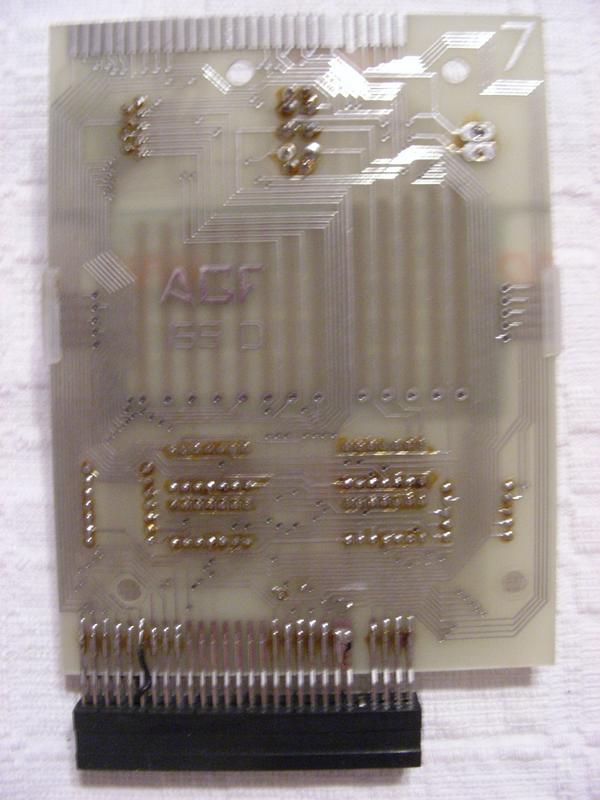
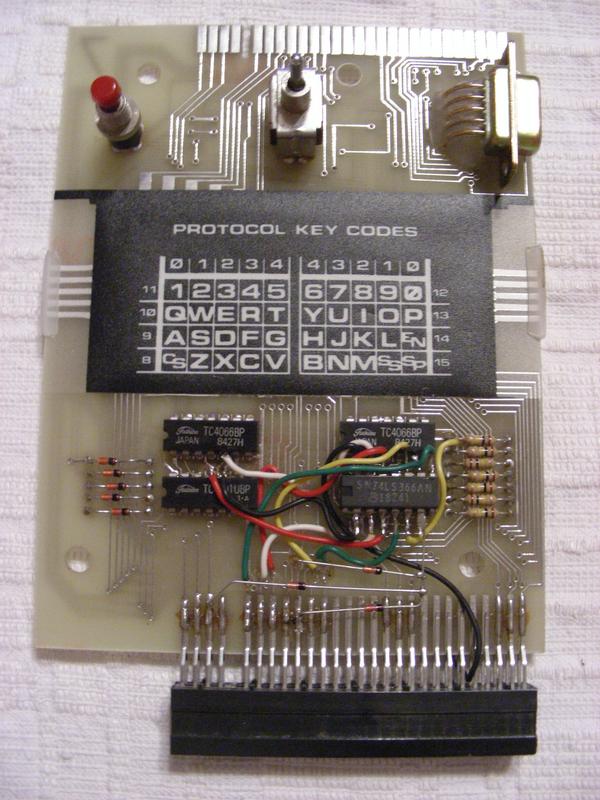
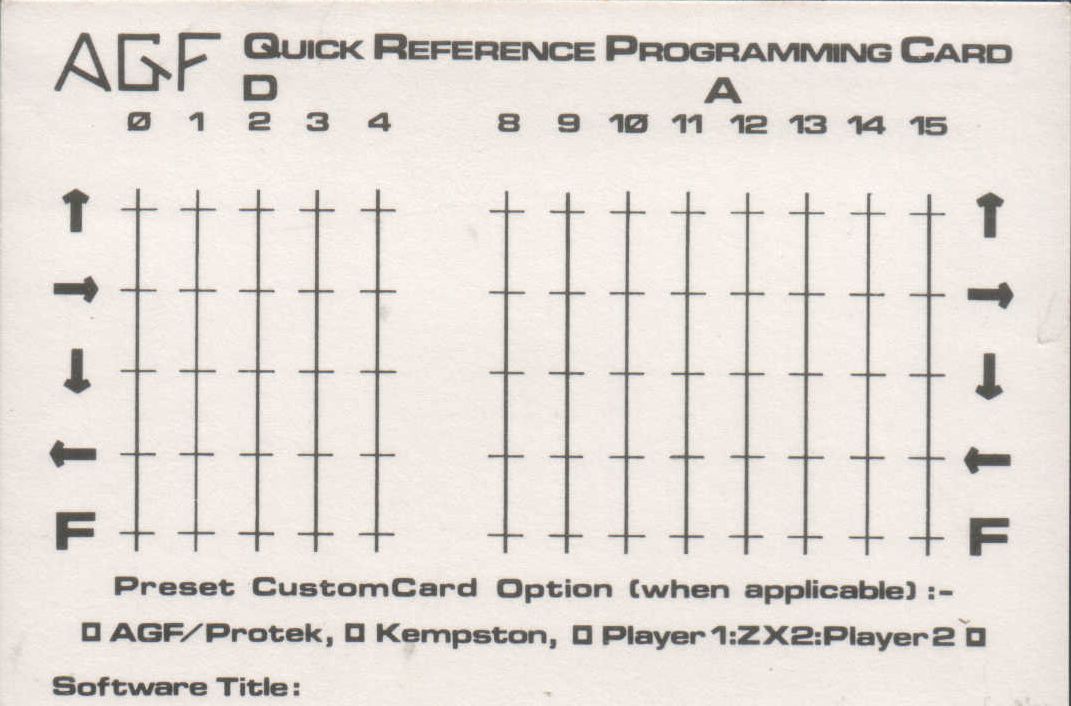
The Ultimate Development. Programmable & fixed interface for AGF, Kempston and ZX Interface 2 games, or any keyboard option games. Supplied with 5 Customcards and 10 Quick Reference Cards.
Discussion
Nobody has started a thread about this yet.
Remarks
Switch up: working with programmed Card Switch down: Kempston Mode, no Card required Red Button: Reset
Documents
- AGFProtocol4(EN).pdfInstructions English1,576 KB
Files and rights
No permission is on record either way. Screens and pictures are copied here on a take-down basis: if you hold the rights and want something removed, say so and it goes.
In the magazines 57
Sinclair User #46Jan 1986 · p.54
John Lambert
STICKING TO THE BEST Zap in style. John Lambert juggles with joysticks. Joysticks are the most popular add-on for the Sinclair computers, not just for playing games but also for drawing, cursor control in word processing packages and for moving anything around the screen. The keyboard can be used for all of those things but it is so much easier with a joystick. Choosing a joystick from the hundreds available is not an easy decision, but this guide will show you what to look for, and how to connect it to a Spectrum or QL. Joysticks are generally all the same. They may be different shapes and sizes but they all contain a number of simple switches which get turned on or off as the stick is moved. That type of digital joystick was first used on a home computer by Atari and, therefore, is sometimes known as the Atari standard. All Sinclair machines use this type of joystick interface. The switch used can vary a great deal. The cheapest joysticks, such as Quickshot 1, us a bubble which when compressed by the stick makes contact. Those can wear fairly quickly and cannot stand up to heavy use. Next in price and strength are leaf spring switches where the stick causes two pieces of metal to make contact. Finally, the most expensive joysticks use microswitches. Those will last a long time and can easily be replaced should they go wrong. Generally, you should buy the most expensive joystick you can afford as that way it should last a long time. Try to get one with a metal shaft in the handle - plastic ones break - and, if possible, try it out in the shop. The feel of a joystick is very important, some are sloppy and others require a lot of movement before they register. it is within the interface that the complications arise. All interfaces have at least one Atari standard socket where the joystick is plugged in, but those vary in how they tell the computer when the stick has been moved. Which type of interface you buy will depend on what software you want to use with it. The most common method is known as Kempston - named after Kempston Microelectronics who invented it. What that does is to configure the interface as part of the Z80 I/O map so that it can be read - to find what position the joystick is in - using the instruction IN 31. Another method is for the interface to emulate the cursor keys - five to eight plus zero as fire. For obvious reasons that is known as Cursor. The third method is known as Sinclair and emulates the six to nine keys, with zero as fire. That is based on Interface 2 from Sinclair. Why Sinclair wanted to bring out yet another method is anybody's guess! The problem is that until you but the software you have no way of knowing which of those three methods it will use. Many programs give you a choice but unfortunately not all. The way to get round that is to use a programmable interface. Those allow you to let each stick direction and fire represent a key on the keyboard. All games have a keyboard option and you just set the interface to the keys it uses. That also gets round the problem of game that do not use any of the three normal methods - Psion is very bad in that respect. Unfortunately, programmable interfaces tend to be the most expensive, and in some cases can be very difficult to set up. For playing arcade games a Kempston standard interface is the most useful, and the cheapest. Some interfaces combine more than one method in the same box, but the more facilities it has the more expensive it will be. Some joysticks offer extra facilities and you should take care when buying those. Although it is popular to have two fire buttons on a joystick, in many cases they are joined electrically and perform the same function, so it does not matter which one you press. Some joysticks, however, have two, independent, fire buttons and some interfaces can take advantage of this. That type of joystick can also be used with interfaces which normally only expect one fire button, and so are particularly worth considering. Care should be taken, though, as pressing the used button on some interfaces, will cause the computer to crash. Another common extra is auto-fire, giving an auto repeat on the fire button. In order to make their interfaces more attractive some companies add extras which are not related to joysticks. The best known is probably the Nidd Valley Slomo which lets you slow down the computer so that - in theory - the games are easier to play. Two other products, the Opus Discovery 1 disc drive, and the Mikro-Gen Mikro-Plus include Kempston compatible interfaces. As far as the QL is concerned life is much simpler. The two control sockets on the back are already wired to emulate either the cursor keys and space, or the function keys. All you need to plug in a joystick is an adaptor which fits the control socket at one end and a standard joystick at the other. Joysticks are available which plug straight into the QL - ones that have a QL style plug rather than the Atari standard. The problem with those is that when you upgrade to a different computer you will have to buy another joystick, as it is unlikely it will fit the new machine. Buying a joystick and interface can be a harrowing experience. Don't be afraid to try out half a dozen in a shop - and don't buy from a shop which won't let you experiment. Ask your friends and, of course, read the reviews in Sinclair User. PROTOCOL 1 Company: AGF Telephone: [redacted] Price: £9.95 Kempston compatible interface which contains a through port. PROTOCOL 2 Company: AGF Telephone: [redacted] Price: £14.95 Kempston, cursor interface. Contains a through port. PROTOCOL 3 Company: AGF Telephone: [redacted] Price: £19.95 Programmable interface. As Protocol 4 but not Kempston compatible. PROTOCOL 4 Company: AGF Telephone: [redacted] Price: £29.95 Programmable, Kempston compatible interface. Top of the range interface which uses a system of preprogrammed cards. Those clip over a membrane on the interface. Also has a through port, reset switch, and free demo tape. Fiddly to program but one of the few which allows auto-fire. It also allows a second interface to be plugged into the back for a second player. COMCON Company: Frel Telephone: [redacted] Price: £19.95 Programmable interface which, although it may not look too good, is easy to program using leads plugged into a matrix. Can run joysticks with two fire buttons. GAMES ACE Company: Datel Telephone: [redacted] Price: £10.99, £17.99 (with Quickshot II) Kempston compatible interface. Allows the use of auto-fire joysticks and outputs sound through the television. SWITCHABLE JOYSTICK INTERFACE Company: Datel Telephone: [redacted] Price: £12.95, £19.99 (with Quickshot II) Kempston, cursor, Sinclair compatible interface. Switchable interface which covers all the main joystick standards. Can be used with auto-fire joysticks. TURBO ACE Company: Datel Telephone: [redacted] Price: £15.99, £22.99 (with Quickshot II) Kempston, cursor, Sinclair compatible interface. Top of the range model which includes all the features of the Games Ace and the Switchable interface. Well priced for the wide range of facilities. DUAL PORT Company: DK'tronics Telephone: [redacted] Price: £13.00 Kempston and Sinclair compatible interface. Interface includes two sockets, one for Kempston and one for Sinclair. PROGRAMMABLE Company: DK'tronics Telephone: [redacted] Price: £22.95 Programmed by loading software from tape. FORMULA 1 Company: Kempston Telephone: [redacted] Price: £16.95 Large joystick with two - not independent - fire buttons. It uses micro switches and has a metal shaft so it should last a long time. Good value. FORMULA 2 Company: Kempston Telephone: [redacted] Price: £11.95 Three fire buttons and plenty of movement for the careful enthusiast. PROGRAMMABLE Company: Fox Telephone: [redacted] Price: £28.95 Programmable interface holding the details of which keys to use for 16 games in a battery backed RAM. Can also be used as a Psuedo ROM. Good operation and value for money. FLIGHTLINK HOTSHOT Company: Frel Telephone: [redacted] Price: £10.50 Small hand held joystick with a very good precise, action and two independent fire buttons. JOYSTICK INTERFACE Company: Kempston Telephone: [redacted] Price: £9.95 Kempston interface made by the inventors of the standard. KEMPSTON PRO Company: Kempston Telephone: [redacted] Price: £16.95 Kempston, cursor, Sinclair compatible interface with three sockets and a slot for games ROMs. Covers all the main standards including two Sinclair sockets, one to five and six to zero. TRISTATE Company: Kempston Telephone: [redacted] Price: £12.95 Kempston, cursor, Sinclair compatible interface. Two sockets cover all the main standards. MIKRO-PLUS Company: Mikro-Gen Telephone: [redacted] Price: £14.95 Kempston compatible interface. Sold as part of the Shadow of the Unicorn game and has 16K of EPROM onboard which will be used in subsequent MikroGen games. Expensive for just a Kempston compatible interface but good value - if you like the game. PACESETTER Company: Nidd Valley Telephone: [redacted] Price: £14.95 Kempston interface with through port and Slomo. PROGRAMMABLE PACESETTER Company: Nidd Valley Telephone: [redacted] Price: £29.95 Tape programmable with Slomo built in, and the ability to use two independent fire buttons. Good range of features. QUICKSHOT 1 Company: AGF Telephone: [redacted] Price: £7.95 Basic joystick which has been overshadowed by the II. QUICKSHOT II Company: AGF Telephone: [redacted] Price: £9.95 Popular joystick, rather fragile and hence, tends to wear out quickly. RAT Company: Cheetah Telephone: [redacted] Price: £19.95 Infra-red remote control joystick and interface. The recently reduced price is good for a complete system and it is the only remote control joystick for the Spectrum. The joystick is a pressure pad which takes a while to master. If possible try one out before buying. TURBO Company: RAM Telephone: [redacted] Price: £18.50 Kempston, cursor, Sinclair compatible interface. All the main standards including two sockets for Sinclair, one to five and six to zero. Also included are ROM slot, full width through port and a reset button. SCOREBOARD Company: Kempston Telephone: [redacted] Price: £19.95 Joystick housed in an enormous consol which is bigger than the Spectrum. Fine if you want to pretend you are in an arcade but a bit over the top. SPECTRUM INTERFACE Company: RAM Telephone: [redacted] Price: £9.95 Standard Kempston interface without through port. SPECTRUM KC Company: Nidd Valley Telephone: [redacted] Price: £8.95, £9.95 (with through port) Kempston compatible interface. Good price for a Kempston with a through port. SUPREME JOYSTICK Company: Cookridge Computer Supplies Telephone: [redacted] Price: £15.95 SURE SHOT JOYSTICK Company: Cookridge Computer Supplies Telephone: [redacted] Price: £12.95 - QL, £15.95 - Atari ZIPSTICK Company: Cookridge Computer Supplies Telephone: [redacted] Price: £12.95 Joystick which is guaranteed for two years' wear and tear.
Sinclair User #34Jan 1985 · p.27
COMPATIBILITY CURE After a slight hiccup AGF has now relaunched its Protocol 4 progammable joystick interface for the Spectrum. The original version was not compatible with all Kempston compatible games but that has now been cured. A novel method is used to program the interface. You are supplied with five small plastic cards, four of which are already set up. Those cards contain a series of holes which represent the Address and Data lines as used by the Spectrum keyboard. Small rubberised pads are then inserted in the holes, one per line per key, according to a chart supplied, until the four directions, and fire, have been programmed. The card is then inserted in the interface so that the rubber pads press down in a membrane, similar to that used on the Spectrum key- board. The four preprogrammed cards simulate the 5, 6, 7, 8 and 0 keys, the 1, 2, 3, 4 and 5 or 6, 7, 8, 9 and 0 Interface 2 keys. The remaining card simulates the Kempston standard. That process may appear rather complicated but it only has to be done once. AGF supply ten reference cards on which you can note the positions of the rubber pads and can supply additional plastic cards so you can keep a stock of preprogrammable cards. The cards can be changed while a program is running, if you are careful not to joggle the interface, and the keyboard is not disabled. On the pre-production version tested, the expansion port had not been carried through to the back of the interface, but AGF plans to do that on later models. It did have a useful reset button on the top of the interface and the ability to use joysticks with the Auto-Rapid Fire feature. There are, however, some reservations about the interface. A membrane has a limited life. Also the cards sometimes fail to locate properly so that only two of the four directions worked. That could be cured by being heavy-handed when inserting them but should not be necessary. The greatest problem is the speed of response. When the keyboard is simulated there is a delay between moving the stick and something happening. When playing a game that could mean the difference between getting zapped or living to fight another day. Overall, the interface has much to offer but fails to deliver. For more details contact AGF, [redacted].
ZX Computing #15Oct 1984 · p.68
INTERFACITS - JOYSTICK INTERFACING INVESTIGATED A comprehensive round up of the units available - checked out by our team of reviewers. One of the first add-ons that a computer owner may contemplate buying is a joystick of some kind. The increase in control that this provides is of obvious benefit to the dedicated games player. In addition it is becoming increasingly necessary for some of the complex graphics packages that are appearing for the Spectrum. However if you have not yet taken the plunge and are now contemplating the purchase of some form of controller you have a difficult choice ahead of you. In essence, most of the actual joysticks are very similar, and your eventual purchase will be based upon personal preferences for shape, size, ease of use etc., but the biggest decision to make will be that concerning the vital link between your joystick and the computer i.e. the INTERFACE. Interfaces allow the use of joysticks with compatible software, and although there is a great variety of material available for use with all the more common interfaces no single one will give you control over every game, unless, of course you opt for a PROGRAMMABLE INTERFACE. These claim to give you joystick compatibility with ALL software. NON PROGRAMMABLE KEMPSTON £11.95 Probably the nearest thing to a "standardised" interface. This unit has been around almost as long as the Spectrum itself and most games have a Kempston option. The unit works by utilising the IN31 function and so the keyboard is not enabled. This also means that a program must cater specifically for it and some of the earlier games don't. To get over this Kempston market a set of tapes which will convert some of these to operate with their interface, each of these will cost £4.95. The box plugs into the port of the back of the Spectrum and the joystick plugs into a standard 9 pin socket at the front of the unit. This means that the joystick leads trail over the keyboard and if you have a full sized keyboard then this plus the fact that the box has a "lip" means that fitting it is a great problem. Although it's starting to show it's age there's still plenty of life in this well tried and loved device. INTERFACE II Sinclair Research £19.95 A multi purpose unit which includes two joystick sockets, a ROM cartridge socket and a limited through port. Sir Clive in his wisdom, decided to use his own "standard" for operating his interface and this is not the same as Kempston. This means that many of the earlier games will not operate with it although most of the recent programs incorporate an Interface II option. In fact many games have a larger choice of joystick options than gameplay options! When provided, two joysticks can be used simultaneously and this is the greatest advantage of this unit. It has been on the market for quite a while now and the presumed flood of cartridge programs has not materialised. This is really the power of this unit and if they are not going to be produced then it has limited value as a joystick interface. RAM TURBO RAM Electronics (Fleet) Ltd. £22.95 Similar to the Sinclair Interface II, this unit has two joystick sockets and a cartridge slot, also has a through port but in the Turbo it is a full one unlike the Interface II. The Sinclair format is not used, but both Kempston (IN31 and Protek (cursor keys systems are supported. I don't know if this means that only one joystick at a time can be used and we never received a review unit. GAMES ACE VOX BOX Datel Electronics £29.95 Although requested, neither of these units were sent for review, so I'll just give a mention of the information available. Games Ace works on the Kempston function so it will be compatible with that option, it also has the bonus of including circuitry to output the sound to the TV where the volume can be controlled. Vox Box is the same as the Games Ace but also includes speech synthesizer based on the allophone system. Sounds interesting. PRO JOYSTICK INTERFACE Kempston Micro Electronics Ltd. £19.95 After a long run with their bes selling interface Kempston have decided to introduce this mode;. Similar in many respects to the Sinclair Interface II it seems much more versatile. As it's hot off the production line we haven't yet seen one. However, I'm told that it has three separate 9-pin plugs which cover Kempston's own system, Sinclair I/F II standard and the AGF/Protek cursor key format. There is also a ROM cartridge port. With Kempston's experience in the market it's got to be worth a look. SOLIDISK Technology Ltd. £8.50 One of the cheapest interfaces on the market, this one operates on the Kempston standard and is claimed to be wobble free. Sold complete with a Quickshot-style joystick for £15.50. Even more useful is that should you forget to change the switch or get the wrong option then you can safely change the option once the program has been loaded and is actually running! An interface which I would recommend to any dedicated games player who requires a simple, effective means of joystick control. Protek also market a presentation pack of joystick, interface and their own flight simulation program for £24.95. AGF JOYSTICK INTERFACE II £9.95 AGF have two joystick interfaces on the market at the moment - one programmable and the other not. Interface II is the non-programmable one, but there are versions for both the ZX81 and the Spectrum. The interface will accept a wide range of joysticks including Atari, Starfighter, Le Stick etc. and has facility for a second joystick to be used. There isn't much to it in the way of hardware, just a few plugs and sockets and six chips. I noticed they have rubbed off the numbers on the chips to deter people making their own, but at £9.95 it's not worth the bother. The interface just clips on the back of your computer and has a rear extension for more add-ons. With a joystick plugged straight in it will mimic keys 5, 6, 7, 8 and 0 and the second port will give you T, Y, U, I and P. To convert games that do not use these keys, you will have to purchase AGF's software and you have a choice of two cassettes. Tape one will convert Arcadia, Schizoids, Hungry Horace, Horace goes Skiing, Spectres, Penetrator and tape two converts Centipede, Planetoids, Jet Pac, PSSST, 3D Combat Zone and Invaders. After you have loaded the cassette it will ask you which game you would like to play and after running the tape further it will automatically find the corresponding software to convert that game and tells you when to load your game. On the inlay, it lists the games you can use the interface with. I would have thought it would have been better to list the key operations as well so that it would be easy to find what other games you could play with it. You can buy the interface, software and joystick direct from AGF if you cannot find it at your local store. Cassettes are £4.95. It is a slightly 'Heath Robinson' way of connecting a joystick but it is cheap. DK'TRONICS JOYSTICK INTERFACE DK'Tronics Ltd. £13.00 Another little shiny black box (7 x 5 x 2.5cm.) to get quickly forgotten somewhere between joystick and computer is the DK'Tronics Joystick Interface. It has a firm positive fit into the expansion port at the rear of the Spectrum, although because only 22 of the contacts on the edge connector are used, the actual fitting tends to require more care and caution than with other units. There are two nine pin, 'D' type ports at the top of the unit and both are clearly identifiable. The first is for use with software using a key change option or using 6, 7, 8, 9 or 0 keys. The second port uses the IN31 command is therefore for use (software compatible) with the Kempston type joystick. The test routines and a few example programs (one using machine code) are given in the accompanying instruction leaflet, for those people who want to stretch themselves beyond being mere players, who want to incorporate their joystick and interface into their own programs. And for those programmers who want to use two joysticks to control two separate objects at the same time on the screen, then both ports of this interface can be incorporated simultaneously into programs. Just out of interest, I wonder how many micro-users actually do use their joysticks and interfaces for anything else besides playing commercially produced games? PROGRAMMABLE INTERFACES Rainbow Electronics £24.00 (+3.00 extra for a through-port) Another interface which never made it to our office in time for this roundup. The interface includes a built in amp and speaker, the joystick socket and the programming switch are positioned at the front (with all the associated problems). CCI (Cusom Cables International) £15.00 This unit is programmed by means of software supplied on tape, and this means that you have to load in the program supplied before loading your game. This isn't a great problem as it is a short program and setting up the keys is straightforward and only takes a few minutes. The unit we had didn't have any instructions. CCI promise that they are supplied with each purchase - we just had "a very early preview model". Nevertheless I found it simplicity itself to operate even without them - which can't be bad. The only problem is that some games don't tell you which keys the program uses so you have to load them in first to find out! This is only a problem the first time round because, being sensible, you kept a record for the next time, didn't you? The unit proved reliable and effective over a three week period of constant and frequent use and I see no reason why it shouldn't perform admirably for a long, long time. At the price it is probably one of the cheapest of it's kind and worth considering if, as it is for me, money is a prime factor. PROGRAMMABLE JOYSTICK INTERFACE Stonechip Electronics £24.45 As with most similar interfaces this is simply a plug-in unit which requires no additional links such as flywires of extra tapes to load. The unit itself measures 90 x 75 x 35mm and is contoured to fit snugly to the rear of your Spectrum. It features a three-way switch at the front enabling the user to select any of the three modes; Program, Play or Normal operation (where control relies upon the keyboard alone). The interface draws its power from the computer and a small red L.E.D. indicates power on. A standard 9 pin Atari-style joystick socket allows the use of your favourite zap-em-stick! It is at this stage that my first complaint appears. No doubt many satisfied users will disagree, but why, when an increasing number of games require the use of at least two extra hands, does the port have to be placed so that the joystick lead runs right across the keyboard? Programming of the interface is fairly easy - set the selector to the Program position, press the appropriate direction key and move the joystick into the relevant (or not so relevant) position. The small, but adequate, instruction sheet advises that the most complex functions be dealt with first and this gives rise to the second little quibble. As opposed to certain other interfaces available, the Stonechip requires the FIRE function to be input separately for each and every direction. This is sometimes not all that easy when you require one hand for the keyboard, one for the fire button and direction and one to stop the mobile joystick from sliding off the table! Apart from that, the programming of this interface is a straightforward, it not lengthy, process. Programming complete, just move the selector to Play and away you go! One additional feature is the Normal position that allows the joystick to be removed without loss or corruption of the keys already programmed. The unit was tested with a variety of joysticks and performed perfectly well with all of them. Included in the instructions is a sample program to enable practice - programming prior to testing on the real thing. If a Programmable interface is the sort that you require then this should be considered. It is slightly expensive in comparison to some of the updated and newer models now appearing, but nevertheless is a tried and tested product that has stood the test of time. THE CAMBRIDGE JOYSTICK INTERFACE £34.95 (including joystick) This interface has a through-port at the back which is very useful for using other units like speech or sound devices. The unit also has a lip on the front to help prevent "wobble" but if you have a non-standard keyboard it gets in the way. There is the usual nine pin plug on the left hand side for the joystick and the overall size is 11.5cm x 3.5cm x 7.5cm. To use the interface you have to load a tape first which programs the interface to respond to the appropriate keys. If the game you're using fails to give this information on the instructions then you have to load the game first to find out! However once you have programmed a set of key-sequences, they can be saved on tape (the reverse side of the tape has been left blank for this purpose and provision is also made for saving to microdrive) and many games can be saved at one time. You are able to check the joystick position at the end of the programming sequence. This interface is sold complete with a joystick and tape - the joystick is available separately and is reviewed as such. The interface is a bit fiddly to use but has proved compatible with all software tried, but when an option of joystick or keyboard is offered from within a program, you must use the keyboard one as the joystick option frequently does not work. PROGRAMMABLE JOYSTICK INTERFACE Downsway Electronics (UK) Ltd. £22.95 The Downsway Programmable Interface, which has been available for quite some time now, is at first sight rather a plain black unit which plugs directly into the Spectrum's rear expansion port. It measures 65 x 95 x 25mm and has a dual-position switch on the rear and a standard 9-pin joystick socket on the right side of the unit. This is one of the advantages that this interface has over some other units currently available, in that the keyboard is left uncluttered by control cables and therefore can be used in conjunction with the joystick. This gives the user a wide range of control options which can be a distinct benefit considering the handful of keys that some programs demand. A small instruction sheet provided with the interface gives all the information that is needed to make your joystick compatible with any program. Programming of the interface can be achieved either prior to loading a game or after the game has loaded. This facility takes care of all those programs that have no detailed instructions on the cassette inlay. To use this unit is simplicity itself - with the dual position switch in 'program' mode press the key for the specified command and move the joystick to the appropriate position. Release joystick and key then repeat for all other movements. In essence that's all there is to it! After programming (a few minutes work) switch to the 'play' mode and away you go! In operation the unit performed perfectly and on the odd occasion when a mistake was made it was a simple matter to re-program the offending key without the necessity of going through the entire procedure again. The FIRE command is independent of direction command and this means that FIRE has only to be programmed once, as opposed to the multiple movement/fire operations needed with some interfaces. The unit was tested with several joysticks ranging from the cheapest to one of the most expensive available and it performed equally well with all, the only noticeable difference being a somewhat coarser movement with one of the cheaper joysticks. Of the many programs used with this interface only two gave any problems - keys could be programmed but pressing the fire button caused the game to restart. As it happens the particular games weren't intended for joystick use anyway! In conclusion, if a joystick interface is high on your list of priorities then it may well be worth your while paying a bit more for the extra flexibility that this excellent little unit provides. FOX PROGRAMMABLE INTERFACE Fox Electronics Ltd. £34.95 I have used this unit consistently over a four week period with a wide variety of games and I recommend it to anyone looking for such a unit. It is a rather large unit and the long suffering DK'Tronics keyboard needed another bit removed before it would fit! The standard case presents no problems however. The unit has a through port so you can use other interfaces behind it, the Currah micro speech unit worked fine at the back, and the standard 9 pin joystick socket is near the bottom of the right hand side of the case. just above the socket is a small, two-way (up/down) switch. On power up the switch should be in the down position - switching it up instantly presents on screen a menu of 16 possible combinations of responses and options to create or select a set or to exit. The more knowledgeable among you will have worked out that the unit must contain a programmable chip of some sort. The program and set of key combinations are kept permanently refreshed by a battery which is constantly recharged. What happens if something goes wrong? The interface is supplied with a back up tape and also your own sets of positions can be saved on tape and easily reloaded into memory if needed. A few times I had to perform this operation due to the awkward fit with the keyboard but it was no real problem. Documentation is good, covering all the operational details and also how to use it as a pseudo ROM. All in all easy to use and one of the most impressive joystick interfaces I've used. AGF PROGRAMMABLE JOYSTICK INTERFACE £26.95 AGF sell a version of this interface for both the Spectrum and the ZX81 and both cost £26.95. The interface works by duplicating the keyboard layout with a grid of wires. The wires ending in crocodile clips can be attached to the various grid wires to route specific keys to the joystick. This means that all games can be controlled by joystick although you must use the keyboard option and not the joystick one when provided. The joystick is connected by a standard 9 pin 0 socket so it is compatible with the majority of the sticks on the market, two sockets are provided for two sticks for two players to play alternatively. Both sockets operate on the same keys and both sockets and the keyboard are always operative. A possible cause for dispute when used by two players! A set of quick reference cards, a demo tape and a stick on chart completes the package. The sight of uncased wires and chips may put off some users, but treated reasonably, this is an almost foolproof method of providing joystick control to any game. The unit has a through port and further peripherals can be added afterwards, I used a Centronics interface and a speech unit with it and had no problems. SWITCHABLE INTERFACE Protek Computing Ltd. £19.95 An interesting and unusual idea from Protek is to provide the ability to switch between the common interface options. The interface has a three way switch at the back marked, logically, 1, 2 and 3. Setting the switch will give you compatibility with Protek/AGF (cursor keys), Kempston and Sinclair Interface II formats respectively. Between these three options I should think that around 90% of the software on the market can be used with this unit. The only programs which will cause problems are those where no joystick options are provided and keys other than the cursor keys are used, and there can't be many of those! The case is quite small and neat with the usual 9-pin plug fitted in the right hand side of the unit. This is a handy position to allow the joystick lead to clear the keyboard. The instruction leaflet is as I like them, written in a simple step by step manner with diagrams - if you get it wrong it certainly won't be Protek's fault. My biggest criticism is the lack of a through-port, but with other devices available to compensate, it's not as drastic a problem as it used to be. Using this is a delight, even though most programmables are quickly and easily programmed, sometimes it doesn't seem worth the bother. With this one, compatibility is usually available at the flick of a switch. FIRMWARE PROGRAMMER INTERFACE £29.00 SOFTWARE PROGRAMMER INTERFACE £22.95 Voltmace Ltd. Two other interfaces unseen by us. One is programmable by using a two-way switch and the other by using a program on tape. The most interesting item that I've seen from this company must be their Delta 3 joystick, which has a rectangular base, three fire buttons (to allow for individual styles of holding the thing), and a fingertip type joystick at £10.00. PACE COMPUTING This company advertises a programmable interface for £26.00 which they say does not disable the keyboard and can be reprogrammed during a game. No further information is available so far. EAST LONDON ROBOTICS LTD. £15.00 Designed to be sold with their Trick Stick (of which we're still waiting for a review sample), it appears to be similar to the AGF programmable interface, in that flyleads which are connected to pins to mimic the keyboard are used. If bought with the Trick Stick, then it will only cost £10.00, which can't be bad! DK'TRONICS LTD. £22.95 This is Dk'Tronics deluxe interface and is programmable from the keyboard by using the switch provided on the top of the unit, or via the program supplied on tape. There is only one socket provided on this model, but as it is fully programmable there isn't any need for two separate sockets to cover the different methods of providing control. The socket is located on the top of the interface next to the switch. During operation, the keyboard is still enabled so that complex games requiring more than five keys to be pressed can still be played. At the time of going to press we haven't been able to obtain one because they're short of stocks, however Ms Green of the company assures me that by now their stockroom will be overflowing. The information given to me claims that movement in seventeen directions is possible, I will be most interested to put this through it's paces! A full through port is included and it is claimed to be microdrive compatible, the usual lip at the top of the Interface is there and I would also be interested in trying it for compatibility with one of their superb looking keyboards. PROTOCOL 4 AGF Hardware £30.95 The very latest unit from AGF, this is an interesting looking interface. It lies flat and is programmed by a set of reprogrammable cards which are snapped into place on the interface. The device is supplied with three pre-programmed cards to cover Kempston, Sinclair and Protek/AGF (cursor keys). An extra, blank card is supplied for your own use. This is a great advance on their older interfaces in style and ease of use, however, ZX81 owners will be pleased to know that AGF are to continue producing and selling their old units because, as Mr. Fosberry told me personally, the demand by ZX81 owners is as great as that from Spectrum owners. The unit has a full through port and amazingly, up to five of these can be connected and programmed individually for multiple control! The latest Quickshot II joystick is supported and the socket for the joystick is placed on the side of the unit. Yet another small but useful extra is a reset button to allow you to turn the computer on or off without having to pull the plug each time with the eventual problems this causes. Slightly expensive but for the dedicated games player probably well worth the money. ENDNOTES We covered as many interfaces as we could and I'd like to thank all the companies that sent us review units which allowed us to write a more comprehensive and detailed report. I do realise that as always, these are written by people who are giving their own opinions and you may or may not agree with them. Overall we have tried to give you an idea of what is available but really nothing substitutes for trying them for yourself at your nearest store. There are probably a few companies that we've missed, if they would like to write and tell is, we'll include them in our future features. Each review was written by the person named as the end, if no name appears then it was reviewed by myself - it's a hard life.
Your Spectrum #6Aug 1984 · p.11
IT'S ON THE CARDS Anyone remember that funny looking, half-completed joystick interface with all those wires and clips - the brainchild of those lovely people at AGF and the only hardware programmable interface on the market? Well, they've done it again, only this time it's a far more professional product that's been housed in a tough injection moulded plastic case. The AGF Protocol 4 utilizes snap-in program cards that can be hardware programmed to work with all Spectrum software as well as any of the other joysticks currently available. Supplied with the interface are four pre-programmed cards that enable immediate use with AGF, Protek, Kempston and ZX interface 2 protocol, in addition to one blank. Also included is a recessed reset button that eliminates the need to pull-the-plug every time a machine code program is cleared. So with the possibility of connecting up to five units, and the promise that it will accept a trackball, this looks like being a real winner. Check with AGF Hardware, [redacted]. Further sets of blank program cards can be ordered at an additional cost.
Full-page ad38
- Sinclair User #37Apr 1985 · p.124
- Your Spectrum #13Apr 1985 · p.7
- Sinclair User #36Mar 1985 · p.57
- Your Spectrum #12Mar 1985 · p.10
- C&VG (Computer & Video Games) #41Mar 1985 · p.48
- Crash #13Feb 1985 · p.129
- Popular Computing Weekly #6Feb 1985 · p.42
- Sinclair User #35Feb 1985 · p.127
- C&VG (Computer & Video Games) #40Feb 1985 · p.57
- Your Spectrum #11Feb 1985 · p.8
- Crash #12Jan 1985 · p.42
- C&VG (Computer & Video Games) #39Jan 1985 · p.89
- Sinclair Programs #27Jan 1985 · p.32
- Sinclair User #34Jan 1985 · p.146
- C&VG (Computer & Video Games) #38Dec 1984 · p.154
- Big K #9Dec 1984 · p.80
- Crash #11Dec 1984 · p.82
- Sinclair User #33Dec 1984 · p.156
- Sinclair Programs #26Dec 1984 · p.56
- ZX Computing #16Dec 1984 · p.126
- Your Spectrum #10Dec 1984 · p.68
- Sinclair User #32Nov 1984 · p.174
- C&VG (Computer & Video Games) #37Nov 1984 · p.154
- Crash #10Nov 1984 · p.64
- Big K #8Nov 1984 · p.115
News/Note9
- ZX Computing #17Feb 1985 · p.11
- Sinclair User #34Jan 1985 · p.10
- Sinclair User #34Jan 1985 · p.27
- Crash #12Jan 1985 · p.173
- Sinclair Answers #2Jan 1985 · p.96
- Big K #5Aug 1984 · p.6
- Your Spectrum #6Aug 1984 · p.11
- Crash #6Jul 1984 · p.36
- Personal Computer News #67Jun 1984 · p.5
Advert2
- Sinclair User #44Nov 1985 · p.6
- Your Computer #8Aug 1985 · p.35
Feature2
- ZX Computing #16Dec 1984 · p.83
- ZX Computing #15Oct 1984 · p.68
Letters1
- Sinclair User #36Mar 1985 · p.20
Review1
- Home Computing Weekly #93Dec 1984 · p.56
Reviews from people here
Sign in to write about this, or make an account. It takes a minute and lets you correct the catalogue too.
Everything ZXDB can hold about this is here.
Sign in to correct or add to this.
Hold the rights to this and want it taken down?