
Challenge Sprint
Hardware: Cassette
Challenge Research Ltd · 1984 · Pound sterling 64.95
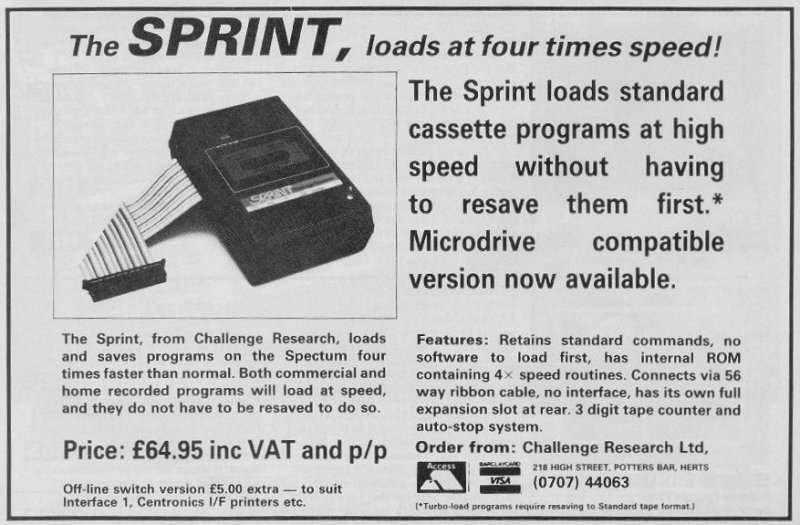
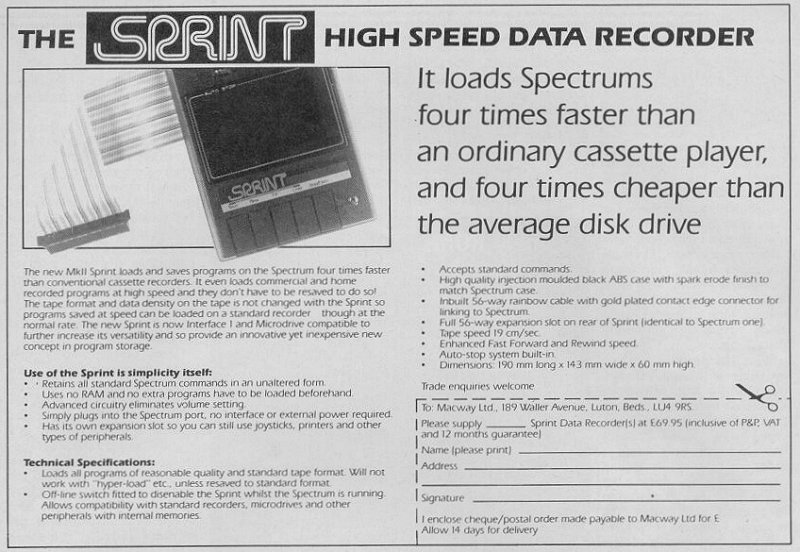
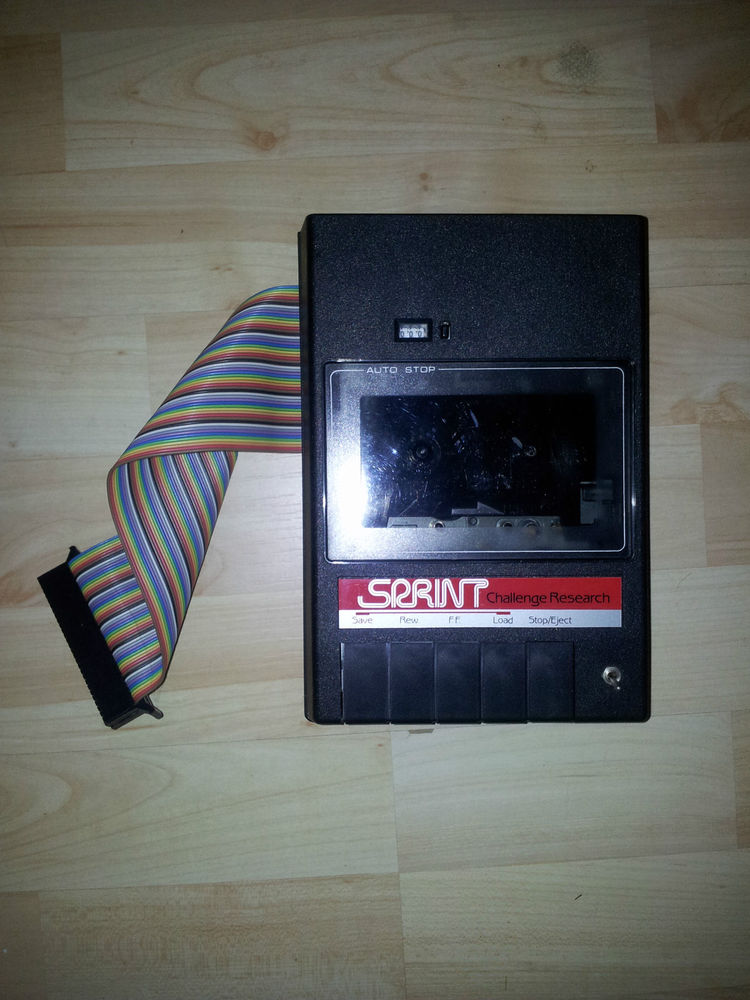
Looks like a standard cassette recorder, but plugs into the user port and gives up to 4 times load/save speed. Uses normal cassette tapes and is fully compatible with all existing software. Average 48K program loads in 75 seconds. Also includes a replacement ROM with faster load/save routines. It later became apparent that newer 'turbo-loader' software such as the older Ultimate titles, were not compatible. (Feb 85)
Discussion
Nobody has started a thread about this yet.
Files and rights
No permission is on record either way. Screens and pictures are copied here on a take-down basis: if you hold the rights and want something removed, say so and it goes.
Scores
In the magazines
- Personal Computer News #841984 · Overall Value2/5
In the magazines 40
Your Spectrum #14May 1985 · p.28
SPEED TRIALS What's slower than the C5? Loading software into the Spectrum, of course. So, speed freak, SQ Factor has stuck the go-faster stripes on his Speccy, and taken it out for a spin. But instead of aerodynamic spoilers he's gone for four fast tape loading systems. D'you remember the excitement when the Microdrive was announced? The anticipation of speed - times never before achieved on the Speccy. And then, the long haul between promise and delivery of the first not-quite-perfect Microdrives. Now you no longer have to wait an age for them and the original, ridiculous price of the cartridges has come down to an almost reasonable two notes. But the Microdrive is no longer the only way of super-charging your Spectrum. Without going the whole hog and splashing out more than the computer cost on a disk drive, you can LOAD at high speed in a number of ways - and as you'd expect YS has the dope. So, we told the dope to draw up a chart of all the info you need to help you in your search for speed. Our chart was prepared so you can compare the features of each system in a quick and easy to follow way. Everything that cannot be compared directly in the z chart is discussed separately. TIME CHECKS The times in the chart were derived by saving and loading the same program on each system. For this, we used a truly enormous BASIC program to wit 10 DIM a$(35000) Once RUN, this program is about 35K Bytes long! Several LOAD times were averaged to get the times for the Microdrive and Wafadrive - both of these require an 'access time' which lets the drive search the tape for the file, as well as the time needed to load the file once it has been found. Access time is not a problem for the systems using ordinary cassette tapes. The times for the Wafadrive were taken using a 64K wafer. THE COMMON TOUCH All of the systems: - Have a full through connection to the Spectrum expansion port - or don't obstruct it. - Need no separate power supply. - Can SAVE the usual types of Spectrum program or data or code. - Can SAVE a Basic program to autorun - though Kwikload is a struggle. And the one feature that runs through them all is tape. I would recommend in every case that you keep backup copies in the standard tape format. You could get caught out if you rely totally on any of these systems to hold your important bits. Each system has plenty of opportunity for operator error to cause loss of data, and of course, fast moving tape will wear out eventually. GET IT TAPED Both Wafa and Micro drives can corrupt a file and make it unusable if you turn the power on or off with the cartridge in the slot. Also take care because both forms of cartridge are easily damaged (though the wafer less so) and impossible to repair. In particular, if the tape is pulled out of the cartridge even a little way, it will never go back. The Sprint mechanism does not prevent you from changing directly from rewind to play, and if you do so you will probably damage the tape, as the speeds involved are higher than normal. You are warned always to use stop between functions, but it would have been better if this was built into the hardware rather than left to the user's memory. This format is standard format (just played faster) but I would still use an ordinary cassette recorder to back up really important stuff. Kwikload is bound to catch you out using the wrong numbers or trying to SAVE with the LOAD program, simply because it's fiddly, but a bigger problem may arise because it is trying to do too much with standard hardware. Unlike the Sprint, which physically runs the tape faster to get its speed, Kwikload crams three times as much data onto the same length of tape. This pushes the average cassette recorder to its limits, and you will need good tape to get away with it. TO WIND UP Used in accordance with the instructions, any of the systems will give you much faster loading than you are used to, and reasonable reliability. The Wafadrive and Microdrive have the advantage of disk-like operating systems which start the motor and find files without you having to mess with play, record and rewind controls. This is a definite plus and makes up for having to cough up more for the cartridges. A few bitter experiences with the Microdrive bias me towards recommending the Wafadrive or the Sprint, but if you're after speed then the Microdrive must be a contender. More speed than this can only come from disks but that is another subject, and one that we'll explore when we're all rich. Let us know if it happens to you! SINCLAIR MICRODRIVES The original Microdrives may not be the best, but they are the fastest system reviewed and what's more they are now reasonably priced. It's also worth noting that software producers have been known to write for them sometimes. The occasional last file and the 'full memory' bug have stopped me putting my Microdrives to serious use - but I have been known to lose files on a disk computer, so I mustn't be too hard on Sinclair. The 'full memory' bug causes a crash if a large BASIC program is LOADed or even a small one if the RAMTOP has been moved down. This is caused by the Microdrive's shadow ROM not checking properly if there is space for both the program and a 500 byte Microdrive channel before LOADing. This can be bad news as it crashes with the drives running, which can corrupt the tape when you switch off. Further evidence of 'dickiness' is the fact that microdrive cartridges format to a different size (in the region of 90K) each time you format them. You may have been advised to format repeatedly until you get the largest number possible, but I believe that the few extra K are suspect. The whole exercise may merely fool your drives into using part of the tape which is on the edge of reliability. You can connect up to eight drives to a Spectrum via Interface 1, but you only get one in the starter package. Still, you also get an RS232 port suitable for a printer (but not usable with a full duplex modem), and the Spectrum network ports. It's said that these will now pass data with the latest version of the QL. On the language front, Microdrive syntax is unnecessarily tortuous, with no defaults and lots of needless punctuation required. You have to specify drive 1 even if you only have the one. Wouldn't it be simpler if number one was assumed to be present (rather than the network, say) unless you told it otherwise? You would save six symbols, many of them needing two keys for the commands you are likely to use most often with Interface 1. Instead of LOAD*"m;1; why not use LOAD 1 for the drive and LOAD n for the network? That would activate the error routine to page in the shadow ROM just as well as * does. Microdrives were long enough coming that these rough edges should have been knocked off well before they were inflicted on you and me. OK, you may think I'm going on a bit, but it's a fact that the drives take less time to LOAD a program than it takes me to type in a command telling them to do it! There is a saving grace though - you can have a program named 'run' which will LOAD and RUN just by entering the keyword RUN. ROTRONICS WAFADRIVES The first thing you notice with Wafadrives is that you get two drives as standard. You also get a bonus of RS232 and Centronics ports. This must make them a better buy than a single Microdrive plus Interface 1 at the same price. The wafers themselves are now more expensive than Micro-cartridges, but they come in three sizes, 16K, 64K, and 128K; and the largest one has greater capacity than a Microdrive cartridge. The wafers are also physically larger and more robust than Micro-cartridges, with a sliding door to protect the tape when it is removed from the drive. The access time varies according to the size of the wafer. The shortest for the 16K version was 6.5 seconds (worst case) as opposed to 45 seconds (worst case) for the 128K wafer. If you're after speed then go for the shorter tapes, always provided they're big enough to hold your program. There is a word processor program in the package but this is probably the only software you will ever find especially written for use with the Wafadrive. However, Rotronics have converted a number of games to wafers. Transferring tape programs onto wafer is no more difficult than with the Microdrive. However, you'll use at least 2K RAM with the wafer system instead of the half K needed for a Microdrive channel. This will almost certainly make it impossible to wafer many of the larger games. Wafer syntax is less of a mouthful than the Microdrive's as defaults are used, so you don't have to specify which drive you are using in every command. Also, fewer punctuation marks are required. ( There's just no stoppin' it. Ed.) CHALLENGE SPRINT This is a fast LOADer that takes standard tape software. It is the ideal solution if you just want to get stuck in pronto without delving into the mysteries of protection busting to transfer tapes onto a faster medium. Even headerless LOADs will work with the Sprint, though be warned, it can't cope with the now common turboload. The price is the lowest of the hardware speed-ups, and it only needs the common cassette. The syntax is also the least fussy of those reviewed - the same as for ordinary tape. On top of this, programs SAVEd on the Sprint can be LOADed (at ordinary speed) by a standard cassette player. Total compatibility at a reasonable price means a critic struck dumb when trying to find a winge to put in the minus column. However, we at YS try harder (or else! Ed.), so I'll note that the cassette unit has a tinny feel, quite out of place in an item made of plastic. Just don't drop it and you'll be all right. Early models wouldn't work with some other peripherals, notably the Microdrive, but the latest version can be switched out of the memory map to avoid trouble, rI'his unit had the tichiest manual of the lot, but that's no problem. What further instructions do you need? KWIKLOAD Now to the real cheapie - a turboloader of your very own. Of course, at this price you'll have to put up with a few drawbacks. Firstly, you'll obviously have to LOAD this tape in the standard format before you can use the routine to do fast LOADs. Secondly, it has a really user-violent syntax made-up mostly of numbers which have to be worked out, even for Basic LOADs. Thirdly, it will be less reliable than the hardware upgrades because it is pushing a standard cassette recorder to its limits. And lastly, it is the least fast of the methods we've looked at. On the plus side, the routines occupy only 220 Bytes, it uses ordinary (but not cheapo) cassettes, the speed is a useful trebling of the standard rate, and since you are likely to be using the same tape machine for SAVE and LOAD, the reliability should be better than with the commercial fastloading games. And don't forget that it costs less than a tenth of the price of the Sprint. Probably the best use for Kwikload is to make turboloading copies of your favourite games rather than doing frequent backups while developing your own programs. For this purpose, the cassette contains a header reader as well, to help you ferret out the addresses needed to make such copies. There are separate programs for loading and saving, and the whole business of making fast loading copies in the first place is fiddly and time consuming. Still, the end result is a tape that has the tricky bits in a short Basic header program. So in practice, once you've done the hard work, you can just use LOAD "" to get your program to turboload. THE 35K GRAND PRIX MICRODRIVE Time to LOAD 35K: 12 seconds System Price: £99.95 Media Price: £2.00 Media Capacity: Approx. 90K Programs Available in this Format: Some RAM Used by System: 600+ Bytes Simplest Case Syntax: LOAD *"m";1;"name" Time to FORMAT: 35 seconds Approximate Actual Transfer Speed: 121 Kilobaud Worst Case Access Time: 8 seconds Size of Manual: 61 page booklet Major Plus: Fastest Extras: Four programs on two cartridges + demo + blank WAFADRIVE Time to LOAD 35K: 40 seconds System Price: £99.95 Media Price: £3.65 Media Capacity: 16K, 64K, or 128K Programs Available in this Format: Some RAM Used by System: 2K+ Bytes Simplest Case Syntax: LOAF *"name" Time to FORMAT: 2.5 minutes Approximate Actual Transfer Speed: 18 Kilobaud Worst Case Access Time: 23 seconds Size of Manual: 68 page spiral bound Major Plus: Most for Money Extras: Word processor plus 3 blank wafers SPRINT Time to LOAD 35K: 43 seconds System Price: £64.95 Media Price: £0.50 Media Capacity: 1300K (120 min. cassette) Programs Available in this Format: Almost all! RAM Used by System: None Simplest Case Syntax: LOAD "" Time to FORMAT: N/A Approximate Actual Transfer Speed: 6000 Baud Worst Case Access Time: N/A Size of Manual: 6 page leaflet Major Plus: Most compatible Extras: Off-line Switch costs £5 extra KWIKLOAD Time to LOAD 35K: 60 seconds System Price: £4.95 Media Price: £0.50 Media Capacity: 3900K Programs Available in this Format: None RAM Used by System: 220 Bytes Simplest Case Syntax: RANDOMISE 23552-35000+USER 653000 Time to FORMAT: N/A Approximate Actual Transfer Speed: 4500 Baud Worst Case Access Time: N/A Size of Manual: 18 page booklet Major Plus: Cheapest Extras: Header reader
And Microdrive takes the flag in the outstanding time of 12 seconds. A clear winner if speed's your thing.
Bonnet to bumper with the Wafadrive, the Sprint cassette is just pipped at the post by 3 seconds.
Lagging behind at the finish Kwikload, the outsider of the bunch crosses the line in a time of one minute flat.
Listed right is the complete run-down on all four fast loaders - performance and price. Check out the spec before placing your bet on the winner.
The Wafadrive has been well lapped by the leader and comes in with a time of 40 seconds - but then it is carrying two passengers!
Timings for the Wafadrive were taken using the 64K wafer Kwikload. Timings do not include the time taken to load the Kwikload routine themselves.
ZX Computing #18Apr 1985 · p.118
Many Spectrum users are still wary of the microdrive, and conflicting reports abound. There are those who find them invaluable and others who have nothing but trouble. If you are using your computer for a serious business purpose then investment in a disc system is probably the solution, but this is rather excessive for the average user who just wants reasonable loading and saving time for their programs and games. An alternative is available in the Challenge Research Sprint tape recorder. This machine is a purpose built unit and only works with the Spectrum. Priced at £69.95 it is cheaper than the microdrive and Interface 1 combination but of course does not offer the RS232 or network facilities. The recorder is a neat black unit which is rather squat. It is connected directly to the computer via a ribbon cable to the user port at the rear of the computer. At the back of the recorder is a full extension port for the addition of other peripherals. A few units which I couldn't get to work with it were the VTX5000 modem and the Technology Research Disk Interface. However a wide variety of joystick interfaces and other units, including the Interface 1 and Microdrives, functioned without any problem. This is a clever unit which increases speed by running the tape at a higher rate than usual, roughly three times as fast. All normal program tapes will load in this way and any programs saved with this recorder will reload from an ordinary recorder. Programs which will not load are those saved with special high speed software systems, such as those used by Micromega and the latest Mikrogen software. In use this proved to work as claimed, it was reliable and really did improve the SAVE/LOAD time. My son, who helped to test it, actually took off his microdrive and used it in preference and was quite sad when we returned it! A unit which I would recommend to the general user, and sum up the advantages as improved speed, compatibility with other cassette players and fairly low cost. The disadvantages are that it is not totally compatible with all peripherals, and unsuitable for loading some (rather good) games.
Sinclair User #33Dec 1984 · p.97
RACING TO THE TAPE Speed, economy or reliability? We take three of the fastest systems out on the track for a test drive. It is now just over a year since the introduction of the microdrive, and in that time it has done more to inhibit the serious use of the Spectrum than any other add-on. Before you put pen to paper and write to us, an explanation is perhaps in order. Users of the BBC, Commodore and other home computers expect to be able to add a fast storage medium - disc, hobbit and so on - to their computer and to be able to buy software in that format. There is an accepted format for both interfaces and recording medium and therefore software houses can develop programs knowing that they will be able to sell them. The announcement of the microdrive, roughly a year before it actually saw the light of day, inhibited manufacturers from developing a standard, as Kempston had done with its joystick interface. The stories of unreliability, unfounded or not, also inhibited software houses as they could not ensure that any programs sold on cartridge would always work. Finally, the price, scarcity and difficulty of duplicating microdrive cartridges gave few writers the confidence to market programs on cartridge. At the time of writing the number of programs available on cartridge can be counted on one hand, with a few more that are 'microdrive compatible', and none which were specially written for it other than copiers. Despite that the microdrive is undoubtedly a remarkable device. It makes available a form of fast storage which many people would otherwise be unable to afford and, within limits, provides a usable system. It is only recently that it has been readily available and so perhaps now it will be accepted. Because of those problems and delays, other manufacturers felt that they could do better and so there are now many other fast storage devices available, with more due to be released. While some are undoubtedly better, and more expensive, than the microdrive they all share one common problem, and that is that because there are so many different systems it is largely left to the user to convert software to run on them. With the ever present spectre of software piracy few software houses make their programs open to inspection and, due to the fact that most of the systems take up valuable memory space, some programs can not be converted even if you are able to break into them. Your own programs, however, should be easily convertible; you are unlikely to write Basic programs in excess of 35-40K, and if you are able to write in machine code then you should be able to move it to an unused part of memory. The problem with commercial tapes is that the usual format is to have a Basic loader program which lowers RAMTOP and then loads a screen display followed by some machine code. It is the lowering of RAMTOP which causes the problems. A BASIC program unusually starts at address 23755 - chapter 24 of the Spectrum manual suggests that you enter CLEAR 23800 (i.e. lower RAMTOP to that address) to see what happens when the computer runs out of memory. In order to be able to enter a short line of Basic you will need about 100-200 bytes of memory, so the minimum address to which you can usefully CLEAR is 24000, giving approximately 100 spare bytes. With the more popular commercial games it is quite common to CLEAR to 24000-25000 and so you can see that there is not much space left. With a program written for the 16K machine it is not uncommon to clear down to 23900. The simple answer is that the less memory the system takes the more programs you will be able to convert. A good indication of that is the sector size. With microdrive and disc the data is held in blocks known as sectors. Those blocks are loaded into memory by the system one at a time and then moved to where they are required. For example, with microdrive the sectors are 512 bytes long, so you will need the operating system of about 100 bytes plus 512 for the sector and 83 to hold the additional channel information - say, 700 bytes spare or a minimum clear of 24700, more if you want to use two drives. Another problem may be that of speed. Almost anything is quicker than cassette; a commercial 48K game takes about five minutes to load, but the method of storage will affect the speed. A microdrive uses a continuous loop of tape and so if the sector you want is next on the tape it will be very quick. If it has just passed that sector then the microdrive will have to go all the way round the tape, and so take longer. A disc, however, normally stores the data in a number of concentric circles, known as tracks, and each track is divided into sectors. As the disc is spun very quickly those sectors are readily available. Overall, the time it takes to find a sector is largely determined by the time it takes to move from track to track. This can be as little as 3ms, 3/1000 ths of a second. There is, finally, the problem of reliability. If you are writing your own programs or using the Spectrum for business then the system must be 100 percent reliable. That can only be judged with time and any comment on a new system can therefore only be an educated guess. The first system looked at was the Challenge Sprint. That is a fairly new system and also the most straightforward. It is, simply, a normal cassette mechanism which has been converted to run the tape at four times the normal speed of 15/16 ips, (inches per second). A flexible lead plugs into the back of the Spectrum and, on the back of the cassette, there is an extension port. It takes its power from the Spectrum. The Sprint recognises all the normal tape commands, whether used from Basic or code, and therefore is very simple to operate. To load a tape you use the usual LOAD "" command and press play. The advantage of the system is that you do not have to convert any of your programs. The only programs which it would unable to load would be those which use their own, non-standard, loading routine such as Halls of the Things, or those where the time between the sections of program is very important. The reduction in loading time is good; Scrabble, by Psion, which normally takes four minutes and 48 seconds to load, now takes only 1.16 minutes. Saving a straight 64K block took 1.15 minutes. To have a means of measuring the speed of the different systems the following program has been used: 10 FOR n= 1 TO 30 20 SAVE ("test" + STR$ n) CODE 32000,200 30 NEXT n with line 20 changed as required. When saving with the Sprint it takes 2.36 minutes, and on loading 2.37 minutes. The disadvantages of the system are largely the same as those at a normal cassette. You cannot control the cassette motor from software and so you cannot load selected programs without correctly positioning the tape by hand, or running through the whole tape. A note must be kept of the tape counter in order to find a program and, due to the speed, that must be very precise. The cassette does not have any volume or tone controls and so when loading your own programs it is a case of all or nothing - if a program does not load then it is not going to. You cannot then try to load it using a normal cassette recorder without disconnecting the Sprint as it expects all tape commands to relate to itself. All the commercial tapes which were tested, however, loaded without problems. The only other possible problem is the speed itself. Cassettes are not designed to be played at the speed at which the unit operates and so, despite having a good system which accelerates the tape to playing speed, when using Stop, Fast Forward or Rewind sudden speed changes occur and the tape is liable to stretching. The only way round that would be to only use those commands when you are certain that there is nothing on the tape at that point. It will Autostop from Play at the end of a tape. Surprisingly, some people want to use the Sprint with their microdrives. Early versions were not compatible with but that is now being corrected. When ordering it would be best to state if you intend to use it with a drive or not. If all you want to do is load commercial tapes faster than normal and you do not want to worry about converting then this is the system for you. It is easy to use and provided the above points are remembered it should prove reliable. The Sinclair microdrive has a number of good and bad points but it is the least expensive way of adding a fast storage/random access device to the Spectrum. Sinclair is selling currently a package of Interface 1, microdrive and four software packages for £99.95. The software is Tasword II and Masterfile, both of which are easily convertible anyway, and Ant Attack and Games Designer from Quicksilva. An introductory program and spare cartridge are also included. The amount of space taken up by the operating system, and the increased length of the commands, have caused some users to experience difficulties in converting tape-based programs to run on it. Some games, such as Jet Set Willy, are easily convertible while others, such as Sabre Wulf or Scrabble present difficulties. In some cases it should be possible to modify the Basic loader program, either by standard memory saving techniques - such as using VAL or PI/PI to cut down the number of bytes used by numbers - or by loading the Basic in more than one part. If you are able to write your own machine code routines then a system of using the screen as a buffer, moving the Stack Pointer and then a block move will work in most cases. Each of the cartridges can hold a minimum of 85K of data. That can sometimes be increased by repeatedly formatting it, each Format command taking 24 seconds. Using the test program given above the microdrive takes 3.42 minutes to save and only 14 seconds to load. If, however, line 10 is changed to: 10 FOR n = 30 TO 1 STEP - 1 so that the sectors are not loaded in sequence, it takes 3.15 minutes. Erasing also takes quite a long time as a number of checks are made by the system when that is done. Using the test program with line 20 set to Erase it takes 3.46 minutes. Simpler commands are much quicker, a 64K block is saved in 18 seconds and CAT performs in only 7.5 seconds. As well as the usual tape based commands for BASIC, CODE and DATA it is also possible to open files to the drive and send information to it. That can be very useful but it presents two problems. Every channel which is opened takes up memory and the data can only be accessed serially, so if you want the last piece of information on the file you have to Read all the way through it. That can be time consuming. To run a microdrive you also need Interface 1. That gives you a RS232 port, useful for running a modem or printer and a network facility. Both are very useful additions but unfortunately most low-cost printers use Centronics rather than RS232 and the add-on kit for an Epson printer, for example, is in the region of £70. Moreover, while Spectrums can be networked there is some confusion as to whether or not the system will work with a QL, and if not that will mean additional software, on top of the 276 bytes used by the system. Whether you love or hate the microdrive it cannot be ignored. If your pocket will not stretch any further then it is worth consideration, but bear in mind that it cannot be used on any other computer and so when you upgrade your system it will no longer be of any use. The manual supplied with it is not up to the usual high Sinclair standard, so you would do well to get one of the many books published about it. Mastering Your ZX Microdrive, by Andrew Pennel, Sunshine Books, or Spectrum Microdrive Book by Dr Ian Logan, Melbourne House, can both be recommended. The former contains many useful programs and a list of ROM bugs, the latter was written by the co-author of the ROM and contains a wealth of information. The newest addition to the range of fast storage devices is the Wafadrive from Rotronics. That is an unashamed attempt to beat the microdrive in terms of the facilities it offers. For the price of £129.99 it offers two drives, Centronics and RS232 ports and, as an introductory offer, a word processing package, Spectral Writer by Softek, which in many ways rivals Tasword II. On power up the Spectrum behaves as usual until the Wafadrive Operating System (WOS) is called. That is done by entering NEW *, at which point a copyright message is displayed and the system is ready to run. The syntax of the WOS has been well thought out, the normal Spectrum commands are used with the addition of the * to indicate the wafadrive rather than tape in the form: SAVE *."test" That applies to all the normal tape commands except DATA. CODE can be made to autorun with the addition of a third parameter. The save name is converted to upper case by the system. A system of defaults is used so the above line would save to the default drive; if that was the A drive and you wanted to save to the B drive the command: SAVE *"b:test" would be used. The default drive can be easily changed using CAT # "b:". Other useful features are LOAD *, which loads the first program on the wafer, ERASE * "te*" which will erase all programs starting with te and SAVE #"test" which will overwrite an existing program called test. That is useful when developing a program as usually any attempt to save using an existing name will cause an error to protect your programs from accidental erasure. CLS* will reset the ink, paper and border colours to the start up black and white. It is not possible to save DATA in the usual way. A system of channels and streams, as used on the microdrive, are used with information being PRINTed to it and INPUT back; INKEY$ can also be used. MOVE is used to copy programs from one drive to the other. That will not work with programs which have been protected. FORMAT is used to format a new wafer and also to set the baud rate of the RS232 channel. When the WOS is initialised it sets aside an area of memory for its own use. That contains a directory of both drives, a 1K buffer into which the sectors of data are loaded and space for the variables used by the system. That takes up 2292 bytes, each additional channel opened takes 1044 bytes and the Centronics interface a further 11 bytes. With so much space taken up, the number of commercial programs which can be easily converted is very small. Fortunately, Rotronics are working on filing and spreadsheet programs for business users and hope to be able to release games in the near future. Wafers are available in three sizes - 16K, 64K and 128K - and the smaller the capacity the quicker the system will work. Each wafer contains a continuous loop of tape and is designed so that a metal tab protects the tape when the wafer is removed from the drive. When testing the system for speed a 64K wafer was used, being middle of the range and most useful to 48K Spectrum owners. Formatting the wafer takes 2.10 minutes; 73 sectors are found, one used for the directory leaving 72K available for storage. A maxi- mum of 32 files can be kept on a wafer due to the design of the directory. Using the test program it takes 14.55 minutes to save, due to the tape doing one complete revolution per save. It also gives an out-of-screen error after 22 saves as the drive prints what it is saving on screen. Loading in sequence takes 14.30 minutes and 14.08 when using a STEP of -1 ; when erasing it also takes 14.08 minutes. If the wildcard facility is used, i.e. ERASE it only takes 29 seconds because the tape only has to make one revolution. It would therefore seem that with a 64K wafer the minimum LOAD/SAVE time is about 30 seconds; a 64K block takes 40 seconds to save. The manual supplied with the drive is well laid out and informative about the drives but lacking in respect of the ports. Apart from setting the baud rate it does not explain how to alter any parameters when printing. It appears that codes below 32 are not sent, other than 13 and/or 10 except by using CHR$, codes 32 to 164 are sent as normal and all tokens, codes 165 and above, are expanded. That is adequate for most simple printing but some modems require parity and stop bits to be set (or not) on RS232 signals and printers can use differing line feed settings. Overall the system has much to offer, proving more reliable than microdrive due to the design of the wafers, but the memory usage is very high and its speed slow compared to other available systems. It will probably be popular with business users where reliability is paramount and the Spectral Writer program is a good indication of what can be achieved. It is very similar to Tasword II in operation, whose text files can be loaded directly, with additional features such as page headings and numbers. It is rather quicker although some of the features are not so convenient, it tends to work on the text file globally rather than by paragraphs and so when justifying the file you cannot do so selectively. It can give odd results, as is found when there are two words on a line at the end of a paragraph and the file is justified. The words are moved to the far left and right rather than both to the left margin. Provided you do not want to convert your own programs or can use the machine code method of using the screen, and you are not worried by the lack of speed then the two drives and ports are very useful. If you use the MOVE command to make back-up copies of wafers be prepared though to take a long coffee break. Next month we look at some of the floppy disc systems available for the Spectrum. Both 3in and 5 1/4in systems are now available including one which we shall be revealing exclusively and which will raise a few eyebrows. We will also include a table detailing the performance of all the drives now available. Challenge Sprint, £69.95 from Challenge Research Ltd, [redacted]. Sinclair Microdrive Expansion Pack, £99.95 from Sinclair Research, [redacted]. Wafadrive. £129.99 from Rotronics, [redacted].
Personal Computer News #84Oct 1984 · p.432/53/51/52/52/5
Features 2/5
Documentation 3/5
Performance 1/5
Overall Value 2/5
Francis Jago 2/5
FAST LOADER The Sprint is intended as a challenge to the usual Spectrum cassette recorders but does it make the grade? Francis Jago puts it to the test. PRODUCT: Sprint PRICE: £69.90 AVAILABILITY: mail order from Challenge Research, [redacted] The Sprint fast tape loader by Challenge Research is intended to replace the usual cassette recorder and in some cases will undoubtedly be used as a cheaper and slower alternative to a Microdrive. FIRST IMPRESSIONS The Sprint tape recorder at first glance looks just like any other tape recorder, the only really apparent difference being the thick ribbon connector protruding from the left hand side. As with most add-ons for the Spectrum it connects straight into the back and in turn it has an expansion port, in introducing the Sprint, Challenge Research has made an attempt to halt the ever-growing tide of quasi disk-drives, such as the Rotronics Wafadrive, by introducing a form of media storage with no more commands than a normal tape but noticeably faster. IN USE Having plugged in the Sprint I immediately attempted to load a game bought only three days previously, Sabre Wulf, and for the first ten seconds all went well; but soon after the screen cleared, the computer hung, for no immediately apparent reason. Having tried both sides of said tape at least three times, with only slight variations in tape loading errors, I became a little frustrated and tried one of my own programs of a little over 6K which I had never known not to load. Much to my surprise this also failed to load. I then proceeded to telephone the company concerned which said that in some cases Spectrums had been known not to work as the quality varied so greatly in production. To ensure that this was not the case with my Spectrum I attached my Interface 1 and Microdrive which worked perfectly first time. In my View the most likely reason for this poor performance was the fact that most commercially-bought programs were not designed to load at this extremely high baud rate and as such the quality of reproduction by most software was insufficiently high for the demands of the Sprint. This was backed up by the fact that when I saved the program I wrote to test the Print for joystick compatibility. It loaded without fault every time, even though it had been saved at four times speed. The next major problem I encountered was the lack of compatibility with a Ram Turbo interface for joysticks. When connected either in front or behind the Sprint, it failed to register any inputs from the joystick. The lack of an autostop at the end of a tape when fast-forwarding or rewinding came as a real surprise, as did the lack of a pause. These facilities are usually found on normal cassette recorders, and one as expensive and supposedly sophisticated as this should have had them. Altogether, the Sprint gave the feeling that it had not been put together very professionally. Physically, it felt as if it was not likely to last all that long. The provision of a switch to cut out the Sprint and allow the use of a Microdrive or other peripheral was thoughtful, but the reality of having both is beyond the means of most Spectrum owners. Even when Challenge Research managed to achieve perfect reliability in loading commercial programs, the new Turboload programs by companies such as Ocean will not work as the Turboload facility uses operating system calls that mean that the Sprint cannot load them. Reliability of loading apart, at £69.95 the Sprint hardly can be called value for money. Even given the fact that it loaded programs four times as fast as a normal cassette recorder, this would be of use only to people who never purchase a commercial cassette. VERDICT There is no question that a machine which would load reliably all commercial cassettes four times faster than normal, and remain totally compatible with all add-ons for the Spectrum would be guaranteed a place as a top-selling alternative to a Microdrive. But unfortunately the Sprint does not represent the challenge its manufacturers intended.
Your Spectrum #6Aug 1984 · p.11
SPEED MACHINE A new concept in loading cassette programs is available from Challenge Research. The Challenge Sprint cassette player is capable of loading standard Spectrum cassette software at four times the normal sDeed of a standard player. The main features of the Sprint are that it retains the standard Spectrum commands and format, uses advanced digital circuitry and signal processing (which eliminates volume setting worries and improves loading reliability) and simply plugs into the Spectrum port. It even has its own expansion slot so that you can use other peripherals at the same time. A full 48K program will load in 75 seconds - compared to five minutes on a conventional recorder. At £64.95 including handling, the Sprint is not cheap, unless you happen to believe that time is money. You can order one by telephone via Access or Visa plastic cash on [redacted]; alternatively, write to [redacted].
Full-page ad21
- Sinclair User #34Jan 1985 · p.67
- Sinclair User #33Dec 1984 · p.12
- Sinclair User #32Nov 1984 · p.41
- Sinclair User #31Oct 1984 · p.22
- Personal Computing Today #2Sep 1984 · p.31
- Sinclair User #30Sep 1984 · p.55
- Sinclair Programs #22Aug 1984 · p.4
- ZX Computing #14Aug 1984 · p.41
- Sinclair User #29Aug 1984 · p.44
- Home Computing Weekly #74Aug 1984 · p.9
- Sinclair User #28Jul 1984 · p.33
- Popular Computing Weekly #28Jul 1984 · p.9
- Home Computing Weekly #70Jul 1984 · p.2
- Home Computing Weekly #69Jul 1984 · p.19
- Sinclair Programs #21Jul 1984 · p.4
- Popular Computing Weekly #23Jun 1984 · p.9
- Popular Computing Weekly #24Jun 1984 · p.9
- Popular Computing Weekly #25Jun 1984 · p.19
- Home Computing Weekly #67Jun 1984 · p.11
- Home Computing Weekly #66Jun 1984 · p.4
- Home Computing Weekly #65Jun 1984 · p.12
Advert5
- Sinclair User #47Feb 1986 · p.21
- Sinclair User #45Dec 1985 · p.48
- Your Spectrum #13Apr 1985 · p.50
- Sinclair User #36Mar 1985 · p.70
- Your Spectrum #12Mar 1985 · p.64
News/Note4
- Home Computing Weekly #119Jul 1985 · p.8
- Sinclair User #35Feb 1985 · p.8
- ZX Computing #15Oct 1984 · p.18
- Your Spectrum #6Aug 1984 · p.11
Feature3
- Your Spectrum #14May 1985 · p.28
- ZX Computing #16Dec 1984 · p.96
- Sinclair User #33Dec 1984 · p.97
Classified1
- Popular Computing Weekly #6Feb 1985 · p.48
Review1
- Sinclair Answers #2Jan 1985 · p.15
Related
- Elsewhere
- WorldOfSpectrum
- Same entry at
- Spectrum ComputingZXInfo
Reviews from people here
Sign in to write about this, or make an account. It takes a minute and lets you correct the catalogue too.
Everything ZXDB can hold about this is here.
Sign in to correct or add to this.
Hold the rights to this and want it taken down?