R.A.T.
Hardware: Joystick
Cheetah Marketing Ltd · 1984 · Pound sterling 29.95
Also known as Remote Action Transmitter (English)
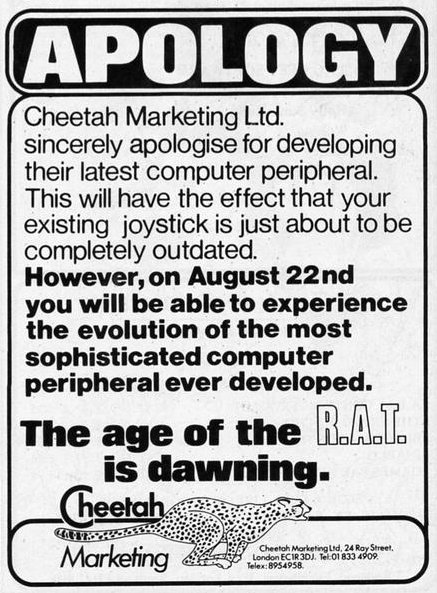



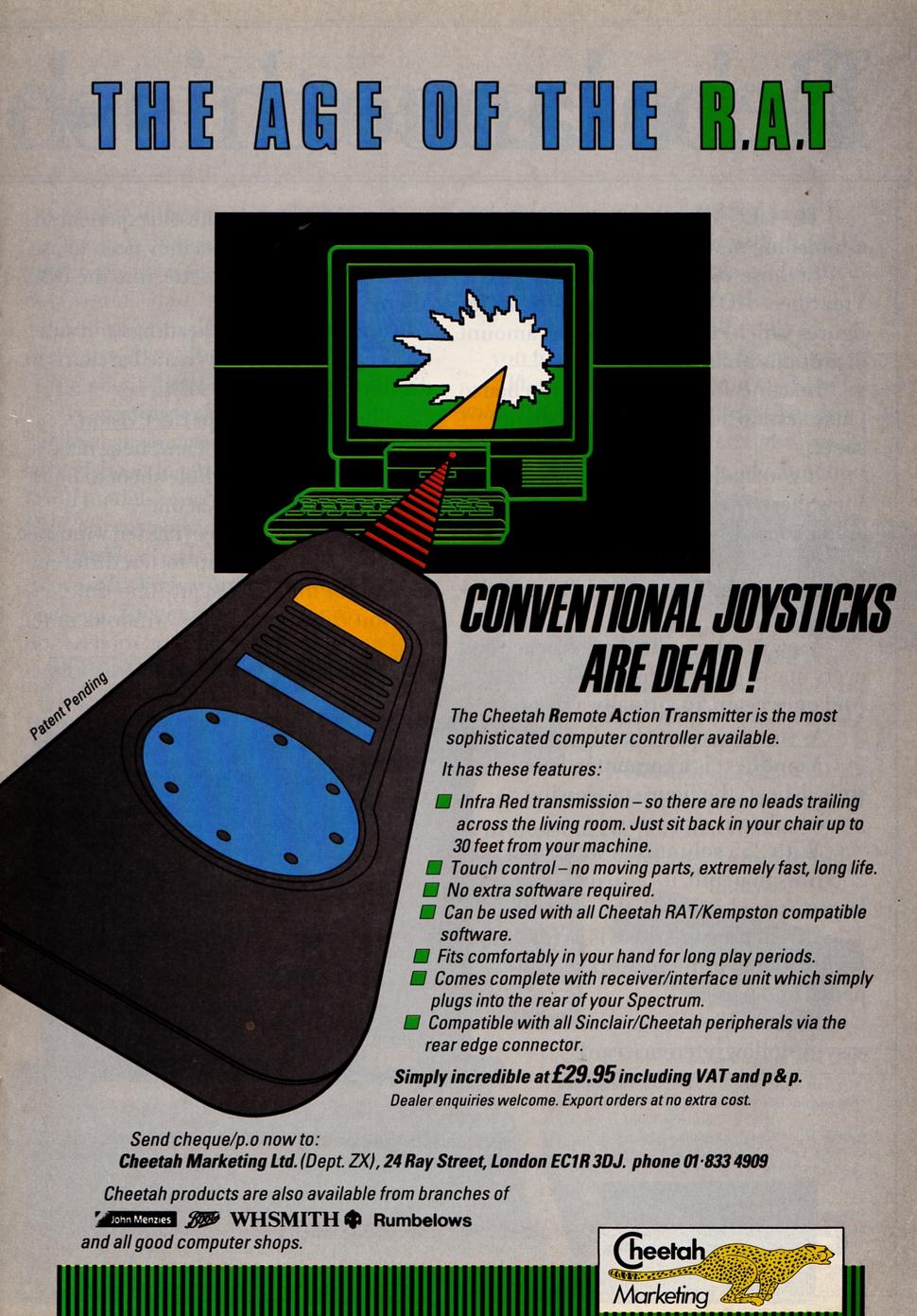
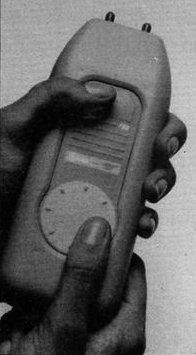
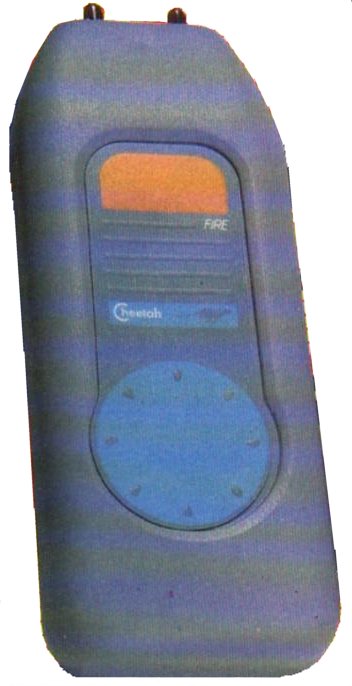
Remote Action Transmitter. Infra red game pad that can be used for games. Kempston compatible.
Discussion
Nobody has started a thread about this yet.
Files and rights
No permission is on record either way. Screens and pictures are copied here on a take-down basis: if you hold the rights and want something removed, say so and it goes.
Awards and competitions
Big K - Readers Poll 1984
- 1Naffware of the Year
In the magazines 95
Sinclair User #46Jan 1986 · p.54
John Lambert
STICKING TO THE BEST Zap in style. John Lambert juggles with joysticks. Joysticks are the most popular add-on for the Sinclair computers, not just for playing games but also for drawing, cursor control in word processing packages and for moving anything around the screen. The keyboard can be used for all of those things but it is so much easier with a joystick. Choosing a joystick from the hundreds available is not an easy decision, but this guide will show you what to look for, and how to connect it to a Spectrum or QL. Joysticks are generally all the same. They may be different shapes and sizes but they all contain a number of simple switches which get turned on or off as the stick is moved. That type of digital joystick was first used on a home computer by Atari and, therefore, is sometimes known as the Atari standard. All Sinclair machines use this type of joystick interface. The switch used can vary a great deal. The cheapest joysticks, such as Quickshot 1, us a bubble which when compressed by the stick makes contact. Those can wear fairly quickly and cannot stand up to heavy use. Next in price and strength are leaf spring switches where the stick causes two pieces of metal to make contact. Finally, the most expensive joysticks use microswitches. Those will last a long time and can easily be replaced should they go wrong. Generally, you should buy the most expensive joystick you can afford as that way it should last a long time. Try to get one with a metal shaft in the handle - plastic ones break - and, if possible, try it out in the shop. The feel of a joystick is very important, some are sloppy and others require a lot of movement before they register. it is within the interface that the complications arise. All interfaces have at least one Atari standard socket where the joystick is plugged in, but those vary in how they tell the computer when the stick has been moved. Which type of interface you buy will depend on what software you want to use with it. The most common method is known as Kempston - named after Kempston Microelectronics who invented it. What that does is to configure the interface as part of the Z80 I/O map so that it can be read - to find what position the joystick is in - using the instruction IN 31. Another method is for the interface to emulate the cursor keys - five to eight plus zero as fire. For obvious reasons that is known as Cursor. The third method is known as Sinclair and emulates the six to nine keys, with zero as fire. That is based on Interface 2 from Sinclair. Why Sinclair wanted to bring out yet another method is anybody's guess! The problem is that until you but the software you have no way of knowing which of those three methods it will use. Many programs give you a choice but unfortunately not all. The way to get round that is to use a programmable interface. Those allow you to let each stick direction and fire represent a key on the keyboard. All games have a keyboard option and you just set the interface to the keys it uses. That also gets round the problem of game that do not use any of the three normal methods - Psion is very bad in that respect. Unfortunately, programmable interfaces tend to be the most expensive, and in some cases can be very difficult to set up. For playing arcade games a Kempston standard interface is the most useful, and the cheapest. Some interfaces combine more than one method in the same box, but the more facilities it has the more expensive it will be. Some joysticks offer extra facilities and you should take care when buying those. Although it is popular to have two fire buttons on a joystick, in many cases they are joined electrically and perform the same function, so it does not matter which one you press. Some joysticks, however, have two, independent, fire buttons and some interfaces can take advantage of this. That type of joystick can also be used with interfaces which normally only expect one fire button, and so are particularly worth considering. Care should be taken, though, as pressing the used button on some interfaces, will cause the computer to crash. Another common extra is auto-fire, giving an auto repeat on the fire button. In order to make their interfaces more attractive some companies add extras which are not related to joysticks. The best known is probably the Nidd Valley Slomo which lets you slow down the computer so that - in theory - the games are easier to play. Two other products, the Opus Discovery 1 disc drive, and the Mikro-Gen Mikro-Plus include Kempston compatible interfaces. As far as the QL is concerned life is much simpler. The two control sockets on the back are already wired to emulate either the cursor keys and space, or the function keys. All you need to plug in a joystick is an adaptor which fits the control socket at one end and a standard joystick at the other. Joysticks are available which plug straight into the QL - ones that have a QL style plug rather than the Atari standard. The problem with those is that when you upgrade to a different computer you will have to buy another joystick, as it is unlikely it will fit the new machine. Buying a joystick and interface can be a harrowing experience. Don't be afraid to try out half a dozen in a shop - and don't buy from a shop which won't let you experiment. Ask your friends and, of course, read the reviews in Sinclair User. PROTOCOL 1 Company: AGF Telephone: [redacted] Price: £9.95 Kempston compatible interface which contains a through port. PROTOCOL 2 Company: AGF Telephone: [redacted] Price: £14.95 Kempston, cursor interface. Contains a through port. PROTOCOL 3 Company: AGF Telephone: [redacted] Price: £19.95 Programmable interface. As Protocol 4 but not Kempston compatible. PROTOCOL 4 Company: AGF Telephone: [redacted] Price: £29.95 Programmable, Kempston compatible interface. Top of the range interface which uses a system of preprogrammed cards. Those clip over a membrane on the interface. Also has a through port, reset switch, and free demo tape. Fiddly to program but one of the few which allows auto-fire. It also allows a second interface to be plugged into the back for a second player. COMCON Company: Frel Telephone: [redacted] Price: £19.95 Programmable interface which, although it may not look too good, is easy to program using leads plugged into a matrix. Can run joysticks with two fire buttons. GAMES ACE Company: Datel Telephone: [redacted] Price: £10.99, £17.99 (with Quickshot II) Kempston compatible interface. Allows the use of auto-fire joysticks and outputs sound through the television. SWITCHABLE JOYSTICK INTERFACE Company: Datel Telephone: [redacted] Price: £12.95, £19.99 (with Quickshot II) Kempston, cursor, Sinclair compatible interface. Switchable interface which covers all the main joystick standards. Can be used with auto-fire joysticks. TURBO ACE Company: Datel Telephone: [redacted] Price: £15.99, £22.99 (with Quickshot II) Kempston, cursor, Sinclair compatible interface. Top of the range model which includes all the features of the Games Ace and the Switchable interface. Well priced for the wide range of facilities. DUAL PORT Company: DK'tronics Telephone: [redacted] Price: £13.00 Kempston and Sinclair compatible interface. Interface includes two sockets, one for Kempston and one for Sinclair. PROGRAMMABLE Company: DK'tronics Telephone: [redacted] Price: £22.95 Programmed by loading software from tape. FORMULA 1 Company: Kempston Telephone: [redacted] Price: £16.95 Large joystick with two - not independent - fire buttons. It uses micro switches and has a metal shaft so it should last a long time. Good value. FORMULA 2 Company: Kempston Telephone: [redacted] Price: £11.95 Three fire buttons and plenty of movement for the careful enthusiast. PROGRAMMABLE Company: Fox Telephone: [redacted] Price: £28.95 Programmable interface holding the details of which keys to use for 16 games in a battery backed RAM. Can also be used as a Psuedo ROM. Good operation and value for money. FLIGHTLINK HOTSHOT Company: Frel Telephone: [redacted] Price: £10.50 Small hand held joystick with a very good precise, action and two independent fire buttons. JOYSTICK INTERFACE Company: Kempston Telephone: [redacted] Price: £9.95 Kempston interface made by the inventors of the standard. KEMPSTON PRO Company: Kempston Telephone: [redacted] Price: £16.95 Kempston, cursor, Sinclair compatible interface with three sockets and a slot for games ROMs. Covers all the main standards including two Sinclair sockets, one to five and six to zero. TRISTATE Company: Kempston Telephone: [redacted] Price: £12.95 Kempston, cursor, Sinclair compatible interface. Two sockets cover all the main standards. MIKRO-PLUS Company: Mikro-Gen Telephone: [redacted] Price: £14.95 Kempston compatible interface. Sold as part of the Shadow of the Unicorn game and has 16K of EPROM onboard which will be used in subsequent MikroGen games. Expensive for just a Kempston compatible interface but good value - if you like the game. PACESETTER Company: Nidd Valley Telephone: [redacted] Price: £14.95 Kempston interface with through port and Slomo. PROGRAMMABLE PACESETTER Company: Nidd Valley Telephone: [redacted] Price: £29.95 Tape programmable with Slomo built in, and the ability to use two independent fire buttons. Good range of features. QUICKSHOT 1 Company: AGF Telephone: [redacted] Price: £7.95 Basic joystick which has been overshadowed by the II. QUICKSHOT II Company: AGF Telephone: [redacted] Price: £9.95 Popular joystick, rather fragile and hence, tends to wear out quickly. RAT Company: Cheetah Telephone: [redacted] Price: £19.95 Infra-red remote control joystick and interface. The recently reduced price is good for a complete system and it is the only remote control joystick for the Spectrum. The joystick is a pressure pad which takes a while to master. If possible try one out before buying. TURBO Company: RAM Telephone: [redacted] Price: £18.50 Kempston, cursor, Sinclair compatible interface. All the main standards including two sockets for Sinclair, one to five and six to zero. Also included are ROM slot, full width through port and a reset button. SCOREBOARD Company: Kempston Telephone: [redacted] Price: £19.95 Joystick housed in an enormous consol which is bigger than the Spectrum. Fine if you want to pretend you are in an arcade but a bit over the top. SPECTRUM INTERFACE Company: RAM Telephone: [redacted] Price: £9.95 Standard Kempston interface without through port. SPECTRUM KC Company: Nidd Valley Telephone: [redacted] Price: £8.95, £9.95 (with through port) Kempston compatible interface. Good price for a Kempston with a through port. SUPREME JOYSTICK Company: Cookridge Computer Supplies Telephone: [redacted] Price: £15.95 SURE SHOT JOYSTICK Company: Cookridge Computer Supplies Telephone: [redacted] Price: £12.95 - QL, £15.95 - Atari ZIPSTICK Company: Cookridge Computer Supplies Telephone: [redacted] Price: £12.95 Joystick which is guaranteed for two years' wear and tear.
C&VG (Computer & Video Games) #41Mar 1985 · p.1105/105/10
Function Rating 5/10
Design Rating 5/10
JOYSTICKS - WHAT TO LOOK FOR When it comes to joysticks, value for money can be difficult to assess. Naturally, you want one that's human proof, flexible, accurate and not likely to fall apart - so, to help you in your search, C&VG did a test run to see what you can expect for your money. We found that the most expensive wasn't necessarily the best. Aside from working out how much you can afford, decide what you want in terms of design and size - if you have limited desk space, or even no desk space at all, you may need one of the mini versions that is either hand held or stays rooted to the spot by little black plastic feet attached to the base, to stop it slipping. You may also have figured that most joysticks come in zap-pow colours like red/black, but more variations on the colour theme keep appearing and, more importantly, there is an increasing abundance of touch-sensitive joysticks, like Cheetasoft's RAT. RAT, which stands for Remote Action Transmitter, is a nice little gadget that enables you to play games without all those awkward dangling wires getting in the way. The RAT comes in two parts - the stick itself with a touch sensitive control surface and the receiver interface which plugs into the back of your Spectrum or Commodore 64. The stick looks more like one of those gizmos you get to work your TV set with - except instead of buttons it has that touch sensitive pad for direction control and another pad for firing/jumping. The RAT is fully Kempston compatible and is available for the Spectrum and Commodore 64 at £29.95. Maidenhead-based company Wico do a selection of traditional-style joysticks priced between £15 and £45, made specially for the CBM 64, Atari and Vic 20. The best one, in my book, is also the cheapest, at £13. Light grey in colour, with a black gear lever and white fire button on top. The Boss looks rather like a vacuum cleaner. However,it will zoom you around arcade games at the speed of light and has decent finger grips for you to hang onto. Their strangest joystick is the £25 Three Way Deluxe which comes with three different grips. One is a puny oval shape, another resembles an outsize radish which is very difficult to hold and the third is very similar to The Boss. This last one, again with proper finger grips, is the only one I'd use if given the Three Way joystick as a present. All three are red on a black base and the two fire buttons can be found on the base and grip tops. The selector switch determines whether you use one fire button or both at once and each grip is easy to pull on or off, without being too loose. However, the price seems excessive unless you really are going to use all three grips - remember you could get an equally good joystick for £12 less. But, to be fair, the thin grip may be good for little kids whose hands can't manage the bigger models. This one didn't work as effectively as The Boss - or, for that matter, the Redball joystick. Despite its name, the latter is a grip-type rather than ball-type joystick and costs £23. Again, there are two fire buttons and a selector switch so you can choose which one you want. Although you have to wrestle a fair bit with this one, it is accurate. However, there is always the problem of gaming cramp - rather like writer's cramp. It certainly makes you limp-wristed - just as if you'd been trying to twist the top off a new jar of marmalade. So instead of giving your aching wrists a break and shaking them around periodically, you may care to raid the bank and fork out a whacking great £45 for Trackball. However, this one was the least reliable of all when tested, with absolutely no results at all. It didn't matter which way you span the ball - you got about as much action as Silent Night. This offering is visually quite plain, consisting of a white ball in a square box with a red top and one fire button. Kempston's joysticks inspired both love and loathing. Love was directed at their cute Junior Pro joystick which is red all over and very tiny - great if you have an untidy desk or limited space. It costs only £5.99, and works very well indeed. More attractive than most joysticks due to its miniature features, it's a smart, compact little number which will work on Vic 20, Atari, CBM 64 and Sinclair Spectrums. Like all the joysticks previously mentioned, it has little rubber feet on the underside of its base to stop it sliding around during use and one fire button can be found on the base. The company isn't kidding when it says this joystick has been designed to combine economy with high performance - the price is unbeatable and shows you don't have to shell out loads of bread in order to make sure you get a good product. Meanwhile, on the other side of the fence is the BBC Pro joystick, also from Kempston at £16.95. Its ugliness is its most interesting feature. Loaded with clashing colours, it looks like a big, square milky bar with two huge red fire buttons on the base, brown grip and black lead. Also for the BBC is Strike Control, a set of two joysticks from Consumer Electronics at £13.85. These can be hand held or left on a surface and, while they're quite dinky and attractive looking, the duo we tested didn't work at all well. Of the two blue and white boxes with black switches at the top, only one worked. If there were two of you playing a game, one of you would be right out of luck. However, the one that did work did an excellent job and can be recommended. From the same company come three more joysticks - Slik Stick, Starfighter and Joy Sensor, all for the Atari, Vic 20 and CBM 64. The first, although it sounds like a make-up pencil or cover-up stick, likes moving characters up or down but has an aversion to right or left. This is a shame, as it is a really smart number, black and orange with quite a sophisticated finish and one base fire button. This one can also be used on the TI-99/4A but you'll need adaptor model 11060 first. The £8 Starfighter gave much the same performance, with up or down movement but apparently no left or right. This one also looks quite good, in a mixture of black, silver and orange, but design-wise is not quite as smart as the Silk Stick. Last but not least, the Joy Sensor seems to have no sense of left or right, either. This £14.65 model is a touch sensitive joystick simulator resembling a calculator without any buttons. But you won't be in luck if you want to use these joysticks on the Commodore C16 - its joystick ports are different from those on the CBM 64 and Commodore expects you to purchase your joysticks from Commodore dealers only. MAKE: The Boss FUNCTION RATING: 9 DESIGN RATING: 6 DISTRIBUTOR: CGL, [redacted] MAKE: Three Way Deluxe FUNCTION RATING: 5 DESIGN RATING: 4 DISTRIBUTOR: CGL, [redacted] MAKE: Redball FUNCTION RATING: 7 DESIGN RATING: 7 DISTRIBUTOR: CGL, [redacted] MAKE: Trackball FUNCTION RATING: 2 DESIGN RATING: 3 DISTRIBUTOR: CGL, [redacted] MAKE: Junior Pro FUNCTION RATING: 9 DESIGN RATING: 9 DISTRIBUTOR: Kempston, [redacted] MAKE: BBC Pro FUNCTION RATING: 8 DESIGN RATING: 3 DISTRIBUTOR: Kempston, [redacted] MAKE: Slik Stick FUNCTION RATING: 5 DESIGN RATING: 8 DISTRIBUTOR: Kempston, [redacted] MAKE: Starfighter FUNCTION RATING: 5 DESIGN RATING: 7 DISTRIBUTOR: Kempston, [redacted] MAKE: Joy Sensor FUNCTION RATING: 5 DESIGN RATING: 5 DISTRIBUTOR: Kempston, [redacted] MAKE: The RAT FUNCTION RATING: 5 DESIGN RATING: 5 DISTRIBUTOR: Cheetahsoft
Above: Redball £23.00. Below: Three Way Deluxe £25.00 both from Wico.
BBC Pro Joystick £16.95 Kempston.
Joy Sensor from £14.65 Consumer Electronics.
Junior Pro Joystick from Kempston.
Strike Control from £13.85 Consumer Electronics.
The Boss £13.00 from Wico.
Sinclair User1985 · p.14
HARDWARE WORLD With ever-increasing amounts of peripherals available for Sinclair computers, users are finding it more and more difficult to know what to buy. We present a buyer's guide to joysticks, keyboard and printers and review the best of the rest from the 1984 add-on market. Joysticks are a popular addition to the Spectrum and many people find it essential for zapping aliens or flying a simulator. In the last year there have been a number of interfaces and joysticks launched, some with more success than others. Nearly all joysticks have accepted a common standard, that of Atari which was the first company to add joysticks to a computer. The style of the joysticks may vary but the connection to the interface remains the same. To use a joystick some form of interface is needed. One, or more, of three standards are normally used. 'Cursor', sometimes known as 'Protek', simulates the four cursor keys for the directions with 0 as fire, 'Sinclair' allows for up to two joysticks and simulates keys 1 to 5 and 6 to 0 respectively and 'Kempston' which does not simulate any of the keys but uses a port address. The most common of those is the Kempston but it is by no means universal. To overcome that a programmable interface can be used which allows you to use any key for any direction or fire. The method of programming varies, some need a tape to be LOADed, while others require you to press a key and then to move the joystick in the direction which that key will simulate; some have physical connections which must be made to signify the key and others simply use a stored memory of which keys are to be used. GRANT DESIGNS & EEC Two designs combine the interface and joystick in one. The Grant Designs Spectrum Stick and a similar one from EEC clip to the Spectrum keyboard over the cursor keys and use a mechanical system to press the keys. Inside the Spectrum Stick there are two frames which move independently up and down, and left and right; to those are attached ramps which push little feet onto the relevant keys. The EEC joystick is more substantial. The casing is a one-piece moulding which fits snugly onto the Spectrum case. Inside that the stick is securely joined to a shaped plate which presses on one or more levers which in turn depress the key. Both are priced at £9.95 and are far cheaper than anything else on the market. Provided they are used with restraint they are better than nothing. RAM TURBO INTERFACE The RAM Turbo interface from Fleet Electronics is what the Sinclair Interface 2 should have been and was not. As well as having two joystick ports, it has a ROM cartridge slot. Moreover, one of the joystick ports can be used for Kempston compatible games and the other can be used as a Protek compatible port. It is similar in size to the Interface 2 but the rear connector is full Spectrum-size as opposed to the Interface 2 ZX-81 size. The area surrounding the joystick port is large enough to take a standard joystick connector. Users who have either built their own joystick or use the Flight Link joystick will have found problems with Interface 2 as the left-hand, most commonly used, port is too near the raised ROM slot. In order to prevent users fitting the interface with the power on (the surest way to blow up your Spectrum) it incorporates a 'Spectrum Protect Adapter', a loop of plastic which covers the power socket on the Spectrum so that the lead must be removed before fitting. If you are considering the Interface 2 then think again; the RAM Turbo interface is better designed and better value for money, costing £22.95. PROTEK INTERFACE The new switchable interface from Protek can be configured for all three of the standards by using a switch on the back. The interface is dead-ended, so it must be the last add-on fitted. As with the Turbo interface, it is liable to crash if used with a twin fire button joystick. Its main drawback is that in the Protek position the top row of keys is disabled, while in the Sinclair position only the 6,7,8,9 and 0 keys are disabled, which could make some games difficult to play. The switch would have to be moved, the key pressed, and the switch returned to its original position. Despite the above problems, which should not affect most users, the interface is easy to use and covers most games on the market. It is priced at £19.95. ELR INTERFACE The programmable interface from East London Robotics for the Spectrum has the distinction of being the cheapest on the market at only £10.00, if bought together with a Trickstick. The interface, as ELR would be the first to admit, was designed to be 'cheap and cheerful' and it is, even to the extent of being uncased. In order to program it small metal clips are used to connect pins which represent the various rows and columns of the keys on the keyboard. That is fiddly and time consuming if you need to reprogram it, but has the advantage that once programmed it is usable from power up. If the interface is purchased separately its price is £15.00. COMCON INTERFACE Frel Ltd market the ComCon programmable interface. Any key on the keyboard can be programmed and there is provision for two fire buttons. To match the interface Frel also markets two compatible joysticks. The interface is of simple design and to program it you have to plug the relevant lead into the pin you want. That can be done with a program running and the keyboard is not disabled. Any joystick with a standard plug can be used and if that has only one fire button then the F1 lead is used. To allow for other add-ons there is an extender card which rises vertically from the front of the board. The two joysticks which Frel markets are the Flightlink and the Quickshot II which has been adapted to have the independent fire buttons, F1 on the trigger and F2 on top. At £19.95 the interface is one of the least expensive and the ease of programming should ensure steady sales. The two joysticks are £10.50 for the Flightlink and £13.95 for the Quickshot, both less £2.00 if ordered with the interface. CCI INTERFACE The interface from Custom Cable International needs a software tape to program it. It can accept any standard joystick; there is no extender card, so it must be the last add-on plugged in. Programming the interface is straightforward. In all, only 10 keypresses are needed plus two to confirm everything is order. The program is written entirely in BASIC which makes it very easy to customise. This is a good interface and competitively priced at £15.00, but it could have been even better if the instructions had been more detailed. PAGE & RAINBOW The Page and Rainbow interfaces are of the kind where you must push a key, move the joystick, release the joystick again for the four positions plus fire, again for the diagonals, again for the diagonals plus fire and finally the fire button on its own. All of that can be done with the game running as the keyboard can still be used. Some people will find that time consuming and fiddly. The one really useful feature of the Page interface is a rapid fire switch. When that is in the up position it simulates the fire button being held down, very handy for the 'zap everything in sight' type of game. The Rainbow interface includes a beep amplifier. With the Rainbow interface at £24.00 and the Page one at £26.00, they deserve consideration provided you do not mind the time and hassle of programming them. FOX ELECTRONICS The programmable interface from Fox Electronics, on the other hand, is probably the easiest of all to program. You only have to flick a switch once you have told it which keys to use. When the switch is up a menu is displayed on the screen. You have the option of creating a new key set, from any of the forty keys or selecting, with a single keystroke, one of the sixteen sets already created. Pressing the E key exits to Basic to load the game and programs the joystick. If necessary the key sets can be saved on tape. Leaving the switch down enables the Spectrum to ignore interface. Inside the interface is a RAM chip and a small ni-cad battery, and on power down it retains the information in its memory for a minimum of six months. When switched on the interface pages the Spectrum ROM and jumps to the program held in its RAM. The program then transfers itself into the Spectrum RAM, pages the ROM back in and puts the menu on the screen. On pressing the E key the program transfers itself back into its own RAM, sets up the joystick and clears the Spectrum memory. Any new key sets created are therefore saved in the process. All that sounds clever but it also has two beneficial side-effects. When the switch is down, the interface causes a hardware reset; in other words, if you have a game running you can jump out of it without pulling the plug - a saving on plug wear. Secondly, details are available from Fox for a machine code programmer to adapt the interface as a pseudo ROM. Often used routines such as toolkits, printer driver programs or complete character sets could then be loaded at the flick of a switch. At £28.95 the interface is excellent value. TRICKSTICK One of the more unusual joystick devices launched in 1984 was the long awaited Trickstick from East London Robotics. In fact, to describe it as a joystick is misleading. It is a 7in long black cylinder with six touch sensitive pads which simulate the four joystick movements, plus two fire buttons. The Trickstick comes with an interface, up to eight of which can be plugged in at any one time, and has the option to give proportional movement on specially written games. It simulates the Kempston joystick so there are many games available on which it can be used. The touch pads use your body as an aerial to pick up mains hum. That is converted by the electronics to simulate the key press. As some people are better aerials than others the sensitivity of the stick can be altered by a small screw near the top. A minor fault is that the lead from the interface to the stick fouls the power lead. It takes some getting used to unlike a joystick, but once mastered is just as useful. As it has no moving parts it should stand up to wear and tear and it is quicker than most others. It costs £34.50. Nineteen eighty-four has been a quiet year for standard joysticks with only two given much publicity. DELTA 3S The Delta 38 from Voltmace has two independent fire buttons, one of which is doubled up for left or right handed players, and rotary switches are used on it. Those switches give it a light action and it can be comfortably held in the hand. At £10.00 the joystick is good value, its solid construction should ensure long life. SUPER CHAMP The Super Champ, currently marketed by Dean Electronics, is unusual in that the cable is held in the base. For use the cable is pulled out and, when you have finished, rotating the stick winds the cable inside. The stick is very long and thin and has two fire buttons, one on top and one in the trigger position; those both operate the same switch. The base is, as expected, larger than usual and has four rubber suckers underneath. Because the stick rotates there has to be a certain amount of play in the pivot. That makes precise control difficult unless you hold down the centre. Despite that the joystick works tolerably and the convenience of not having the wire lying around almost makes up for it. The Super Champ is priced at £12.95. RAT Finally, if the advertising is to be believed, the age of conventional joysticks is past and the future belongs to the RAT and its offspring. The RAT (Remote Action Transmitter) operates in a similar fashion to TV remote control handsets; you simply wave it in the general direction of the screen and press the touch-sensitive movement and fire buttons. It is sold with a receiving unit that connects to the Spectrum and is compatible with most popular Spectrum software. The RAT is powered by a normal PP3 battery which fits into the underbelly of the handset. The first of its kind, the RAT suffers minor teething problems and can cause excessive handache but, like the Trickstick, you will soon grow fond of it. The price is £29.95 from Cheetah Marketing and high street stores. Grant Designs, Bank House, Reepham, Norwich, Norfolk NR10 4JJ. Tel: (0603) 870852. EEC, [redacted]. RAM Electronics (Fleet) Ltd, [redacted]. Protek, [redacted]. East London Robotics Ltd, [redacted]. Frel Ltd, [redacted]. Custom Cables International Ltd, [redacted]. Page Computing, [redacted]. Rainbow Electronics, [redacted]. Fox Electronics, [redacted]. Voltmace Ltd, [redacted]. Dean Electronics Ltd, [redacted]. Cheetah Marketing Ltd, [redacted].
ComCon.
Custom Cables International.
Delta 3S.
EEC.
East London Robotics.
Fox Electronics.
Page.
Protek.
Quickshot II.
RAM Turbo.
RAT.
Super Champ.
Trickstick.
Interface: Grant Programmables: No Cursor: Yes Sinclair: No Kempston: No x2 Fire: No Price: £9.95 Interface: EEC Programmables: No Cursor: Yes Sinclair: No Kempston: No x2 Fire: No Price: £9.95 Interface: RAM Turbo Programmables: No Cursor: Yes Sinclair: Yes Kempston: Yes x2 Fire: No Price: £22.95 Interface: Protek Programmables: No Cursor: Yes Sinclair: Yes Kempston: Yes x2 Fire: No Price: £19.95 Interface: ELR Programmables: Yes Cursor: No Sinclair: No Kempston: No x2 Fire: Yes Price: £15.00 Interface: ComCon Programmables: Yes Cursor: No Sinclair: No Kempston: No x2 Fire: Yes Price: £19.95 Interface: CCI Programmables: Yes Cursor: No Sinclair: No Kempston: No x2 Fire: No Price: £15.00 Interface: Page Programmables: Yes Cursor: No Sinclair: No Kempston: No x2 Fire: No Price: £26.00 Interface: Rainbow Programmables: Yes Cursor: No Sinclair: No Kempston: No x2 Fire: No Price: £24.00 Interface: Fox Programmables: Yes Cursor: No Sinclair: No Kempston: No x2 Fire: No Price: £28.95
Sinclair User #32Nov 1984 · p.43
THE RAT SEES RED Conventional joysticks are dead! claims Cheetah Marketing, unleashing the RAT upon an unsuspecting public. The RAT - Remote Action Transmitter - is a joystick with a difference, remote controlled, working up to 15 feet from the receiver unit. The receiver unit has a user port connector and a rear edge connector for other add-ons. The unit picks up infra-red beams from the hand set, which is touch sensitive and similar to TV remote control. The handset has two touch pads which work in a similar manner to the ZX-81 keyboard. In the base is a compartment which takes a PP3 battery. The RAT is operated by pointing its nose at the screen and pressing its pads. The RAT was tried on several games, and was found to be hard on the hands because of the pressure needed to push the pads. When used on TVs with a remote control facility the RAT changed channels constantly without controlling the objects on the screen. Cheetah assures us that this bug has now been eliminated. On other TVs and monitors the RAT worked well. Retailing at £29.95, the RAT can be run to ground in High Street chain stores and computer shops.
C&VG (Computer & Video Games) #37Nov 1984 · p.196
RAT WITHOUT A TAIL Hottest news on the joystick front is that 1984 is the year of the Rat. That's the name Cheetah Marketing's new remote control joystick. Rat, by the way, stands for Remote Action Transmitter and you can now play your favourite Spectrum game without being linked to the computer with all those dangling wires which always tended to get caught round the dog's tail as he walked past. The receiver part is a black box in the same style as Cheetah's other products or the Spectrum, like Sweet Talker for example. This just plugs into the back of the computer and you can then forget that it's there. Other peripherals can still be plugged into the back of it. The clever part is the joystick. In fact it looks more like the remote control gadget for a TV than a conventional joystick. It doesn't actually have a trigger, but is touch sensitive. Direction control comes by touching a circle about 1.5" across. Movement corresponds to where on the circle your finger actually falls, but you soon get used to this method. There's also a touch sensitive fire button and the system performed well when I managed to get my hands on one. The Rat is very accurate and it didn't matter whether I was pointing the joystick at the computer, the TV or anywhere else for that matter. The range is very wide. I managed to get so far away from the screen that I could hardly recognise which game I was playing. The joystick, though, still worked fine! Cheetah is on [redacted] and at £29.95 the Rat seems good value to me. Especially when you realise that it's fully Kempston compatible.
At £29.95, the RAT from Cheetah is the latest in joystick technology. No more wires trailing across the room. Control is easy but it won't be suitable for trigger-wobbling games like Decathlon.
Big K #8Nov 1984 · p.92
Richard Burton
Famous rats of history. The "dirty" one Cagney spoke of; Manuel's pet in Fawlty Towers; the early morning TV one called Roland. To this illustrious list may soon be added the one from Cheetah that controls your Spectrum. R.A.T. - Remote Action Transmitter - is your actual infrared controller. Look, ma, no wires! Cheetah reckon it'll put the joystick about level with the Dodo in terms of mass-appeal. But at nearly £30 a throw I don't think the Dodo's got much to worry about just yet. The R.A.T. consists of two parts. You hold the transmitter, an "ergonomically-designed" unit that looks like a reject from the model-making shop of Star Trek. It contrasts jarringly with the functional black box of the other part, the receiver, which plugs into the Spectrum's expansion slot. The transmitter utilises two touch-sensitive pads (ex-ZX81 owners will feel right at home) for all control functions: a firing pad, with rapid-fire facility, and an eight-direction control pad below. Signals are fed to two infra-red diodes on the R.A.T.'s 'nose' and beamed directly to the receiver which can be anything up to 30ft away (for games playing at this distance binoculars are a necessary optional extra). The infra-red signals operate on a different frequency to TV remote control units so there's no fear of suddenly switching over to 'Dynasty' just when you've cracked the 60th screen of Jet Set Willy. In action the R.A.T. works well. Cheetah claim that it will work with 'most' Kempston-compatible games without any additional software and it seemed to do just that with most of the games it was tested on. Reaction times are fast and the angle of acceptance for the infra-red beam seems fairly wide. Having no moving parts to contend with takes some getting used to and a control disc just doesn't have the same tactile feel that a joystick gives - too many video game companies have discovered this. Cheetah deserve a big hand for the R.A.T. It's innovative, it's easy to use - and its British! But at £29.95 it's not going to take over the world just yet.
Personal Computer News #81Oct 1984 · p.343/53/51/53/53/5
Features 3/5
Documentation 3/5
Performance 1/5
Value For Money 3/5
David Lester 3/5
REMOTE CONTROL RAT This joystick alternative for the Spectrum brought little joy for David Lester. MANUFACTURER: Cheetah Marketing PRICE: £29.95 AVAILABILITY: Retail If you were thinking of throwing away your joystick, for Cheetah's new infra-red device - think again. Be cause the Remote Action Transmitter, code name the RAT, is not up to scratch. PRESENTATION It is a small, grey piece of plastic that looks like a pocket torch, and nothing like a joystick. There are no wires to connect it to the interface since the 'revolutionary' aspect is the fact that the RAT is infra-red. But there is another big difference: instead of the RAT being just a joystick without wires, it is a pressure sensitive pad - yes, that's right, just like the old ZX81 keyboard. GETTING STARTED Getting started is easy enough - just like using any other joystick. You plug the interface into the rear edge connector on the Spectrum (or Interface 1 or 2), place a battery into the RAT, and you are ready to play. The interface works to the Kempston standard, so that you can use your RAT for most Spectrum games. But in case you don't have any Kempston compatible games yet, you can try out your joystick with the test program. When you run the program above, a cursor will appear on the screen. You can use your RAT to move it around the screen - and it will leave a line behind it, so you can draw with it. IN USE You may have gathered that I was slightly sceptical about the RAT in theory: - in practice my doubts became reality. The RAT is hard to use, especially in conjunction with the fast-moving arcade games for which it is intended. With a joystick, it is simple to change direction from left to right, or up or down. With the RAT this is not so - you have to find the exact spot on the touch-sensitive pad which performs the required action. And in the middle of an arcade game, this should be the last of your thoughts (after all, if you're on the point of saving Earth from final destruction, you don't want to be hampered with a troublesome controller). The infra-red part works quite well. There is a wide field for the signals to travel through, so you don't need to worry about pointing the RAT directly at the TV. In addition, it does not interfere with the TV picture, or domestic TV remote control units. Another pitfall of the RAT is that if you wish to play a two player game, then your RAT will interfere with your opponent's, and vice-versa. What's even worse is that the RAT is battery-powered. Can you imagine it - only one mutant hamburger to go, and then your battery runs out. Cheetah has released three games along with its RAT. I used one of these, The Perils of Bear George, to try out the RAT. The game has some reasonable graphics, but very little else, and only emphasised how clumsy the RAT is. I then changed over to using a normal Kempston joystick, and this made all the difference. With the RAT the game seemed difficult, without it there was no challenge at all. Comparing the RAT to the joystick using other software, the normal joystick won hands down. VERDICT Cheetah obviously started with a good idea - a wireless joystick. Although I had never experienced any problems with wires in joysticks, it is nice to be able to sit some way away from the computer and still be able to play a game. But the project after that lacks thought. Joysticks are handy because of their shape, so to return to a ZX81-ish touch-sensitive pad is ridiculous. And to make the RAT battery-powered seems fatal. At this stage Cheetah should call in the Pied Piper to recall all the RATs sold so far and start again. TEST PROGRAM 10 LET X = 127: LET Y = 88 20 PLOT X,Y 30 IF IN 31 = 1 AND X < 255 THEN LET X = X + 1 40 IF IN 31 = 2 AND X > 0 THEN LET X = X - 1 50 IF IN 31 = 8 AND Y < 175 THEN LET Y = Y + 1 60 IF IN 31 = 4 AND Y > 0 THEN LET Y = Y - 1 70 GO TO 20
Your Spectrum #8Oct 1984 · p.3
HAMSTERS TO FOLLOW? Oh for the days when computer peripherals weren't named after vermin! Yes, the RAT is here (Remote Action Transmitter to you!) and it's a new product from Cheetah Marketing. Basically, it's a remote control, touch-sensitive joystick which interfaces - from a distance - with a standard looking peripheral box via infra red transmission. In use, the case of the box made it pretty difficult to get a secure connection on the Speccy's expansion port, but after fiddling around it is possible. In operation, the joystick is sensitive, but there's a marked delay between touching the controls and something happening on-screen. For those who wouldn't touch some games with a barge pole, now you won't have to - you can play from clear across the room. For further details in the £29.95 RAT, call Cheetah Marketing on [redacted].
Advert45
- Your Sinclair #30Jun 1988 · p.98
- Sinclair User #63Jun 1987 · p.50
- Your Sinclair #17May 1987 · p.56
- Sinclair User #62May 1987 · p.7
- Computer Gamer #25Apr 1987 · p.21
- Your Sinclair #15Mar 1987 · p.32
- C&VG (Computer & Video Games) #65Mar 1987 · p.39
- Sinclair User #60Mar 1987 · p.64
- Sinclair User #59Feb 1987 · p.7
- Your Computer #2Feb 1987 · p.34
- Your Sinclair #14Feb 1987 · p.80
- Your Computer #1Jan 1987 · p.30
- ZX Computing #33Jan 1987 · p.7
- Popular Computing Weekly #49Dec 1986 · p.11
- Your Sinclair #3Mar 1986 · p.20
- Sinclair User #47Feb 1986 · p.86
- ZX Computing #23Feb 1986 · p.9
- Your Sinclair #2Feb 1986 · p.71
- Sinclair User #46Jan 1986 · p.4
- Your Sinclair #1Jan 1986 · p.30
- Sinclair User1986 · p.119
- Sinclair User #45Dec 1985 · p.88
- Your Spectrum #21Dec 1985 · p.16
- Your Spectrum #20Nov 1985 · p.52
- Sinclair User #44Nov 1985 · p.15
Full-page ad24
- ZX Computing #18Apr 1985 · p.23
- Your Spectrum #13Apr 1985 · p.44
- Your Spectrum #12Mar 1985
- Sinclair User #36Mar 1985 · p.44
- Your Spectrum #11Feb 1985
- ZX Computing #17Feb 1985 · p.22
- Sinclair User #34Jan 1985 · p.102
- Sinclair User1985 · p.43
- Your Spectrum #10Dec 1984 · p.2
- Sinclair User #33Dec 1984 · p.64
- C&VG (Computer & Video Games) #38Dec 1984 · p.84
- Big K #9Dec 1984 · p.42
- ZX Computing #16Dec 1984 · p.3
- C&VG (Computer & Video Games) #37Nov 1984 · p.185
- Your Spectrum #9Nov 1984 · p.71
- Sinclair User #32Nov 1984 · p.45
- Sinclair User #31Oct 1984 · p.123
- Your Computer #10Oct 1984 · p.148
- C&VG (Computer & Video Games) #36Oct 1984 · p.28
- Big K #7Oct 1984 · p.106
- Your Spectrum #8Oct 1984 · p.89
- ZX Computing #15Oct 1984 · p.27
- Home Computing Weekly #79Sep 1984 · p.23
- Popular Computing Weekly #38Sep 1984 · p.34
News/Note9
- New Computer ExpressDec 1988 · p.4
- Sinclair User #32Nov 1984 · p.43
- Big K #8Nov 1984 · p.92
- C&VG (Computer & Video Games) #37Nov 1984 · p.196
- Personal Computer Games #12Nov 1984 · p.16
- Your Spectrum #8Oct 1984 · p.3
- TV GamerOct 1984 · p.6
- Home Computing Weekly #81Sep 1984 · p.6
- Popular Computing Weekly #35Aug 1984 · p.5
Feature5
- Your Computer #5May 1986 · p.58
- C&VG (Computer & Video Games) #41Mar 1985 · p.110
- Personal Computing Today #6Jan 1985 · p.75
- Sinclair User1985 · p.14
- ZX Computing #16Dec 1984 · p.83
Review2
- Home Computing Weekly #86Oct 1984 · p.15
- Popular Computing Weekly #36Sep 1984 · p.17
CompoResult1
- Your Spectrum #12Mar 1985 · p.11
CompoEntry1
- Your Spectrum #9Nov 1984 · p.39
Related
- Elsewhere
- WorldOfSpectrum
- Same entry at
- Spectrum ComputingZXInfo
Reviews from people here
Sign in to write about this, or make an account. It takes a minute and lets you correct the catalogue too.
Everything ZXDB can hold about this is here.
Sign in to correct or add to this.
Hold the rights to this and want it taken down?