Currah MicroSpeech
Hardware: Sound/Speech
Currah Computer Components Ltd · 1983 · Pound sterling 29.95
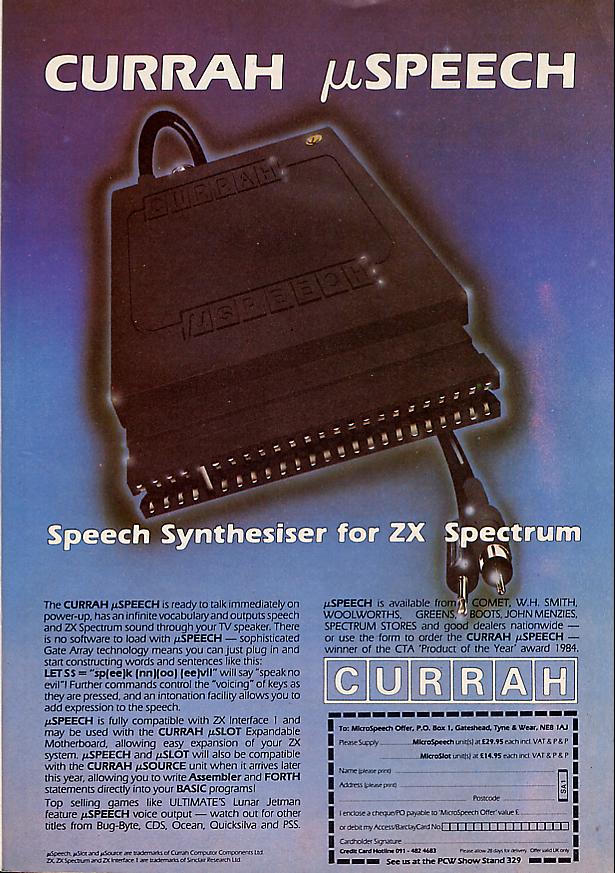
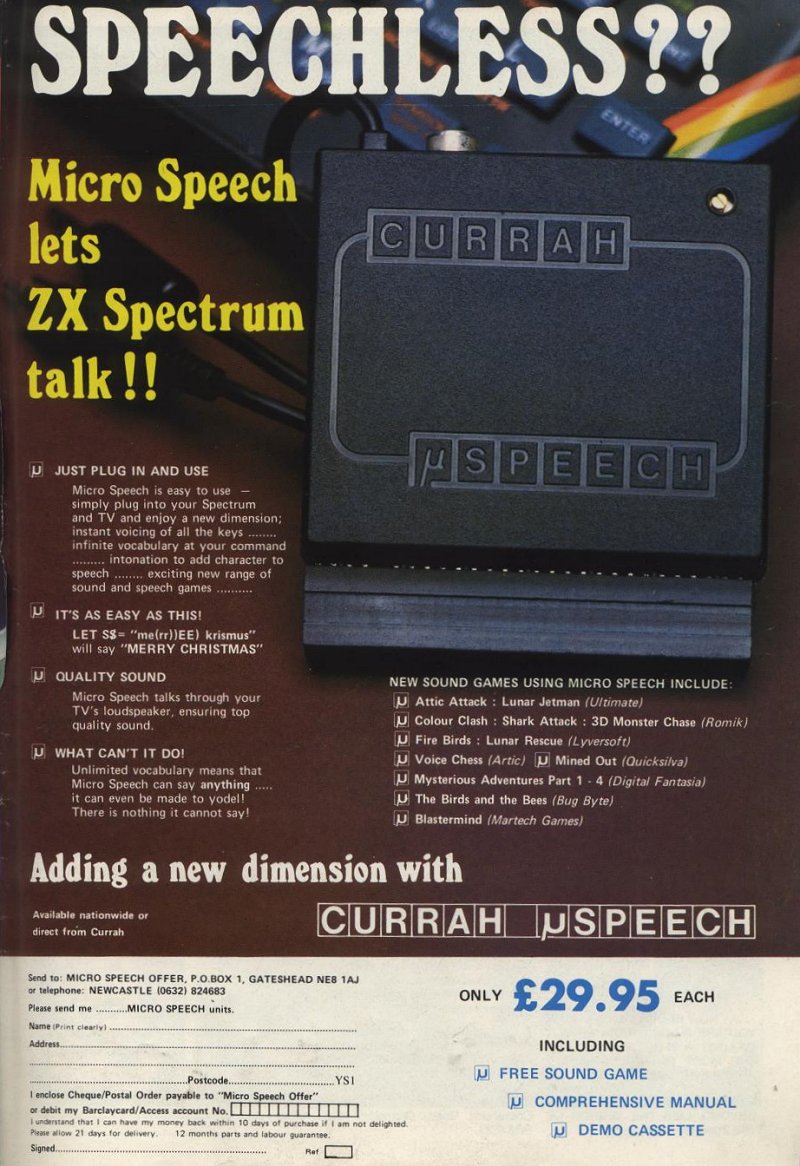
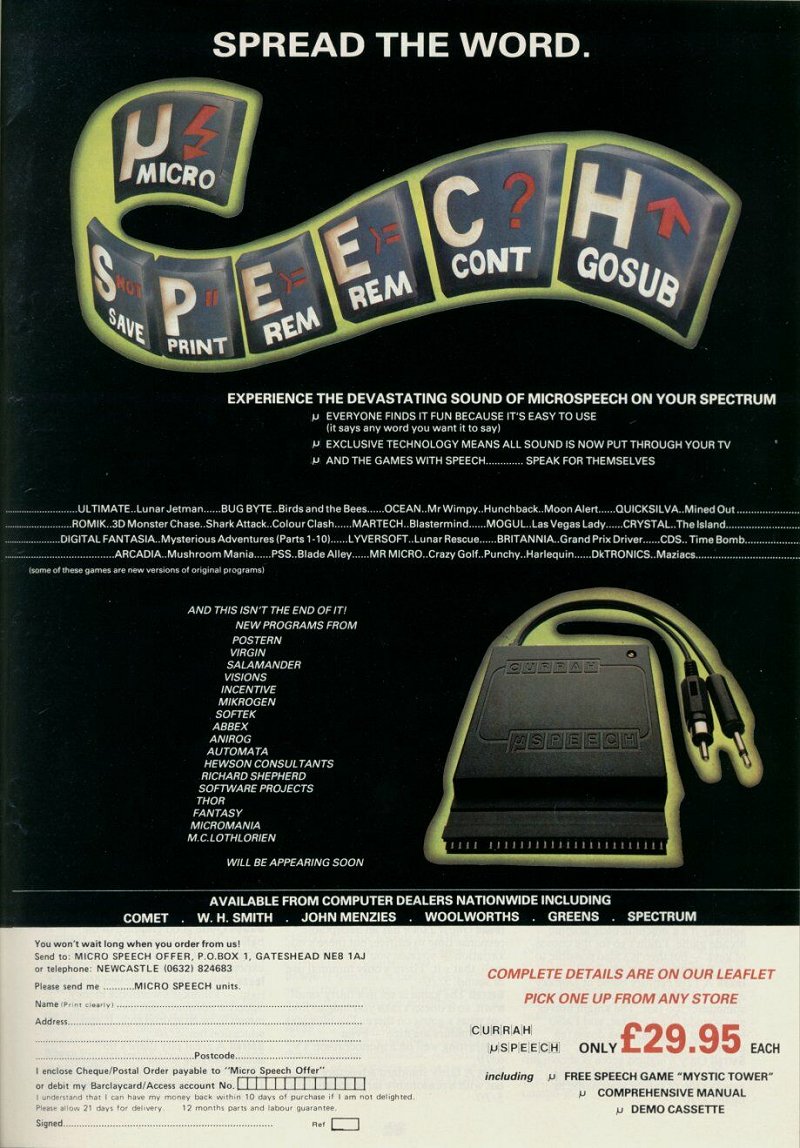
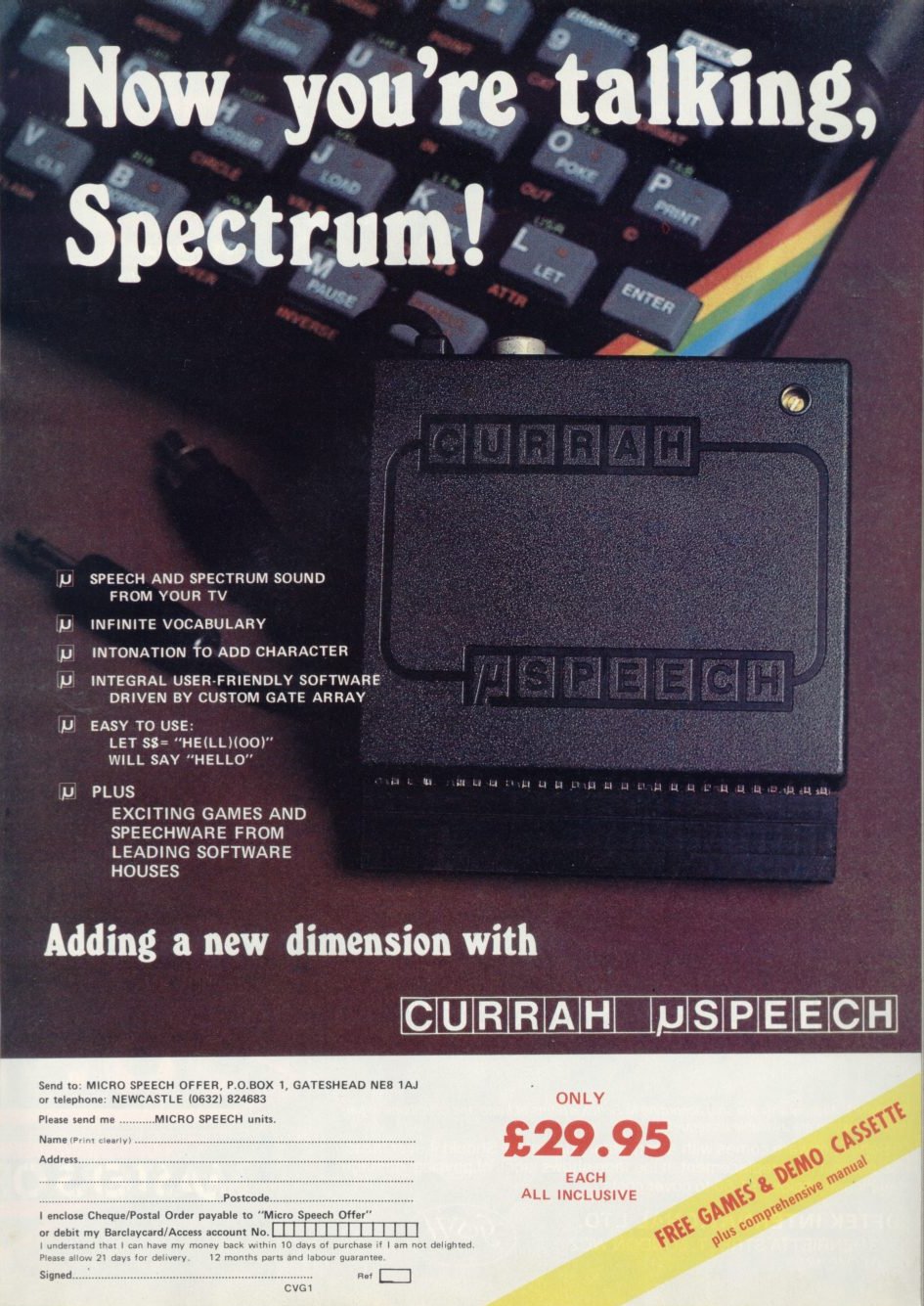
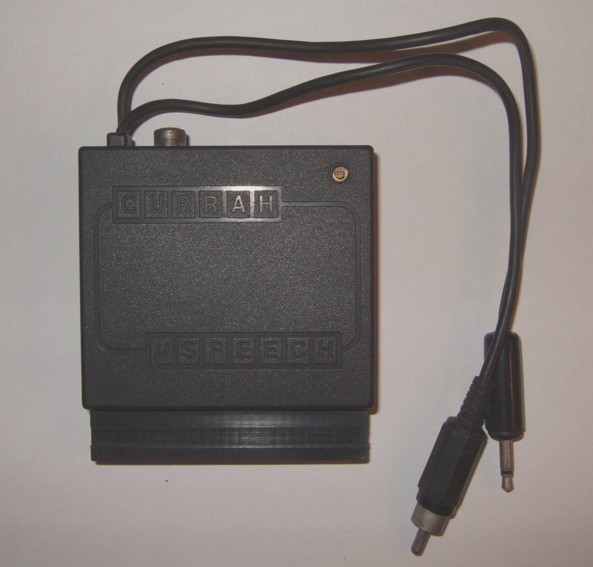
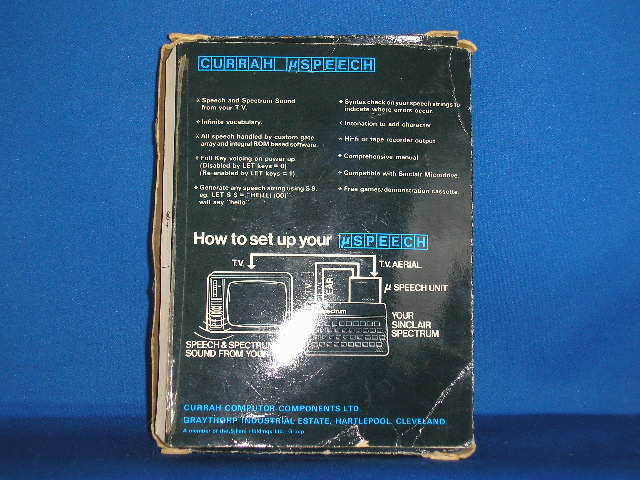
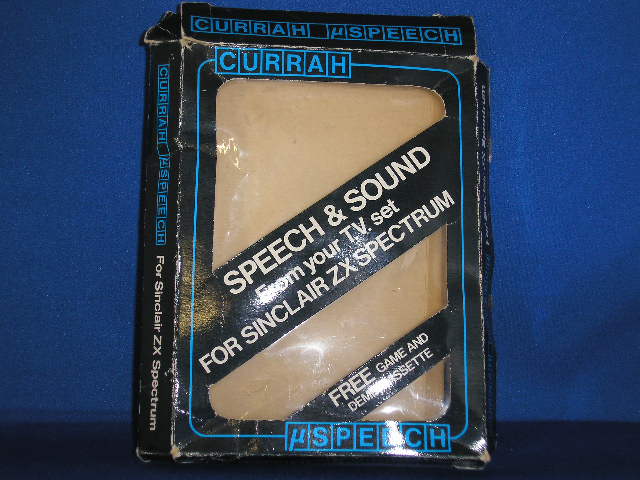
Speech synthesis box using the SP0256-AL2 speech processor. Outputs sound via the TV.
Discussion
Nobody has started a thread about this yet.
Remarks
speech synthesiser
Documents
- CurrahMicroSpeech_ProgrammingManual.htmlInstructions 31 KB
- CurrahMicroSpeech_ProgrammingManual.txtInstructions 26 KB
Other files
- roms.htmlRemote link English
Files and rights
No permission is on record either way. Screens and pictures are copied here on a take-down basis: if you hold the rights and want something removed, say so and it goes.
Scores
Elsewhere on the web
- WorldOfSpectrum 7 votes10.00
In the magazines 99
ZX Computing #17Feb 1985 · p.115
Ray Elder
MUSIC MICRO PLEASE! An outline of some of the more harmonious programs and devices recently produced. Ray Elder takes up the Baton and conducts the investigation. For the professional/dedicated/expert musician there is the Midi interface and synthesiser system, but for many others, including yours truly, the cost of such equipment is beyond the realms of an overdraft. For us interested but impoverished would be musicians there are a few more affordable, though much less versatile, alternatives. FORTE! An essential first step is to do something about the BEEP, there are several ways around this, you can simply amplify the thing or, if you want to get the most from the computer, then you will need to purchase a unit which incorporates a sound chip. Most of these units use a version of the AY-3-8910/8912 chip and this is a well tested and reliable chip which can produce some impressive sounds. Simple amplification of the BEEP can be achieved in several ways and is the least expensive of the two options. Beep amps either have a built in speaker or send the sound to the TV and some such units are: THE CHEETAH BEEP AMP, this puts the sound through the TV and is in the same size box as their other units, complete with a full through port for other peripherals. Cost £9.95. CURRAH MICRO SPEECH unit. This is primarily a speech unit but it also routes the Spectrum Beep through the TV and is worth considering if you want to investigate the world of speech as well. Cost £29.95. DK'TRONICS BEEP AUDIO AMP. This is a self contained unit in two parts, the amplifier interface and a separate 1" pod mounted loudspeaker. The interface has a full through port and, although lipped, fits both versions of the Spectrum securely. Cost £14.95. THE TRICHORD, a full sound box including AY chip, amp and speaker and software for both ZX81 and Spectrum, available from Newtech Developments Ltd. Cost ranges from £24.95 to £26.95 depending on model and internal amp fitted or not. WILLIAM STUART SYSTEMS sound generator unit, designed to go with their speech recognition and synthesiser units but can be used on its own (if plugged into a stereo system it sounds superb). Software is available separately and is excellent, the ARP program kept me fascinated for hours. FULLER (reinstated by Nordic) have a sound unit and a master unit which includes speech, we have not tried one out yet, but the new look packaging is nice. And finally DK'TRONICS again, identical to their beep amp in size and shape is a full Sound Synthesiser. This is based on the AY chip and is supplied with a demo tape. Cost £29.95. THE DK'TRONICS 3 CHANNEL SOUND UNIT I will give a detailed account of this unit as it is one of the few still left in my possession, most of the others had to be returned after each specific review, and anyway its one of the latest on the market, and most are similar in operation. This is supplied with an eight page booklet which gives setting up details, the volume is adjustable by a small screwdriver through a little hole in the top of the unit, full volume is loud enough for most purposes! Some demo programs are given which explain the basics of programming the beast, these are in BASIC but a machine code programmer can glean enough information to enable him/her to incorporate routines in their programs. Most of the manual is dedicated to operating instructions for the program supplied, these are brief and there are gaps which left me confused - the use of the Envelope generator for instance. The software itself is good and allows you to create tunes in 3 part harmony and is cursor controlled, this means that it can be operated by a joystick. However I found it a little tedious to use and the editing is almost non-existent, an error early on means re-entry of the rest of the line. During playback the three lines of music are shown as a letter/number representing note and octave. Without prior musical knowledge you may find it hard to get anything of worth from it. The sound quality itself is very good, the speaker handles the output with minimal distortion and many a long hour was happily spent with this program. A unit which is nicely made, looks and sounds good and is well worth considering. It also works well with other peripherals, the Technology Research Disk drive unit functioned without problems and it was easy to convert the software supplied to disk. The ZXLprint III Centronics unit also sat at the back quite happily, and of course DK's own units, joystick interface etc. proved compatible. MAKE MUSIC is a program produced by the Buffer micro shop which works in conjunction with any Spectrum sound unit using the AY-3-8912 chip and attempts to emulate a three track recorder, similar to the BBC Music Processor program. It is quite successful although rather awkward to operate, the screen display is not as informative as the BBC, and envelope control is non existent. Good, but not as versatile as it could have been, and as far as I know, the only one of its type for the Spectrum. XOR from a company called Xorsoft and described by reviewer Clive Smith as "one of the better ones" and Music Maker from Malan are two programs which help you compose simple tunes with the inbuilt Beep. Music Maker from Bellflower is an early attempt which didn't quite come up to scratch, editing and printer copies are virtually non-existent and there are irritating pauses when a new line is needed. Sinclair's own offering is Musicmaster. When it came out I said that it probably pushed this aspect of Spectrum computing to the limit and it remains a top program in this field. This has two modes of entry, note names and keyboard simulated, editing is good, replay is fast and a stave printout is provided. AND FINALLY... from a small company (you may like to play "spot the advert" for their products) comes my favourite program so far! MUSIC TYPEWRITER from Romantic Robot, [redacted] is a very professional piece of programming, easy to use, excellent screen presentation, error trapping and helpful prompts. Fast replay, versatile editing, stave and note printouts, transposing to other keys, six octaves, treble and bass clefs, 23-255MM (metronome scale), menu driven and up to 16 pieces of music held in memory at one time. Even without an amp it sounds good. Do you get the impression I'm impressed? A keyboard overlay is provided and versions of the program are available for use with a sound generator chip and even with the Midi interface if you so require. If you are interested in music and own a computer then get it. Cost £9.95. For those of you who enjoy DIY then watch out for our Beep amp hardware project and some musical programs soon to be published in ZX Computing.
ZX Computing #14Aug 1984 · p.33
Ray Elder
TALKBACK: SPEECH UNITS ASSESSED When you find you get to the stage where you find yourself talkiing to your micro, it helps if it answers back! From the time the Daleks trundled across our TV screens muttering "Exterminate, Exterminate" in their chillingly inhuman voice, I have been intrigued by speech synthesizers. At the time of writing, and to the best of my knowledge, there are six different units on the market to enable your micro to answer you back. Two others have recently lost their voice, I asked why, but the suppliers aren't talking. The units on the market at the moment are "Sweet Talker" from Cheetah for both ZX81 and Spectrum, "Micro Speech" from Currah, "Orator" from Fuller, "Vox Box" from Datel Electronics, "Chatterbox" by William Stuart Systems, and "S-Pack" by DCP. I contacted all of the above companies and those units that were supplied for review I sent to different reviewers for their independent comments. For your own assessment here's what they thought.... CURRAH MICROSPEECH UNIT Currah Computer Components Ltd [redacted] £29.95 This unit is one of the most easily obtainable, as many shops including Woolworths sell it. Packed in an eye-catching box, the unit itself is neat and lies flat on it's back when connected to the user port, unlike most peripherals which stand upright. It is sold complete with a well written manual and demo tape which also contains an adventure game featuring speech. A useful feature is that the sound, both speech and the normal Spectrum sound, are output through the TV speaker. A drawback is that the unit is dead ended and you cannot add anything on after it. I also found that the leads which are permanently attached to it are a little short if you want to add it on after other units. The unit users an allophone system, but instead of the usual technical means of using the OUT instruction followed by the respective number. Micro Speech reserves S$ for its own use and a ROM in the unit decodes the required word. Although the system is more related to English words, to get the correct pronunciation you have to break the word into its component syllables and reconstruct it in Currah language. "Hello", for instance, is spoken by using LET S$ = "HE{LL> (OO)" And of course there are ways to add information and inflexion to the speech, all of which make it a reasonably complex bit of equipment to use. Currah have spent a great deal of time and effort persuading many software houses to adopt their unit for producing speech in their games, and this is obviously an incentive when purchasing such a unit. Most games also tend to use the Kempston joystick interface as a standard, and the two units cannot be operated at the same time, at least until now! Currah once more show that they are aware of the market and it's shortcomings and have produced an extension to the Spectrum's port which will allow two (or more) units to be used simultaneously. This can be used with other items such as printer interfaces of course. After all this, how does it perform? To be honest, I was disappointed at first. It didn't seem to live up to its promotion. The demo tape seemed indistinct and words were not pronounced clearly at all, a bit of very careful adjustment of the TV and the unit improved this slightly. However after using it for a few days I became used to the electronic voice and began producing scathing comments to go with my games. The software companies who use it seem to get a better quality of speech and so far those who did use it used it sensibly and sparingly. I must now admit that) find it an interesting and effective extension to my Spectrum and will make much use of it. Recommended to anyone who has an interest in going one step further.
Personal Computer News #49Feb 1984 · p.36
David Janda
SPECTRUMSPEAK Spectrum speech synthesis: David Janda says it all. PRODUCT: Sweet Talker MANUFACTURER: Cheetah Marketing, [redacted] PRICE: £29.75 inc VAT PRODUCT: DCP Speech pack MANUFACTURER: DCP Developments, [redacted] PRICE: £29.95 inc VAT. (Extra vocabularies £12.95 each.) PRODUCT: Microspeech MANUFACTURER: Currah Computer Components, [redacted] PRICE: £30 inc VAT. The choice of speech units available for the Spectrum is increasing and it's hard to find a magazine without at least one advertisement for something 'new and exciting' in this field. We compared the Cheetah Sweet Talker with two already reviewed, the DCP (Issue 1) and the Currah (Issue 34). Speech synthesisers can be either allophone or digital. Advertisements for the former usually say they'll speak any word you like, but each word must be built up from a set of allophones. In what can be a time-consuming trial and error process. Furthermore, the allophone systems tend to sound like Daleks. Digital speech synthesisers don't sound so bad but neither are they crystal clear. They use words, letters or numbers digitally encoded onto a ROM or ROMS. To get the machine to say something, a number corresponding to a word is sent to the synthesiser, eg 1 = hello. 2 = goodbye,... Since both methods need lots of memory, chunks of the speech unit's memory are transferred in turn, via a buffer in RAM. CURRAH MICROSPEECH Allophone This unit superimposes sound through the TV speaker, which can also be fed into an external tape or Hi-Fi. Pressing any key causes the appropriate letter sound to be spoken. Like the Sweet Talker, it comes with a demo cassette, but its advantage over the Cheetah is that getting it so say something is more natural than sending numbers to a port - with Microspeech you put words into the string S$, enclose the allophones in brackets, and the unit does the rest. Currah's unit still seems to be the best allophone speech synthesiser for the Spectrum, though upgrades on existing models like the Computer Add-ons Speech Unit, will be interesting. DCP SPEECH PACK Digital Digital speech packs can cost up to twice as much as the more conventional allophone equipment, and they have a limited vocabulary. The DCP pack has just 71 entries in its initial directory of numbers, letters, and a few useful words. These are stored in a ROM, and up to three extras can be fitted with more useful words - at a price - to give a total of about 250 words. Accessing the words is simple: when the number corresponding to a word is entered, the word is spoken. This is done with the Spectrum's our command, and the muss: statement gives gaps mid-speech. The unit attaches to the edge connector, and includes a volume control, though you'll need a screwdriver to adjust it. Digital speech is better than the allophone variety and can be further improved by feeding the pack's output to your amplifier from the audio socket provided - adding a little bass can improve the sound dramatically. CHEETAH SWEET TALKER Allophone The Sweet Talker is a small black box which fits onto the edge connector of the Spectrum. A small loudspeaker is housed at the back of the unit, facing away from the user. There are no volume controls, and no means of connecting it to a tape recorder or Hi-Fi, thereby eliminating one way of improving synthesized speech. With the unit you get a demonstration tape and a two-page manual, keeping the package simple, but limiting control. The document contains a list of the 63 allophones available, along with a data number, letter and example for each. They give a good indication of how the allophone will sound, but there are no details about what memory the unit uses or how it uses it, and machine code programmers will need to know this. The unit runs with a rather annoying buzz, which continues as it speaks, adding to the mechanical nature of the sound. However, you get used to this and it's not difficult to get simple sentences spoken. The fact that the sound remains on until switched off means you can add emphasis and lengthen words, though this takes time and a good deal of practice to get it to sound realistic. It is unfortunate, though, that there is no speech editor with the demo tape, which would enable you to bash in sentences which would be translated into codes and then be spoken. This wouldn't need a mammoth piece of code, and it's a pity that Cheetah didn't supply it.
C&VG (Computer & Video Games) #28Feb 1984 · p.156
Robert Schifreen
EXTRA BITS! If you want to extend the capabilities of your computer or games machine there are now lots of bits and pieces which you can plug into the back to make it do things better or faster, or things which it could never do before. Such plug in goodies include extra memory, better keyboards, joystick interfaces, Micronet adaptor or devices to make the beast speak or play tunes. Robert Schifreen takes a break from Bug Hunting to bring you news of some of the current plastic boxes which you can plug into your micro or games machine. Upgrading your present equipment by using add-ons means that you may not have to buy that new machine after all! COMMUNICATIONS Communications means making your micro talk or listen to other computers in their own language. They communicate either over the airwaves at radio frequencies or over the telephone lines. Each has its advantages. Radio communication is only one-way whereas telephone can be both. But long conversations on the phone can be expensive. If you want to read more about this subject, dig out November's issue of C&VG and turn to page 114. If you want to receive Teletext on your micro, you'll need a BBC model B with a Teletext adaptor. This lets you receive Ceefax and Oracle, which are information services broadcast by the BBC and by ITV. You just plug your TV aerial into the back of the adaptor, and the computer will do the rest. The adaptor gives you four channels of teletext information; BBC 1, BBC2, ITV and Channel 4. You can find out about such things as what's on TV tonight, the latest world news, sports news and ITV also has a kids corner with jokes and the like. Teletext is like a big electronic newspaper, You can read its pages on your TV but you can't write back to it. The other method of communication is over the telephone. This is what systems like Micronet 800 use. This way, the computer can send messages and you can also type back. There are loads of computers which you can dial into and most of them are free except for the price of the phone call. However, these free bulletin boards, as they're called, run on different baud rates (no pun intended) to Micronet so unfortunately you can't use a Micronet adaptor to call them. You can buy a 300 baud modem quite cheaply from various companies, like Maplin Electronics who supply units for the Dragon, Vic-20, Commodore 64, Atari and Spectrum. I tested the Atari one and managed to dial into some local systems and also used Maplin's own service called Cashtel which allows you to order stuff from the Maplin catalogue via your computer by typing in your credit card number. A lot of computer clubs run bulletin boards, and you can dial them up for computing news; you can also send messages to the club by typing at your computer. This is the two-way advantage gained by using the 'phone as opposed to the airwaves. You can set up your own bulletin board with a Maplin modem, but you'll also need some software. You will soon be able to buy a Micronet/Prestel type modem for your BBC micro from Acorn which has some better features than the Micronet package. But it's more expensive, and you'll still have to pay a fee to join Micronet if you want to look at their private areas on the database. You can also buy slightly cheaper modems like the Micro-Myte which will not receive Micronet or other information systems, but will allow you to talk to your friend's computers, providing he or she also has a similar modem. This way you can send each other programs or messages, but you'll have to phone him up first to tell him to switch his modem on! The Micronet modems offer this person-to-person facility as well as normal Micronet use, but are slightly more expensive. STORAGE DEVICES When you finally decide that cassettes are too slow for your needs, you'll want to look for something faster. The best thing is a real disc drive which for micros will probably use 5.25" discs. A cheaper alternative is a 3" drive which is available for many micros. You can buy a Byte Drive 500 3" system from ITL for about £250, and this contains a special cable to link the drive to your micro. If you have two computers, or decide to change your machine, you just buy a new cable. Blank 5" discs start at about £1.50, but 3" systems use special cartridges which are currently about £6. The Byte Drive 500 will soon be available for the Dragon, Spectrum and Commodore 64. It is already available for the Oric, BBC and Apple. If you have a Spectrum, the official Sinclair way of progressing from cassette is the Microdrive. This costs £50 for each drive, but you'll also need an interface which is another £30. You can store between 85 and 100K on a Microdrive cartridge, and a 16K program will load in about 10 seconds. Microdrives are fast, but they're not really discs. Inside a microdrive cartridge is a loop of high quality tape, and the drive itself is just a very accurate (supposedly) cassette recorder. If you've got a BBC then you'll need a disc interface fitted, which costs around £90. ITL has no intention at the moment of producing one, so you'll have to use the BBC one. MORE MEMORY The size of the largest program which you cart fit into your machine is governed by the size of the area of memory in which the computer stores it. The problem is that although memory chips are now quite cheap, some micros still have very little RAM, as it's called. One of the first enhancements which a computer owner will make in such a case is a memory expansion. The ZX81 although very popular has only 1K of RAM. (1K is about two screenloads of program.) It's very easy to expand your ZX81's memory. You can buy a 16K RAM pack which just plugs into the back of the machine and costs around £30. You may have heard of the much-feared contemporary disease known as "RAM pack wobble", caused by Sinclair not putting the edge connector on their RAM pack in the right place. This disease can be fatal to a program, as a slight wobble at the wrong time can erase a whole afternoon's typing. One cure is a blob of something sticky under the machine, although a less messy solution is to look to a different company. You can also get 64K RAM packs which allow for even more storage of data and programs. Upgrades for the 16K Spectrum are available from Sinclair for £40, but you'll have to send your machine back to Clive, and you know how long that takes, don't you? Alternatively, you can buy a ZX81-like RAM pack which sits on the back of the machine, or some companies sell chips which you can stick inside, as long as you didn't really want the guarantee anyway. If you're going to upgrade your Spectrum, check that the company's product will fit your particular machine. There are currently three different versions of the Spectrum in circulation and although they all look the same from the outside, there are some small variations inside which may make a difference. Expansion for an Atari is easy; the memory comes in chunks of plastic which you install by removing the cover on top of the machine. Newer machines come with 48K but some old 400's still have only 16K. Your local dealer should be able to tell you how to improve this. To expand a Texas TI99/4 or 4a you'll need a peripheral expansion box. This takes the form of a large aluminium crate about the size of the small freezer compartment in a fridge. (I don't know why, but everyone seems to measure the size of computers in relation to parts of fridges.) Inside this you can then put disc drives, memory expansions and anything else. Retail price for the box alone was around £80 but that may drop now that the Texas micro is no longer being made. Memory expansion on a Vic is peculiar. It is in the form of plug-in cartridges and comes in four flavours, which are 3K, 8K, 16K or 32K. The annoying thing is that because the cartridge overwrites that part of memory which used to hold the contents of the screen, the screen RAM is moved to a different place. The problem is that each cartridge puts it somewhere different, so programs written for use with an extra 3K will not necessarily run directly on a 16K machine without minor alterations. This is very inconvenient, especially for magazines who publish program listings! If you're tired of having to do octopus impressions to play your favourite computer game a joystick interface is called for. This allows machines which normally have no provision for such a gadget to have one, and very useful they are too. The most popular machine, which lacks a joystick interface, is the Spectrum, and there are now quite a few companies who will remedy this situation for you. The official way is by use of the Sinclair Interface 2. This costs just under £20 - you get 5p change! - and allows two standard Atari-type controllers to be used. You can then write your own games using the joysticks to control the action, or buy commercial software written for use with the device. Interface 2 also allows you to use plug-in cartridge software, although these retail at £15 a time. The problem with all the different joystick interfaces is that they use their own systems. So a program written for use with a Kempston joystick will not run on an Interface 2 unless the program contains a routine for each and you are allowed to select which one you want. One way round this predicament is by a programmable joystick interface. Such a beast is the one from AGF. This comes with a grid of small holes and a set of five wires. The wires are labelled with the functions of the joystick (up, down, left, right and fire) and the holes are labelled with the keys on a Spectrum keyboard. If the game which you want to play uses the 'K' key to fire, then you plug the 'FIRE' lead into the 'K' hole and so on. Such a device is very useful. BETTER KEYBOARDS When you finally tire of the piece of dead flesh known as your Spectrum's keyboard, there are a number of better ones around. The best are quite expensive at around £40 but they allow the whole machine to fit inside and look rather smart. One of the most popular around is made by Fuller. Kempston is also about to launch a high quality keyboard for the Spectrum, as demonstrated recently at the ZX Microfair. You'll also find replacements for the touch-sensitive keyboard of the Atari 400 from about £65. If you have an Atari VCS and feel like getting into computing, you can now buy an add-on keyboard from Vulcan Electronics, which is made by Spectravideo. It sits on top of the VCS and plugs in to the joystick ports and the main cartridge slot and you can then program your VCS in Basic, it costs £50. Mattel Intellivision owners can also do the same to their machine. Mattel offers a similar device, as well as a music keyboard to enable you to compose music on your machine. I don't reckon Bach would think much of it, but it's not bad. SOUNDS AND SPEECH If your idea of a good evening is being locked in a quiet room with a micro, then you could always get more friendly with it by talking to it or having it talk to you. But before those nice little men in white coats come to take you away, let me explain. If you have a Pet, Vic, 64. Spectrum, ZX81 or BBC and need someone to talk to you then you could always try a Chatterbox. This costs £49 from William Stuart Systems and you can program it to say anything you like. From the same company comes Big Ears which, for another £49, reverses the process and allows you to speak to your computer. Say the word through the microphone a few times, and the machine will then remember it. If you then say it again, it should recognise what you're saying. If it's a Spectrum you've got then the Currah Microspeech is another possibility besides a Chatterbox. It works on the same system and sells for under £30. BBC owners can also choose the official Acorn speech system, which is a computerised version of Kenneth Kendall. Personally I can just about recognise him, but many say that it might just as well be Moira Stuart. (In fact, I wish it was.) If you prefer noise to plain speech then there are a couple of units available to improve the sound of a Spectrum by providing it with the same sound chip as the BBC and Oric. WHAT'S LEFT OVER Finally, we come to the rest of the oddments which space did not allow separate headings for. If you own an Aquarius, then this year should see the introduction of the home controller unit. Th is plugs into the machine and allows you to control household appliances by using special plugs which go into the wall and receive messages from the computer. Such a system is also planned for the Electron. If you have an Atari VCS then you may already know about the super expander. This lets you load games from cassette, and also improves the quality of the graphics slightly. Printerface is a mixture of interface and printer and is a device to let you link a printer to a micro. DAMS office systems supplies an IEEE cartridge to allow a Vic or 64 to connect to any Commodore printer (or disc drive for that matter.) The Spectrum will only work with a ZX printer, but you can use the RS232 connection on an Interface 1 to link a large range of printers. If you have a Centronics-type printer then Kempston will supply you with a suitable interface for a Spectrum. If you own a computer other than a Sinclair machine but would be perfectly happy to use a cheap (£40) Sinclair printer, you can get a suitable interface for many popular micros, including the BBC, Dragon and Vic, from Microtanic Computer Systems of London. LIGHT SENSORS Another way of controlling a game is with a light sensing device. Usually mounted in a pen-like barrel (and, therefore, called a light pen) these allow you to draw patterns on the screen as though it were a piece of paper. Recently launched is the Light Rifle from Stack Systems of Bootle, Merseyside. It comes with three demo games where you have to shoot at targets on screen, just like those old TV game machines, but these games are better as they rely on all the facilities of the micro. You can also write your own shooting-time programs. The light rifle costs just under £30 and versions are available for the Spectrum, Vic and 64.
At long last, the microdrive has actually been launched. As expected, demand is still exceeding supply and it will be some time before you can just walk into Smiths and buy one. They're not really disc drives at all, just miniature cassette recorders. You can load a 16K program from a Microdrive in about 10 seconds.
The byte-drive 500 is a 3" disc drive from ITL. The small discs are enclosed in rigid plastic and currently cost over £5 each. The clever part is the cable which links the drive to the micro. This contains all the electronics, so if you change micros, you just change the cable but keep the same drive.
You can now fit two standard Atari-type joysticks to your Spectrum with an Interface 2. It plugs into the back of the computer, and also has a slot to take the new Sinclair software cartridges. The BBC (below) can now become a Teletext terminal with the new add-on from Acorn. As well as displaying pages of information, it can also store the data in memory and use it in its own programs.
Your Spectrum #1Jan 1984 · p.33
Maggie Buton
TALK TO ME, OH MICROSPEECH One of the great things about speech synthesis add-ons is that, for one reason or another, they usually give your computer an unrivalled capacity to make people laugh. Maggie Burton discovered that Currah Computer Components's MicroSpeech turned out to be no exception. A MicroSpeech unit is about the size of two Swan Vesta matchboxes stuck together by their striking edges, it's matt black (you have to keep the colour scheme consistent with Uncle Clive's tastes) and very light. Actual dimensions are 75mm wide by 70mm deep by 17mm high. It clips into the printer/expansion port at the back of the Spectrum and, of course, it's compatible with the whole range of extras - printer and interface et al - so there's no worry about being unable to list out hard copies of programs while the MicroSpeech is in use. The unit is made to function by redirection of the sound output to the TV loudspeaker. Instead, the TV lead is plugged into a hole in the MicroSpeech and an output lead from the MicroSpeech then completes the exchange by plugging into the usual TV port. Following switch-on, it isn't long before you notice that every Spectrum key you press is 'voiced' by the computer. The fact that it says 'norrt' rather than 'nought' is just a mere distraction. You can, however, switch these 'key-voices' off by typing LET keys=0; LET keys= 1 turns back them on again. Although this could presumably be useful for someone with visual disabilities, one cannot help but envisage problems with the Spectrum's SHIFT keys - which are not voiced. It's also of little help in editing, so a blind computernik would still have a lot of problems putting his or her verbal creations into RAM. Speechfreaks (try getting the device to say that) are likely to be only too well aware of the fiddly nature of many speech synthesis devices. Most of them are better programmed in assembler for full effect; not so with MicroSpeech. It works on the basis of an allophone set rather than the use of smaller phonemes or libraries of words and bits of words. Any contact with addresses/contents of addresses/pushing stacks is reserved for real hackers. In short, machine level work is not necessary. You can make it chat away quite happily from Basic. Each allophone produces a distinct, different sound. The five vowels make the 'school alphabet noises' - Ah, Eh, Ih, Oh and Uh. Combinations of vowels produce different sounds. Single consonants are phonetic. Strong phonetic allophones are double consonants and complex allophones are noises like 'th', 'ch' and 'ear'. They and the strong allophones are enclosed in brackets. The brackets distinguish these sounds from groups of phonetic allophones. Leaving the brackets out of the allophone (ggg)( a strong 'G' as in GOTO) will produce something like 'g-g-g' - a new complaint known as the silicon stammer. Altogether there are 58 allophones and they're designed to cater for every sound in the English language. Naturally, heavy compromises are necessary and, for instance,'q' and 'x' are not recognised because they can be made up of combinations of other sounds - 'kw' for 'qu' and 'ks' for 'x'. Thus, in making up a sentence it is necessary to see the word exactly as it is pronounced, not as it is spelt. Even then it's possible to get the wrong end of the stick - 'th', for instance, should be '(dth)'. But there is also a '(th)' - a slightly softer '(dth)'. Knowing which to use is all down to trial and error. Those whose knowledge of Sinclair Basic is reasonable should get to know how the MicroSpeech works pretty quickly. And it's possible to build up libraries of useful phrases by putting them in string variables (from Basic all words to be spoken are treated as strings). You can then use these over and over again, like this: 5 REM OKAY WISE GUY THIS iS iT 10 LET a$=" (oo)K (AA)" 20 LET b$="w(ii)z (ggg) (ii)." 30 LET c$ = " (dth)is iz it " 40 LET S$ = a$ + b$ + c$ Line 40 is the line which does the talking and S$ is a reserved variable which, when used, sends all those carefully planned allophones whizzing off to the speech buffer. But note that if the MicroSpeech doesn't recognise one part of a LET S$ statement it'll maintain an eerie silence or skip that phrase and jump to the next one it does understand. Notice the use of the capital 'A' in line 10. Using a capital letter on a vowel raises the pitch at which that vowel is pronounced. A limited amount of intonation is possible in this way - but beware; one of the best ways of confusing the MicroSpeech is to use a capital consonant. Even the versatile human voicebox can do little about raising or lowering the pitch of the sound 'P' for instance. Pauses of various kinds can be included with the help of a space, comma, apostrophe or full stop. The apostrophe is useful for giving emphasis to a bit of a word, as in d(oo)n' (tt) - don't - by shoving a discreet and very short pause in where the apostrophe is placed. The space separates words, the comma, phrases, and the full stop separates sentences. A PAUSE command has to be placed between each LET S$ command and the one following. This makes sure the computer can detect each one. If a PAUSE is left out (it need only be PAUSE 1) the S$ command following where the PAUSE should have been (with me so far?) is omitted. One complaint is the amount of interference the MicroSpeech causes on the TV. It makes it more difficult to tune in properly and all the time the machine is switched on, the TV performs its own impersonation of a beehive. This varies in intensity according to what's on the screen and is at its worst when a program has been listed. Some of the voicing is very unclear. For instance 'g' and 'd' sound very much the same and there's no real way to get nuances of pronunciation into what the MicroSpeech will say. So don't expect it to read too well from Shakespeare or the Gospel of St John - although it's been tried, with predictably silly results. Certainly experimentation is necessary to work out some words although the small-but-perfectly-formed manual is fairly helpful in this direction, providing details of how some of the keywords are voiced and giving some pretty stock-in-trade examples. It's also possible to connect the MicroSpeech to a tape recorder, through a line lead adjacent to the TV connector. Using this it's possible to record speech as it leaves the computer - just plug the lead into the 'MIC' socket of the tape recorder. And by the same token, output to a hi-fi is possible by connecting the same lead to the auxiliary socket of an amplifier. The speech chip used in the Currah MicroSpeech is General Instruments' SP0256-AL2. Currah and GI worked quite closely together on the project and the end result (at £29.95) is an absorbing, easily used add-on which represents pretty good value in an age of destitution and hardship. It's available, Sinclair-style, by mail order from Currah and comes complete with a demo cassette. It can also be bought through Spectrum Computer centres, Computers For All and Comet, W H Smith and Boots will probably get round to it eventually as well. Several software houses have quickly cottoned on and a good list is available of packages which make interesting use of the MicroSpeech's capabilities. This includes, from Bug-Byte, The Birds and the Bees, from Artic, Talking Chess, and from Romik, a version of 3D Monster Maze. To date, claims Steve Currah of Currah Computer Components, "about 20,000" MicroSpeech units have sold, mainly to stores. No wonder - it's good fun and great value.
A good list of packages is available, which make interesting use of the Microspeech's capabilities.
Sinclair User1984 · p.39
Stephen Adams
THE INGENUITY OF THE PERIPHERALS MANUFACTURERS HAS CONTINUED AND SINCLAIR RESEARCH FINALLY LAUNCHED THE MICRODRIVE. STEPHEN ADAMS REVIEWS ANOTHER INTERESTING YEAR FOR SINCLAIR USERS. INGENUITY BEATS SPECTRUM LIMITS Stephen Adams summarises the add-ons. The biggest blow to users of non-Sinclair-produced equipment was the announcement of the Spectrum. It knocked most memory-mapped add-ons on the head, as no provision for those devices had been made. That was because, unlike the ZX-81, there was no way of turning-off the internal RAM from the expansion port. The only thing left was for producers to put things in the input/output map or to supply RAM packs or RAM upgrade kits. The I/O map was already full of Sinclair devices, allowing the use of only eight separate devices, if they wanted them to be compatible with the Microdrive. Nevertheless, ingenuity brought forward a large number of new devices after the initial shock had worn off. RAM kits for upgrading the 16K Spectrum to 32K are now readily available for about £21. Fox Electronics, for example, supplies a kit for £20.99 and it has instructions on how to improve your TV display. They are easy to fit and now have simple instructions on what to do, if you can overcome the fear of opening the case. The kits are usually identical to the proposed Sinclair upgrade but will fit only on model 2-type Spectrums. East London Robotics can also supply an extra 64K kit which is paged. For those with a model 1 Spectrum, identified easily by the grey keys, there is the choice of an add-on board made by Downsway Electronics or the Spectrum 32K RAM pack by Cheetah Marketing. The Spectrum RAM pack will also fit on to any other Spectrum, as it plugs into the expansion port. Another memory-mapped device available this year was in a surprising place, inside the Spectrum 16K ROM space. It was the Orme Electronics ROM containing RENUMBER, block delete of Basic lines and many other usefiil routines in a 2K ROM. That can be very useful, as it is immediately available on power-up. Sinclair has also provided new devices in the ROM space, which should please hardware and software users. One is the Microdrive Interface One which not only contains the controlling ULA and hardware to run the RS232/network/highspeed cassette Microdrive but an extra ROM which can be used to write your own Basic commands. The other is the ROM cartridge system available with Interface Two. The RS232 can handle a printer easily with its limited handshaking ability but Still is limited for input from an RS232 device, as all that is under software control and not a hardware chip. The network is a very simple arrangement which allows you to talk between 64 Spectrums but I have no doubt that someone will write similar software to use it with the ZX-81 through the cassette sockets. Two books which should help in this respect are those by Andrew Pennel and Dr Ian Logan. The Pennel one also contains an ON ERROR GOTO machine code routine which should trap 90 percent of Basic errors and send them to a program line to deal with them. Sinclair has also launched the Interface Two, containing two joystick sockets which will operate the first or last set of five number keys. That will mean that software will have to be re-written to use Sinclair joysticks, as the accepted standard at the moment is the one set earlier in the year by the Kempston joystick interface which operates as an I/O device, depending for its decoding on A6 only being low. Much software has already been converted to use it and I cannot see software writers wanting to do it all again. Programmable joysticks are just starting to reach the market, which will eliminate the need to rewrite the software. For the Spectrum and soon the ZX-81, the Stonechip one seems to be best. For ZX-81 and Spectrum users, a cheaper hardware-based version, the Pickard controller, can be used as it fits both computers by plugging into the keyboard sockets. The AGF version uses crocodile clips to set up the five keys to be used; it is a little unstable but it plugs into the edge connector and does not require entering the machine. The Interface Two also has a single ROM socket which allows you to use Sinclair-designed cartridges. It is not known whether software suppliers will want to try to fit normal ROMs to a port like this. That, and the fact that recording Microdrive cartridges is a slow process, will limit the amount of software available from software manufacturers on Sinclair devices. EPROM software for ZX-81s is available from Eprom Services and Audio Computers. Both, however, concentrate on the machine code user and not the games player. The fall in price of the ZX-81 and the amount of hardware available for it has started to attract the business user as a control processor for a robot or controlling some industrial process. That is because it contains all the requirements of the development system on one board - Z-80-A, one of the most popular processors, working at 3.25MHz, TV interface, cassette interface for program storage, alphanumeric keyboard, Basic as well as machine code monitor for designing programs, and an expandable memory map and I/O map. There is also a wide range of machine code assemblers, disassemblers, EPROM cards and blowers, RAM, battery-backed memory already available, costing just a few pounds. That to the industrial process manufacturer is peanuts, as a development kit from a chip manufacturer would cost more than £200 with far fewer facilities. The ZX-81 costs only £45 with a massive 16K memory included. Plain-paper printer interfaces for the Spectrum abound and Tasword, the word processing program, can work with most of them. Hilderbay and Kempston provide software-driven Centronics versions, while Morex provides both RS232 and Centronics outputs. Deans also introduced its version of the Timex printer, which uses a much better paper than the Sinclair, gives a clearer print in both black and blue ink, and will use Sinclair commands to control it, so there is no need for extra software. Printers and other hardware devices make the software "come alive" and that combination makes the Spectrum a very powerful business computer. That is the most important event of the year, as the more software which is written to use the large amount of hardware, the more that hardware will be used. Voice output units, modems - to talk to other users or databases over the telephone - RS232 interfaces and light pens all rely on good software to make use of them. The Cheetah Marketing Sweet Talker, for instance, works better because it is accompanied by an instruction tape which not only demonstrates how to use the unit but also shows the user how to structure programs to make it easier to use in their programs. Modems from Maplin, Ambit and Micronet - for Prestel - will allow users of the Spectrum and, in the first two cases, the ZX-81, to talk to many other computers. Some of them will be other types of computers, like the BBC and the Commodore 64. The others will be maintained by public and private companies which maintain large amounts of information and programs on their computers. Micronet 800 is a database maintained on Prestel computers as a 24-hour-a-day, seven-day-a-week computer club. It has hints and tips on Spectrums - ZX-81s at the moment cannot use the system - as well as news, free programs and a mail box facility. Keyboards and consoles also have been making their presence felt as ZX-81 and Spectrum users want to upgrade their machines. Plastic cases from W H Smith are about the cheapest containers at £3.99 and will take a ZX-81 or Spectrum, as well as a few add-ons. The d'Ktronics keyboard and case or that from Fullers appear to be the most popular but neither will allow the use of the Microdrive interface without taking it out of its case. The Filesixty button set is a cheap alternative for ZX-81 users which gives the advantage of spring-loaded keyboard the same size as that of Sinclair, but without costing more than £10. Colour for the ZX~81 is now available in a simple form for all PAL television users - that is, most of Europe. The black box requires only two wires to insert between the modulator and the breaking of tracks and can be re-connected if required. The rest of the box plugs into the back of the ZX-81 to give black characters on a choice of 16 coloured backgrounds or coloured characters on a black background from DDC. It is also more stable than the Spectrum and requires no extra memory to use it. It will work even on a 1K machine. One device which requires extra memory is the excellent High-res screen - 192 by 256 pixels - and user-definable graphics package made by Nottingdale Technology Centre. It uses the ZX-81 internal 1K RAM for its system variables and 6K of memory for the storage of the screen in the program. No internal wiring is required, as the unit plugs directly on to the back of the ZX-81. For the Spectrum, a unit has appeared which will be of great delight to children and disabled users. It is the Currah microSpeech unit which plugs into the back of the Spectrum and, on command, will speak the key pressed. That happens during program input as well as INPUT and INKEY$. It requires no programming of the speech by the user. Speech output can also be programmed by using S$ to contain the allophones - sounds which make up words - which are then spoken immediately. Thus input and output can be spoken rather than read. Tapes have been causing problems ever since the ZX computers came into existence; the Spectrum is better than the ZX-81 but still can be improved with some extra hardware. Tape filters and switch-controlled SAVE and LOAD devices are available from several firms, like Abacus and Elinca. There have now been three Spectrums produced by Sinclair. The model is, which can be identified by the grey keys or by looking through the expansion interface and seeing an IC socket on the left-hand side; the model 25 have the large, black, ROM chip there. Those Spectrums need their extra 32K of RAM mounted on a printed circuit board before they can be put into the computer. There are no Sinclair RAM boards available for the machine. The model 25 were re-designed completely by a computer and the ULA was changed to get rid of an extra 1C which had to be inserted in the model is, due to a design error. The extra 32K of RAM which can be added to 16K machine now requires only chips to be plugged into sockets on the board. Model 1s and model 2s have had to have an extra transistor fitted to prevent a clash between the keyboard and the ULA TV interface. The latest model 3s have also had their internal circuitry re-arranged and the ULA updated to give a wider tuning range on TV sets. It has also caused some software problems, as the keyboard inputs are no longer held to binary l - + 5 volts - when not in use. That was done to reduce the power 1 requirements of the ULA.
AGF programmable joystick.
Cheetah Sweet Talker.
Microdrive with Interface 1.
Microdrive.
Orme Electronics EPROM read card.
'Printers and other hardware devices make the software come alive.'
Personal Computer News #40Dec 1983 · p.321
Geof Wheelwight
Ian Scales
John Lettice
PC MICROPEDIA VOL 13 PART 2 PERIPHERALS Your guide to microcomputing add-ons. PERIPHERALS BUYERS GUIDE Once you've bought your micro, you'll soon discover the purchase of that central piece of hardware wasn't even the half of it. You'll start learning about the capabilities of your chosen machine, and as you go you'll find you want to do a number of things that require add-ons. You may want to handle large quantities of data, for example, or you may just want to handle it faster, in which case you'll need a disk drive. And you'll want some hard copy output, so you'll need a printer. Not just any old printer either, because you may want to have a specific kind of printout. You're also likely to be having trouble negotiating the use of the domestic TV - so can you afford a monitor, and if so, how do you choose one? Once you've got it all, your micro may want to phone up its mates and tell them all about it, so what about a modem? What's available for your micro, and how do you choose the best? All this and more will be revealed in our peripherals buyers guide. ADD-ONS ADDED UP Microcomputers are not very useful without other pieces of equipment for them to control or be controlled by. In the world of computers these pieces of equipment are known as peripherals; a clumsy and unfortunate term but one which we're stuck with. Peripherals aren't just things which you add on as a luxury or afterthought as the term may imply. In a technical sense just about everything apart from the processor chip itself is a peripheral - the RAM memory is a peripheral, as is the keyboard, the various interfaces and the video circuitry. These features instruct or are instructed by the logic produced by the processor and the software. This section deals with what we will call add-ons. Add-ons are always peripherals, but they are peripherals of a special kind in that they are designed to be optional extras, hardware enhancements. They are the bits of equipment you are likely to want to buy once you have come to grips with Basic programming and are looking for new and interesting ways to use your machine. Add-ons are products such as printers, cassette tape systems, disk drives, monitors, speech synthesisers, graphic input devices and devices which enable communication over the telephone to another computer or receive information over the airways from a broadcasting database like Oracle or Ceefax. This Micropaedia will look at a range of off-the-shelf peripherals for a variety of machines and give you an idea of the sort of things you can buy, what you can use them to do and what you should look out for when you're deciding which item to purchase. In many cases an add-on will require an interface to enable it to communicate with the host computer. The two most common standard interfaces are the parallel Centronics interface and the serial RS232. Parallel interfaces send information a byte at a time down a ribbon cable (the bits which make bytes travel in rows like a line of cars driving side by side down a multi-lane roadway during rush-hour). The serial interface is rather like a one lane off-ramp going from our imaginary multi-lane road, it straightens our rows of bytes into a single line of bits and sends them off one at a time. The serial interface is a necessary prerequisite to communicating over a telephone line, though it is often used to send information to printers and other peripherals as well. A computer like the BBC Micro is well endowed with a host of interfaces to enable it to talk to disk drives, printers and different sorts of display units. However, in comparison with many of its competitors the BBC is an expensive micro. When you buy a less expensive micro like the ZX Spectrum, for instance, you'll find that it's cheap because most of these I/O (input/output) features have been left out of the design. To compensate, the cheaper machines often have an edge connector. This is really just an extension to the micro's bus (the parallel pathway taken by the data around the circuit board). With the provision of the edge connector, Sinclair Research was able to offer add-ons like the ZX printer, Interface 1 and Interface 2. But the problem with this approach is that the user is limited to add-ons which are specifically designed to be used with a particular computer. You can't (without expensive adaptions) use the ZX Printer with other computers, and you can't use just any old printer with the Spectrum. It wasn't long, therefore, before independent manufacturers were producing what are known as standard interfaces as add-ons for the Spectrum so that users could configure and use a wide range of standard add-ons, especially printers. But even hobbyist computers with interfaces can suffer from compatibility problems. Commodore owners, for instance, will be well aware that the interfaces on their machines are not industry standard ones, and they are therefore limited to buying printers and disk drives from Commodore. So it's not surprising that there are several interface adaption units now on the market that enable the Commodore interfaces to communicate with standard printers. Joysticks are becoming especially popular add-ons for most machines. Many computer manufacturers seem to have been caught napping, under-estimating the interest in action games. Providing the necessaries has often fallen on third-party manufacturers. The Spectrum, especially, has been deluged with various joysticks and interfaces to control them. Again, especially with the Spectrum, the problems concerning standards comes to the fore. Fortunately, Sinclair has now released its Interface 2 for the Spectrum. This unit, which plugs onto the edge connector, allows you to plug in standard joysticks, it also has a games cartridge slot for Sinclair's own range of games. The importance of Interface 2, is it will enforce a standard on software writers. Before Sinclair's release the different controllers available had different ways of controlling the screen action, so a game written with one set of joystick routines wouldn't necessarily run with another. Most of the games produced for machines without joysticks as standard were configured to use a combination of key depressions to control the action on-screen. So some of the joystick controllers on offer get you to configure them so they know which key is supposed to be depressed and send the program the character string it's looking for. On other machines the joystick controller is no problem. On the BBC, Atari, Commodore and so on there are joystick ports as standard. But users are not limited to simply using the joysticks on offer from the manufacturer as there are a bewildering variety of custom sticks available from the third-party people. Some joysticks use potentiometers instead of plain old contacts. This tends to give you a greater degree of precision. Some sticks have been designed to be hand-held, with the stick on top of a pistol grip handle and a trigger as the fire button. Others are table-top types, also with a pistol-grip but with a button on the top for the thumb to fire. Some games controllers aren't joysticks at all. The Apple, for instance, can be fitted with a track-ball device instead of a joystick. Communications is another popular area to expand your machine into. The costs of the devices necessary to hook yourself into the telephone network are coming down in price rapidly as chip manufacturers produce the wherewithal to do it on smaller and smaller slivers of silicon. What you normally need is an RS232 and a modem. The modem can be either directly or acoustically coupled. The attractions of the modern have increased recently with the establishment of Micronet, a specialist information provider on Prestel which gives the latest micro news and provides a large array of free software which can be downloaded by its subscribers. Whatever the sorts of add-ons you wish to acquire, the most important consideration is that of compatibility. As you can see from the run-down above, compatibility (or lack of it) is the thing which probably promotes the most nail-biting among users. This consideration applies most of all to storage. There have been some wonderful and innovative storage devices touted recently. Unfortunately, these are of much less use to the average punter if they are not widely supported by the people who produce the software. In many cases it will be impossible to move your existent games and commercial programs across to your new media as the programs will be protected. With add-ons, get assurances that they are going to do the job for which you require them before money changes hands. -- Interfacing is a crucial question for the micro owner. A cheap micro like the Spectrum is cheap partly because it doesn't have a range of interfaces built in. You can buy interfaces for it, both Centronics and RS232, but if you just have the basic machine the only printer you can connect it to is the ZX Printer, which is cheap, cheerful, and a shade illegible. With a BBC, on the other hand, you get RS232 and Centronics interfaces built in, so you can hook it up to an Epson, say, or the Shinwa CP80 quite easily. The same principle applies to other add-ons, such as joysticks, disk drives and monitors, so if you want to hook your micro up to a lot of things, and you have one of the machines that is short on interfacing, your first step is to get some. -- Printers probably offer the most diverse range of choices to people who want to do a spot of adding on. They can be divided roughly into three broad categories. The most popular type of printer is probably the dot matrix. This uses a column of tiny wires which punch through ribbon creating each character as a matrix of dots. This technology produces the best possible of all printer worlds, with fairly high-quality results when printing text, the possibility (with the right software) of doing graphical output and a reasonable speed and price to cap the package off. Dot matrix printers usually achieve at least 40 cps (characters per second), and more outlay will get one which can do up to 160 or more cps. Most hobbyists would probably find 40 to 80 cps quite adequate. Printers with this sort of speed and reasonable flexibility can now be bought for between £200 and £300. Although dot matrix text is eminently readable, it's not thought to be quite up to the standard of the traditional typewriter-type of output, which of course uses solid moulded characters stamped through a ribbon to create a precise character image. To cater for people who plan to use their printers mostly for turning out letters there is a category of printers called daisywheels. These are basically typewriters designed to be used by computers. Enough print arms to support the alphabet and various special symbols radiate from a central hub. The wheel is rotated back and forth so that the desired character appears under a hammer which then strikes the moulded character through a ribbon and imprints it on the paper. The assembly containing the wheel and hammer is drawn back and forth across the page as the paper is fed through the mechanism. Unlike dot matrix printers, which use a tractor mechanism to feed through continuous paper, the daisywheel is usually set up to accept single sheets. Because it's a very mechanical device it's also slower than a dot matrix when it's priced in a similar bracket. Money will buy you a fast daisy, but it is usually a lot of money. There are now a few daisies under £500, and these tend to plod along at about 12 to 15 cps - usually enough time to walk around the block while a reasonably sized piece of text is being printed out. Considering the noise a lot of them make, this might not be a bad idea. There is a third category of printers which we can call 'alternative technologies'. These are usually either electrostatic or thermal. As a rule, if you get rid of as many precision moving parts as possible you keep the price down. These printers often cost around £100 or less like Sinclair's ZX Printer, an electrostatic printer which selectively burns a special coated paper as it passes through. Tandy has just released the TP 10, a thermal printer, which achieves much the same result by applying heated elements to special paper. These printers usually work on narrow rolls of paper, and are targeted at users who only want to have a hard-copy of listings and dabble with a few graphics. There is no 'best of all worlds' in buying a printer. Without spending a gigantic amount of money you are going to lose out on either print quality, graphics ability or speed - it's very difficult to get all three together. The following examples are typical of what's available on the market. The different capabilities will give you an idea of what you should look for in the printer you require. -- The CP 80 should serve as a similar pointer to the dot matrix market. We think it's a particularly nice little printer and it is competitively priced. The first thing you notice about the CP 80 is that it is light and fairly small. The second thing you notice is that the paper is fed in by the tractors from the rear of the printer rather than dragged out once it's been printed. This seems to work without a hitch, and enables you to start a new lot of continuous paper without wasting a piece by feeding it into the tractor mechanism. This printer has both a tractor and normal typewriter-type rollers, so you can use single sheets of paper as well. There is the normal clutch of buttons and warning lights. The printer is capable of about 80 cps. Another interesting feature is its carbon film ribbon which is slightly more expensive than your normal dot matrix ribbons, but this drawback has been allowed for by the manufacturers. The penny pinchers among us are able to change the ribbon in the cartridge up to 4 times instead of throwing the cartridge away. This ribbon gives very sharp and dense text. The dip switches are inside the machine. Using these and the control codes you are able to do such things as choose between normal, enlarged, condensed, emphasised, double strike, subscript, superscript and underline type-styles. You can switch the character set to italics, and do bit image graphics superscripts, subscripts, alter line spacing in 216ths of an inch, change the form length and the line length and line spacing. -- When the Juki 6100 Daisywheel printer was released in May 1983, it caused as much of a stir in the industry as any printer is likely to cause. Here was a daisywheel with lots of nice features, high-quality print, and all for a price of just £399. Previously you would have been shelling out at least twice as much for a printer of similar quality. The Juki can provide you with a benchmark. You are unlikely to find anything much cheaper with the same features. If you look at more expensive daisies you can work out for yourself whether their features are worth the extra cost to you. The Juki uses standard Triumph Adler daisywheels and IBM ribbons, it's a plodder, not a racer, and churns along at about 17 cps, in doing this, however, it tends to make a high pitched whining noise which is minimised to some extent by lots of insulation on the interior casing - still, you can't have everything. The maximum paper width is 13 inches and this can be fed in sheet form or you can use continuous stationery if you're that way inclined. The pitch (that's the number of characters per inch) can be varied between 10, 12 and 15. You can buy a wide selection of wheels featuring different typefaces and different pitch sizes. The all-important dip switches (there are 10) control the automatic line feed, form length (it can be 11 or 12 inches) and the number of lines per inch (6 or 8). You can specify continuous or cut paper. In addition to the dip switches, of course, there is a big selection of control codes. They enable you, among other things, to backspace by one column, do an upward or downward paper feed and to insert sub or superscripts. You can do bold or shadow printing, set the left and right margins as well as the top and bottom and you can get the printer to print its extra symbols on the daisywheel. -- Storage is a vexing problem for the low-cost micros. By their very precise mechanical nature, magnetic storage devices must be priced at a level which usually puts them completely out of the scale with the micros at the bottom end of the market, it's difficult to justify linking up a full-scale disk system costing several hundred pounds to a £99 Spectrum, for instance. Yet cassette tape storage is so slow and inefficient, that there have been many attempts to find a middle course between the cost of a floppy disk system with all its random access and variable length file-handling capabilities and the out-of-depth domestic cassette tape recorder, which, after all, was designed to play analogue music tapes. Despite the problems, however, prices in the disk drive area are falling, due mostly to increased volume and more streamlined distribution methods. There are, after all, a lot of Dragons and BBCs out in the field and last year's computer buyers are often this year's disk drive purchasers. It is possible to buy single 40 track drives below £200 now, but the chances are that this particular technology is not going to get much cheaper in the near future. Disk drive buyers must pay careful attention to the details concerning compatibility with existing disk operating systems and disk interfaces. The point is that a disk drive is only really useful if it gives you access to a wealth of off-the-shelf disk-based software. Always seek assurance that the program you want to run will be formatted for the drives you are buying. And don't be too certain that you can save your existing tape-based games and programs to the disk. Many of these are protected by the program to make them unlistable so they can't be copied. What makes the floppy disk drives so expensive is the precision components necessary to rotate the disk at the correct speed and align it in the spindle at the correct angle. Then there is a stepper motor which must position the read/write head at exactly the right position over the disk as it spins. -- When it comes to alternatives, the most successful so far must be Sinclair's Microdrives. The Microdrives can be used by the Spectrum with the addition of the Sinclair Interface 1. Instead of a disk, the drives house an endless tape cartridge, so there's no stepper motor and no finicky alignment problems. The tape is wound right through in about 10 seconds and because it's wound off the middle of its spindle and simultaneously wound back on the outside it's ready to go through again immediately. Because of the speed of the data transfer (about 16 Kilobits per second) it can do a good job of simulating genuine random access. ie you can specify a file and the system will go through the tape reading all the information and keeping the relevant sectors in its memory. Unlike a cassette tape system it has an operating system which allows it to maintain variable length files. If you save a file and then save another one or two after it, you have no way of increasing the length of the first or second file without saving a new version on another tape. As with a disk, the Microdrive splits its media up into segments of 255 bytes and then splits up the file and writes them to as many of these segments as the length of the file requires. Then if you load the file and perhaps add more information to it, the operating system will simply save it to its former segments and any other free segments it can find on the tape. After you've been using the tape for some time loading, changing, resaving and deleting files, all the sectors of all the files will be scattered right over the length of the tape. It's to be hoped that the Microdrive will be the forerunner to other such devices for other computers. At the moment it is only being sold by Sinclair on a strict rotation basis to mail-order purchasers of the Spectrum, but it shouldn't be long before it's readily available to one and all. Once this happens it's almost inevitable that enterprising concerns will engineer interfaces so that other machines can also take advantage of its cheap price. -- The Hobbit was released earlier this year as a halfway house between disk and cassette for BBC users. It gains access to the BBC micro through the user port and uses Philips digital microcassettes to store data. Its operating system is housed on a ROM which goes into one of the free 'sideways' ROM sockets in the BBC. Once installed, the operation of the drive is completely under software control. Data is loaded at about 750 bytes per second - much faster than a domestic tape recorder, it has a full set of file handling commands and operates in much the same way as a very slow disk drive. -- Choosing a modem at the right price is becoming an easier proposition these days as the prices of the components which go into the things plummets for the manufacturers who put them together. Modem stands for MODulator/DEModulator, and its task is to act as the go-between for the digital computer and the analogue telephone system. A modem takes the digital pulses that race around a computer and converts them into modulated tones that can be sent down a telephone line. The digital pulses first have to be straightened out by an RS232 interface into a serial form (one bit at a time). If your computer has an RS232 interface it is a fairly straightforward task to put a communications system together. Most standard modems will plug straight in. If you haven't got any interfaces on your machine then the procedure is a little more problematic. The Spectrum, for instance, now offers two fairly reliable routes to the wonderful world of telephone communication. The addition of Sinclair's Interface 1 (when it becomes generally available) will enable you to directly connect the necessaries as Interface 1 has its own RS232 interface. Alternatively, Spectrum users can opt for the new VTX 5000 from Prism, which has built-in RS232 and software and plugs directly into the Spectrum's edge connector. For other machines there is rather more diversity. There are dozens of standard modems on the market to choose from. Modems sort themselves out into two broad categories. These are acoustically coupled modems and hardwired or directly coupled modems. As the name suggests the hardwired modem is plugged directly into the telephone network via a standard Telecom wall socket. The acoustically coupled modem attaches itself to the telephone's handset where a speaker in the coupler opposes the handset's mouthpiece and a microphone opposes the earpiece. The acoustic coupler has the advantage of being more portable than the hardwired modem and, up until recently, seemed to be slightly more popular because the prices of the directly-wired variety were higher. This was presumably because of the stiff regulations placed in the way of directly connected modems. (Telephone companies are always wary of allowing items running off the mains to be attached to their expensive networks. Think of the damage a short-circuit could do by sending 240 volts into the telephone system). Acoustic couplers can also suffer from background noise corrupting the data. Direct modems are often capable of dialing their own numbers and automatically receiving a call and accepting data. Terms you will encounter when buying a modem are likely to include half and full duplex. Full duplex describes modems which are capable of simultaneously sending and receiving data. Why, you may ask, should a modem want to do this, it acts as a check on the integrity of the data being received at the other end. The full duplex computer receiving the data is immediately sending it back again to check its validity. The sending and receiving is done at different frequencies so that the data doesn't get tangled up. Half duplex mode only sends data one way at a time. Because it is only using a single area on the bandwidth it is less likely to be the victim of interference. Most modems are now capable of both half and full duplex. Baud rate is another bit of obscure jargon guaranteed to confuse and frustrate the budding communicator; Baud is a measure, of the number of modulations per second (the modulations represent the binary code). It's important to know what the baud rates of your likely digital correspondents will be before you purchase your modem, as you can't always select a full range of transmission or receive speeds, especially with the cheaper products. Micronet for instance, a micro enthusiast's database on Prestel,operates at 1200 baud receive and 75 send (from the user's point of view). -- Prism Microproducts is at the forefront of the new generation of (mostly) hardwired modems. PCN recently reviewed its latest release, the VTX 5000, an all-in-one communications package for the edge connector of the Spectrum to enable it to hook up to Micronet. (Issue 30.) Prism's general purpose hardwired modem costs £89.95, and we'll look at this to give you an idea of some of the features you should expect to get for the price, now that Prism has set a new standard in value for money. Although it's been targeted at Prestel and Micronet, this is no ordinary Prestel modem, it does have the requisite 1200 receive/75 transmit baud rates for the service, but it also offers 1200 baud in half duplex, opening up the possibilities of micro-to-micro communication over the telephone system. We tested this one on a BBC using the standard Micronet terminal software and it performed faultlessly. Don't pay more than £89.95. -- Joysticks are a subject close to the hearts of many micro enthusiasts. It was (probably still is) widely predicted that action games would be a flash in the RAM phenomenon like the hoola hoop - a quick craze that will die out once users realise the joys of programming. Indeed this seems to have been the thinking behind the Sinclair computers. Both the ZX81 and Spectrum were released without any type of joystick facility. The idea was that the users would learn how to do Basic programming, and their widespread success seemed to bear this idea out. But it's probably true to say that the Spectrum and ZX81 sold despite their being stickless - because they were affordable while their games-playing competitors were out of reach. It wasn't long, in the Spectrum's case, before manufacturers produced joystick controllers. Sinclair Research didn't take too long to cotton on as well, and released the Interface 2 about three months ago - it's reported to be selling well. Most other micros have joystick facilities as standard. Those that don't, like the Spectrum, have at least one independent supplier of controllers. But the good news with joysticks is that once the controller has been sorted out, compatibility isn't too much of a problem. Add-on joysticks for the portless computers seem to have settled on the 9-way D-Plug joystick socket arrangement. Computers like the BBC and Dragon have their own separate plugs and sockets, but the computer manufacturers, for once, seem to have left the field open to the third-party manufacturers. At best they only make a token effort in providing their own joysticks which, if available, are usually fairly cheap and nasty. Sinclair hasn't even attempted to provide joysticks, just the controller with a D-socket so you can choose your own. It's pretty easy to tell a good, rugged, well constructed joystick from a flimsy, liable-to-fall-to-pieces one. Ruggedisation (as the computer industry likes to call anything that prevent kit from disintegrating at the slightest excuse ) is of prime importance when you're picking a joystick, especially if you're the excitable type and actually think you are repelling invaders. Here are three joysticks which illustrate three basic approaches to the problems of controlling screen objects in a precise manner. All three are very solidly constructed and should stand a lot of abuse. -- The Flight Link Joystick takes yet another approach with its potentiometer joystick. Instead of a mechanical assembly closing one or two of four contacts to return the appropriate character strings to the processor, the Flight Link has two potentiometers on a universal joint mechanism which sit at right angles to each other. The potentiometers fix the desired direction of movement by plotting an x/y co-ordinate according to the rotation of the potentiometers. To you or me, this means that there is no spring loading. Instead, the stick moves freely on its axis and stays where you leave it. The stick itself is very small and you are required to be dainty rather than brutish to make the best use of the system. Thumb and forefinger rather than clenched fist is the way to handle this one. You can keep it on the table or hold it in your hand, and it's ruggedly constructed so you can probably drop it a few times as well. Available from Flite Link Control [redacted]. -- Kempston's Competition Pro is a good, solid family saloon type of joystick. Nothing flash or innovative here, just attention to detail and precise control. The stick's 'throw' (the distance you have to move it to get things moving on screen ) is very short, and this means that its base is capable of supporting the assembly without you having to tie up your remaining hand to prevent it toppling over as you dash to the other side of the screen to zap an alien. This also makes it extremely responsive. Kempston claims the shaft is nylon covered steel, which sounds impressive. There's also a comfortable knob on top so you don't develop a permanent extension to your life line - often an unfortunate side-effect after extended playing with some of its angular competitors. The firing buttons are 'hair trigger' and the merest hint of push will set off whatever is supposed to be set off. The Kempston features a standard D-plug. Available from Kempston [redacted]. -- The Spectravision Quickshot changes the joystick recipe with a helicopter-style grip and a choice of fire buttons. Many people prefer this sort of grip to the more conventional Kempston type because it's easier to keep the whole assembly in the one position when you are playing. Damage is done on screen by either the thumb or one of the fingers of your free hand. The Quickshot also proudly features what is described as a contour groove to give your free hand better purchase around the auxiliary fire button on the base. If all this doesn't keep the thing steady, you can resort to using the suction caps on the four corners. Accuracy, again, is very good and the triggers are very responsive. Again the standard plug to suit Atari, Commodore, NEC and Spectrum (Interface 2). Available from most Atari and Commodore dealers. -- Speech synthesisers are just starting to graduate from being experimental whizz-bang gadgets, with which you can amaze and delight your friends, to everyday features. Not run-of-the-mill you understand, but at least useful aids in their own right - especially to enhance the realism of games, both the action and adventure types. They also appear regularly in educational-type products such as spelling aids. Up until recently it was left up to the users to program speech into their own programming creations, usually the user (listener) is given a couple of levels of entry into the system. At a basic level there is generally a set of tailor-made words in ROM which the user can just POKE into a program. These may include the letters of the alphabet and the numbers and perhaps a few Basic keywords. Some synthesisers feature a second level. Here you can actually phonetically concoct your own words by typing allaphones. Allaphones are alphabetical symbols which stand for the 64 (yes only 64) distinct sounds we make when we talk. By combining allaphones with suitable pauses you can laboriously put your own words together. It gets better with practice and not surprisingly, even if you don't learn anything about computers doing it you do gain an understanding of speech. The slightest millisecond pause makes all the difference between a word making sense or sounding foreign. -- The Namel Supertalker is a good all-rounder. It can make use of phonemes, another form of coding the human voice's composite sounds, and it also has its own built in 550-word vocabulary. It's also very versatile because, unlike many of the other products, it works through an RS232 interface and so can work with any micro which possesses RS232 output. The Supertalker has its own processor and RAM, so you can download a custom vocabulary and call up the words you want when you want them. Its sound comes from a built-in speaker driven by a small amplifier. Not the cheapest but certainly one of the best. -- The BBC Microcomputer, with all its extra nooks and crannies, can play host to a couple of ROM chips supplied by Acorn; which impersonate veteran newscaster Kenneth Kendall. No untidy black boxes for Acorn, Kenneth is tucked right out of sight and his voice comes through the BBC's built-in speaker. You can access 165 words provided in the PHROM (Phrase Read Only Memory). To make up your own words you have access to what Acorn calls compound words, made up by combining two or more words from the 165 word vocabulary. Silent periods can also be generated. You can write in assembly language straight to the processor, though this is a very tedious process and can use up a disproportionate amount of the already limited user RAM on the BBC, so most users will probably stick to the words provided. The sound is recognisably Kenneth Kendall, though he does sound a little muffled. -- For the micro that has everything, you could do worse than buy it its own little robot. The Zeaker Turtle measures just 5in by 5in by 2in, and not only can it move around, it also has an artistic bent - in fact drawing on the floor is its forte. The Zeaker can work with the BBC, Spectrum or ZX81; the latter through special adaptions for the edge connector. You control it through a high-level language called Snail Logo. This gives you commands like Forward, Left, Right, Pen up, Pen down and soon on, and all this can be looped and repeated. It's very simple, but it is fun to use and the beauty of it is that it provides the budding programmer with very positive and immediate feedback. You are actually getting something concrete happening through you own programming efforts. The Zeaker can also turn out reasonable graphics - nothing like a plotter of course, but with care the results can be quite pleasing. Contact Colne Robotics [redacted]. -- The Beebplotter is not what it sounds - it is for the BBC, but it's not a plotter - it can more accurately be described as a tracer. It plots graphics onto the screen. It can work as a light pen, translating your free-hand sketches to the computer's memory. But it beats the light pen because it's also capable of tracing outline. If your drawing's like mine you'd rather lift someone else's artistic efforts in any case. It's ideal for copying maps or diagrams. Beebplotter can be used in any of the BBC's graphics modes and it plugs into the analogue port. It supports a number of commands to do things like fill enclosed spaces with a specified colour. The results can be dumped to a Seikosha or Epson printer and your efforts can obviously be saved to disk or tape. Contact Watford Electronics [redacted]. -- What about a system that accepts voice commands for the Apple II? VIM (Voice Input Module) represents a major advance in packaging what was previously mainframe experimental technique on a tiny card at a relatively tiny price (£899 inc VAT). The card disappears into the Apple and the only obvious bit of hardware is a microphone. You load up the requisite software and are ready to input. This is really a very sophisticated device as it scans the sound waves we offer it as input at several frequencies and samples them at specific points in time. You have to build up your own vocabulary of course, so that the thing knows what you're talking about. You type in a word and the system asks you to make the audio equivalent several times. Then it can get a good idea of how you are likely to say it. -- Micropaedia Editor: Geof Wheelwright Contributors: Ian Scales, John Lettice Design: Nigel Wingrove NEXT WEEK To finish off our series of buyer's guides we will be looking at a range of 'popular software' - otherwise known as games. Just in time for the Christmas rush, you can choose your stocking fillers from our selection of games for the Spectrum, Dragon, BBC, Oric, ZX81, Vic-20 and Atari.
Chatterbox starts from a slightly different premise from most units, in that it can be used for a number of machines with slight modification.
Mannesman Tally printers tend to be more upmarket, but the company does also sell the MT80, which is aimed more at the Epson end of the market.
Seikosha is best know in the hobbyist market for its low-cost printers. Print quality isn't as easy on the eye as more expensive models, but they're still excellent value.
The Currah Microspeech sells for £30, and while it's a reasonable little speech synthesiser in a crowded market, the really interesting things about it is that Currah is trying to get software manufacturers to incorporate its facilities into their games.
The Juki 6100 was something of an advance for daisywheel printers when it came out in the early Summer. At around £450 it brings the cost of letter quality daisywheel printers within striking distance of dot matrix. It's fairly good for the price, and importantly for daisywheel printers, is relatively quiet. Overall it's a highly creditable debut in the printer market for Juki.
The Prism VTX5000 modem for the Spectrum (top) is designed to hook the Spectrum up to Micronet 800. It's important because it's a cheap, hardwired modem that gives a mass market machine easy - and comprehenslble - access to the outside world in the form of Micronet and Prestel. Modems in general tend to be less accessible than this, but the idea is really that you can get your micro to talk to other micros over the phone.
Today when you say printer, you're very likely to be saying Epson. The Epson matrix printers are reliable workhorses in many an office and home.
Sinclair User #21Dec 1983 · p.40
CLEAR SPEECH FROM CURRAH MODULE The Currah U Speech module is a black plastic box which plugs into the back of a Spectrum and gives an amazing range of facilities. The unit is approximately 3in. square and 0.5in. high. Once plugged into the Spectrum expansion port, no more expansion is possible unless a motherboard is used, as it lies flat behind the Spectrum. There are two leads from the unit. One goes into the aerial socket and the other into the MIC socket. The lead to the TV is plugged into the socket on the back of the unit. That must be done before powering-up the Spectrum. The unit provides its own copyright message at the top of the screen when powered-up and pressing a key will also start the unit into its keyvoice mode. That is where every key used is spoken by the unit. All the keywords except the tilth (~) are spoken - even the direction arrows which come out as CURSOR. The colours, of course, are not spoken or the various modes. The keyvoice is controlled by a variable called KEYS and can be turned-off by LET KEYS=0. That can be used directly or in the program and the keyvoice can be turned on again by LET KEYS=1. The keyvoice also works for keys pressed in the INPUT or INKEY$ unless disabled. Another useful feature is that S$ has been allocated as a speech buffer and any LET S$ command makes S$ into a spoken string. Only letters are allowed, which is a pity, since numbers would be useful. Letters can also be used in brackets to give single or double allophones. An allophone is a sound rather than a letter in speech and words be programmed to must sound correct. Most words will be satisfactory if typed-in directly but Os, As and some others may need a set of allophones instead. In that respect the booklet with the unit is very good, giving clear examples and a list of suitable alternatives. Unfortunately the variable KEYS does not effect the speaking of S$. For the technically-minded, the unit contains a ULA which works on a WRITE command from the microprocessor, a ROM containing the keyword speech patterns and SP0256-AL2 speech processor. It also contains a clock for clear speech and an audio modulator to transfer the sound to the TV lead. The sound can be adjusted by using a screwdriver on the screw showing on the top at right-hand side of the box. The U-Speech allocates itself the top 256 bytes of memory at switch-on and moves down the USR graphics and RAMTOP. More can be allocated to that buffer by the use of CLEAR. That makes it incompatible with some programs which use that space for machine code. Details of the buffer are given at the back of the book for machine code users. Time must be allowed in all programs for the speech as it is updated only by the keyboard interrupt routine every 50ms. That also means that during SAVE/LOAD/VERIFY/BEEP and dealings with any device connected to interface one - i.e., Microdrive, RS232 or network - no speech should be in progress. That is because the speech will continue as one sound until the operation is finished. The unit is extremely useful but time has not permitted it to be tested with any other units to see if they clash. What is presented is a very good clear speech box, with a very easy way of programming it and, even more useful, a spoken response to any key input. That might become a more than essential unit for some of disabled users. The Currah U Speech unit costs £29.95. Currah Computer Components is at [redacted]. The company is intending to make it usable for the ZX-81, BBC and other computers.
Personal Computer News #34Nov 1983 · p.39
Max Phillips
ITEM: Currah Microspeech PRICE: £30 MACHINE: ZX Spectrum, 16K or 48K CONTACT: Currah Computer Components, [redacted] TALKING SPECTRUM Now you can teach your Spectrum to speak, as Max Phillips has been discovering. After the Microdrives, Interface 2 and Prism modem you'd have thought it would be difficult to come up with exciting new add-ons for the Spectrum. But Currah thinks not. Speech synthesis has always been an offbeat sideline, but it is entertaining, and the company's new Microspeech add-on for the Spectrum should prove particularly so. It comes as a single unit that amplifies Spectrum sound, can say almost anything you like, and can voice all the keys on the keyboard. It costs a very reasonable £30. But what is more important is the fact that Currah has been out of its way to persuade software houses to support the unit. It will take time to see how well it has succeeded, but the list of houses working on Microspeech software already includes Bug-byte, Artic and Romik. PRESENTATION The Microspeech comes in a display box with an 11 page manual and a demonstration cassette. The cassette means you can plug it in and see (sorry, hear) it do something effective. It provides a sort of tutorial on the unit, and a talking version of a crude adventure game called Mystic Tower. DOCUMENTATION The Microspeech is properly documented in an 18 page booklet. It's straightforward and comprehensive. All the necessary information, such as a complete list of the available allophones and plenty of examples, is there. Currah sensibly gives memory usage details and explains how to drive the unit from machine code - both these are essential if programmers are going to write compatible software. There are even extra tips, on increasing the size of the speech buffer, for example. Anyone who thought that a speech synthesiser is a difficult beast to get to grips with will be surprised. DESIGN The Microspeech is a compact black box which sits firmly on the expansion port. The works include a ROM with firmware to drive the unit and to provide the keyboard voice facility. A custom ULA does the actual synthesis work. The Microspeech takes the Spectrum's TV output and modulates the speech onto it. A second input is taken from the MIC socket so that all normal Spectrum sound is amplified and reproduced through the TV speaker. SETTING UP Plugging Microspeech into the expansion port is straightforward. Its leads then go into the Spectrum's TV and MIC outputs, and you then connect your TV to the Microspeech. There are no problems here, as LOADing and SAVEing on at Spectrum involves pulling plugs in and out anyway. As an alternative you can take the line lead out of MIC and pipe speech through your Hi-Fi or tape recorder. Switch on the Spectrum and you get the usual copyright message plus a sign-on from the Microspeech across the top of the screen. The unit powers up in its keyboard voice mode. Every key you press will be spoken - letters, punctuation, keywords, cursor controls and all. The chances are you won't hear this at first, as the Microspeech usually needs to be tuned with a small screwdriver so that the sound is picked up by the TV. However, the setting does vary greatly from TV to TV, and on one I tried it was extremely difficult to get good sound and a good picture at the same time. The unit is also susceptible to radio interference - other household electrical equipment and even radio stations spoiled the quality, though neither proved incurable or particularly annoying. IN USE The first thing you notice is that the speech isn't very wonderful. It's a very mechanical, computerised voice - there's none of the smooth quality of more expensive digitising units. The Microspeech is based on an allophone system, where words are built by stringing together predefined bits of words. This hasn't the quality of digitised speech but it doesn't need tons and tons of memory, and it has an 'infinite' vocabulary. Anyway, the mechanical voice only adds to the fun. It sounds exactly how a machine that talks should sound, and taking the mickey out or its vorce is a whole'new hobby. Incidentally, program it for too long and, you really, do end, up talking like it... - 'Th'e'only thing that counts with the quality is that occasionally it is difficult to understand the Microspeech. Mostly, it's the fault of the programmer - either being lazy with his allophones or forcing it to talk too quickly, and 99 per cent of the time there's no problem - particularly since you usually know what it is trying to say. Programming it is great fun. The first stage is the keyboard voice - a sort of nursery school phase. Microspeech speaks every key and you spend hours looking for keywords or symbols that will beat it. It has a go at most of them although some, such as ?, are a little rough. To spoil the fun, the only thing it chickens out of is ~ (pronounced tilda). The keyboard voice is a bit of a gimmick. It does actually help with typing - talk about audio feedback - but rapidly becomes annoying. It also gets mixed up with auto-repeats and LOAD and SAVE operations. To turn it off, just enter LET keys = 0. The Microspeech reserves two Basic variables for its own use. The first is the keys switch (1 for on, 0 for off), and the second is S$, used to speak allophone sequences. To get the Microspeech to talk, you just assign the speech to SS$. For example, LET S$ = "he(ll) (00)" speaks a pretty good "hello". Speech is automatically buffered - once S$ has been assigned, the unit gets on with speaking while the Spectrum gets on with the rest of the program. One of the few untidy points with the system is that the LET S$ must be followed with a PAUSE 1 statement to ensure it is detected. Speech is made up from a set number of allophones. These start off simply with the letters a-z (ignoring x and q) and progress through to complex sounds like (eau), (yy), (wh) and so on. Besides these, apostrophe, comma, full stop and space control the timing of the words. The Microspeech is capable of intonation. A capital A instead of an a is intoned up. By careful selection (and often refinement) of the allophones and intonation, it is possible to produce some very realistic speech. There's a reasonable diagnostic facility. After execution, PRINT S$ prints the string, with a * as a first character if the Microspeech finds it syntactically correct, and a question mark if there are problems with it. Illegal characters in the string are marked with a question mark. The only problem is noticing if a string is wrong. If it finds illegal characters at run time, then Microspeech just clams up. There's no attempt to speak the string and no error message. It's easy enough to debug if you have short programs, but on a serious venture it could take you days to realise that something that should be spoken isn't being spoken. Besides running your own programs, the Microspeech should gradually become the catalyst for a large amount of software. The games already available aren't particularly wonderful, being hasty adaptations of existing games, and there is a danger that 'much talking software will be of this nature. But the potential to develop programs that actually exploit speech, rather than do it as a throwaway addition, is there. The other nice thing about having a Microspeech is that it amplifies sound from ordinary games, Currah is the first to point out that it can't guarantee compatibility with existing software, but at worse all you have to do is unplug the unit. So don't buy the unit just as an amplifier - it might not always work. When it does, of course, it makes a tremendous difference to games... VERDICT The Microspeech is a capable little synthesiser in a very presentable form. It's nicely made and well packaged and documented. Whether it's of interest to you or not is very much up to you, if it does receive a lot of software support (and it's not the convert-me-quick variety) then it will be a very attractive buy. Even if it doesn't. Its programmability will let you toy with all the current applications for speech. These range from your own games to serious applications, such as aids for disabled people, and tasks where the user can't see a screen. Verbal diagnostics could also prove a real boon for programmers. Currah has come up with yet another dilemma for the Spectrum owner who fancies a new add-on. At £30, the Microspeech has got to be talking...
The mechanical voice only adds to the fun.
This is the beast real-size. The two leads connect to the Spectrum's TV and Mic Plugs and the TV lead to the Microspeech. The unit itself goes into the edge connector.
Full-page ad51
- Sinclair User1985 · p.66
- Your Spectrum #9Nov 1984 · p.15
- Sinclair User #32Nov 1984 · p.203
- Crash #10Nov 1984 · p.159
- Popular Computing Weekly #41Oct 1984 · p.2
- Personal Computer Games #11Oct 1984 · p.137
- Big K #7Oct 1984 · p.10
- Crash #9Oct 1984 · p.15
- Your Spectrum #8Oct 1984
- ZX Computing #15Oct 1984 · p.139
- Sinclair Programs #24Oct 1984 · p.59
- Your Computer #10Oct 1984 · p.121
- Sinclair User #31Oct 1984 · p.171
- Popular Computing Weekly #39Sep 1984 · p.2
- Popular Computing Weekly #38Sep 1984 · p.15
- Sinclair Programs #23Sep 1984 · p.60
- Personal Computer Games #10Sep 1984 · p.115
- Popular Computing Weekly #36Sep 1984 · p.13
- Crash #8Sep 1984 · p.10
- Your Computer #9Sep 1984 · p.185
- Sinclair Answers #1Sep 1984 · p.17
- Your Spectrum #7Sep 1984 · p.73
- Big K #5Aug 1984 · p.63
- Your Spectrum #4Jun 1984 · p.51
- Personal Computer News #63Jun 1984 · p.14
Advert11
- Sinclair User #45Dec 1985 · p.99
- Crash #23Dec 1985 · p.72
- Sinclair User #44Nov 1985 · p.105
- Sinclair User #43Oct 1985 · p.14
- Home Computing Weekly #128Sep 1985 · p.31
- Your Computer #5May 1985 · p.120
- Computer Gamer #1Apr 1985 · p.37
- Sinclair User #36Mar 1985 · p.115
- Sinclair User #34Jan 1985 · p.93
- Home Computing Weekly #96Jan 1985 · p.45
- Sinclair User #33Dec 1984 · p.93
News/Note11
- ZX Computing #22Dec 1985 · p.10
- Home Computing Weekly #115Jun 1985 · p.7
- C&VG (Computer & Video Games) #42Apr 1985 · p.11
- Crash #14Mar 1985 · p.57
- Home Computing Weekly #103Mar 1985 · p.4
- Home Computing Weekly #90Nov 1984 · p.5
- ZX Computing #11Feb 1984 · p.86
- Crash #1Feb 1984 · p.26
- Sinclair Projects #8Feb 1984 · p.10
- Popular Computing Weekly #46Nov 1983 · p.7
- Home Computing Weekly #32Oct 1983 · p.10
Feature10
- The Spectrum Show #1Apr 2014 · p.13
- ZX Computing #17Feb 1985 · p.115
- Sinclair Answers #2Jan 1985 · p.10
- Personal Computing Today #6Jan 1985 · p.77
- ZX Computing #16Dec 1984 · p.92
- Sinclair Answers #1Sep 1984 · p.14
- Computer ChoiceApr 1984 · p.34
- Crash #2Mar 1984 · p.42
- Your Spectrum #1Jan 1984 · p.30
- ZX Computing #10Dec 1983 · p.106
CompoEntry3
- Micro Adventurer #13Nov 1984 · p.29
- Sinclair User #22Jan 1984 · p.123
- Sinclair User #21Dec 1983 · p.125
Classified2
- Sinclair User #69Dec 1987 · p.145
- Sinclair User #67Oct 1987 · p.112
Review1
- Your Spectrum #9Nov 1984 · p.52
Letters1
- Your Spectrum #3May 1984 · p.19
Reviews from people here
Sign in to write about this, or make an account. It takes a minute and lets you correct the catalogue too.
Everything ZXDB can hold about this is here.
Sign in to correct or add to this.
Hold the rights to this and want it taken down?