
DK'Tronics Parallel Centronics Interface
Hardware: Printer
DK'Tronics Ltd · 1985 · Pound sterling 39.95
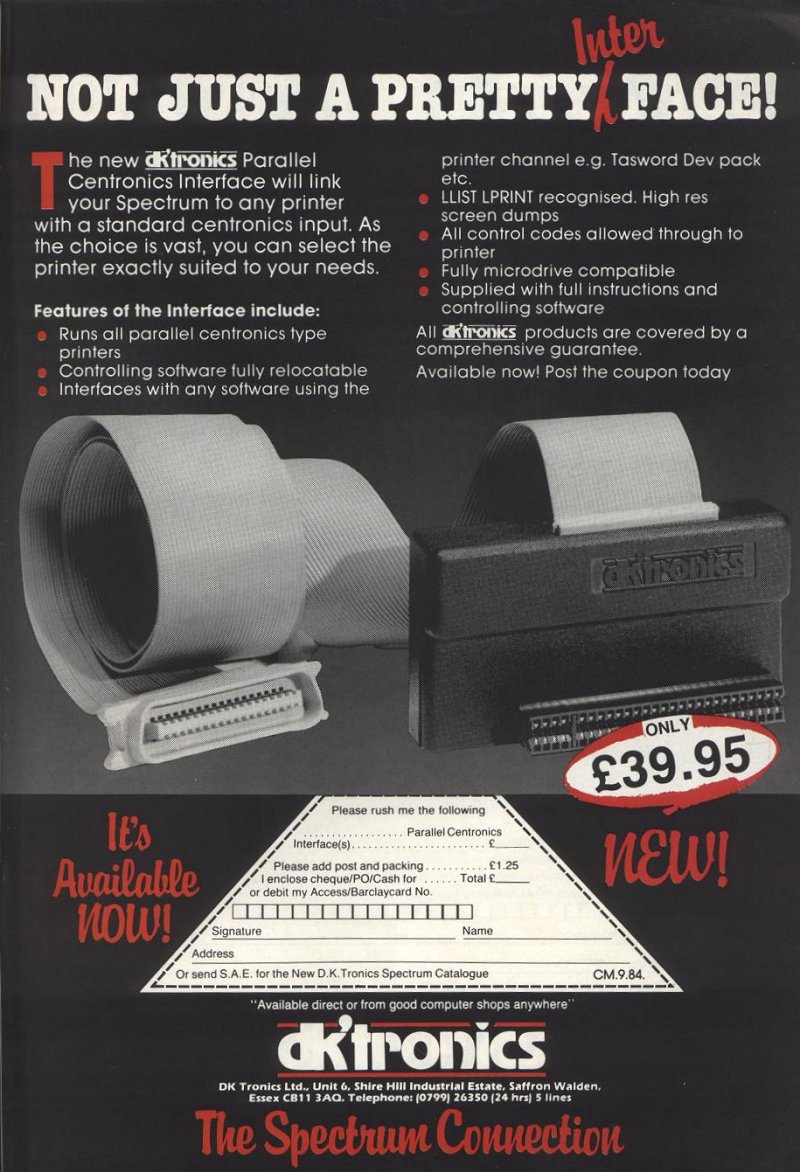
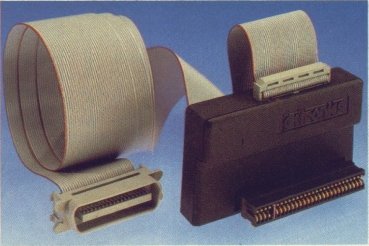
Allows any printer with a centronics interface to be connected to you Spectrum. Uses standard print commands.
Discussion
Nobody has started a thread about this yet.
Documents
- DKTronicsParallelCentronicsInterface(EN).pdfInstructions English829 KB
Files and rights
No permission is on record either way. Screens and pictures are copied here on a take-down basis: if you hold the rights and want something removed, say so and it goes.
In the magazines 30
Sinclair User #36Mar 1985 · p.25
MORE FROM DK STABLE As one of the oldest suppliers of add-ons for the Sinclair market, DK'tronics has built up a reputation for good, basic, hardware. The latest additions to its range for the Spectrum - two joystick interfaces, a printer interface and a sound generator - do not break any new ground but are well designed and constructed. All use a new, restyled, case which can be used with the Spectrum Plus and should also fit most full-sized keyboards. In addition, three of the four items have through connectors - a welcome change. The less expensive joystick interface is Kempston/Sinclair compatible. It has two standard joystick sockets on the top, the left Kempston and the right Sinclair - keys 6, 7, 8, 9 and 0 for fire. Priced at £13 it should prove popular with arcade fanatics. It does not have a through connector, and thus must be the last add-on attached. For those who need a wider choice of keys the programmable interface at £22.95 could be the answer. It can be programmed using the tape provided or, when a game is running, via a switch on the top. The tape allows you to program any of the keys, including Shift and Enter, and to read two or more keys at once, so you can move diagonally and fire at the same time. The printer interface is disappointing. It can drive any Centronics printer but it has disadvantages which make it a doubtful buy. The software tape provided has two pieces of code on it, one for Epson compatibles and the other for the MCP 40. The Epson code is only 520 bytes long and redirects LPRINT and LLIST to the printer. A copy routine is included but only in one size and, when tested on an Epson printer, appeared to give a line feed which was out by 1/72in. The bottom two lines of the screen are not copied. The MCP code is 680 bytes long and includes a half-sized copy option as well as supporting the INK command. For MCP 40 users the interface might well be a good buy at £39.95 but Epson or Seikosha users who want to use COPY should look carefully before buying. The Sound Generator, priced £29.95, is based around the ever popular AY-3-8912 chip and includes a built-in amplifier and external speaker; it also amplifies the BEEP. The problem with this chip is that it is not one of the easiest to program, although thorough instructions are included that show you how to do this in Basic or code. To overcome that, software is included on tape which allows you to write a tune in three-part harmony and replay it. You cannot alter the length of note - you have to enter two notes to double the length - nor edit a voice once it is entered; you are limited to 256 notes per voice. The chip has 15 envelopes built in and a different one, and/or noise, can be assigned to each voice. That, again, is rather basic and reflects the age of the chip. Although the chip is well known the problem has always been lack of support from software writers. DK'tronics is well placed to change this and some future releases will contain routines to drive the generator.
Your Spectrum #8Oct 1984 · p.5
FACING UP Will nothing hold back the prolific DK'Tronics? Latest for the Spectrum is a Centronics interface at £39.95 (including VAT) that offers fully relocatable software, interfacing with any package that's using the printer channel (Tasword, DEV Pack and so on); it recognizes LLIST and LPRINT, and it's fully Microdrive compatible. And from the same company, there's the new Dual Port Joystick Interface - at £13 and featuring first port simulation of '6','7','8','9' and '0' keys. The second port simulates the IN (31) command. The ports will accept any Atari-style joystick. Needless to say these two new products interconnect with the existing vista oi DK'Tronics products.
Advert19
- Sinclair User #81Dec 1988 · p.68
- Sinclair User #80Nov 1988 · p.66
- Sinclair User #79Oct 1988 · p.72
- Sinclair User #64Jul 1987 · p.98
- Sinclair User #63Jun 1987 · p.114
- Sinclair User #62May 1987 · p.114
- Sinclair User #37Apr 1985 · p.39
- Crash #15Apr 1985 · p.23
- Your Computer #3Mar 1985 · p.89
- Crash #14Mar 1985 · p.39
- Your Spectrum #12Mar 1985 · p.55
- Sinclair User #36Mar 1985 · p.113
- ZX Computing #16Dec 1984 · p.68
- Your Computer #12Dec 1984 · p.124
- Sinclair User #33Dec 1984 · p.74
- Sinclair User #32Nov 1984 · p.46
- Crash #10Nov 1984 · p.152
- Your Computer #11Nov 1984 · p.220
- Crash #9Oct 1984 · p.56
Full-page ad5
- Sinclair User #31Oct 1984 · p.33
- Crash #8Sep 1984 · p.109
- Sinclair User #30Sep 1984 · p.33
- Sinclair Programs #22Aug 1984 · p.40
- Your Computer #7Jul 1984 · p.51
Feature2
- Your Computer #5May 1986 · p.58
- ZX Computing #16Dec 1984 · p.88
News/Note2
- Sinclair User #36Mar 1985 · p.25
- Your Spectrum #8Oct 1984 · p.5
Reviews from people here
Sign in to write about this, or make an account. It takes a minute and lets you correct the catalogue too.
Everything ZXDB can hold about this is here.
Sign in to correct or add to this.
Hold the rights to this and want it taken down?