F.I.Z.
Hardware: Disk
Macronics Systems Ltd · 1983
Also known as Floppy Interface for ZX Spectrum 48K (English)
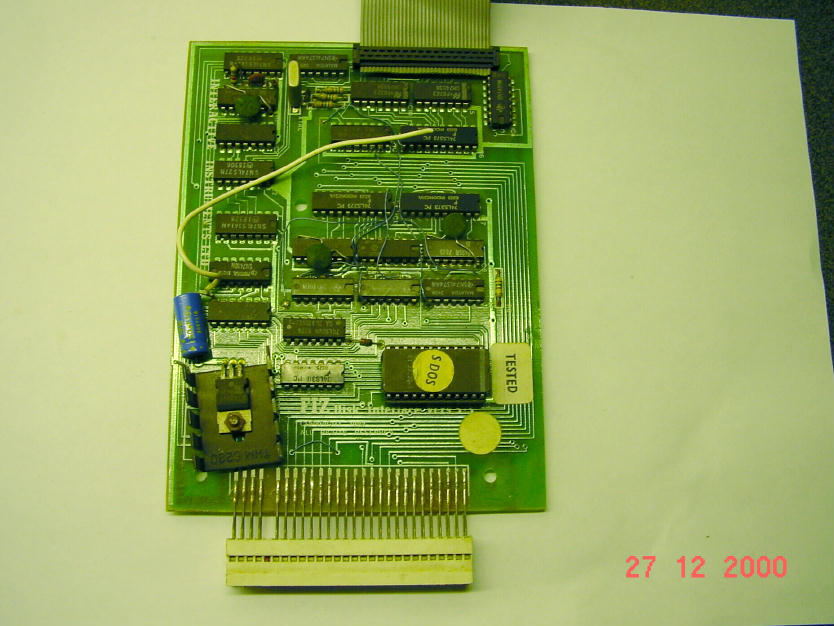
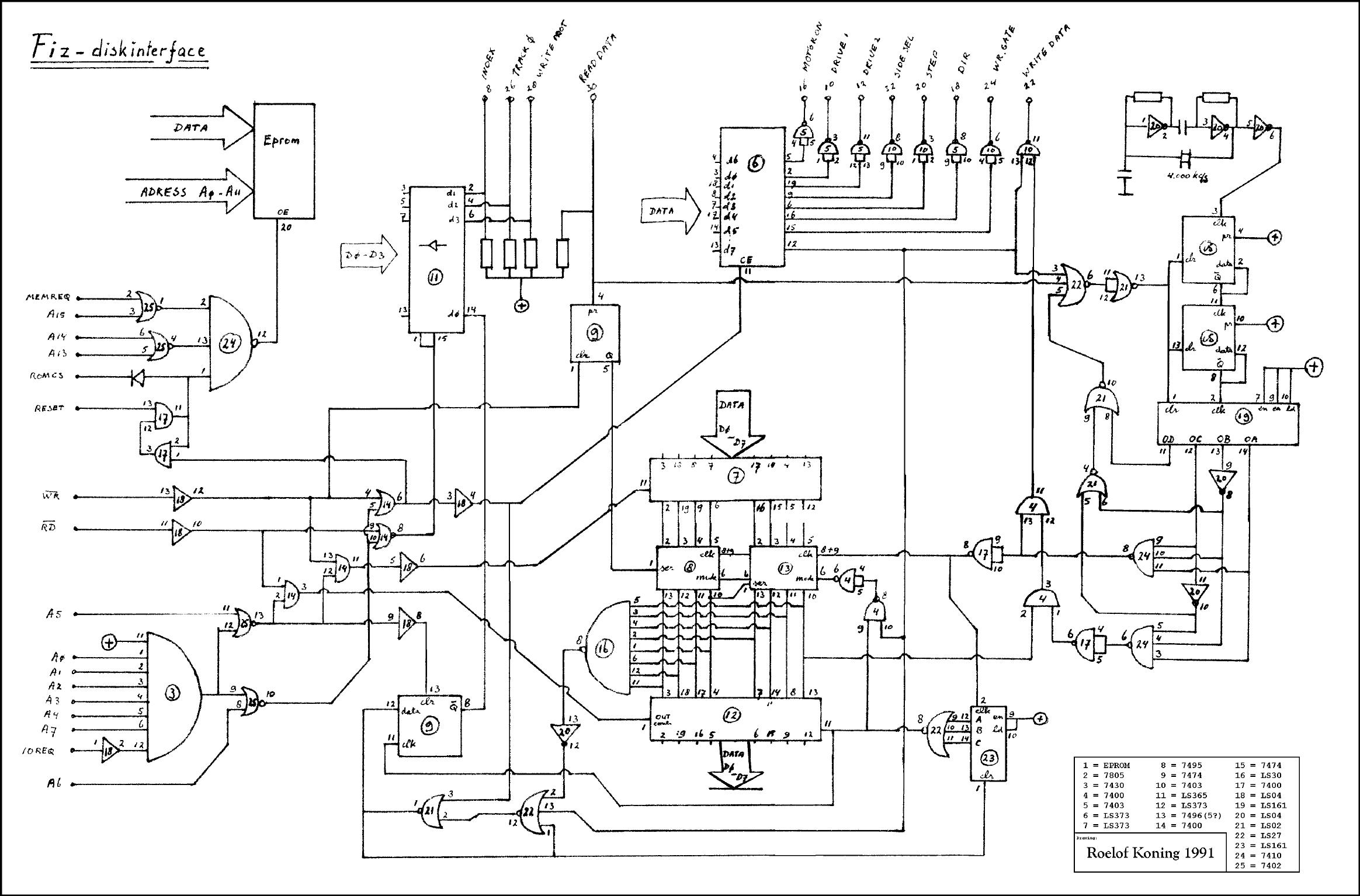
This was an early floppy disk interface for the ZX81, later also for Spectrum. It had its own DOS on board in EPROM, featuring 10 commands for Load, Save etc. to a 40 track single sided 5.25" floppy disk. The Spectrum version was housed in a small metal box. The magnetic tracks on a floppy were used as if they were cassette tapes, each could hold a program. The loading/saving synchronized on the index pulse and had to be done and over before the next index pulse arrived. Apparently over 65,000 x 8 data bits could be shifted in and out during one revolution of the disk, which takes 0.2 sec.!
Discussion
Nobody has started a thread about this yet.
Documents
- F.I.Z._UserManual.docInstructions 2,104 KB
- F.I.Z._UserManualZX81.pdfInstructions 93 KB
Files and rights
No permission is on record either way. Screens and pictures are copied here on a take-down basis: if you hold the rights and want something removed, say so and it goes.
Credits
- Interactive Components Ltdcredited
Sign in to credit somebody, or say what these people did.
In the magazines 3
Big K #4Jul 1984 · p.45
Richard Taylor
LET'S GET FIZ-ICAL... Richard Taylor gets to grpips with Primordial Peripheral's disc drive for the 48K Spectrum. I suppose it was inevitable that someone, sooner or later would come up with a proper disc drive for the Spectrum. Even though Sinclair have launched their famous Microdrive, its distinct lack of availability (now being eased by limited shop sales) and relatively slow access speed (compared to a real disc system) have prevented its domination of the Spectrum mass storage system market. There is something of a price gap, however, because the 'real disc system' under examination here will set you back nearly £250, close to the cost of two new 48K Spectrums, the only model this drive will work with. The FIZ system (Floppy disc drive and Interface for the ZX Spectrum, would you believe) comes in two units; the drive itself and, connected by 50cm of ribbon cable, the interface box which plugs into the back of the Spectrum. The interface contains quite a large assortment of chips powered by an extra voltage regulator - there to ease the load on the Spectrum's already overworked and overheated internal regulator. The disc unit (a Shugart for those who must know) has a separate mains connection, so you may need a 2-way mains adaptor if you're suffering from 'clogged-up' power sockets and what hacker isn't these days? The 9 volt plug from the Spectrum's own power supply goes into the back of the interface box, the old socket being concealed by the interface. Switch on and the disc whirrs into life. Instead of the usual Sinclair copyright line the screen clears with the message FIZZ S3/540.4 OPERATING FIRMWARE © 1983 Macronics Systems Ltd. There's no loading or saving of the DOS (Disc Operating System) from tape as the necessary software is held in an EPROM. On power up the contents of the EPROM is transferred to the top 4K of the Spectrum's RAM. With a further 4K being used by the DOS for temporary storage, the top 8K of RAM is technically rendered unusable. This could've been a major drawback to the system, making useless many programs that rely on that top 8K for certain functions. However, Primordial supply a formatted-disc that carries a special program called 'lodos'. The program is called up by the command an dos, thus the instruction PRINT USA dos transfers the DOS from high to low memory. Pretty neat. The DOS itself relies heavily on BASIC variables and USR calls. After switching on the Spectrum the variables as, bs, cs, dir, back, al, bl, cl, zap and nd are initialised to the addresses of machine code routines in the DOS. So, for instance, PRINT USR dir gives a list of what is on the disc - as well as an indication of the amount of storage capacity and the main disc title. The USR statement returns the number of any error that might have occurred and there is a comprehensive and helpful set of error codes. The DOS has facilities to save and load BASIC programs, machine code programs (there's an auto-run facility for machine code) and arrays. It is also possible to format new discs, erase files or make back-up copies of discs. Some commands need filenames or other parameters passed to them. This is done by assigning the BASIC variable f$ with the name before typing in the USR statement. For instance, LET f$ - = "Graph" : PRINT USR bs saves a BASIC program onto a disc called "Graph". The commands can be used equally as well in programs as they do as direct commands. The drive uses single-sided, single density discs; each one capable of 109K of user-available storage. A disc is formatted using the nd command. One of the 40 tracks on the disc is used by the DOS to store the directory, leaving the user with 39 tracks; each one with a capacity of 2816 odd bytes. One of the idiosyncracies of the system is that a file will occupy at least a complete track even if it is only a few bytes in length - therefore placing a maximum limit of 39 files per disc. The actual operation of the disc was extremely fast and reliable. The documentation, although brief, was adequate and well presented. The FIZ system represents value for money if you use your Spectrum for program development or for some sort of data handling. I suspect, however, that the majority of users do not desperately need the added flexibility (and expense) of a proper disc system and would probably do better with a Microdrive. The system will come into its own when more software is available to run on it. Some games material is available but, as I said, the price tag makes the FIZ a games system in the 'executive toy' class. Primordial have recently announced a word processing disc (based on old 'Tasman' WP) and have an assembler in the works. FIZ costs £249.95 from Primordial Peripherals Ltd., [redacted]. The interface unit can be bought as a separate item for use with other disc drives, price £79.95.
Sinclair User #2May 1982 · p.7
FIZ INTO FLOPPY ACTION Called a FIZ - Floppy-disc Interface for the ZX-81 - the Macronics floppy disc provides a standard 5.25in. floppy disc drive, software in a 2K ROM and a motherboard in the same unit. The disc will provide 43K of storage which can be LOADed at a rate of 8K in 22 seconds. The disc has 34 tracks and 10-128 byte records on each track, for storing data or programs. The commands are given to routines stored in ROM, so that no RAM is wasted and all the disc commands are written to be used from Sinclair Basic. The motherboard provides all the power for the system, including ZX-81, and interface cards to a paper printer will be available soon. There is also the possibility of a networking card soon. FIZ costs £303.03 inclusive and is available from Macronics, [redacted].
Sinclair User #1Apr 1982 · p.56
Stephen Adams
PLENTY FOR USERS TO CHOOSE FROM To lead into in-depth analyses of hardware products, Stephen Adams scans the market. There has been no shortage of developments on the hardware side of the market since the introduction of the ZX-81 in March, 1981. Most were based on designs which developed on the ZX-80 and enhanced by the introduction of the ZX-81. The main differences between the ZX-80 - even with the 8K ROM - and the ZX-81 are the appearance of a static screen on the ZX-81 - slow mode - and the extension to the expansion bus - the edge connector at the back of the ROM CS line which meant that some of the Sinclair address decoding should be sorted-out externally to the ZX-81. For the first six months or so, firms were very cautious about the ZX-81, watching the market to see whether it would take off. The first product to appear was a sound board, complete with input/output port and a motherboard from Quicksilva; that was one of the first motherboards for the ZX-81 and meant that the user could have more than just the Sinclair 16K RAM pack on the back. The next announcements appeared in September, 1981 at the Personal Computer World Show - floppy discs, RS232 serial printer port, cheaper input/output ports and, for the first time, the Sinclair printer. Since then things have snowballed; ZX-81 sales have exceeded the 250,000 mark, showing that there is a great deal of feeling for the micro and the number of firms which have been set up to deal with ZX-81 equipment has more than doubled since September. The ZX Microfair in November was an event which meant that the equipment which was promised in the glossy advertisements available previously only on mail order could be seen before purchasing. Such was the enthusiasm for that type of Microfair by both the exhibitors - Sinclair alone took more than £8,000 in orders on one day - and the users that another was organised quickly for Janaury. A word of warning to users - be wary of certain manufacturers who claim that they have a product available when all they are doing is testing the market to see if anyone is interested. It is better to write and confirm on what date they will be able to supply the product to you. Computer manufacturers have the tendency to quote a date and then supply the product between six and 12 weeks after you have paid. Bigger firms are the main culprits. I have divided this review of the hardware products available for the ZX-81 into three headings - essential add-ons, keyboards, motherboards and extra RAM. They comprise input and output capabilities where some technical knowledge is assumed; enhancements which require programming skill, but either plug direct into the ZX-81 expansion bus or the ZX-81 is modified by the manufacturer. There are two leaders in the amount of RAM you can cram into the ZX-81 memory map. The Memotech 48K RAM pack has the largest continuous Basic memory; not all of it can be used for a Basic program - only the bottom 16K (16K-32K). The rest has to be used for storing data but not machine code. Audio Computing has the largest memory pack available, 128K of RAM but only 32K of it available at any time. To switch between sets of 32K, called banks of memory, a manual switch has to be thrown and the ZX-81 has to be re-set to start up the Basic system again. That is not very convenient, as it cannot yet be operated from software or the variables transferred from bank to bank. The Memotech 48K was one of the packs I have tested; it was good value at £129 plus VAT, assembled, and is very easy to use. So the arrival of Memotech's 64K pack must be welcomed, especially as it retails for only £79 including VAT. More about this newly-released product soon. There are other external RAM packs varying from an extra 3K giving a total of 4K of RAM to a full 16K of RAM cheaper than Sinclair's. Always check that the RAM pack does not prevent you connecting other equipment after it is fitted to the expansion bus. That was the case with the Sinclair RAM pack, which meant that you had to spend at least £10 to attach anything else to the ZX-81. If you are spending that money you might as well look at the expansion possibilities after you have it. The only other RAM extension possible is to change the 1K of RAM chips fitted into the basic ZX-81 for a 2K chip. That necessitates going inside the ZX-81 and perhaps some soldering. After checking inside to see if you have one chip - just change the original chip for the new one - or two - a new-28 pin IC socket needs to be fitted - change one strap on the board. Full instructions usually are given with the kits. The new memory chip will cost at least £7 and RAM packs start at £18. Various keyboards can be obtained which are basically of the same construction, consisting of 40 professional microswitches mounted on to a bare printed circuit board. That replaces the keyboard on the ZX-81. Usually some soldering has to be done. The new keyboard usually is very light to the touch and extremely responsive. Improving the time taken to enter a program by at least 50 percent. None of the original keyboard functions are lost as they are all controlled from software. There is a wide selection of input/ output ports available which can provide from 16 to 24 bits of information on a separate bus to the ZX-81 databus. Those outputs are latched; they keep the data the same while the ZX-81 does other things. They are the only way of getting information in and out of the ZX-81 to control other equipment. They can be divided into two types. memory-mapped - can be PEEKed and POKEd from a Basic program-and input/output-mapped - using special machine-code routines. Now various attachments can be used on those ports; A/D converters which take a voltage, measure it and give out a digital number for the ZX-81 to read. D/A converters which take a digital number and output a voltage corresponding to it. Light pens can be used to draw on the screen by checking the light received against the screen layout at the time. Most of those require some technical knowledge to be able to use them. Macronics disc system will act like a super-fast tape recorder using specially-written machine core routines. They will be stored in ROM and can be used to SAVE, LOAD and store random data on 5.25in. disc. The maximum is 40K per disc and the cost is expected to be £249. It also includes the only RS232 printer port available; it will accept data only one bit at a time but many printers are available for it. There are various attachments to the ZX-81 which, although not essential, can improve the facilities available to the programmer. The newest must be the speech input by William Stuart Systems and the speech output by DCP. That means that you can program the ZX-81 to accept words like LIST, RUN and the like and have it reply in a limited number of words. Another facility is to have a colour board by Haven Hardware, which is programmable in 16 colours. Programmable character generators can create high-resolution graphics, which can then be printed-out by the very good quality Sinclair printer. Each dot on the screen can be specified, so the resolution can be 512 by 256. The Sinclair printer uses an aluminium-coated paper with all the characters being shown by black dots. Even without the character board, it can print your own-designed characters but that takes a good deal of memory. Digital cassette recorders can be bought, designed specially by Monolith for the ZX-81. They are given a registered number and are highly-tuned. If you still want to use your own recorder, Abacus has a cassette switch which will prevent confusion when SAVEing or LOADing. Motherboards can be plugged easily into the expansion port to give you more sockets, so that all those devices can plug into the ZX-81 all at once. With all those products it is pleasant to see that one manufacturer, at least, is sufficiently concerned to contact other firms to agree some kind of standard. If you intend to produce something. why not speak to Nick Lambert of Quicksilva? The final enhancement is more of a service than a product. It is called the Buffer Shop and has been set up in London to cater only for the ZX machines. It is the only retail outlet for products. apart from WH Smith, supplying only the Sinclair ZX-81 and 16K RAM pack. A greater need for any user is more knowledge about what is available. It is only through co-operation of manufacturers with magazines such as Sinclair User that the user of a ZX-81 can make a valid judgement. I can only say that I have done my part and now it is up to you.
Speech input from William Stuart Systems.
Reviews from people here
Sign in to write about this, or make an account. It takes a minute and lets you correct the catalogue too.
Everything ZXDB can hold about this is here.
Sign in to correct or add to this.
Hold the rights to this and want it taken down?