
Floyd 40
Hardware: Network
Floyd · 1985 · Pound sterling 79.95 · Pound sterling 69.95 budget
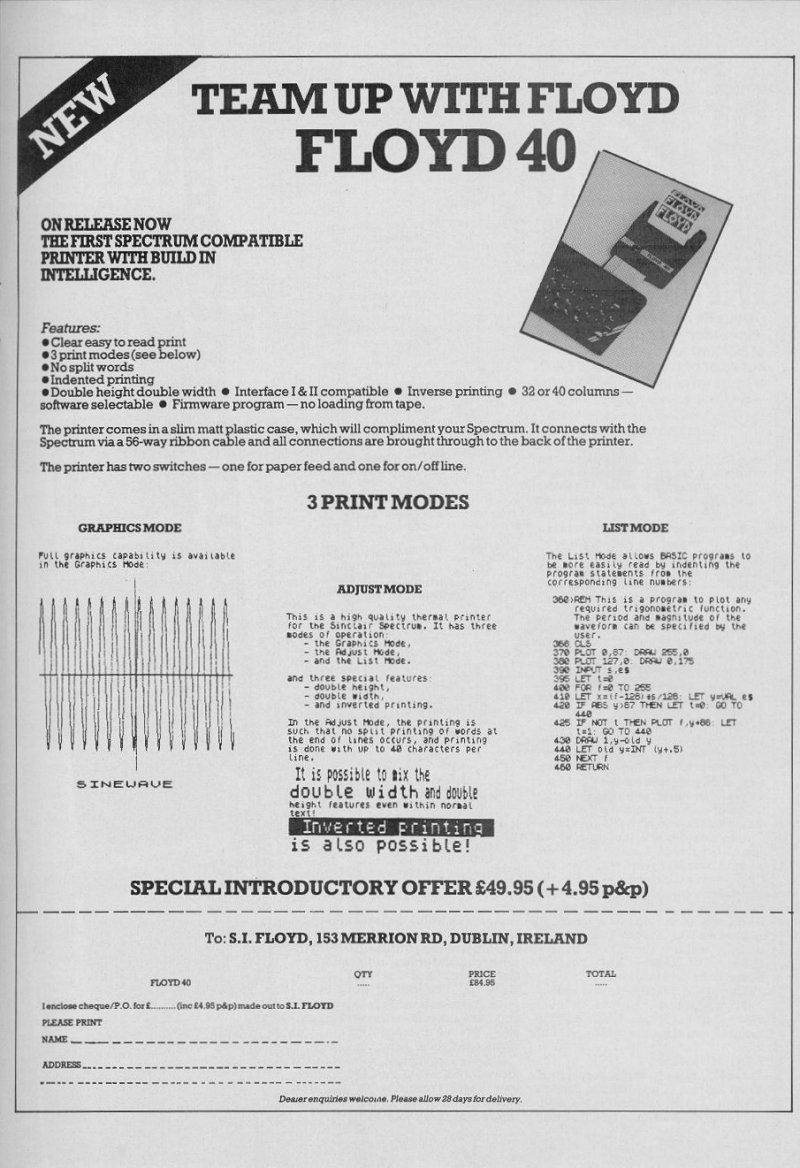
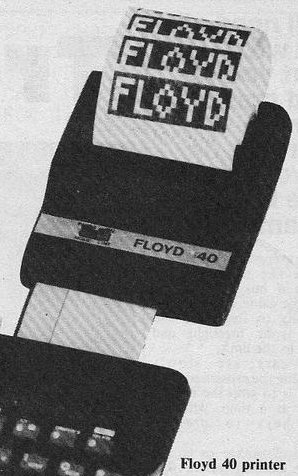
Printer. 32 or 40 character printing. Inverse. Double width/height. Firmware software.
Discussion
Nobody has started a thread about this yet.
Remarks
Alphacom-type thermal printer 32 or 40 col width
Files and rights
No permission is on record either way. Screens and pictures are copied here on a take-down basis: if you hold the rights and want something removed, say so and it goes.
In the magazines 15
Your Spectrum #15Jun 1985 · p.42
Peter Green
HOTHEADS If you're not that flush, but you need a printer, stay cool and go thermal. Peter Green comes in from the cold to consider the hottest ones around. The Sinclair ZX Printer was unique - for its size and price, it was quite a remarkable technical achievement. Still, it did leave something to be desired. All those sweaty paw prints, left all over the silver listing paper. And the print quality would strain the definition of the word adequate, as well as your eyes. Program listings on the stuff cause harassed editors to tear their hair out (or at least that's Kevin's excuse!). One solution has been to find a way of linking 'real' printers, like the large dot matrix ones, to your Spectrum. For that you need a commercial interface, or you could have a crack at knocking up one yourself. (Of course, you'll need a copy of YS issue 6 for that. Ed). This works, but your Speccy is now dwarfed by a huge printer - a bit of a shame when Uncle Clive has gone to so much trouble to keep it all small. And it causes even more problems if you've got to squeeze your complete computer setup into the confines of a cramped living room - worst of all it means shelling out between two and three times as much for the printer as you paid for your Speccy. That's good enough reason for me to look seriously at thermal printers. ANYTHING YOU CAN DO... So, what can thermal printers do that dot matrix or daisywheel can't? Well, nothing really - except save you a lot of space and some cash. Most of them are quite tiny, and the good news is that they're all comparable in price to a Spectrum. Thermal printers don't need linked ribbon because they use special paper impregnated with a heat-sensitive ink. The print head is still 'dot-matrix' but the dots are small wires that can be independently heated. The heat makes the ink visible in the correct dot patterns to display characters. Take into account that the saving you'll make on ribbons is offset slightly by the higher cost of the special paper. It's only got to brush its heating elements over the surface, as the print head doesn't have to strike the paper to form an image. Also, thermal printers ought to be much quieter than dot matrix ones to make its mark. Not so though, I'm afraid - to bring the price down the manufacturers often use fairly cheap electric motors to feed the paper and scan the print head, so you get a different sort of noise, but it's not quieter. It's no coincidence that the least noisy of the printers I tested was also the most expensive. If you plump for one of the most basic of the thermal printers, you won't need an interface. They are designed as plugin replacements and work directly from the Spectrum bus. The others have standard RS-232C or Centronics ports, so you need a printer interface as well - take this into account when you're considering your budget. For the extra though, you'll get many of the features of the big machines, including emphasised, condensed and enlarged fonts, variable line spacing, international character sets and bit image graphics. IN THE PICTURE Bit image graphics means you have direct control over the heating elements in the print head. So, you can print any pattern of dots onto the paper. Interfaces such as the ZX Lprint contain the software that uses this facility to perform a screen dump, so duplicating the COPY command. Although you'll have to bone up on the graphics modes before you get to grips with them fully (especially since most Epson-compatibles are Japanese, with manuals written in Janglish!), they do allow you to draw dot graphics of any kind, unrestricted by the Spectrum screen size or resolution. And as they all use roll paper, you could write a program that printed a frieze type of picture. NO LIMIT? Bear in mind if you're considering thermals that, with one exception, none of them can handle A4 width paper, or even cut sheets. Using roll paper means that the top and bottom of your printouts have ragged edges where you've torn them off. Still, that's OK if you only want the printer for listings - or if you're happy sending out letters that look like supermarket checkout receipts. You'll also need another spare mains socket. All but one of these printers require an external power supply, of the small transformer PSU type. Two of them can run off batteries, but they eat them and if you don't use re-chargeables, your running costs will be unbelievable. WHAT PRINTER? Before choosing one of these printers, you'll have to decide exactly what you're going to do with it. If you're looking for a straight replacement for the ZX Printer, then the Floyd 40 is your best bet. Unlike the Alphacom it does a lot of clever tricks besides duplicating a Sinclair printout. However, if you're likely to be writing letters and so forth, you'll need to look up-market a bit. There, the Epson P-40 equals the Brother HR-5 on features, but for the extra fifty quid, the HR-5 lets you use cut A4 sheets and offers the back-up of ink ribbon if you run out of thermal paper. Remember though, that you'll need an extra interface for both of them. ALPHACOM 32 Dean Electronics, [redacted] When it comes down to performance, the Alphacom 32 is simply a souped-up ZX Printer. It will LPRINT, LLIST and COPY in exactly the same 32-column format and nothing else. It won't recognize any of the standard Epson control characters which alter the print width, font style or anything else. And you won't get the graphics commands in any other form than the COPY mode. It even prints a question mark if you send it a line feed code! For my money, this makes it the least useful of the four printers. I tested the blue thermal paper (though you can get black) and found it easier to read than a ZX printout, but the print quality was about the same. The printer also kicked up a bit of a racket - there was a constant grinding of the powerful, geared motor throughout the printing cycle. The machine has a similar footprint to the Spectrum. There's a through connector for other peripherals but the thick connecting cable puts pressure on the power input jack so you can't tell whether it's on or not - it uses non-latching membrane one-off switches and there's no LED indication. The plus is that it's a plug-in-and-go printer, so no software setting-up is required.
HOT STUFF PRINTER: Alphacom 32 PRICE: £54.95 SIZE: 193 x 143 x 48 INTERFACE: ZX-Bus MAX. PAPER WIDTH: 110mm (4.25") MAX. CHARACTERS PER LINE: 32 PRINTING SPEED: 64 CPS GRAPHICS MODE: Spectrum copy command only POWER SUPPLY: Separate OTHER SPECIAL FEATURES: None PRINTER: Floyd 40 PRICE: £69.95 SIZE: 115 x 162 x 54 INTERFACE: ZX-Bus MAX. PAPER WIDTH: 80mm (3 1/8") MAX. CHARACTERS PER LINE: 40 PRINTING SPEED: 33 CPS GRAPHICS MODE: Spectrum copy command only POWER SUPPLY: From Spectrum OTHER SPECIAL FEATURES: Can automatically word-wrap text and indent listings for maximum readability PRINTER: Epson P-40 PRICE: £99.95 SIZE: 216 x 128 x 46 INTERFACE: Centronics or RS232C MAX. PAPER WIDTH: 112mm (4.25") MAX. CHARACTERS PER LINE: 80 PRINTING SPEED: 20-45 CPS GRAPHICS MODE: Block Capitals, Bit image, Graphics, (Requires special software to perform copy) POWER SUPPLY: Internal battery plus AC adaptor OTHER SPECIAL FEATURES: Self-test mode for printhead, variable line spacing, international fonts including Japanese Scandinavian PRINTER: Brother HR-5 PRICE: £149.50 SIZE: 303 x 74 x 65 INTERFACE: Centronics or RS232C MAX. PAPER WIDTH: 216mm (8.5") MAX. CHARACTERS PER LINE: 132 PRINTING SPEED: 30 CPS (A) GRAPHICS MODE: Block graphics, Bit image graphics, (Requires special software to perform copy) POWER SUPPLY: Internal battery or AC adaptor OTHER SPECIAL FEATURES: Accepts A4 cut sheets, self-test mode for printhead, variable line spacing, international fonts including French and German. Can also accept ink ribbons.
Your Spectrum #12Mar 1985 · p.5
PRINTING IN THE PINK A new Dublin-based company called Floyd has recently launched their first ever product for the Spectrum; an intelligent, Alphacom-type, thermal printer. Called the Floyd 40 and priced at £79.95, it's obviously going to be a direct competitor to the established Alphacom 32. The difference between the Floyd 40 and Alphacom 32 are numerous. Though the Floyd 40 can cope with all the usual stuff like screen copy and software on ROM, it also offers intelligence with three different print modes including Graphics, Adjust and List. It can also print double height, double width and inverted. On top of all these apparently thrilling features it can also list at either 32 or 40 columns. For more information, drop Floyd a line at [redacted].
Floyd 40 - listing to 32 or 40 columns.
Advert8
- Your Sinclair #1Jan 1986 · p.44
- Your Spectrum #21Dec 1985 · p.59
- Your Spectrum #20Nov 1985 · p.10
- Your Spectrum #16Jul 1985 · p.8
- Your Spectrum #15Jun 1985 · p.13
- Your Spectrum #14May 1985 · p.65
- Your Spectrum #12Mar 1985 · p.13
- Your Spectrum #11Feb 1985 · p.75
News/Note3
- Your Spectrum #12Mar 1985 · p.5
- Your Spectrum #11Feb 1985 · p.86
- Home Computing Weekly #95Jan 1985 · p.9
Feature1
- Your Spectrum #15Jun 1985 · p.42
Full-page ad1
- Your Spectrum #10Dec 1984 · p.51
Reviews from people here
Sign in to write about this, or make an account. It takes a minute and lets you correct the catalogue too.
Everything ZXDB can hold about this is here.
Sign in to correct or add to this.
Hold the rights to this and want it taken down?