Fuller FDS Desktop System
Hardware: Keyboard
Fuller Micro Systems Ltd · 1983 · Pound sterling 39.95
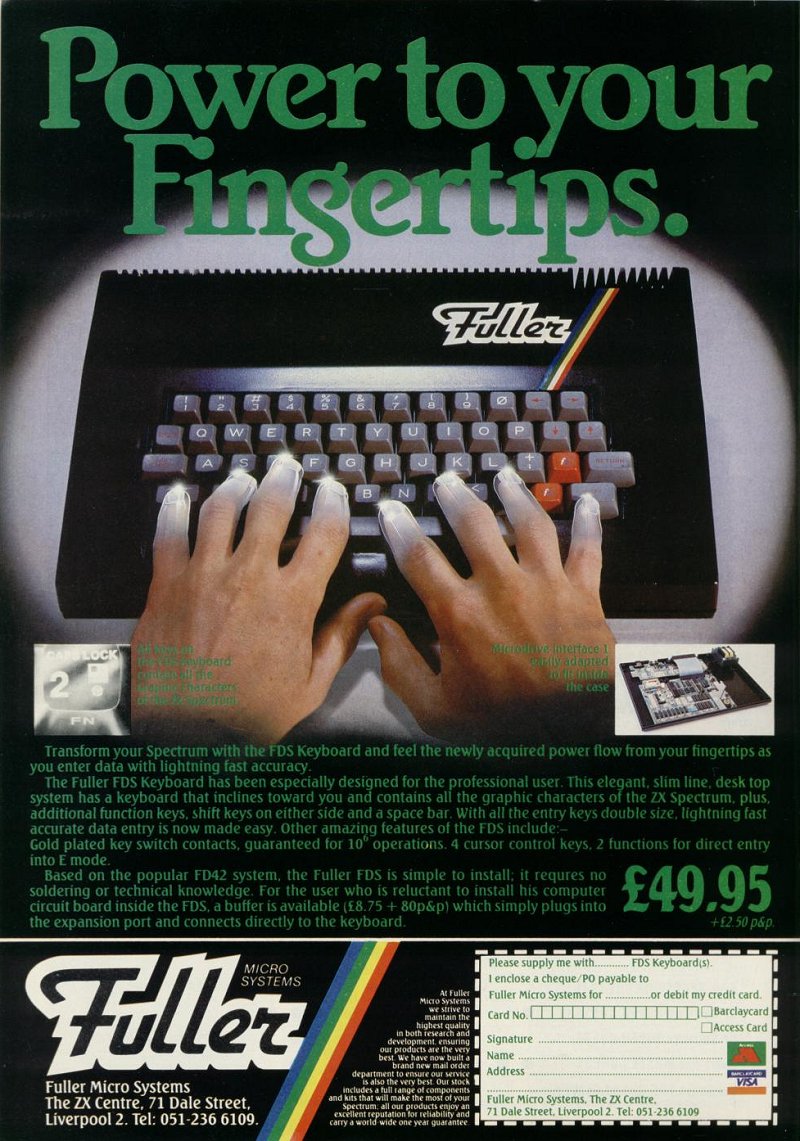
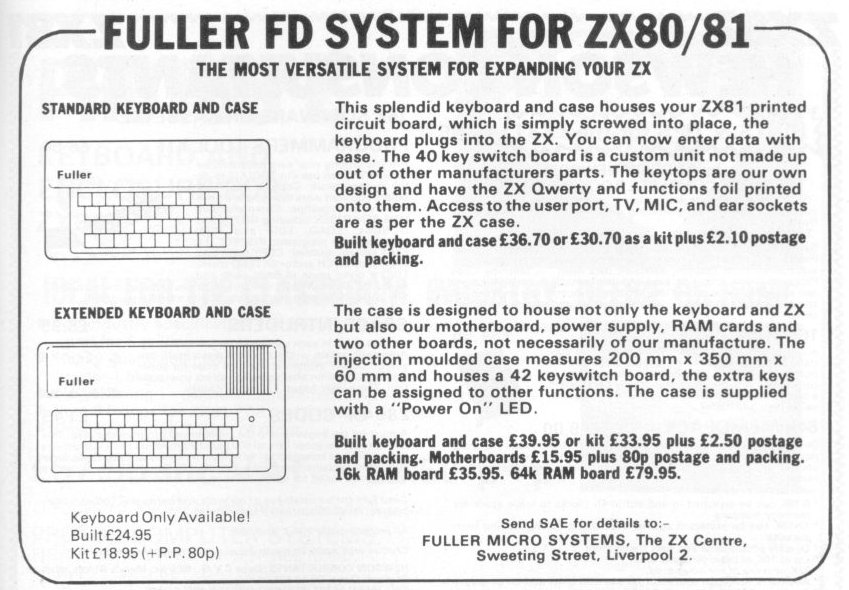
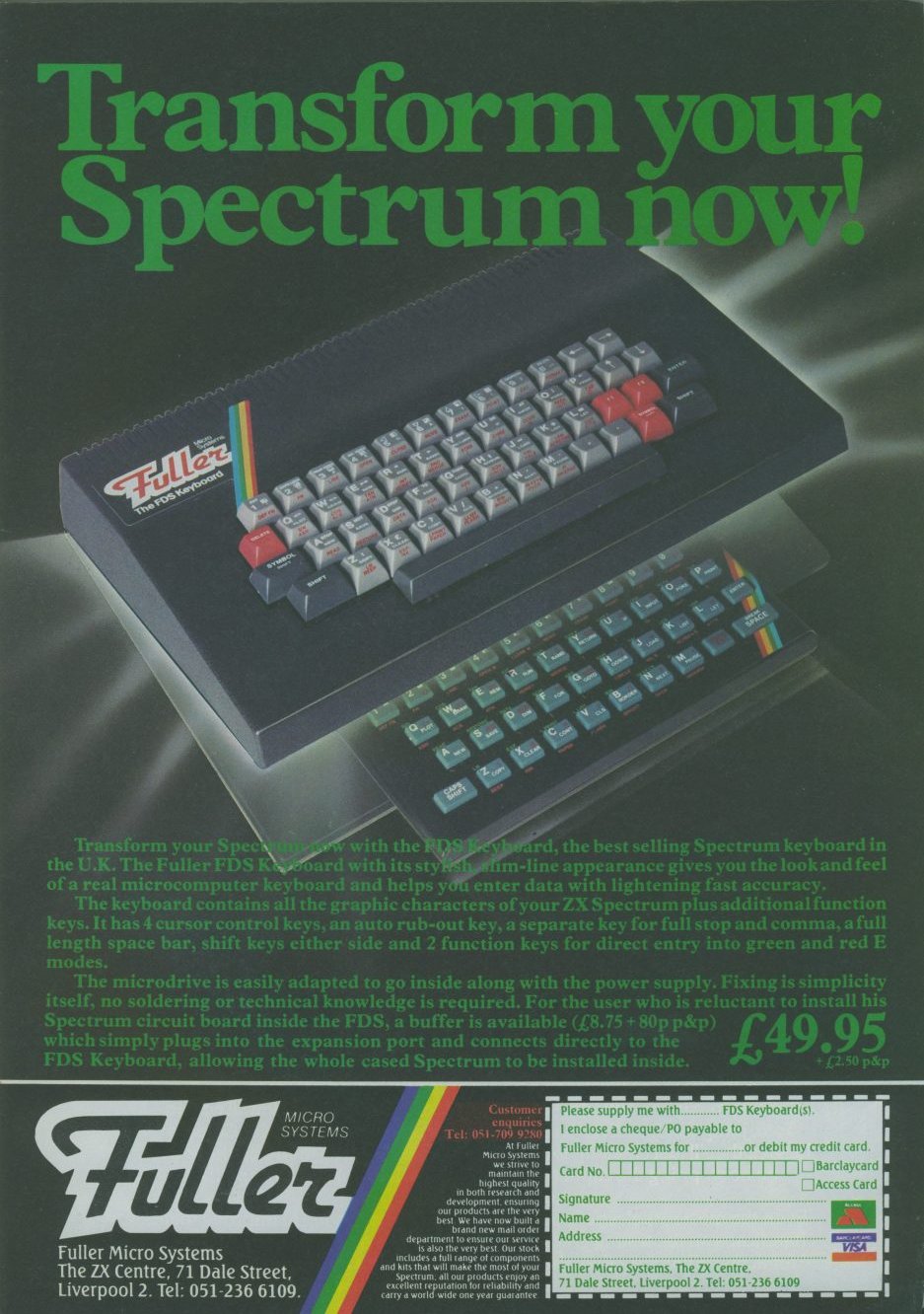
Elegant system designed for professional use. Includes full travel keyboard based on the FD42.
Discussion
Nobody has started a thread about this yet.
Remarks
various models/prices
Files and rights
No permission is on record either way. Screens and pictures are copied here on a take-down basis: if you hold the rights and want something removed, say so and it goes.
In the magazines 75
Personal Computer News #90Dec 1984 · p.29
PLUG IN PARAPHERNALIA Our eight-page guide to Christmas peripherals. PICK OF THE PRINTERS MONITORS IN FOCUS DISK DRIVES ASSESSED ...AND OTHER ADD-ONS DECIPHERING THE PERIPHERALS PUZZLE Once you've had a computer for a little while,you may be wondering what else you can do with it, aside from playing games and writing the odd program. Buying one of the wealth of peripherals currently on the market can open up a whole new realm of possibilities, by presenting new programming challenges, new types of software,and providing more capabilities for your computer. The problem is, what to buy, for how much,and where from? Probably the most uninteresting peripherals are printers,which are only of real use for word processing, screen dumps,and program listings. These come in many different types, sizes, prices and capabilities,from dot matrix to daisywheel. Of much more interest these days are modems. Unfortunately,they can give you that dreaded disease known as Hackery, which includes symptoms such as high telephone bills, sleepless nights and no interest in anything else. Other add-ons include light pens and touch pads for budding computer artists. These generally come with some software, but make sure when you buy that there are some details on howto program it yourself. The same applies to joysticks and tracker balls. On some machines handling these is easy but on others, such as the Spectrum and Electron, things area little more difficult. There are so many gadgets available that it would be impossible to name them all. Out of these, perhaps the most exciting are second processors, some of which can turn your humble home micro into something approaching the power of a minicomputer. Others are just add-ons to allow a sought after CP/M system. These are much more common, being available for the BBC, Commodore 64, Amstrad CPC464, and Sinclair QL, to name but a few. One point to bear in mind when you buy something extra for your micro is what you are going to do with it when you become fed up with the applications that come with it. If you make sure that there are details on how to access and control it, you will be able to write your own routines to run it, thereby giving it a whole new lease of life. PCN's six page peripherals guide should give you some idea of what is available, how much you should expect to pay, and where you can get them from. PRINTERS Many people think they can live without printers, probably due to their high prices, but eventually you'll probably want one for your microcomputer. There are a number of types around, from the more expensive daisy wheels to the cheaper thermal or ballpoint pen printers. Not to be forgotten, too, are the ubiquitous dot matrix and the ink jet types. The former are generally judged by their Epson compatibility and features. Once the type of printer has been decided upon, there are then a number of additional features to choose from, print buffers, RS232 or Centronics, graphics capabilities, redefinable character sets, and speed being just a few. A printer with all of these the Smith Corona D200 for example - can cost up to £500. Alternatively, a ballpoint pen plotter such as a MCP-40 will cost around £150, but this only takes narrow paper and doesn't give you half the facilities. THERMAL BROTHER EP-22 The EP-22 is quite cheap and will take either thermal paper or a carbon ribbon. It has a keyboard, which makes it a word processor too. PRICE: £169.95 INTERFACES: RS232 REVIEW: Issue 35 FEED MECH: Pinch PRINT MECH: Thermal paper or thermal carbon ribbon PAPER SIZE: A4 width SPEED (APPROX): 16cps POWER SUPPLY: 4 U2 batteries AVAILABILITY: Brother [redacted] BROTHER HR5 The HR5 thermal printer from Brother basically uses the same mechanism as the EP-22 and EP-44. PRICE: £180.55 INTERFACES: RS232 REVIEW: Issue 47 FEED MECH: Pinch PRINT MECH: Thermal paper or carbon ribbon PAPER SIZE: A4 width SPEED (APPROX): 16cps POWER SUPPLY: 4 U2 batteries AVAILABILITY: Jones & Brother [redacted] DOT MATRIX SMITH CORONA D200 If you want a dot matrix that does nearly everything for your needs then the Smith Corona D200, at £483, is a good buy. PRICE: £483 INTERFACES: RS232 and Centronics, both fitted REVIEW: Issue 87 FEED MECH: Pinch and tractor PAPER SIZE: A4 width SPEED: 160cps FEATURES: 2K internal buffer, NLQ AVAILABILITY: Smith Corona dealers WALTERS WM80 If you just want a workhorse with no fancy bits, then choose a bottom-end machine such as this. PRICE: £189.75 INTERFACES: RS232 or Centronics REVIEW: Issue 43 FEED MECH: Pinch and tractor PAPER SIZE: A4 width SPEED: 80cps AVAILABILITY: Walters Microsystems International, [redacted] COLOUR INTEGREX COLORJET The Integrex Colorjet is mainly for BBC and Apple owners. A BBC screen dump program comes with this very versatile printer. PRICE: £632.50 INTERFACES: RS232 and Centronics REVIEW: Issue 51 and 44 FEED MECH: Pinch PAPER SIZE: A4 width SPEED: 37cps AVAILABILITY: Integrex [redacted] COMMODORE MPS 801 There are no frills on this and you will have difficulty attaching it to anything except a Commodore. PRICE: £395.95 INTERFACES: I triple Commodorey REVIEW: Issue 79 FEED MECH: Pinch and tractor PAPER SIZE: A4 width SPEED: 38cps AVAILABILITY: Commodore [redacted] DAISIES JUKI 6100 The Juki 6100 has above average speed at 17cps and is a nice cheap daisy wheel printer although it does have a few rough edges. PRICE: £385.25 INTERFACES: RS232 and Centronics REVIEW: Issue 17 FEED MECH: Pinch WHEEL TYPES: Triumph Adler PAPER SIZE: Up to 13in SPEED: 17cps AVAILABILITY: Most dealers SMITH CORONA L1000 The L1000 from Smith Corona is a good quality printer if a little noisy and slow. £50 extra for a parallel interface. PRICE: £368 INTERFACES: RS232 and Centronics REVIEW: Issue 78 FEED MECH: Pinch and optional tractor feed WHEEL TYPES: Smith Corona PAPER SIZE: Up to 13in SPEED: 12cps AVAILABILITY: Smith Corona dealers MODEMS Modems could well be classed as the up and coming peripheral of 1985. With the rapid growth of bulletin boards and the increase in Prestel-type systems, the number of cheap modems available has doubled since last year. One of the problems that beset their introduction was BABT/BSI approval. The modems had to be sent to the BABT or BSI for testing for compatibility with BT's telephone network. By the middle of 1984, there were so many modems awaiting the green sticker that people started selling them without. Things have settled down a bit now and there are a number of good modems on the market. These can be split up into different types - direct connection, acoustic coupler, single speed, or multi speed. The standard transmission speeds are 300/300 and 120005. The first is generally used for bulletin boards, although both Prestel and Telecom Gold are available on this speed. Whatever modem you buy, make sure you get one that fits your needs as far as baud rates go, otherwise you may feel a bit left out. COMMODORE COMMUNICATIONS Those with a Commodore 64 needn't feel left out. The Commodore Communications modem gives you access to Compunet, of course, and also Prestel. In the near future, Commodore is going to produce some software to allow user to user communication. If you want to use the various bulletin boards, you will have to acquire an RS232 port and a standard 300 modem. PRICE: £99.95 BATA?: Yes BAUD RATES: Full duplex 1200/75 INTERFACE: Commodore cartridge port and direct connection to BT CONTACT: Commodore dealers PRISM VTX 5000 One of the most popular modems for the Spectrum is the Prism VTX 5000. If you only want access to Micronet and Prestel it is ideal, although it can have a few problems with Interface 1. The way around this is to connect the whole system up without the modem and let it warm up (go and make a cup of coffee). Once warm, the VTX5000 can be connected (after powering down again) and it will work. PRICE: £99.95 BATA?: Yes BAUD RATES: Full duplex 1200/75 INTERFACE: Spectrum system bus and direct connection to BT CONTACT: Micronet 800, [redacted] PACE NIGHTINGALE The Pace Nightingale is another multi speed modem with both Bell and CCITT frequencies. It is a hard wire modem ie it connects directly into the telephone socket. Built mainly to be used with the BBC, for which the Commstar ROM is available, the complete package costs about £136. It is also available for any other RS232 compatible communications package. PRICE: £136.85 BATA?: Yes BAUD RATES: Full duplex 300/300 1200/75 INTERFACE: RS423/232 CONTACT: Pace Software [redacted] MINOR MIRACLES WS2000 The Minor Miracle WS2000 is great for bulletin board hackers and Prestel users alike. It lacks auto dial and auto answer facilities, which are a little expensive at £30 each but at least you're given the option. PRICE: £149.44 Auto dial and answer boards extra at £30 each BATA?: Yes BAUD RATES: Full duplex 300, 1200/75, half duplex 600,1200 INTERFACE: RS232 with DTR, RTS, CTS, DCD handshaking EXTRAS: Also has the Bell 103/113, 108, 202 and CCITT, V21, V23 tones standards fitted. CONTACT: Minor Miracles [redacted] SENDATA 700B For the ultimate in portability, it is hard to beat the Sendata 700B acoustic modem, distributed by Tandy. This modem will fit onto any standard telephone via its flexible connector so you can use it in a phone box if you don't mind the pips corrupting your data. PRICE: £235 BATA?: Yes BAUD RATES: Full duplex 300/300 INTERFACE: RS232 to the computer, and acoustic modem to BT CONTACT: Sendata [redacted] MONITORS The major excuse for not buying a monitor is that it's not strictly necessary if you have a TV. The counter arguments are that with a monitor you can see your superb high-resolution graphics with less eyestrain. The clincher is that someone else might want to watch TV. You mostly measure a monitor's quality by its bandwidth. This defines how fast the individual dots are scanned on the screen so obviously the faster it does this, the better the picture will be. 10MHz is at the low end of the range with the better colour monitors having over 20MHz. Another consideration is whether to buy colour or monochrome. The latter comes in various different coloured phosphors, usually green on green. Other options are orange on orange or grey on grey, if you want full colour, you must pay quite a lot more for high quality. If you are not too bothered about that there are a number of converted TV tube monitors available for much less. CHEAP COLOUR At the very cheap end come the JVC and Fidelity converted TV tube-type monitors. The JVCs come in two different versions, medium- and high-resolution. The 1302-2 is the high-resolution version but has a rather dirty white. This is generally caused by the quality of the phosphors used. However, it's not at all bad for £229.95. The lower priced version, the 1302-1, costs less at £149.95 but the bandwidth is not as good. MONITOR: JVC 1302-1/1302-2 PRICE: £253 RESOLUTION: 370 x 470 pixels/580 x 470 CRT SIZE: 14in/14in BANDWIDTH: 6MHz/10MHz CHARACTERS: 80 x 25/80 x 25 CONNECTION: RGB analogue/TTL SYNC: Pos or neg AVAILABILITY: Opus Supplies, [redacted] The Fidelity CM14 resembles the JVCs ie it's a converted TV tube. Its advantage is that it can be interfaced to a number of different machines, and has a built-in speaker and amplifier to allow access to, for instance, the Commodore 64's sound output. Cables for a number of machines are available from Tape Recorder Spares. One drawback to the CM14 is that it gives a better picture with some computers such as the Oric, but a bad one with others, notably the Dragon. MONITOR: Fidelity CM14 PRICE: £228 RESOLUTION: 370 x 470 pixels CRT SIZE: 14in BANDWIDTH: 12MHz CHARACTERS: 80 x 25 CONNECTION: RGB TTL, Audio input (1Kohm imp) SYNC: Pos or neg AVAILABILITY: Micro Peripherals [redacted] BETTER QUALITY Near the top of the range of colour monitors are Kaga, Microvitec, and one from Prism. The latter looks suspiciously like the Fidelity although it is better quality. The Kaga monitors come in a range, at the top of which is the Vision III. This has a black anti-glare tube and good colours. MONITOR: Kaga Vision III PRICE: £370 RESOLUTION: 640 x 440 CRT SIZE: 12in BANDWIDTH: 18MHz CHARACTERS: 80 x 25 CONNECTION: RGB AVAILABILITY: MBS Data Efficiency, [redacted] The Cub is popular and usually found attached to BBCs. The range is wide but the standard version is probably the most common. MONITOR: Microvitec Cub 1431 PRICE: £225 RESOLUTION: 452 x 585 CRT SIZE: 12in BANDWIDTH: 18MHz CHARACTERS: 80 x 25 CONNECTION: RGB TTL AVAILABILITY: Dealers MONOCHROME There are several monochromes around, and again, you pay for quality. A very average green-on-green monitor is Zenith's. This produces a fairly good picture on its 12in tube. It does have a switched option to allow the screen size to be altered between 40 or 80 columns. MONITOR: Zenith 123E PRICE: £90.85 RESOLUTION: 640 x 300 CRT SIZE: 12in BANDWIDTH: 18MHz CHARACTERS: 80 x 25 or 40 x 25 CONNECTION: Composite video AVAILABILITY: Most dealers Since most home micros now have an RF output socket as standard, many people want to use them with TVs. The quality of picture varies but the Sony Trinitron range is generally the best. MONITOR: Sony Trinitron KV1430 PRICE: £249 RESOLUTION: 320 x 250 CRT SIZE: 14in CHARACTERS: 60 x 25 CONNECTION: UHF switchable. AVAILABILITY: Electrical stores STORAGE Most home micros can only store data and programs on cassette, which can be a major hassle. The first big upgrade step that most micro owners take is some kind of fast access, mass storage system. For most machines this means a disk drive although for the Spectrum, Microdrives or Wafa drives are usually cheaper. As well as the disk/wafer drive, most machines need an interface to allow them to control the system. The odd one out is the Commodore 64 which has all the necessary bits and pieces built in. The problem here is that it can only be used with Commodore disk units (a typical Commodore gambit). SPECTRUM The main Spectrum storage system is the Sinclair Microdrive. This needs the Interface 1 to be fitted but once in, up to eight drives can be used, each giving access to 85K or so of storage. Unfortunately, this is not too reliable and is still rather slow, and there's no fancy filing system. The additional commands are those printed on the top row of the keyboard in red, so there are no random access files and no way of telling what type the file is until you try to load it. A better system is the Rotronics Wafa drive. This gives access to more storage space and a few more details about file types and sizes. The wafers, so far, have also been found to be much more reliable than the Sinclair Micro cartridges. SYSTEM: ZX Microdrive expansion pack PRICE: £99.95 COMMENTS: Comes with Interface 1, a single Microdrive, four pieces of software, an introductory cartridge, and a blank. Extra drives at £49.95 each. Interface 1 has a pseudo RS232 and a network port. AVAILABILITY: High street stores SYSTEM: Rotronics Wafa drive PRICE: £129.95 COMMENTS: Includes two drives, a word processor and a blank cartridge. Also includes an RS232 and a Centronics port. AVAILABILITY: High street stores BBC The BBC has one of the better filing systems found on home micros. From Basic you get proper random access files, loading and saving of programs and data with the big bonus that it is fast. The drawbacks are that you must have your Beeb altered and a disk controller fitted, costing around £100. You are also limited to a maximum of 31 files per disk and only four drives.The Acorn system is the most common, so if you don't buy its disk drives (which are not the best) you won't get a format program or a disk manual. Most dealers have sussed this and will sell you some other drives with the format disk included, or just the format disk at a nominal cost. The manual or a facsimile can be obtained in most good computer stores. There are a number of alternative filing systems for the BBC. These include the AMCOM, Watford, plus many others. They are not standard and some AcornSoft programs may not run on them. They do, however, improve on the Acorn DFS by getting around the 31 file limit. Which one you get depends on its price, performance, and what you want to do. Also for the BBC are a number of fast tape systems, including the Ikon Ultradrive and the Phloopy. The Ultradrive is better and costs about a quarter the price of a disk system. SYSTEM: Acorn DFS Upgrade PRICE: £115 Fitted DISK DRIVES: Cumana 100K £171.35, 200K £222 AVAILABILITY: Acorn Dealers SYSTEM: Watford DFS PRICE: In kit form £142.60 for single density, £97.75 for double density COMMENTS: The single density (100K 40 track) is more expensive due to the 8271 disk controller costing £90 AVAILABILITY: Watford Electronics [redacted] SYSTEM: Ikon Ultradrive PRICE: £79.95 COMMENTS: Pack of 6 cassettes £20.13 AVAILABILITY: Ikon Computer Products [redacted] AMSTRAD The Amstrad has a disk system in the offing, from Amstrad itself. This is a Hitachi drive and can be accessed from Basic using the definable I command to give IA, IB to select which drive, ITAPE, IDISC, ICPM, IDIR, IERA, and IUSER. From Basic there are, unfortunately, no random access files. The facilities are minimal with no proper filing. However, it does come with a full CP/M system and DR Logo fitted. The CP/M is the same good old standard that has been around for a number of years, the assembler is for the 8080 but on the whole, it paves the way for the Amstrad to become a full business system. SYSTEM: DDI-1 PRICE: £199.95 COMMENTS: Includes interface CP/M and DR Logo AVAILABILITY: High street stores INPUTS Input devices are things like joysticks, add-on keyboards, touchpads and light pens. Most of these can be simply plugged in and either come with their own software or can be used with existing games. Most computers have a minimum of a keyboard for input but some, most notably the original Spectrum Minus, have a keyboard that is less than suitable for a great deal of typing, as in word processing. Due to this, there has been a ready supply of add-on keyboards offerings from, for instance, Fuller, Cheetah, Transform and lately Sinclair itself, with the launch of the Spectrum Plus. Touchpads also seem to be booming with the release of the Touchmaster system for the Spectrum, Commodore 64, and Dragon. Also in the running is the KoalaPad but this is mainly for the Commodore 64 and the Apple. Also in the range of peripherals to help you with your graphics are light pens. These are usually for the Commodore 64 and imported from the US. A number of add-on Spectrum keyboards are available and most require fitting by the user. All you do is invalidate your guarantee by opening up the Spectrum's case, and pull out the keyboard connectors. These are then replugged into the add-on keyboard with the Spectrum circuit board and the add-on box re-assembled. A simpler way uses a buffer that plugs directly into the back of the Spectrum, so you don't have to invalidate your guarantee. KEYBOARD: Transform PRICE: £69.95 FITTING: Invalidates guarantee AVAILABILITY: Transform [redacted] KEYBOARD: Fuller FDS PRICE: £49.95 FITTING: Invalidates guarantee AVAILABILITY: Fuller [redacted] KEYBOARD: Stonechip PRICE: £59.95 FITTING: Plugs straight in AVAILABILITY: Stonechip Electronics [redacted] The peripheral for games players who want more speed and style is a joystick. The shape, size, and quality vary greatly but a rule of thumb is that quality costs more. Joysticks also fall into two types, is switched and analogue. The former is by far the most common with the usual connection being the standard Atari D plug with nine pins. Commodore, Atari, and Spectrum use this type and it is normally possible to obtain an interface for most other machines. The BBC micro is left out when it comes to joysticks as it uses the analogue type. These tend to be more expensive but more flexible to use. The major thing to watch out for is whether the stick might break just as you escape from the whirling hurling alien that is breathing down your back. One of the best is the Quickshot MkII, which comes with suction cups on the base to stop it slipping at tight moments. It also has its fire button built into the handle - good value for £12.95. Another good 'un is the Kempston Pro which doesn't have the fire button in the handle. It has two in tandem on the base allowing use by fight or left handers. It is also very solid. The BBC requires analogue sticks that plug into the analogue port at the back. The recommended version is marketed by Acorn but it seems to have been designed the wrong way round and is difficult to control. Other versions such as the Shado sticks from Spectrum at £16.95, come with an automatic centering mechanism that improves things no end. Of the light pen systems available, most and by far the best, are for the Commodore 64. The Flexidraw package from Inkwell Systems costs £140 but the accompanying software is flexible with full rubber banding, circles, fills, and a zoom. For the BBC, the best graphics package available is the BitStick. The trouble is that this does require the 6502 second processor and disk drives plus a souped-up joystick. However, for your money you get a system that will allow very high quality graphics to be designed and stored. The cleverest part is where you can zoom into part of a picture and then into a smaller part and so on until you run out of disk space. This means pictures can be designed with much more detail than is possible to see on screen. The major drawbacks are the price (£375 plus £199 for the second processor), and the lack of a suitable printer/plotter to obtain hard copy. The Spectrum is way behind in the graphics stakes with Touchmaster, DK'Tronics, and Stack being the few to produce something. The packages that come with these systems are primitive compared with other machines. The problem appears to be lack of interest from the US. The Touchmaster system costs £149.95 and is available from Touchmaster on [redacted]. The DK'Tronics light pen costs £19.95 and is available from DK'Tronics [redacted].
Your Spectrum #7Sep 1984 · p.28
Henry Budgett
GOING OVER BOARDS Feeling out of touch with your Spectrum? Then join Henry Budgett as he fingers his way through five replacement 'boards - all out to prove that pressing keys doesn't have to be a rubbery experience. Ask a hundred owners of the Spectrum to point out their least favourite aspect of the machine and it's odds on that 99 per cent will plump for the keyboard as the prime culprit - which is hardly surprising, considering it feels not unlike a hunk of dead meat! Added to the peculiarities of its india-rubber action are the allied quirks of a non-standard spacing, a fiendishly complicated system of Shifts and Symbol Shifts to access the various keywords, and punctuation symbols littered everywhere. While Sinclair Research's revolutionary keyword and syntax checking system works well enough for the beginner, it tends to stifle the familiarity that occurs on a more regular kind of computer keyboard. Remember, however much fast typing is simply not possible on a squidgy membrane, still there are several word-processing programs available! Obviously, many of the major objections could be alleviated by the simple bolting-on of a full QWERTY keyboard that uses full-travel keys; this, however, is surely not the ideal answer. Many of the difficulties experienced by users trying to cope with the idiosyncratic shifting system could be solved through the addition of extra keys to handle the more commonly occurring characters - such as the punctuation and mathematical symbols, and the Delete key. While carrying out such reorganisation, an astute designer can also build-in switches to control the power and isolate the EAR lead while recording. And further enhancements could include a case big enough to hold various components of the system... such as the power supply, Microdrive, Interface 1 and other add-ons. All these possible options have been considered while judging the five keyboards under test. So, the question we're going to be asking ourselves is: just how far have the manufacturers gone towards creating the 'ideal' replacement? But there's a sting in the tail. Add a keyboard to your Spectrum and, although you're going to be enhancing its usefulness, you're going to raise its overall price to a level where you're justified in expecting something very special indeed. That's the high level of criteria to which the five units here have been subjected. CONCLUSION Just one of the keyboards on test comes close to meeting the exacting criteria I initially laid down for a replacement unit, and that's the Fuller FDS; even here the finishing touches let it down a bit. From a manufacture point of view, the best made by far was the product from Ricoll; given a set of decently engraved keytops, this would rate very highly as a direct replacement system - and it's also quite attractively priced. Of the rest, the Lo>>Profile had most to offer but lacked the extra function keys of the Fuller model and could also do with more support for its keyboard. The Dk'Tronics unit needs to be supplied with the keys engraved or moulded - stick-on labels that the customer has to apply are not really sufficient. Otherwise it's a substantial add-on. The Transform device seems to be a little over-priced for the facilities it has to offer over its cheaper rivals. Despite that it's recently been rated "top keyboard at the moment" by one of our magazine rivals; maybe you should check it out to see if I've missed an endearing quality or two. On a final note, now that Sinclair Research has perfected the newer type of membrane - as used on the QL - it would be interesting to speculate whether the add-on companies are likely to make the switch too. It could be the key to success! LO>>PROFILE KEYBOARD Price: £49.95 Supplier: Advanced Memory Systems, [redacted] The description 'Big, Black but Slim' might easily be misconstrued by some, but as dedicated readers of a computer magazine I'm sure you'll realise at once that I'm talking about the Lo>>Profile keyboard. Internally, the keyboard can only accept the ZX Spectrum's main PCB - the various connectors hang out the back through slots, allowing you to add whatever's necessary. It comes supplied with a photocopy of an advertisement for the device - presumably to pass on to a friend - and a single sheet of instructions showing you how to fit it all together. Using logic, it's easy enough to assemble but nowhere does it mention that you've got to unplug the old keyboard, or that the Spectrum's PCB must go in the right way round. Once fitted, at first sight it looks really nice, with a decent set of keys all properly laid out and a numeric pad set off to the right. All the legends are printed clearly on the keytops in the same colours as the original; the only one missing is Break - which ought to be on the Space bar, but isn't. The cursor keys are repeated on the numeric keyboard that features its own Caps Shift and V keys as well. The casing is much wider than it needs to be - presumably designed on the premise that bigger looks better - and although the top is made of a substantial plastic, the base isn't and tends to 'give' under pressure. The keyboard surround is also rather flexible; it has provision for 11 mounting plates but only six were fitted. Overall, the unit worked very well, but the initial feeling that it looked smart slowly evaporated once it had sat on the desk for an hour or two. But for those who hold great stead by personal appearances, the Lo>>Profile is definitely a 'looker'. FDS KEYBOARD Price: £49.95 Supplier: Fuller Micro Systems, [redacted]. A sleek, black plastic casing surrounds a contender that's really rather pleasant to look at. But the first obvious problem was a complete lack of any instructions - such is a reviewer's lot. Still, inside the case I found two sets of possible mountings for the Spectrum's PCB - and as only one clears the keyboard, that was easy to solve. Unfortunately, only two of the four posts lined up with corresponding holes on the PCB - which is hardly good news from the mounting point of view. The power lead from the transformer has to go to the keyboard first, and a short lead from here connects to the PCB. There appear to be mountings for the transformer but I suspect these might be best ignored for safety reasons. One of the two ribbon cables was damaged, a wire having broken off at the joint between the cable and the plug; both were rather short, making installation harder than it should have been. The standard set of Spectrum keys have been added-to in an intelligent way, with a cluster of cursor keys, a full-size Space bar and a Shift key on each side of the keyboard. Also included are keys designated Rubout, f1, f2 and Sym - all labelled in bright red; the remainder are grey or black. Once in operation I discovered the extra keys, f1 and f2, select the lower and upper keywords printed on the keytops - a neat idea and one which saves playing octaves across the keys to reach both Shift and Symbol Shift. The legends are screen-printed - which is one better than stickon labels, but so badly done in some cases that it's a toss-up which is the least desirable method. Overall, but for the quality of the finishing touches, I'd have to proclaim the FDS a pretty decent unit. Better keytop printing is a must and the installation of the PCB needs to be made much more secure. And, as usual, I still have serious reservations about installing the power supply unit inside the box. TRANSFORM KEYBOARD Price: £69.95 Supplier: Transform Ltd, [redacted]. This case has obviously been designed to look nice, and it certainly does - for almost £70, you'd have every right to expect something special. Constructed from metal, the unit obviously presented its designers with the problem of isolating the Spectrum's PCB from its new case. Their solution was to request that you leave the bottom half of the computer's casing attached to the PCB - hardly the neatest of ways around the difficulty, but it does solve the problem. The power supply goes in too, and the whole thing (plus case) is stuck down with one of those double-sided pads. Both a power switch and LED are provided but you'll have to be adept with a soldering iron to fit them; the instructions for fitting these extras are not at all clear. Another source of worry is the fact that the case isn't earthed; once again, you've got mains voltages hanging around, just waiting to bite you. While the Ricoll unit is built of solid metal that's formed into a proper box, the Transform keyboard is flimsy by comparison. Littered with sharp-angled corners, it feels as if the slightest pressure could collapse it; with such little support. the board is prone to excessive flexing. There are extra keyboard facilities on-board which include both Delete and Edit keys, as well as a full numeric keypad; once again, however, the Break function isn't labelled - but I'm sure you'll find it. DK'TRONICS CASE KEYBOARD Price: 45 Supplier: Dk'Tronics, [redacted] Definitely one for the DIY fanatic here! A really solid, black plastic case with a real key copy of the Spectrum's existing keyboard on the left and a 12-key numeric/editing keypad on the right. The Spectrum's PCB fixes on to four plastic pillars, and for that you're expected to use the screws that came out of the computer - so don't lose any of them! The power supply will also fit inside the case, although it has to be removed from its casing before you can install it. That means there's a healthy 240 volts floating just an inch or so away from the Spectrum PCB and keyboard. The manual points out that mains can kill - but even if nothing untoward happens, the mains hum will probably affect the picture quality. The DIY element comes in when you find the sheet of self-adhesive stickers, to be used for labelling the blank keytops! The result is cheap, messy and unlikely to last as long as the legends painted on Uncle Sir Clive's original rubber squares. Insufficient support is provided for both the keyboard and keypad (which sag under pressure) but the key actions are quite nice. That apart, if the keyboard came supplied with the keytops engraved or moulded, then I'd have to vote it a very reasonable product. RICOLL ELECTRONICS RIKB1 Price: £37.95 Supplier; Ricoll Electronics, [redacted] If you see sheer weight as a good judge of a product's quality, you're certain to be pleased with this one! Tipping the scales at a good old 1.5kg, this metal-cased keyboard seemed at first to be a solid prospect. The system keyboard support proves better than that offered by many a rival and the main board stays firmly locked on to four metal studs mounted on the base. The 'manual' consists of two photocopied sheets, plus an extra note slipped in; this warns that one of the leads to the keyboard - must be twisted, and that the user should beware of long component leads from the Spectrum's PCB shorting out on the metal base. Shudder! Unfortunately, apart from its full-size Space bar, the device is once again a real key copy of the original. But with no numeric keyboard added the unit is certainly compact and, being built of heavy gauge metal, it's virtually guaranteed to last. The same, however, cannot be said of the keyboard itself - it uses nasty little keytops that feature stick-on legends. Oh well, at least they've been stuck on for you! This could have been a winner, had the quality of the keyboard matched up to that of the casing. As it is it's still a whole lot better than the Spectrum's rubber pads and very reasonable at the price.
Features of the keyboard include separate cursor keys, two function keys to allow a simple method of accessing those tricky extended modes, and a single delete key.
The case itself is constructed from strong ABS plastic.
The moulded keys make this one of the more attractive choices of add-on keyboard, but the quality of the screen-printing leaves a little to be desired.
The ventilation slots may provide the means of cooling an overheating power supply, but take care not to drop a paper clip or something in there... or there could be trouble!
LO-PROFILE Keyboard Type: Mechanical Action: Excellent Total Keys: 53 Numeric Keypad: Yes Cursor Keypad: Yes Function Keys: No Extra Shift Keys: Yes Full Space Bar: Yes Size (mm): 436 x 218 x 50 Weight (kg): 0.85 Case Material: Plastic Label Method: Screenprint MIC Switch: No Power Unit Inside: No Power Switch: No TRANSFORM Keyboard Type: Mechanical Action: Good Total Keys: 60 Numeric Keypad: Yes Cursor Keypad: Yes Function Keys: Yes Extra Shift Keys: Yes Full Space Bar: Yes Size (mm): 407 x 220 x 75 Weight (kg): 1.3 Case Material: Metal Label Method: Screenprint MIC Switch: No Power Unit Inside: Yes Power Switch: Yes DK'TRONICS Keyboard Type: Mechanical Action: Good Total Keys: 52 Numeric Keypad: Yes Cursor Keypad: Yes Function Keys: No Extra Shift Keys: Yes Full Space Bar: No Size (mm): 350 x 250 x 70 Weight (kg): 1.1 Case Material: Plastic Label Method: Stick-on MIC Switch: No Power Unit Inside: Yes Power Switch: No FULLER FDS Keyboard Type: Mechanical Action: Good Total Keys: 51 Numeric Keypad: No Cursor Keypad: Yes Function Keys: Yes Extra Shift Keys: Yes Full Space Bar: Yes Size (mm): 340 x 225 x 70 Weight (kg): 1.0 Case Material: Plastic Label Method: Screenprint MIC Switch: No Power Unit Inside: Yes Power Switch: No RICOLL Keyboard Type: Mechanical Action: Fair Total Keys: 42 Numeric Keypad: No Cursor Keypad: No Function Keys: No Extra Shift Keys: Yes Full Space Bar: Yes Size (mm): 285 x 205 x 60 Weight (kg): 1.5 Case Material: Metal Label Method: Sticck-on MIC Switch: No Power Unit Inside: No Power Switch: No
Sinclair User #27Jun 1984 · p.45
John Lambert
GIVE YOUR MACHINE THE POSITIVE TOUCH John Lambert flexes his fingers over five professional keyboards for the Spectrum. One of the first add-ons for most Spectrum users is a full-size keyboard. While the original keyboard was a vast improvement on the ZX81, it is still very limiting if you use your Spectrum a great deal. For professional use it is almost a necessity. In the last few months six new keyboards have either been announced or appeared on the market. Of those, we managed to obtain four for review, one was seen in its prototype stage and we are still waiting for the other. In each case we fitted a Spectrum and Interface One to the keyboards to see how difficult it was and also tried to fit a power supply inside, where there was either room or it was suggested in the instructions. We also tried to connect a Kempston printer interface, which is a fairly standard interface and did not fit on some of the older keyboards. Whether or not it fits can therefore be taken as a measure of how other add-ons will fit. The feel and size of a keyboard are important; after all, they are the reasons for buying a new one. The sizes are given in the table but the feel is more difficult to measure, as it will differ from person to person. If possible, visit either a local computer shop or one of the Microfairs and try them yourself; if you cannot do that any of the keyboards should be satisfactory. The Maplin keyboard, marketed under the name Mapsoft, is for the home hobbyist, in that it is supplied in kit form. It is also the only one which connects to the user port of the Spectrum. There is an extender PCB which fits on to the Spectrum and a ribbon cable to the keyboard. It has 47 keys, the normal 40 plus Delete, Graphs lock, Shift lock, Caps Lock, single key E Mode and two space keys. There is also one extra key which you can wire up to your own requirements. Making up the kit is straightforward, provided that you are wed to soldering; if not, it might be an idea to practise first. None of the chips is socketed and special care has to be taken with them. The made-up board is fitted into a thin plastic moulded case, the top of which is held in place by pieces of Velcro and has the colour legends for keys 1 to 7 and 0. The legends on the keys are three colour cards which fit under a clear plastic top. Unfortunately the keyboard was received late for review and we did not have time to test it fully. First impressions, however, were favourable, although the case appears to be fairly flexible. If you prefer making your own keyboard, this is perhaps the best, if not the only one available. The kit costs £44.95 inc. and can be obtained from Maplin Electronic Supplies, [redacted], or from its many shops. The dK'Tronics model for the Spectrum is largely the same as the old, with the same stick-on legends. The case is made of plastic and there are extra holes in the back to allow connection to Interface One when fitted. To fit the Spectrum in the keyboard it must be taken out of its case and screwed to the new base. If you have an Interface One, that is fitted first and the Spectrum PCB is slotted into it and then screwed down. As the PCB is fitted in the back right-hand corner, there is an extender PCB for the Microdrive lead which connects to Interface One by the solid connector supplied with the Microdrive. The lead is taken out of the case through a small slot in the left-hand side. Also on the left-hand side are three pillars on which you can mount the power supply. To do that the power supply must be taken out of its case and should therefore be fitted only by people who have some electrical knowledge. There are a number of problems fitting this power supply - the Sinclair power supply has gone through a number of design changes. If it is marked Made in UK on the base it will probably fit on the pillars. When fitting Interface One it may make the back of the case bulge slightly. It is possible, however, to trim the case but that should not be necessary and is poor design. The Kempston interface will not fit unless you are using Interface One; again, it is possible to trim the case. Despite those difficulties and the lack of a full-size space bar, the keyboard has been very popular in the past. The reviewer has used the old version for the last nine months and it has proved reliable. It is a pity that dK'Tronics did not put a little more thought into the new version, as it could have made a good keyboard even better. Overall, however, it is a good keyboard; it has a pleasant feel to it and can be recommended. It is available, price £45 plus £1.25 p&p, from dK'Tronics, [redacted], or through the Spectrum chain of shops. The keyboard which probably started the sudden interest is the Fuller FDS. It has been a long time arriving and has had more written about it than any other keyboard - not all of it good. As well as the usual 40 keys, it has an extra 11, including a full-size space bar. The extra keys are four direction keys - they are shifted 5, 6, 7 and 8, very useful when editing or using a word processor; two function keys which put the Spectrum into extended mode - f1 gives the red functions and f2 the green; extra Caps Shift and Symbol Shift; and single-key entry for Delete, Comma and Full Stop. All the keys have their legends printed on them, the main functions in white on the top and Extended mode functions on the front in red. Fitting the Spectrum inside proved somewhat difficult, as the screw positions did not line up exactly with those on the Spectrum PCB; with a little effort it can be made to fit if one of the screws is omitted. When trying to fit Interface One more problems arose. In this case the Spectrum is fitted at the front and Interface One at the back, with a flexible connector between them. Fuller does not supply that as standard. As the Spectrum is so far forward the power, cassette and aerial sockets are inaccessable when the keyboard is put back together and would therefore either have to be fitted permanently or additional leads made up and brought out to the back, where holes would have to be drilled in the case to take them. Neither is there a slot for the Microdrive lead and that would have to be cut out if required. The Spectrum power supply is connected directly to the keyboard; a lead which goes to the Spectrum is only just long enough - if you have the Fuller Master Unit you may have to extend it. That also means that if you want to move your Spectrum, you have either to open the case to unplug it or take the power supply with you. It should be possible to fit it inside the case and Fuller has put four pillars in the back right corner for it. Unfortunately they do not line up with any of the holes on the power supply PCB on either version and would need a great deal of ingenuity to fit. In use, the keyboard was reasonably good, the extra keys being a boon when using a word processor, particularly the arrow keys. Unfortunately it was impossible to get shifted Z, X, C and V. That would appear to be a design fault, as we had two keyboards for review and the fault was common to both. Other than that, the keys were a little stiff but that is only to be expected with a new keyboard. All-in-all, the keyboard could have been very good but it has too many little faults and a few major ones. If you can obtain one where the keys work correctly and are prepared to spend a little time customising, it would be worthwhile buying, otherwise do not bother. It is available, mail order only, costing £49.95 plus £2.50 p&p from Fuller Micro System, [redacted]. The emergency enquiry number is [redacted]. The new Saga keyboard, the Emperor, is still in the prototype stage but was expected to be readily available by the latter part of April. We were able to have an exclusive preview of the new model which looks as if it will provide the first real competition to dK'Tronics. There are 67 keys, the normal 40 in white, plus 27 beige function ones, including full-size space bar. They are four shifted arrow keys, 5, 6, 7 and 8; two unshifted ones, 6 and 7, plus 0, to be used in games; two extra Caps Shift and Symbol Shift; and single-key entry for Edit, Delete, Caps Lock and Graphics. In addition a number of keys which normally need symbol shift are now single-key entry; for mathematicians, plus, minus, divide, times and equals; for word processors, comma, full stop, colon, semi-colon and quote; and for programmers, greater than, less than, string and hash. Fitting is very straightforward. Only the top of the Spectrum case is removed and the base, containing the PCB, is bolted to the bottom of the keyboard. In that way Interface One will not have to be taken out of its case and will fit directly to a Spectrum base. The Kempston interface will also fit if the strain relief bar is removed. On the top of the keyboard is a groove to hold pens. Saga could well have a winner if the production modeL is anywhere near as good as the prototype. It will cost £54.45 plus £1.15 p&p and is obtainable, by mail order, from Saga Systems Ltd, [redacted] or in person at The Woking Computer Centre, [redacted]. The Transform keyboard is aimed squarely at professional users. It is the only keyboard reviewed which had a metal case and also the only one with three-colour printed key caps. There are 60 keys, including a numeric pad which has an extra Caps Shift and full stop, plus a full-size space bar. The other extra keys are Symbol Shift, Edit, Delete, E Mode, Colon, Semi Colon, Comma and another Full Stop. Fitting is very straightforward. The base of the Spectrum is retained as an insulator and bolted through to the base of the keyboard. If Interface One is being used, the two long mounting screws have to be removed and the bolts then go through it and the Spectrum. There is provision to put the power supply inside the case and special connectors are used to wire up an on/off switch and a LED. That is also relatively easy. You need not worry about the leads shorting out as everything is well insulated; in any event the switch is on the 9V side and could not cause damage. The keyboard has a solid feel to it and it certainly the best-looking of the keyboards reviewed. The only problem which may be experienced is that some Issue 3 Spectrums are temperamental when used with it. Its price of £69.95 reflects the kind of use to which it will be put but it is certainly the top keyboard at the moment. Transform is at [redacted].
'Saga could have a winner with the new Emperor keyboard.'
'The Fuller FDS probably started the sudden interest.'
Make: Sinclair Length Q-P: 195 Space: N/A No. of keys: 40 Price: Free Size in mm: 230 x 140 x 30 Make: Maplin Length Q-P: 185 Space: 75 No. of keys: 47 Price: £44.95 Size in mm: 370 x 165 x 50 Make: dK'Tronics Length Q-P: 200 Space: N/A No. of keys: 52 Price: £45.00 Size in mm: Make: Fuller Length Q-P: 185 Space: 150 No. of keys: 51 Price: £49.95 Size in mm: 355 x 255 x 65 Make: Saga Length Q-P: 190 Space: 150 No. of keys: 67 Price: £54.45 Size in mm: 370 x 180 x 50 Make: Transform Length Q-P: 188 Space: 150 No. of keys: 60 Price: £69.95 Size in mm: 410 x 220 x 75 The length measured across the Q and P keys is the overall distance and is included to give an idea of the pitch.
Personal Computer News #54Mar 1984 · p.34
John Lettice
ALL KEYED UP Spectrum keyboards feel the light brush of John Lettice's fingertips. PRODUCT: Fuller FDS Keyboard PRICE: £49.95 inc VAT, add £2 p&p MANUFACTURER: Fuller, [redacted] PRODUCT: Transform Keyboard PRICE: £69.95 inc VAT MANUFACTURER: Transform, [redacted] PRODUCT: DK Tronics Keyboard PRICE: £45 inc VAT, add £1.25 p&p MANUFACTURER: DK Tronics, [redacted] In the beginning was the word, and the word was that there was a professional keyboard for the Sinclair Spectrum just around the corner. But the tale grew in the telling, as did the waiting lists. At the end of last summer there were, apparently, plenty of keyboards on the market. We asked for samples from a half-dozen companies in order to compare them. They almost all said they'd send one within ten days, and, with the honourable exception of DK Tronics, they all failed to come up with the goods. Five months on, Fuller has finally launched the FDS and Transform, a newcomer, has started supplying a classy-looking keyboard. And we've still got the one from DK Tronics, so here goes. FULLER FDS Considering the gestation period, the Fuller FDS should be first rate - it certainly looks good. The keyboard layout is essentially the same as on the Spectrum, with a number of additions. You get a full-size space bar, a delete key on the left of the top row, an extra four cursor keys and two function keys which split the role of the symbol shift. The symbol shift is also duplicated on the left of the keyboard, and there's an extra shift on the right. Most important is a comma key plus a full stop key on the right hand side of the bottom row. They look isolated sitting alone on their two keys, but they're crucial if you want to use the Spectrum for word processing. The keys themselves have a smooth feel to them, and click when you hit them. They come with the relevant characters ready printed on the top and the front. The colours aren't the same as on the original Spectrum case, and the colour codes 1-7 are missing. So it could be a bit confusing. I'm not suggesting the FDS is an unmitigated success - we haven't looked inside yet. When you open the case for the first time you don't realise the full horror of the situation. Six small screw holes allow the printed circuit board to be secured either at the front or the back of the case. Just consider the interfacing implications of having the board at the front. Four pillars at the rear right house the power supply. The latter could be terminal for the unwary. When we asked Fuller about the power supply, the company was categorical that an amateur should not take the Sinclair power supply unit out of its case and fit it into the FDS case. The company will fit its own power supply, which looks safe and sturdy. But since there's no official warning in the documentation, someone is likely to try to fit it the Sinclair power unit, even though we warn against it. I risked life and limb and gave it a try. One Fuller advert says: 'The Microdrive is easily adapted to go inside along with the power supply. Fixing is simplicity itself, no soldering or technical knowledge is required.' I'd say this is fairly misleading, but read on, unless you're of a nervous disposition and/or work for Sinclair Research. My first problem was the fact that the power unit I had was secured by three screws, and the FDS had four pillars to screw it to. So I backed off the four pillars, and did a measuring job with a view to super-gluing the power unit base into the FDS. No dice. Even hacking off the various projecting bits of plastic on the unit case still left me about 5mm short when I tried to close the FDS. I finally got together a strictly temporary arrangement consisting of Araldite adhesive and rubber sheeting for insulation, the latter because the ventilation grille at the back of the FDS is so large you could easily poke something in by mistake. So even it you were mad enough to try this you'd come to the same conclusion I did and buy a Fuller power unit. The recommended method for installing Interface 1 is to remove it from its original case, connect it to the back of the Spectrum board with a ribbon connector, then attach it to the back of the keyboard base. Investigations at the ZX Microfair revealed that Fuller itself uses double-sided transparent adhesive tape. I reverted to Araldite adhesive and rubber sheet, filing off the various screw sockets on the keyboard base so I could get it lying flat, then weighting it with tins of corned beef while the glue dried. You've probably worked out disadvantages in this method, not least being the problems getting Interface 1 repaired. Two last details. You need a hacksaw to enlarge the hole at the back of the case so you can use the RS232, and you must cut a slot at the side to run the ribbon cable for the Microdrives out of the machine. Then plug in the tape cables. TV cable and Microdrive cable and close the case. Cost will have dictated short cuts, but it would be nice to have screw holes in the, right place to fit Interface 1, and proper tape control and TV sockets on the back rather than inside. DK TRONICS The DK Tronics keyboard suffers from the same problems inside, this time compounded by the four pillars for the power unit having no screw holes, and the fact that the board sits at the back, leaving no room for Interface 1. The only way to fit the latter would be to do a hacksaw job on the base of the keyboard. The instructions point out mains voltage can kill, but suggest that. Ifyou know what you're doing, you can bolt the power unit to the base of the case. I won't try this until I find a non-conductive bolt. The keys themselves are stiff to use, and there's no space bar. There is a numeric keypad, but you have to stick your own legends on the keys. The main advantage of this one is that it's cheap and available. TRANSFORM Transform's keyboard is a weightier metal-cased beast. An on-off switch sits on the right hand side, there's a numeric keypad and an LED shows you when it's on. At the moment the keys are clear plastic with the legend on the underside, but later models should have standard printed plastic keys. Assembling it isn't as tricky as the FDS. You keep the circuit board in the base of the Spectrum case and bolt it onto the base of the Transform. You attach Interface 1, to the Spectrum's original base and bolt it all inside. The provisions made for the power unit are equally logical. All you have to do is place the whole thing inside the Transform case. If you're using the switch and LED you have to wire them up, but that's the only hassle. I was rather disturbed by the prospect of the switch - it's supposed to go in the cable from the mains, and although it seemed relatively safe, it's not something I'd like to do with a metal-cased keyboard. The keys themselves are of a higher quality construction than the Fuller keys, but there's little qualitative difference in the feel. The numeric keypad is a boon for programmers, but the qwerty section of the keyboard falls down in that the keys, apart from Enter and the space bar, are the same size. There's also only one caps shift, unless you count the extra one on the numeric keypad. However, it does have full stop and comma keys, and the review model had a rubout although it had no legend on it. One other blank key is intended to be a semi-colon, just as soon as it's wired in. The final test for a professional keyboard for the Spectrum is to see how it works with Tasword 2. Because of the springy keys the DK Tronics keyboards couldn't keep up with my typing speed, nor could the Fuller and Transform. This would suggest that the keyboards and Spectrum can't keep up with each other, so there might be a case for a buffer to store the extra characters.
Inside, the power pack stays wrapped up in its araldite and rubber sheeting, and sellotape keeps stray wires at bay. All cables have to be plugged in inside the keyboard, before you replace the cover.
Real keys for your Spectrum, and a colourful peel-off transfer conceals the hard work it took to get the Fuller set up.
The Transform has the advantage of having room to fit the power supply inside without de-casing it. The ribbon cables provided are considerably more sturdy than their Sinclair counterparts.
The Transform is a metal cased keyboard, with plastic topped keys which allow you to interchange the inscriptions. The Transform also boats a separate numeric keypad, for those with an interest in accounting.
A FULLER STORY Despite Fuller's promises that customers' complaints regarding the delivery of Fuller products would be attended to (Issue 48) PCN still receives regular Fuller queries. Fuller's complaints number (051 709 9280) seems to be badly overloaded, and one spot check with an auto-dialling machine took five hours to get through. There also seem to be problems with some FDS units. On some keyboards, hit both function keys at the same time while running machine code, and the Spectrum crashes. There have also been cases of keyboards which did not allow accessing of some keywords. These problems are apparently related to the keyboard scanning, possibly made worse by the way the power to the Spectrum PCB runs through the Fuller circuit board first.
Advert32
- Sinclair User #34Jan 1985 · p.49
- Sinclair Programs #26Dec 1984 · p.44
- Sinclair User #33Dec 1984 · p.166
- Your Computer #11Nov 1984 · p.4
- Popular Computing Weekly #21May 1984 · p.6
- Computer ChoiceFeb 1984 · p.79
- Computer ChoiceJan 1984 · p.40
- Sinclair User1984 · p.98
- Computer ChoiceDec 1983 · p.70
- Sinclair User #21Dec 1983 · p.178
- Sinclair User #20Nov 1983 · p.55
- Your Computer #11Nov 1983 · p.220
- Your Computer #10Oct 1983 · p.38
- Sinclair User #19Oct 1983 · p.90
- Your Computer #9Sep 1983 · p.200
- Your Computer #8Aug 1983 · p.172
- ZX Computing #8Aug 1983 · p.84
- Your Computer #7Jul 1983 · p.104
- Your Computer #6Jun 1983 · p.104
- Your Computer #5May 1983 · p.202
- Personal Computer News #8May 1983 · p.17
- Your Computer #4Apr 1983 · p.153
- Your Computer #3Mar 1983 · p.35
- ZX Computing #4Dec 1982 · p.114
- Personal Computing Today #4Nov 1982 · p.106
Full-page ad30
- C&VG (Computer & Video Games) #31May 1984 · p.148
- Your Spectrum #3May 1984 · p.46
- Games ComputingApr 1984 · p.73
- C&VG (Computer & Video Games) #30Apr 1984 · p.9
- Personal Computer Games #5Apr 1984 · p.103
- ZX Computing #11Feb 1984 · p.78
- Home Computing Weekly #50Feb 1984 · p.41
- Your Spectrum #1Jan 1984 · p.40
- Your Computer #12Dec 1983 · p.296
- Sinclair User #21Dec 1983 · p.192
- Your Computer #12Dec 1983 · p.247
- Your Computer #12Dec 1983 · p.86
- ZX Computing #10Dec 1983 · p.182
- Personal Computer News #35Nov 1983 · p.44
- Personal Computer News #38Nov 1983 · p.45
- Your Computer #2Feb 1983 · p.145
- Your Computer #12Dec 1982 · p.139
- Personal Computing Today #5Dec 1982 · p.84
- Your Computer #11Nov 1982 · p.40
- Sinclair User #7Oct 1982 · p.60
- ZX Computing #3Oct 1982 · p.131
- Sinclair User #6Sep 1982 · p.14
- Popular Computing Weekly #20Sep 1982 · p.28
- Popular Computing Weekly #21Sep 1982 · p.4
- Popular Computing Weekly #23Sep 1982 · p.28
Feature6
- ZX Computing #20Aug 1985 · p.46
- Sinclair Answers #2Jan 1985 · p.4
- Your Spectrum #7Sep 1984 · p.28
- Sinclair User #27Jun 1984 · p.45
- ZX Computing #10Dec 1983 · p.105
- Personal Computer Games #1Sep 1983 · p.19
Letters2
- Your Spectrum #12Mar 1985 · p.19
- Home Computing Weekly #36Nov 1983 · p.65
News/Note1
- Home Computing Weekly #15Jun 1983 · p.12
Reviews from people here
Sign in to write about this, or make an account. It takes a minute and lets you correct the catalogue too.
Everything ZXDB can hold about this is here.
Sign in to correct or add to this.
Hold the rights to this and want it taken down?