Fuller Box Master Unit
Hardware: Sound/Speech
Fuller Micro Systems Ltd · 1983 · Pound sterling 54.95
Also known as Fuller - The Master Unit (English)
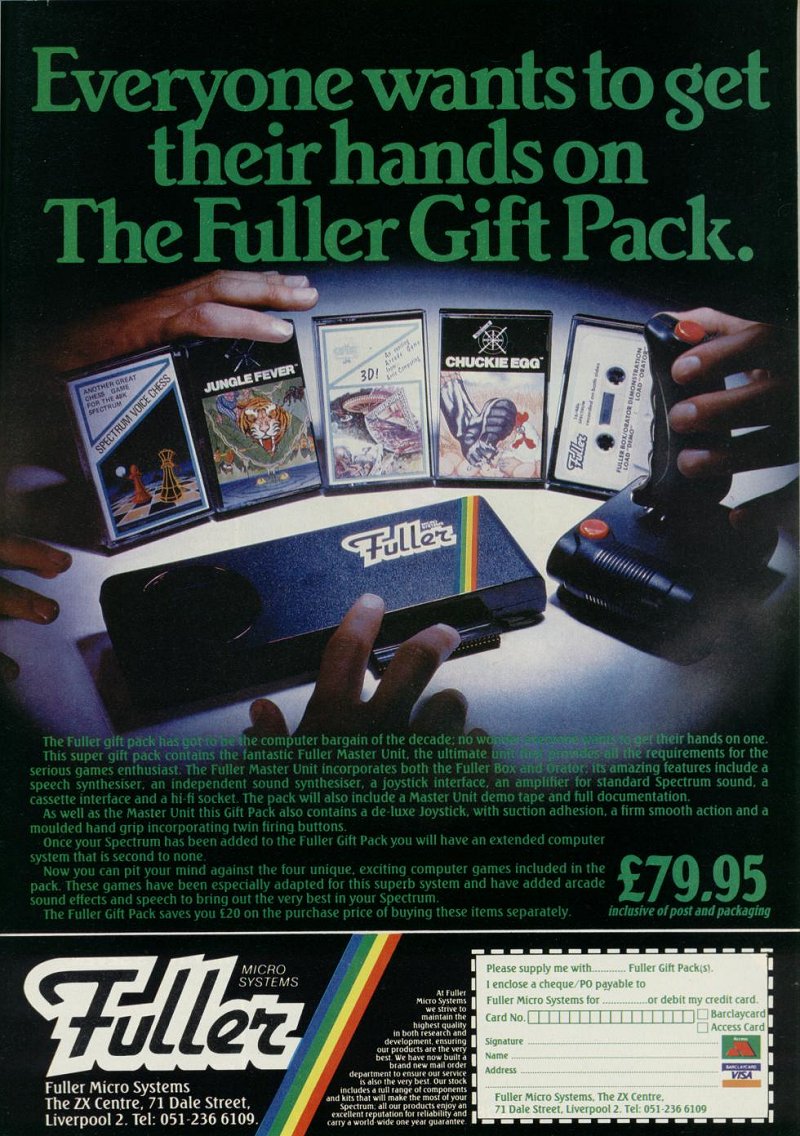
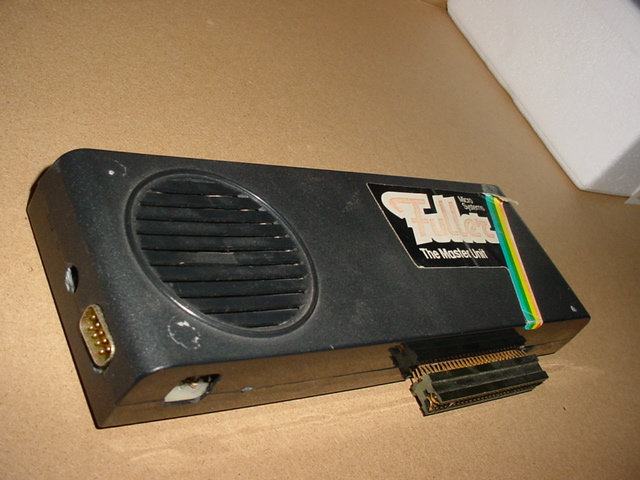
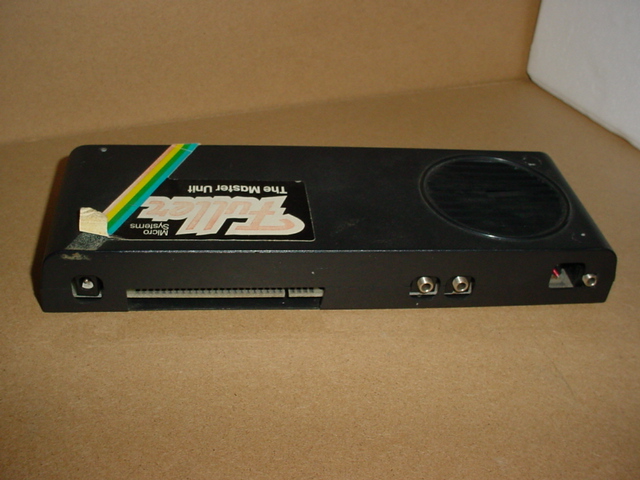
Contains both the Fuller Box and Orator in the same box.
Discussion
Nobody has started a thread about this yet.
Remarks
SPOT: Fuller Box + Orator + Sound Synthesiser + amplifier + joystick port; Fuller Box + Orator: speech synthesis + 3-channel sound + joystick & tape interfaces
Files and rights
No permission is on record either way. Screens and pictures are copied here on a take-down basis: if you hold the rights and want something removed, say so and it goes.
In the magazines 38
Your Spectrum #9Nov 1984 · p.52
Henry Budgett
SPECTRUM SPEAKERS The word is that attaching any old speech synthesiser to your Spectrum will allow you to have cosy chats together. Henry Budgett determines where this is one of the first signs of madness. For years science Fiction films and futuristic novels have depicted an era when man and machine can communicate in perfect harmony. The reality, of course, is slightly different. While speech recognition has yet to he fully developed (ACT's latest Rascal notwithstanding), chip-based speech synthesis has been both mastered and available for several years. Until recently the computing power needed to produce human-sounding utterances was substantial. Now almost every home computer is capable of being equipped to talk back to its owner at a price that won't even break the average piggy bank. SOUNDING OFF When we speak we produce three distinctly different types of sound. The most obvious are the 'voiced' or vowel-type sounds; oo, ar, ee, and so on. These are produced by air from the lungs making the vocal cords vibrate. The frequency of this vibration determines which vowel sound we hear. The second group is the unvoiced or 'fricative' sounds; ss, sh, t and ff. Here the air from the lungs rushes past the vocal cords without making them vibrate and the frequency produced is controlled by the positioning of the lips and tongue. Finally there's silence or, to be more precise, the minute gaps that occur within words (for example six, eight) where we change from voiced to unvoiced and vice versa. FAKING IT In order to generate speech-like sounds, the electronics designers generally go for one of two methods. The first - and until recently the most common - is synthesis by rule. If the frequencies contained within speech are analysed it's possible to devise a system of rules that allow us to re-create any sound from its basic frequencies. These 'building blocks' of sound are called phonemes and by using them in various combinations any word can be constructed. The individuality of a human speaker tends to be lost when speech is generated like this but the words can be clearly understood. Because the synthesis rules for each phoneme are built into the equipment, the user has simply to supply a list of phonemes to be spoken. It's then possible to generate complete sentences instantly, simply by calling up a string of stored phoneme commands. In reality these phonemes tend to be called allophones; this is because the various building blocks sound different depending on their positioning within a word or phrase. However the principle's much the same. The second method for generating speech relies on the fact that the human ear and brain are very good at filling in gaps. The speech we hear over a telephone line is (British Telecom permitting) perfectly understandable. Yet technically the quality - the range of frequencies we can hear - is only one-fifth of what we'd expect from a standard hi-fi system. We understand what's being said only because our brain does the job of filling in the gaps. With the fall in cost of computer memory it's now possible to convert speech into digital information compressed many hundreds of times by a wonderful mathematical technique called Linear Predictive Coding. The resulting numbers representing the original speech are stored in a ROM. To get any of the stored words out again as speech is easy; we simply give the computer the address in memory of the word and the digital information is recovered and converted back into sound, and because the original speaker's words have been stored, all the personal characteristics remain. That's why Acorn's speech chips for the BBC Micro really do sound like Kenneth Baker. WHAT'S THE USE? The commercial uses for speech synthesis are so many and varied that it's just about impossible to list them all. Looking just at the tip of the iceberg it can be used to replace taped announcements at railway stations and airports; in America it's widely used on the telephone system to inform callers of misdialled numbers and engaged or withdrawn services. Speech synthesis units are also being incorporated into cars like Maestros and Montegos as part of the standard instrumentation so, as well as being something of a sales ploy, they can provide warnings the driver can hear without having to take his or her eyes off the road. A major contribution to road safety perhaps? As far as we are concerned in the home computer and electronic games market, speech synthesis is generally used to enhance games. Scores can be read out and warnings of imminent enemy attack can be given to warn players leaving them free to concentrate on the tactics of the game. Of the five speech units under review here, four of them use the phoneme system and one the stored speech method. Let's take a look at how they succeed in fulfilling their purpose. SUMMARY If you're looking for a means of adding a voice to your Spectrum and of incorporating the facility either into games or just for fun, then the Currah MicroSpeech is almost certainly going to be the best buy for you. It's also got the largest number of games already written for it if you prefer to use shop-bought software. Another of its clear advantages over the other units is the addition of a BEEP amplifier for putting the sound through the TV. For those of you who haven't yet bought a joystick controller or a sound generator and fancy a speech synthesiser at the same time, then the Fuller Box/Orator combination - though expensive - offers the lot in one package. Serious users of speech output have an equally clear-cut choice. The superior quality offered by the DCP S-Pack's Digitalker chips make this the logical buy for anyone using the Spectrum as an annunciator rather than as a games machine. The manuals supplied aren't good enough by far, but the Digitalker chips are more versatile than you might think, so if you buy this one get in touch with National Semiconductor for the real data. Of the remaining two units, the Cheetah offers a built-in amplifier and speaker whereas the Timedata unit doesn't; their respective prices reflect this. Neither of them comes close to the overall 'usableness' of the MicroSpeech and they both lack the BEEP amplifier and keyword voicing. SWEET TALKER Price: £29.75 Cheetah Marketing [redacted] HARDWARE: Based on the by now familiar General Instruments allophone chip, this unit comes housed in a vertical box that measures 100mm by 75mm by 50mm. Offering the benefits of an internal speaker (without volume control) and an expansion bus. Sweet Talker stays pretty much on a par with its rivals in terms of design; although it is well made and very neatly assembled on its single PCB. SOFTWARE: This is the easy bit. Unlike the Currah MicroSpeech where the allophones are built up in strings (which is neat but consumes memory) the Sweet Talker simply uses numbers to generate the allophones. These can be stored as DATA statements ready assembled in word order, or you could build a list in alphabetical order sorted by position within a word. You can generate any of the allophones simply by keying OUT 7,n - where n is the allophone number. MANUAL: It's virtually nonexistent and the meager four sides of A5 give you just the allophone list with some examples of how they would be used and that's about it. The tape includes a short demonstration which, according to the manual, "will explain precisely how to use it." SUMMARY: The quality is as good as any other allophone-based synthesiser and the box does have the space-saving advantage of being vertically mounted. ZXS SPEECH SYNTHESISER Price: £24.99 Timedata [redacted] HARDWARE: Physically this is the smallest of the review units at just 65mm by 70mm by 40mm. Housed in a vertically mounted 'potting' box it offers an expansion bus connector and uses the GI allophone chip. The unit is too small to include a loudspeaker so a 3.5mm jack socket is provided for connection to an external amplifier and speaker. Construction on the single PCB is neat and well thought out. SOFTWARE: Two programs are provided on the accompanying cassette. but the second one - a speech editor from the manual - stubbornly refused to perform, giving 'out of memory' errors when trying to RUN. The cause was an over-dimensioned array, but it's a bug all the same. You can access the allophones direct by using their codes and doing an OUT, or you can make use of the machine code subroutine provided and build strings of allophoncs in the reserved variable s$. In this respect the unit works in much the same way as Currah's MicroSpecch, but without the advantage of having the software built-in. MANUAL: Twenty A5 pages cover the theory and practice of allophone synthesis and example programs are included as well as being supplied on tape. SUMMARY: Although it's the cheapest of the bunch, the lack of an internal amplifier and speaker is a nuisance. With these added it would have been directly comparable to the Cheetah. CURRAH MICR0SPEECH Price: £29.95 Currah Computer Components Ltd [redacted] HARDWARE: Fitted into a neat, flat, black box (75mm by 75mm by 20mm) the unit is certainly designed economically. Just three chips from General Instruments and a handful of resistors and so on are assembled on to a very clean PCB. The standard Spectrum edge connector is fixed horizontally and there's no expansion port. The MicroSpecch will have to be the last unit you fit on the back of your Spectrum, but that's probably a small price to pay. This interesting design puts the Spectrum sound (including any speech) through your TV's loudspeaker - which makes a lot more sense than many of the other methods I've seen. To get the sound out there's one flying lead from the back of the MicroSpeech that goes to the EAR sockct and another for the TV socket. (The new TV socket is fitted to the back of the unit.) You do, however, have to unplug the EAR lead when you want to LOAD a new program; perhaps another socket would have been better. A small 'trimmer' is fitted to allow the TV signal to be tuned in to produce the best combination of sound and picture and once set the MicroSpccch didn't need any further adjustment. MicroSpeech uses the allophone system, with the added advantage that every keyword on the Spectrum can be voiced for you. 'Great for the blind', I thought, but then someone pointed out that it isn't a Braille keyboard... Anyway, you can turn the keyboard voicing off if it gets too much for you. SOFTWARE: The MicroSpeech comes with a cassette that on one side offers a rather silly adventure game that speaks to you, and on the other a demo of the various facilities. Written in Basic, the demo is well worth a look if only to see how the 'professionals' construct their words from the allophone set. When you're driving the device from your own programs the allophone strings are built up in a special string variable which is then automatically spoken. It may save a lot of memory to put the words you want into DATA statements as strings, rather than to store the actual strings themselves. Experimentation here is probably worthwhile if you've got a lot to say! MANUAL: Neat, clear, well presented and very thorough! Need I say more? SUMMARY: If you want to boost your Spectrum's sound output and fancy the idea of a speech synthesiser, then this has to be worth considering. The only possible complaint about it is the fact that it doesn't have an expansion connector. FULLER BOX/ORATOR Price: £56.00 Fuller Micro [redacted] HARDWARE: Designed as much more than just a speech synthesiser, here is a unit that fits right across the back of the Spectrum and measures 235mm by 100mm by 40mm. Because the casing masks all the normal socketry at the rear of the Spectrum most sockets are duplicated on the back of the Fuller Box. I say 'most' because the TV aerial lead isn't; you've got to take the box apart to feed this through. The inside of the box is, to be reasonably polite, a mess! The sound and speech chips are both standard socketed General Instruments devices, but the rest of the construction is a hotchpotch of extra wires and piggy-backed chips. Still, as well as providing sound and speech the fully expanded Fuller Box also provides a BEEP amplifier with volume control, joystick port and an electronically switched LOAD/SAVE system - which means that you don't have to keep on unplugging the EAR lead while saving programs. An extra 3.5mm jack socket has been installed at the back of the unit which isn't explained anywhere in the manual, but it turned out to be an extension speaker socket. SOFTWARE: Activating the speech chip is just a matter of using the OUT statement to pass the relevant allophone number to the Orator. The chip contains 64 standard allophoncs, but quite why Fuller suggest you try a loop from one to 255 is a mystery. Included are two demonstration programs; one covering the Box in general, the second dealing with the Orator. Listing the program is likely to provide rather more information than just listening to it! imagine gets a posthumous plug for its software, some of which works with the Orator, I believe, and all their joystick games are compatible with the joystick system used by the Box. MANUAL: It's the sort of paperwork that looks good at first sight but doesn't really tell you very much. If you want more details on the sound chip itself, try the official GI Data Sheet. The manual's explanation of allophones is quite good but fails to expand into real example. That's why it's a good idea to LIST the demo program. SUMMARY: As an all-in-one unit it's probably quite good for the dedicated games enthusiast who likes the idea of tinkering with sounds and speech. As a speech unit in its own right, it's rather big and clumsy and nearly twice the price of its opposition. S-PACK Price: £29.95 (Extra Word Packs £12.95 each) DCP Microdevelopments [redacted] HARDWARE: Based on the National Semiconductor 'Digitalker' system this was the only review device to use compressed speech. In terms of producing intelligible utterances it wins hands down over all the rest but there are several reservations. It comes housed in a 75mm by 110mm by 45mm plastic box and mounts horizontally behind the Spectrum. In its favour is the provision of an expansion bus connector but, unfortunately, the rest of the construction is fairly low-grade. Inside are two PCBs, one providing the bus and the other the speech synthesis components. An internal speaker is provided along with a 3.5mm jack socket to connect the device to a larger external speaker. The volume control is an edgewise potentiometer, in my view a cheap and nasty approach. The speech chips are all socketed and there's provision for installing four vocabulary ROMs... our review model had all four fitted. When I first tested a Digitalker system some three years ago these were the standard chips. Although the price has fallen dramatically (the experimenter kit was then about £130 with two vocabulary ROMs), the repertoire hasn't. It may be worth contacting National Semiconductor direct to see what else it can offer (UK offices are in Bedford). The speech quality from this unit is excellent. It's easy to hear that the log-on message "This is Digitalkcr" is spoken by an American female and the rest of the words in the first two ROMs are spoken by an American male. I'm also pretty sure that there are two other people speaking on the second pair of ROMs, which is an indication of the sort of information a digitised speech system contains that you don't get from an allophone system. SOFTWARE: Er, there isn't any! You just OUT the required word number to the appropriate port and the device says it. MANUAL: Not a lot of use, I'm afraid. The four A5 sides tell you how to use the thing, but miss out on all sorts of interesting details. Your best move is to get the National Semiconductor data sheets (usually free) and find out from them how to string words together, get parts of words and a whole lot more besides. SUMMARY: For pure speech that's immediately understandable this wins hand down. On the other hand you may want words that aren't in its vocabulary and, as it stands, there's no way to make them. Therefore, it's main use would be in a dedicated system announcing times and other numeric data - it's not much good for games and so on.
As an all-in-one unit it's probably quite good for the dedicated games enthusiast…
SPEAKER COMPARISON CHART Synthsiser: Currah Microspeech Synthesis Type: Allophone Allophone Coding: String Keyword Voicing: Yes Internal Amplifier: Uses TV Internal Speaker: Uses TV BEEP Amplifier: Yes Volume Control: Uses TV Demonstration Tape: Yes Software Provided: In ROM Games Available: Yes PHYSICAL NOTES Size (in mm): 75 by 75 by 28 Format: Horizontal Case Material: Plastic Expansion Bus: No Synthsiser: Fuller Box/Orator Synthesis Type: Allophone Allophone Coding: Numbers Keyword Voicing: No Internal Amplifier:Yes Internal Speaker: Yes BEEP Amplifier: Yes Volume Control: Yes Demonstration Tape: Yes Software Provided: No Games Available: Yes PHYSICAL NOTES Size (in mm): 235 by 100 by 48 Format: Horizontal Case Material: Plastic Expansion Bus: Yes Synthsiser: DCP S-Pack Synthesis Type: Compressed speech Allophone Coding: Numbers Keyword Voicing: No Internal Amplifier: Yes Internal Speaker: Yes BEEP Amplifier: No Volume Control: Yes Demonstration Tape: No Software Provided: No Games Available: No PHYSICAL NOTES Size (in mm): 75 by 110 by 45 Format: Horizontal Case Material: Plastic Expansion Bus: Yes Synthsiser: Timedata ZXS Synthesis Type: Allophone Allophone Coding: String/Numbers Keyword Voicing: No Internal Amplifier: No Internal Speaker: No BEEP Amplifier: No Volume Control: No Demonstration Tape: Yes Software Provided: On tape Games Available: No PHYSICAL NOTES Size (in mm): 65 by 78 by 40 Format: Upright Case Material: Plastic Expansion Bus: Yes Synthsiser: Cheetah Sweet Talker Synthesis Type: Allophone Allophone Coding: Numbers Keyword Voicing: No Internal Amplifier: Yes Internal Speaker: Yes BEEP Amplifier: No Volume Control: No Demonstration Tape: Yes Software Provided: No Games Available: No PHYSICAL NOTES Size (in mm): 110 by 75 by 50 Format: Upright Case Material: Plastic Expansion Bus: Yes
Sinclair User #20Nov 1983 · p.31
FULLER PUTS ALL ITS EGGS IN ONE BASKET The Fuller Box is an extension which looks natural to the back of a Spectrum. It contains a sound board, amplifier, joystick port and separate cassette EAR and MIC sockets. The sound board contains the AY-3-8912 sound chip used in many computers and has three programmable pitch tone supplies, plus a noise generator. It also has envelope control to give rising or falling pitched sounds. The sound board works on port numbers 63 and 95, while the joystick works on port 127. The joystick socket is the standard Atari one and besides the demonstration cassette some commercial software will also work with it, as it is similar to the Kempston joystick. It costs £30.75 for the basic unit - called the Fuller Box - and the master unit costs £55.75, which includes the speech chip. You can if you wish upgrade to the speech chip at a later date. Fuller Micro Systems, [redacted]. Other shops sell the units.
ZX Computing #8Aug 1983 · p.44
Peter Shaw
IT'S IN THE BOX Peter Shaw takes the lid off the Fuller Master Unit and tells us what he found there. Fuller, the Liverpool based company who have brought you add-ons for the ZX81 and Spectrum in great quantities in the past, have come up with the goods once again with a very useful peripheral for the ZX Spectrum. DOES IT MEASURE UP? The Master Unit itself is built into a tough black plastic box measuring 8cm by 24cm by 3cm. The connector at the back of the Master Unit is strong and forms a good and healthy connection with the Spectrum. The unit also has a connector at the back allowing you to make the outputs you would from the Spectrum itself. The Master Unit can perform a wide range of fancy tricks although its main feature is speech. The unit is capable of forming a large number of phonemes, all of which are clear, easy to use and, more importantly, easy to understand. You use the Master Unit's speech facility by sending a chosen number in port 159, ie if you say 'OUT 159,x' where x would be phoneme you wish to be enunciated. The speech demo supplied with the unit was not amazing but was adequate to test the unit's prowess. There are also rumours to suggest that there might be software coming soon from Fuller themselves which could drive the speech unit as well as providing a well written arcade game. ZAP! POW!! BOOM!!! The next feature the Master Unit offers is three channel sound - a very useful addition to the limited voice of the Spectrum. Unfortunately, the demo tape to illustrate the capabilities of this facility is not that good, just providing some sample arcade zaps and explosions before giving you a do-it-yourself sound generator program. However, as I found, it is very worthwhile 'doing it yourself' as some of the noises you can come up with are fantastic. But the unit doesn't stop there! It also has a joystick port for Atari-type joysticks which works very well with a lot of the software I have. The Master Unit also has an on-board cassette interface which enhances all the signals from the Spectrum and allows you to keep both EAR and MIC plugs connected at the same time. WE SHALL NOT BE MOVED The Fuller Master Unit sounds amazing, doesn't it - and it is. I'm not going to take it off the back of my Spectrum for a long time. You can buy the Master Unit for £54.95, or if you would prefer a cheaper version which has all the features of the Master Unit except the speech, you can get one for £29.95. For more information on the Master Unit or any other Fuller products, get in contact with Fuller Micro Systems, [redacted]. Telephone enquiries can be made on [redacted].
Advert26
- Sinclair User #34Jan 1985 · p.49
- Sinclair User #33Dec 1984 · p.166
- Sinclair Programs #26Dec 1984 · p.44
- Your Computer #11Nov 1984 · p.4
- Popular Computing Weekly #21May 1984 · p.6
- ZX Computing #11Feb 1984 · p.79
- Computer ChoiceFeb 1984 · p.79
- Computer ChoiceJan 1984 · p.40
- Sinclair User1984 · p.98
- Sinclair User #21Dec 1983 · p.178
- Your Computer #12Dec 1983 · p.297
- ZX Computing #10Dec 1983 · p.183
- Computer ChoiceDec 1983 · p.70
- Sinclair User #20Nov 1983 · p.55
- Your Computer #11Nov 1983 · p.221
- Sinclair User #19Oct 1983 · p.90
- Your Computer #10Oct 1983 · p.39
- Your Computer #9Sep 1983 · p.201
- ZX Computing #8Aug 1983 · p.85
- Your Computer #8Aug 1983 · p.173
- Your Computer #7Jul 1983 · p.105
- Your Computer #6Jun 1983 · p.105
- Your Computer #5May 1983 · p.202
- Personal Computer News #8May 1983 · p.17
- Your Computer #4Apr 1983 · p.153
Feature4
- ZX Computing #17Feb 1985 · p.115
- Sinclair Answers #1Sep 1984 · p.25
- Crash #1Feb 1984 · p.21
- ZX Computing #10Dec 1983 · p.106
Full-page ad3
- Your Spectrum #1Jan 1984 · p.41
- Your Computer #12Dec 1983 · p.246
- Your Computer #12Dec 1983 · p.92
Letters1
- Sinclair User #31Oct 1984 · p.15
News/Note1
- ZX Computing #7Jun 1983 · p.58
Related
- Elsewhere
- Centre for Computing History
- Same entry at
- Spectrum ComputingZXInfo
Reviews from people here
Sign in to write about this, or make an account. It takes a minute and lets you correct the catalogue too.
Everything ZXDB can hold about this is here.
Sign in to correct or add to this.
Hold the rights to this and want it taken down?