ZX Interface 2
Hardware: Joystick
Sinclair Research Ltd · Sep 1983 · Pound sterling 19.05 · Pound sterling 9.95 budget
Also known as ZX Interface II (English)
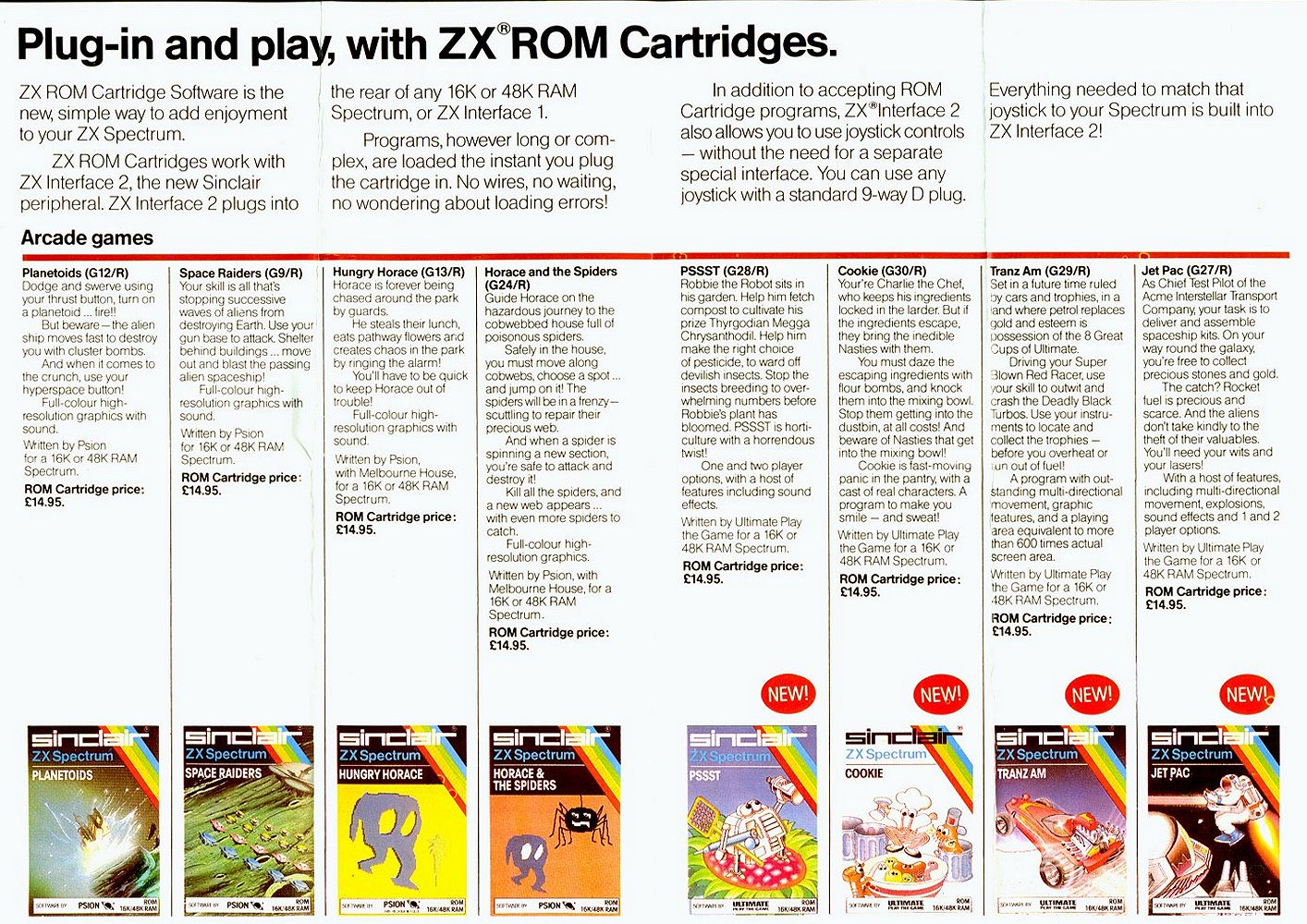
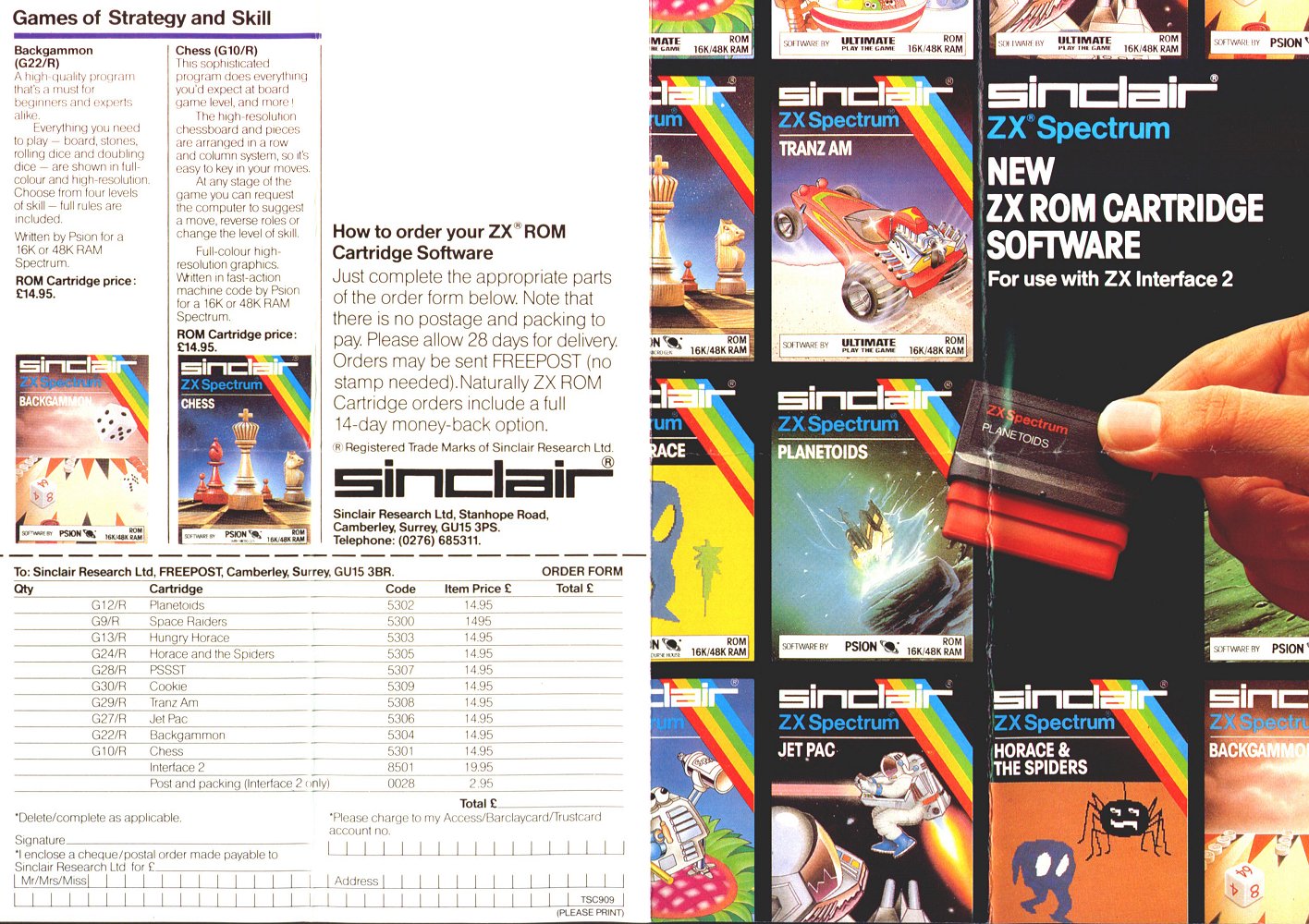
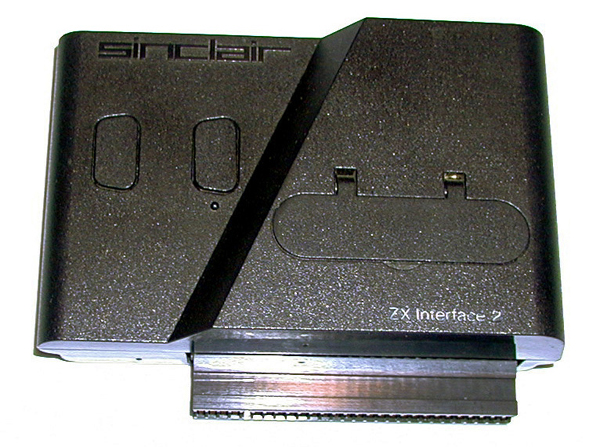
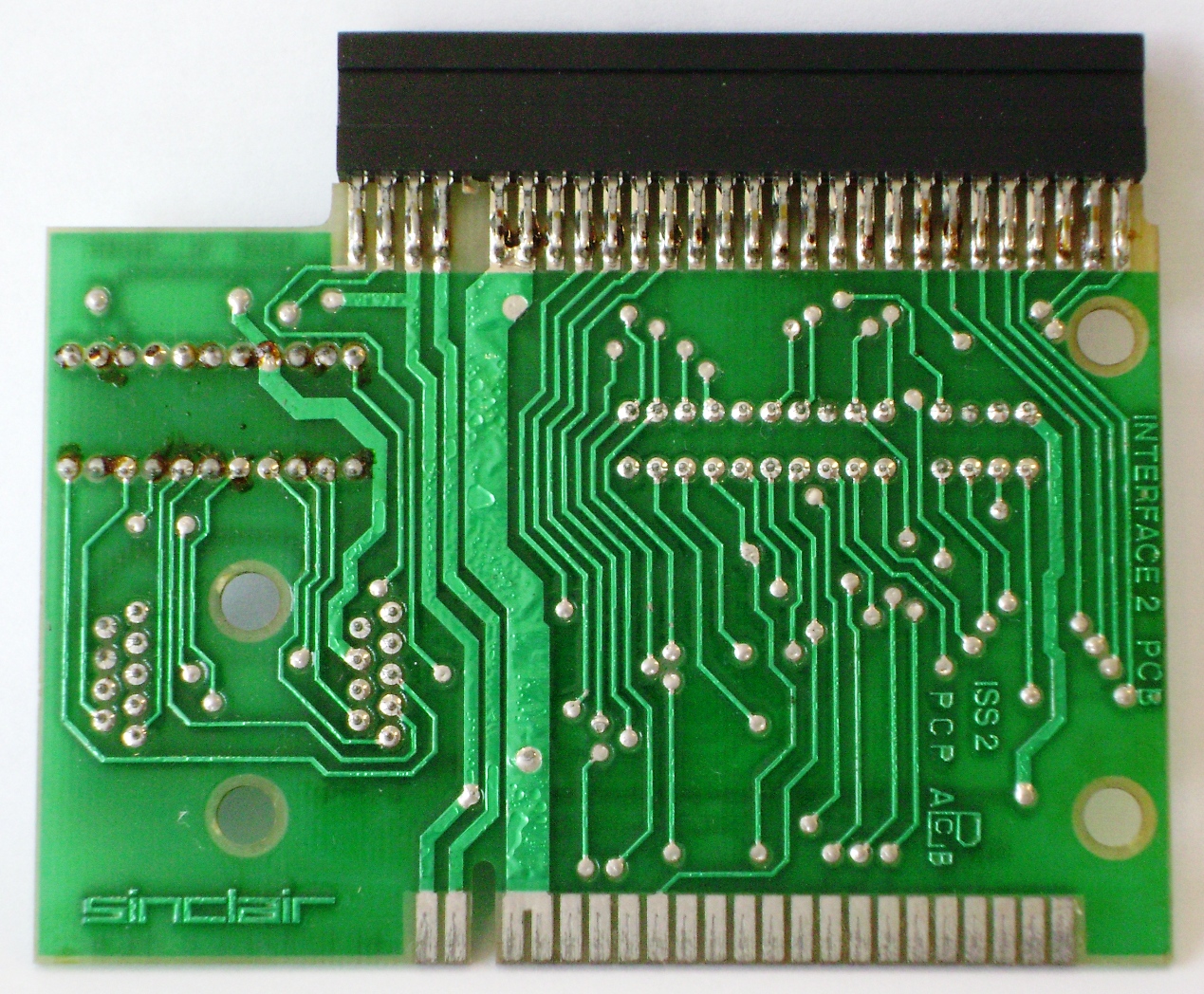
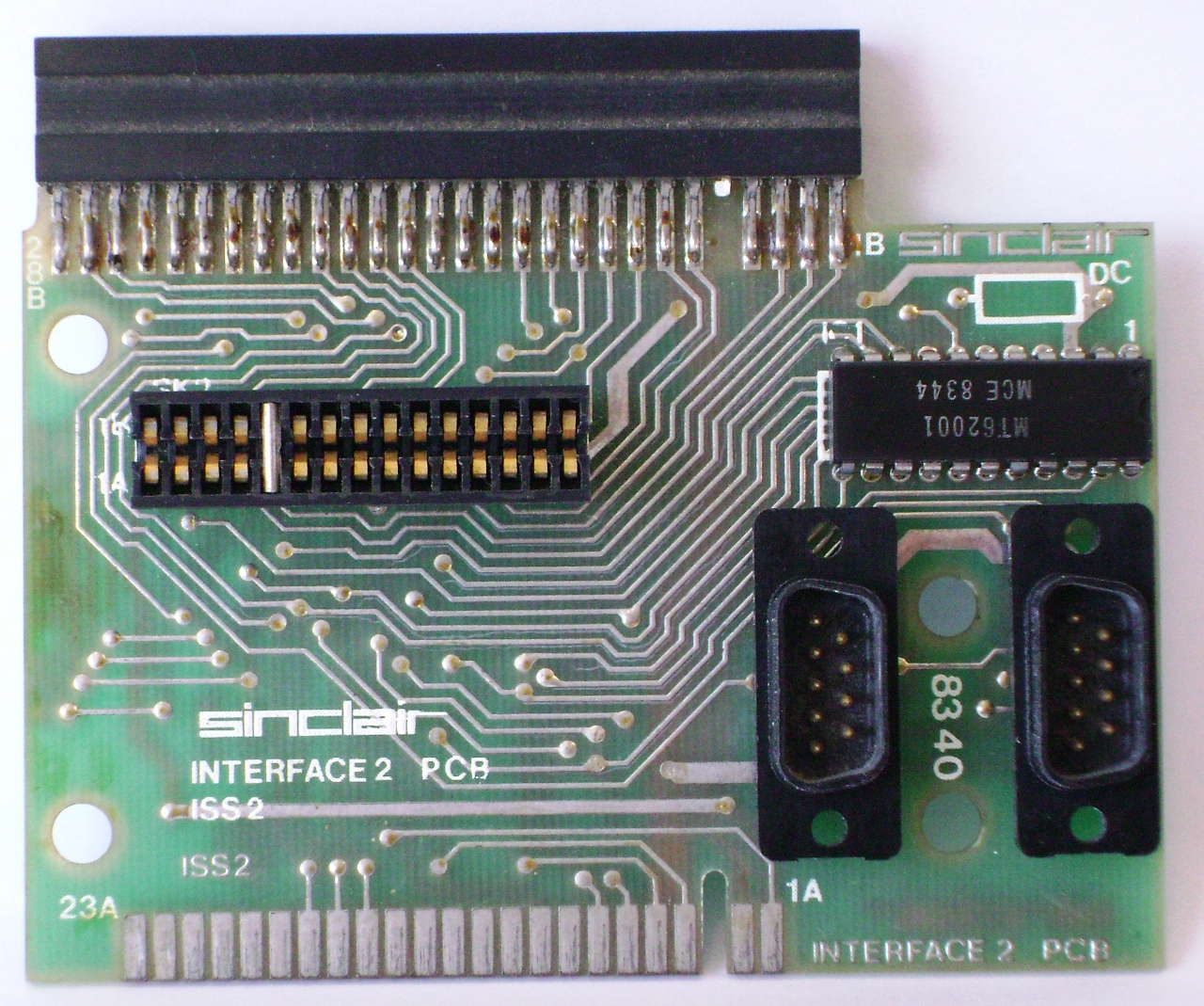
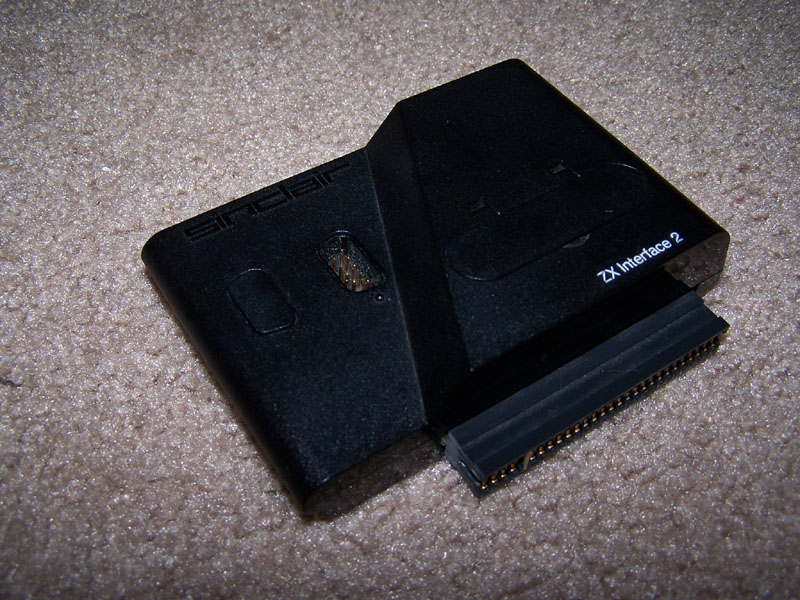
ROM cartridge interface with twin joystick ports.
Discussion
Nobody has started a thread about this yet.
Remarks
Sinclair's second interface did not take off like the first one. This ROM interface was produced to try and keep up with the consoles. Instant loading ROM cartridges were produced for the interface, licenced by Sinclair. Only 10 titles were ever available: - {Planetoids|Sinclair Research Ltd|0003755} (Sinclair Research Ltd) - {Space Raiders|Sinclair Research Ltd|0004678} (Sinclair Research Ltd) - {Backgammon|Sinclair Research Ltd|0000374} (Sinclair Research Ltd) - {Pssst|Ultimate Play The Game|0009401} (Ultimate Play The Game) - {Cookie|Ultimate Play The Game|0009326} (Ultimate Play The Game) - {Jetpac|Ultimate Play The Game|0009362} (Ultimate Play The Game) - {Tranz Am|Ultimate Play The Game|0009443} (Ultimate Play The Game) - {Hungry Horace|Sinclair Research Ltd|0002390} (Sinclair Research Ltd) - {Horace and the Spiders|Sinclair Research Ltd|0002350} (Sinclair Research Ltd) - {Chess|Sinclair Research Ltd|0000914} (Sinclair Research Ltd)
Documents
- ZXInterface2_Manual.htmlInstructions 5 KB
Other files
- ZXInterface2_Flyer.zipHardware advertisement scan 2,727 KB
- ZXInterface2_Flyer2.zipHardware advertisement scan 991 KB
Files and rights
Distribution permission is on record, granted to another archive rather than to this one. Screens and pictures are copied here; everything else links to the archive that holds it.
- AllowedSinclair Research Ltd → WorldOfSpectrum
In the magazines 60
ZX Computing #15Oct 1984 · p.68
INTERFACITS - JOYSTICK INTERFACING INVESTIGATED A comprehensive round up of the units available - checked out by our team of reviewers. One of the first add-ons that a computer owner may contemplate buying is a joystick of some kind. The increase in control that this provides is of obvious benefit to the dedicated games player. In addition it is becoming increasingly necessary for some of the complex graphics packages that are appearing for the Spectrum. However if you have not yet taken the plunge and are now contemplating the purchase of some form of controller you have a difficult choice ahead of you. In essence, most of the actual joysticks are very similar, and your eventual purchase will be based upon personal preferences for shape, size, ease of use etc., but the biggest decision to make will be that concerning the vital link between your joystick and the computer i.e. the INTERFACE. Interfaces allow the use of joysticks with compatible software, and although there is a great variety of material available for use with all the more common interfaces no single one will give you control over every game, unless, of course you opt for a PROGRAMMABLE INTERFACE. These claim to give you joystick compatibility with ALL software. NON PROGRAMMABLE KEMPSTON £11.95 Probably the nearest thing to a "standardised" interface. This unit has been around almost as long as the Spectrum itself and most games have a Kempston option. The unit works by utilising the IN31 function and so the keyboard is not enabled. This also means that a program must cater specifically for it and some of the earlier games don't. To get over this Kempston market a set of tapes which will convert some of these to operate with their interface, each of these will cost £4.95. The box plugs into the port of the back of the Spectrum and the joystick plugs into a standard 9 pin socket at the front of the unit. This means that the joystick leads trail over the keyboard and if you have a full sized keyboard then this plus the fact that the box has a "lip" means that fitting it is a great problem. Although it's starting to show it's age there's still plenty of life in this well tried and loved device. INTERFACE II Sinclair Research £19.95 A multi purpose unit which includes two joystick sockets, a ROM cartridge socket and a limited through port. Sir Clive in his wisdom, decided to use his own "standard" for operating his interface and this is not the same as Kempston. This means that many of the earlier games will not operate with it although most of the recent programs incorporate an Interface II option. In fact many games have a larger choice of joystick options than gameplay options! When provided, two joysticks can be used simultaneously and this is the greatest advantage of this unit. It has been on the market for quite a while now and the presumed flood of cartridge programs has not materialised. This is really the power of this unit and if they are not going to be produced then it has limited value as a joystick interface. RAM TURBO RAM Electronics (Fleet) Ltd. £22.95 Similar to the Sinclair Interface II, this unit has two joystick sockets and a cartridge slot, also has a through port but in the Turbo it is a full one unlike the Interface II. The Sinclair format is not used, but both Kempston (IN31 and Protek (cursor keys systems are supported. I don't know if this means that only one joystick at a time can be used and we never received a review unit. GAMES ACE VOX BOX Datel Electronics £29.95 Although requested, neither of these units were sent for review, so I'll just give a mention of the information available. Games Ace works on the Kempston function so it will be compatible with that option, it also has the bonus of including circuitry to output the sound to the TV where the volume can be controlled. Vox Box is the same as the Games Ace but also includes speech synthesizer based on the allophone system. Sounds interesting. PRO JOYSTICK INTERFACE Kempston Micro Electronics Ltd. £19.95 After a long run with their bes selling interface Kempston have decided to introduce this mode;. Similar in many respects to the Sinclair Interface II it seems much more versatile. As it's hot off the production line we haven't yet seen one. However, I'm told that it has three separate 9-pin plugs which cover Kempston's own system, Sinclair I/F II standard and the AGF/Protek cursor key format. There is also a ROM cartridge port. With Kempston's experience in the market it's got to be worth a look. SOLIDISK Technology Ltd. £8.50 One of the cheapest interfaces on the market, this one operates on the Kempston standard and is claimed to be wobble free. Sold complete with a Quickshot-style joystick for £15.50. Even more useful is that should you forget to change the switch or get the wrong option then you can safely change the option once the program has been loaded and is actually running! An interface which I would recommend to any dedicated games player who requires a simple, effective means of joystick control. Protek also market a presentation pack of joystick, interface and their own flight simulation program for £24.95. AGF JOYSTICK INTERFACE II £9.95 AGF have two joystick interfaces on the market at the moment - one programmable and the other not. Interface II is the non-programmable one, but there are versions for both the ZX81 and the Spectrum. The interface will accept a wide range of joysticks including Atari, Starfighter, Le Stick etc. and has facility for a second joystick to be used. There isn't much to it in the way of hardware, just a few plugs and sockets and six chips. I noticed they have rubbed off the numbers on the chips to deter people making their own, but at £9.95 it's not worth the bother. The interface just clips on the back of your computer and has a rear extension for more add-ons. With a joystick plugged straight in it will mimic keys 5, 6, 7, 8 and 0 and the second port will give you T, Y, U, I and P. To convert games that do not use these keys, you will have to purchase AGF's software and you have a choice of two cassettes. Tape one will convert Arcadia, Schizoids, Hungry Horace, Horace goes Skiing, Spectres, Penetrator and tape two converts Centipede, Planetoids, Jet Pac, PSSST, 3D Combat Zone and Invaders. After you have loaded the cassette it will ask you which game you would like to play and after running the tape further it will automatically find the corresponding software to convert that game and tells you when to load your game. On the inlay, it lists the games you can use the interface with. I would have thought it would have been better to list the key operations as well so that it would be easy to find what other games you could play with it. You can buy the interface, software and joystick direct from AGF if you cannot find it at your local store. Cassettes are £4.95. It is a slightly 'Heath Robinson' way of connecting a joystick but it is cheap. DK'TRONICS JOYSTICK INTERFACE DK'Tronics Ltd. £13.00 Another little shiny black box (7 x 5 x 2.5cm.) to get quickly forgotten somewhere between joystick and computer is the DK'Tronics Joystick Interface. It has a firm positive fit into the expansion port at the rear of the Spectrum, although because only 22 of the contacts on the edge connector are used, the actual fitting tends to require more care and caution than with other units. There are two nine pin, 'D' type ports at the top of the unit and both are clearly identifiable. The first is for use with software using a key change option or using 6, 7, 8, 9 or 0 keys. The second port uses the IN31 command is therefore for use (software compatible) with the Kempston type joystick. The test routines and a few example programs (one using machine code) are given in the accompanying instruction leaflet, for those people who want to stretch themselves beyond being mere players, who want to incorporate their joystick and interface into their own programs. And for those programmers who want to use two joysticks to control two separate objects at the same time on the screen, then both ports of this interface can be incorporated simultaneously into programs. Just out of interest, I wonder how many micro-users actually do use their joysticks and interfaces for anything else besides playing commercially produced games? PROGRAMMABLE INTERFACES Rainbow Electronics £24.00 (+3.00 extra for a through-port) Another interface which never made it to our office in time for this roundup. The interface includes a built in amp and speaker, the joystick socket and the programming switch are positioned at the front (with all the associated problems). CCI (Cusom Cables International) £15.00 This unit is programmed by means of software supplied on tape, and this means that you have to load in the program supplied before loading your game. This isn't a great problem as it is a short program and setting up the keys is straightforward and only takes a few minutes. The unit we had didn't have any instructions. CCI promise that they are supplied with each purchase - we just had "a very early preview model". Nevertheless I found it simplicity itself to operate even without them - which can't be bad. The only problem is that some games don't tell you which keys the program uses so you have to load them in first to find out! This is only a problem the first time round because, being sensible, you kept a record for the next time, didn't you? The unit proved reliable and effective over a three week period of constant and frequent use and I see no reason why it shouldn't perform admirably for a long, long time. At the price it is probably one of the cheapest of it's kind and worth considering if, as it is for me, money is a prime factor. PROGRAMMABLE JOYSTICK INTERFACE Stonechip Electronics £24.45 As with most similar interfaces this is simply a plug-in unit which requires no additional links such as flywires of extra tapes to load. The unit itself measures 90 x 75 x 35mm and is contoured to fit snugly to the rear of your Spectrum. It features a three-way switch at the front enabling the user to select any of the three modes; Program, Play or Normal operation (where control relies upon the keyboard alone). The interface draws its power from the computer and a small red L.E.D. indicates power on. A standard 9 pin Atari-style joystick socket allows the use of your favourite zap-em-stick! It is at this stage that my first complaint appears. No doubt many satisfied users will disagree, but why, when an increasing number of games require the use of at least two extra hands, does the port have to be placed so that the joystick lead runs right across the keyboard? Programming of the interface is fairly easy - set the selector to the Program position, press the appropriate direction key and move the joystick into the relevant (or not so relevant) position. The small, but adequate, instruction sheet advises that the most complex functions be dealt with first and this gives rise to the second little quibble. As opposed to certain other interfaces available, the Stonechip requires the FIRE function to be input separately for each and every direction. This is sometimes not all that easy when you require one hand for the keyboard, one for the fire button and direction and one to stop the mobile joystick from sliding off the table! Apart from that, the programming of this interface is a straightforward, it not lengthy, process. Programming complete, just move the selector to Play and away you go! One additional feature is the Normal position that allows the joystick to be removed without loss or corruption of the keys already programmed. The unit was tested with a variety of joysticks and performed perfectly well with all of them. Included in the instructions is a sample program to enable practice - programming prior to testing on the real thing. If a Programmable interface is the sort that you require then this should be considered. It is slightly expensive in comparison to some of the updated and newer models now appearing, but nevertheless is a tried and tested product that has stood the test of time. THE CAMBRIDGE JOYSTICK INTERFACE £34.95 (including joystick) This interface has a through-port at the back which is very useful for using other units like speech or sound devices. The unit also has a lip on the front to help prevent "wobble" but if you have a non-standard keyboard it gets in the way. There is the usual nine pin plug on the left hand side for the joystick and the overall size is 11.5cm x 3.5cm x 7.5cm. To use the interface you have to load a tape first which programs the interface to respond to the appropriate keys. If the game you're using fails to give this information on the instructions then you have to load the game first to find out! However once you have programmed a set of key-sequences, they can be saved on tape (the reverse side of the tape has been left blank for this purpose and provision is also made for saving to microdrive) and many games can be saved at one time. You are able to check the joystick position at the end of the programming sequence. This interface is sold complete with a joystick and tape - the joystick is available separately and is reviewed as such. The interface is a bit fiddly to use but has proved compatible with all software tried, but when an option of joystick or keyboard is offered from within a program, you must use the keyboard one as the joystick option frequently does not work. PROGRAMMABLE JOYSTICK INTERFACE Downsway Electronics (UK) Ltd. £22.95 The Downsway Programmable Interface, which has been available for quite some time now, is at first sight rather a plain black unit which plugs directly into the Spectrum's rear expansion port. It measures 65 x 95 x 25mm and has a dual-position switch on the rear and a standard 9-pin joystick socket on the right side of the unit. This is one of the advantages that this interface has over some other units currently available, in that the keyboard is left uncluttered by control cables and therefore can be used in conjunction with the joystick. This gives the user a wide range of control options which can be a distinct benefit considering the handful of keys that some programs demand. A small instruction sheet provided with the interface gives all the information that is needed to make your joystick compatible with any program. Programming of the interface can be achieved either prior to loading a game or after the game has loaded. This facility takes care of all those programs that have no detailed instructions on the cassette inlay. To use this unit is simplicity itself - with the dual position switch in 'program' mode press the key for the specified command and move the joystick to the appropriate position. Release joystick and key then repeat for all other movements. In essence that's all there is to it! After programming (a few minutes work) switch to the 'play' mode and away you go! In operation the unit performed perfectly and on the odd occasion when a mistake was made it was a simple matter to re-program the offending key without the necessity of going through the entire procedure again. The FIRE command is independent of direction command and this means that FIRE has only to be programmed once, as opposed to the multiple movement/fire operations needed with some interfaces. The unit was tested with several joysticks ranging from the cheapest to one of the most expensive available and it performed equally well with all, the only noticeable difference being a somewhat coarser movement with one of the cheaper joysticks. Of the many programs used with this interface only two gave any problems - keys could be programmed but pressing the fire button caused the game to restart. As it happens the particular games weren't intended for joystick use anyway! In conclusion, if a joystick interface is high on your list of priorities then it may well be worth your while paying a bit more for the extra flexibility that this excellent little unit provides. FOX PROGRAMMABLE INTERFACE Fox Electronics Ltd. £34.95 I have used this unit consistently over a four week period with a wide variety of games and I recommend it to anyone looking for such a unit. It is a rather large unit and the long suffering DK'Tronics keyboard needed another bit removed before it would fit! The standard case presents no problems however. The unit has a through port so you can use other interfaces behind it, the Currah micro speech unit worked fine at the back, and the standard 9 pin joystick socket is near the bottom of the right hand side of the case. just above the socket is a small, two-way (up/down) switch. On power up the switch should be in the down position - switching it up instantly presents on screen a menu of 16 possible combinations of responses and options to create or select a set or to exit. The more knowledgeable among you will have worked out that the unit must contain a programmable chip of some sort. The program and set of key combinations are kept permanently refreshed by a battery which is constantly recharged. What happens if something goes wrong? The interface is supplied with a back up tape and also your own sets of positions can be saved on tape and easily reloaded into memory if needed. A few times I had to perform this operation due to the awkward fit with the keyboard but it was no real problem. Documentation is good, covering all the operational details and also how to use it as a pseudo ROM. All in all easy to use and one of the most impressive joystick interfaces I've used. AGF PROGRAMMABLE JOYSTICK INTERFACE £26.95 AGF sell a version of this interface for both the Spectrum and the ZX81 and both cost £26.95. The interface works by duplicating the keyboard layout with a grid of wires. The wires ending in crocodile clips can be attached to the various grid wires to route specific keys to the joystick. This means that all games can be controlled by joystick although you must use the keyboard option and not the joystick one when provided. The joystick is connected by a standard 9 pin 0 socket so it is compatible with the majority of the sticks on the market, two sockets are provided for two sticks for two players to play alternatively. Both sockets operate on the same keys and both sockets and the keyboard are always operative. A possible cause for dispute when used by two players! A set of quick reference cards, a demo tape and a stick on chart completes the package. The sight of uncased wires and chips may put off some users, but treated reasonably, this is an almost foolproof method of providing joystick control to any game. The unit has a through port and further peripherals can be added afterwards, I used a Centronics interface and a speech unit with it and had no problems. SWITCHABLE INTERFACE Protek Computing Ltd. £19.95 An interesting and unusual idea from Protek is to provide the ability to switch between the common interface options. The interface has a three way switch at the back marked, logically, 1, 2 and 3. Setting the switch will give you compatibility with Protek/AGF (cursor keys), Kempston and Sinclair Interface II formats respectively. Between these three options I should think that around 90% of the software on the market can be used with this unit. The only programs which will cause problems are those where no joystick options are provided and keys other than the cursor keys are used, and there can't be many of those! The case is quite small and neat with the usual 9-pin plug fitted in the right hand side of the unit. This is a handy position to allow the joystick lead to clear the keyboard. The instruction leaflet is as I like them, written in a simple step by step manner with diagrams - if you get it wrong it certainly won't be Protek's fault. My biggest criticism is the lack of a through-port, but with other devices available to compensate, it's not as drastic a problem as it used to be. Using this is a delight, even though most programmables are quickly and easily programmed, sometimes it doesn't seem worth the bother. With this one, compatibility is usually available at the flick of a switch. FIRMWARE PROGRAMMER INTERFACE £29.00 SOFTWARE PROGRAMMER INTERFACE £22.95 Voltmace Ltd. Two other interfaces unseen by us. One is programmable by using a two-way switch and the other by using a program on tape. The most interesting item that I've seen from this company must be their Delta 3 joystick, which has a rectangular base, three fire buttons (to allow for individual styles of holding the thing), and a fingertip type joystick at £10.00. PACE COMPUTING This company advertises a programmable interface for £26.00 which they say does not disable the keyboard and can be reprogrammed during a game. No further information is available so far. EAST LONDON ROBOTICS LTD. £15.00 Designed to be sold with their Trick Stick (of which we're still waiting for a review sample), it appears to be similar to the AGF programmable interface, in that flyleads which are connected to pins to mimic the keyboard are used. If bought with the Trick Stick, then it will only cost £10.00, which can't be bad! DK'TRONICS LTD. £22.95 This is Dk'Tronics deluxe interface and is programmable from the keyboard by using the switch provided on the top of the unit, or via the program supplied on tape. There is only one socket provided on this model, but as it is fully programmable there isn't any need for two separate sockets to cover the different methods of providing control. The socket is located on the top of the interface next to the switch. During operation, the keyboard is still enabled so that complex games requiring more than five keys to be pressed can still be played. At the time of going to press we haven't been able to obtain one because they're short of stocks, however Ms Green of the company assures me that by now their stockroom will be overflowing. The information given to me claims that movement in seventeen directions is possible, I will be most interested to put this through it's paces! A full through port is included and it is claimed to be microdrive compatible, the usual lip at the top of the Interface is there and I would also be interested in trying it for compatibility with one of their superb looking keyboards. PROTOCOL 4 AGF Hardware £30.95 The very latest unit from AGF, this is an interesting looking interface. It lies flat and is programmed by a set of reprogrammable cards which are snapped into place on the interface. The device is supplied with three pre-programmed cards to cover Kempston, Sinclair and Protek/AGF (cursor keys). An extra, blank card is supplied for your own use. This is a great advance on their older interfaces in style and ease of use, however, ZX81 owners will be pleased to know that AGF are to continue producing and selling their old units because, as Mr. Fosberry told me personally, the demand by ZX81 owners is as great as that from Spectrum owners. The unit has a full through port and amazingly, up to five of these can be connected and programmed individually for multiple control! The latest Quickshot II joystick is supported and the socket for the joystick is placed on the side of the unit. Yet another small but useful extra is a reset button to allow you to turn the computer on or off without having to pull the plug each time with the eventual problems this causes. Slightly expensive but for the dedicated games player probably well worth the money. ENDNOTES We covered as many interfaces as we could and I'd like to thank all the companies that sent us review units which allowed us to write a more comprehensive and detailed report. I do realise that as always, these are written by people who are giving their own opinions and you may or may not agree with them. Overall we have tried to give you an idea of what is available but really nothing substitutes for trying them for yourself at your nearest store. There are probably a few companies that we've missed, if they would like to write and tell is, we'll include them in our future features. Each review was written by the person named as the end, if no name appears then it was reviewed by myself - it's a hard life.
C&VG (Computer & Video Games) #28Feb 1984 · p.156
Robert Schifreen
EXTRA BITS! If you want to extend the capabilities of your computer or games machine there are now lots of bits and pieces which you can plug into the back to make it do things better or faster, or things which it could never do before. Such plug in goodies include extra memory, better keyboards, joystick interfaces, Micronet adaptor or devices to make the beast speak or play tunes. Robert Schifreen takes a break from Bug Hunting to bring you news of some of the current plastic boxes which you can plug into your micro or games machine. Upgrading your present equipment by using add-ons means that you may not have to buy that new machine after all! COMMUNICATIONS Communications means making your micro talk or listen to other computers in their own language. They communicate either over the airwaves at radio frequencies or over the telephone lines. Each has its advantages. Radio communication is only one-way whereas telephone can be both. But long conversations on the phone can be expensive. If you want to read more about this subject, dig out November's issue of C&VG and turn to page 114. If you want to receive Teletext on your micro, you'll need a BBC model B with a Teletext adaptor. This lets you receive Ceefax and Oracle, which are information services broadcast by the BBC and by ITV. You just plug your TV aerial into the back of the adaptor, and the computer will do the rest. The adaptor gives you four channels of teletext information; BBC 1, BBC2, ITV and Channel 4. You can find out about such things as what's on TV tonight, the latest world news, sports news and ITV also has a kids corner with jokes and the like. Teletext is like a big electronic newspaper, You can read its pages on your TV but you can't write back to it. The other method of communication is over the telephone. This is what systems like Micronet 800 use. This way, the computer can send messages and you can also type back. There are loads of computers which you can dial into and most of them are free except for the price of the phone call. However, these free bulletin boards, as they're called, run on different baud rates (no pun intended) to Micronet so unfortunately you can't use a Micronet adaptor to call them. You can buy a 300 baud modem quite cheaply from various companies, like Maplin Electronics who supply units for the Dragon, Vic-20, Commodore 64, Atari and Spectrum. I tested the Atari one and managed to dial into some local systems and also used Maplin's own service called Cashtel which allows you to order stuff from the Maplin catalogue via your computer by typing in your credit card number. A lot of computer clubs run bulletin boards, and you can dial them up for computing news; you can also send messages to the club by typing at your computer. This is the two-way advantage gained by using the 'phone as opposed to the airwaves. You can set up your own bulletin board with a Maplin modem, but you'll also need some software. You will soon be able to buy a Micronet/Prestel type modem for your BBC micro from Acorn which has some better features than the Micronet package. But it's more expensive, and you'll still have to pay a fee to join Micronet if you want to look at their private areas on the database. You can also buy slightly cheaper modems like the Micro-Myte which will not receive Micronet or other information systems, but will allow you to talk to your friend's computers, providing he or she also has a similar modem. This way you can send each other programs or messages, but you'll have to phone him up first to tell him to switch his modem on! The Micronet modems offer this person-to-person facility as well as normal Micronet use, but are slightly more expensive. STORAGE DEVICES When you finally decide that cassettes are too slow for your needs, you'll want to look for something faster. The best thing is a real disc drive which for micros will probably use 5.25" discs. A cheaper alternative is a 3" drive which is available for many micros. You can buy a Byte Drive 500 3" system from ITL for about £250, and this contains a special cable to link the drive to your micro. If you have two computers, or decide to change your machine, you just buy a new cable. Blank 5" discs start at about £1.50, but 3" systems use special cartridges which are currently about £6. The Byte Drive 500 will soon be available for the Dragon, Spectrum and Commodore 64. It is already available for the Oric, BBC and Apple. If you have a Spectrum, the official Sinclair way of progressing from cassette is the Microdrive. This costs £50 for each drive, but you'll also need an interface which is another £30. You can store between 85 and 100K on a Microdrive cartridge, and a 16K program will load in about 10 seconds. Microdrives are fast, but they're not really discs. Inside a microdrive cartridge is a loop of high quality tape, and the drive itself is just a very accurate (supposedly) cassette recorder. If you've got a BBC then you'll need a disc interface fitted, which costs around £90. ITL has no intention at the moment of producing one, so you'll have to use the BBC one. MORE MEMORY The size of the largest program which you cart fit into your machine is governed by the size of the area of memory in which the computer stores it. The problem is that although memory chips are now quite cheap, some micros still have very little RAM, as it's called. One of the first enhancements which a computer owner will make in such a case is a memory expansion. The ZX81 although very popular has only 1K of RAM. (1K is about two screenloads of program.) It's very easy to expand your ZX81's memory. You can buy a 16K RAM pack which just plugs into the back of the machine and costs around £30. You may have heard of the much-feared contemporary disease known as "RAM pack wobble", caused by Sinclair not putting the edge connector on their RAM pack in the right place. This disease can be fatal to a program, as a slight wobble at the wrong time can erase a whole afternoon's typing. One cure is a blob of something sticky under the machine, although a less messy solution is to look to a different company. You can also get 64K RAM packs which allow for even more storage of data and programs. Upgrades for the 16K Spectrum are available from Sinclair for £40, but you'll have to send your machine back to Clive, and you know how long that takes, don't you? Alternatively, you can buy a ZX81-like RAM pack which sits on the back of the machine, or some companies sell chips which you can stick inside, as long as you didn't really want the guarantee anyway. If you're going to upgrade your Spectrum, check that the company's product will fit your particular machine. There are currently three different versions of the Spectrum in circulation and although they all look the same from the outside, there are some small variations inside which may make a difference. Expansion for an Atari is easy; the memory comes in chunks of plastic which you install by removing the cover on top of the machine. Newer machines come with 48K but some old 400's still have only 16K. Your local dealer should be able to tell you how to improve this. To expand a Texas TI99/4 or 4a you'll need a peripheral expansion box. This takes the form of a large aluminium crate about the size of the small freezer compartment in a fridge. (I don't know why, but everyone seems to measure the size of computers in relation to parts of fridges.) Inside this you can then put disc drives, memory expansions and anything else. Retail price for the box alone was around £80 but that may drop now that the Texas micro is no longer being made. Memory expansion on a Vic is peculiar. It is in the form of plug-in cartridges and comes in four flavours, which are 3K, 8K, 16K or 32K. The annoying thing is that because the cartridge overwrites that part of memory which used to hold the contents of the screen, the screen RAM is moved to a different place. The problem is that each cartridge puts it somewhere different, so programs written for use with an extra 3K will not necessarily run directly on a 16K machine without minor alterations. This is very inconvenient, especially for magazines who publish program listings! If you're tired of having to do octopus impressions to play your favourite computer game a joystick interface is called for. This allows machines which normally have no provision for such a gadget to have one, and very useful they are too. The most popular machine, which lacks a joystick interface, is the Spectrum, and there are now quite a few companies who will remedy this situation for you. The official way is by use of the Sinclair Interface 2. This costs just under £20 - you get 5p change! - and allows two standard Atari-type controllers to be used. You can then write your own games using the joysticks to control the action, or buy commercial software written for use with the device. Interface 2 also allows you to use plug-in cartridge software, although these retail at £15 a time. The problem with all the different joystick interfaces is that they use their own systems. So a program written for use with a Kempston joystick will not run on an Interface 2 unless the program contains a routine for each and you are allowed to select which one you want. One way round this predicament is by a programmable joystick interface. Such a beast is the one from AGF. This comes with a grid of small holes and a set of five wires. The wires are labelled with the functions of the joystick (up, down, left, right and fire) and the holes are labelled with the keys on a Spectrum keyboard. If the game which you want to play uses the 'K' key to fire, then you plug the 'FIRE' lead into the 'K' hole and so on. Such a device is very useful. BETTER KEYBOARDS When you finally tire of the piece of dead flesh known as your Spectrum's keyboard, there are a number of better ones around. The best are quite expensive at around £40 but they allow the whole machine to fit inside and look rather smart. One of the most popular around is made by Fuller. Kempston is also about to launch a high quality keyboard for the Spectrum, as demonstrated recently at the ZX Microfair. You'll also find replacements for the touch-sensitive keyboard of the Atari 400 from about £65. If you have an Atari VCS and feel like getting into computing, you can now buy an add-on keyboard from Vulcan Electronics, which is made by Spectravideo. It sits on top of the VCS and plugs in to the joystick ports and the main cartridge slot and you can then program your VCS in Basic, it costs £50. Mattel Intellivision owners can also do the same to their machine. Mattel offers a similar device, as well as a music keyboard to enable you to compose music on your machine. I don't reckon Bach would think much of it, but it's not bad. SOUNDS AND SPEECH If your idea of a good evening is being locked in a quiet room with a micro, then you could always get more friendly with it by talking to it or having it talk to you. But before those nice little men in white coats come to take you away, let me explain. If you have a Pet, Vic, 64. Spectrum, ZX81 or BBC and need someone to talk to you then you could always try a Chatterbox. This costs £49 from William Stuart Systems and you can program it to say anything you like. From the same company comes Big Ears which, for another £49, reverses the process and allows you to speak to your computer. Say the word through the microphone a few times, and the machine will then remember it. If you then say it again, it should recognise what you're saying. If it's a Spectrum you've got then the Currah Microspeech is another possibility besides a Chatterbox. It works on the same system and sells for under £30. BBC owners can also choose the official Acorn speech system, which is a computerised version of Kenneth Kendall. Personally I can just about recognise him, but many say that it might just as well be Moira Stuart. (In fact, I wish it was.) If you prefer noise to plain speech then there are a couple of units available to improve the sound of a Spectrum by providing it with the same sound chip as the BBC and Oric. WHAT'S LEFT OVER Finally, we come to the rest of the oddments which space did not allow separate headings for. If you own an Aquarius, then this year should see the introduction of the home controller unit. Th is plugs into the machine and allows you to control household appliances by using special plugs which go into the wall and receive messages from the computer. Such a system is also planned for the Electron. If you have an Atari VCS then you may already know about the super expander. This lets you load games from cassette, and also improves the quality of the graphics slightly. Printerface is a mixture of interface and printer and is a device to let you link a printer to a micro. DAMS office systems supplies an IEEE cartridge to allow a Vic or 64 to connect to any Commodore printer (or disc drive for that matter.) The Spectrum will only work with a ZX printer, but you can use the RS232 connection on an Interface 1 to link a large range of printers. If you have a Centronics-type printer then Kempston will supply you with a suitable interface for a Spectrum. If you own a computer other than a Sinclair machine but would be perfectly happy to use a cheap (£40) Sinclair printer, you can get a suitable interface for many popular micros, including the BBC, Dragon and Vic, from Microtanic Computer Systems of London. LIGHT SENSORS Another way of controlling a game is with a light sensing device. Usually mounted in a pen-like barrel (and, therefore, called a light pen) these allow you to draw patterns on the screen as though it were a piece of paper. Recently launched is the Light Rifle from Stack Systems of Bootle, Merseyside. It comes with three demo games where you have to shoot at targets on screen, just like those old TV game machines, but these games are better as they rely on all the facilities of the micro. You can also write your own shooting-time programs. The light rifle costs just under £30 and versions are available for the Spectrum, Vic and 64.
At long last, the microdrive has actually been launched. As expected, demand is still exceeding supply and it will be some time before you can just walk into Smiths and buy one. They're not really disc drives at all, just miniature cassette recorders. You can load a 16K program from a Microdrive in about 10 seconds.
The byte-drive 500 is a 3" disc drive from ITL. The small discs are enclosed in rigid plastic and currently cost over £5 each. The clever part is the cable which links the drive to the micro. This contains all the electronics, so if you change micros, you just change the cable but keep the same drive.
You can now fit two standard Atari-type joysticks to your Spectrum with an Interface 2. It plugs into the back of the computer, and also has a slot to take the new Sinclair software cartridges. The BBC (below) can now become a Teletext terminal with the new add-on from Acorn. As well as displaying pages of information, it can also store the data in memory and use it in its own programs.
ZX Computing #11Feb 1984 · p.116
Peter Shaw
Our reviewer, Peter Shaw, takes a look at one of the latest Sinclair releases. Sinclair's new black box appeared while we were still trying to get over the Microdrive launch. ROM software is something Sinclair users will not have come in contact with unless they have a video game machine, and even then there are many differences. THE FACTS Before I go on, I'll explain exactly what the Interface 2 is: A two-joystick interface + ROM cartridge software socket, contained within a small black box, oddly shaped with a stepped level which is difficult to describe without you actually seeing one. The ROM cartridge idea was pretty smart, although the software that is available at the moment is obviously biased towards the game player. I would have preferred to see a word-processor, like Tasword, or a dissasembler, like Zeus, on cartridge. These sort of programs are more suited towards the ROM slot. Obviously you cannot 'save' your own programs on cartridge, and with commercial cartridges at £14.95 I doubt whether anybody will have more than three cartridges in their collection. The physical shape of the cartridges, and the way they are connected to the slot is very odd. The cartridge has a red plastic 'skirt' which rides up to reveal an edge connector: on the Interface itself there is a female connector below a plastic 'door'. In theory the cartridge simply plugs in the female connector, just by pressing the cartridge in. It took me some time to get one of the cartridges in the right place. I don't think it's going to do the Interface a lot of good with all these users shoving their cartridges in willy-nilly. The joystick Interface will accept any 9-way D-type connector Joystick, ie the Atari or Kempston sticks. The joystick connectors are protected by two small covers which took me all of two days to lose. Joysticks can be plugged into, and unplugged from the computer at any time without causing it to crash. Joysticks 1+2 work on the keys 1-0 in the following way; The instructions supplied with the Interface was not without many errors, carefully corrected with a black biro. A CONCLUSION The Interface is pretty good value at only £19.95, but the cartridges are very pricey £14.95. It might be worth buying the Interface just for the joystick interface, which obviously become standard. Sinclair Research, [redacted].
Key: 1, Joystick 1: Left Key: 2, Joystick 1: Right Key: 3, Joystick 1: Down Key: 4, Joystick 1: Up Key: 5, Joystick 1: Fire Key: 6, Joystick 2: Left Key: 7, Joystick 2: Right Key: 8, Joystick 2: Down Key: 9, Joystick 2: Up Key: 0, Joystick 2: Fire Of course, in BASIC you could not read more than one key at a time using the INKEY$ command. But you can use the IN command; IN 63486: bit 4, Joystick 1: Fire IN 63486: bit 3, Joystick 1: Up IN 63486: bit 2, Joystick 1: Down IN 63486: bit 1, Joystick 1: Left IN 63486: bit 0, Joystick 1: Right IN 61438: bit 0, Joystick 2: Fire IN 61438: bit 1, Joystick 2: Up IN 61438: bit 2, Joystick 2: Down IN 61438: bit 3, Joystick 2: Left IN 61438: bit 4, Joystick 2: Right
Your Spectrum #1Jan 1984 · p.6
ENTER THE ROM Hot on the heels of the flat screen TV, the Interface 2 was launched, allowing Spectrum owners to use ROM software and joysticks. Old Sinclair games and the more recent Ultimate ones make up the initial range of software but don't, at least for the time being, expect much in the business line. The problem is that the machine code in the cartridge cannot use any of the existing routines in either the Basic or the Microdrive ROM, so a programmer must reinvent the wheel every time he or she wants to print a character, read the keyboard, or save to tape or Microdrive. This latter function will be very difficult for any independent software house to duplicate because Sinclair Research is not going to allow any technical details of the Interface 1 to be published. The company is also intending to regularly change the ROM contents. It says it does not regard the ROM as sacrosanct and that only what's published can be relied upon to appear in subsequent releases. This will only succeed in making machine code routines much harder to write. Some of the adverts for the new ROM interface might give the impression that 48K cassette programs will work on 16K machines with the ROM adaptor. Of course this isn't the case, so don't expect The - Hobbit or Scrabble to appear on ROM for the cheaper model. The interface 2 also accepts two joysticks, but uses a nonstandard method of interfacing. This means that no software will work with it. other than the ROM games and Sinclair's own cassette games. Interface 2 should certainly be reliable - in fact the design is so simple, the wonder is that it took 16 months to produce, or even that the hardware wasn't included within the original Spectrum design.
Sinclair User1984 · p.39
Stephen Adams
THE INGENUITY OF THE PERIPHERALS MANUFACTURERS HAS CONTINUED AND SINCLAIR RESEARCH FINALLY LAUNCHED THE MICRODRIVE. STEPHEN ADAMS REVIEWS ANOTHER INTERESTING YEAR FOR SINCLAIR USERS. INGENUITY BEATS SPECTRUM LIMITS Stephen Adams summarises the add-ons. The biggest blow to users of non-Sinclair-produced equipment was the announcement of the Spectrum. It knocked most memory-mapped add-ons on the head, as no provision for those devices had been made. That was because, unlike the ZX-81, there was no way of turning-off the internal RAM from the expansion port. The only thing left was for producers to put things in the input/output map or to supply RAM packs or RAM upgrade kits. The I/O map was already full of Sinclair devices, allowing the use of only eight separate devices, if they wanted them to be compatible with the Microdrive. Nevertheless, ingenuity brought forward a large number of new devices after the initial shock had worn off. RAM kits for upgrading the 16K Spectrum to 32K are now readily available for about £21. Fox Electronics, for example, supplies a kit for £20.99 and it has instructions on how to improve your TV display. They are easy to fit and now have simple instructions on what to do, if you can overcome the fear of opening the case. The kits are usually identical to the proposed Sinclair upgrade but will fit only on model 2-type Spectrums. East London Robotics can also supply an extra 64K kit which is paged. For those with a model 1 Spectrum, identified easily by the grey keys, there is the choice of an add-on board made by Downsway Electronics or the Spectrum 32K RAM pack by Cheetah Marketing. The Spectrum RAM pack will also fit on to any other Spectrum, as it plugs into the expansion port. Another memory-mapped device available this year was in a surprising place, inside the Spectrum 16K ROM space. It was the Orme Electronics ROM containing RENUMBER, block delete of Basic lines and many other usefiil routines in a 2K ROM. That can be very useful, as it is immediately available on power-up. Sinclair has also provided new devices in the ROM space, which should please hardware and software users. One is the Microdrive Interface One which not only contains the controlling ULA and hardware to run the RS232/network/highspeed cassette Microdrive but an extra ROM which can be used to write your own Basic commands. The other is the ROM cartridge system available with Interface Two. The RS232 can handle a printer easily with its limited handshaking ability but Still is limited for input from an RS232 device, as all that is under software control and not a hardware chip. The network is a very simple arrangement which allows you to talk between 64 Spectrums but I have no doubt that someone will write similar software to use it with the ZX-81 through the cassette sockets. Two books which should help in this respect are those by Andrew Pennel and Dr Ian Logan. The Pennel one also contains an ON ERROR GOTO machine code routine which should trap 90 percent of Basic errors and send them to a program line to deal with them. Sinclair has also launched the Interface Two, containing two joystick sockets which will operate the first or last set of five number keys. That will mean that software will have to be re-written to use Sinclair joysticks, as the accepted standard at the moment is the one set earlier in the year by the Kempston joystick interface which operates as an I/O device, depending for its decoding on A6 only being low. Much software has already been converted to use it and I cannot see software writers wanting to do it all again. Programmable joysticks are just starting to reach the market, which will eliminate the need to rewrite the software. For the Spectrum and soon the ZX-81, the Stonechip one seems to be best. For ZX-81 and Spectrum users, a cheaper hardware-based version, the Pickard controller, can be used as it fits both computers by plugging into the keyboard sockets. The AGF version uses crocodile clips to set up the five keys to be used; it is a little unstable but it plugs into the edge connector and does not require entering the machine. The Interface Two also has a single ROM socket which allows you to use Sinclair-designed cartridges. It is not known whether software suppliers will want to try to fit normal ROMs to a port like this. That, and the fact that recording Microdrive cartridges is a slow process, will limit the amount of software available from software manufacturers on Sinclair devices. EPROM software for ZX-81s is available from Eprom Services and Audio Computers. Both, however, concentrate on the machine code user and not the games player. The fall in price of the ZX-81 and the amount of hardware available for it has started to attract the business user as a control processor for a robot or controlling some industrial process. That is because it contains all the requirements of the development system on one board - Z-80-A, one of the most popular processors, working at 3.25MHz, TV interface, cassette interface for program storage, alphanumeric keyboard, Basic as well as machine code monitor for designing programs, and an expandable memory map and I/O map. There is also a wide range of machine code assemblers, disassemblers, EPROM cards and blowers, RAM, battery-backed memory already available, costing just a few pounds. That to the industrial process manufacturer is peanuts, as a development kit from a chip manufacturer would cost more than £200 with far fewer facilities. The ZX-81 costs only £45 with a massive 16K memory included. Plain-paper printer interfaces for the Spectrum abound and Tasword, the word processing program, can work with most of them. Hilderbay and Kempston provide software-driven Centronics versions, while Morex provides both RS232 and Centronics outputs. Deans also introduced its version of the Timex printer, which uses a much better paper than the Sinclair, gives a clearer print in both black and blue ink, and will use Sinclair commands to control it, so there is no need for extra software. Printers and other hardware devices make the software "come alive" and that combination makes the Spectrum a very powerful business computer. That is the most important event of the year, as the more software which is written to use the large amount of hardware, the more that hardware will be used. Voice output units, modems - to talk to other users or databases over the telephone - RS232 interfaces and light pens all rely on good software to make use of them. The Cheetah Marketing Sweet Talker, for instance, works better because it is accompanied by an instruction tape which not only demonstrates how to use the unit but also shows the user how to structure programs to make it easier to use in their programs. Modems from Maplin, Ambit and Micronet - for Prestel - will allow users of the Spectrum and, in the first two cases, the ZX-81, to talk to many other computers. Some of them will be other types of computers, like the BBC and the Commodore 64. The others will be maintained by public and private companies which maintain large amounts of information and programs on their computers. Micronet 800 is a database maintained on Prestel computers as a 24-hour-a-day, seven-day-a-week computer club. It has hints and tips on Spectrums - ZX-81s at the moment cannot use the system - as well as news, free programs and a mail box facility. Keyboards and consoles also have been making their presence felt as ZX-81 and Spectrum users want to upgrade their machines. Plastic cases from W H Smith are about the cheapest containers at £3.99 and will take a ZX-81 or Spectrum, as well as a few add-ons. The d'Ktronics keyboard and case or that from Fullers appear to be the most popular but neither will allow the use of the Microdrive interface without taking it out of its case. The Filesixty button set is a cheap alternative for ZX-81 users which gives the advantage of spring-loaded keyboard the same size as that of Sinclair, but without costing more than £10. Colour for the ZX~81 is now available in a simple form for all PAL television users - that is, most of Europe. The black box requires only two wires to insert between the modulator and the breaking of tracks and can be re-connected if required. The rest of the box plugs into the back of the ZX-81 to give black characters on a choice of 16 coloured backgrounds or coloured characters on a black background from DDC. It is also more stable than the Spectrum and requires no extra memory to use it. It will work even on a 1K machine. One device which requires extra memory is the excellent High-res screen - 192 by 256 pixels - and user-definable graphics package made by Nottingdale Technology Centre. It uses the ZX-81 internal 1K RAM for its system variables and 6K of memory for the storage of the screen in the program. No internal wiring is required, as the unit plugs directly on to the back of the ZX-81. For the Spectrum, a unit has appeared which will be of great delight to children and disabled users. It is the Currah microSpeech unit which plugs into the back of the Spectrum and, on command, will speak the key pressed. That happens during program input as well as INPUT and INKEY$. It requires no programming of the speech by the user. Speech output can also be programmed by using S$ to contain the allophones - sounds which make up words - which are then spoken immediately. Thus input and output can be spoken rather than read. Tapes have been causing problems ever since the ZX computers came into existence; the Spectrum is better than the ZX-81 but still can be improved with some extra hardware. Tape filters and switch-controlled SAVE and LOAD devices are available from several firms, like Abacus and Elinca. There have now been three Spectrums produced by Sinclair. The model is, which can be identified by the grey keys or by looking through the expansion interface and seeing an IC socket on the left-hand side; the model 25 have the large, black, ROM chip there. Those Spectrums need their extra 32K of RAM mounted on a printed circuit board before they can be put into the computer. There are no Sinclair RAM boards available for the machine. The model 25 were re-designed completely by a computer and the ULA was changed to get rid of an extra 1C which had to be inserted in the model is, due to a design error. The extra 32K of RAM which can be added to 16K machine now requires only chips to be plugged into sockets on the board. Model 1s and model 2s have had to have an extra transistor fitted to prevent a clash between the keyboard and the ULA TV interface. The latest model 3s have also had their internal circuitry re-arranged and the ULA updated to give a wider tuning range on TV sets. It has also caused some software problems, as the keyboard inputs are no longer held to binary l - + 5 volts - when not in use. That was done to reduce the power 1 requirements of the ULA.
AGF programmable joystick.
Cheetah Sweet Talker.
Microdrive with Interface 1.
Microdrive.
Orme Electronics EPROM read card.
'Printers and other hardware devices make the software come alive.'
Sinclair User #21Dec 1983 · p.35
SINCLAIR CARTRIDGES MAY BE OUT OF STEP Sinclair has just announced the Interface Two, which has followed the Interface One within a few weeks. Interface Two provides two joystick sockets, which take standard Atari joysticks and a ROM cartridge slot. The joystick ports are non-standard, as the only software to work with them is from Sinclair or Psion. They operate the number keys only and each joystick operates the first or last set of numbers. Despite the advertisements there is no software built into Interface Two - only a ULA to act as a port for the joysticks. The ROM cartridge socket is also a disappointment, as it provides no special switching to page ROMs in and out. The cartridge has all 16 address lines and eight data lines on it but, because of the way Sinclair designed the Spectrum, none of the internal memory can be switched off, so the only programs which can be provided can be 16K long versions which will replace the Basic ROM. They are available by turning-off the power, plugging in the cartridge and turning-on the power. The games then auto-start. An interesting point is that Sinclair has saved money by having the bare silicon chip wired direct to the PCB instead of mounted inside the normal IC casing. A printer connection is provided at the back of the unit to run the Sinclair printer only. That is because none of the other connections is connected. It would seem that Sinclair has produced its last peripheral for the Spectrum. At £19.95 for the Interface Two and £14.95 for each ROM cartridge, they may not be in great demand unless the price is reduced dramatically. The joysticks are also out of step with software manufacturers who program games to work with the Kempston-type joystick interface. Sinclair Research is the only company selling Interface Two. The address is [redacted].
C&VG (Computer & Video Games) #26Dec 1983 · p.19
TRY PLAYING YOUR FACE WITH YOUR SPECTRUM! A whole new world of games is opening up for Spectrum gamesters following the recent introduction of the long-awaited Microdrives, Sinclair has just launched the Spectrum Interface 2. This device, which was previewed at the PCW show this Summer. Is now generally available by mail order with none of the delays associated with the Microdrive and its Interface 1. Interface 2 connects to the user port at the back 01 the Spectrum and will work on either a 16K or 48K machine, and with or without an Interface 1. It enables the Spectrum to accept software on ROM cartridge as well as cassette, and also contains 2 joystick ports. The main feature of the cartridge facility is that the software will be built into a chip and therefore takes no RAM. This means that a program which normally runs only in 48K will now run in cartridge form on a 16K machine. The joystick scores over its rival, the Kempston interface, as there is provision for 2 controllers while Kempston has just one. The new Sinclair software will be available to work with joysticks, and the manual also tells you how to adapt your own programs as well. There are ten programs available on ROM initially, six from Sinclair's own range and also four Ultimate games, including Jet Pac. To load a program from cartridge couldn't be easier. It's a lot faster than either cassette or Microdrive but, of course, you can't store your own programs on cartridge. You simply plug the Interface 2 into the back of the Spectrum and plug the cartridge you wish to use into the slot on the interface. As soon as you turn on the computer, the program is loaded and ready to play. It's as easy as that! The introduction of joysticks may turn some of the software houses away from making programs compatible with other makes of joystick. It is likely that the Sinclair official interface will become the standard. A ZX Interface 2 will cost you £19.95, while each ROM cart will retail at £14.95. Any standard Atari type joystick will work, and you'll have to buy these separately.
Your Computer #11Nov 1983 · p.105
Darren Robert
DARREN ROBERT LOOKS AT THE ZXX INTERFACE 2 WHICH PROVIDES THE SPECTRUM WITH TWO JOYSTICK PORTS AND A ROM SOFTWARE CARTRIDGE PORT. Sinclair launched the ZX Interface 2 at the PCW show on September 28. At a cost of £19.95 plus £2.95 post and packing, it provides the Spectrum with ports for two standard joysticks and a ROM software cartridge port for which there are 10 programs available priced at £14.95 each. The Interface plugs into the rear connector of the Spectrum or the Microdrive Interface 1, if attached. The only peripheral that can be plugged into the back of interface 2 is the ZX printer as not all the normal connections are provided. Inside there is one printed circuit board, two joystick 9-pin D plus connectors, one ROM cartridge socket and just one integrated circuit chip. The joy-sticks are operated as either keys 1 to 5, 6 to 0 or read using the IN command and bit testing - table 1. The ROM cartridge is a 2" by 1.75" by 3/8" black package with a recessed flat to indicate the front, and a flashy red rubber shroud to protect the gold-plated contacts of the printed circuit board inside the casing. The shroud is simply pushed out of the way as the cartridge enters the interface socket. The cartridges will allow most 48Kobnsed cassette software to run on a 16K machine when in cartridge format. To use this extremely convenient method of program storage, switch off the Spectrum and simply plug Interface 2 into the back of the computer, insert the ROM cartridge after raising the protective cover, re-insert the power supply plug to switch on and the computer is ready to go. Well, that is the theory, now what about the practice. The first problem is to raise the cartridge port cover, this clips into the interface casing which has a very small half-moon shaped cut-out providing access to the edge of the cover. Obviously the designer has long finger nails, because without them you will need a screwdriver or similar tool to prize open the cover. There is no guide to position the polarised cartridge on initial entry into the port aperture. This means that if the cartridge enters at an angle or slightly to one side, it is not going to engage the socket. With interface in the hand, there is no real problem as you can see where everything fits. Piggyback Interface 2 onto Interface 1 and assemble to the Spectrum on a desk and it is not so easy - the cartridge slot is now no longer in direct line of sight. The user will get used to it, but initially everyone who have tried it had difficulties. The rubber shroud over the connector - it feels like a silicone rubber - may start off tight but after use it soon becomes loose, leaving a nice space between the cover and the connectors which can now pick up dirt. Even more worrying is the design of the shroud; there is a lip at the top which, beware of the mould tool design, leaves a slither of rubber just waiting to come adrift. When it finally does, and it already shows signs of doing so on two of three cartridges that I have, contact will not be made on all the connections in the socket. A minor point: I would have liked the title on the top edge of the cartridge, the obvious way to store the cartridges is shroud pointing down, side by side. The user has to switch off to load the ROM cartridge and to change from working with ROM software to Microdrive or cassette software. Why was not the opportunity taken to add the on/off switch that just about everybody would like, instead of leaving the continual plugging and unplugging of the power supply? The joystick ports are fitted with a 9-pin D type plugs and use standard Atari/Comrnodore type joysticks. Two removable caps protect the plugs when the ports are not in use. The ZX Interface 2 manual, a piece of card folded into three pages, is clear but has no diagrams. There is a simple program for drawing on the screen using a joystick and the information on how to read the joystick in a Basic program. To err is human - to make the same mistake twice is daft. Interface 1 is fixed very firmly onto the Spectrum to alleviate the dreaded wobbles and we all applauded, Interface 2 just plugs in. Playing the cartridge games using the keyboard enthusiastically causes those unmistakable symptoms, this sort of faulty design is unexcusable. CONCLUSION It is eight weeks since the launch of Interface 1 and this unit contains three connectors and one integrated circuit; the interfaces should have been combined. The ROM cartridge design implementation is poor and not what one normally hopes for from a Sinclair product. The joystick ports work well and I am sure the key choice is logical but I, and a lot of other users, will be less than pleased at having to change the interface to play some of the other independently produced joystick games which do not use these keys. At £14.95 for cartridges, it is a very big increase in software price. Sinclair's advantage over the other machines in this price bracket is the range of software at very low cost. My view is that if the user intended to use mostly ROM-based software that the Vic-20 - £9.99 for cartridge - would be a better buy and a lot less trouble.
TABLE 1. Key: 1 Joystick 1: Left In 63486: Bit 0 Key: 6 Joystick 2: Left In 61438: Bit 4 Key: 2 Joystick 1: Right In 63486: Bit 1 Key: 7 Joystick 2: Right In 61438: Bit 3 Key: 3 Joystick 1: Down In 63486: Bit 2 Key: 8 Joystick 2: Down In 61438: Bit 2 Key: 4 Joystick 1: Up In 63486: Bit 3 Key: 9 Joystick 2: Up In 61438: Bit 1 Key: 5 Joystick 1: Fire In 63486: Bit 4 Key: 0 Joystick 2: Fire In 61438: Bit 0
TABLE 2. ROM Cartridges £14.95 Space Raiders Planetoids Hungry Horace Horace and the Spiders Chess Backgammon (New titles) Psst Jet Pac Cookie Trans Am
TABLE 3. Relative computer costs for running cartridge software. SPECTRUM Computer: £100 Cartridge I/F: £20 Invaders: £15 Chess: £15 Total: £150 VIC-20 Computer: £100 Cartridge I/F: - Invaders: £10 Chess: £10 Total: £120 TI-99/4 Computer: £100 Cartridge I/F: - Invaders: £20 Chess: £35 Total: £155
Personal Computer News #33Oct 1983 · p.18
Ian Scales
NAME: Sinclair ZX Interface 2 SYSTEM: ZX Spectrum PRICE: £19.95, Cartridges £14.95 PUBLISHER: Sinclair Research AVAILABLE: Mail order, Sinclair Research, [redacted] PLUG IN AND GO... Ian Scales reports on another major peripheral for the Spectrum - the cartridge interface. Instantaneous loading is now a reality for Spectrum owners, with the release of Interface 2, which provides a joystick interface and ROM cartridge port for the machine. Its arrival comes as something of a surprise - it was launched quietly in late September, bang on schedule, and users waiting for the Microdrives, courtesy of Interface 1, are currently being invited to buy Interface 2 before they've even had so much as a sniff of Interface 1! Stocks of the new interface are apparently large enough for it to be readily available, although Microdrives are still in very short supply. Interface 2 plugs neatly into the back of the Spectrum - or, for the lucky few, into the back of Interface 1 - and provides two major advantages for the machine. First, ROM cartridges can be used, so all you need do is power up for your program to be ready and loaded, and second, it will accept two standard Atari-type D-plug joysticks. Sinclair Research emphasises that these can be any type of joystick with a 9-way D-plug, and that, as the necessary software is built into Interface 2, the joysticks will work with cassette-loaded programs as well as ROM cartridges. Ten of the most popular Spectrum games, are already available on cartridge, Interface 2 is currently being sold by mail order for £19.95, and the ROM cartridges are selling for £14.95 - cheap for what they are, but still something of a blow for those used to cheap games tapes. The Spectrum was initially conceived by Sinclair as a low-cost hobbyists' micro - it did the job it set out to do well, at a very competitive price. But it was still something of a 'bare bones' machine - many of the facilities needed to communicate adequately with the outside world were left out of the design. Users were therefore left with just the cassette interface, and with a cheap, but poor quality, printer. Bit by bit, companies like Kempston filled the gap - it became possible to use joysticks and decent printers, although there were still compatibility problems. Not all games would operate with a given joystick, and vice versa. Therefore, although some excellent games have been produced for the Spectrum. It hasn't always been possible to play them the way they should be played. And if you were reduced to playing through the keyboard alone, you'd have even more problems because of the poor response from the cut-price keys. CONSTRUCTION With Interface 2, these problems are starting to fade. The device itself is finished in the standard Sinclair Model T black, is slightly wider than the Spectrum's edge connector, and slots tidily into said connector. The ROM cartridge itself slots into a slightly oval socket, which is protected by a sort of batch affair, and the joystick ports are situated to the left of this. It is a prime example of the growing petite-ness of Sinclair Research products. But in operation, it's more than just a pretty case. Setting aside for the moment the ROM cartridge facility, which will allow you to load programs which would otherwise be simply too big for the Spectrum, the joystick interface alone promises to give the market a thorough shaking up, for a number of reasons. First, there is the advantage of standardisation. The Kempston set-up had already gone some way to achieving this. Like Interface 2, the Kempston interface plugs into the edge connector, and uses standard D-plug joysticks, and the company has been having some considerable success in persuading software producers to include joystick code routines in their games programs. But this has in no way been a universal solution to the problem. Many of the Spectrum owners most willing to spend money on a joystick interface must already be confirmed games addicts, and so will have at least a handful of games which were, until now, incompatible with joysticks of any description. You could use the Pickard Joystick Controller, which is wired up in such a way that it fools the computer into thinking that you are sending it the key codes it expects, but it is a fiddly operation to fit, and is not particularly warranty-friendly. Interface 2 gets round this rather stylishly, and simply because it comes from the machine's manufacturer, it is assured of the position of the industry standard. Sinclair hasn't made the support bracket featured on the Interface 1 part of the package. This bracket screws onto both the Spectrum case and Interface 1 to form an solid connection with the Spectrum board and reduces the dreaded RAM-wobble problem prevalent on the ZX81. The connection has a tendency to wear down leading to frequent crashes and the omission here is particularly unfortunate considering the unavoidable amount of stress and strain likely to be placed on the Interface 2 as cartridges and joysticks are plugged in and out. Visually, the nicest thing about the product is the cartridge itself. True to form, Sinclair has done a marvellous miniaturisation job, producing cartridges about 1.5 x 2 x 0.3 inches. At £14.95 Sinclair is producing some of the cheapest games cartridges on the market although they now look decidedly overpriced following Commodore's recent decision to cut its games cartridges for the Vic 20 to around the £10 mark. There was some talk from Sinclair before the launch to the effect that £10 would be the price for its cartridges although it may be that the price will come down after a few months. Another nifty feature is the red rubber skirt which envelops and protects the cartridge connector when it is not plugged into the games port. When the cartridge is plugged in, the skirt is pulled up out of the way. There's a hinged lid over the games port and a pair of plastic plugs to protect the joystick sockets. These are easily removable - and also easy to lose, although Sinclair says they can be dispensed with anyway. IN USE As with all cartridge systems the power must be off when the cartridge is inserted or removed from the port. On the Atari this restriction is made idiot-proof by the access lid to the cartridge cavity switching off the power to the computer when it is opened. Unfortunately, no such safeguards are featured with Interface 2, though the law of probability says you will commit this crime at least once during the lifetime of the system. The accompanying literature is sketchy but adequate, telling you how to program the joysticks for you own games in Basic or machine code. The codes follow the top row of the keyboard: ten keys equal up, down, left, right and fire for each of the joysticks and these can be read from Basic using the IN function. All the cartridges can be used with either a 16K or 48K Spectrum because you're not using much of the RAM memory in any case. You can use the interface and joysticks with cassette games as well, and according to Sinclair the games produced over the past year already have the routines for joystick control included. Sinclair won't commit itself to when the interface and cartridges will make an appearance in the shops alongside the cassette tapes. It will depend on demand, which so far has been encouraging. VERDICT The Interface 2 is a neat little product. It's priced about right, and Sinclair obviously hopes to make a big killing in the run-up to Christmas. It would be a much better product if the cartridges were priced at £10 instead of £15.
At the moment there are ten games available on cartridge. These are, Space Raiders, Planetoids, Hungry Horace, Horace and the Spiders, Chess, Backgammon, Psst, Jet Pac, Cookie and Tranz Am.
News/Note18
- C&VG (Computer & Video Games) #34Aug 1984 · p.129
- Sinclair User #26May 1984 · p.29
- Sinclair Projects #8Feb 1984 · p.9
- Sinclair User #23Feb 1984 · p.17
- Popular Computing Weekly #1Jan 1984 · p.5
- Your Spectrum #1Jan 1984 · p.6
- Computer ChoiceDec 1983 · p.9
- ZX Computing #10Dec 1983 · p.71
- Sinclair User #21Dec 1983 · p.18
- Sinclair User #21Dec 1983 · p.35
- C&VG (Computer & Video Games) #26Dec 1983 · p.19
- Popular Computing Weekly #40Oct 1983 · p.1
- Home Computing Weekly #31Oct 1983 · p.5
- Sinclair User #16Jul 1983 · p.14
- Sinclair User #15Jun 1983 · p.14
- Popular Computing Weekly #21May 1983 · p.5
- Popular Computing Weekly #20May 1983 · p.1
- Personal Computer News #10May 1983 · p.2
Advert8
- Your Sinclair #19Jul 1987 · p.33
- Your Sinclair #18Jun 1987 · p.66
- C&VG (Computer & Video Games) #27Jan 1984 · p.128
- Computer ChoiceJan 1984 · p.50
- Your Computer #1Jan 1984 · p.32
- Home Computing Weekly #41Dec 1983 · p.66
- Personal Computer News #40Dec 1983 · p.70
- Home Computing Weekly #38Nov 1983 · p.58
Feature7
- ZX Computing #16Dec 1984 · p.83
- ZX Computing #15Oct 1984 · p.68
- Sinclair User #24Mar 1984 · p.54
- C&VG (Computer & Video Games) #28Feb 1984 · p.156
- Computer ChoiceFeb 1984 · p.62
- Crash #1Feb 1984 · p.21
- Home Computing Weekly #32Oct 1983 · p.42
Multipage ad7
- Computer ChoiceDec 1983 · p.41
- ZX Computing #10Dec 1983 · p.35
- Your Computer #12Dec 1983 · p.23
- C&VG (Computer & Video Games) #25Nov 1983 · p.173
- Practical Computing #11Nov 1983 · p.9
- Home Computing Weekly #33Oct 1983 · p.47
- Personal Computer News #32Oct 1983 · p.59
Classified4
- Your Sinclair #21Sep 1987 · p.95
- Your Sinclair #20Aug 1987 · p.92
- Your Sinclair #19Jul 1987 · p.95
- Your Sinclair #18Jun 1987 · p.99
Full-page ad4
- Sinclair User #21Dec 1983 · p.183
- Sinclair Programs #14Dec 1983 · p.17
- Your Computer #11Nov 1983 · p.157
- Sinclair User #20Nov 1983 · p.137
Letters2
- Home Computing Weekly #51Feb 1984 · p.32
- Popular Computing Weekly #43Oct 1983 · p.7
Review1
- Personal Computer News #69Jul 1984 · p.26
Related
- Elsewhere
- WorldOfSpectrum
- Same entry at
- Spectrum ComputingZXInfo
Reviews from people here
Sign in to write about this, or make an account. It takes a minute and lets you correct the catalogue too.
Everything ZXDB can hold about this is here.
Sign in to correct or add to this.
Hold the rights to this and want it taken down?