Micro Command
Hardware: Add-on
Orion Data Ltd · 1984 · Pound sterling 49.95
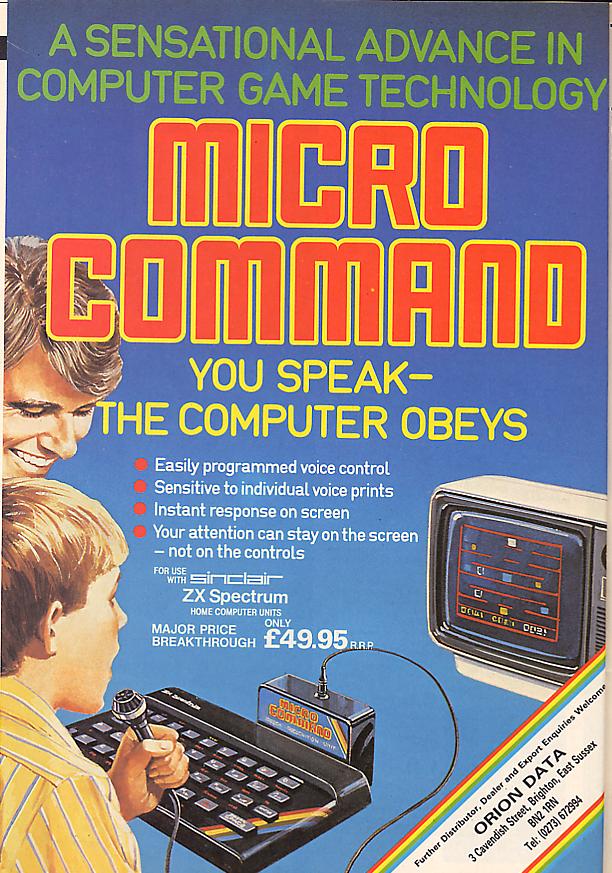
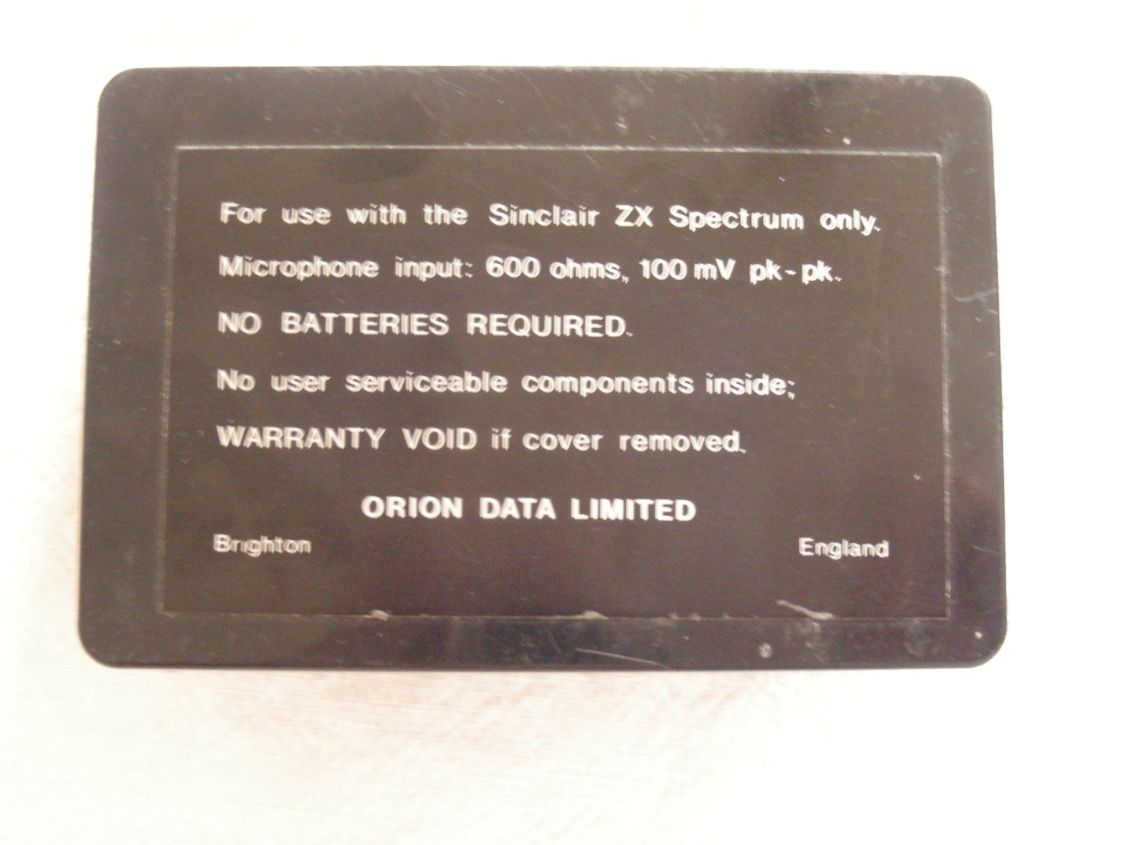
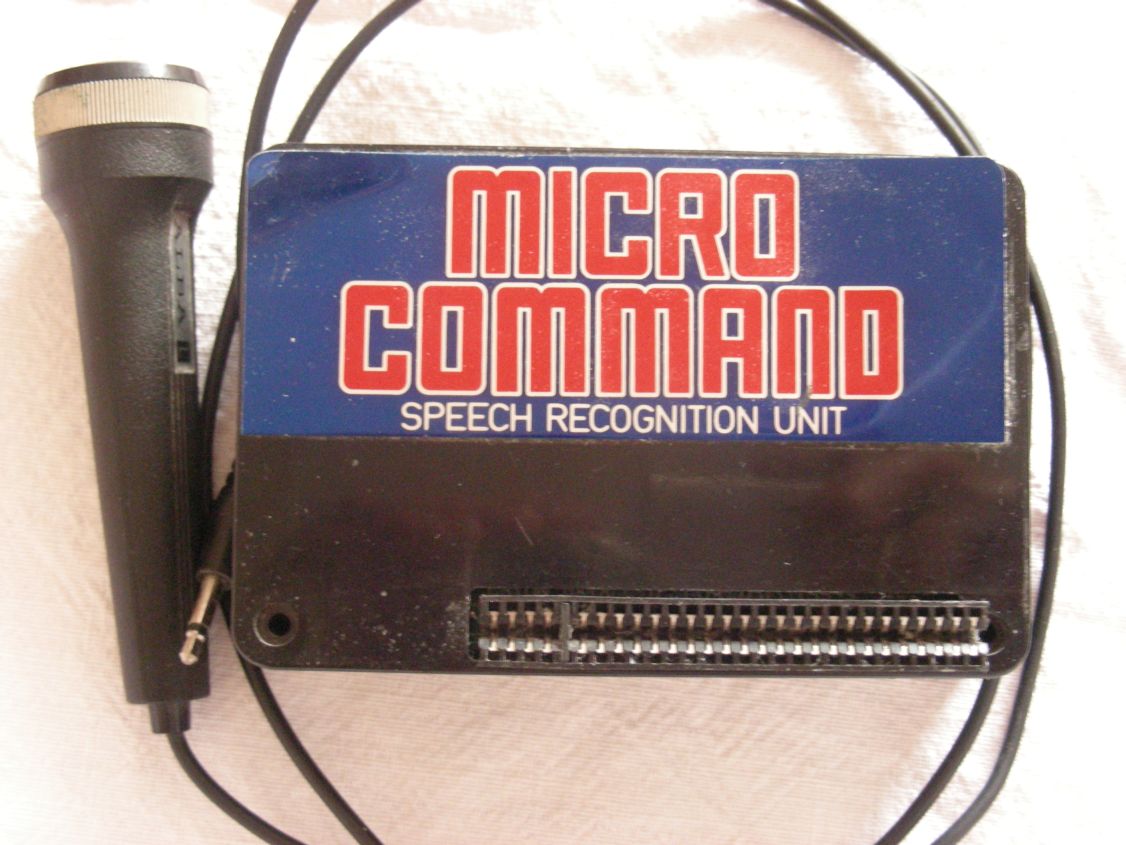
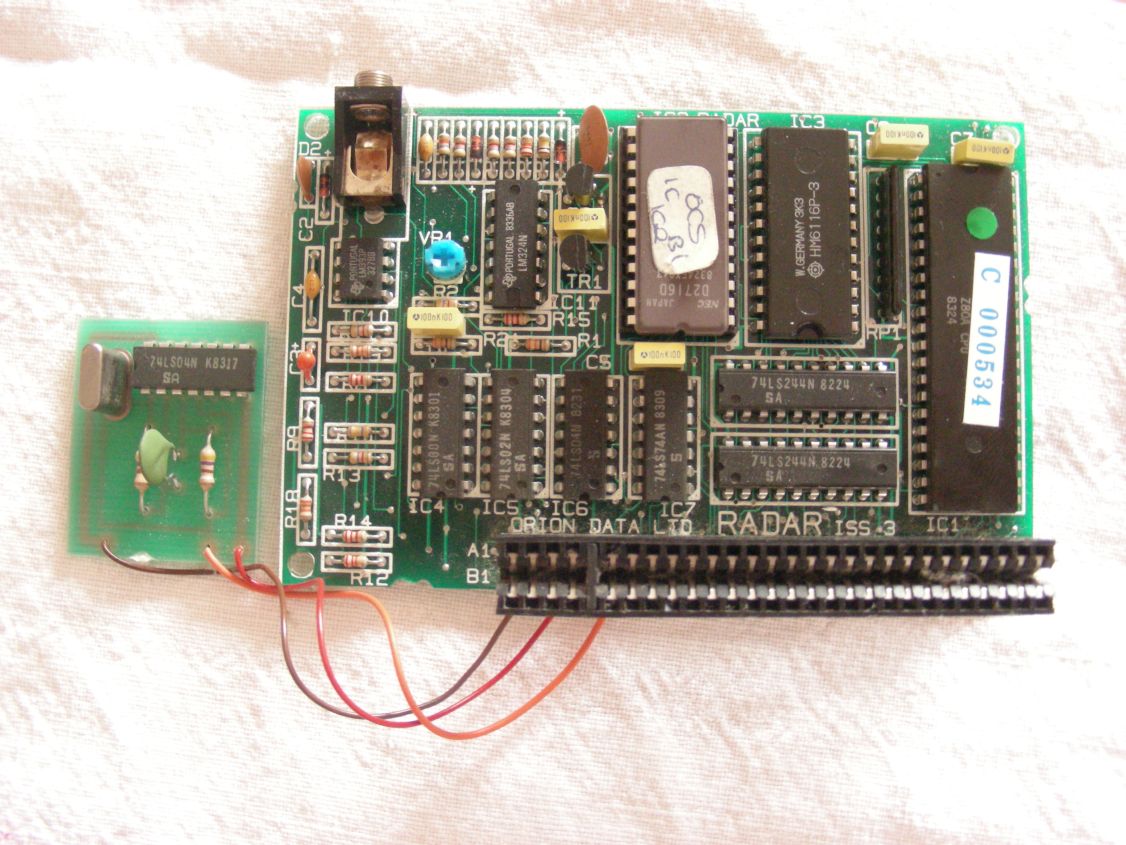
Sensational advance in computer game technology. You speak, the computer obeys. Easy to program voice control. Sensitive to individual voices. Instant response.
Discussion
Nobody has started a thread about this yet.
Remarks
Came with the {Micro Command Cassette|Orion Data Ltd|0014737}.
SPOT: voice recognition (voice control add-on)
Documents
- MicroCommand(EN).pdfInstructions English480 KB
- MicroCommand(EN)_2.pdfInstructions English815 KB
Files and rights
No permission is on record either way. Screens and pictures are copied here on a take-down basis: if you hold the rights and want something removed, say so and it goes.
In the magazines 32
Your Spectrum #5Jul 1984 · p.7
PEEK WHEN YOUR SPOKEN TO Micro Command is a new speech recognition system that can be used initially with games, but after a bit of practice you can use the routines provided for systems of your own design. Included in the package is an interface, a microphone and a cassette containing various programs ranging from an introduction to speech recognition through to a game called Sheeptalk which has you rounding up sheep by giving verbal commands to a sheepdog! Micro Command has a recommended retail price of £49.95 and is available from high street shops. In case of difficulty call Orion Data Ltd on [redacted].
Sinclair User #27Jun 1984 · p.30
TO HEAR IS TO OBEY WITH MICRO COMMAND Speech recognition is a growing area of interest and the new Micro Command from Orion Data looks set to help. It is supplied with a microphone and a demonstration tape which allows Spectrum users to teach their computers up to 15 words and then to have words recognised when repeated. Users of 48K will also be able to play Sheeptalk, a game where the dog is controlled by spoken commands. Normally, speech recognition for a computer is very expensive; a look inside Micro Command shows why. It contains a Z-80A CPU, as used in the Spectrum, ROM and RAM, buffers and audio circuitry. The demonstration tape takes you through the process of learning to use the unit in easy stages. Starting with up and down and then adding left and right it allows you to continue only if you score more than 80 percent. You must pronounce each word very carefully. Once past that stage you can play Sheeptalk. The game, produced originally by Virgin Games, is in Basic and hence fairly slow. It shows the limitations of the unit, as it is difficult to keep the same careful tone when the dog starts driving the sheep into the river. Included with Micro Command are comprehensive instructions for its use, plus an additional information booklet which lists the basic teaching program and a disassembly of the machine code which is used. It also gives details of the variables used by the code and shows how to include Micro Command in your programs. Micro Command costs £49.95. That may seem expensive to Spectrum users but considering its contents, the work which must have gone into it, and the price of other similar units, it is reasonable. Orion Data is at [redacted].
Micro Adventurer #8Jun 1984 · p.25
Peter Green
COMMANDING MICRO: Spectrum 48K PRICE: £49.95 SUPPLIER: Orion Data Ltd, [redacted] As befits a magazine called Micro Adventurer, getting this product set up and working properly was an adventure in itself. Was it my fault that the mistakes attributed to the Micro Command cartridge were in fact due to my ageing Spectrum deciding that it wanted to meet the great chip maker in the sky? With a working Spectrum Micro Command worked a treat. This unique product comes in the form of a cartridge, which you connect up to the back of the Spectrum via its edge connector. Into this cartridge you have to insert a supplied microphone, and with the aid of a few simple commands your Spectrum is then able to respond to voice as well as keyboard input. A demonstration cassette comes with the package, and the first program on this tape is designed to get the machine used to the sound of your voice. When prompted, you have to say the words Up, Down, Left, Right and Stop into the microphone, and the accompanying program then decides how well it can understand you. When you've convinced the machine of your ability to speak English (and it responded quite happily to Kentish, Lancastrian and Devonian accents) you can then proceed to play a simple game using the aforementioned five words. This is a version of Sheepwalk, where you have to guide a sheepdog around a field and make him herd a number of sheep into a pen. The kindest thing that can be said about this program is that Micro Command deserves to sell well in spite of it. Ignoring the game however, the power of this package comes from being able to teach it to accept a number of your own words. Up to 15 words (or for that matter sounds) can be programmed into the cartridge, and with the aid of a few more programs on the supplied cassette you can get the unit to respond with a number for each word you said into it. Thus if word one happened to be FIRE, whenever you said that word into the microphone the unit would set the appropriate variable to equal 1. You can picture the confusion. A fast, all-action arcade game has you merrily shouting 'FIRE! FIRE!' into the microphone, the neighbours hear your apparent pleas for help, and the next thing you know is that the local fire brigade are happily drenching you and your house with gallons of water. It would make a useful addition to any adventure game, although you would have to put up with a rather limited vocabulary. Thus in the Hobbit, say, one could literally talk to Elrond and get free lunches out of him all day. An interesting product then, with a wide range of possible applications. It remains to be seen how many software companies (or individuals) realise the possibilities which Orion Data has presented them.
Personal Computer News #56Apr 1984 · p.19
Piers Letcher
ON SPEAKING TERMS New developments are bringing home micros towards the speech standards of minis and mainframes. Text-to-speech technology is one area rapidly being improve. It avoids the vocabulary limitations of digital speech - about 200 words - and the complications of allophones, and enables you to type in what you want your micro to say. A new device from Votrax, called Type 'n' talk, does this for the BBC, and Commodore plans to release a text-to-speech cartridge for its speech synthesiser, Magic Voice. The other half of speech technology, voice recognition, is also undergoing rapid development. Until recently these devices used speech or noises as switches. Now, however, you can teach your micro words and use them to control it. Such is the case with Micro Command from Orion Data Systems which works with the Spectrum and costs just £50. PRODUCT: Micro Command MANUFACTURER: Orion Data, [redacted] PRICE: £49.95 in VAT INTERFACE: Spectrum OUTLETS: Retail Joysticks took control of the computer one step away from the keyboard: speech input takes it another. Micro Command allows you to control the Spectrum from a microphone, by teaching it words and then using them as controls from within programs. Like many Spectrum speech peripherals, Micro Command is a black oblong plug-in box. There's no socket on the back so you can't then plug Interface 1 or 2 into it, let alone a speech synthesiser - a logical addition to voice input. If the speech synthesiser you want to use has an edge connector on its back you could plug Micro Command into this. The microphone provided plugs into an earphone socket on the top of the unit. The key to the package is the accompanying cassette which contains programs to help you use Micro Command and master its idiosyncrasies. Two A5 card manuals are professionally presented, but the main (blue) manual is' rather insubstantial. The 'additional information' yellow pamphlet is more useful, giving programs and detailed explanations of how to use Micro Command in your own programs. This unit can be extremely frustrating. The principle of voice recognition is that you train a device to understand your voice. In practice, however, you train yourself to speak consistently, which takes a lot of patience. If you can't do this you'll find Micro Command very tiresome. One of the first programs gets you to say up and down, showing how well Micro Command understands you by making, figures on the screen move up and down on request - or not. You must have a success rate of over 80 per cent to move on to the next part, and frustration soon builds up. The cassette leads tip to a voice-driven version of an uninspiring game where you round tip sheep. While training yourself in accurate repetition it's best to lock yourself in a soundproofed room to reduce background noise and embarrassment. Using the speech routines provided from your own programs is more rewarding as you begin to feel in command. You can define up to 15 words, though this requires a long learning phase. VERDICT It's frustrating learning to use Micro Command, but after that it's entertaining to use. Despite the picture on the cover showing father and son bellowing at the unit, it can really be used by only one person at a time, ideally in a silent room. Speech is a subjective area of computing. Matty people would rather use a keyboard than a speech unit or a joystick. However, the future should be interesting for those who like their machines to answer back, and to speak when spoken to.
Full-page ad12
- Sinclair Answers #1Sep 1984 · p.68
- Games ComputingSep 1984 · p.64
- Sinclair User #29Aug 1984 · p.26
- ZX Computing #14Aug 1984 · p.67
- C&VG (Computer & Video Games) #34Aug 1984 · p.58
- Personal Computer Games #8Jul 1984 · p.24
- Computer ChoiceJul 1984 · p.83
- Micro Adventurer #7May 1984 · p.52
- Sinclair User #26May 1984 · p.12
- Sinclair Programs #19May 1984 · p.67
- Crash #4May 1984 · p.15
- Micro Adventurer #6Apr 1984 · p.52
News/Note7
- Your Spectrum #5Jul 1984 · p.7
- TV GamerApr 1984 · p.13
- ZX Computing #12Apr 1984 · p.122
- Popular Computing Weekly #13Mar 1984 · p.7
- Home Computing Weekly #51Feb 1984 · p.5
- C&VG (Computer & Video Games) #27Jan 1984 · p.12
- Your Computer #1Jan 1984 · p.55
Feature3
- Personal Computing Today #6Jan 1985 · p.76
- ZX Computing #16Dec 1984 · p.84
- Crash #4May 1984 · p.108
Review3
- Home Computing Weekly #90Nov 1984 · p.15
- Games ComputingSep 1984 · p.58
- Sinclair Answers #1Sep 1984 · p.20
CompoEntry2
- Games ComputingSep 1984 · p.68
- Micro Adventurer #7May 1984 · p.50
CompoResult1
- Micro Adventurer #9Jul 1984 · p.46
Related
- Elsewhere
- WorldOfSpectrum
- Same entry at
- Spectrum ComputingZXInfo
Reviews from people here
Sign in to write about this, or make an account. It takes a minute and lets you correct the catalogue too.
Everything ZXDB can hold about this is here.
Sign in to correct or add to this.
Hold the rights to this and want it taken down?