
Protek 1200 Modem
Hardware: Network
Protek Computing Ltd · 1984 · Pound sterling 59.95
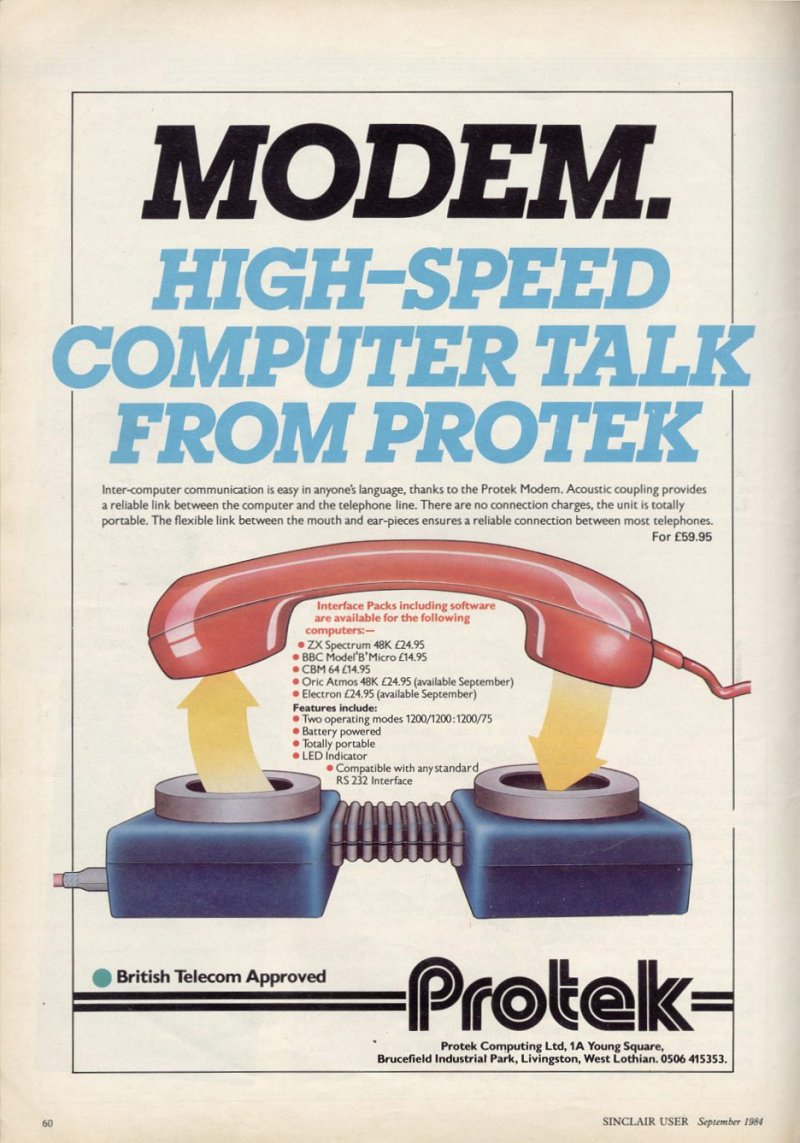
A modem four times as fast and half the price of the modem you've been looking for. 1200/1200 or 1200/75 baud rates. Accoustic coupling.
Discussion
Nobody has started a thread about this yet.
Remarks
separate Mark I/II prices £59.95/£79.95; + £24.95 for interface
Documents
- Protek1200Modem_InstructionManual.pdfInstructions 170 KB
Files and rights
No permission is on record either way. Screens and pictures are copied here on a take-down basis: if you hold the rights and want something removed, say so and it goes.
Scores
In the magazines
- Personal Computer News #981985 · Overall Value2/5
In the magazines 23
Crash #18Jul 1985 · p.92
MORE MODEM MANIA In the last issue of Tech Niche we promised you a review of Spectrum modems. On the face of it that was a little bold, not only because there are so many modems about but also because the manufacturers of them are either a) mean b) hard to find c) don't want to be found or d) they never really had a modem in the first place. Anyway enough excuses. We did manage to decide on the two most important modems to review in this issue and we'll pass over the other for the meantime. The VTX 5000 and the Protek 1200 modems are both front runners simply because they provide an uncomplicated means of communicating with Prestel or, perhaps more importantly Micronet, at a reasonable cost. These two modems are limited because they do not provide the facilities that would allow you to communicate easily with every sort of on line computer there is - there are modems that do, but generally they cost a lot more and are more complicated to set up. When we reach the stage of examining hobbyist bulletin boards and specialist databases we shall also examine some of the kit that is needed to make those connections. But they will have to wait for a future Niche. To begin to explain why modern compatibility is nearly as big a laugh as computer software compatibility, it is necessary to take a look at the workings of modems. As stated in the last issue Modem is simply a shortened form of MOdulator DEModulator. We all know that computers hump information around internally as representations of one's and zero's. Computers really aren't that smart: to a computer life is very simple, a situation is either black or white, on or off, one or zero. All this means is that if a computer wants to tell somebody that it knows The Answer it can't simply shout out 'forty two', well it can, but only because the computer knows how to turn its version of 'forty two', 101010, into our version of 'forty two' - 42. So if one computer wants to chat to another computer it will do so in a signal representing binary numbers, and all that the modem does is to take the binary message and turn it into a form that can be sent down a standard telephone line. Fed with data in serial rather than parallel form, all a modem does is convert characters into sequences of notes for transmission, and decode incoming signals which have been sent down the telephone line, assemble them into characters and hand them over to its host computer. In the case of the basic Spectrum, which doesn't have a RS232 port fitted as standard, you either need to get hold of a modem which connects directly to the edge connector and sorts out the interfacing problem for itself, or use a suitable RS232 interface for your Spectrum which should allow you to connect it to any modem. The RS232 interface provided on Interface 1 isn't up to the job, although people are rumoured to working on that problem. Once you've got a modem attached to a Spectrum and working, the next problem is to make sure that it is compatible with the modem at the other end of the the line. They must both talk the same language in order to hold a successful conversation. A number of variables are involved, the two most important of which concern the speed with which the signal is sent and the pitch of the notes used. In Europe we have two main standards. CCITT V.21 which is for 300/300 baud communications, and the V.23 for 1200/75. The baud rate is a measure of the speed at which data is transmitted. Typically, 300 baud represents a rate of about 30 characters a second, while 1200 baud is about the fastest speed of transmission achievable on a normal telephone line, and works out at about three lines of text on the Spectrum screen per second. The V.21 standard is used by most hobbyist bulletin boards and on-line services. If you want a modem to talk to these chaps then it must be able to adopt that standard (neither the VTX or the Protek can). The most widely used standard now being used by Spectrum owners, due largely to Micronet, is the 1200/75 baud V.23. This is the standard adopted by Prestel which sends frames at 1200 baud and receives instructions at 75 baud. It was this standard that the VTX and Protek modems were designed to use. Some bulletin boards cater for 1200/75 communications, however, and user-to-user communication is also possible with these modems. If you have a burning desire to go truly international and communicate with systems in the USA or Canada, then you will have to consider yet another range of standards. The American Bell 103 is similar to our V.21 and the Bell 202 is like our Prestel (V.23) standard except that Bell uses different pitches to CCITT systems. Modems are around that can switch between all these different standards - but at a price. We hope to bring you news of one of these, the new Miracle Modems Spectrum version soon. There's no point on lashing out on super whizzo (and expensive) hardware if your main interest is in talking to Prestel and Micronet, however. Apart from the communications software needed to drive the modem itself and sort out such housekeeping problems as word length and parity so that the receiving modem on a system is sent what it expects to receive, a further problem can arise from lack of compatibility with software. Clearly the computer that you want to talk to and your computer both need software to organise a multitude of functions be it simply transmitting chunks of text to another computer or sending a message to a mailbox on a large system. The problem is that each computer has a different view of the outside world. For example, problems may be caused by incompatible character sets. Prestel would never understand what a Spectrum SYMBOL SHIFT keypress was meant to mean, but software converts it to be sent as a star - that's fine because the Prestel machine knows that the star means an instruction is on it's way. Saves a lot of argument and down time with grumpy computers does the software. Remember that no matter how smart a modem is, without the software it's just a pile of chips and capacitors. The software that comes with the VTX and the Protek modems is able to convert the Spectrum's output into a form understood by Prestel, and a few more clever tasks besides. THE PRISM VTX 5000 Supplier: Modem House Price: £49.95 This modem really seems to have become the standard for clever people (a recent survey shows that most clever people own Spectrums Source: SEOS 1985). The principal advantages with the VTX are two fold. Firstly the software is held on ROM (read only memory) which means the machine is raring to go on power up so time is saved especially when, as often happens, your connection with the mainframe is broken and you have to reset the Speccy. The second advantage is that the modem is hard wired, plugging into the phone socket and then the phone plugs into the back of the modem. This greatly reduces the chances of the modem being interfered with by outside noises! The software has most of the functions that you could need including automatic log on and off. Micronet frames can be saved to tape or microdrive and printed out, you are able to download the software or compile messages off line loaded to tape ready to be sent when you are on line. The VTX can be used as a user to user modem to allow you to communicate with other users so long as the same V.23 standard is observed. Other software is available for the machine which allows you contact databases and bulletin boards that use the same speeds but transmit text in an rolling form as opposed to screen by screen. Specnet by Stephen Adams costs £5.95 and a similar package by Stephen Gold can be downloaded from Micronet for a small charge. THE PROTEK 1200 Supplier: Protek and high street shops Price: £39.95 The battery powered Protek machine is £10 cheaper than the VTX, but it presents the disadvantages of having to load the software into your machine before you can go on line. Also, the modem is acoustically coupled, which can give you some very undignified moments as you try to squidge your handset into the two rubber cups. If you have a trimfone or a phone in a style other than the traditional one then forget it, but being battery powered the modem has certain portability advantages (only really advantageous when you get your Spectrum running off batteries too, though!) While the software is as useful as that of the VTX it is not as easy to use since some functions require you to load in the odd chunk. If you want to use the modem user to user you have to agree which one of you is to be the original sender and who is to receive and then load in the appropriate code. With the VTX modem you only have to slide a switch. CONCLUSION In my opinion the extra £10 for the VTX modem is more than justified. It is easier to use and simple to set up, it is moderately idiot proof as well as being neat and tidy when in operation. The only advantage that the Protek may have is that the acoustic coupler could, in theory, be used with any computer that can supply it with RS232 input providing you can write, buy or scrounge the appropriate software to drive it.
Personal Computer News #98Feb 1985 · p.302/53/52/52/52/5
Features 2/5
Documentation 3/5
Performance 2/5
Overall Value 2/5
David Janda 2/5
DEPECHE MODE Has Protek, with its multi-interfacable 1200, come up with a model for all micros? David Janda gets on-line with it. NAME: Protek 1200 + Interface packs. PRICE: Modem 1200 £59.95. Interface packs: Spectrum £24.95; BBC £19.95; Commodore 64 £19.95; Amstrad CPC464 £29.95; Oric/Atmos £29.95; Electron £29.95 MANUFACTURER: Protek Computing [redacted] If a manufacturer wants to produce a modem for all popular micros, it can be an expensive business - which is reflected in the cost to the user. Even though the modem can be the same for all makes of micro, the interfacing between the micro and the modem, is usually different for each machine and so different models have to be produced. Protek has overcome this problem by producing one modem with different interface packs for the BBC Micro, Commodore 64, Spectrum/Spectrum Plus, Oric/Atmos and the Electron. Each interface pack contains the cables/hardware to connect the micro to the modem as well as software to drive it. So you simply buy the modem and interface pack for your particular machine. FEATURES The particular model (called the 1200) is a battery powered acoustic coupler operating at 1200/75 and 1200/1200 baud rates, making it eminently suitable for accessing viewdata databases such as Prestel. The interface packs include software to do this. Bulletin board fans can also use it to connect up to the growing number of boards that now support 1200/75 - CABB, MOBB and METRO to name a few. However, you'll need your own software to drive the modem because the software included with the interface packs is only viewdata compatible. The modem is also capable of operating at 1200/1200 half duplex, which makes it especially useful for file transfer. Powered by four AA batteries, it should have a 30-to 50-hour lifespan. The batteries are placed in two holders which are situated in the modem's earpiece and mouthpiece, and these areas also contain the electronics that work the modem. A small front panel of controls can be found at the earpiece end of the modem. It consists of a small battery indicator, the baud select switch, female RS232C socket and an earpiece socket. An earpiece (like the ones supplied with the 'old' transistor radios) is supplied for monitoring the call without disturbing the acoustic link - a nice touch. Each interface pack contains instructions, the interface itself and software to drive the modem. The Spectrum interface, for example, attaches to the back of the edge connector on the Spectrum or Interface 1. Note that the modem cannot use the RS232 port on the Interface 1. For the 64, an edge connector is plugged into the user port, while the BBC pack simply consists of the software and cable (because the Beeb has an RS423 interface built in). Once the interface has been attached to the micro, the cable leading from it is plugged into the modem. Although the modem-drivers sup, plied with each interface pack differ between machine, they offer the same basic facilities - accessing Prestel and user-to-user communications. A main menu displays various options which include auto-log on/off and saving and loading of frames. IN USE Hats off to Protek for producing an acoustically sound modem. First I tested the modem with my own software, hoping to determine how prone the unit was to vibration and external background noise. The results? Well, even when I used the modem with a low-volume phone, results were above average. This is because the cups are well designed and allow the handset to be firmly inserted. Unlike other acoustic couplers, the connection between the ear and mouthpiece is flexible, so it is possible to 'twist' either end of the modem when inserting the handset. The Spectrum software gave details on how it could be saved to Microdrive, but when I tried, it crashed. There were no details on how the software could be saved to disk for the Commodore and BBC versions, which was a pity. Accessing Prestel required the user ID to be entered before connecting. With no facility to save it to tape or disk, I thought this was rather pointless. Worse still, on many occasions Prestel refused to accept the ten digit code once it was transmitted, and I had to enter my ID manually. The Spectrum software 'builds' an incoming frame within memory and only displays it once the whole frame has been sent. This is normally okay, but it means that dynamic frames (of the 'd', 'o' and 'n' type) cannot be viewed properly. The Commodore 64 software was not much better. It appeared to 'forget' to clear the screen. The result was a very messy display. No telesoftware downloading facility was provided. Nice modem shame about the software. I really think Protek could have done a lot better.
Hooking into the Spectrum is more complex.
The BBC interface is a cable.
The C64 has a non-standard RS232 on its user port.
Sinclair User #35Feb 1985 · p.48
COMMUNICATING DOWN THE LINE The Protek 1200 modem and Spectrum interface are now available and can operate in two modes, 1200/75 for database connection such as Prestel and Micronet 800 and 1200/1200 for user-to-user communication over the telephone lines. In Prestel mode the Spectrum becomes a Prestel keypad and basic information on using it in that mode is given in the instructions. In user-to-user mode the other party you are contacting must also have a Protek 1200 modem running under the same software. After setting up the telephone link, informing the system of where the file you want to send sits in memory and defining block start and size for the code you are ready to transfer data. Priced at £59.95 for the modem and £24.95 for the Spectrum interface they are available from Protek Computing.
Your Spectrum #9Nov 1984 · p.3
MODEM TO MODEM Protek Computing has released their 1200 Modem recently, providing a computer/telephone link which they claim is four times as fast as any of its competitors. The modem is compatible with any RS232/243 computer - although driving software is required. The Protek device is battery-powered and completely portable with a flexible acoustic link. Good news for those with a fear of the phone is that you don't need to adapt the system at all. The price is a competitive £59.95 and further details are available from Protek Computing on [redacted].
Protek's flexible link modem can be used wtih just about any old phone... except the Trimphone.
C&VG (Computer & Video Games) #37Nov 1984 · p.195
MODEMS AGAIN The much talked about modem from Protek has finally been launched. It's an acoustic coupler which means that, instead of wiring it directly to your phone, you just plug the handset into the two rubber cups on the modem itself. This works fine for standard phones but won't fit if you have one of those posh trimphones. The modem works at 1200/1200 baud half duplex and 1200/75 baud full duplex and is fully BT approved. The first standard is used for talking to other Protek modems and sending listings and data to your friends through the phone network. The 1200/75 option will allow you to link into Micronet and Prestel. The cost is just £60, which really is good value. Before you can use it, though, you'll need some software, a cable and, for some micros, a special interface. This costs £14.95 or £24.95, depending on whether or not you need the RS232 interface. The software which drives the modem is, to say the least, not very good. The BBC version is the best and will certainly let you into Micronet and Prestel. But because pressing the ESCape key will put you back to the program's menu, you can't actually end an ESCape character to Prestel. This rules out colour-coded Mailboxes and pretty frame designs. The Commodore 64 version suffers from the same problems and also lacks a return key as this is used for a Prestel hash character (#). This means that, at the moment, you can't use the system for connecting to Telecom Gold, despite Protek's claims to the contrary. The Spectrum version is awful. Instead of displaying the Prestel screen as it comes down the phone line character by character, it waits for the whole frame and then displays it at the end. So when you call up a page, you have to wait quite a few seconds before it appears, just like teletext and rather disappointing. If only the software was as good as the modem. But that's what you have to do to keep down your costs. Apparently, it would have added around £10 to the Spectrum version's cost to provide a proper display. I'd have paid - wouldn't you? Protek are in Scotland on [redacted].
The new 1200 modem from Protek is a cheap way into the world of communications. The modem itself is great for Prestel and user-to-user data transfer. The software which comes with though, is not. Some vital keys are missing from the character set which will cause problems for users of "serious" systems like Telecom Gold or PSS. Version two is on the way.
Your Spectrum #6Aug 1984 · p.9
HAPPY TALK Personal computing need no longer be a solitary pastime now that Protek Computing has announced a new low-cost acoustic modem that enables Spectrum owners to 'talk' to one another - or indeed to a large database such as Prestel. All you need is a telephone, and a healthy bank account to cover BT's ensuing financial demands. Known as the Protek 1200, it makes use of two operating rates. One is for high-speed (1200/ 1200) computer to computer communication such as the transfer of keyboard to keyboard information, blocks of data or complete programs. The other, slower speed (1200/75), is used for communicating with databases and bulletin boards, and while some of these will require special software to decode the teletext output, that can be supplied at additional cost. Other features include a flexible design that allows the modem to be used with most telephones (excluding Trimphones), the use of four 1.5V AA batteries to ensure portability, and a light emitting diode (LED) to show that it's switched on. The cost of the modem is £59.95, plus another £24.95 for the necessary interface, cable and software. Further information and orders to Protek Computing, [redacted].
Full-page ad12
- Your Computer #3Mar 1985 · p.138
- Your Computer #1Jan 1985 · p.115
- Your Computer #12Dec 1984 · p.118
- Sinclair User #33Dec 1984 · p.114
- Your Computer #11Nov 1984 · p.94
- Your Computer #10Oct 1984 · p.90
- Your Computer #9Sep 1984 · p.20
- Sinclair User #30Sep 1984 · p.60
- Sinclair User #27Jun 1984 · p.126
- Your Computer #6Jun 1984 · p.50
- Your Computer #5May 1984 · p.46
- Sinclair User #26May 1984 · p.54
News/Note5
- Sinclair User #35Feb 1985 · p.48
- Your Spectrum #9Nov 1984 · p.3
- C&VG (Computer & Video Games) #37Nov 1984 · p.195
- Your Spectrum #6Aug 1984 · p.9
- Popular Computing Weekly #17Apr 1984 · p.5
Reviews from people here
Sign in to write about this, or make an account. It takes a minute and lets you correct the catalogue too.
Everything ZXDB can hold about this is here.
Sign in to correct or add to this.
Hold the rights to this and want it taken down?