
Stack Light Rifle
Hardware: Add-on
Stack Computer Services Ltd · 1983 · Pound sterling 29.95 · Pound sterling 19.95 budget
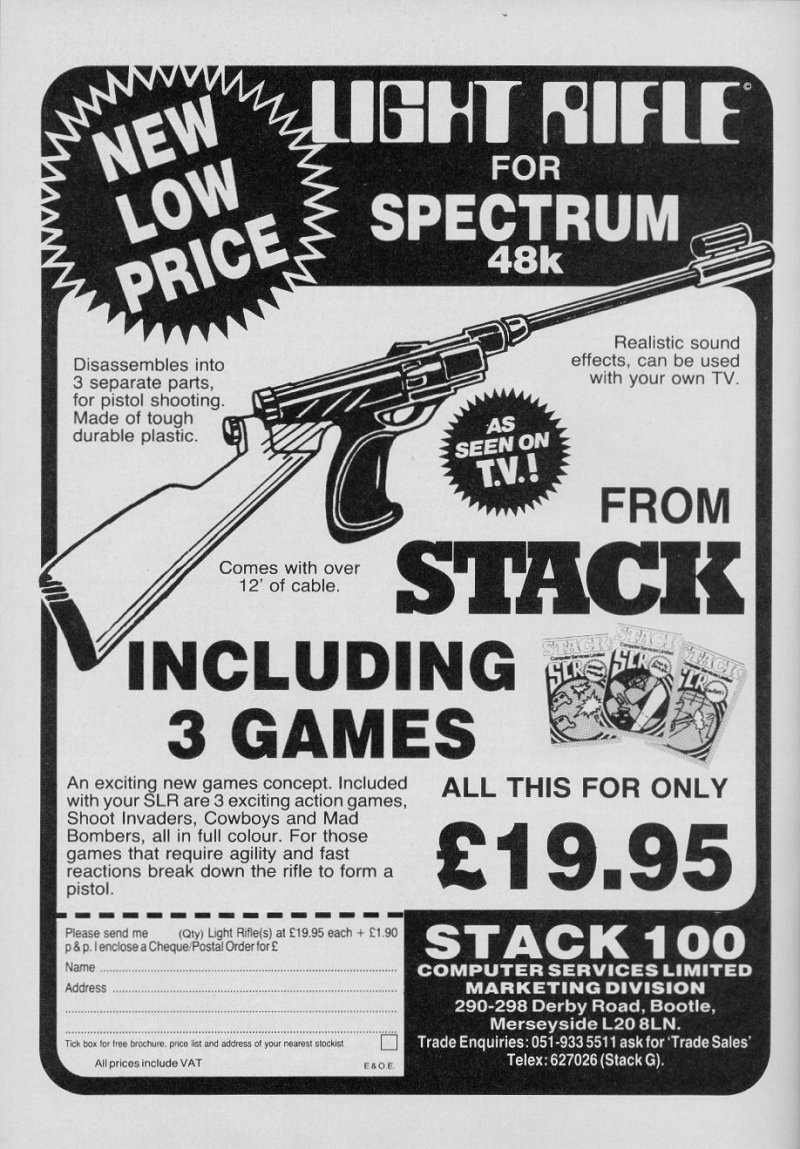

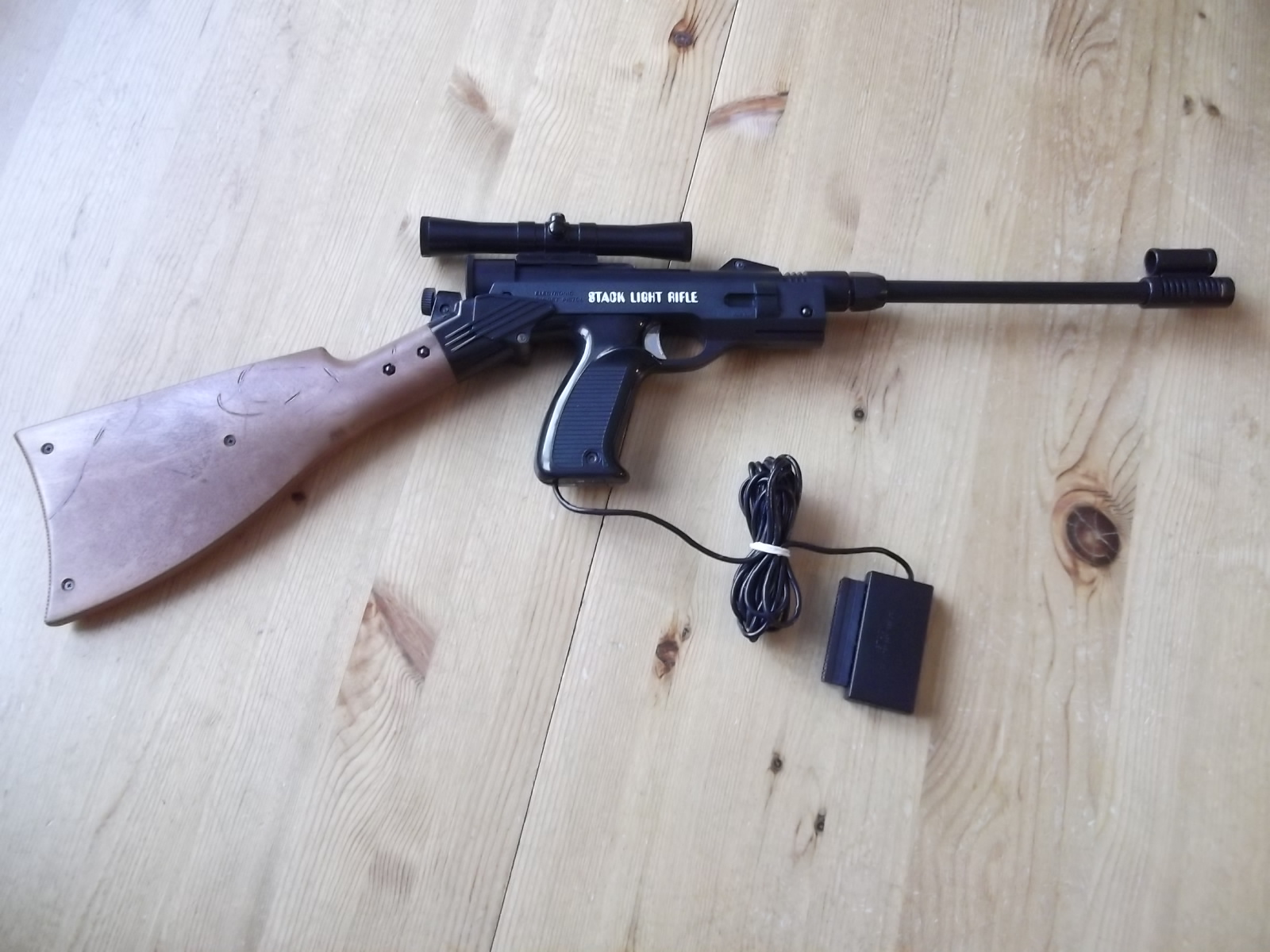
Now you can shoot at the screen ! Plastic light gun allowing you to aim at targets on screen. Splits into smaller pistol stlye gun. Supplied with 3 games.
Discussion
Nobody has started a thread about this yet.
Remarks
Came with the {Stack Light Rifle|Stack Computer Services Ltd|0012585} compilation.
SPOT: released with 3 games:
Files and rights
No permission is on record either way. Screens and pictures are copied here on a take-down basis: if you hold the rights and want something removed, say so and it goes.
In the magazines 54
Crash #3Apr 1984 · p.46
TAKE AIM, FIRE! There was a time when SLR stood for Single Lens Reflex. Militarists will tell you that it really stands for Self Loading Rifle, but film makers have the drop. As long ago as the 1936 Olympics, the idea of a reflex viewing system for cameras was developed and used. Anyway, it's all irrelevant now because computer games players know it stands for Stack Light Rifle. The Stack Light Rifle is a giant light pen that works very well up to about ten feet from your television set. If you've tried drawing on the screen with a light pen, you'll know that you can't do much with it unless the tip of the pen is pressed close to the screen, so it gives some indication of the accuracy and power of the Stack Light Rifle that it operates so far from the screen. There have been some complaints recently in magazine reports about the accuracy of the 'telescopic' sight on the rifle's barrel, but in tests, we found our review rifle behaved with commendable accuracy if you used it as you would a normal rifle. Because it isn't a proper rifle sight, and is fixed to slide a limited distance, adjustable in one axis only, it obviously suffers some shortcomings, but nothing like we heard mentioned. The rifle comes in three bits, the barrel, stock and firing mechanism. The barrel slots in and is held firm with a locking nut. The stock slips into a cut groove just behind the trigger guard and handle and then has a brass tightening screw to lock it into place. It takes approximately half a minute to strip it down so that it can be used as a hand gun instead of a rifle. The games which are obviously suited to the use of the Stack Light Rifle are shoot em ups, and the rifle comes complete with a cassette containing three games which make the point: High Noon, Shooting Gallery and Grouse Shoot. The best of the three, High Noon by D.E. Tsang, pits you against endless gunslingers walking round the screen and turning to fire at you. It seems a shame that Stack couldn't have come up with better quality games to give away with the rifle. The High Noon gun fighters are reasonably animated, but the graphics of the other two are extremely primitive. Which raises one obvious point - is there enough software being produced to work with the Stack Light Rifle to make it worth forking out the £30 it costs? Stack say that they are talking to a number of software houses, notably Anirog, who are preparing games, and that there should be several on the market before long. Micromania are actually the first out with a game called invasion Force. Invasion Force is a different kettle of aliens compared to the games which come with the rifle, and one reviewer was overheard saying that he hadn't had as much fun since giving up Smirnov. We talked recently to another leading software house about games for the Stack Light Rifle, and they said that they wouldn't actually produce and sell one themselves because there is still a somewhat limited market at the moment, but they would certainly consider writing a game for Stack to market under the Stack name. As long as new games come along, or indeed some old ones are made compatible for the rifle, then it should be assured a successful future, for there's no doubt that it brings an entirely new angle on computer games with it - or perhaps it would be more accurate to say that it brings a very old angle back, that of physically shooting something up! The Stack Light Rifle, priced £29.95 is available from many good computer retail outlets.
C&VG (Computer & Video Games) #28Feb 1984 · p.156
Robert Schifreen
EXTRA BITS! If you want to extend the capabilities of your computer or games machine there are now lots of bits and pieces which you can plug into the back to make it do things better or faster, or things which it could never do before. Such plug in goodies include extra memory, better keyboards, joystick interfaces, Micronet adaptor or devices to make the beast speak or play tunes. Robert Schifreen takes a break from Bug Hunting to bring you news of some of the current plastic boxes which you can plug into your micro or games machine. Upgrading your present equipment by using add-ons means that you may not have to buy that new machine after all! COMMUNICATIONS Communications means making your micro talk or listen to other computers in their own language. They communicate either over the airwaves at radio frequencies or over the telephone lines. Each has its advantages. Radio communication is only one-way whereas telephone can be both. But long conversations on the phone can be expensive. If you want to read more about this subject, dig out November's issue of C&VG and turn to page 114. If you want to receive Teletext on your micro, you'll need a BBC model B with a Teletext adaptor. This lets you receive Ceefax and Oracle, which are information services broadcast by the BBC and by ITV. You just plug your TV aerial into the back of the adaptor, and the computer will do the rest. The adaptor gives you four channels of teletext information; BBC 1, BBC2, ITV and Channel 4. You can find out about such things as what's on TV tonight, the latest world news, sports news and ITV also has a kids corner with jokes and the like. Teletext is like a big electronic newspaper, You can read its pages on your TV but you can't write back to it. The other method of communication is over the telephone. This is what systems like Micronet 800 use. This way, the computer can send messages and you can also type back. There are loads of computers which you can dial into and most of them are free except for the price of the phone call. However, these free bulletin boards, as they're called, run on different baud rates (no pun intended) to Micronet so unfortunately you can't use a Micronet adaptor to call them. You can buy a 300 baud modem quite cheaply from various companies, like Maplin Electronics who supply units for the Dragon, Vic-20, Commodore 64, Atari and Spectrum. I tested the Atari one and managed to dial into some local systems and also used Maplin's own service called Cashtel which allows you to order stuff from the Maplin catalogue via your computer by typing in your credit card number. A lot of computer clubs run bulletin boards, and you can dial them up for computing news; you can also send messages to the club by typing at your computer. This is the two-way advantage gained by using the 'phone as opposed to the airwaves. You can set up your own bulletin board with a Maplin modem, but you'll also need some software. You will soon be able to buy a Micronet/Prestel type modem for your BBC micro from Acorn which has some better features than the Micronet package. But it's more expensive, and you'll still have to pay a fee to join Micronet if you want to look at their private areas on the database. You can also buy slightly cheaper modems like the Micro-Myte which will not receive Micronet or other information systems, but will allow you to talk to your friend's computers, providing he or she also has a similar modem. This way you can send each other programs or messages, but you'll have to phone him up first to tell him to switch his modem on! The Micronet modems offer this person-to-person facility as well as normal Micronet use, but are slightly more expensive. STORAGE DEVICES When you finally decide that cassettes are too slow for your needs, you'll want to look for something faster. The best thing is a real disc drive which for micros will probably use 5.25" discs. A cheaper alternative is a 3" drive which is available for many micros. You can buy a Byte Drive 500 3" system from ITL for about £250, and this contains a special cable to link the drive to your micro. If you have two computers, or decide to change your machine, you just buy a new cable. Blank 5" discs start at about £1.50, but 3" systems use special cartridges which are currently about £6. The Byte Drive 500 will soon be available for the Dragon, Spectrum and Commodore 64. It is already available for the Oric, BBC and Apple. If you have a Spectrum, the official Sinclair way of progressing from cassette is the Microdrive. This costs £50 for each drive, but you'll also need an interface which is another £30. You can store between 85 and 100K on a Microdrive cartridge, and a 16K program will load in about 10 seconds. Microdrives are fast, but they're not really discs. Inside a microdrive cartridge is a loop of high quality tape, and the drive itself is just a very accurate (supposedly) cassette recorder. If you've got a BBC then you'll need a disc interface fitted, which costs around £90. ITL has no intention at the moment of producing one, so you'll have to use the BBC one. MORE MEMORY The size of the largest program which you cart fit into your machine is governed by the size of the area of memory in which the computer stores it. The problem is that although memory chips are now quite cheap, some micros still have very little RAM, as it's called. One of the first enhancements which a computer owner will make in such a case is a memory expansion. The ZX81 although very popular has only 1K of RAM. (1K is about two screenloads of program.) It's very easy to expand your ZX81's memory. You can buy a 16K RAM pack which just plugs into the back of the machine and costs around £30. You may have heard of the much-feared contemporary disease known as "RAM pack wobble", caused by Sinclair not putting the edge connector on their RAM pack in the right place. This disease can be fatal to a program, as a slight wobble at the wrong time can erase a whole afternoon's typing. One cure is a blob of something sticky under the machine, although a less messy solution is to look to a different company. You can also get 64K RAM packs which allow for even more storage of data and programs. Upgrades for the 16K Spectrum are available from Sinclair for £40, but you'll have to send your machine back to Clive, and you know how long that takes, don't you? Alternatively, you can buy a ZX81-like RAM pack which sits on the back of the machine, or some companies sell chips which you can stick inside, as long as you didn't really want the guarantee anyway. If you're going to upgrade your Spectrum, check that the company's product will fit your particular machine. There are currently three different versions of the Spectrum in circulation and although they all look the same from the outside, there are some small variations inside which may make a difference. Expansion for an Atari is easy; the memory comes in chunks of plastic which you install by removing the cover on top of the machine. Newer machines come with 48K but some old 400's still have only 16K. Your local dealer should be able to tell you how to improve this. To expand a Texas TI99/4 or 4a you'll need a peripheral expansion box. This takes the form of a large aluminium crate about the size of the small freezer compartment in a fridge. (I don't know why, but everyone seems to measure the size of computers in relation to parts of fridges.) Inside this you can then put disc drives, memory expansions and anything else. Retail price for the box alone was around £80 but that may drop now that the Texas micro is no longer being made. Memory expansion on a Vic is peculiar. It is in the form of plug-in cartridges and comes in four flavours, which are 3K, 8K, 16K or 32K. The annoying thing is that because the cartridge overwrites that part of memory which used to hold the contents of the screen, the screen RAM is moved to a different place. The problem is that each cartridge puts it somewhere different, so programs written for use with an extra 3K will not necessarily run directly on a 16K machine without minor alterations. This is very inconvenient, especially for magazines who publish program listings! If you're tired of having to do octopus impressions to play your favourite computer game a joystick interface is called for. This allows machines which normally have no provision for such a gadget to have one, and very useful they are too. The most popular machine, which lacks a joystick interface, is the Spectrum, and there are now quite a few companies who will remedy this situation for you. The official way is by use of the Sinclair Interface 2. This costs just under £20 - you get 5p change! - and allows two standard Atari-type controllers to be used. You can then write your own games using the joysticks to control the action, or buy commercial software written for use with the device. Interface 2 also allows you to use plug-in cartridge software, although these retail at £15 a time. The problem with all the different joystick interfaces is that they use their own systems. So a program written for use with a Kempston joystick will not run on an Interface 2 unless the program contains a routine for each and you are allowed to select which one you want. One way round this predicament is by a programmable joystick interface. Such a beast is the one from AGF. This comes with a grid of small holes and a set of five wires. The wires are labelled with the functions of the joystick (up, down, left, right and fire) and the holes are labelled with the keys on a Spectrum keyboard. If the game which you want to play uses the 'K' key to fire, then you plug the 'FIRE' lead into the 'K' hole and so on. Such a device is very useful. BETTER KEYBOARDS When you finally tire of the piece of dead flesh known as your Spectrum's keyboard, there are a number of better ones around. The best are quite expensive at around £40 but they allow the whole machine to fit inside and look rather smart. One of the most popular around is made by Fuller. Kempston is also about to launch a high quality keyboard for the Spectrum, as demonstrated recently at the ZX Microfair. You'll also find replacements for the touch-sensitive keyboard of the Atari 400 from about £65. If you have an Atari VCS and feel like getting into computing, you can now buy an add-on keyboard from Vulcan Electronics, which is made by Spectravideo. It sits on top of the VCS and plugs in to the joystick ports and the main cartridge slot and you can then program your VCS in Basic, it costs £50. Mattel Intellivision owners can also do the same to their machine. Mattel offers a similar device, as well as a music keyboard to enable you to compose music on your machine. I don't reckon Bach would think much of it, but it's not bad. SOUNDS AND SPEECH If your idea of a good evening is being locked in a quiet room with a micro, then you could always get more friendly with it by talking to it or having it talk to you. But before those nice little men in white coats come to take you away, let me explain. If you have a Pet, Vic, 64. Spectrum, ZX81 or BBC and need someone to talk to you then you could always try a Chatterbox. This costs £49 from William Stuart Systems and you can program it to say anything you like. From the same company comes Big Ears which, for another £49, reverses the process and allows you to speak to your computer. Say the word through the microphone a few times, and the machine will then remember it. If you then say it again, it should recognise what you're saying. If it's a Spectrum you've got then the Currah Microspeech is another possibility besides a Chatterbox. It works on the same system and sells for under £30. BBC owners can also choose the official Acorn speech system, which is a computerised version of Kenneth Kendall. Personally I can just about recognise him, but many say that it might just as well be Moira Stuart. (In fact, I wish it was.) If you prefer noise to plain speech then there are a couple of units available to improve the sound of a Spectrum by providing it with the same sound chip as the BBC and Oric. WHAT'S LEFT OVER Finally, we come to the rest of the oddments which space did not allow separate headings for. If you own an Aquarius, then this year should see the introduction of the home controller unit. Th is plugs into the machine and allows you to control household appliances by using special plugs which go into the wall and receive messages from the computer. Such a system is also planned for the Electron. If you have an Atari VCS then you may already know about the super expander. This lets you load games from cassette, and also improves the quality of the graphics slightly. Printerface is a mixture of interface and printer and is a device to let you link a printer to a micro. DAMS office systems supplies an IEEE cartridge to allow a Vic or 64 to connect to any Commodore printer (or disc drive for that matter.) The Spectrum will only work with a ZX printer, but you can use the RS232 connection on an Interface 1 to link a large range of printers. If you have a Centronics-type printer then Kempston will supply you with a suitable interface for a Spectrum. If you own a computer other than a Sinclair machine but would be perfectly happy to use a cheap (£40) Sinclair printer, you can get a suitable interface for many popular micros, including the BBC, Dragon and Vic, from Microtanic Computer Systems of London. LIGHT SENSORS Another way of controlling a game is with a light sensing device. Usually mounted in a pen-like barrel (and, therefore, called a light pen) these allow you to draw patterns on the screen as though it were a piece of paper. Recently launched is the Light Rifle from Stack Systems of Bootle, Merseyside. It comes with three demo games where you have to shoot at targets on screen, just like those old TV game machines, but these games are better as they rely on all the facilities of the micro. You can also write your own shooting-time programs. The light rifle costs just under £30 and versions are available for the Spectrum, Vic and 64.
At long last, the microdrive has actually been launched. As expected, demand is still exceeding supply and it will be some time before you can just walk into Smiths and buy one. They're not really disc drives at all, just miniature cassette recorders. You can load a 16K program from a Microdrive in about 10 seconds.
The byte-drive 500 is a 3" disc drive from ITL. The small discs are enclosed in rigid plastic and currently cost over £5 each. The clever part is the cable which links the drive to the micro. This contains all the electronics, so if you change micros, you just change the cable but keep the same drive.
You can now fit two standard Atari-type joysticks to your Spectrum with an Interface 2. It plugs into the back of the computer, and also has a slot to take the new Sinclair software cartridges. The BBC (below) can now become a Teletext terminal with the new add-on from Acorn. As well as displaying pages of information, it can also store the data in memory and use it in its own programs.
Advert30
- C&VG (Computer & Video Games) #37Nov 1984 · p.203
- Big K #8Nov 1984 · p.117
- Sinclair User #31Oct 1984 · p.169
- C&VG (Computer & Video Games) #36Oct 1984 · p.75
- Big K #7Oct 1984 · p.86
- Sinclair Answers #1Sep 1984 · p.84
- Personal Computing Today #2Sep 1984 · p.41
- Sinclair Answers #1Sep 1984 · p.55
- Your Computer #9Sep 1984 · p.183
- Your Spectrum #6Aug 1984 · p.23
- C&VG (Computer & Video Games) #34Aug 1984 · p.87
- Crash #6Jul 1984 · p.43
- Your Computer #7Jul 1984 · p.175
- Your Spectrum #5Jul 1984 · p.35
- C&VG (Computer & Video Games) #33Jul 1984 · p.51
- Your Computer #6Jun 1984 · p.31
- Your Spectrum #4Jun 1984 · p.44
- C&VG (Computer & Video Games) #32Jun 1984 · p.100
- Crash #5Jun 1984 · p.85
- C&VG (Computer & Video Games) #29Mar 1984 · p.146
- C&VG (Computer & Video Games) #27Jan 1984 · p.44
- Your Computer #1Jan 1984 · p.252
- Sinclair User #22Jan 1984 · p.58
- C&VG (Computer & Video Games) #26Dec 1983 · p.150
- Your Computer #12Dec 1983 · p.62
News/Note12
- Personal Computer News #109May 1985 · p.3
- Sinclair User #37Apr 1985 · p.7
- Sinclair Projects #10Jun 1984 · p.5
- Sinclair User #26May 1984 · p.29
- Personal Computer News #62May 1984 · p.4
- Personal Computer Games #5Apr 1984 · p.23
- Your Spectrum #2Mar 1984 · p.6
- ZX Computing #11Feb 1984 · p.87
- Computer ChoiceDec 1983 · p.9
- C&VG (Computer & Video Games) #26Dec 1983 · p.13
- Your Computer #11Nov 1983 · p.54
- Popular Computing Weekly #42Oct 1983 · p.5
Feature3
- Games ComputingDec 1984 · p.42
- ZX Computing #16Dec 1984 · p.84
- Computer ChoiceMar 1984 · p.68
CompoEntry3
- Crash #5Jun 1984 · p.60
- Your Spectrum #3May 1984 · p.119
- Personal Computer News #39Dec 1983 · p.89
Full-page ad2
- Your Spectrum #11Feb 1985 · p.50
- Your Spectrum #10Dec 1984 · p.62
Related
- Elsewhere
- WorldOfSpectrum
- Same entry at
- Spectrum ComputingZXInfo
Reviews from people here
Sign in to write about this, or make an account. It takes a minute and lets you correct the catalogue too.
Everything ZXDB can hold about this is here.
Sign in to correct or add to this.
Hold the rights to this and want it taken down?