
The Code
Adventure Game: Text-Only · ZX-Spectrum 48K · 1 players · English
Soft Concern Ltd · 1984 · Pound sterling 9.95
Discussion
Nobody has started a thread about this yet.
Remarks
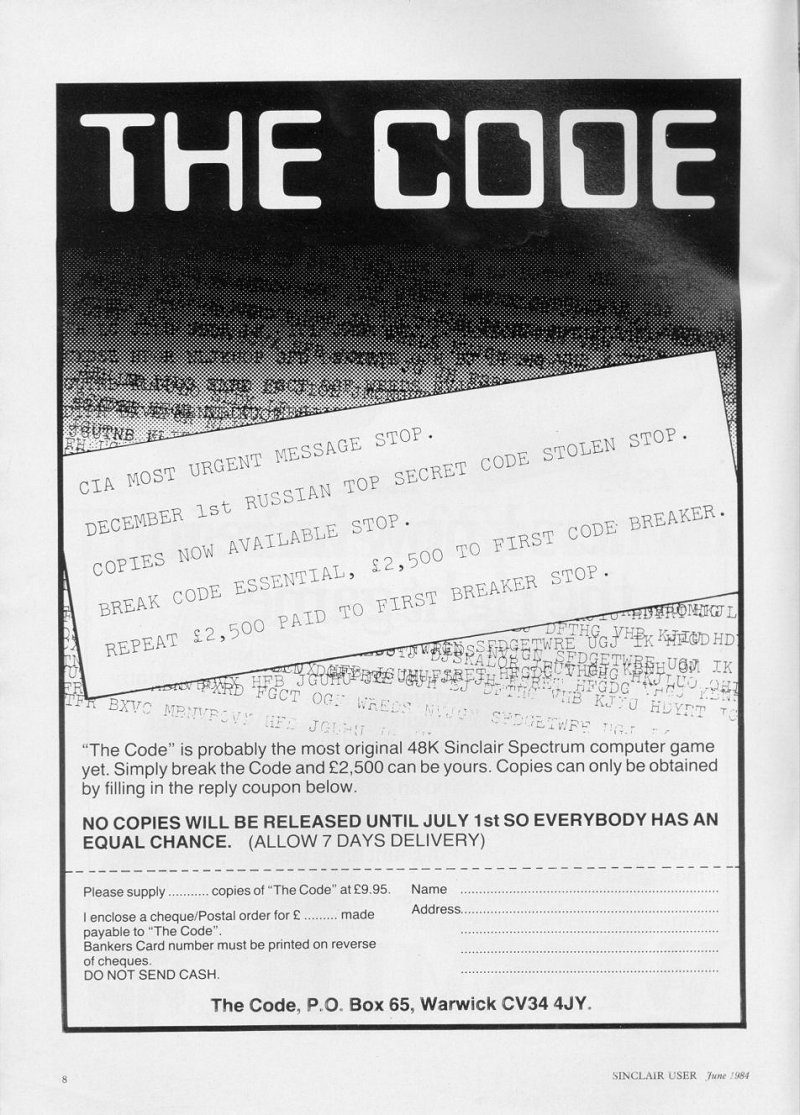
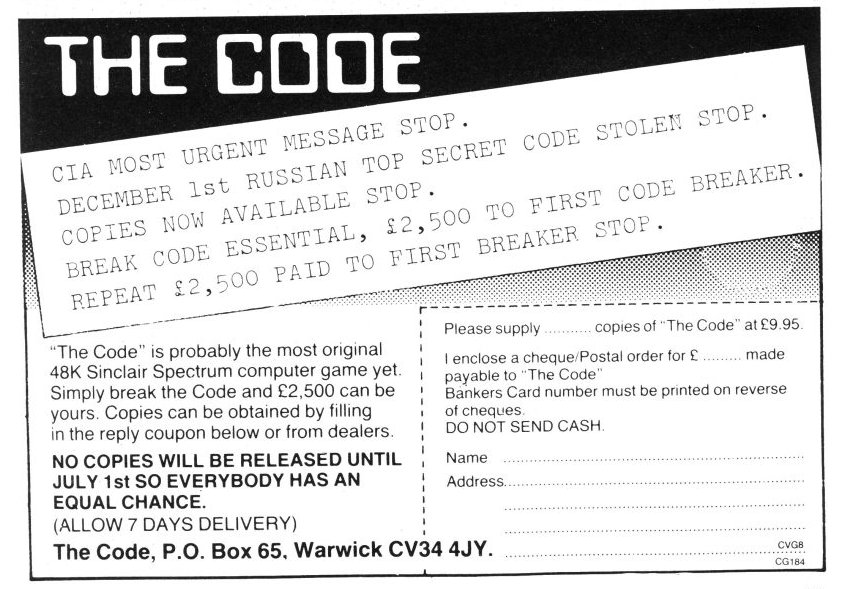
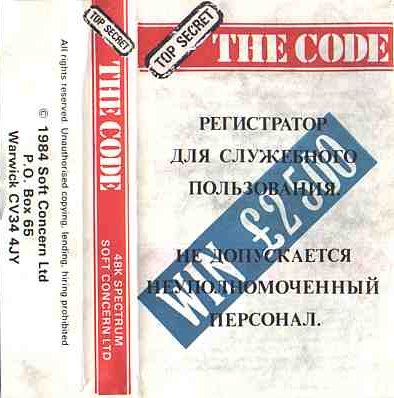
The Code is a prize game - the first person to crack the code would win £2500, with 10 runners-up winning £25.
Play
- CodeThe.z80.zipSnapshot image English18 KB
- CodeThe.tzx.zipTape image English19 KB
- CodeThe(different).tzx.zipTape image English22 KB
Documents
- CodeThe.txtInstructions English1 KB
Files and rights
No permission is on record either way. Screens and pictures are copied here on a take-down basis: if you hold the rights and want something removed, say so and it goes.
Credits
- Kevin Plunkettcredited
Sign in to credit somebody, or say what these people did.
Scores
Elsewhere on the web
- WorldOfSpectrum 2 votes4.00
In the magazines 19
ZX Computing #16Dec 1984 · p.63
Greg Turnbull
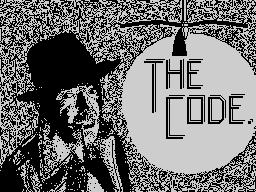
This is a highly complex text-only adventure puzzle, with a prize of £25,000 for anyone who can complete it. Ten runner-up prizes of £25 are also available. The idea being that you are a secret agent in a Russian military establishment. You must work your way through four floor levels to reach the code room, and crack the code. The program is highly detailed in text-only adventure, with extremely complex problems to be solved. This is to be expected considering the sum of money involved if you can beat it. Verdict: Only buy it if you are superb at solving difficult puzzles and can think laterally, or are very short of cash! If like me you can't progress very far through the program, at least there is a nice Bogart screen picture to look at while the tape is loading.
C&VG (Computer & Video Games) #37Nov 1984 · p.122
Keith Campbell
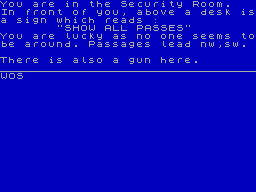
The Code is on Adventure game offering a prize of £2,500 for the first player to decode the secret messages found during play. Thus the codes are like treasures which must then be worked on to enable the player to claim the prize. There are a number of consolation prizes worth £25 as compensation for those not first to the post. The setting is a secret military establishment and so I, as a secret agent, set about gathering the coded clues. The game is text only, and a lot of it there is too. The location descriptions read almost like a book but, in trying to use any of the information displayed, discovered that, from the Adventure point of view, they were empty. A caretaker's office is described as being more like a lost property office, housing shelves of umbrellas, gloves, boots etc. Taking one of these objects is not possible. The description goes on... there are a number of ways out. Are they lost passages collected here with everything else?"" Unless I am completely missing the point, much of the text is banal. Another room is lined with matching shelves containing boxes "meticulously labelled". READ LABEL I typed. THERE'S NO WRITING ON IT came the reply. Well, I ask you! On visiting the washroom, well fitted with baths, showers and cubicles, the game dared me to waste my precious time in answering the calls of nature. So I tried. I BEG YOUR PARDON? came the indignant response. Why bother with a washroom? There was a row of cubicles on the south wall and, after failing to either have a bath or a shower or anything else and being unable to ENTER CUBICLE, I tried moving south, only to be told I hadn't the key for level 2. Wow! For some reason, the lights kept going off and on and a message told me how useful a torch would be. But there didn't seem to be one around. So I just waited through the blackouts until power was magically restored. Accepting the fact that there was little around that could be manipulated or examined to any effect, I proceeded to explore. I was attacked by an enemy agent - obviously a ripe candidate for early retirement, judging by his markmanship. On one of these occasions, I got a bit fumble-fisted Iwith the Spectrum keyboard (who doesn't?) and accidentally typed Y to restore a saved game. As I didn't have one, to avoid reloading the whole program to restore the prompt (not that there is one - another case "hunt the missing cursor"), I started playing the main program tape in, hoping it might give me a BAD SAVE message and return the prompt. How wrong I was! It put me back to the start of the game but this time, lying in the security room instead of the usual gun, was - a torch! And it happened every time. I asked Kevin Plunkett, the author, if I was missing some vital command in trying to do something with the various features described in the rooms - in particular, the shelves and boxes. "Oh no!" he exclaimed. "the instructions tell you that nothing is what it seems. We watched adventurers play this at the computer fair, and they all did the some as you - tried to examine everything everywhere! We had a good laugh. There's nothing there!" Ha! Ha! How very droll. Many of those people, no doubt, had played Adventures with some depth and expected more. Although the game has a number of good features, such as a quick response, and well written text that is grammatically correct, it just lacks imaginative flair. What with the shooting bouts, bombs going off and lights up and down all the time, this could claim the prize for being the first text-only arcade game. The Code is for 48k Spectrum from Soft Concern Ltd.
Personal Computer News #84Oct 1984 · p.20
Bob Chappell
KEY ISSUES A triple-decker of adventures is sampled by this week's Master of the Dungeon, Bob Chappell. Although one of the most popular science fiction characters on TV, Doctor Who has not so far featured in a text adventure to my knowledge. So if Daleks, Cybermen and things Galifreyean are your cup of Saurean Brandy, you're in for a treat. Lumpsoft, an oddly-named Leeds company and new to me, has released a Spectrum adventure called The Key To Time and jolly good it is too. The program is dedicated to the memory of William Hartnell who played the very first Doctor Who. In the adventure, you have to guide the original Doctor by sending him messages through the Time Lords' telepathic controller (which has been cunningly disguised as a Spectrum). Without knowing what your mission is, you start out, of course, in the Tardis control room. Once you've managed to get a nearby hologram player going, you'll discover that your task is to recover the five fragments of TheKey To Time. The next thing to do is find out how to get the Tardis moving. There are several places to visit, including Regents Park Zoo and, more exotically, Gallifrey itself. The program appears to have a comprehensive vocabulary - but not the 'zillions and zillions of words' claimed on the inlay. There are plenty of objects to examine, collect and think about, as well as a pretty good set of testing puzzles. It has a sense of humour too. As a sample, should you type WAIT, you'll be on the receiving end of a batch of purple prose - 'the infinite sands of time trickle through the cosmic hourglass'. Then it turns Pythonesque - 'I never wanted to be an adventure game, I wanted to be a Lumberjack'. Python fans will immediately recognise the tune that follows. None of this sits too comfortably with the theme of the adventure but it comes as a pleasant surprise all the same. Definitely one worth having in the collection for both Dr Who followers and non-believers, ILL-MANORED No so hot is Mystery of Munroe Manor, a text and graphics adventure for the Commodore 64 from Severn Software. The game starts in fine style. The background to the adventure in the form of newspaper clippings is followed by a scene of Munroe Manor where a silhouetted figure moves slowly past a window. To the accompaniment of suitably spooky music, the front door swings open to permit your entrance but suddenly closes with a bang. Then the first disappointment - you've now got to load the main program, a wait of 12 minutes before you even begin. Once that's over, you find yourself in the hallway of the manor. Each location is depicted in simple but colourful style. At the base of the screen, an area is reserved for a description of the location and any objects therein. Disappointment number two - the descriptions are extremely terse thus depriving the game of any much-needed atmosphere. The same area is used for your input and the program's response, the latter remaining on screen for several seconds before the text area is wiped clean. Until this wipe is done, you can't enter any further commands. This really puts the brakes on. Particularly so since the game's vocabulary is very limited and you're continually being told that your command has not been understood - very frustrating. There are some depressing idiosyncracies in the game, too. Although you can read a book in the library, you can't take it because you're not strong enough. One such book refers to consulting a 'physicatrist'. Really! A shame, as the game is not without merit. The graphics are drawn instantly and the puzzles appear tough - or are they merely obscure? If you're prepared to put up with the flaws, you might actually enjoy Munroe Manor. Me? I've got better things to spend my screen time on. RANDOM INTERFERENCE The Code from Soft Concern of Warwick is a text-only Spectrum adventure with a £2,500 prize for the first one to solve it. The game takes place on four levels deep within a KGB stronghold. The idea is to progress until you reach the Code Room where the instructions become suitably enigmatic. Like many text adventures for the Spectrum, the text appears in white against a blue background. However, the presentation is slightly odd - there are no prompts or cursor to indicate that the program is awaiting your input. You begin in a security room and it's quite obvious you're going to need a pass before long. The reason for this is that a guard appears at random who, if you're not carrying the correct means of identification, will haul you back to the security room. That, unfortunately, is not the only random event. Another such is an enemy agent who keeps popping up to take potshots at you. You can usually dispose of him for the time being with your own gun, but sometimes you miss. Then you have to keep defusing a bomb by pulling out one of four wires it's pure luck whether you select the right one or get blown to bits. A further bit of silliness is that the lights keep going off. All you have to do is wait long enough and they come back on again. You may have gathered from this that I'm no fan of adventures which contain random elements - and you'd be dead right. I can't stand them. The Code has some pretty interesting puzzles - although the topography is quite barmy - and it's a shame it's spoiled by these unnecessary random interventions.
Mystery Of Munroe Manor
The Key To Time
Advert7
- Personal Computer Games #14Jan 1985 · p.74
- C&VG (Computer & Video Games) #38Dec 1984 · p.30
- Personal Computer Games #13Dec 1984 · p.30
- C&VG (Computer & Video Games) #37Nov 1984 · p.12
- Personal Computer Games #12Nov 1984 · p.139
- C&VG (Computer & Video Games) #34Aug 1984 · p.79
- C&VG (Computer & Video Games) #32Jun 1984 · p.19
News/Note4
- C&VG (Computer & Video Games) #38Dec 1984 · p.168
- ZX Computing #14Aug 1984 · p.36
- Home Computing Weekly #75Aug 1984 · p.5
- C&VG (Computer & Video Games) #32Jun 1984 · p.21
Review2
- Games ComputingFeb 1985 · p.51
- Home Computing Weekly #86Oct 1984 · p.9
Full-page ad2
- Sinclair User #28Jul 1984 · p.47
- Sinclair User #27Jun 1984 · p.8
Letters1
- C&VG (Computer & Video Games) #65Mar 1987 · p.61
Related
- Tags
- Prize Game
- Elsewhere
- CASAThe TipshopUVL
- Same entry at
- Spectrum ComputingZXInfo
Reviews from people here
Sign in to write about this, or make an account. It takes a minute and lets you correct the catalogue too.
Everything ZXDB can hold about this is here.
Sign in to correct or add to this.
Hold the rights to this and want it taken down?