
Voltmace Delta 3S
Hardware: Joystick
Voltmace Ltd · 1984 · Pound sterling 10.00
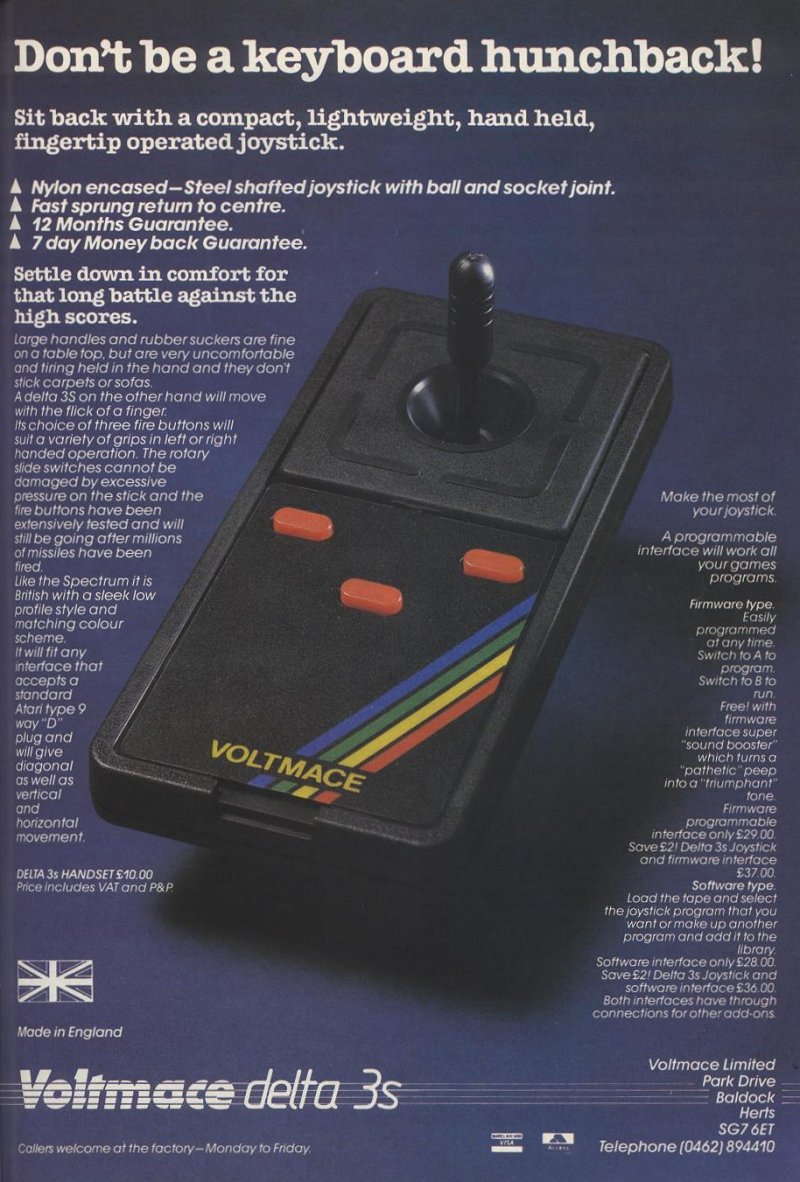
Compact, lightweight, hand held fingertip controler.
Discussion
Nobody has started a thread about this yet.
Remarks
various additional prices depending on interface
Files and rights
No permission is on record either way. Screens and pictures are copied here on a take-down basis: if you hold the rights and want something removed, say so and it goes.
Scores
In the magazines
- Your Sinclair #351988 · Overall Performance2/5
- Crash #601989 · Overall3/5
In the magazines 16
Crash #60Jan 1989 · p.793/5
Overall 3/5
Mark Caswell
Phil King
STICKS IN THE MUD Christmas time seems to have brought forward quite a few new joysticks, with the Navigator in particular being heavily-hyped. Most of them look really good, but how do they play? Two of the CRASH lads put them to the test, on all types of software ('cept word processors, of course!)... Delta 3S Voltmace £14.95 MARK: What's going on? Why can't I change channels with this dratted thing? Whoops! My mistake, it isn't a TV remote-control unit, it's a joystick. A chunky oblong with a spindly-looking shaft and three oddly-placed tiny fire buttons - its certainly original. No less strange is how this tiny stick has such a long travel - it's worse than the Quickshot. Held in the hand it's awkward to hold, but it seems designed for table use and works well enough there. As for toughness, we haven't managed to break it yet so it's worth experiencing. PHIL: Cor! It's almost like playing with a matchstick! Even more amazing is the long travel - the stick can be moved to about 45' from the vertical, stopped only by rutting the sides of the surrounding 'dimple' in the casing! Yet despite the definite lack of feel, the Delta 3s is well-suited to handheld/table-mounted play and in practice proves surprisingly responsive, although a question mark must be put against its durability. That's all folks, remember that the opinions of the CRASH lads are only meant as a guide. There are many joysticks on the market, we've covered what we could get hold of (further updates when we receive any more - hint, hint). Opinions on joysticks are as individual as those on games - 'every hand is different' as Lloyd's granny says. Certainly you should ask to try one before buying it, and of course keep your receipt, especially for those with long guarantees. You should also bear in mind none of these joysticks, with the single exception of the Navigator, will work with the +2 or +3 joystick interfaces without a small converter, such as the Frei adaptor (£2.50 - see the CRASH Hypermarket, page 95). But whichever one you choose it's got to be better than the Sinclair SJS-1...!
Your Sinclair #35Nov 1988 · p.411/53/52/52/52/5
Precision 1/5
Strength 3/5
Manouevrability 2/5
Value For Money 2/5
Overall Performance 2/5
Howard King
Miles Tudor
Steven Brewer
THE JOY OF STICKS We've waggled our way through the joystick jungle to bring you the latest on the firepower of ten top joysticks. If you're a real games addict you'll know how important a good joystick is. Games have moved on a bit since Pacman and Space Invaders where all you had to do was move left and right and blast the fire button every now and again. Then you could use the same joystick for all the seven games on the market. Nowadays, however, computer games are much more demanding and varied - shoot 'em ups, beat 'em ups, fly 'em ups, waggle 'em ups, steer 'em ups and even fry 'em ups - they all need differing degrees of precision, manoeuvrability and strength. Which is why you need a damn good joystick for the job - and there are plenty to choose from. So there's no excuse for a bad game player to blame his tools! But which joystick is best for the games you play? Which joystick do you choose? There are thousands. And you've only got twenty quid. Well, it just so happens that we've got a run-down on 10 of the most popular sticks on the market - read on to find out which one covers your every need. THE GAMES A joystick's performance varies considerably from game to game. The precise movements needed in a martial arts game become redundant in an out and out waggle 'em up. And then, the strength and slackness of one stick might not help in a steering game where full control and manoeuvrability is necessary. So, in order to test the joysticks fully, we chose three different titles to strain those sticks to the limit. Target Renegade tests for precision, Daley Thompson's Olympic Challenge for strength and Skate Crazy for manoeuvrability. And to make the contest even harder we asked three hot gamesplayers to give us their opinions on which sticks they preferred. TARGET RENEGADE A beefy beat 'em up. All that punching and kicking and butting requires a stick with easy access to diagonals and fire buttons, plus the ability to move slightly and quickly in any direction. SKATE CRAZY A loose and bouncy roller skate game, needing a combination of ease-of-movement and well positioned fire buttons for that sudden leap. A stick for this game will also need a strong shaft to resist those frantic circular steering motions. DALEY THOMPSON'S OLYMPIC CHALLENGE The meanest, the baddest and the toughest waggle 'em up in existence. The constant waggling environment requires a stick with excellent strength and good speed, coupled with a sturdy desk hold and well contoured grip. THE JURY Yes, solemn of face, tough of opinion, stingy of money, and ravenous of hunger, here are the three jury members, unswayable by money (or cheeseburger), ready to deliver their verdicts on the guilty sharp sticks. STEVEN BREWER Age: 16 Sex: Male Dist Features: Inane grin Computers: Speccy, QL Fave Rave: Gauntlet Hobbies: Grinning inanely, being enthusiastic about nothing Fave Music: U2 MILES TUDOR Age: 16 Sex: Twice a... (Snip. Ed) Dist Features: Bloodshot, knackered eyes Computers: I ain't got one, but if anybody's offerin'? Fave Rave: Target Renegade Hobbies: Sheep-spotting, train-spotting, spot-picking Fave Music: Prince HOWARD KING Age: 16 Sex: Male Dist Features: 'boyish good looks' Spluuter! Computers: Speccy 48K Fave Rave: Robin O' the Wood Hobbies: Boasting about his handicap (gold), kicking the dog 'bout a bit' Fave Music: Queen SPECTRAVIDEO QUICKSHOT 2 The Quickshot 2 is the father of most joysticks today, but its age does not show in its design. It has a square base, and a wide, sharply contoured handle as well as three fire buttons and an auto fire switch. It's four suckers stick relentlessly to any surface. The shaft is long and loose, which provides a fairly slowish response. The diagonals are difficult to locate in a hurry and it can't handle double movements (such as flying kicks) too well. It excels waggle-wise and the auto-fire switch is easily flicked on by the wrist. But despite all these faults, it works remarkably well in all games. Steve: 'Its slackness click irritated the hell out of my moody sister.' Miles: 'One old timer that's still up there with the new ones.' Howard: 'Ooh I'm a sucker for the suckers!' A little slow, a little temperamental, a little noisy - but what do you expect from a four year old joystick? Recommended. SUNCOM TAC 5 Now here's a very striking joystick - its beige and grey colouring is very chic, good-looking and elegant. The bulky square base sits on four studs and its size makes it unmoveably solid on a desk top even during savage waggling. There are three fire buttons. The stick moves with a very distinctive microswitch click that would annoy your parents and dogs. Movement is pretty good. The diagonals are excellent and there when you want them, although the stick does twist disconcertingly when you move it. It shines in all four departments but the granulated grip is a little too soft. Steve: 'I felt in full control when using this one. Great stuff.' Miles: 'Though it looks very "Habitat" I didn't find it very responsive.' Howard: 'I sweated so much the red directional marks rubbed off and I thought id cut myself!' Extremely attractive number with solid build, good diagonals and response. Annoying microswitch click, impotent fire button positioning and rub-off-when-wet paint let it down a little. Recommended. CHEETAH 125+3 The design of this joystick is very authentic, attractive and similar to the Quickshot 2. The base is robust and granulated for extra grip. It has four fire buttons. The stick, however, looks very plasticy and the seams were bluntly evident. The wide grip and tight throw allow magnificent handling although its size tends to make delicate or slight movements tricky. It responds quickly and smoothly especially in abrupt direction changes, despite the loud groans the stick emits under stress. Precision is perfect but in waggle-'em-ups, the stiffness of the stick prevents a good fast momentum. And it is simply perfect for games requiring manoeuvrability. Steve: 'The Cheetah 125+3 is the one for me - it's a beauty to handle!' Miles: 'I found this stick particularly useful in Skate Crazy which requires a lot of direction changes.' Howard: 'If only it would waggle better!' Outstanding all round joystick, authentically designed, furiously responsive, unbeatable steering but disappointing waggle-ratio. Recommended. POWERPLAY CRUISER The Cruiser is an instantly appealing and very attractive joystick, with its blue curved base, two-deep set white base buttons, and red standard stick. It rests solidly on four suckers on any desk top, but the curved design also suits the hand. The feature that really makes this joystick is the variable tension feature that allows you to select one of three degrees of tightness. The fire buttons are very well placed and click responsively. Diagonals are easy to find and direction changes are good. Adjusting the tension to number two helped in games requiring manoeuvrability, and as for waggling, number three seemed the best. The tightest tension (number one) worked best with Renegade. One of the less muscle-bound reviewers observed that the way you changed the tension (lifting then turning the stick) was quite difficult and a weak and feeble gamesplayer may find it a touch difficult. Steve: 'I'm a wimp so I found changing the tension awkward - I was so tired I couldn't play the game.' Miles: 'Not a bad little number for the all round gamesplayer. Worth, the money!' Howard: 'This is my top stick. It caters for everything and looks neat too!' Noisy but powerful joystick with unique variable tension option and multi-coloured "spaceship" look. Recommended. RAM DELTA The RAM Delia's design is very distinctive, futuristic and angular. The base is shaped like the front of a car while the shaft looks like a gear-stick. It's supported on three suckers placed at each corner, but holds just as well in the palm of your hand. Unfortunately it's shortness restricts precision, especially during hectic Renegade combat. Response is very polished and light, and the microswitches make the direction changes quick and substantial. While waggling, the small throw (the distance the stick moves in any direction) of the stick creates a good rhythm, but excess exertion leads to a sweaty slippery grip. All directional movements are springy, and the clicks of the switches are quiet and unobtrusive, yet loud enough to indicate when you had forced the joystick far enough. Steve: 'I liked the design but found handling a little awkward.' Miles: 'This one is definitely my favourite - I've never gripped such a nice stick!' Howard: 'Control is superb - and I loved those suckers!' Superb sculptured joystick, dedicated to those who like looks, body and character in their sticks. Recommended. EUROMAX PRO-ACE The Pro-Ace is a sturdy-based joystick with a long slender shaft and two fire buttons. The shaft is good and stiff but feels rather flimsy - as if it might break off at any moment. The lack of suckers and a firm base make it rock drunkenly on the desk during any frantic action. The fire buttons, however, are well placed and responsive. The throw is microscopic and renders waggling virtually useless. Described as emphatically pedestrian (What?? Ed) the Pro-ace steers quite well considering the limited throw, but the diagonals have to be forced and the shaft is too long for the field of Renegade movement. Steve: 'Not bad, not bad! I've used a better tool though!' Miles: 'Nice looking stick this - and it handles well too!' Howard: 'Cor this is rather good. I quite like it.' A stiff and flimsy affair, which rocks on the table and reacts very slowly. Steers well though. SUNCOM TAC 2 This small, square based joystick is the most solid on a desk top, and is compact, durable and quite rugged. It has two buttons The stick only moves slightly in each direction but triggers first-rate responses. However this light operation is let down by the overly (or underly) short shaft. The sensitivity is excellent and made both steering and diagonals a piece of cake. After a bout of waggling though, the handle became quite wet and one of the more sensitive reviewers suffered from a sore thumb after a heavy game of Renegade. Steve: 'This one was in a class of its own in playing Skate Crazy.' Miles: 'Not as good as the Suncom Tac 2 I'm afraid.' Howard: 'Tac is an apt name 'cos it's one of the tackiest objects I've seen.' Sturdy solid joystick, attractively metal-plated, is not so hot precision-wise but practically boiling in the steering field. KONIX SPEEDKING This unusually shaped joystick looks a little like a lost jigsaw piece and half a pelvis. It's very well designed for a hand held grip but so does not sit easily on the desk. The stick is a short red affair in arcade-machine stumpy style and is microswitched. It slides quickly into diagonal position and the small throw allows very fast direction change. But the same smallness restricts steering and makes the joystick feel disconnected in games like Skate Crazy where it only gives a fair degree of control. The smoothness of response is great for Renegade, and perfect waggle rhythm is a cinch to get going. The disparity of the design is difficult to get used to, and a sweaty session of waggling can make the stick very slippery. Steve: I just couldn't decide how to hold this one.' Miles: 'It looks quite natty and is a good all round joystick.' Howard: 'It's a bit small for my tastes.' Originally and economically designed, the Speedking is perfect for those who don't have a desk to lean on and don't sweat much while waggling. TERMINATOR Believe it or not this strange looking object really is a joystick. Shaped like a hand grenade (for the Rambo addicts?) this joystick is aimed more at the novelty and toy market rather than our serious 'executive' gamesplayer. The metallic fire button is the clip on the side, while the small Meccano stick juts out of the top. It sits well in your hand and is lighter than its explosive counterpart. As a joystick it's pretty useless, a nightmare to use and makes you want to go "aaarrghhh!". The fire button is awkwardly positioned and is easy to press unintentionally. The stumpy stick is awful for precision and all movements have to be shoved into direction, although the diagonals are easy to obtain. Obviously an excellent novelty and gimic but not very useful as a serious tool. Steve: 'The slippery stick is hideous and waggling is bleuuuch!' Miles: 'I really couldn't get to grips with this one.' Howard: 'I reckon you'd get arrested if you walked into a bank carrying this!' Excellent 'macho' gimic that looks exactly like a grenade with a piece of Meccano stuck in the top. Absolutely rubbish as a joystick though. VOLTMACE DELTA 3S The old fashioned prehistoric design makes the Volt mace Delta an instant turn off, but it's not as bad as it looks. Shaped like a door wedge, the Delta has three fire buttons and a small orbiting stick. It's quite awkward to hold and is happier on a desk top. The three red base buttons are too far away and tiny - rather like TV remote control buttons. The stick is also too small and weedy making small turns and movements virtually impossible - to go anywhere you have to exaggerate the movements. Changes in the direction and precision are easy because of the movable stick and the wide gap for movement, but the diagonals are spindly. Waggle-wise it performs surprisingly well and with the minimum cramp or restriction. Steve: 'I wish I could say this is a pleasure to use - but it isn't.' Miles: 'Urrggh! This one looks like a bar of Dairy Milk - shame you can't eat it!' Howard: 'If you like waggling, you'll like this!' Prehistoric design is not too attractive but it sits comfortably on your desk despite spindly diagonals and misplaced fire buttons. Comparatively outstanding at waggling. VERDICT It was a close thing with each reviewer snuggling up to their favourite sticks, and beating each other about the head with their not so favourite ones. But in the end the Cheetah 125+ scraped into first place, with the RAM Delta and Powerplay Cruiser coming second and third respectively, closely followed by the Konix Speedking and Quickshot 2. The overall positioning was: 1. CHEETAH 125+ 2. RAM Delta 3. POWERPLAY Cruiser 4. KONIX Speedking 5. SPECTRAV1DEO Quickshot 2 6. SUNCOM TAC 5 7. SUNCOM TAC 2 8. VOLTMACE Delta 3s 9. EUROMAX Pro-Ace 10. TERMINATOR Now for the votes on the best and worst buys. Here's what the reviewers had to say and they mean that most sincerely folks! STEVEN BEST - Cheetah 125+ "Magnificent handling... brilliant fire buttons... a real treat." WORST- Terminator "Aaarghhhhh... awful... my goldfish steers better than this." MILES BEST- RAM Delta 'Looked quite sexy... the knob was really nice... good and springy." WORST- Terminator "Bleuchhh!... Terrible... Looks too much like a hand grenade and 1 didn't know to hold it." HOWARD BEST - Powerplay Cruiser 'Fits well in the hand... stands out... good stuff and the stick variable tension - wow!" WORST - Terminator "Yicckkk!... a nightmare... it's bad, really, really bad." 1st Place Supplier: Cheetah Marketing Ltd, [redacted] Price: £12.99 Guarantee: 1 year Features: A C D E F G
FEATURES A- Suckers B - Studs C - Thumb Button D - Trigger Type Button E - Base Button F - Auto Fire G - +2/+3 Compatible H - Metal Shaft I - Miscroswitches
SCORES 1 - Eeek! 2 - Poor 3 - Average 4 - Good 5 - Excellent
TOP TEN TIPS WHEN BUYING A STICK 1. Don't be taken in by sales blurb. Disregard phrases like "the greatest ever joystick " or "the most responsive on the market" plastered on the packaging. Stay in touch with the real world. 2. Consult a guide (ie, this one). 3. Decide beforehand how much you are prepared to pay. There are two sides to the market: budget (five to seven pounds) and the not so budget (ten to twenty pounds). 4. Keep in mind the type of games you'll be playing. If you're a shoot 'em up addict you'll want a stick with good manoeuvrability and a well-placed fire button: if you're a flight sim man you won't want a tiny effort. 5. Check for +2/+3 compatibility. More often than not, if a stick is compatible it will be supplied with two leads or an adaptor. Otherwise search around for a suitable interface. 6. When buying an interface, stick to names you know. 7. Search through mail order firms (like DATEL) for good prices and special offers. Often you can buy an interface and a joystick in a combined cheap package. 8. If possible, ask to test the joystick. Not necessarily with a game, but just move it around and get a feel for it. Test the tension, consider the looks, examine the quality. 9. Check out the guarantee. Don't accept under a year for any joystick. 10. Keep in mind, the amount of desk space you have. Buy a hand held model if you have no space.
WARNING Before you rush out and buy a brand new joystick, remember you'll need a joystick interface too. Rubber keyboard owners have always needed one and although Amstrad included a joystick port on the Plus 2 and 3, it's only compatible with Amstrad joysticks, so you'll still need an interface for Kempston and Cursor sticks. Got that?
Sinclair User1985 · p.14
HARDWARE WORLD With ever-increasing amounts of peripherals available for Sinclair computers, users are finding it more and more difficult to know what to buy. We present a buyer's guide to joysticks, keyboard and printers and review the best of the rest from the 1984 add-on market. Joysticks are a popular addition to the Spectrum and many people find it essential for zapping aliens or flying a simulator. In the last year there have been a number of interfaces and joysticks launched, some with more success than others. Nearly all joysticks have accepted a common standard, that of Atari which was the first company to add joysticks to a computer. The style of the joysticks may vary but the connection to the interface remains the same. To use a joystick some form of interface is needed. One, or more, of three standards are normally used. 'Cursor', sometimes known as 'Protek', simulates the four cursor keys for the directions with 0 as fire, 'Sinclair' allows for up to two joysticks and simulates keys 1 to 5 and 6 to 0 respectively and 'Kempston' which does not simulate any of the keys but uses a port address. The most common of those is the Kempston but it is by no means universal. To overcome that a programmable interface can be used which allows you to use any key for any direction or fire. The method of programming varies, some need a tape to be LOADed, while others require you to press a key and then to move the joystick in the direction which that key will simulate; some have physical connections which must be made to signify the key and others simply use a stored memory of which keys are to be used. GRANT DESIGNS & EEC Two designs combine the interface and joystick in one. The Grant Designs Spectrum Stick and a similar one from EEC clip to the Spectrum keyboard over the cursor keys and use a mechanical system to press the keys. Inside the Spectrum Stick there are two frames which move independently up and down, and left and right; to those are attached ramps which push little feet onto the relevant keys. The EEC joystick is more substantial. The casing is a one-piece moulding which fits snugly onto the Spectrum case. Inside that the stick is securely joined to a shaped plate which presses on one or more levers which in turn depress the key. Both are priced at £9.95 and are far cheaper than anything else on the market. Provided they are used with restraint they are better than nothing. RAM TURBO INTERFACE The RAM Turbo interface from Fleet Electronics is what the Sinclair Interface 2 should have been and was not. As well as having two joystick ports, it has a ROM cartridge slot. Moreover, one of the joystick ports can be used for Kempston compatible games and the other can be used as a Protek compatible port. It is similar in size to the Interface 2 but the rear connector is full Spectrum-size as opposed to the Interface 2 ZX-81 size. The area surrounding the joystick port is large enough to take a standard joystick connector. Users who have either built their own joystick or use the Flight Link joystick will have found problems with Interface 2 as the left-hand, most commonly used, port is too near the raised ROM slot. In order to prevent users fitting the interface with the power on (the surest way to blow up your Spectrum) it incorporates a 'Spectrum Protect Adapter', a loop of plastic which covers the power socket on the Spectrum so that the lead must be removed before fitting. If you are considering the Interface 2 then think again; the RAM Turbo interface is better designed and better value for money, costing £22.95. PROTEK INTERFACE The new switchable interface from Protek can be configured for all three of the standards by using a switch on the back. The interface is dead-ended, so it must be the last add-on fitted. As with the Turbo interface, it is liable to crash if used with a twin fire button joystick. Its main drawback is that in the Protek position the top row of keys is disabled, while in the Sinclair position only the 6,7,8,9 and 0 keys are disabled, which could make some games difficult to play. The switch would have to be moved, the key pressed, and the switch returned to its original position. Despite the above problems, which should not affect most users, the interface is easy to use and covers most games on the market. It is priced at £19.95. ELR INTERFACE The programmable interface from East London Robotics for the Spectrum has the distinction of being the cheapest on the market at only £10.00, if bought together with a Trickstick. The interface, as ELR would be the first to admit, was designed to be 'cheap and cheerful' and it is, even to the extent of being uncased. In order to program it small metal clips are used to connect pins which represent the various rows and columns of the keys on the keyboard. That is fiddly and time consuming if you need to reprogram it, but has the advantage that once programmed it is usable from power up. If the interface is purchased separately its price is £15.00. COMCON INTERFACE Frel Ltd market the ComCon programmable interface. Any key on the keyboard can be programmed and there is provision for two fire buttons. To match the interface Frel also markets two compatible joysticks. The interface is of simple design and to program it you have to plug the relevant lead into the pin you want. That can be done with a program running and the keyboard is not disabled. Any joystick with a standard plug can be used and if that has only one fire button then the F1 lead is used. To allow for other add-ons there is an extender card which rises vertically from the front of the board. The two joysticks which Frel markets are the Flightlink and the Quickshot II which has been adapted to have the independent fire buttons, F1 on the trigger and F2 on top. At £19.95 the interface is one of the least expensive and the ease of programming should ensure steady sales. The two joysticks are £10.50 for the Flightlink and £13.95 for the Quickshot, both less £2.00 if ordered with the interface. CCI INTERFACE The interface from Custom Cable International needs a software tape to program it. It can accept any standard joystick; there is no extender card, so it must be the last add-on plugged in. Programming the interface is straightforward. In all, only 10 keypresses are needed plus two to confirm everything is order. The program is written entirely in BASIC which makes it very easy to customise. This is a good interface and competitively priced at £15.00, but it could have been even better if the instructions had been more detailed. PAGE & RAINBOW The Page and Rainbow interfaces are of the kind where you must push a key, move the joystick, release the joystick again for the four positions plus fire, again for the diagonals, again for the diagonals plus fire and finally the fire button on its own. All of that can be done with the game running as the keyboard can still be used. Some people will find that time consuming and fiddly. The one really useful feature of the Page interface is a rapid fire switch. When that is in the up position it simulates the fire button being held down, very handy for the 'zap everything in sight' type of game. The Rainbow interface includes a beep amplifier. With the Rainbow interface at £24.00 and the Page one at £26.00, they deserve consideration provided you do not mind the time and hassle of programming them. FOX ELECTRONICS The programmable interface from Fox Electronics, on the other hand, is probably the easiest of all to program. You only have to flick a switch once you have told it which keys to use. When the switch is up a menu is displayed on the screen. You have the option of creating a new key set, from any of the forty keys or selecting, with a single keystroke, one of the sixteen sets already created. Pressing the E key exits to Basic to load the game and programs the joystick. If necessary the key sets can be saved on tape. Leaving the switch down enables the Spectrum to ignore interface. Inside the interface is a RAM chip and a small ni-cad battery, and on power down it retains the information in its memory for a minimum of six months. When switched on the interface pages the Spectrum ROM and jumps to the program held in its RAM. The program then transfers itself into the Spectrum RAM, pages the ROM back in and puts the menu on the screen. On pressing the E key the program transfers itself back into its own RAM, sets up the joystick and clears the Spectrum memory. Any new key sets created are therefore saved in the process. All that sounds clever but it also has two beneficial side-effects. When the switch is down, the interface causes a hardware reset; in other words, if you have a game running you can jump out of it without pulling the plug - a saving on plug wear. Secondly, details are available from Fox for a machine code programmer to adapt the interface as a pseudo ROM. Often used routines such as toolkits, printer driver programs or complete character sets could then be loaded at the flick of a switch. At £28.95 the interface is excellent value. TRICKSTICK One of the more unusual joystick devices launched in 1984 was the long awaited Trickstick from East London Robotics. In fact, to describe it as a joystick is misleading. It is a 7in long black cylinder with six touch sensitive pads which simulate the four joystick movements, plus two fire buttons. The Trickstick comes with an interface, up to eight of which can be plugged in at any one time, and has the option to give proportional movement on specially written games. It simulates the Kempston joystick so there are many games available on which it can be used. The touch pads use your body as an aerial to pick up mains hum. That is converted by the electronics to simulate the key press. As some people are better aerials than others the sensitivity of the stick can be altered by a small screw near the top. A minor fault is that the lead from the interface to the stick fouls the power lead. It takes some getting used to unlike a joystick, but once mastered is just as useful. As it has no moving parts it should stand up to wear and tear and it is quicker than most others. It costs £34.50. Nineteen eighty-four has been a quiet year for standard joysticks with only two given much publicity. DELTA 3S The Delta 38 from Voltmace has two independent fire buttons, one of which is doubled up for left or right handed players, and rotary switches are used on it. Those switches give it a light action and it can be comfortably held in the hand. At £10.00 the joystick is good value, its solid construction should ensure long life. SUPER CHAMP The Super Champ, currently marketed by Dean Electronics, is unusual in that the cable is held in the base. For use the cable is pulled out and, when you have finished, rotating the stick winds the cable inside. The stick is very long and thin and has two fire buttons, one on top and one in the trigger position; those both operate the same switch. The base is, as expected, larger than usual and has four rubber suckers underneath. Because the stick rotates there has to be a certain amount of play in the pivot. That makes precise control difficult unless you hold down the centre. Despite that the joystick works tolerably and the convenience of not having the wire lying around almost makes up for it. The Super Champ is priced at £12.95. RAT Finally, if the advertising is to be believed, the age of conventional joysticks is past and the future belongs to the RAT and its offspring. The RAT (Remote Action Transmitter) operates in a similar fashion to TV remote control handsets; you simply wave it in the general direction of the screen and press the touch-sensitive movement and fire buttons. It is sold with a receiving unit that connects to the Spectrum and is compatible with most popular Spectrum software. The RAT is powered by a normal PP3 battery which fits into the underbelly of the handset. The first of its kind, the RAT suffers minor teething problems and can cause excessive handache but, like the Trickstick, you will soon grow fond of it. The price is £29.95 from Cheetah Marketing and high street stores. Grant Designs, Bank House, Reepham, Norwich, Norfolk NR10 4JJ. Tel: (0603) 870852. EEC, [redacted]. RAM Electronics (Fleet) Ltd, [redacted]. Protek, [redacted]. East London Robotics Ltd, [redacted]. Frel Ltd, [redacted]. Custom Cables International Ltd, [redacted]. Page Computing, [redacted]. Rainbow Electronics, [redacted]. Fox Electronics, [redacted]. Voltmace Ltd, [redacted]. Dean Electronics Ltd, [redacted]. Cheetah Marketing Ltd, [redacted].
ComCon.
Custom Cables International.
Delta 3S.
EEC.
East London Robotics.
Fox Electronics.
Page.
Protek.
Quickshot II.
RAM Turbo.
RAT.
Super Champ.
Trickstick.
Interface: Grant Programmables: No Cursor: Yes Sinclair: No Kempston: No x2 Fire: No Price: £9.95 Interface: EEC Programmables: No Cursor: Yes Sinclair: No Kempston: No x2 Fire: No Price: £9.95 Interface: RAM Turbo Programmables: No Cursor: Yes Sinclair: Yes Kempston: Yes x2 Fire: No Price: £22.95 Interface: Protek Programmables: No Cursor: Yes Sinclair: Yes Kempston: Yes x2 Fire: No Price: £19.95 Interface: ELR Programmables: Yes Cursor: No Sinclair: No Kempston: No x2 Fire: Yes Price: £15.00 Interface: ComCon Programmables: Yes Cursor: No Sinclair: No Kempston: No x2 Fire: Yes Price: £19.95 Interface: CCI Programmables: Yes Cursor: No Sinclair: No Kempston: No x2 Fire: No Price: £15.00 Interface: Page Programmables: Yes Cursor: No Sinclair: No Kempston: No x2 Fire: No Price: £26.00 Interface: Rainbow Programmables: Yes Cursor: No Sinclair: No Kempston: No x2 Fire: No Price: £24.00 Interface: Fox Programmables: Yes Cursor: No Sinclair: No Kempston: No x2 Fire: No Price: £28.95
Crash #10Nov 1984 · p.24
BATTLEFIELD JOYSTICK Joysticks are your most immediate connection with any game you play - the man-machine interface. The melting joystick makes a nice image for an advertiser who's suggesting that his games can beat anything, but do joysticks in real life really stand up to the beating they receive, are they tough enough for the job, do they move well, are the handles right, will the buttons fire? The CRASH reviewing team settled down for a weekend of joystick bashing on several types and makes, and here we look at the results... There are now many makes of joystick available, and almost as many types as there are makes. Each boasts design innovations so that it is better than all the others - and they come in a range of prices too. We all know that joysticks on arcade machines take a battering, so too do those at home. Do they stand up? We tested 19 joysticks from well known manufacturers to see how they all compared. A joystick must be able to withstand games that require fast and repeated movement, so what better than Ocean's Daley Thompson's Decathlon? We used the Commodore version of the game because it is more violent than the Spectrum! But it isn't only toughness; joysticks must also be capable of fine and positive movement, comfortable to use with sensible fire buttons. Several arcade skill games were used to test four major points for both the stick action and the fire button action. TRAVEL means the maximum movement between opposite poles (e.g. up/down) on the stick, and how far the fire button had to be depressed. On stick action over 1.5 inches was considered to be very long. Oddly, some of the short sticks had longer to travel than the taller sticks. ACTION FORCE means the amount of hand or finger pressure required to keep the stick pressed over or the fire button down. REACTION SPEED indicates how fast contact is made, how quickly the action affects the game, and how well rapid movements can be made (especially rapid fire buttons). RESPONSE/FEEDBACK indicates how positive the stick or fire action feels and whether there is any physical or audible feedback to tell the player that contact has been made. ERGONOMICS how useful is the stick for hand held playing, and how well does it operate on a table top. Is the stick well designed for comfort, ease of fire action and general stability. After preliminary testing, the joysticks all went through ten minutes of the Decathlon to see how long they were likely to stand up to use. During this test, some joysticks broke. Finally, all the sticks have 9 pin D connectors and are Atari compatible on the pin outs. They all need an interface of one sort or another to work with the Spectrum (except the clip-ons). Some offer 2 independent fire actions, but these only work with either a Cambridge interface or the programmable Comcon from Frei Ltd., which was the interface used for this test. Each joystick review is split into two halves; firstly a brief technical breakdown; secondly the review team's report. PRO ACE Supplier: Sumklock Microware, [redacted] Price: £12.95 Lever Action: Strong plastic handle suspended between two plastic bushes. Central copper star acting as self-centering spring and contacting 4 copper rivets Fire Action: Oblong fire button at 12 o'clock operating copper contact switch. Trigger button at tip of stick activates copper plate contact. Ergonomics: Average size easy grip enclosure for handheld operation. Rubber feet for table operation. Left and righthanders welcome. Lead: Plastic moulded D connector and retaining grommet. Weak point: Copper contact star can weaken and deform. Soft copper contact surface creates dust and can oxidise if not used over long period. STICK ACTION Travel: long Action force: very hard Reaction speed: slow Response/feedback: very poor and irregular - up/down was not too bad but left/right was terrible, and a lot of slack FIRE ACTION Travel: long on stick button, very long on base button. Action force: medium. Reaction speed: poor Response/feedback: poor, no indication or 'feel'; rather rubbery. Ergonomics: the shaped base fits the hand well with a well positioned left or right hand base fire button, but very unstable on a table top, especially with the sticky travel. The long thin stick is quite comfortable to hold. Life expectancy: top fire button pulls out too easily, the copper contacts bend out of shape easily with use, causing erratic response. The general stick response and travel means that the handle will take a beating on hard, fast games. SPECTRUM MECHANICAL Supplier: EEC Ltd., [redacted] Price: £9.95 Lever Action: Plastic shaft strengthened by long selftapping screw suspended in rubber mount activates via cam plate four flexible key actuating fingers. Fire Action: None Fixing: integrally moulded clip grips. Main body flexes under use. STICK ACTION Travel: long Action force: heavy. Reaction speed: poor Response/feedback: no feedback and generally poor response as casing flexes greatly during play. Ergonomics: This unit clips over the edges of the computer and is made from one piece. This means that together with the stiff stick movement the unit flexes heavily during use, especially with more violent games, and this sometimes renders the key pressed inoperable. The tendency to move away from position during play can also disenable any 8 directional movement. Life expectancy: not very high on fast games, and indeed there may be the slight chance of damaging the computer in a game like the Decathlon. FLIGHTLINK Supplier: Flightlink Control Ltd., [redacted] Price: £10.50 Lever Action: Short Steel short suspended in brass bell bush and compression spring for self-centering action. Plastic bush activates subminiature microswitches. Fire Action: 2 miniature square fire buttons at 6 o'clock. Two independent fire actions in combination with appropriate interface. Ergonomics: No rubber feet. Lever shaped body for handheld operation. Left and right-handers welcome. Lead: D type connector with plastic cover. No grommet Weak point: Lead entry point unprotected. STICK ACTION Travel: long. Action force: very light Reaction speed: fast. Response/feedback: good, positive lock at end of travel for secondary compass points, but tends to slide on primary compass points (left/right/up/down). FIRE ACTION Travel: medium long. Action force: light. Reaction speed: fast - good for rapid fire. Response/feedback: some slack but reasonably firm and positive. Ergonomics: handheld is very good because of small size and light weight but overall a bit pathetic on the table top. The 2 independent fire buttons are in a straight line, which make them a bit awkward for table use, as supporting hand is in the way. Life expectancy: because of fight action and metal construction, stands up to a hard game very well. Life should be quite good. SLIK STIK Supplier: Consumer Electronics Ltd., [redacted] Price: £9.95 Lever Action: Short rubber mounted steel shaft contacting 4 rigid contact plates in end position. Tough short throw movement. Fire Action: 1 left-hand round fire button at left 10/11 o'clock position in enclosure. No trigger button. Ergonomics: No rubber feet or suction cups. Small well rounded body for handheld operation. Left-handers only Lead: Plastic moulded D type connector and sleeved retaining grommet Weak point: Moulded plastic support wall for contact plates can crack and break off. STICK ACTION Travel: very short Action force: medium Reaction speed: good. Response/feedback: quite positive feel and solid end stop with solid clunk. FIRE ACTION Travel: short Action force: medium to hard. Reaction speed: good. Response/feedback: sort of sticky feel, but solid end stop with loud clunk. Ergonomics: lightweight construction and small size make it good for handheld use and reasonably stable on a table top, the corner position of the fire button is good for right handers, but poor for left handers. Life expectancy: Pretty good because of the short stick, short travel and steel shaft. It feels quite safe even on a hard game. KEMPSTON PRO 5000 Supplier: Kempston Micro Electronics Ltd., [redacted] Price: £13.50 Lever Action: Strong steel shall suspended in rubber bush. Leaf contact switches actuated by nylon bush. Fire Action: 2 large arcade style round fire buttons actuating leaf contact switches Ergonomics: Average size well rounded enclosure for handheld operation. Rubber feet for table top operation. Lead: Plastic moulded D type connector and moulded sleeved grommet. Week point: Body flexes under use. STICK ACTION Travel: short Action force: medium Reaction speed: instant Response/feedback: no audible feedback but fairly good response overall. FIRE ACTION Travel: very short. Action force: very light - good rapid fire. Reaction speed: fast. Response/feedback: good with hard, positive feel Ergonomics: not very good for handheld use with the large base but reasonably steady on a table top. The two large arcade style fire buttons on the base are well placed for left or right-hand use, and the round knob shaped stick is comfortable to hold. The slightly stiffer action of the stick on this version of the 5000 make it slightly more tiring to use on the Decathlon. Life expectancy: Good KEMPSTON PRO 3000 Supplier: Kempston Micro Electronics Ltd., [redacted] Price: £12.75 Lever Action: Hollow plastic shaft supported in rubber washer actuating 4 leaf contact switches. Fire Action: 2 trigger buttons (trigger finger and thumb) and one banana shaped fire button at 12'o clock. All fire buttons operate one leaf contact switch. Ergonomics: Small rubber feet. Handheld or table top operated. Lead: Moulded D type connector and moulded sleeved grommet Weak point: very weak hollow plastic shaft STICK ACTION Travel: medium long Action force: medium to hard. Reaction speed: quite fast Response/feedback: slow, very soggy feel and imprecise. FIRE ACTION Travel: base button medium - top and trigger buttons long. Action force: medium Reaction speed: poor Response/feedback: not very positive, soggy feel and no feedback. Ergonomics: similar to PRO 1000 - top fire button badly placed for handheld use. On a table the base button is in the way of second hand holding base fire button which occupies most of the front of the base. Trigger fire is quite well placed. Life expectancy: the hard game proved too much for this joystick, which broke, the stick snapping off at the base, before its ten minutes were up. The somewhat thin hollow plastic stick obviously lowers life expectancy rather drastically if hard games are going to be played with it. KEMPSTON PRO 1000 Supplier: Kempston Micro Electronics Ltd., [redacted] Price: £10.99 Lever Action: Hollow plastic shaft supported in rubber washer actuating 4 leaf contact switches. Fire Action: Banana shaped red fire button operates leaf contact switch. Ergonomics: Handheld or table top operated (rubber feet). Lead: Moulded D type connector and moulded sleeved grommet Weak point: Very weak hollow plastic shaft STICK ACTION Travel: short. Action force: hard. Reaction speed: medium. Response/feedback: no feedback, rubbery feel to the stick and even on a slow game it felt as though the handle might break at any second FIRE ACTION Travel: medium long Action force: medium hard and tiring for rapid fire. Reaction speed: slow. Response/feedback: no feedback, again - very rubbery. Ergonomics: seems fine for handheld use at first, but not well designed as centre of gravity is all wrong to be able to operate stick and fire at the same time. Not too bad on a table top, quite stable with supporting hand holding it tightly, but too much resistance for single handed stick operation. Again, the long, curving base fire button gets in the way of the supporting hand. Life expectancy: Joystick was rendered useless after two minutes of Decathlon, because the stick snapped off at the base. Same thin, hollow Construction as the Pro 3000. COMPETITION PRO Supplier: Euromax Electonice Ltd., [redacted] Price: £16.95 Lever Action: Strong steel shaft suspended in rubber bush. 4 industry standard V3 microswitches actuated by plastic bush. Fire Action: 2 large arcade style round fire buttons actuating leaf contact switches. Ergonomics: Average size well rounded enclosure for handheld operation. Rubber feet for table top operation. Plastic moulded 0 type connector and moulded sleeved grommet. Weak point: Body flexes under action STICK ACTION Travel: short, in fact just about right. Action force: light. Reaction speed: instant. Response/feedback: although in most respects identical to the Pro 5000 this stick has audible clicks - generally very good. FIRE ACTION Travel: very short. Action force: very light - good rapid fire Reaction speed: Fast. Response speed: good, with hard positive feel. Ergonomics: base too large for handheld use, stable on table top with well placed left hand fire buttons on base. Comfortable knob shaped slick. Life expectancy: Good. ATARI Supplier: Atari International, [redacted]. Price: £7.50 Lever Action: Nylon shaft supported between pivot point and upper shoulder support. Nylon actuator ring activates 4 dome switches on pcb. Plastic gaiter and deformation of ring creates self-centering force. Fire Action: One round fire button at 10/1 1 o'clock activates dome switch. Ergonomics: Average size square body for hand-held operation Rubber feet for table top operation. Lead: Moulded D typo connector and moulded sleeved grommet. Weak Point: Actuator ring will wear and snap. STICK ACTION Travel: short Action Force: light to medium. Reaction: good Response/feedback: no feedback, soggy feel which gets soggier with use and hardens up with disuse. FIRE ACTION Travel: medium. Action Force: light. Reaction Speed: good - very good rapid fire Response/Feedback: very firm feel but no feedback. Ergonomics: the hand-sized square base and light construction are ideal for hand-held use, although the corner placed fire button can be awkward, and isn't very good for left-handers. Life Expectancy: not too long, but reasonable considering price. SUPER JOY Supplier: Spectravideo Ltd., [redacted] Price: £9.95 Lever Action: Plastic shaft with actuator ring activating 4 dome switches on pcb. Deformation of ring creates self centering action. Shaft Supported between lower pivot point and upper shoulder bearing. Fire Action: 3 firing buttons, on lever thumb switch, two on side of enclosure (10 and 2 o'clock). All three activate dome switches. Ergonomics: Slim body suitable for handheld operation. 4 suction cups for table operation. Lead: Moulded D type connector and moulded sleeved grommet. Weak point: Actuator ring will wear and snap. STICK ACTION Travel: short. Action force: very light. Reaction speed: medium fast. Response/feedback: not very good - a lot of play in the stick and then over travel. FIRE ACTION Travel: short. Action force: light Reaction speed: medium to slow. Response/feedback: no good for rapid fire with top stick button and oddly placed twin fires on either side of the base. Quite a positive click. Ergonomics: quite good for handheld use with slim sides to the base - we found the side buttons hard to use. On the table the narrow base with large suction cups make single handed stick operation hopeless, and the cups tend to give it a soggy feel overall. The long stick travel was found to be too much for the Decathlon and the thin base, even with supporting hand, makes wobble too much in a fast game. Life expectancy: if the unit had actually had good suction cups, it wood have smashed to bits within minutes on the Decathlon - as it was the units base only lasted the ten minutes before coming apart at the base seam with the side buttons sliding inside. It was repairable. FAMOUS REDBALL Supplier: CGL, [redacted] Price: £23 Lever Action: Long and hefty steel shaft supported in elastomeric bearing. Plastic ball sleeve activates 4 leaf contact switches Fire Action: Thumb activated lever switch activates leaf contact via central tappet and dome head. Round fire button at 10/11 o'clock activates further leaf contact. Ergonomics: Large body with 4 rubber feet designed for table top operation Lead: Moulded D type connector and integrally moulded sleeved retaining grommet. Special feature: Button selector switch for lever or enclosure fire button control. Weak point: Lever suspension allows slight axial movement which can activate fire leaf contact by mistake. STICK ACTION Travel: medium long. Action force: medium Reaction speed: good. Response/feedback: no audible feedback, response quite springy. FIRE ACTION Travel: short to contact with over travel. Action force: light Reaction speed: last - good rapid fire from base not bad from stick top Response/feedback: positive response, feels solid on base, less so on stick button. Ergonomics: solid and heavy base make it very stable, but hard to hand hold. The round knob shaped stick is comfortable and very good for single handed use as the top fire button can be disenabled for hand over the top action. The disenabling switch is at the rear of the base. Flexing of the centre steel shaft however, can cause unwanted firing action during direction movement, and is particularly pronounced during fast games. Life expectancy: very good due to solid construction. THREE WAY DELUXE Supplier: CGL, [redacted] Price: £25 Lever Action: Long tough steel shaft suspended in elastomeric bearing support. Plastic ball sleeve activates 4 leaf contact switches Fire Action: Thumb lever switch activates leaf contact via tappet and dome head. Extra fire button at 10/11 o'clock activates further leaf contact switch. Ergonomics: Moulded D type connector end moulded sleeved retaining grommet. Special feature: Fire function selector disables body mounted fire button. Three different grips provided, which can be pushed onto steel shaft. Grips have 360 degree rotation. Weak point: Shaft suspension allows slight axial movement which can trigger off fire button inadvertently. STICK ACTION Travel: very long Action force: medium. Reaction speed: good. Response/feedback: some over travel, otherwise a positive end stop, no audible clicks. FIRE ACTION Travel: medium on stick top and long on base button. Action force: light Reaction speed: fast, good rapid fire from either button. Response/feedback: light clicks, rather soft in feel. Ergonomics: base identical to Famous Red Ball, so not good for handheld use but steady on table top. A base mounted slide switch allows either both or only one fire button to operate. The steel centre shaft has pull off handle which may be replaced with one of two others, so there is a moulded grip handle. This allows a wide range of individual grips and is an unusual feature. Again, like the Famous Red Ball, the flexing centre shaft can cause unwanted fire action during directional movement. On a fast game, the tendency of the handles to twist around the shaft can be disorienting. Life expectancy: stood up very well, and because of solid construction, should have a long life. THE BOSS Supplier: CGL, [redacted] Price: £13 Lever Action: Steel shaft supported in elastomeric bearing. Plastic ball sleeve activates 4 leaf contact switches. Fire Action: Thumb activated lever switch activates leaf contact via tappet and dome head. Ergonomics: Average size body for handheld operation. 4 rubber feet for table top operation. Lever grip can be rotated. Lead: Moulded D type connector and integrally moulded sleeved retaining grommet. Weak point: Lever suspension allows slight movement which can activate fire leaf contact by mistake. STICK ACTION Travel: long on over travel Action force: medium. Reaction speed: medium. Response/feedback: no feedback, response a little soft but reasonable. FIRE ACTION Travel: short to contact with over travel. Action force: very light. Reaction speed: fast - good rapid fire. Response/feedback: good positive response, no feedback. Ergonomics: rather heavy, solid construction and large base makes it awkward to hand hold, although a rebated underlie at the front and back do help. Moulded handle grip and top stick fire are reasonable for either hand use or table top, where the weight makes it reasonably stable. The handle twists on the base, which is uncomfortable and disorienting. Life expectancy: quite good as the whole is very solid but the long over travel on the tall stick may put it at risk on regular hard games. VOLTMACE DELTA 3S Supplier: Voltmace Ltd, [redacted] Price: £10.00 Lever Action: Short steel shaft, gimble mechanism operating two small rotary switches, two small tension springs for self-centering action. Fire Action: 3 small fire buttons operating rubber membrane switches. Two independent fire actions in conjunction with appropriate interface. Central green fire button F1, two red buttons for F2. Ergonomics: Calculator style flat enclosure for hand-held operation. No rubber feel for table top operation. Lead: Moulded D type connector, no grommet. Weak Point: Life of Rotary switch contacts may be limited, lead entry point. STICK ACTION Travel: long over-travel but short dead travel. Action Force: exceptionally light. Reaction Speed: instant. Response/Feedback: very good response, not much feedback. FIRE ACTION Travel: very short - more over travel. Action Force: very light. Reaction Speed: very good. Response/Feedback: nice firm end to travel, not much feedback. Ergonomics: above average for hand-held use with light stick travel and fire buttons within easy reach of thumb, ibis features 2 independent fire actions, with fire one using one button, and fire 2 using two for left or right-handed players. Very well laid out and light. It's long base makes it reasonable on the table although it moves in frenzied games. Life Expectancy: quite good because of the steel shaft. It 'feels' safe. SPECTRUM STICK Supplier: Grant Design Ltd., [redacted] Price: £9.95 Lever Action: Plastic handle suspended by lower pivot point and two upper slide plates with integrally moulded leaf spring for sell-centering. Slide plate cams activate key plungers. Fire Action: None Fixing: Left and right grip arms with stud and wing nuts. Weak point: Plastic arm will wear and snap. STICK ACTION Travel: very long. Action force: very light. Reaction speed: good. Response/feedback: no audible feedback, but feels positive. Ergonomics: this is a cursor key clip on joystick unit which mechanically depresses the cursor keys. It operates well in 8 directions and is quickly attached to the keyboard, leaving the zero key free for fire action. The short slick moves freely and feels good. Obviously it cannot be handheld and when attached to the computer is very stable! Life expectancy; surprisingly good, considering its light construction but not designed to withstand the onslaught of too many Decathlons. ARCADE PROFESSIONAL Supplier: Euromax Electronics Ltd., [redacted] Price: £28.95 Lever Action: Short and strong steel shaft rotating in ball point bush compressed spring and nylon washer for self-centering action. 4 industry standard V3 lever operated microswitches actuated by nylon bush. Extra plastic end stop bush for 8 or 4 way action. Fire Action: 2 large body-mounted arcade style round fire buttons. Ergonomics: Large arcade style console for two hand operation. Heavy metal base with foam pad for stable table top use. Console top out of GRP with silver flake black high-gloss paint. Lead: Plastic moulded D type connector. Non retaining round grommet. Weak point: None STICK ACTION Travel: medium to long Action force: light. Reaction speed: instant. Response/feedback: good to excellent, very positive. FIRE ACTION Travel: medium to long. Action force: light. Reaction speed: very fast - excellent for rapid fire. Response/feedback: good, solid feel and clunky feedback. Ergonomics: handheld - you've got to be joking! It's huge! the large sized arcade style box makes it excellently stable and it has a low centre of gravity, hardly moves at all. Nice big arcade style fire buttons make life easy. Life expectancy: very good, it feels solid. Everyone felt this was just about the best on a hard game. QUICKSHOT 1 Supplier: Spectravideo Ltd, [redacted] Price: £9.95 Lever Action: Plastic shaft supported between pivot point and upper shoulder support. Plastic actuator ring actuates 4 dome switches on pcb. Deformation of ring creates sell-centering effect. Fire Action: One round fire button at 10/11 o'clock activates dome switch. Lever thumb switch activates dome switch. Ergonomics: Average size well rounded body for hand-held operation. 4 suction pads for table top operation. Lead: Moulded D type connector and moulded sleeved retaining grommet. Weak Point: Very weak actuator ring will wear and snap. STICK ACTION Travel: very long. Action Force: light to medium. Reaction Speed: good. Response/Feedback: audible click, but it didn't feel very responsive. FIRE ACTION Travel: short Action Force: medium. Reaction Speed: slow. Response/Feedback: audible click with positive feel, but resistance makes for poor rapid fire speeds Ergonomics: the long stick and large base with big suckers makes it poor for hand-held use, but reasonably stable on a table with the suction cups, although they give it a soggy feel. Life expectancy: not very long, showed signs of splitting along base seam, and the base area of the stick was starting to wear where it enters the base. QUICKSHOT 2 Supplier: Spectravideo Ltd., [redacted] Price: £11.95 Lever Action: Plastic shaft supported between pivot point and upper shoulder support. Plastic actuator ring activates 4 dome switches on pcb. Defamation of ring creates self centering force. Fire Action: Large trigger fire button and lever thumb switch both activating dome switches. Ergonomics: Average size moulded body for handheld operation. 4 suction feet for table top operation. Lead: Moulded D type connector and integrally moulded sleeved retaining grommet. Special feature: Rapid fire action increases firing power on single shot games. Provided constant stream of firing signals. Will not work with all interfaces, as it requires non standard 5V supply on the D connector. Weak point: Plastic actuator ring will wear and snap. STICK ACTION Travel: medium long Action force: medium Reaction speed: good Response/feedback: no feedback, overall rather soggy feel to it. FIRE ACTION Travel: very short. Action force: light. Reaction speed: good - reasonable rapid fire. Response/feedback: good, positive feel and audible click. Ergonomics: no good for hand held use with large base and suction cups in the way, although this makes it good on a table. This joystick has a Rapid Fire slide switch, which is badly placed so that the supporting hand tends to knock it on, and it doesn't always work with the Spectrum, causing all sorts of disasters! Top stick and trigger fire buttons are usefully placed. Life expectancy: better than Quickshot 1, medium expectancy - the long stick and travel means it gets rather a battering in fast games, especially with the full hand grip required. TRIGA COMMAND Supplier: Datel Electronics, [redacted] Price: £19.99 (excl. P & P) Lever Action: Nylon shaft supported between pivot point and upper ball support. Nylon actuator ring activates 4 dome switches on pcb. Deformation of ring creates self-centering action. Fire Action: Trigger button forces large copper contact to solid contact post. Ergonomics: Average size square body for handheld operation or with 3 separate suction cups for table operation. Large handgrip with trigger button. Lead: Moulded U type connector and moulded sleeved grommet. Weak point: Actuator ring and handgrip rotation stoppers will snap. STICK ACTION Travel: very long, although travel to response is short with long over travel. Action force: very light Reaction: very fast. Response/feedback: good response, long travel after contact makes life easy, no audible feedback. FIRE ACTION Travel: short to response, long over travel. Action force: very light. Reaction speed: medium - trigger action tires finger rapidly on fast firing games. Response/feedback: audible click - long travel after contact makes for a tiring fire action. Ergonomics: too large a base for comfortable handheld use, but light action and solid base make it very steady on a table. The large girth stick is comfortable to hold but the trigger fire is awkwardly pieced so that the finger tends to squeeze oh it, and its edges are quite sharp. This stick only has a trigger fire. Life expectancy: The large handle lends to twist too much and this combined with the long over travel makes it feel unsafe on a hard game, as though the stick would break off it survived the ten minutes however. THE ARCADE Supplier: Euromax Electronics Ltd., [redacted] Price: £15.95 Lever Action: Steel shaft supported in tough rubber washer. Plastic dome on shaft activates 4 subminiature lever microswitches. Self-centering with rubber washer and plastic nose for endstop. Fire Action: Single large red fire button activates subminiature microswitch. Light action. Ergonomics: Hand or table operation with 4 rubber feet. Solid feel and operation. Lead: Moulded D type connector and moulded sleeved grommet. Weak point: None. STICK ACTION Travel: very short Action force: hard. Reaction speed: slow and not very delicate. Response/feedback: not very good because of overall stiffness. FIRE ACTION Travel: long Action force: medium Reaction speed: slow - not good for rapid fire. Response/feedback: audible click, but soggy in feel. Ergonomics: quite good to hold, although the smallish, tapered base cause the hand to slip forwards in use. On the table, very stable with quiet games, although moves a bit on the faster ones because of hard action force required. Life expectancy: quite good, seems robust enough. This review does not cover the entire spectrum of joysticks on the market. Below you will find a further list of joysticks which may be reviewed in a later issue - God and the manufacturers of joystick willing. Please ask the suppliers listed in this review where to get hold of their products - not all operate a mail order service. COOKBRIDGE SURESHOT Supplier: Coookbridge Computer Supplies, [redacted]. Price: £15.95 CRACKSHOT Supplier: Jiles Electronics, [redacted]. Price: £7.50 SUPERCHAMP Supplier: Dean Electronics Ltd., [redacted]. Price: £12.95 QUICKSHOT 2+2 (modified Quickshot 2 with 2 independent fire actions and no rapid fire action) Supplier: Frel Ltd., [redacted]. Price: £13.95 LS JOYSTICK Supplier: Solidisk Technology Ltd., [redacted]. Price: £9.95 STARFIGHTER Supplier: Consumer Electronics Ltd., [redacted]. Price: £13.95 TAC 2 Supplier: Consumer Electronics Ltd., [redacted]. Price: £18.95 JOY SENSOR Supplier: Consumer Electronics Ltd., [redacted]. Price: £29.95
Sinclair User #31Oct 1984 · p.24
INDEPENDENT JOYSTICK Voltmace has launched its new joystick - the Delta 3S. Unlike most joysticks it features two independent fire buttons, one of which can be used by either left- or right- handed players, and rotary switches are used on the stick. Those switches give it a very light action and the stick can be comfortably held in the hand. Together with the joystick Voltmace is marketing two interfaces. One, made by Rainbow Electronics, is hardware-programmable and the other, from Cambridge Computing, requires software. The Rainbow interface also incorporates a beep amplifier. The stick has a standard nine pin Atari-style plug and so will work on any interface. Priced at £10.00 the joystick is good value and its solid construction should ensure it outlives most competitors. The Cambridge Computing interface costs £22.95 - £29.95 with joystick - and the Rainbow interface is £29.00 - £37.00 with joystick. All prices include VAT and p&p. They are available by mail order from Voltmace Ltd, [redacted].
Full-page ad6
- Computer Gamer #3Jun 1985 · p.69
- Computer Gamer #2May 1985 · p.19
- Computer Gamer #1Apr 1985 · p.34
- Sinclair User #29Aug 1984 · p.124
- Crash #6Jul 1984 · p.111
- Crash #5Jun 1984 · p.97
Feature3
- Crash #60Jan 1989 · p.78
- Your Computer #8Aug 1985 · p.32
- Sinclair User1985 · p.14
News/Note1
- Sinclair User #31Oct 1984 · p.24
Classified1
- Personal Computer News #30Oct 1983 · p.85
Reviews from people here
Sign in to write about this, or make an account. It takes a minute and lets you correct the catalogue too.
Everything ZXDB can hold about this is here.
Sign in to correct or add to this.
Hold the rights to this and want it taken down?