
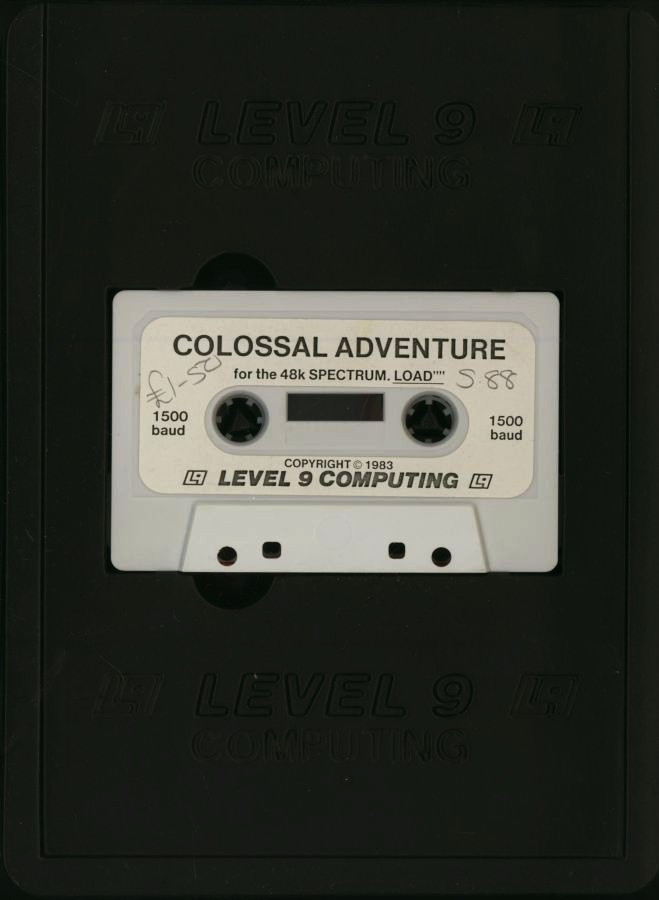
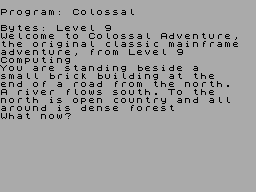
Colossal Adventure
Adventure Game: Text-Only · ZX-Spectrum 16K/48K · 1 players · English
Level 9 Computing Ltd · 1982 · Pound sterling 10.00
Middle Earth Adventures, 1 of 3
Discussion
Nobody has started a thread about this yet.
Remarks
A 16k version was advertised for £8 (this version is still MIA).
Awards
Rank #16 - 1984 Sinclair User Top 50 Spectrum Software Classics
Play
- ColossalAdventureV2.z80.zipSnapshot image English18 KB
- ColossalAdventure.tzx.zipTape image English19 KB
- ColossalAdventure(different).tzx.zipTape image English20 KB
- ColossalAdventureV1.tap.zipTape image English22 KB
Documents
- ColossalAdventure.txtInstructions English10 KB
- ColossalAdventure(EN).pdfInstructions English986 KB
Files and rights
No permission is on record either way. Screens and pictures are copied here on a take-down basis: if you hold the rights and want something removed, say so and it goes.
Credits
- Pete Austincredited
- Mike Austincredited
- Nick Austincredited
- James Horslercredited
- Godfrey DowsonInlay/Poster Art
Sign in to credit somebody, or say what these people did.
Scores
Elsewhere on the web
- WorldOfSpectrum 19 votes8.16
In the magazines 137
ZX Computing #21Oct 1985 · p.68
Simon Hollands
To a seasoned adventurer 'Level 9' will have long been a household name, with games like Lord of Time, Snowball and Return to Eden to their credit. However Level 9 didn't make their name from these, excellent though they are. Any self-respecting adventurer worth his or her salt, really ought to have the Middle Earth Trilogy on his/her bookshelf. They are masterpieces of imagination, verbosity (some responses rival Infocom in length!) and speed. They really are the yardstick by which adventures should be measured. Colossal Adventure, Adventure Quest and Dungeon Adventure are well presented, supplied with a good instruction booklet (which gives VERY little away.) If you write to them they will send you a huge hint sheet, cleverly devised so that you don't accidentally find the answer to a puzzle you haven't yet come to. The adventures are all text only, which will please many people who, like me, think that graphics are pretty, superficial and rather gimmicky. After all, if you've seen a static picture once, you don't really need to see it time and time again, particularly when it resides in memory and wastes valuable RAM. The locations (200 + in all three adventures) are 'graphically' described in eloquent text, They are all, of course, entirely machine coded, and Level 9 use a purpose built text compressor called 'a code' which replaces text with signs in memory, and then reconstitutes it on screen. Thus a quart is very effectively squeezed out of a pint pot. The puzzles in all the games are clever, (reasonably) logical, and artfully devised to keep you coming back. Many's the time I've had to give up at two o'clock in the morning, 'slept on it' and come back the next day to solve a puzzle that kept me awake hours. There is an enormous list of objects, some useful and some valuable, to be collected on your journeys, and the answer to a puzzle in the last-but-one location! You really have to use your brain the whole time, tn these games there is no such thing as luck! Well, not much. Colossal Adventure is a faithful, even better, rendition of the original Crowther and Woods 'Colossal Caves' with the added bonus of an extra 70 location end-game. It is worth noting, however, that if you already have a copy of 'Classic Adventure' from Melbourne House, or indeed anything with a picnic area, bird and cage and PLUGH/XYZZY (!) then you'd better be careful not to duplicate a game you've already got, though I suspect that with the end game Colossal Adventure is a better buy. The objective of the game is to enter the vast Colossal Caves, score maximum points by gathering up as much treasure as you can, rescuing some pitiful elves and living to tell the tale. The game is complex, but fairly easy to map. A word of warning: it isn't easy. As with all Level 9 games, response time is virtually nil, the vocabulary large, and text prolific to say the least. Adventure Quest has a rather less vague objective: find the Dark Tower and destroy the Demon Lord, Agaliarept, who resides therein. I only completed this game yesterday after a year and a half. The game starts off in the same area as Colossal, so those people who played Colossal will affectionately remember the little brick building etc, etc. However, after navigating the desert, nearly drowning in the underground river, exploring the underwater churchyard, meeting a Balrog on a rocky bridge over a huge chasm, and solving innumerable other tricks, traps and conundrums, you have far more to think about than mere sentimental memories! What is particularly frustrating with Quest is that you are only allowed to carry four objects at a time, so you often have to retrace your steps to collect objects you couldn't take the first time. This is really excruciating in the desert, but I suppose it's the price you have to pay for such a huge amount of objects. And now, the piece de resistance! Dungeon Adventure has no less than 100 puzzles to solve, over 220 locations and about 100 objects. Even the most experienced adventurer can expect to get fried a few times here, and end up like a stinking chip! Still, rats don't like stinking chips, so you should be all right. The adventure takes place immediately after Quest, although you don't need to have played Quest to understand what's going on in Dungeon. It is well documented, and, if you go to the right place in the adventure you can get even more precise instructions. Basically though, the object of the game is to ransack the shattered Black Tower, getting out (alive) with as much loot as you can. Level 9 don't hinder you by only letting you carry four items here. You have a rather cleverly designed packing case to carry everything in. It also stops you getting killed. If you thought the other two games were tough - beware. This is the ultimate text only fantasy adventure. All the Level 9 adventures show that care has gone into the concept and design of the adventures. For instance, you are never killed outright (what is more frustrating than sudden death, back-to-the-beginning adventures?) You are always given three lives, and in Dungeon, you can, theoretically go on for ever. None of their adventures have ever crashed on me, though occasionally the text compressor gets it wrong. Have you ever heard of 'a grate as rusted as y'? Neither had I, until I played Quest. Still these are only minor quibbles, with what must be the best trilogy of adventures on the market at the moment. Colossal Adventure, Adventure Quest, and Dungeon Adventure are available in many shops, or by mail order from: Level 9 Computing [redacted] They cost £9.90 each, and are worth every penny. If anyone needs help, or a complete map of any of these three, please send 70p to Simon Hollands, [redacted].
Sinclair User #32Nov 1984 · p.18
Back in the dawn of history two gentlemen, Crowther and Woods, created an adventure game on a DEC mainframe and started the whole computer adventure scene. Their adventure is still one of the finest text adventures ever written, and is available in a number of versions on the Spectrum. Colossal Adventure is one such, with the additional bonus of 70 extra locations. Using advanced compression techniques, the program contains long, involved text descriptions, a large vocabulary, and hundreds of rooms and puzzles. It has all the classic ingredients: a dungeon, a plot, lots of wit and it produces a real sense of satisfaction. Position 16/50
Big K #7Oct 1984 · p.54
CLASSIC GAMES OF OUR TIME No. 6: Colossal Adventure (Level 9). Orig. Colossal Cave AND THE WORLD WAS XYZZY! "I've got a map of the pirate's maze. What have you got?" "The pirate's maze! Hot dog! Let's think do you know how to get past the troll for free?" "Really? Not bad! Anything else" "Well that's pretty good isn't it? OK, how to kill the dragon." "Done." "You certainly have been." I spent the winter of 1982/3 haggling like this. The office had just acquired a word processor and the suppliers threw in a disc labelled 'Adventur. To play with'. Not a whole lot of word processing got done those first few weeks, and the game became an office obsession. When the top brass came past the excited little groups hunched round the monitor, we'd tell them that it was hands-on experience. It seemed to keep them happy. Then we found that other people were playing it too, and the trading began. In those days there weren't any helpful books. What we'd been given was a genuine, no-argument classic, the kind of thing that will get a chapter to itself when professors start writing the history of computing. Its origins lie far back in the very dawn of the computer age, around 1975, when the first version, variously known as 'Adventure', 'Adventures' 'Colossal Cave' or 'Colossal Cave Adventure', was created by two gentlemen named Willie Crowther and Don Woods. Some might say that creating games with no redeeming intellectual, scientific or social value using multi-million dollar equipment and valuable computer time, was a prime example of the tendency of Homo Ludens to reduce everything to play. Others might cite it as a glaring instance of irresponsible computer freaks deliberately abusing their employers' trust. Most of us will just be glad that in that golden moment, the adventure game was born. Crowther and Woods' game was written in Fortran (300K of it!) and ran on DEC PDP 11s, but was soon translated into other mainframe versions. An American business computer magazine survey showed that the average company lost two full weeks of programmers' time whenever the staff laid their hands on an implementation of 'Adventure'. TRANSLATION The game's translation from mainframes to micros was in three stages. First came a CP/M version, painfully slow, that ran on many business machines (such as ours). Then came Jim Butterfield's condensed version for PETs and a rather primitive assembler version for IBMs, the game being in the public domain. Finally came the fully matured version - Level 9's. 'Colossal Adventure', as Level 9 dubbed it, was originally intended to be a complete version of the game for micros, with their own a-code making it possible to squeeze the whole 300K's worth into 32K. However, after advertising it as a 200 location adventure, when Level 9's Pete Austin sat down and counted them, he found to his horror that there were actually only 130 odd. Being a man of his word, he promptly added a 70 location endgame, and that's the version that you can get for virtually any computer. Colossal Adventure illustrates from the word Go the importance of the Five Golden Rules Of Adventure Gaming - 1. Make a map. 2. Everything is there for a reason. 3. SAVE before you do anything that looks chancy. 4. Read all descriptions very carefully. 5. You haven't got all day. The fact that nobody has come up with a game that adds to these shows how sound Crowther and Woods' pioneering work was. Most of these rules should be obvious, though in my experience many players aren't fully aware of them or their implications. Mapping mazes, for instance, ought to be dead easy, but I was able to trade my maps for Colossal Adventures for solutions to real problems. The map bears directly on the time aspect. At the beginning of Colossal Adventure you find a lamp which you can switch on. However you can also switch it off, and you need to do this whenever possible because it will burn out sooner or later, leaving you to break your neck in the dark. With a map you can wind the game up before the batteries give out. Otherwise you'll have to put coins in the battery dispenser. What battery dispenser? That's your problem, chum. Colossal Adventure set the standard for puzzle setting in later games. Call it the Golden Rule for designers - a game should not be impossible to solve - a rule that is not always observed even now. The solutions are devious, complicated and sometimes downright bizarre (though Level 9 accidentally abolished my favourite, how to kill the dragon, in their version), but there's always an answer. At one time Level 9 used to provide a one problem solution per player services. You got, and still get, an envelope with your copy which you could use once, and once only, to get out of a jam. This didn't work out too well, so now they send you, on request, a clue sheet which will at least point you in the right direction. On top of this you can find answers to many of the problems in various adventure game books (see page 10), which regularly use the game as an illustration of the genre. There are a number of differences bet ween Level 9's version and the original. Some are relatively minor; one of the treasures has been moved, it is, if anything, easier to find, and one of the utilities (the food) has been shifted and takes a bit of work to acquire. More crucial is the limit on how much you can carry. Level 9 have rather cruelly cut this down from seven items to four, which means that you have to get back to base to unload treasures far more often. All that running around means that your lamp is more likely to burn out before you've finished. And if the pirate gets you with two treasures, you're in real trouble, because you can't carry them and the chest (assuming that you can find them at all, that is) and your lamp and your axe at the same time, so it's either two trips or, horrors, drop the axe before you go in the maze. Pretty unpalatable alternatives, what? Another small, but tricky change is that Level 9 don't remind you about the axe after you've thrown it at a dwarf, which is OK as long as you're still fighting, but makes it very easy to forget it after you've killed the little brute. This can be very embarrassing later on when you find you haven't got it any more, inevitably when you really need it. But the big, big difference is the endgame, The original game had 350 points to win, at least 1 of which was strictly for perfectionists (Spelunker's Gazette), Level 9's has 1100, and boy you have to work hard for them. The endgame is a fiendishly difficult race against time, with a particularly brutal maze bang across your only route. What's more, none of the guidebooks covers it, so you are on your own. Even by Level 9's present standards, 'Colossal Adventure is not the best game available, nor the most engrossing, the most difficult, the most fun, or indeed the most anything. Compared to Snowball, Zork, The Hobbit to Lords of Midnight it might seem primitive and restricted, solvable by methodical plodding. But - and it's a very big "but" - but it is the grand original, the prototype game from which all the rest have sprung, the inspiration games that have surpassed it in almost every way, but can never claim that essential creative spark. In the Beginning was the Word, and the Word was XYZZY.
Crash #4May 1984 · p.73
Producer: Level 9 Computing, 48K £9.90 Discover the fifteen hidden treasures, rescue two groups of captured elves and then try to find the cave exit through a massive complex of passages, tunnels and rooms. During this major quest you will have to kill many wandering dwarves with your axe, get a knife thrown at you, stumble across the elves crown jewels and make sure that the batteries of your light don't run out. Coins from one of the treasures may be used in a vending machine for more batteries. Otherwise its the pits! Watch out for those pits in the dark! Like other Level 9 adventures, this one is all text and very large. Locations are magically described and the keyboard responses are good. You are only allowed to carry four objects at a time, so much time and battery life is wasted transporting useful items from place to place, dropping them and then going back for them when they are needed. Recommended.
C&VG (Computer & Video Games) #30Apr 1984 · p.114
THE OLD PROBLEM! There are many derivatives of the original Adventure, the Colossal Cave, written by Crowther and Wood for a mainframe computer. First on the scene was Radio Shack, with Pyramid 2000, a 16K TRS-80 version with an unlikely name, and much maligned by the critics in the USA at the time. One particularly scathing mention was the review in 80-Microcomputing t the time, complaining that a sceptre was used in place of what was obviously a wand in the original. "It is fairly logical to wave a wand - but who on earth would want to wave a sceptre?" Once inside, it is down the grating so to speak - so why bother with the pyramid bit? Copyright? You could hardly fail to recognise the bird statue and the statue box! So there it was, all the trappings except the well-house and river. Next to arrive was a ZX81 game innocuously entitled Abersoft Adventure, later available for the Spectrum. This one was much more easily recognised as Colossal, for it featured the well-house and river. The bird had to go in a wicker cage, and - no sceptre! A black rod this time! My next foray into the cave came when I had the opportunity of logging on to Comshare. The black rod had a rusty star on the end - much more easily recognisable as a wand. A couple of short, sharp lunch hours connected to the mainframe was all I managed, but I amazed my friends by achieving things they had been spending months trying to do! I eventually let on that I wrote the Adventure column for C&VG, and I had played some lookalikes! I was nearly maimed as I rushed over the crystal bridge, heading for the door! "Oh woe is mine!" I wrote a couple of months ago, not having a copy of Colossal Adventure from Level 9. At the same time, I contacted them, and I am now a proud possessor of that Adventure! That doesn't mean, Dan and Andrea, that I can answer all your problems! And what of Level 9's interpretation of Colossal? No need to describe the scenario - perhaps an apt description might be "You've played the rest, now try the best". The game I played on the mainframe had a charming little sequence in which I encountered a frog, kissed it, and was devastated to find I had not created a prince or princess merely got myself covered with warts! The events that followed were even more hilarious - I kissed a princess and passed on the warts, and then, deciding to leap into her four-poster, was told "You can't, and in any case, she has a headache!" I eventually solved the problem, which had an unexpected twist. Now, although the Level 9 version is the nearest to the mainframe version I played, there was not a hint of a frog to be seen. Was I playing an enhanced version of the original, or are all the micro versions abridged? How can I tell - what IS the original adventure, and how can it be recognised? So, Dan and Andrea, play on! I hope to be able to help you soon but, on the other hand, may easily be asking you to help me! (Y2 carved upon a rock?...)
Jewels of Darkness carries this game and has 35 references of its own.
Advert87
- Crash #19Aug 1985 · p.33
- Popular Computing Weekly #30Jul 1985 · p.2
- Micro Adventurer #16Feb 1985 · p.2
- Sinclair User #34Jan 1985 · p.162
- Your Computer #1Jan 1985 · p.192
- Crash #12Jan 1985 · p.121
- Micro Adventurer #15Jan 1985 · p.2
- C&VG (Computer & Video Games) #39Jan 1985 · p.92
- Sinclair User #31Oct 1984 · p.59
- Your Computer #10Oct 1984 · p.22
- Crash #9Oct 1984 · p.74
- Micro Adventurer #12Oct 1984 · p.2
- Big K #7Oct 1984 · p.80
- Personal Computer Games #11Oct 1984 · p.16
- Your Computer #9Sep 1984 · p.10
- Micro Adventurer #11Sep 1984 · p.2
- Sinclair Answers #1Sep 1984 · p.35
- Popular Computing Weekly #39Sep 1984 · p.55
- Micro Adventurer #10Aug 1984 · p.2
- Personal Computer Games #9Aug 1984 · p.107
- Your Computer #7Jul 1984 · p.58
- Micro Adventurer #9Jul 1984 · p.2
- Your Computer #6Jun 1984 · p.104
- Crash #5Jun 1984 · p.79
- Micro Adventurer #8Jun 1984 · p.2
Tips28
- ACE (Advanced Computer Entertainment) #2Nov 1987 · p.92
- Sinclair User #64Jul 1987 · p.72
- Popular Computing Weekly #8Feb 1987 · p.21
- ZX Computing #24Apr 1986 · p.98
- C&VG (Computer & Video Games) #54Apr 1986 · p.69
- C&VG (Computer & Video Games) #54Apr 1986 · p.70
- Sinclair User #47Feb 1986 · p.23
- Home Computing Weekly #132Oct 1985 · p.31
- Popular Computing Weekly #42Oct 1985 · p.17
- Home Computing Weekly #130Sep 1985 · p.15
- Popular Computing Weekly #36Sep 1985 · p.32
- Your Computer #8Aug 1985 · p.51
- C&VG (Computer & Video Games) #41Mar 1985 · p.30
- Your Spectrum #11Feb 1985 · p.40
- Micro Adventurer #14Dec 1984 · p.32
- Personal Computer Games #13Dec 1984 · p.110
- Crash #9Oct 1984 · p.88
- C&VG (Computer & Video Games) #36Oct 1984 · p.136
- Micro Adventurer #11Sep 1984 · p.21
- Crash #7Aug 1984 · p.75
- Crash #6Jul 1984 · p.79
- Micro Adventurer #9Jul 1984 · p.44
- C&VG (Computer & Video Games) #33Jul 1984 · p.137
- Micro Adventurer #8Jun 1984 · p.45
- C&VG (Computer & Video Games) #32Jun 1984 · p.159
Feature6
- ZX Computing #29Sep 1986 · p.35
- Sinclair User #38May 1985 · p.60
- Sinclair User #32Nov 1984 · p.146
- Big K #7Oct 1984 · p.54
- Computer ChoiceFeb 1984 · p.56
- Popular Computing Weekly #25Jun 1983 · p.37
Hack/Poke3
- Your Sinclair #10Oct 1986 · p.10
- Crash #20Sep 1985 · p.96
- Crash #18Jul 1985 · p.105
Classified3
- Personal Computing Today #8Mar 1983 · p.105
- Personal Computing Today #7Feb 1983 · p.105
- Personal Computing Today #4Nov 1982 · p.113
Review2
- Home Computing Weekly #107Apr 1985 · p.12
- ZX Collection1984 · p.112
CompoResult1
- Micro Adventurer #5Mar 1984 · p.50
CompoEntry1
- Micro Adventurer #2Dec 1983 · p.50
News/Note1
- Popular Computing Weekly #19May 1983 · p.35
Licensed from
- Advent/Colossal CaveSoftwareunofficialCrowther & Woods
Related
- Compilations
- Jewels of Darkness
- Ports
- (Amstrad CPC), (BBC Micro), (Commodore 64), (MSX)
- Tags
- Teleportation
- Same entry at
- Spectrum ComputingZXInfo
Reviews from people here
Sign in to write about this, or make an account. It takes a minute and lets you correct the catalogue too.
Everything ZXDB can hold about this is here.
Sign in to correct or add to this.
Hold the rights to this and want it taken down?