
ZON X Soundbox
Hardware: Sound/Speech
Bi-Pak Semiconductors · 1982 · Pound sterling 32.75
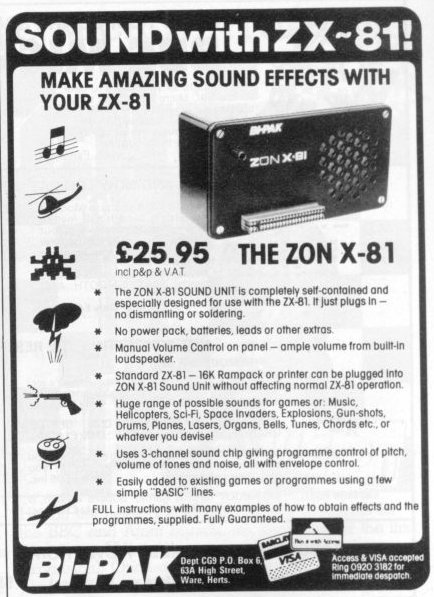
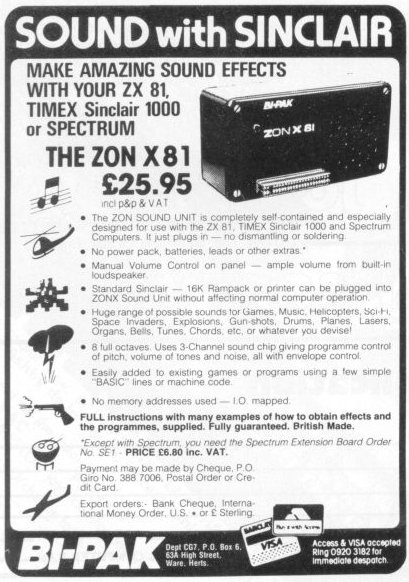
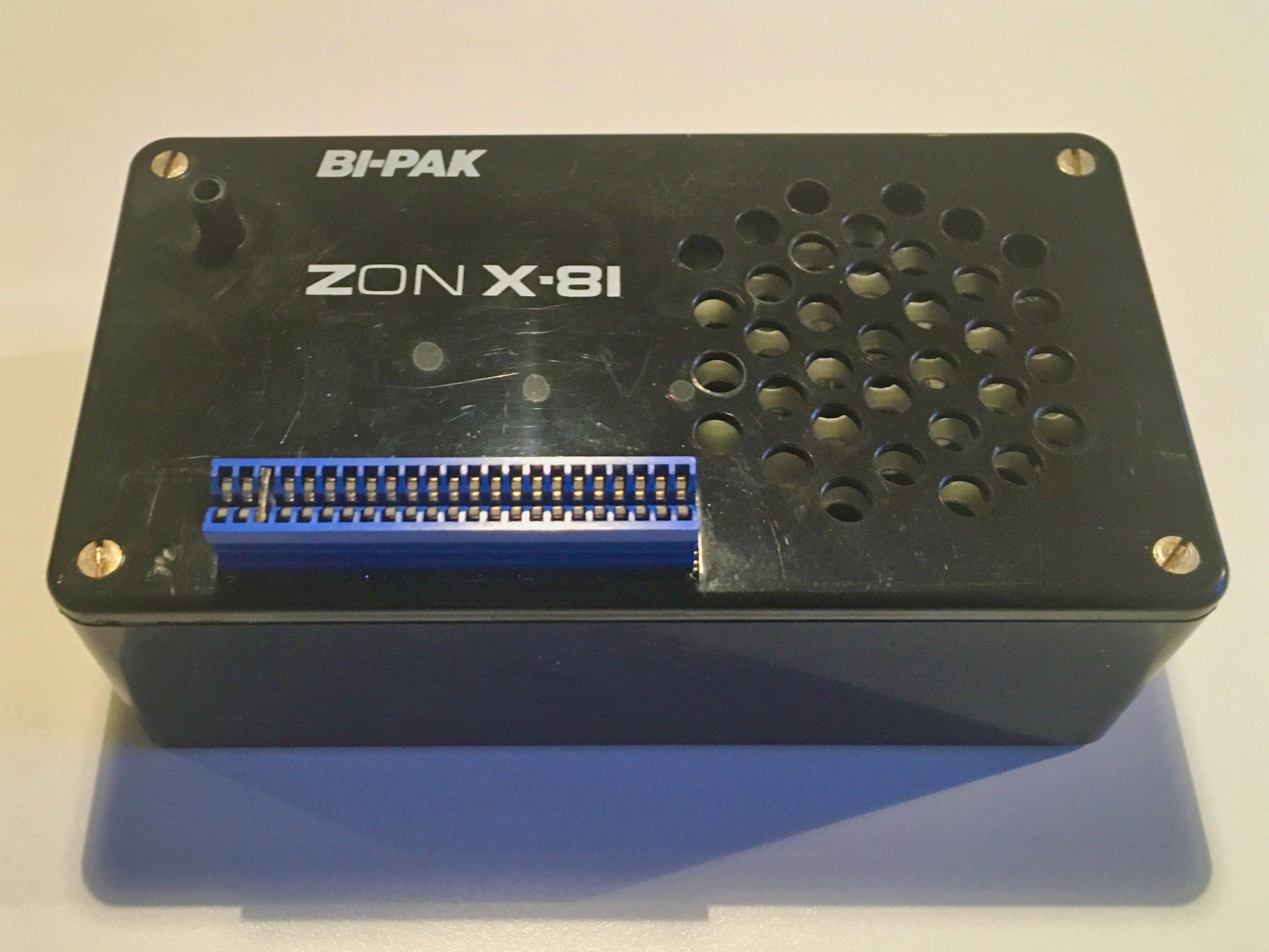
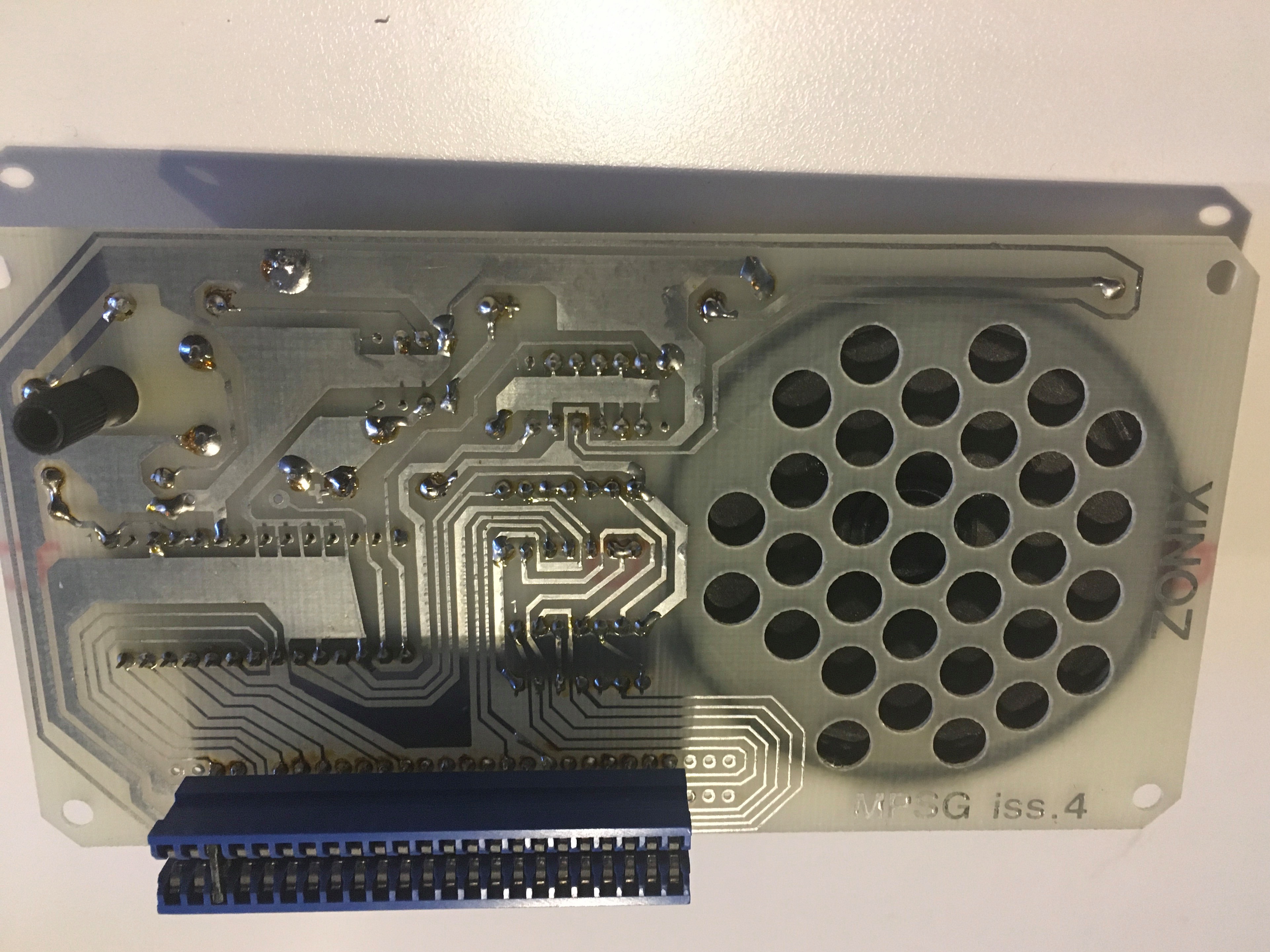
"Make amazing sounds with your Spectrum." 8 octaves, 3 channels with full control over pitch, volume, tones and noise, all with envelope control. Usable in your own Basic or M/C programs. Because this devices used the A4 address space, it is not compatable with the Interface 1 and Micrdrive. Because this was originaly a ZX81 interface, a small additional board is required. It sits between the ZON X and the Spaccy, and conatins a 3.5Mhz oscillator to stabalise the frequency.
Discussion
Nobody has started a thread about this yet.
Remarks
sound effects; originally for ZX-81, but Spectrum adaptor available
Files and rights
No permission is on record either way. Screens and pictures are copied here on a take-down basis: if you hold the rights and want something removed, say so and it goes.
In the magazines 41
ZX Computing #13Jun 1984 · p.59
M.D. Brunt
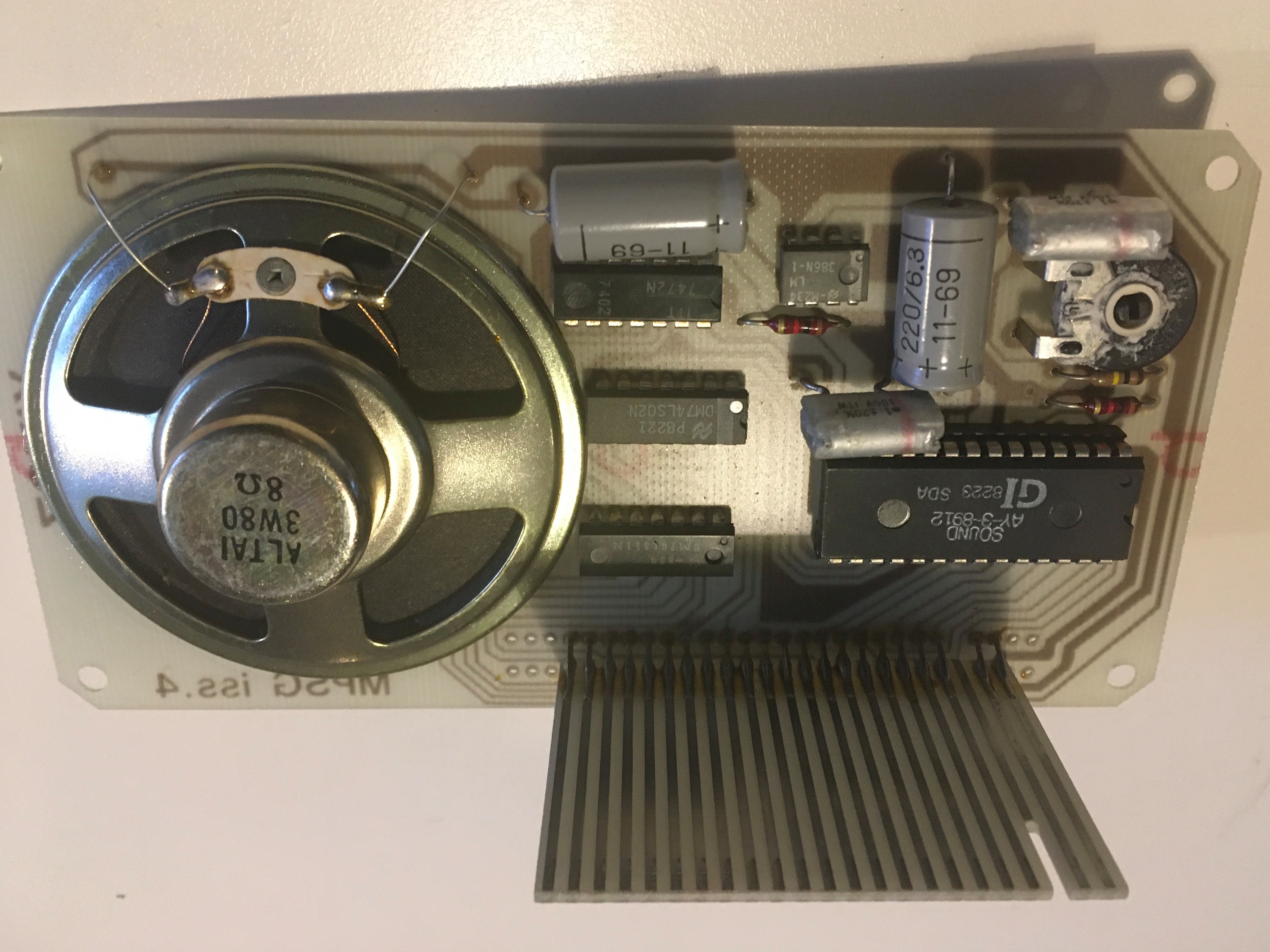
READERS' REVIEWS Once again we throw caution to the wind and air your opinions on the software currently available for the ZX machines. ZONX-81 Bi-Pak Semiconductors M.D. Brunt Last December I decided that it would be nice to have some sound for my ZX81. Of the three sound synthesisers that were on the market, the ZONX was the cheapest, just, and it was a self contained unit, the others required an amplifier and a speaker although they did have two I/O ports. My decision made, I sent off and prepared for a Sinclair style wait. I need not have worried. Although it was less than a month till Christmas the ZONX arrived in less than one week! I quickly tried to fit the ZONX to my ZX81, only to discover that my full size keyboard got in the way. The problem was that there is a small volume control on the front of the ZONX and it was this that prevented the ZONX from fitting. My solution was to fit a new control into the top of the ZONX. I opened the ZONX to find a speaker and several chips, all soldered very neatly I might add, and the AY-3-8912. The volume control turned out to be a preset pot, which is not really designed for a lot of use, and I would suggest that it should be moved as little as possible to reduce wear. I replaced it with a standard 'volume control' which I mounted through the top of the ZONX. The manual for the ZONX is small (5.5" by 4") and only twenty pages long, but it is fairly clear and it explains what each of the AY-3-8912's thirteen registers are for and how they are used. The ZONX resides in the I/O area of the Z-80's memory and so a short (9 bytes) machine code routine is needed to access it. The routine is held in a REM statement and can be typed in directly from the keyboard. The manual also contains eight short programs including one which turns the top row of keys (1-0) into an electronic organ. The 16K RAM pack connects to the ZX81 through the ZONX, the edge connector of the ZX81 being duplicated on the ZONX, which is just as well since a simple explosion takes up twenty-five lines of BASIC. The main disadvantage of the ZONX, or any sound synthesiser, is the time needed to develop a given sound - in most cases done by trial and error. Since neither Bi-Pak nor any other software company that I know of, markets any software for the ZONX, you will have to work on them yourself. The results can be worth it though. The other problem is with speed, most sounds are built up from BASIC loops and so they must either be run in fast mode or they sound far too slow. To use sound in games, therefore, will require some simple machine code programming. I have had a lot of fun with my ZONX and I would recommend it to anyone, provided that they are prepared to spend a lot of time with it. If not, then they would be wasting their money. The ZONX units cost £25.95 for the ZX81 and Spectrum. (An extension board is required for the Spectrum at £6.80).
ZX Computing #6Apr 1983 · p.30
ADDING ON YOUR SPECTRUM Our review team take a brief look at some of the hardware add-ons fir the ZX Spectrum. Now that the ZX Spectrum has well and truly established itself on the micro market, it is amply supported by a wealth of hardware add-ons. Most of these peripheral devices have been manufactured by the people who supported the ZX81, but just as the Spectrum has attracted new users with its prowess, so too has it attracted a new following from the add-on manufacturers. In this brief guide, we have not tried to cover all the devices currently available on the market but rather give you a flavour of the technology you can add on to your Spectrum. As joysticks are an obvious favourite, these have been covered in some detail whereas RAM packs are fairly standard and so have only been briefly touched on. Also included in this section area number of quite specialised add-ons like sound units and a digital tracer. If you own a Spectrum, you will no doubt have begun to realise the potential you hold in your hands. Over the next few pages you will hopefully see further applications for you and your computer to explore. ZONX - BI-PAK SEMICONDUCTORS Originally designed for the ZX81, Bi-Pak have now released an adaptor so that the ZONX-81 can now be utilised with the Spectrum. Self-contained in a strong plastic box, the unit easily plugs into the rear of the Spectrum forming a good connection. There is a manual control for the volume, the sound produced being clear and within a reasonable volume range. Using the unit, via simple BASIC commands included within a piece of software, a wide range of sound effects can be produced by the three channel plus noise chip housed within the unit. Thus, depending on various statements within a program, the pitches and volumes of three channels and overall attack/decay envelope can be manipulated. And what that means is that you can get quite realistic sound of explosions, helicopters, bells, etc. There is an interface at the rear of the device which means that you could add other devices on the back of the Spectrum at the same time as your ZONX. Complete with a very comprehensive manual with tried and tested software examples, the ZOISIX is priced at £32.75. For more information contact Bi-Pak Semiconductors, [redacted].
The ZONX-81 speech pack complete with interface for use on the ZX Spectrum from Bi-Pak Semiconductors.
Sinclair User #13Apr 1983 · p.25
ZON X FOR SPECTRUM Bi-Pak has now made the ZON X-81 sound box available for the Spectrum as well as the ZX-81. It contains an 8912 three-channel sound chip with a powerful amplifier, loudspeaker and volume control in a 6in. x 3in. x 2in. black box. Everything is powered from the computer and some complicated sounds can be generated which will repeat without the aid of the computer. As the device is I/O-mapped it requires machine code on the ZX-81 but an ingenious method of making it compatible with other REM-located machine code makes it easy. The Spectrum must use an additional board which contains a 3.5MHz oscillator to stabilise the frequency used. That is about 2in. long and fits between the Spectrum and the ZON 81. One problem with the decoding makes it incompatible with the Microdrive and RS232 intended for the Spectrum as it uses A4, which Sinclair has already declared will be used by its devices. Apart from that it works well on both machines, providing a cheap and easy alternative to the BEEP command. Bi-Pack sells the ZON X for £25.95 and the Spectrum board for £6.80. Bi-Pak is at [redacted].
Sinclair User #8Nov 1982 · p.21
ZON-81 GETS ITSELF HEARD The ZON-81 is a three-channel mono sound box which fits on the back of the ZX-81 and soon the Spectrum. It is a I/O device and contains its own loudspeaker and volume control. It can be programmed to give a wide range of sounds, from gunshots to an electronic organ. There is also a noise generator included in the AY-3-8912 chip. The box is powered from the computer and is driven via two machine code routines - nine bytes in all. The cost of the unit is £25.95 from Bi-Pak, [redacted].
ZX Computing #3Oct 1982 · p.35
NOISY LITTLE THINGS In this issue, our hardware reviewers look at a system which allows your ZX81 to listen, a ZX81 sound maker or three and a device to ensure that you don't lose a program when the power fails. ZON SOUND UNIT A wide range of sound effects can be added to your ZX-81 with the ZON X-81 Sound Unit now available from BI-PAK. The unit is based on a three-channel-plus-noise sound chip, and is so designed that the pitches and volumes of the three channels and the overall attach/decay envelope can be controlled by simple BASIC statements. By this means, piano, organ, bells, helicopters, lasers and explosions can be simulated and easily added to existing programs. ZON X-81 is completely self contained in a neat black plastic case with loudspeaker and manual volume control (in addition to programmed volume), and simply plugs in between the rear of the ZX-81 and its RAM pack and/or printer (if fitted). No dismantling, wiring, soldering, batteries, power supplies or leads are required. Instructions take you through the operation of the unit step by step and include a number of example program of useful sound. It is available from BI-PAK Semiconductors, [redacted]. Price: £25.95, including postage and V.A.T. BIG EARS The 'Big Ear's speech recognition system, which costs £49, plus VAT, including p&p, consists of a microphone, pre-amplifier, analogue frequency filters and digital interface, complete with software. Words are stored as voice patterns which the system learns from repetition by the user. Ten or so words can be stored at a time. The computer then checks each word spoken against its word bank, and assigns a percentage to each word regarding its chance of being the word spoken. It assumes the word gaining the highest score is the spoken word, and responds accordingly. It is available from William Stuart Systems, [redacted]. PROTECTING THAT PROGRAM The 'software protection unit', made by Microbyte of Lichfield, looks like being a partial answer to all those horrifying moments when 8K worth of carefully typed in programs suddenly vanishes. The software protection unit has a socket to take the mains power unit jack plug from your ZX81 mains transformer, and the plug on the unit then hooks into the ZX81. If you unscrew the four screws on the lid of the unit, you'll see two battery containers, which hold a total of six batteries. These are the secret of the unit, which is designed to take over if the power fails. When we tried it, we found it worked exactly as described. We didn't try the 'how long will a program last' test, but take the manufacturer's word that with a ZX81 alone, a program will stay intact for three hours, and with the 16K attached, about an hour and a half. You're cautioned to always remove the power jack plug on the ZX81 after turning off the mains supply, or the batteries will think there has been a power supply, and wear themselves out keeping the '81 going. The batteries are, of course, only intended for emergency use. Excessively used batteries are signalled by video character deformation, and loss of sync, although at this stage the RAM contents are not lost. The unit costs £8.60 and is available from Microbyte, [redacted].
ZON X-81 sound unit
Advert26
- Sinclair User #22Jan 1984 · p.74
- Your Computer #1Jan 1984 · p.272
- Sinclair User #21Dec 1983 · p.177
- Sinclair User #18Sep 1983 · p.113
- Your Computer #9Sep 1983 · p.172
- ZX Computing #8Aug 1983 · p.62
- Personal Computing Today #1Aug 1983 · p.6
- Your Computer #8Aug 1983 · p.78
- Sinclair User #17Aug 1983 · p.73
- Your Computer #7Jul 1983 · p.186
- C&VG (Computer & Video Games) #21Jul 1983 · p.62
- ZX Computing #7Jun 1983 · p.12
- Sinclair User #15Jun 1983 · p.110
- Your Computer #6Jun 1983 · p.40
- Your Computer #5May 1983 · p.182
- Sinclair User #13Apr 1983 · p.92
- C&VG (Computer & Video Games) #18Apr 1983 · p.34
- ZX Computing #6Apr 1983 · p.72
- Your Computer #4Apr 1983 · p.164
- Personal Computing Today #8Mar 1983 · p.44
- C&VG (Computer & Video Games) #17Mar 1983 · p.94
- Your Computer #3Mar 1983 · p.130
- Sinclair User #12Mar 1983 · p.29
- Your Computer #2Feb 1983 · p.95
- Sinclair User #11Feb 1983 · p.42
News/Note5
- Sinclair User #16Jul 1983 · p.24
- Computing TodayJun 1983 · p.7
- Sinclair User #13Apr 1983 · p.25
- Home Computing Weekly #5Apr 1983 · p.12
- Sinclair Projects #3Apr 1983 · p.10
Feature4
- Computer ChoiceApr 1984 · p.34
- ZX Computing #10Dec 1983 · p.106
- ZX Computing #6Apr 1983 · p.30
- ZX Computing #3Oct 1982 · p.35
Letters1
- Computer Answers #15Apr 1984 · p.98
Reviews from people here
Sign in to write about this, or make an account. It takes a minute and lets you correct the catalogue too.
Everything ZXDB can hold about this is here.
Sign in to correct or add to this.
Hold the rights to this and want it taken down?