Cheetah MK5 Mini Interface
Hardware: Music
Cheetah Marketing Ltd · 1986
Also known as Cheetah Mini Interface (English)
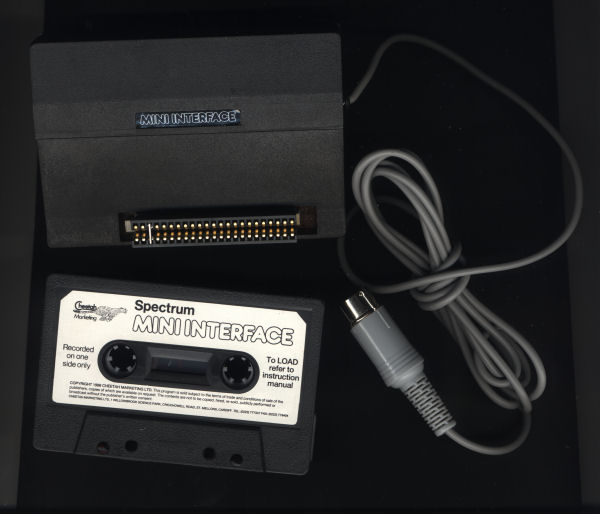
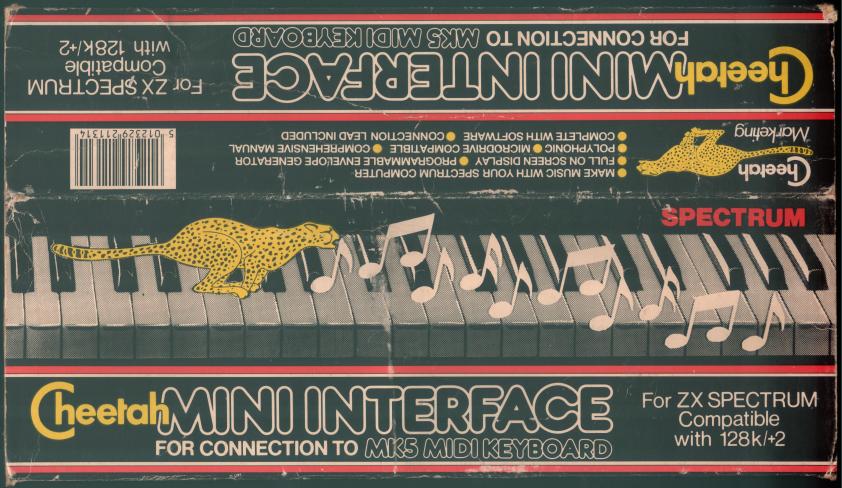
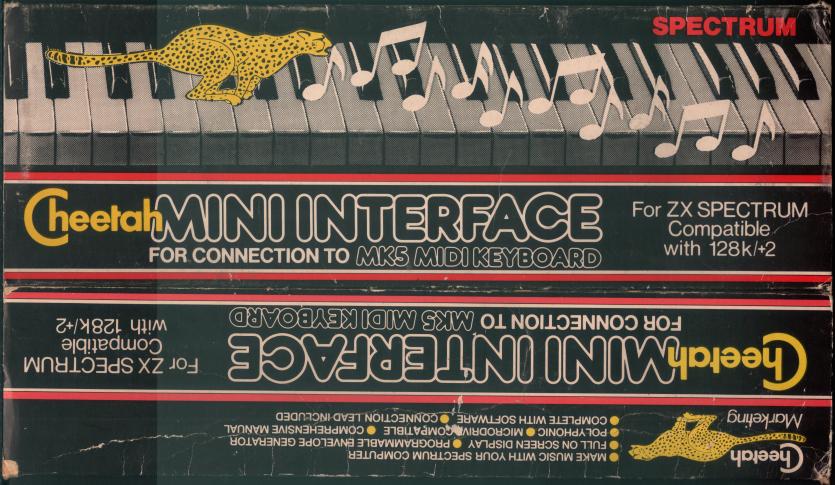
The Cheetah MK5 Mini Interface is an interface to allow connection of the Cheetah MK5 MIDI Keyboard to a suitable computer, creating a powerful musical instrument with many exciting capabilities.
Discussion
Nobody has started a thread about this yet.
Remarks
Came with the {The Mini Synth|Cheetah Marketing Ltd|0015559} tape.
Documents
- CheetahMK5MiniInterface_Manual.pdfInstructions 109 KB
Files and rights
No permission is on record either way. Screens and pictures are copied here on a take-down basis: if you hold the rights and want something removed, say so and it goes.
Credits
- Robert Powellcredited
Sign in to credit somebody, or say what these people did.
Scores
In the magazines
- Your Sinclair #181987 · Overall8/10
In the magazines 1
Your Sinclair #18Jun 1987 · p.647/108/109/109/108/108/10
Documentation 7/10
Playability 8/10
MIDI Compatibility 9/10
Value For Money 9/10
Overall 8/10
Phil South 8/10
SLAVE TO THE RHYTHM Yeah, right. You know when the band's really cooking and the drums are beating fast, the bass is thumping like a heartbeat and... yeah! Woooh! Yee har! Phil South's got this amazing new Cheetah MK5 MIDI master keyboard and he's plinking away. Take it away Phil... Oi! Come back! Heyyy! Worra sexy piece of kit, eh? A master MIDI keyboard for under a hundred quid... what? What's MIDI? Oh come on, you must know! No? Okay, let's start at the very beginning (A very good place to start...) The Cheetah MK5 is a long metal box with a piano keyboard on it, and no actual sound-making capability of its own, for £99. If you'd have tried to market something like this five years ago, people would have stamped on your foot and told you where you could put it, and not even supplied the shoe horn. But in 1987 the self same box will sell like hot taters in winter and, at the price, knocks spots off the competition. Why? The answer lies in a simple four-letter word... Before you start getting naughty, (tut tut), those letters that put a silent rattly keyboard to the top of every musos wish list are M-I-D-I. MIDI stands for Musical Instrument Digital Interface. This allows any digital synthesiser (or similar MIDI equipped device like a drum machine) to communicate with any other MIDI device or computer. Although this may sound irrelevant to making any kind of music, in practice it's extremely useful. The Cheetah MK5 keyboard is a fully equipped MIDI device, and with it you can control a number of MIDI sound producing devices, known as 'sound sources'. It's called a 'master' keyboard, because you can use it as the central controller for other instruments. THE MIDI'S TOUCH The Cheetah 'master' keyboard can be linked up to a number of sound sources, allowing you to play all of them from the keyboard itself, simply by selecting a different MIDI 'channel'! Alternatively, you can plug your MK5 into a 'synth expander module'. An expander module is a synthesiser without a keyboard, usually added to a synth to expand its sound making abilities. If you plug a master keyboard into a expander, you can play the sounds on the expander as if it was a normal synth! Compare the probable cost of around £1400 for a Yamaha DX7IID synth, the biggest and best one they do, to the cost of a Yamaha TX7 expander module (£600ish) and the Cheetah MK5 (£99). The two things do exactly the same jobs but the TX7/MK5 combo costs 700 quid less! The beauty of MIDI is that it's so adaptable! Using your Cheetah MK5, you can play not only the various synth modules, but any other kind of MIDI synth. For example, say you have a Casio CZ-101. It's a fantastic little keyboard, with great sounds that are easy to edit, but it suffers from one big drawback. The keyboard is one of those titchy tiny ones that you find on home organs, which makes you play like you've got a bunch of overripe bananas for fingers. So all you need do is get a Cheetah MK5, and you can play a reasonable sized keyboard, and add another octave of playable pitches to boot! A further use of the MK5 keyboard comes to light in the form of Cheetah's MINI interface, available separately at £29.95. Connect this between your MK5 and a 128 Speccy, and you can play and edit the sounds from the 128's sound chip! Cor! A minisynthesiser for 30 quid! But this is as nothing to what you can do with it if you use Cheetah's new MIDI interface! ACE 'FACE With the MIDI interface, you can use your computer to send MIDI information (like sounds and pitches) to a number of keyboards at once using Cheetah's own sequencing software. This means that provided you have enough MIDI devices (synths and drum machines) you can compose, arrange and PLAY a piece of music on loads of instruments at once! So there's no need to worry about using multitracking tape decks to write tunes on. Just do it on all your synths! You can compose tunes in Step Time, by selecting the notes you want to play one at a time at your leisure, or in Real Time, playing them live at the keyboard. Either way you get eight tracks of music... provided you've got eight MIDI sound sources to play them on. (Yamaha's FB01 and TX81Z are very good for this, as they have eight synths all together in a little black box the size of a hardback book!) The rhythm elements of a tune can be triggered from a MIDI compatible drum box, and the effects on the voices can be changed in mid warble if you have a MIDI reverb, like Yamaha's Rev 7 or Alesis' MIDIVERB, or a multi-effects unit like Alesis' MIDIFEX or Yamaha's SPX90. The mixing can even be done for you too, if you have a MIDI mixing desk. Akai make a heinously expensive one called the MPX-820, which at £1399 prompts the quip "Great, I'll have two!" This means that you can control the faders of the mixer, using MIDI to pull them about electronically. As MIDI gets more and more complex, and the technology to make computer music becomes more affordable, devices like the Cheetah MIDI system will be very welcome. They're cheap, but the quality of their performance is very high indeed. Watch this space for further developments. Okay lads, from the top. A-one, a-two, a-one, two. three, four... CHEETAH MINI INTERFACE FAX BOX Game: MINI Interface Price: £29.95 Publisher: Cheetah Marketing Ltd Reviewer: Phil South One of the original ideas behind the Cheetah MK5 was the ability to play the soundchip on the 128 Spectrum as a synth in its own right. If this sounds like a dippy idea to you, just think about it for a second - imagine how much more flexible and musical the 128's sound chip could be if you couid edit the sounds and piay them from a full sized keyboard! Using a gadget called a MINI interface (Yes, that's MINI, not MIDI!) with its own editing software, you can edit and piay the sounds on your 128. Never thought you had a synth in your Speccy, did you? With the special MINI software, you can edit the sounds, pitch envelopes, mix white noise and tone, and edit tremelo (vibrato) on the 128's screen. In the sound edit mode, you get a graphic display of the way the sound looks, a sort of oscilloscope view of the envelope shape. There are also keyboard split routines, so you can play one sound on the top half of the keyboard, and another on the bottom half. Okay, so it's only a MINI synthesiser, but what do you want for under £30, Jean Michel Jarre? A fine use of the Spectrum's sound, and more fun than a barrel of organ-grinders.
MUSO'S BLUFFING GLOSSARY A bluffers guide to selected music and MIDI terms, device - (when applied to MIDI) is any MIDI equipped instrument - drumbox, synth, digital trousers. expander - a MIDI device usually used to add voices and timbres to a synth, but which can be used as a synth in its own right if you have a MIDI master keyboard to trigger the different pitches. faders - the things that producers and engineers get paid to slide up and down on mixing desks. master - a controller for a MIDI keyboard setup. MIDI - acronym for Musical Instrument Digital Interface, monophonic - in mono mode, you can play a synth one note at a time - you can't play chords. multitimbral - having many different voices, patch - the settings on a synthesiser which produce a certain sound - also applied to the sound itself. pitch - an absolute frequency assigned to a specific note on a musical instrument. High notes have a high pitch, low notes have a low pitch. polyphonic - in poly mode, you can play more than one note at a time - you can play chords. real time - playing notes into a sequencer live. sequencer - a device or program which stores pitch information and plays it back on a synthesiser. slave - a device which responds to the commands of a master or controller device. sound - source any sound producing device. step time - playing notes into a sequencer one by one, with no time limit. timbre - the character of a note, usually called tone colour - what a note sounds like. voices - if you can press down eight notes on a synth and they all sound, the synth is said to have eight voices; each individual tone.
TALK TO THEM A selection of useful addresses and phone numbers for your music notebook, in case you need more information. Happy plinking! Cheetah Marketing, [redacted] Yamaha Music Pulse, [redacted] Casio Computara, [redacted] Turnkey Shop, [redacted]
THE MIDI LEAD'S CONNECTED TO THE... ...synth bone! Here are a few useful hints and tips for the uninitiated on how to arrange the Cheetah MK5 and MIDI and MINI interfaces so that you'll get lots of lovely noise. The simplest way to enjoy MIDI music with the MK5 is to plug it straight into a MIDI equipped synthesiser, like the Casio CZ-101. Then you can play the super-dooper Casio sounds on a proper-sized keyboard, instead of the piddly little one it comes with. To turn your 128/+2 into a mini synthesiser, first plug in the MINI interface, and then attach the MK5 to the end of the interface cable. You can then, with the free software, edit and play the sound chip as if it was a real synth! Cor, flip me! The cheapest way of owning a top flight synthesiser is to add a MK5 to an expander module, like the Yamaha FB01. You simply run a MIDI cable from the MK5 into the FB01 and voila! A muiti-timbral (eh?) FM synthesiser for a fraction of the price of the real thing! Using the MIDI interface you can sequence up to eight different MIDI devices, putting the patch and pitch information into the sequencer by playing the keys on the MK5. The sequences can then be played back - it's a bit like having a digital tape recorder!
WOT'S THE DAMAGE, JOHN? All prices are approximate retail prices, and are correct at the time of going to press - shop around a bit and you may get them cheaper!) Yamaha DX7IID - £1499 Yamaha SPX90 - £629 Yamaha TX7 - £699 Casio CZ-101 - £299 Yamaha FB01 - £325 Alesis MIDIFEX - £299 Yamaha TX81Z - £399 Akai MPX-820 mixer - £1399
Reviews from people here
Sign in to write about this, or make an account. It takes a minute and lets you correct the catalogue too.
Everything ZXDB can hold about this is here.
Sign in to correct or add to this.
Hold the rights to this and want it taken down?