
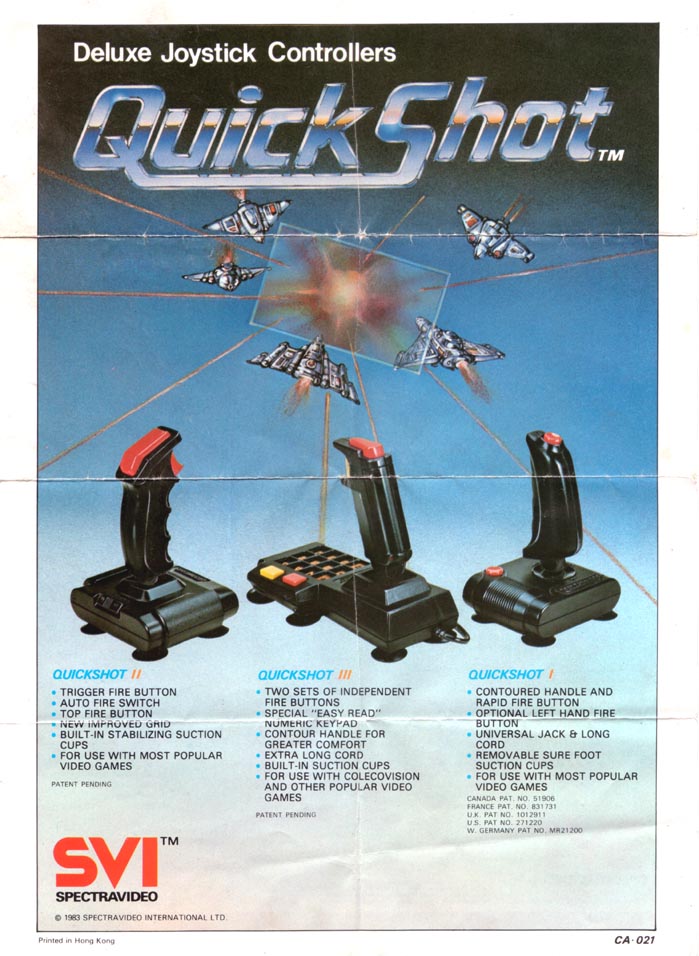
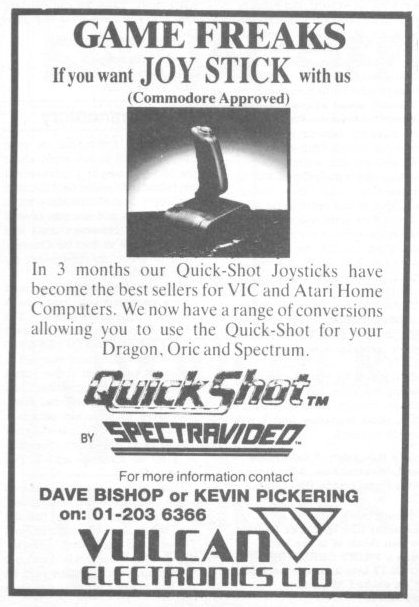
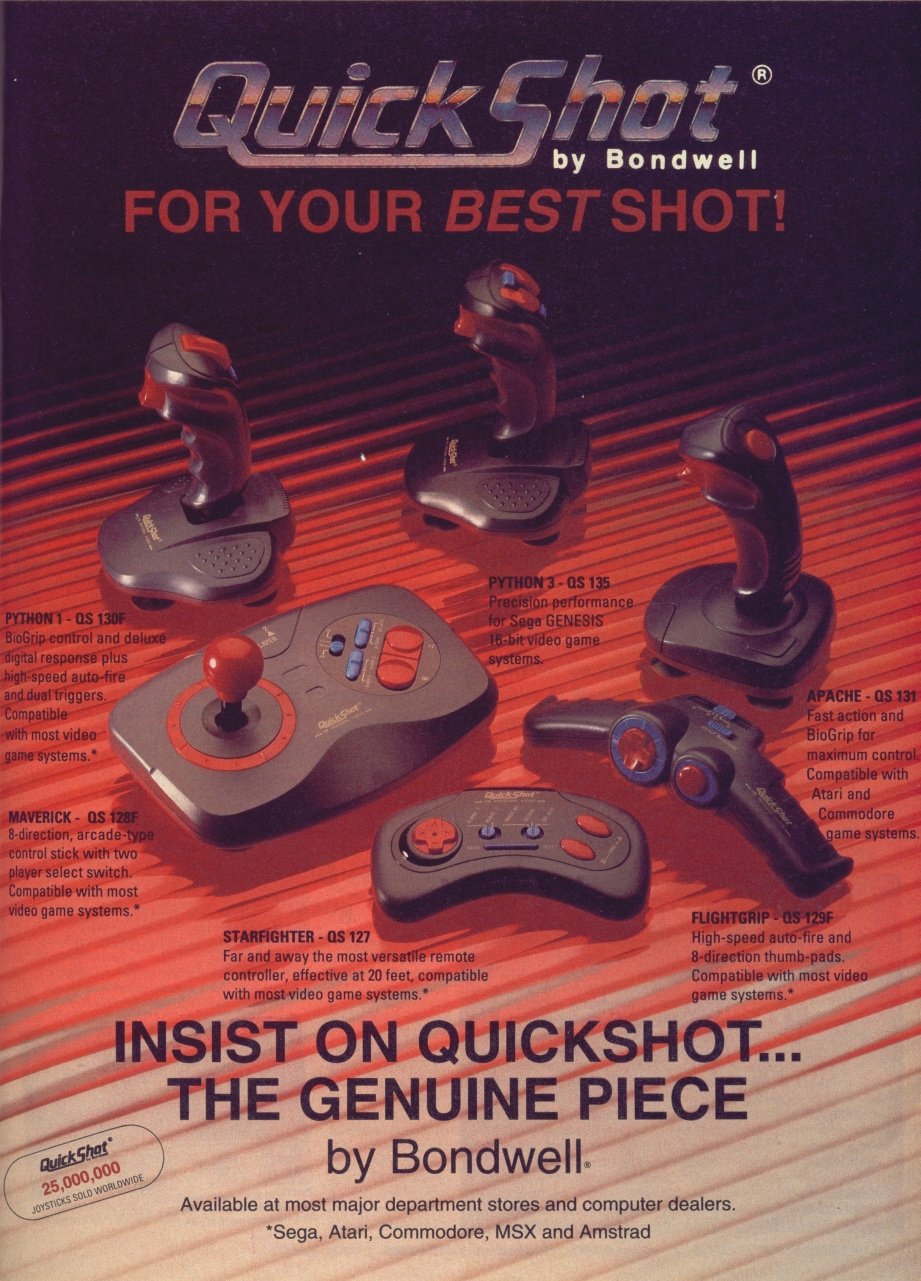
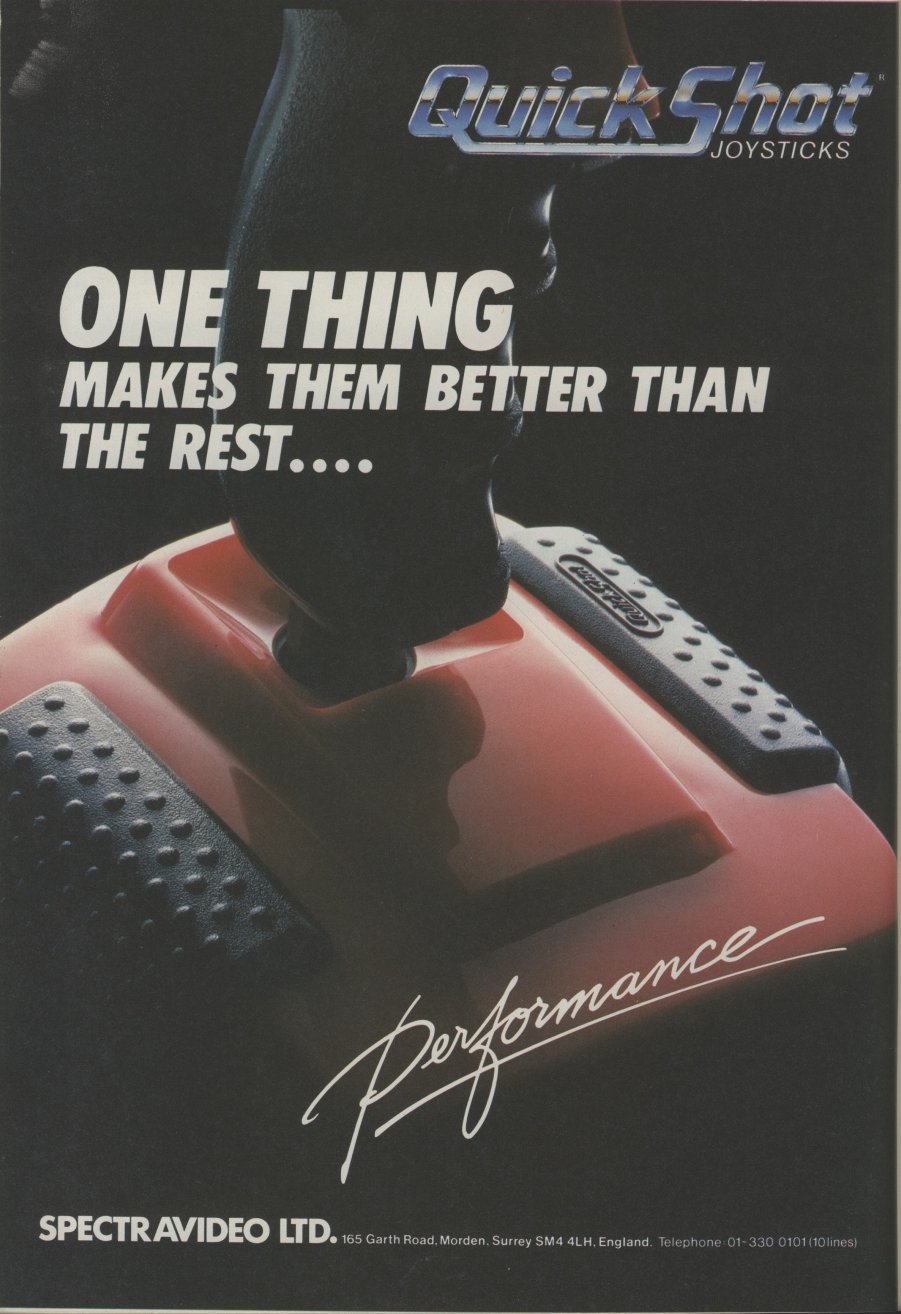
Quickshot I Joystick
Hardware: JoyCommon
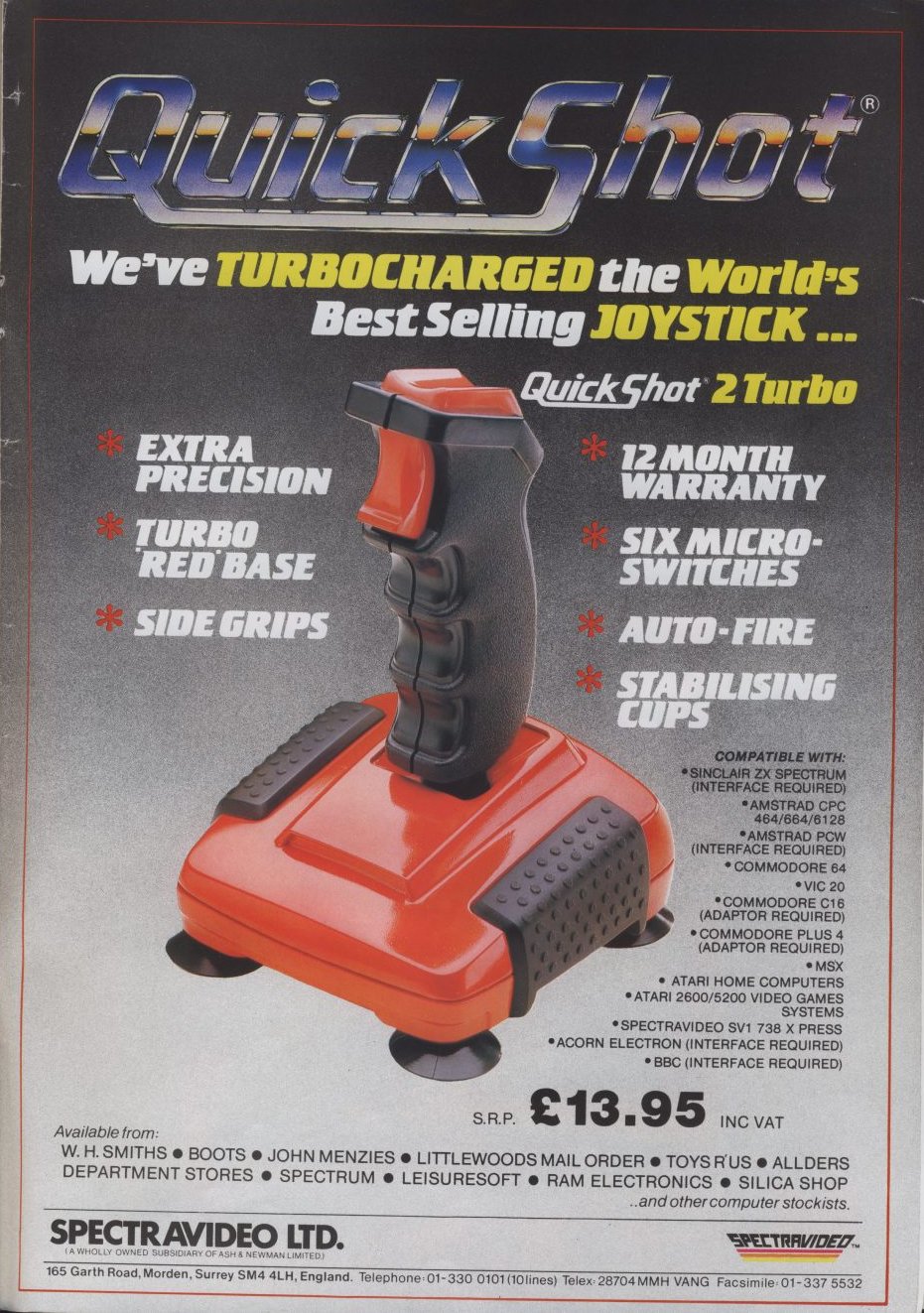
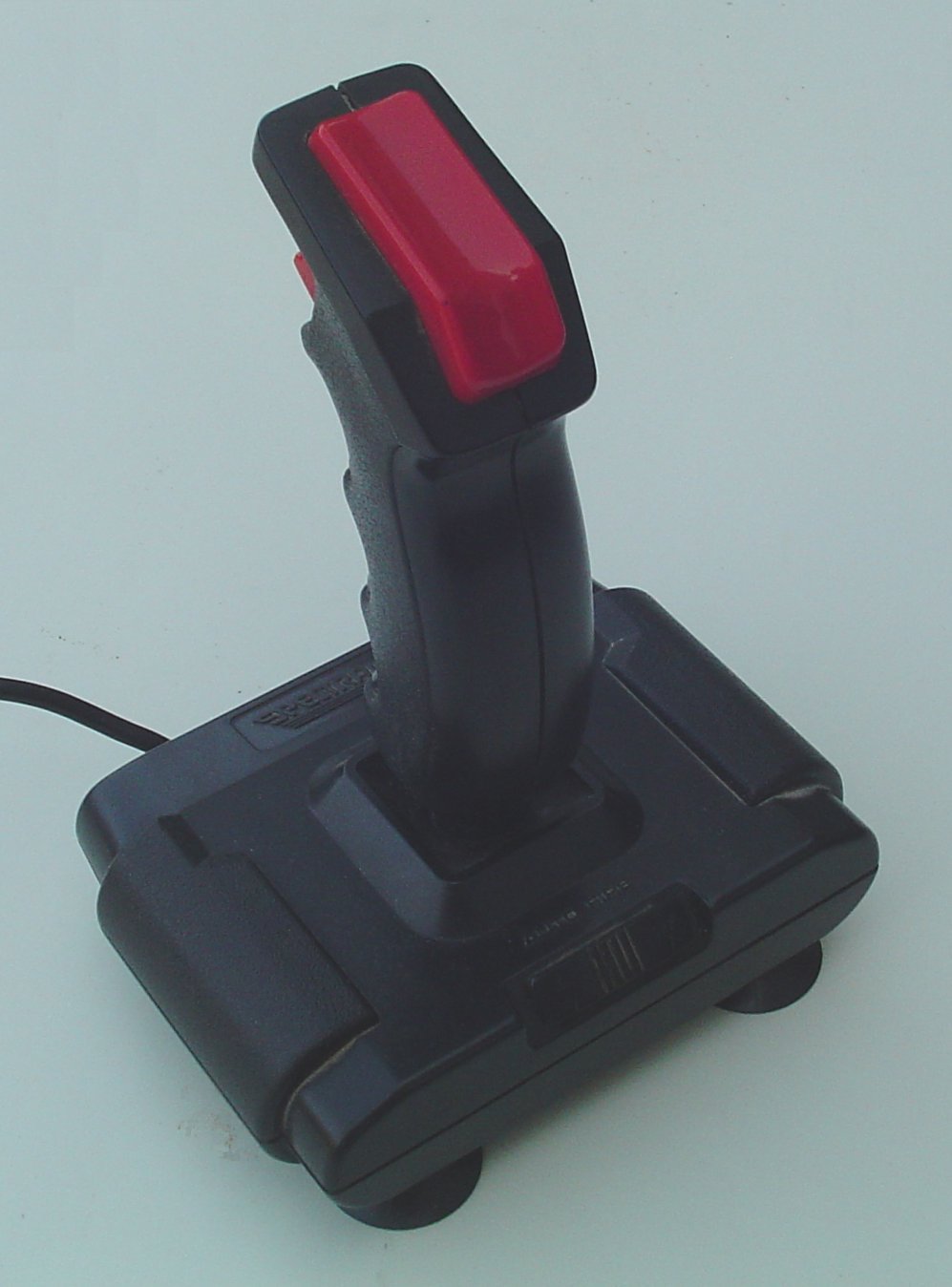
Spectravideo · 1983 · Pound sterling 16.95
Discussion
Nobody has started a thread about this yet.
Files and rights
No permission is on record either way. Screens and pictures are copied here on a take-down basis: if you hold the rights and want something removed, say so and it goes.
Scores
In the magazines
- C&VG (Computer & Video Games) #571986 · Overall4/10
- Your Sinclair #21986 · Overall6/10
- Sinclair User #561986 · Overall67%
In the magazines 412
ZX Computing #31Nov 1986 · p.21
Charlton Appleby
JOYSTICK CONNOISSEUR CHARLTON APPLEBY TAKES A CRITICAL LOOK AT ESTABLISHED SPECTRUM JOYSTICKS AND ALSO PLAYTESTS CHEETAH'S NEW 128+2 COMPATIBLE STICKS. FIGHTER PILOT Tandy £8.95 This stick used to be marketed by Spectravideo under the name 'Quickshot' before the Quickshot II came out. Now rebadged, Tandy are selling it under their own brand name. This stick has a fire button on the on the base, one on the top of the stick for your thumb, and a contoured grip - though not up to the standard of the Quickshot II. The base has suction cups on it to provide a firm footing for one handed operation, though there is no great problem using two hands as the base is also designed to be held. Internal construction is once again by the collapsible dome method, with the usual limitations of not being too hard wearing, but with the advantages of good control and tactile feedback.
Sinclair User #56Nov 1986 · p.5067%67%
Overall 67%
Graham Taylor 67%
ONE JOYSTICK'S THE SAME AS ANOTHER ISN'T IT? NO. WHY? BECAUSE GRAHAM TAYLOR SAYS THAT'S THE WAY IT IS! Well you just yank it don' you, I mean sometimes you stab it wiv your fumb as well but das about it reely. Is there such a thing as a cool joystick? What particular piece of plastic will most perfectly set off your Georgio Armani lime green California casuals. If Crockett and Tubbs bust aliens instead of cars what would be the piece of plastic for them? When it comes to joysticks there are as many opinions as there are frazzled aliens. Ain't nobody gonna be damn fool enough to pretend that it's possible to do some sort of definitive/objective analysis. So what we have here is a mixture of fact and faction. Actually reading between the lines will probably reveal some deep-seated and dodgy details about the reviewer. THE RATING SYSTEM KILL FACTOR: A general purpose term implying how responsive the joystick is to your slightest movement. Responsive equals alien deaths. DEFENSIVE SYSTEMS: Can the thing take the strain? Is it going to fall apart in five minutes if the going gets rough? LOOKS CAM KILL: Is it stylish? Is it easy to grip? If it were a car would it be Ferrari Daytona or a dumper truck? This section is almost totally biased. OVERALL COOL: The lot totalled up, fiddled with, adjusted and generally mutated to give a definitive overall impression of the total joystick concept. QUICKSHOT 1 Archetypal joystick, that seems to turn up under a lot of different names. Two small fire buttons. KILL FACTOR Response only reasonable. Don't know why, since the thing has microswitches but I just don't think this one quite cracks it with the response times. Fire button seems a bit slow and stodgy too. DEFENSIVE SYSTEMS Looks a bit thin and flimsy but actually seems quite tough when given the 'they didn't actually say they wanted this back' test, in which the thing is yanked backward and forward a lot. LOOKS CAN KILL Naff and nasty. I think the grooved base gives the stick the vague impression of 30's art deco at its worst. Hand grip is, however, particularly good - firm and nicely contoured. OVERALL COOL Not too hot on responses and not very elegant. Strong though. PRICE: £6.95
C&VG (Computer & Video Games) #57Jul 1986 · p.704/105/104/104/104/10
Accuracy 4/10
Ergonomics 5/10
Strength 4/10
Overall 4/10
Jim Douglas 4/10
JIM'S JOYSTICK JURY! "PROBABLY THE MOST INTERESTING JOYSTICK ARTICLE... IN THE WORLD!!" For most games players, the most important piece of extra equipment they will buy for their micro will be a joystick. In his search for the ultimate joysticks, C+VG's JIM DOUGLAS locked himself in a small, dark room with Uridium and Winter Games. This is his story... KEMPSTON PRO 5000 The Kempston has reigned as the top games-players' joystick since it first emerged from Coin Controls Limited all those years ago. Despite various gimmicks employed by other firms to make their sticks seem superior, the 5000 seems to have fought off all competition without much bother. Evdn with few alterations over its relatively long life span the Kempston still remains a favourite with most gamers. Performance on Uridium: It performed almost perfectly! The rapid fire needed in the game was admirably supported by the twin fire buttons, neither of which "stuck" or missed a shot. Although there is no definite "switch"ing sound when changing from one direction to another, no problems with accuracy arose at all, Performance on Winter Games: Owing to the lack of audible switching some events became more difficult. In the figure and free skating for example, it is necessary to make a move with extreme precision. The "click" which some sticks produce makes this easier; although it's very easy to correct an error with the Pro 5000. It's also very easy to make a slip. EUROMAX PRO ACE The Pro Ace looks utterly tremendous - all black, with a bright red fire button and direction indicators - but it's awkward to hold, unresponsive and a rather poor show overall! Performance on Uridium: I skimmed over the first Dreadnought's surface, unsuccessfully struggling to hold the blasted thing without partially paralyzing my hand. Firing is very hard work. You've got to push the button firmly home before you get any response. It's very strong - but that's really all I could say for it. Performance on Winter Games: This stick seems to perform best when only minor accuracy is required. On the long events. such as speed skating, it works quite well, although hard work, owing to the power of the sell-centring mechanism. The fire-button was barely adequate. EUROMAX MICRO ACE Doesn't this look frightfully similar to the Pro Ace? Hang on! This has got a RED handle, and WHITE directional arrows! It has also got micro switches, which make life a whole lot easier. Performance on Uridium: It's still a hit of a nightmare to hold, but is better than the Pro Ace. The switches make play more accurate, end less tiring. Firing is still pretty awful, causing terminal cramp in the reviewer's thumb! Performance on Winter Games: Well, it's a bit of an improvement! Movement is easier, and more precise. The firing lets the stick down. On long events, the shape causes considerable discomfort. VULCAN ELECTRONICS' GUNSHOT The Gunshot looks like yet another variation on Spectravideo's Quickshot range. It has the same design style, with one fire button positioned on the base, and another on the shaft. Here, though, the latter sits on top of the handle. Although it offers an effective autofire option, the stick feels a little top-heavy and the rubber feet aren't any real use. Performance on Uridium: The autofire option really comes into its own in the game! it will produce a continual stream of fire while you deal with the tricky aspect of steering. Unfortunately, the stick doesn't really have the necessary accuracy to avoid all the meteor shields. Performance on Winter Games: The grip is very comfortable, especially when working your way through the tough Biathlon event. The firing wasn't particularly sensitive. It has smooth movement, though, making the long-distance events such as speed-skating quite easy. I'm not ease how much it would stand, before the switches became bent away from their contacts. EUROMAX WIZ CARD "Pah", thinks the standard reviewer as this little monstrosity falls from the packet. Well, yah-boo sucks to "standard" reviewers, 'cos this is one of the best "sticks" in the entire universe. So there! It's around the size of an individual Fruit 'n' Nut choc-bar, allowing - obviously - some extra size for the two fire buttons and directional thingy on lop. Performance on Uridium: It's wonderfully accurate, and easy to operate. The only problem with using the Wiz Card (so-called because it's a bit like a card, and a "wiz" to use - geddit?) is if you've got used to a standard joystick. Once you've got the hang of the movement, it's a dream to use. You don't need to exert any force to change direction, and it fits easily into the hand. It's really quite good. Performance on Winter Games: Wonderful! This one worked with hardly any problems at all. Firing was responsive and trouble-free. Direction changes were precise, too. The only problem arose on long events, where continual direction changes are necessary, it was quite hard to get a comfortable grip. You can't really use one thumb, as you've got to press on different areas of the pivoting button. Using the digits though, is rather awkward! QUICKSHOT 1 Many regard the Quickshot 1 as the turning point in joystick manufacture. It's cheap, simple to use and versatile. Unfortunately it's also a pretty awful joystick. Performance on Uridium: Direction changes are ghastly. Firing is cumbersome and stiff. To get any response you need to use a good deal of force. Quite unbearable. Ugh! Take it away! Performance on Winter Games: You can hardly call it "performance". It's horrible. QUICKSHOT 2 Umpteen games players still swear by the Quickshot 2. It's lightweight and efficient. It fits well into the hand, and is comfortable for long-term use. Performance on Uridium: This is a bit of an improvement! It's a lot better than the Q.Shot 1. The autofire works well, giving a nice, healthy stream of bullets. Movement is still a little on the unresponsive side, causing the user to exert more force than is actually necessary on the stick. Its possible to be accurate enough to achieve a reasonable score. Performance on Winter Games: It's certainly of a higher quality than the Quickshot 1. It's easier to use, and the firing is more accurate. Movement isn't much cop, and when you need speed and precision you may as well forget it. CHEETAH 125 Yet another Quickshot clone! It's black, with red buttons, rubber feet and a rather dodgy switch system. This stick has got fire buttons all over it! There are two on the base, a trigger, one on the very top of the shaft and an autofire. It's reasonably strong, but is very Light, and feels as if it's suffering under the strain of multi-directional zapping! Performance on Uridium: Urgh! These base-mounted buttons are dreadful! Let's try the trigger; not much use either. Now about autofire? Oh. That doesn't work either. Not doing very well so far, is it, folks? Playing a passive game of Uridium isn't the easiest - or most sensible thing in the world. Still, the movement is pretty good. There isn't much resistance to direction-changes, and it's not too hard to avoid the dreadnought's static defences. Performance on Winter Games: Still rather awful. The firing was slow and inaccurate, and movement followed suit. It felt strong, though, and held up reasonably well under prolonged play. QUICKSHOT 7 "THE JOYCARD" Yah! Right on! This is the business! Not only do you get a dead swish black card-like object, with an immensely smooth direction-disc in the middle and two fire buttons. BUT... Da-daa! Two red lights to show you when you're firing! More of these little wonders are appearing on the market all the time, and if this one is anything to go by, they could soon be taking business away from conventional sticks. Performance on Uridium: You can hold the button down for autofire, or set it as a normal button. And just watch those red bights go! Movement takes a while to get used to, but is responsive, slick and requires minimal user strength! The design means you con use it with one hand, leaving the other free for slurping coffee etc.
THE RATINGS EXPLAINED The sticks featured here have all been graded on a scale of 1-10 in the following categories: Ergonomics: Design to you, stupid! Does the stick stay firmly in your hand, or does it wrench itself from your grip at the first sign of an approaching nasty? Do those buttons take the superhuman hammering dealt out when you're dealing with a squadron of Uridium fighters? Strength: At the end of your record-breaking effort, is the machinery still in working order? Accuracy: A pretty vital rating this. The last thing you want to happen as you try to match the rotation of the Elite space-stations is for your joystick to decide it only wants to turn one way, and fire at will! Overall: Does the stick do the job?
Your Sinclair #2Feb 1986 · p.556/10
Overall 6/10
Darren Stephens
Martin Covill
Noel Wallace
Peter Shaw
[ZXSR: The overall scores are an average of the marks given individually by the three reviewers over the three games tested (Daley Thompson's Supertest, Wanted: Monty Mole and The Way of The Exploding Fist). The actual reviewer scores are included in the review text.] IT'S A STICK UP! Are you still scraping by using a keyboard on the latest arcade games - and scraping the skin off the ends of your fingers into the bargain? What you need's a 'stick to bring the joy back to your gamesplaying. To help you choose the right one for the job, we asked three YS readers to take a grip of themselves and review the top ten. Peter Shaw joined them and came in for some stick! How d'you go about choosing a joystick? We're all guilty of believing that a joystick is a joystick is a joystick - so why not plump for the cheapest. After all, they all work in the same way, don't they? No, they jolly well don't. Even leaving aside an obvious novelty like the Suncom Joysensor, you'll find that each 'stick has its own feel, almost its own personality. (What is yours called? Ed). There are big 'uns and little 'uns, some with flexible shafts, others stiff. You'll come across some real neat ones and some that are just plain ugly. And, to make things even more complicated, you'll soon suss out that a joystick that hits the heights on one game is of no earthly use on another. In an ideal world, you'd have a different joystick for every game in your collection - but then in an ideal world we'd be picking pound notes off the pavement! So, if you play more than one game, you're now faced with a very tricky bit of decision making. Do you pick a joystick that'll allow you to excel on your fave rave but only lets you plod along with pedestrian scores on the rest - or do you choose an all-rounder that'll give you better than average scores on a variety of games? But then you'll have to resign yourself to the fact that you may never receive the ultimate accolade of being chosen as one of Hex's Heroes. Of course, for most of us, our minds are made up by the weight of our wallets. (What's a wallet? Ed). But whichever way you want to choose a joystick, you'll find all the information you need in our comprehensive review of the top ten. Each 'stick; has been thoroughly put through its paces by three great games players who've been hand picked from Hex's Heroes. And then they did the rough stuff on three very different types of game - a platform, Monty On The Run, a hand-to-hand combat, Way Of The Exploding Fist and a joystick waggler, Daley Thompson's Supertest. So, if you're in the market for a new 'stick, turn the page and get stuck into the full reviews from our team of joyriders. HIT & MISS STICKS DALEY THOMPSON'S SUPERTEST - OCEAN This is the ultimate game that'll push any joystick to its limits. If a 'stick can cope with a day's pounding from DT then you can be sure it's tough. And it's not just the shaft - The fire buttons need to be good too - easily accessible and very responsive for that last minute press before taking a penalty or diving from the spring board. Quickshot II Martin: I like the reactions with this one an' it's got some of the best positioned fire buttons of all the sticks. On The Stickometer: 8/10 HIT Darren: I don't think this joystick wanted to co-operate and building up speed was tricky. On The Stickometer: 2/10 MISS Noel: The length of the shaft tires your arm out too quickly with all that waggling. Not keen on this one at all. On The Stickometer: 6/10 MISS Gunshot 1 Martin: Quite a good design but not as good as most joysticks. I don't think the omission of rapid fire matters. On The Stickometer: 6/10 HIT Darren: Not exactly a special joystick - very standard 8-directional. Still I did get some good scores with it. On The Stickometer: 7/10 HIT Noel: Looks too much like the Quickshot for my liking, and I don't reckon it'll take the strain of Supertest On The Stickometer: 5/10 MISS Formula 1 Martin: A good joystick with a good reaction time. The fire buttons are also well positioned. Where can I find fault? On The Stickometer: 9/10 HIT Darren: It's a good joystick - what else can I say? The colour's a bit garish but that doesn't bother me. On The Stickometer: 9/10 HIT Noel: Oh dear, this one's deafening me! The reaction's OK, but the size of the shaft made my arm ache. On The Stickometer: /810 HIT Formula II Martin: Wonderful design job and a really good response to back it up. This has it all apart for big buttons. On The Stickometer: 8/ HIT10 Darren: Great stick. Well designed, good response and above all, the fire buttons are in the right place! On The Stickometer: 9/10 Noel: This one's too flimsy. I prefer a good stiff stem, and this joystick definitely hasn't got what it takes. On The Stickometer: 3/10 MISS Kraft Martin: Don't think much of this one. The design's too fragile and it just ain't good with Supertest. On The Stickometer: 3/10 MISS Darren: I reckon it's good. I prefer the small 'sticks as long as the control's still in there. On The Stickometer: 9/10 HIT Noel: This joystick is just right for Supertest. A short shaft means less work for me and it's tough enough. On The Stickometer: 8/10 HIT Micro Stick Martin: Not much cop for this sort of game. The rotation of the shaft makes it pretty awkward to use. On The Stickometer: 5/10 MISS Darren: Don't really like this one - the fire button is much too stiff to be of any use in this game. On The Stickometer: 7/10 MISS Noel: Well it's very nice but it tires your arm out after only a few waggles of the shaft. On The Stickometer: 7/10 HIT The Champion Martin: It's got nice fire buttons and a good reaction but it doesn't seem to work with Supertest too well. On The Stickometer: 5/10 MISS Darren: Well it's easy to grip and easy to fire. I quite like the stylish design too. On The Stickometer: 7/10 HIT Noel: It's got very quick reactions and an excellent grip. I'll go for this one any day. On The Stickometer: 8/10 HIT Le Stick Martin: Oh it's so easy to win on Supertest - you only have to shake the joystick vigorously! On The Stickometer: 10/10 HIT Darren: Excellent joystick to use with Supertest - I've got my best score ever on nearly all the games. On The Stickometer: 10/10 HIT Noel: Ideal for this game, you only need to wiggle the joystick - it's that simple! On The Stickometer: 10/10 HIT Command Control Martin: Well it's a good joystick and it's got a decent sized base to grab hold of. Bigger is better, eh? On The Stickometer: 8/10 HIT Darren: I don't think the vigorous action of Supertest is going to do this one any favours! On The Stickometer: 5/10 MISS Noel: Brilliant joystick to use with Supertest - very sturdy and reactions are fast. On The Stickometer: 9/10 HIT Suncom Joysensor Martin: Ugh. It's terrible. Too much like using a ZX81 keyboard. There's no real control at all. On The Stickometer: 1/10 MISS Darren: It's really useless for this game - how can you do left/right quickly on a membrane? On The Stickometer: 4/10 MISS Noel: It reacted well but took the skin off the end of me finger while rubbing. On The Stickometer: 6/10 MISS MONTY ON THE RUN - GREMLIN GRAPHICS For a platform game like this, a joystick's gonna need pinpoint accuracy so you can get as close to the edge as possible. And as you'll expect to spend a fair dew hours meeting Monty's goal, you don;t want a grip that'll leave you with sweaty palms and a slippery shaft. And the button had better be big so a thumb can easily be dumped on it for those long jumps. Quickshot II Martin: This joystick definitely works well with platform games. It's nice and accurate with a well-designed shaft. On The Stickometer: 9/10 HIT Darren: This is the one I've got at home, and I'm used to the action but that's not to say it's the best there is. On The Stickometer: 9/10 HIT Noel: OK, so it's not bad at coping with platform games, but I still reckon that the shaft is too flimsy. On The Stickometer: 6/10 MISS Gunshot 1 Martin: Quite a good joystick to use on the old platforms - everything seems easy to control. On The Stickometer: 8/10 HIT Darren: It's got an average response and all-in-all it's a pretty average joystick. Nothing to write home about. On The Stickometer: 8/10 HIT Noel: Stem seems to spindly and the grip gets as sweaty as Bumpry's armpit. Not for me this one. On The Stickometer: 5/10 MISS Formula 1 Martin: Very easy to get used to. I like the design and its accuracy overwhelmed me. I'll take one! On The Stickometer: 8/10 HIT Darren: Nice shaft though it could be longer and the reaction is OK. The overall effect is good. On The Stickometer: 5/10 HIT Noel: This one went very well with Monty. Its reaction is very fast - not bad at all. On The Stickometer: 7/10 HIT Formula II Martin:Very good. The fire buttons react very well. Overall, perfect for this kind of game. On The Stickometer: 9/10 HIT Darren: It's very similar to the Gunshot. I like it, the design's very hi-tech and the reaction's fast. On The Stickometer: 8/10 HIT Noel: It's still too flimsy for my liking but it works well with Monty though. On The Stickometer: 6/10 MISS Kraft Martin: I don't rate this joystick at all. the response is OK but I find it too fragile for the game. On The Stickometer: 2/10 MISS Darren: It's a good joystick. I like this design more than most and the shaft's very comfortable. On The Stickometer: 10/10 HIT Noel: Oh, it's horrible - Monty, just doesn't work with it. I'd get more response from a garden gnome. On The Stickometer: 4/10 MISS Micro Stick Martin: It's too stiffm very slow and unresponsive. But the design is quite good so I'll be gentle. On The Stickometer: 5/10 MISS Darren: Better in this game, possibly because everything doesn't go so fast. Still not impressed. On The Stickometer: 7/10 MISS Noel: It's quite good. It's got fast action and a good grip design. I like it even if they don't. On The Stickometer: 8/10 HIT The Champion Martin: It's very pretty but I don't think much of the overall effect. The controls seem a bit dodgy. On The Stickometer: 4/10 MISS Darren: It's a smooth joystick, but I don't reckon it works to well with this game. On The Stickometer: 6/10 MISS Noel: It's the best desiigned joystick of the pack and to top that the reaction speed is fast too. On The Stickometer: 8/10 HIT Le Stick Martin: It's a lot of hard work stopping Monty running into things when you haven't got a leg to stand on. On The Stickometer: 6/10 MISS Darren: It's much too awkward to use in this game - you really can't control what's happening. On The Stickometer: 5/10 MISS Noel: Ooops - no good for Monty as he keeps running off the end of all the platforms. On The Stickometer: 3/10 MISS Command Control Martin: Directional control on this joystick is quite good. Unfortunately the top button lets it down. On The Stickometer: 6/10 HIT Darren: The shaft's the right size, it's the right shape and offers good control. Just right for platforms. On The Stickometer: 9/10 HIT Noel: Well apart from getting a little too sweaty in my paw, this one works really well. On The Stickometer: 8/10 HIT Suncom Joysensor Martin: Even worse than with Supertest. The movement control is absolutely tosh. Double ugh! On The Stickometer: 1/10 MISS Darren: It's not quite right for platforms somehow, but it was great fun trying! On The Stickometer: 6/10 HIT Noel: It's useless with platforms as you can't change direction accurately enough. On The Stickometer: 4/10 MISS WAY OF THE EXPLODING FIST - MELBOURNE HOUSE If you're ready to face the karate challenge, your joystick will need the combined powers of both shaft and button. If the shaft won't react quickly enough, or its directional flexibility is dodgy, then a joystick can be considered worthless with a game like this. Plus you'll need a fire button that's easily accessible and very responsive - or it's the chop for you, matey! Quickshot II Martin: Hmmm, it;s realy easy to use with Fist, The reaction is good and the buttons are just right. On The Stickometer: 8/10 HIT Darren: Can't say I like this combination. Maybe it's me but it sure seems a bit unresponsive. On The Stickometer: 3.5/10 MISS Noel: It's got a well designed grip and fire button positioning, but the movement feels too limp and flimsy. On The Stickometer: 5/10 MISS Gunshot 1 Martin: Nothing special, but the reactions are fast enough to keep up with Fist and fire buttons are OK. On The Stickometer: 9/10 HIT Darren: Well I like it. I found it very co-operative an' I'd be quite happy having one on my Speccy. So there! On The Stickometer: 9/10 HIT Noel: The shaft's too spindly and I reckon it'll break if you sneeze on it. Please take it away! On The Stickometer: 5/10 MISS Formula 1 Martin: Not so good for use with Fist. The size of the shaft seems a disadvantage. Fire buttons are nice though. On The Stickometer: 5/10 MISS Darren: I think it gives you a lot of control. The fire buttons are in exactly the right position and they're BIG! On The Stickometer: 8/10 HIT Noel: Reacts quite well and the size of the fire buttons are a big plus in this joystick's favour. On The Stickometer: 8/10 HIT Formula II Martin: This one seems made for Fist, the reaction time is good - control is easy and the fire buttons are fab. On The Stickometer: 8/10 HIT Darren: It's great. The case design is very smart and the reaction time is good too - I'm tempted to get one. On The Stickometer: 10/10 HIT Noel: It's really too flimsy. I know I keep going on about it but I rather hold a piece of raw liver than this joystick. On The Stickometer: 6/10 MISS Kraft Martin: Reactions are quick enough but the shaft's too small. You won't find me buying one. On The Stickometer: 3/10 MISS Darren: Pretty good - it responds well with this game. I like the four-way, eight-way feature. On The Stickometer: 8/10 HIT Noel: Shock, horror - it reacts quite well with Fist. You wouldn't think it was the same joystick. On The Stickometer: 6/10 HIT Micro Stick Martin: Don't like it a great deal, it's a bit too stiff. You get massacred using this one for Fist. On The Stickometer: 4/10 MISS Darren: Oh dear... maybe the fire button has actually packed up. Not a good mark in my book. On The Stickometer: 5/10 MISS Noel: Quite a good joystick (The fire button must still have been working! Ed). Good response. On The Stickometer: 7/10 HIT The Champion Martin: It''s a pretty design but being left handed I find it quite awkward to use. On The Stickometer: 5/10 HIT Darren: Another one of the joysticks has packed up on me this time the directional controls are up the spout! On The Stickometer: 3/10 MISS Noel: It's got quite good reactions and responsive diagonal controls. Good joystick. On The Stickometer: 8/10 HIT Le Stick Martin: Terrible! Very hard to judge where it is and diagonals are nigh-on impossible to achieve. On The Stickometer: 2/10 MISS Darren: I think it's quite good but if you get too excited then you might lose track of where you are. On The Stickometer: 8/10 HIT Noel: Very slow reacting - I reckon it's a miss for Fist. (More, Adrian Mole poetry huh? Ed.) On The Stickometer: 4/10 MISS Command Control Martin: A good stick with an easy-to-handle shaft but the choice of etierh top or bottom fire button is naff. On The Stickometer: 7/10 HIT Darren: The buttons are good although I'd have preferred to use both. Works well with Fist though. On The Stickometer: 9/10 HIT Noel: You can really kick the proverbial out of the other player with this stick. Very responsive! On The Stickometer: 9/10 HIT Suncom Joysensor Martin: It's not really very practical. As joysticks go, this one's more of a novelty than anything. On The Stickometer: 2/10 MISS Darren: Seems to work better with Fist than with any of the other games. Quite a good sore with this one. On The Stickometer: 8/10 HIT Noel: Reacts really well. I've just beaten my all-time high score. I might even buy one! On The Stickometer: 9/10 HIT
GETTING SOME STICK Joystick Name: Quickkshot II Price: £10.95 Manufacturers Name and Phone Number: Spectravideo Ltd. [redacted] Joystick Name: Gunshot 1 Price: £7.95 Manufacturers Name and Phone Number: Vulcan Electronics. [redacted] Joystick Name: Kraft Price: From £12.95 Manufacturers Name and Phone Number: Vulcan Electronics. [redacted] Joystick Name: Formula I Price: £16.95 Manufacturers Name and Phone Number: Kempston Micro. [redacted] Joystick Name: Formula II Price: £11.95 Manufacturers Name and Phone Number: Kempston Micro. [redacted] Joystick Name: Micro Stick Price: £ Manufacturers Name and Phone Number: Datex Ltd. Joystick Name: The Champion Price: £11.99 Manufacturers Name and Phone Number: CGL Ltd. [redacted] Joystick Name: Command Control Price: £27.95 Manufacturers Name and Phone Number: CGL Ltd. [redacted] Joystick Name: LeStick Price: £12.99 Manufacturers Name and Phone Number: Lightwave Leisure. No number available. Joystick Name: Joysensor Price: £19.95 Manufacturers Name and Phone Number: Consumer Electronics. [redacted]
GIVE 'EM STICK Talk about too much of a good thing! Even with all the reviews in front of you, it's still tricky choosing the right one for you. One way is to add up all the scores, of course. But if you're really clever, you'll use Chris Somerville's program, Second Opinion that appeared in YS 19. We tried it and came up with some very interesting results. Le Stick got into the quarter finals before being toppled and the Quickshot II and Formula II tied until reaching the final. Just take a look at our top five raves after they'd come through the mincer. 1st - Command Control, Wico/CGL; Formula II, Kempston 3rd - Quickshot, Spectravideo 4th - Le Stick, Lightwave Leisure 5th - Micro Stick, Datex
Yikes - here's the poor YS readers who're in for some stick. There's Martin Covill, a 15- year-old self-confessed Madonna fan (OK you can turn the tap off and take the matchsticks out now) who hails from Canterbury. In the middle is Darren Stephens who's 13 and brought his whole family plus pets to see the YS office. Finally, meet Noel Wallace who lives a 55p bus ride away - so, we made him walk home, and before you tell us, we know that Noel sometimes gets hold of the wrong end of the stick. After all, anyone who needs two hands to pull on a Quickshot and can injure himself on a Joysensor is brilliant enough to replace Troubleshootin' Pete!
Sinclair User #46Jan 1986 · p.54
John Lambert
STICKING TO THE BEST Zap in style. John Lambert juggles with joysticks. Joysticks are the most popular add-on for the Sinclair computers, not just for playing games but also for drawing, cursor control in word processing packages and for moving anything around the screen. The keyboard can be used for all of those things but it is so much easier with a joystick. Choosing a joystick from the hundreds available is not an easy decision, but this guide will show you what to look for, and how to connect it to a Spectrum or QL. Joysticks are generally all the same. They may be different shapes and sizes but they all contain a number of simple switches which get turned on or off as the stick is moved. That type of digital joystick was first used on a home computer by Atari and, therefore, is sometimes known as the Atari standard. All Sinclair machines use this type of joystick interface. The switch used can vary a great deal. The cheapest joysticks, such as Quickshot 1, us a bubble which when compressed by the stick makes contact. Those can wear fairly quickly and cannot stand up to heavy use. Next in price and strength are leaf spring switches where the stick causes two pieces of metal to make contact. Finally, the most expensive joysticks use microswitches. Those will last a long time and can easily be replaced should they go wrong. Generally, you should buy the most expensive joystick you can afford as that way it should last a long time. Try to get one with a metal shaft in the handle - plastic ones break - and, if possible, try it out in the shop. The feel of a joystick is very important, some are sloppy and others require a lot of movement before they register. it is within the interface that the complications arise. All interfaces have at least one Atari standard socket where the joystick is plugged in, but those vary in how they tell the computer when the stick has been moved. Which type of interface you buy will depend on what software you want to use with it. The most common method is known as Kempston - named after Kempston Microelectronics who invented it. What that does is to configure the interface as part of the Z80 I/O map so that it can be read - to find what position the joystick is in - using the instruction IN 31. Another method is for the interface to emulate the cursor keys - five to eight plus zero as fire. For obvious reasons that is known as Cursor. The third method is known as Sinclair and emulates the six to nine keys, with zero as fire. That is based on Interface 2 from Sinclair. Why Sinclair wanted to bring out yet another method is anybody's guess! The problem is that until you but the software you have no way of knowing which of those three methods it will use. Many programs give you a choice but unfortunately not all. The way to get round that is to use a programmable interface. Those allow you to let each stick direction and fire represent a key on the keyboard. All games have a keyboard option and you just set the interface to the keys it uses. That also gets round the problem of game that do not use any of the three normal methods - Psion is very bad in that respect. Unfortunately, programmable interfaces tend to be the most expensive, and in some cases can be very difficult to set up. For playing arcade games a Kempston standard interface is the most useful, and the cheapest. Some interfaces combine more than one method in the same box, but the more facilities it has the more expensive it will be. Some joysticks offer extra facilities and you should take care when buying those. Although it is popular to have two fire buttons on a joystick, in many cases they are joined electrically and perform the same function, so it does not matter which one you press. Some joysticks, however, have two, independent, fire buttons and some interfaces can take advantage of this. That type of joystick can also be used with interfaces which normally only expect one fire button, and so are particularly worth considering. Care should be taken, though, as pressing the used button on some interfaces, will cause the computer to crash. Another common extra is auto-fire, giving an auto repeat on the fire button. In order to make their interfaces more attractive some companies add extras which are not related to joysticks. The best known is probably the Nidd Valley Slomo which lets you slow down the computer so that - in theory - the games are easier to play. Two other products, the Opus Discovery 1 disc drive, and the Mikro-Gen Mikro-Plus include Kempston compatible interfaces. As far as the QL is concerned life is much simpler. The two control sockets on the back are already wired to emulate either the cursor keys and space, or the function keys. All you need to plug in a joystick is an adaptor which fits the control socket at one end and a standard joystick at the other. Joysticks are available which plug straight into the QL - ones that have a QL style plug rather than the Atari standard. The problem with those is that when you upgrade to a different computer you will have to buy another joystick, as it is unlikely it will fit the new machine. Buying a joystick and interface can be a harrowing experience. Don't be afraid to try out half a dozen in a shop - and don't buy from a shop which won't let you experiment. Ask your friends and, of course, read the reviews in Sinclair User. PROTOCOL 1 Company: AGF Telephone: [redacted] Price: £9.95 Kempston compatible interface which contains a through port. PROTOCOL 2 Company: AGF Telephone: [redacted] Price: £14.95 Kempston, cursor interface. Contains a through port. PROTOCOL 3 Company: AGF Telephone: [redacted] Price: £19.95 Programmable interface. As Protocol 4 but not Kempston compatible. PROTOCOL 4 Company: AGF Telephone: [redacted] Price: £29.95 Programmable, Kempston compatible interface. Top of the range interface which uses a system of preprogrammed cards. Those clip over a membrane on the interface. Also has a through port, reset switch, and free demo tape. Fiddly to program but one of the few which allows auto-fire. It also allows a second interface to be plugged into the back for a second player. COMCON Company: Frel Telephone: [redacted] Price: £19.95 Programmable interface which, although it may not look too good, is easy to program using leads plugged into a matrix. Can run joysticks with two fire buttons. GAMES ACE Company: Datel Telephone: [redacted] Price: £10.99, £17.99 (with Quickshot II) Kempston compatible interface. Allows the use of auto-fire joysticks and outputs sound through the television. SWITCHABLE JOYSTICK INTERFACE Company: Datel Telephone: [redacted] Price: £12.95, £19.99 (with Quickshot II) Kempston, cursor, Sinclair compatible interface. Switchable interface which covers all the main joystick standards. Can be used with auto-fire joysticks. TURBO ACE Company: Datel Telephone: [redacted] Price: £15.99, £22.99 (with Quickshot II) Kempston, cursor, Sinclair compatible interface. Top of the range model which includes all the features of the Games Ace and the Switchable interface. Well priced for the wide range of facilities. DUAL PORT Company: DK'tronics Telephone: [redacted] Price: £13.00 Kempston and Sinclair compatible interface. Interface includes two sockets, one for Kempston and one for Sinclair. PROGRAMMABLE Company: DK'tronics Telephone: [redacted] Price: £22.95 Programmed by loading software from tape. FORMULA 1 Company: Kempston Telephone: [redacted] Price: £16.95 Large joystick with two - not independent - fire buttons. It uses micro switches and has a metal shaft so it should last a long time. Good value. FORMULA 2 Company: Kempston Telephone: [redacted] Price: £11.95 Three fire buttons and plenty of movement for the careful enthusiast. PROGRAMMABLE Company: Fox Telephone: [redacted] Price: £28.95 Programmable interface holding the details of which keys to use for 16 games in a battery backed RAM. Can also be used as a Psuedo ROM. Good operation and value for money. FLIGHTLINK HOTSHOT Company: Frel Telephone: [redacted] Price: £10.50 Small hand held joystick with a very good precise, action and two independent fire buttons. JOYSTICK INTERFACE Company: Kempston Telephone: [redacted] Price: £9.95 Kempston interface made by the inventors of the standard. KEMPSTON PRO Company: Kempston Telephone: [redacted] Price: £16.95 Kempston, cursor, Sinclair compatible interface with three sockets and a slot for games ROMs. Covers all the main standards including two Sinclair sockets, one to five and six to zero. TRISTATE Company: Kempston Telephone: [redacted] Price: £12.95 Kempston, cursor, Sinclair compatible interface. Two sockets cover all the main standards. MIKRO-PLUS Company: Mikro-Gen Telephone: [redacted] Price: £14.95 Kempston compatible interface. Sold as part of the Shadow of the Unicorn game and has 16K of EPROM onboard which will be used in subsequent MikroGen games. Expensive for just a Kempston compatible interface but good value - if you like the game. PACESETTER Company: Nidd Valley Telephone: [redacted] Price: £14.95 Kempston interface with through port and Slomo. PROGRAMMABLE PACESETTER Company: Nidd Valley Telephone: [redacted] Price: £29.95 Tape programmable with Slomo built in, and the ability to use two independent fire buttons. Good range of features. QUICKSHOT 1 Company: AGF Telephone: [redacted] Price: £7.95 Basic joystick which has been overshadowed by the II. QUICKSHOT II Company: AGF Telephone: [redacted] Price: £9.95 Popular joystick, rather fragile and hence, tends to wear out quickly. RAT Company: Cheetah Telephone: [redacted] Price: £19.95 Infra-red remote control joystick and interface. The recently reduced price is good for a complete system and it is the only remote control joystick for the Spectrum. The joystick is a pressure pad which takes a while to master. If possible try one out before buying. TURBO Company: RAM Telephone: [redacted] Price: £18.50 Kempston, cursor, Sinclair compatible interface. All the main standards including two sockets for Sinclair, one to five and six to zero. Also included are ROM slot, full width through port and a reset button. SCOREBOARD Company: Kempston Telephone: [redacted] Price: £19.95 Joystick housed in an enormous consol which is bigger than the Spectrum. Fine if you want to pretend you are in an arcade but a bit over the top. SPECTRUM INTERFACE Company: RAM Telephone: [redacted] Price: £9.95 Standard Kempston interface without through port. SPECTRUM KC Company: Nidd Valley Telephone: [redacted] Price: £8.95, £9.95 (with through port) Kempston compatible interface. Good price for a Kempston with a through port. SUPREME JOYSTICK Company: Cookridge Computer Supplies Telephone: [redacted] Price: £15.95 SURE SHOT JOYSTICK Company: Cookridge Computer Supplies Telephone: [redacted] Price: £12.95 - QL, £15.95 - Atari ZIPSTICK Company: Cookridge Computer Supplies Telephone: [redacted] Price: £12.95 Joystick which is guaranteed for two years' wear and tear.
Crash #10Nov 1984 · p.24
BATTLEFIELD JOYSTICK Joysticks are your most immediate connection with any game you play - the man-machine interface. The melting joystick makes a nice image for an advertiser who's suggesting that his games can beat anything, but do joysticks in real life really stand up to the beating they receive, are they tough enough for the job, do they move well, are the handles right, will the buttons fire? The CRASH reviewing team settled down for a weekend of joystick bashing on several types and makes, and here we look at the results... There are now many makes of joystick available, and almost as many types as there are makes. Each boasts design innovations so that it is better than all the others - and they come in a range of prices too. We all know that joysticks on arcade machines take a battering, so too do those at home. Do they stand up? We tested 19 joysticks from well known manufacturers to see how they all compared. A joystick must be able to withstand games that require fast and repeated movement, so what better than Ocean's Daley Thompson's Decathlon? We used the Commodore version of the game because it is more violent than the Spectrum! But it isn't only toughness; joysticks must also be capable of fine and positive movement, comfortable to use with sensible fire buttons. Several arcade skill games were used to test four major points for both the stick action and the fire button action. TRAVEL means the maximum movement between opposite poles (e.g. up/down) on the stick, and how far the fire button had to be depressed. On stick action over 1.5 inches was considered to be very long. Oddly, some of the short sticks had longer to travel than the taller sticks. ACTION FORCE means the amount of hand or finger pressure required to keep the stick pressed over or the fire button down. REACTION SPEED indicates how fast contact is made, how quickly the action affects the game, and how well rapid movements can be made (especially rapid fire buttons). RESPONSE/FEEDBACK indicates how positive the stick or fire action feels and whether there is any physical or audible feedback to tell the player that contact has been made. ERGONOMICS how useful is the stick for hand held playing, and how well does it operate on a table top. Is the stick well designed for comfort, ease of fire action and general stability. After preliminary testing, the joysticks all went through ten minutes of the Decathlon to see how long they were likely to stand up to use. During this test, some joysticks broke. Finally, all the sticks have 9 pin D connectors and are Atari compatible on the pin outs. They all need an interface of one sort or another to work with the Spectrum (except the clip-ons). Some offer 2 independent fire actions, but these only work with either a Cambridge interface or the programmable Comcon from Frei Ltd., which was the interface used for this test. Each joystick review is split into two halves; firstly a brief technical breakdown; secondly the review team's report. PRO ACE Supplier: Sumklock Microware, [redacted] Price: £12.95 Lever Action: Strong plastic handle suspended between two plastic bushes. Central copper star acting as self-centering spring and contacting 4 copper rivets Fire Action: Oblong fire button at 12 o'clock operating copper contact switch. Trigger button at tip of stick activates copper plate contact. Ergonomics: Average size easy grip enclosure for handheld operation. Rubber feet for table operation. Left and righthanders welcome. Lead: Plastic moulded D connector and retaining grommet. Weak point: Copper contact star can weaken and deform. Soft copper contact surface creates dust and can oxidise if not used over long period. STICK ACTION Travel: long Action force: very hard Reaction speed: slow Response/feedback: very poor and irregular - up/down was not too bad but left/right was terrible, and a lot of slack FIRE ACTION Travel: long on stick button, very long on base button. Action force: medium. Reaction speed: poor Response/feedback: poor, no indication or 'feel'; rather rubbery. Ergonomics: the shaped base fits the hand well with a well positioned left or right hand base fire button, but very unstable on a table top, especially with the sticky travel. The long thin stick is quite comfortable to hold. Life expectancy: top fire button pulls out too easily, the copper contacts bend out of shape easily with use, causing erratic response. The general stick response and travel means that the handle will take a beating on hard, fast games. SPECTRUM MECHANICAL Supplier: EEC Ltd., [redacted] Price: £9.95 Lever Action: Plastic shaft strengthened by long selftapping screw suspended in rubber mount activates via cam plate four flexible key actuating fingers. Fire Action: None Fixing: integrally moulded clip grips. Main body flexes under use. STICK ACTION Travel: long Action force: heavy. Reaction speed: poor Response/feedback: no feedback and generally poor response as casing flexes greatly during play. Ergonomics: This unit clips over the edges of the computer and is made from one piece. This means that together with the stiff stick movement the unit flexes heavily during use, especially with more violent games, and this sometimes renders the key pressed inoperable. The tendency to move away from position during play can also disenable any 8 directional movement. Life expectancy: not very high on fast games, and indeed there may be the slight chance of damaging the computer in a game like the Decathlon. FLIGHTLINK Supplier: Flightlink Control Ltd., [redacted] Price: £10.50 Lever Action: Short Steel short suspended in brass bell bush and compression spring for self-centering action. Plastic bush activates subminiature microswitches. Fire Action: 2 miniature square fire buttons at 6 o'clock. Two independent fire actions in combination with appropriate interface. Ergonomics: No rubber feet. Lever shaped body for handheld operation. Left and right-handers welcome. Lead: D type connector with plastic cover. No grommet Weak point: Lead entry point unprotected. STICK ACTION Travel: long. Action force: very light Reaction speed: fast. Response/feedback: good, positive lock at end of travel for secondary compass points, but tends to slide on primary compass points (left/right/up/down). FIRE ACTION Travel: medium long. Action force: light. Reaction speed: fast - good for rapid fire. Response/feedback: some slack but reasonably firm and positive. Ergonomics: handheld is very good because of small size and light weight but overall a bit pathetic on the table top. The 2 independent fire buttons are in a straight line, which make them a bit awkward for table use, as supporting hand is in the way. Life expectancy: because of fight action and metal construction, stands up to a hard game very well. Life should be quite good. SLIK STIK Supplier: Consumer Electronics Ltd., [redacted] Price: £9.95 Lever Action: Short rubber mounted steel shaft contacting 4 rigid contact plates in end position. Tough short throw movement. Fire Action: 1 left-hand round fire button at left 10/11 o'clock position in enclosure. No trigger button. Ergonomics: No rubber feet or suction cups. Small well rounded body for handheld operation. Left-handers only Lead: Plastic moulded D type connector and sleeved retaining grommet Weak point: Moulded plastic support wall for contact plates can crack and break off. STICK ACTION Travel: very short Action force: medium Reaction speed: good. Response/feedback: quite positive feel and solid end stop with solid clunk. FIRE ACTION Travel: short Action force: medium to hard. Reaction speed: good. Response/feedback: sort of sticky feel, but solid end stop with loud clunk. Ergonomics: lightweight construction and small size make it good for handheld use and reasonably stable on a table top, the corner position of the fire button is good for right handers, but poor for left handers. Life expectancy: Pretty good because of the short stick, short travel and steel shaft. It feels quite safe even on a hard game. KEMPSTON PRO 5000 Supplier: Kempston Micro Electronics Ltd., [redacted] Price: £13.50 Lever Action: Strong steel shall suspended in rubber bush. Leaf contact switches actuated by nylon bush. Fire Action: 2 large arcade style round fire buttons actuating leaf contact switches Ergonomics: Average size well rounded enclosure for handheld operation. Rubber feet for table top operation. Lead: Plastic moulded D type connector and moulded sleeved grommet. Week point: Body flexes under use. STICK ACTION Travel: short Action force: medium Reaction speed: instant Response/feedback: no audible feedback but fairly good response overall. FIRE ACTION Travel: very short. Action force: very light - good rapid fire. Reaction speed: fast. Response/feedback: good with hard, positive feel Ergonomics: not very good for handheld use with the large base but reasonably steady on a table top. The two large arcade style fire buttons on the base are well placed for left or right-hand use, and the round knob shaped stick is comfortable to hold. The slightly stiffer action of the stick on this version of the 5000 make it slightly more tiring to use on the Decathlon. Life expectancy: Good KEMPSTON PRO 3000 Supplier: Kempston Micro Electronics Ltd., [redacted] Price: £12.75 Lever Action: Hollow plastic shaft supported in rubber washer actuating 4 leaf contact switches. Fire Action: 2 trigger buttons (trigger finger and thumb) and one banana shaped fire button at 12'o clock. All fire buttons operate one leaf contact switch. Ergonomics: Small rubber feet. Handheld or table top operated. Lead: Moulded D type connector and moulded sleeved grommet Weak point: very weak hollow plastic shaft STICK ACTION Travel: medium long Action force: medium to hard. Reaction speed: quite fast Response/feedback: slow, very soggy feel and imprecise. FIRE ACTION Travel: base button medium - top and trigger buttons long. Action force: medium Reaction speed: poor Response/feedback: not very positive, soggy feel and no feedback. Ergonomics: similar to PRO 1000 - top fire button badly placed for handheld use. On a table the base button is in the way of second hand holding base fire button which occupies most of the front of the base. Trigger fire is quite well placed. Life expectancy: the hard game proved too much for this joystick, which broke, the stick snapping off at the base, before its ten minutes were up. The somewhat thin hollow plastic stick obviously lowers life expectancy rather drastically if hard games are going to be played with it. KEMPSTON PRO 1000 Supplier: Kempston Micro Electronics Ltd., [redacted] Price: £10.99 Lever Action: Hollow plastic shaft supported in rubber washer actuating 4 leaf contact switches. Fire Action: Banana shaped red fire button operates leaf contact switch. Ergonomics: Handheld or table top operated (rubber feet). Lead: Moulded D type connector and moulded sleeved grommet Weak point: Very weak hollow plastic shaft STICK ACTION Travel: short. Action force: hard. Reaction speed: medium. Response/feedback: no feedback, rubbery feel to the stick and even on a slow game it felt as though the handle might break at any second FIRE ACTION Travel: medium long Action force: medium hard and tiring for rapid fire. Reaction speed: slow. Response/feedback: no feedback, again - very rubbery. Ergonomics: seems fine for handheld use at first, but not well designed as centre of gravity is all wrong to be able to operate stick and fire at the same time. Not too bad on a table top, quite stable with supporting hand holding it tightly, but too much resistance for single handed stick operation. Again, the long, curving base fire button gets in the way of the supporting hand. Life expectancy: Joystick was rendered useless after two minutes of Decathlon, because the stick snapped off at the base. Same thin, hollow Construction as the Pro 3000. COMPETITION PRO Supplier: Euromax Electonice Ltd., [redacted] Price: £16.95 Lever Action: Strong steel shaft suspended in rubber bush. 4 industry standard V3 microswitches actuated by plastic bush. Fire Action: 2 large arcade style round fire buttons actuating leaf contact switches. Ergonomics: Average size well rounded enclosure for handheld operation. Rubber feet for table top operation. Plastic moulded 0 type connector and moulded sleeved grommet. Weak point: Body flexes under action STICK ACTION Travel: short, in fact just about right. Action force: light. Reaction speed: instant. Response/feedback: although in most respects identical to the Pro 5000 this stick has audible clicks - generally very good. FIRE ACTION Travel: very short. Action force: very light - good rapid fire Reaction speed: Fast. Response speed: good, with hard positive feel. Ergonomics: base too large for handheld use, stable on table top with well placed left hand fire buttons on base. Comfortable knob shaped slick. Life expectancy: Good. ATARI Supplier: Atari International, [redacted]. Price: £7.50 Lever Action: Nylon shaft supported between pivot point and upper shoulder support. Nylon actuator ring activates 4 dome switches on pcb. Plastic gaiter and deformation of ring creates self-centering force. Fire Action: One round fire button at 10/1 1 o'clock activates dome switch. Ergonomics: Average size square body for hand-held operation Rubber feet for table top operation. Lead: Moulded D typo connector and moulded sleeved grommet. Weak Point: Actuator ring will wear and snap. STICK ACTION Travel: short Action Force: light to medium. Reaction: good Response/feedback: no feedback, soggy feel which gets soggier with use and hardens up with disuse. FIRE ACTION Travel: medium. Action Force: light. Reaction Speed: good - very good rapid fire Response/Feedback: very firm feel but no feedback. Ergonomics: the hand-sized square base and light construction are ideal for hand-held use, although the corner placed fire button can be awkward, and isn't very good for left-handers. Life Expectancy: not too long, but reasonable considering price. SUPER JOY Supplier: Spectravideo Ltd., [redacted] Price: £9.95 Lever Action: Plastic shaft with actuator ring activating 4 dome switches on pcb. Deformation of ring creates self centering action. Shaft Supported between lower pivot point and upper shoulder bearing. Fire Action: 3 firing buttons, on lever thumb switch, two on side of enclosure (10 and 2 o'clock). All three activate dome switches. Ergonomics: Slim body suitable for handheld operation. 4 suction cups for table operation. Lead: Moulded D type connector and moulded sleeved grommet. Weak point: Actuator ring will wear and snap. STICK ACTION Travel: short. Action force: very light. Reaction speed: medium fast. Response/feedback: not very good - a lot of play in the stick and then over travel. FIRE ACTION Travel: short. Action force: light Reaction speed: medium to slow. Response/feedback: no good for rapid fire with top stick button and oddly placed twin fires on either side of the base. Quite a positive click. Ergonomics: quite good for handheld use with slim sides to the base - we found the side buttons hard to use. On the table the narrow base with large suction cups make single handed stick operation hopeless, and the cups tend to give it a soggy feel overall. The long stick travel was found to be too much for the Decathlon and the thin base, even with supporting hand, makes wobble too much in a fast game. Life expectancy: if the unit had actually had good suction cups, it wood have smashed to bits within minutes on the Decathlon - as it was the units base only lasted the ten minutes before coming apart at the base seam with the side buttons sliding inside. It was repairable. FAMOUS REDBALL Supplier: CGL, [redacted] Price: £23 Lever Action: Long and hefty steel shaft supported in elastomeric bearing. Plastic ball sleeve activates 4 leaf contact switches Fire Action: Thumb activated lever switch activates leaf contact via central tappet and dome head. Round fire button at 10/11 o'clock activates further leaf contact. Ergonomics: Large body with 4 rubber feet designed for table top operation Lead: Moulded D type connector and integrally moulded sleeved retaining grommet. Special feature: Button selector switch for lever or enclosure fire button control. Weak point: Lever suspension allows slight axial movement which can activate fire leaf contact by mistake. STICK ACTION Travel: medium long. Action force: medium Reaction speed: good. Response/feedback: no audible feedback, response quite springy. FIRE ACTION Travel: short to contact with over travel. Action force: light Reaction speed: last - good rapid fire from base not bad from stick top Response/feedback: positive response, feels solid on base, less so on stick button. Ergonomics: solid and heavy base make it very stable, but hard to hand hold. The round knob shaped stick is comfortable and very good for single handed use as the top fire button can be disenabled for hand over the top action. The disenabling switch is at the rear of the base. Flexing of the centre steel shaft however, can cause unwanted firing action during direction movement, and is particularly pronounced during fast games. Life expectancy: very good due to solid construction. THREE WAY DELUXE Supplier: CGL, [redacted] Price: £25 Lever Action: Long tough steel shaft suspended in elastomeric bearing support. Plastic ball sleeve activates 4 leaf contact switches Fire Action: Thumb lever switch activates leaf contact via tappet and dome head. Extra fire button at 10/11 o'clock activates further leaf contact switch. Ergonomics: Moulded D type connector end moulded sleeved retaining grommet. Special feature: Fire function selector disables body mounted fire button. Three different grips provided, which can be pushed onto steel shaft. Grips have 360 degree rotation. Weak point: Shaft suspension allows slight axial movement which can trigger off fire button inadvertently. STICK ACTION Travel: very long Action force: medium. Reaction speed: good. Response/feedback: some over travel, otherwise a positive end stop, no audible clicks. FIRE ACTION Travel: medium on stick top and long on base button. Action force: light Reaction speed: fast, good rapid fire from either button. Response/feedback: light clicks, rather soft in feel. Ergonomics: base identical to Famous Red Ball, so not good for handheld use but steady on table top. A base mounted slide switch allows either both or only one fire button to operate. The steel centre shaft has pull off handle which may be replaced with one of two others, so there is a moulded grip handle. This allows a wide range of individual grips and is an unusual feature. Again, like the Famous Red Ball, the flexing centre shaft can cause unwanted fire action during directional movement. On a fast game, the tendency of the handles to twist around the shaft can be disorienting. Life expectancy: stood up very well, and because of solid construction, should have a long life. THE BOSS Supplier: CGL, [redacted] Price: £13 Lever Action: Steel shaft supported in elastomeric bearing. Plastic ball sleeve activates 4 leaf contact switches. Fire Action: Thumb activated lever switch activates leaf contact via tappet and dome head. Ergonomics: Average size body for handheld operation. 4 rubber feet for table top operation. Lever grip can be rotated. Lead: Moulded D type connector and integrally moulded sleeved retaining grommet. Weak point: Lever suspension allows slight movement which can activate fire leaf contact by mistake. STICK ACTION Travel: long on over travel Action force: medium. Reaction speed: medium. Response/feedback: no feedback, response a little soft but reasonable. FIRE ACTION Travel: short to contact with over travel. Action force: very light. Reaction speed: fast - good rapid fire. Response/feedback: good positive response, no feedback. Ergonomics: rather heavy, solid construction and large base makes it awkward to hand hold, although a rebated underlie at the front and back do help. Moulded handle grip and top stick fire are reasonable for either hand use or table top, where the weight makes it reasonably stable. The handle twists on the base, which is uncomfortable and disorienting. Life expectancy: quite good as the whole is very solid but the long over travel on the tall stick may put it at risk on regular hard games. VOLTMACE DELTA 3S Supplier: Voltmace Ltd, [redacted] Price: £10.00 Lever Action: Short steel shaft, gimble mechanism operating two small rotary switches, two small tension springs for self-centering action. Fire Action: 3 small fire buttons operating rubber membrane switches. Two independent fire actions in conjunction with appropriate interface. Central green fire button F1, two red buttons for F2. Ergonomics: Calculator style flat enclosure for hand-held operation. No rubber feel for table top operation. Lead: Moulded D type connector, no grommet. Weak Point: Life of Rotary switch contacts may be limited, lead entry point. STICK ACTION Travel: long over-travel but short dead travel. Action Force: exceptionally light. Reaction Speed: instant. Response/Feedback: very good response, not much feedback. FIRE ACTION Travel: very short - more over travel. Action Force: very light. Reaction Speed: very good. Response/Feedback: nice firm end to travel, not much feedback. Ergonomics: above average for hand-held use with light stick travel and fire buttons within easy reach of thumb, ibis features 2 independent fire actions, with fire one using one button, and fire 2 using two for left or right-handed players. Very well laid out and light. It's long base makes it reasonable on the table although it moves in frenzied games. Life Expectancy: quite good because of the steel shaft. It 'feels' safe. SPECTRUM STICK Supplier: Grant Design Ltd., [redacted] Price: £9.95 Lever Action: Plastic handle suspended by lower pivot point and two upper slide plates with integrally moulded leaf spring for sell-centering. Slide plate cams activate key plungers. Fire Action: None Fixing: Left and right grip arms with stud and wing nuts. Weak point: Plastic arm will wear and snap. STICK ACTION Travel: very long. Action force: very light. Reaction speed: good. Response/feedback: no audible feedback, but feels positive. Ergonomics: this is a cursor key clip on joystick unit which mechanically depresses the cursor keys. It operates well in 8 directions and is quickly attached to the keyboard, leaving the zero key free for fire action. The short slick moves freely and feels good. Obviously it cannot be handheld and when attached to the computer is very stable! Life expectancy; surprisingly good, considering its light construction but not designed to withstand the onslaught of too many Decathlons. ARCADE PROFESSIONAL Supplier: Euromax Electronics Ltd., [redacted] Price: £28.95 Lever Action: Short and strong steel shaft rotating in ball point bush compressed spring and nylon washer for self-centering action. 4 industry standard V3 lever operated microswitches actuated by nylon bush. Extra plastic end stop bush for 8 or 4 way action. Fire Action: 2 large body-mounted arcade style round fire buttons. Ergonomics: Large arcade style console for two hand operation. Heavy metal base with foam pad for stable table top use. Console top out of GRP with silver flake black high-gloss paint. Lead: Plastic moulded D type connector. Non retaining round grommet. Weak point: None STICK ACTION Travel: medium to long Action force: light. Reaction speed: instant. Response/feedback: good to excellent, very positive. FIRE ACTION Travel: medium to long. Action force: light. Reaction speed: very fast - excellent for rapid fire. Response/feedback: good, solid feel and clunky feedback. Ergonomics: handheld - you've got to be joking! It's huge! the large sized arcade style box makes it excellently stable and it has a low centre of gravity, hardly moves at all. Nice big arcade style fire buttons make life easy. Life expectancy: very good, it feels solid. Everyone felt this was just about the best on a hard game. QUICKSHOT 1 Supplier: Spectravideo Ltd, [redacted] Price: £9.95 Lever Action: Plastic shaft supported between pivot point and upper shoulder support. Plastic actuator ring actuates 4 dome switches on pcb. Deformation of ring creates sell-centering effect. Fire Action: One round fire button at 10/11 o'clock activates dome switch. Lever thumb switch activates dome switch. Ergonomics: Average size well rounded body for hand-held operation. 4 suction pads for table top operation. Lead: Moulded D type connector and moulded sleeved retaining grommet. Weak Point: Very weak actuator ring will wear and snap. STICK ACTION Travel: very long. Action Force: light to medium. Reaction Speed: good. Response/Feedback: audible click, but it didn't feel very responsive. FIRE ACTION Travel: short Action Force: medium. Reaction Speed: slow. Response/Feedback: audible click with positive feel, but resistance makes for poor rapid fire speeds Ergonomics: the long stick and large base with big suckers makes it poor for hand-held use, but reasonably stable on a table with the suction cups, although they give it a soggy feel. Life expectancy: not very long, showed signs of splitting along base seam, and the base area of the stick was starting to wear where it enters the base. QUICKSHOT 2 Supplier: Spectravideo Ltd., [redacted] Price: £11.95 Lever Action: Plastic shaft supported between pivot point and upper shoulder support. Plastic actuator ring activates 4 dome switches on pcb. Defamation of ring creates self centering force. Fire Action: Large trigger fire button and lever thumb switch both activating dome switches. Ergonomics: Average size moulded body for handheld operation. 4 suction feet for table top operation. Lead: Moulded D type connector and integrally moulded sleeved retaining grommet. Special feature: Rapid fire action increases firing power on single shot games. Provided constant stream of firing signals. Will not work with all interfaces, as it requires non standard 5V supply on the D connector. Weak point: Plastic actuator ring will wear and snap. STICK ACTION Travel: medium long Action force: medium Reaction speed: good Response/feedback: no feedback, overall rather soggy feel to it. FIRE ACTION Travel: very short. Action force: light. Reaction speed: good - reasonable rapid fire. Response/feedback: good, positive feel and audible click. Ergonomics: no good for hand held use with large base and suction cups in the way, although this makes it good on a table. This joystick has a Rapid Fire slide switch, which is badly placed so that the supporting hand tends to knock it on, and it doesn't always work with the Spectrum, causing all sorts of disasters! Top stick and trigger fire buttons are usefully placed. Life expectancy: better than Quickshot 1, medium expectancy - the long stick and travel means it gets rather a battering in fast games, especially with the full hand grip required. TRIGA COMMAND Supplier: Datel Electronics, [redacted] Price: £19.99 (excl. P & P) Lever Action: Nylon shaft supported between pivot point and upper ball support. Nylon actuator ring activates 4 dome switches on pcb. Deformation of ring creates self-centering action. Fire Action: Trigger button forces large copper contact to solid contact post. Ergonomics: Average size square body for handheld operation or with 3 separate suction cups for table operation. Large handgrip with trigger button. Lead: Moulded U type connector and moulded sleeved grommet. Weak point: Actuator ring and handgrip rotation stoppers will snap. STICK ACTION Travel: very long, although travel to response is short with long over travel. Action force: very light Reaction: very fast. Response/feedback: good response, long travel after contact makes life easy, no audible feedback. FIRE ACTION Travel: short to response, long over travel. Action force: very light. Reaction speed: medium - trigger action tires finger rapidly on fast firing games. Response/feedback: audible click - long travel after contact makes for a tiring fire action. Ergonomics: too large a base for comfortable handheld use, but light action and solid base make it very steady on a table. The large girth stick is comfortable to hold but the trigger fire is awkwardly pieced so that the finger tends to squeeze oh it, and its edges are quite sharp. This stick only has a trigger fire. Life expectancy: The large handle lends to twist too much and this combined with the long over travel makes it feel unsafe on a hard game, as though the stick would break off it survived the ten minutes however. THE ARCADE Supplier: Euromax Electronics Ltd., [redacted] Price: £15.95 Lever Action: Steel shaft supported in tough rubber washer. Plastic dome on shaft activates 4 subminiature lever microswitches. Self-centering with rubber washer and plastic nose for endstop. Fire Action: Single large red fire button activates subminiature microswitch. Light action. Ergonomics: Hand or table operation with 4 rubber feet. Solid feel and operation. Lead: Moulded D type connector and moulded sleeved grommet. Weak point: None. STICK ACTION Travel: very short Action force: hard. Reaction speed: slow and not very delicate. Response/feedback: not very good because of overall stiffness. FIRE ACTION Travel: long Action force: medium Reaction speed: slow - not good for rapid fire. Response/feedback: audible click, but soggy in feel. Ergonomics: quite good to hold, although the smallish, tapered base cause the hand to slip forwards in use. On the table, very stable with quiet games, although moves a bit on the faster ones because of hard action force required. Life expectancy: quite good, seems robust enough. This review does not cover the entire spectrum of joysticks on the market. Below you will find a further list of joysticks which may be reviewed in a later issue - God and the manufacturers of joystick willing. Please ask the suppliers listed in this review where to get hold of their products - not all operate a mail order service. COOKBRIDGE SURESHOT Supplier: Coookbridge Computer Supplies, [redacted]. Price: £15.95 CRACKSHOT Supplier: Jiles Electronics, [redacted]. Price: £7.50 SUPERCHAMP Supplier: Dean Electronics Ltd., [redacted]. Price: £12.95 QUICKSHOT 2+2 (modified Quickshot 2 with 2 independent fire actions and no rapid fire action) Supplier: Frel Ltd., [redacted]. Price: £13.95 LS JOYSTICK Supplier: Solidisk Technology Ltd., [redacted]. Price: £9.95 STARFIGHTER Supplier: Consumer Electronics Ltd., [redacted]. Price: £13.95 TAC 2 Supplier: Consumer Electronics Ltd., [redacted]. Price: £18.95 JOY SENSOR Supplier: Consumer Electronics Ltd., [redacted]. Price: £29.95
Big K #6Sep 1984 · p.34
John Conquest
STICKS MAY BREAK... ...Or do their bearings in, but nothing fazes John Conquest. He's got plenty more to fall back on. Look through the computer mag ads and you'll see that there are a lot of people trying to sell you custom joysticks, all convinced that theirs is the real McCoy. "Arcade action", "instant response", "high quality", "professional" - writing joysticks ads looks like a doddle, but what we're concerned with here is the rather more difficult business of actually buying one. Obviously the first consideration is compatibility, whether or not the widget will fit your machine. Virtually all the joysticks currently available are designed to fit Atari video & computer systems and Commodores, though they'll also work on CBS's Colecovision videos (you'll still need a standard controller in the second port to make the games run). Wico supply adaptor leads for Apple and Radio Shack marchines and, like Suncom, for Texas instruments TI 99/4As. A rare exception is Suncom's Strike Commander (£18.95), made specifically for the BBC or Dragon, though Kempston are also planning a BBC stick. VEXED The vexed question of interfaces is one on which you'll need expert, and hopefully disinterested, advice. For Spectrums, the Kempston at £11.50, which will accept any stick, has only one drawback, a single port. For BBc's the Wizard at £14.95 is recommended. The basic rules are not to get joysticks with plugs jury-rigged to fit machines they weren't designed for (they don't work too well) and to avoid anything that needs a program to make it run. A less obvious but vital consideration is the size of your hand. Believe me, that's important. Many of the sticks I tried simply weren't comfortable, but might well suit someone with smaller, or indeed larger, hands and this applies especially to shaped grips. Unfortunately a lot of shops stock a very limited range, usually Quickshot IIs or Point Masters, so for this and many other reasons it's well worth while going to one of the big computer shops and trying your hand at their range. Lion House in London's Tottenham Court Road, for instance, has 17 models ready to be hooked up for demonstration, and the Silica shop in Sidcup reckons to have at least 15 of a possible 26 in stock at any given time. Even if you just try them for feel, you'll notice the differences. Ask yourself realistically how much you're going to use a stick. Price differences are almost entirely down to quality of construction and the cheap ones simply aren't up to a lot of punishment. If you're heavily into 'Decathalon', to take an extreme example, a cheap joystick is going to be a waste of money. With joysticks you get what you pay for with a vengeance, and Atari owners at least should calculate whet her they're really improving on the standard issue sticks. OBVIOUS The most obvious differences between cheap and not so cheap sticks are whether or not they have steel shafts, the grade of plastics (high impact or extruded) used and the general solidity of construction. What you don't see is the guts, which is what really sorts them out. Very few sticks have microswitches (though Kempston are rumoured to be using them in all future models), but the leaf switches found in most vary considerably in quality and the cheap ones have very limited lives. Also hidden inside the casing is the shaft mounting which is another thing that decides whether or not the stick will go on doing what you want it to do. You should also think about the kind of game you usually play. Sticks come in two basic configurations, with the fire button in the handle, either centre fire on the top or trigger fire in the handle itself, or mounted on the base. I'm convinced that handle fire is a major contribution to fire control. Most of the sticks with handle fire have a base button as well, which can be a nuisance when hand holding, and some base mountings are available in either left or right hand versions or already have both, either as separate buttons or as a bar across the width of the base. Most of the sticks mentioned were tested with Activision's Atari computer version of River Raid.It requires precise manoeuvre, reliable and responsive speed control and pinpoint fire - in other words it uses everything that a joystick ought to offer. The cheapest sticks around are Acorn at £13 a pair (soon to go up to £19), which are so terrible that nobody seems to stock them. The Pinnacle at £7.95 is admired more for its price than for the quality of its 8-way movement and handle and base fire buttons, but if you really want to spend the minimum, this is the one. For £9.95 you can get Spectravision's Quickshot I with centre handle fire and sucker feet, which, for rather more, is a standard Spectrum interface offering. Like its big brother (below) its shaped handle makes hand size critical. Easy to use, though because of the shaft mounting rather loose, it's as fragile as it looks and would last about five minutes in an arcade. Its leaf switches have a poor reputation. Alternatively there's Suncom's Slik Stik, the cheapest half way reasonable stick, which has a ball grip, a left hand side base fire button and is a nice hand size. Solidly made, it's the kind of thing Atari ought to be offering as standard. First in over the £10 mark is the very basic Kempston 1000 (£10.99) which has little over the Slik Stik except a base fire bar, workable from left or right. The handle suggests that it might best be controlled with the thumb. It's followed at £11.95 by the Quickshot II which is identical to the junior version already dealt with except that it has 'auto rapid fire' via a trigger in the handle, its main selling point. LOOSE FEEL The Triga Command (£12.99) has a very similar loose feel, again due to the shaft mounting, and looks very plasticky. It has a trigger tire only (and suctions cup feet) and comes in £19.99 versions for Spectrum and BBC. The handles design however is excellent with a diamond cross-cut pistol grip that is very satisfying. The much solider Kempston 3000 with handle centre, trigger and base fire bar buttons is El 2.75. At £12.95 you can choose between the Point Master, very similar to the Quickshot II but slightly less robust, and Sumlock's all-British Pro-Ace which resembles the Kempstons in its solid high-impact plastic construction and fire bar (plus centre fire in the handle), but which I found sluggish and awkwardly shaped. On the other hand, Sumlock back up the quality of their leaf switches with a two year warranty, so it should be pretty reliable in the long term. The top of the range Kempston 5000 (£13.50) is, again, a very solid piece of work with a ball grip on a short, tapered steel shaft and both left and right hand base fire buttons. It feels a bit stiff but I'm told that it wears in well. The next Suncom, the £13.95 Starfighter (also available in a ritzier version for Apple computers at a very ritzy £39.96) is a very nice hand size with excellent manoeuvre and speed control. It has a left hand base fire button and a stubby unshaped plastic handle that I found far too short, but that's me. Wico, like Suncom and American firm, make their first entry at £14.95 with The Boss, a muscular brute that I found very heavy to use, aggravating my advanced case of video wrist, but very positive. However as the hand grip is shaped for a much smaller hand than mine, it's virtually unusable in my glove size. The Arcade at £15.95 is the cheapest stick that one can get really enthusiastic about. Dutch made, with very superior microswitches, it's extremely positive and responsive, a real pleasure to use. This is an excellent device and highly recommended - not just by me but by Lion House where it's a big favourite. STEEL SHAFT Back to Suncom at £18,95 with the TAC which has a ball handle, steel shaft, nonslip feet and left and right hand side base fire buttons. A nice size for hand holding but, despite the amazing manoeuvre control, I find the shaft too short, the fire buttons need very firm instruction and the game (River Raid) seemed much speedier than with other sticks. The legendary Le Stick at £19.95 boasts unique mercury switches, but they're a mixed blessing. While it's ideal for one-handed use and suits games like Decathalon superbly, firing jogs the switches so that it has a tendency to jump about when you start shooting. Le Stick is if anything too responsive and so hard to control, making it a real wrist killer. QUALITY Jumping to £24.95 we have another Wico, the Red Ball a quality number with a longer steel shaft, a good size ball handle with built in fire button, plus another on the base, and all the control one expects from Wico widgets. However at this price I'd spring another £3 to get the £27.95 Wico Three Way. This is my personal favourite of all the sticks I tried and, for my money, the top of the range. It has a very long steel shaft, which means a far better 'throw', and three different clip-on handles, though in practice I only use one, the slim tapered job. The Three Way has a centre fire button in the handle and another on the base, but it offers a unique switching feature which enables one to cut off the base button, extremely useful if, like me, you like holding the stick in one hand and working it with the other. With other dual fire sticks it's very easy to find your fingers working both fire buttons, which may not be what you want. For River Raid at any rate the Three Way is the primp stick for control, fire accuracy, delicacy of manoeuvre, speed control and overall feel and response. TOUGH BABY From the same stable as The Arcade comes the Professional Mark at £28.95, which looks rather like it had been ripped off the front of an arcade machine. This is one tough baby and though I can't help wondering exactly what 'Professional' means in this context, if anything deserves the name this does. I imagine some of you must at some time have put your noses into a video arcade. If so, you'll know exactly what to expect from this one, The joker in the joystick pack is Suncom's Joy Sensor which looks rather like an upmarket version of Intellivision's control pad. I can't make it work and though I've heard rumours of people who have mastered it and love it. I've never actually met one of them. All it gives me is vicious oversteer. At £29.95 this seems like a real gamble, but maybe I'm missing something. MOVE BLIP All joysticks do pretty much the same thing, move a little blip round a TV screen. So how come there's a £20+ difference between the cheapest and the most expensive? Well, it depends on whether they're being made to a price or to a standard. I am not a racist... but. The tell-tale on the cheap sticks is the 'Made in Taiwan, Hong Kong, South Korea' and there's no getting away from the fact that they're not in the same class as the American and Dutch made sticks. The trick is to find one that suits both your hand and your pocket, which is why you need access to a wide range. However even the big shops have no consensus view; Lion House are big Wico fans, plugging the price range with the Pinnacle and The Arcade, while Silica Shop prefer the Suncom Slik Stik and Starfighter with the Quickshot as back up. To me the ideal stick would be a cross between the Triga (handle design), The Arcade (micro switches) and Wico Three Way (everything else), in the real world three sticks seem to me to stand out as value for money and they are: 1. Suncom Slik Stik - £9.95 2. The Arcade - £15.95. 3. Wico Three Way - £27.95
ABOVE: the Spectravision 2.
Both Spectras.
LEFT: Suncom Slik Stik. RIGHT: the Joy-Sensor vicious oversteer.
The Professional.
The WICO range - with the 3-Way top of the list.
The lot.
Personal Computer Games #5Apr 1984 · p.348/109/108/109/10
Strength 8/10
Responsiveness 9/10
Ease Of Use 8/10
Value For Money 9/10
Peter Connor
THE JOYSTICK OPTION Peter Connor takes today's joysticks through their paces. It's when you've just been playing a version of Defender and you have to ask your mum to come and untie the knots in your scrambled fingers that you finally realize it might be a good idea to get yourself a joystick. But which one? How can you choose from the thousands of ads in the computer magazines, each claiming that their particular peripheral is the best? Money, of course, will be an important factor, especially when you notice that the more luxurious models can cost two or three times as much as something more modest. But after you've smashed the piggy-bank and decided what you can afford there are still some tricky decisions to be made. You will have to consider the kind of games you like to play and also the kind of games-player you are. Are you on of those hunched desperadoes who grips his stick with both hands and wildly wrenches it all over the place? Or are you the more refined type, calmly zooming out of trouble with the gentlest of pressure on the controls? Depending on which of these two descriptions fits you best you will want something either big and strong or smaller and more sensitive. It might even be necessary for you to consider such factors as the behavior of pets and parents. There isn't much point buying a joystick with a spongy grip if Fido likes nothing better than chewing on something rubbery and bone-like in his playful moments. And what's the use of a small sensitive stick if your ham-fisted Dad is in the habit of having a good mega-zap when you're tucked up in bed? Before you buy you must do some serious thinking about your family and yourself, and then most important of all read the PCG guide on how to get real joy from your stick. Suncom's Joy Sensor is one of the more unusual sticks around. In fact, it isn't a stick at all, it consists of a circular, flat plastic pad on which the player presses to produce movement on the screen. Above the circular pad is a smaller, rectangular one which is the firing pad. This has rapid or single fire options. The Joy Sensor's controls are very sensitive and the rapid-firing option is welcome, but somehow it just doesn't seem right. Pressing hard or quickly on the direction pad is likely to give you nasty friction burns on your thumb. And the shape of the contraption - like a pocket calculator - makes it rather uncomfortable to hold. The manufacturers make a selling point of the fact that there is 'no stick to move, no resistance to movement', but don't games-players want at least something to grasp and at least some resistance? Suncom's other products Starfighter, Slik Stik and Tac-2 - are more traditional, all being versions of the stick-in-base formula. The Slik Stik's thin steel handle is set in a light but sturdy plastic base. The handle is topped by a bright orange knob to stop your hand slipping. The stick is quite stiff in the base but is still very responsive. It does, though, seem a little small for an adult's hand and is probably better suited to the younger player. The Starfighter has a similar base but the handle is smoother, thicker and minus the knob: it is also quite short. Control is of similar quality to the Slik Stik but the handle can get a bit slippery and the whole thing seems less robust; you might be afraid of breaking it if you get too excited. Tac-2 is Suncom's luxury joystick. It's bigger and much more robust than either of the two already discussed. It has a long thin stick with a black knob set in a solid plastic base. Suncom claim it can withstand two million depressions, and I wouldn't like to argue with that figure. Despite its strength it has a good feel and is very responsive. There's also a choice of two fire-buttons. Wico also produce a range of four sticks, one of which is a curiosity. This is Le Stick, a joystick without a base works by means of mercury switches in the grip. Movement is produced by tilting it at least 20 degrees in the desired direction. Le Stick is made of springy black rubber and has the fire button on top, it's very comfortable and a lot less tiring than the normal type of stick. It does, though, feel very strange at first and takes some getting used to. The lack of a base and the lack of resistance could mean that some will never come to terms with it. It's quite easy to confuse directions on games such as Defender and seems more suited to lateral movement games such as Galaxians. Wico's range of more conventional sticks starts with The Boss. The comable black handle has moulded finger-grips and is set in a solid base providing good resistance. The Boss gives good control but the fire-button, at the top of the handle, is a little slack and has a slow response time. A step up from this is the Command Control 'built on a solid steel shaft mounted in Wico's ultra smooth arcade diaphragm module.' You get a red grip and a snazzy red and black base. Firing is interchangeable between base and grip. This is a very solid stick with a nice feel and good response. Top of the Wico range is the 3 Way Command Control. This is essentially the same thing as the ordinary Command Control but has three different grips 'ergonomically designed to fit your hand and mind.' Not bad, eh? The choice is between a grip with finger mouldings, a narrow smooth one and a thin smooth one. You should be able to accommodate just about everybody with this range. As well as this choice of grips the 3 Way also has the edge over the ordinary Command Control in responsiveness and robustness. Emax Computing's Arcade Professional comes with a truly awesome warning: 'This panel,' you are told, 'is a professional module. It is not a toy.' Well, if it isn't a toy it isn't going to sell very well, because the number of people I know who make a living playing arcade games is pretty small. The Arcade Professional is an enormous module, as befits its price. The base measures about a foot across, dwarfing the stick itself. The 'non-slip foam base' doesn't prevent the module from roaming around the table when you get excited. Control is very disappointing; the steel stick is too loose in the base and, consequently, response time is slow. What is worse is that the stick is in the ideal position for left-handers. I have nothing against these people, but I do believe that the right-handed are in the majority, even among the arcade professionals. The Spectravideo Quickshot is, I think, a toy; but it's still a good joystick. It has a large grip with finger-mouldings set firmly in a sturdy base. There is a choice of fire-buttons on grip and base and there are also suction pads to stick it down to the table. It's very comfortable and gives good response. If you like a really big handle, then Triga Command 2 could suit you. The grip is curved away from the player and has tough plastic on the sides with the fire-button at the top front. The stick is fixed quite loosely in the base and does not feel very strong, but it is responsive. Lighter and smaller, but just as sensitive, is the Pro-Ace. The shaft here is small and smooth and set firmly in the base; only the slightest pressure is required to get movement on the screen. Unfortunately, the fire-button at the top of the stick seems a little loose and makes a clanking noise every time you shoot. Another one for those who like something firm and sensitive is the Competition-Pro. This has a very stout base in which two fire-buttons are set - there's no button on the stick itself. The large knob and short stick mean that this is one to hold in the palm and direct with short, sharp movements. There's not a great choice of joystick for Dragon owners. Dragon Data themselves produce one, but it is far from satisfactory. It's designed to be held in one hand while the stick is manipulated with the other. Unfortunately the stick is very small and very weak; over-enthusiastic use can lead to an early retirement. But the worst thing about this stick is that it isn't self-centring. As a result you go all over the place and movement takes a long time. A much better version of the same thing is the Computer Joystick which is self-centring and is therefore much more responsive. It's also rather more robust. Useful gadgets for the Spectrum are clip-on mechancial sticks for games using cursor-key control. EEC's stick is sturdy and has a nice large handle. This is quite stiff in the base and would suit players who appreciate some resistance. Grant Design's stick is smaller and has a looser feel; less pressure is required to produce movement. That old favourite, the Atari joystick, shouldn't be forgotten. Most games-players must by now be familiar with this sturdy peripheral. Its simple design has withstood many a mega-zap from the roughest of players. It has a straight stick with the fire-button on the base. There is quite a lot of resistance and control is good. Despite the flashly new styles around the Atari is still a contender. The Trickstick is a remarkable new idea which you will either love or hate. It is quite different from any other joystick I've encountered. The stick is basically a slim cylinder with six buttons: two on the top face, two on the upper part and two on the lower part. You hold it in two hands and are supposed to press lightly on the buttons. These you have already adjusted by turning the sensitivity knob; different people it seems require different degrees of resistance. The Trickstick is much more comfortable than the normal kind of joystick, but really does take some mental adjustment from the player. You have to restrain yourself from wrenching the thing all over the place as with the usual thing. Once you get the hang of it, it becomes exceptionally responsive and saves a lot of wear and tear on the thumbs. Of course, old-fashioned megazappers might never adjust. But the Trickstick is the shape of things to come. LINKING UP YOUR SPECTRUM OR ORIC One of the problems that games players suffer with machines such as the Spectrum and Oric is that no provision is made for a joystick, the only remedy to this is to buy an interface costing anything from £10 upwards. There are two main types of interface: dedicated and programmable. The dedicated type usually plugs into the edge connector of your micro. It suffers from the fact that only software written specifically for it can be used with it. However, the most popular interface of the dedicated type, the Kempston joystick interface for the Spectrum, can be used with a large number of games. Sinclair have recently launched their own joystick/cartridge interface, the Interface 2 and this will probably become the favourite with both software houses and users. But as yet not a great number of games are compatible. The latest addition to the joystick interface market are the programmable type. These allow you to make each position of the joystick equivalent to any key you choose. This means that the joystick can be used with any game. The AGF interface is one example.
Background: Mechanical Stick Foreground: Spectrum Stick
C&VG (Computer & Video Games) #29Mar 1984 · p.62
WHICH STICK? WE PRESENT THE RESULTS OF OUR JOYSTICK SURVEY A computer without a joystick is like a canoe without a paddle. No self respecting games player would want to be without a decent stick for his machine. Opinions vary as to the best stick and video games players are like seasoned tennis pro's, when it comes to choosing their favourite. At C&VG over the last few weeks we've tested just about every stick on the market to bring you this comprehensive guide to the best sticks around. We have tested the sticks for responsiveness, ease of grip and fire, robust construction of casing, attractiveness, and value for money. ARCADE PROFESSIONAL The Arcade Professional has a real arcade look and feel to it. Based on the controllers from an actual arcade game, the Professional comes in a shiny black metal case. It sits on a hard surface or on your lap with a foam base to protect your parents' best coffee table. Just like an arcade machine there are two fire buttons - useful in games like Scramble where you have to bomb as well as fire. The Arcade Pro is as responsive as any of the other sticks tested. The fire buttons are true arcade style alien blasters - as large as five pence pieces and dish shaped to avoid "finger-slip" - that dreaded affliction known to all vid kids! The Arcade Professional can be opened up to alter the stick's movement - four directions for maze games and eight directions for shoot-'em-ups. THE VERDICT Robust stick which can actually be repaired unlike some of the plastic throw-away sticks on sale. This advantage, however, makes the Arcade Pro dearer at £38.50. Nice design - will make your friends go green with envy! QUICKSHOT The Quickshot range of joysticks are the slickest, most futuristic sticks on offer. The original Quickshot stick with its long helicopter-style grip keys makes it easy to hold. Rubber suction pads on the base of the stick also make it easier to use - particularly with maze games where you can benefit from the stick being firmly secured to a solid base. Two fire buttons - one at the top of the shaft for thumb firing and another at the base of the stick - for you to choose your most comfortable fire position. THE VERDICT Good sturdy construction and comfortable grip. The stick scores best on shoot-'em-up type games where the shaft-mounted button is a real bonus. The bulkiness of the shaft makes the playing of maze games a little more difficult. One of the better sticks - retailing at £11.95. Compatible with Atari 400, 800, 600XL and VCS - will also work with Spectrum through the Sinclair interface. QUICKSHOT II Spectravideo's Quickshot II must be one of the best arcade-style sticks around for video gamesters. Its solid design promises hours of trouble tree playing. And you can use it with the Atari VCS, or Atari home computers, the Vic-20, CBM 64 and many others. The Quickshot II has a number of interesting features. Starting from the top of the aircraft style stick grip, you'll find the primary shooting button - for those games players who like to blast away using their thumbs. Below this is a trigger style fire button which lets those weary thumbs take a rest! Spectravideo say that the moulded stick grip is "ultra-ergonomic" - and who are we to contradict them. Suffice it to say that the slick is comfortable - even after an extended session of River Raid! The base at the stick is very sturdy and has a neat little innovation built in - an Auto-Fire switch. This allows you to unleash a continuous stream of bullets by simply locking the shooting mechanism. To make the stick stable, there are four powerful suction cups on the bottom of the base - this allows you to play one-handed. And the stick won't come unstuck even during the most exciting space battle! The Quickshot II is available from Spectravideo stockists and costs £12.95. THE VERDICT A winner from top to toe. The C&VG joystick jury voted the Quickshot II the best stick to come into the office for same time. RED BALL America's favourite deluxe controller (or, as they call them in the US, "gourmet stick'!) is the Wico range of sticks. It's easy to see why these sticks have been such a success across the water. They are sturdy, responsive, and built to last. The top of the Wico range is the Red Ball controller at £27.95. This is one of the most responsive sticks we tested - with a steel shaft, and fire buttons mounted on the base and the ball at the top of the shaft. Slightly cheaper than the Red Ball is the Wico Extended Lever stick, This has an extremely long control shaft, though unlike the Red Ball it only has a fire button on the base. The cheapest of the Wico sticks is the £16.00 Boss. It has a moulded grip which makes it comfortable to use. A well sprung fire button is mounted at the top of the shaft. THE VERDICT Wico sticks are generally regarded as the "Rolls-Royce" of video game controllers. If you can afford to fork out £27.95, you'll get no finer stick than the Red Ball - the Extended Lever and Boss are also excellent sticks at a slightly more affordable price. TRAK BALL Trak Ball controllers introduce a new specialist element to video-gaming. Like a professional goiter carefully selecting a certain iron to match the conditions of the green, so a true video games superstar will reach for a Trak Ball to play in certain games - such as Centipede, or Missile Command. The Trak Ball otters precision control in games where you need to move your character all over the screen as quickly and accurately as possible. It is a sleek black box with triangular-shaped "fire buttons" in both top right and left hand corners. Trak Ball-style controllers were first used in arcade games, but are now also available for home use and the latest version is Atari's controller far the VCS, 400 and 800. THE VERDICT I tested the Trak Ball on Centipede and Missile Command and found that it added the real feel of the arcade to these games. Something of a luxury add-on - but if you really lake your gaming seriously, the Trak Ball is a must at £39.99. STARFIGHTER Suncom's Starfighter is described by its makers as the ultimate joystick. Short and stubby and difficult to get a good grip on, I did not find the Starfighter very easy to use. Although the stick was reasonably responsive, I found the shaft a little stiff. THE VERDICT I was not happy with the fire button - it was sluggish and let too many nasty aliens slip through the net for my liking. Starfighter is a little overpriced at £13.95. LE STICK Another baseless stick is Datasoft's mercury-controlled Le Stick. What's really unique about Le Stick is that to move an object on screen you simply point the stick in the direction in which you wish the object to move. Mercury inside the stick makes the connections to make the objects move. THE VERDICT A nice idea - but one that doesn't come off - and we cannot recommend Le Stick. Priced at £24.95. VIDEO COMMAND Video Command is a baseless stick with a control grip secured to the top of the shaft. The fire button is mounted half way down the shaft so that you fire with the same hand as you hold the stick. The stick is good on shoot-'em-ups, but the lack of a firm base makes it difficult to handle the tight cornering required in maze games. Manufactured by Imagic - the makers of the Imagic range of video games - the stick is in the shops at £12.99. THE VERDICT Design of the stick means that it is extremely lightweight and easy to use. Fire response was adequate. The only drawback is that the short knob controller may make the stick difficult to use in games where a large amount of manoeuvring is required. TAC II TAC stands for totally accurate controller. The stick's extra responsiveness is due to a set of mini sensors built on to the shaft at the stick itself. The TAC's construction is amongst the most robust of the sticks we tested. On maze games, the joystick performed excellently. It also proved to be a good alien stomper. THE VERDICT This is my work-a-day stick. The one I reach for first when I sit down to review a game for C&VG. Its no-nonsense design with two large well positioned fire buttons makes the TAC II a joy to use. Available from Sumcom of Manchester at £18.95.
Sinclair User #21Dec 1983 · p.67
Stephen Adams
AIMING TO SPEED THE RESPONSE Stephen Adams looks at the wide range of joysticks that are now the market. Joysticks are a favourite weapon against space invaders, pirates and in other fighting games. They are also very useful for flight simulation, maze games like Mazog for the ZX-81 or Escape for the Spectrum. That is because they speed the response to the games by up to 300 percent and if the games have been written to obey joysticks, the response to the keyboard has probably made the game run more slowly. Most work on one of two principles, the commonest being the switched type like the Atari joystick. The other is the proportional joystick, which instead of just indicating the direction of the joystick also sends back a report on its exact position. It does so by giving an X/Y value for the position of the stick in the vertical and horizontal directions. You can write software for those joysticks but no commercial software uses them. The Atari joystick set a standard by being the first to be used on a video game and since then the style has changed but the connections to the game have not. The Atari joystick has a 9-pin "D" type socket on the end of it which has five pins at the top and four pins at the bottom. They are numbered from one to nine, starting at the top right-hand side - looking at the plug - and only pins 1-4, 6 and 8 are connected. Those pins are connected to five switches in the joystick, one side of the switch being connected to a numbered socket, and the other being connected to a common point, which is connected to pin on the socket. Operating the joystick in any of the four directions makes that switch operate, connecting the common pin to the socket pin of that switch. The fifth switch is the fire button. Thus only one switch can be operated at a time, plus the fire button. That kind of switch cannot be used directly in place of the keyboard switches, as all the switches are connected together. Therefore an interface has to be used to connect the joystick to the Spectrum without damaging it. The interfaces are of various kinds but a standard seems to have been set by Kempston, which contacted software companies before it launched its joystick to pursuade them that there should be a standard way of using a joystick on a Spectrum. That standard way of working has now been written into some of the software by mos of the big companies as an alternative to using the Sinclair keyboard. The software is easier to write if you have only one address to look at or to control. It is also not difficult in machine code to take one byte from an address and check that a switch has operated. It is much easier than scanning the entire keyboard for several different keys. The address the Kempstori uses is very simple; it requires only bit A6 to be low using anIN instruction to operate the chip. Address 31 is used to read the value of the joystick. The joystick switches each operate one bit of the binary data returned from the port and as the Kempston Competition Pro joystick allows you to operate two switches directly instead of one - allowing you to go in diagonal directions as well - it is very useful. Only five of the bits are thus used and all the rest are set to 0. If one of the joystick switches is operated, that bit changes to a binary 1 and the number returned will be greater than zero. The AGF Interface II allows you to simulate a set of keys on the keyboard but they are fixed to the cursor keys and use 0 for the fire button. It also allows you to use other devices on the back of the joystick and is available in ZX-81 and Spectrum versions. Unlike the Kempston joystick, which works on both the ZX-81 and Spectrum with the appropriate software, keyboard interfaces for the Spectrum cannot be transferred to the ZX-81 as not only is the edge connector too big - 28 ways instead of the 23 of the ZX-81 - but the expansion port has different connections. The Protek is also a cursor-type interface but like most of the interfaces reviewed has no PCB edge to which to connect anything else like a sound board. The Jiles Electronics interface is a three-way, bare-board device which can he made to look like that from Kempston, a cursor-controlled joystick, or to work Psion programs. The selection is via two little pegs and is probably the cheapest solution to fitting joysticks, at £13.95. The Sinclair joystick port in Interface Two operates either the first five or the last five of the number keys. The only software which works with the system is that from Sinclair or Psion. Soundboards like the Fuller Box and the ZXM from Timedata also have joystick interfaces but use different addresses for them. Programmable joystick interfaces have also begun to appear for the Spectrum which allow you to program the positions of the joystick to operate different keys on the keyboard. That allows you to operate it with any software, whether it be designed for the joystick or not. The simplest to understand is the Pickard controller, a plastic box on which there are 40 sockets, one for each key on the keyboard. Five jack plugs, the same type as the cassette leads, are used to program the five positions of the joystick by plugging them into the appropriate sockets for the game. At no time is the keyboard disabled. The connection to the joystick is via an Atari socket on the side and the connection to the computer is made by plugging-in plugs to the keyboard sockets inside the case. The power is obtained by plugging the power supply into the unit and then a flying lead is plugged into the computer power socket. It is a very simple and inexpensive way of doing the job and will work for the ZX81 or Spectrum. The AGF version also programs it manually by using a set of crocodile clips, one for each data line and one for each address line. It now seems a complicated way of doing things, as it is not as easy to understand as the Pickard, but it does not involve entering the computer. A set of cards is provided to mark the positions of the clips for each game, which seems to prove the point. The unit also tends to be unstable and programming it during a game can crash the system. Cambridge Computing and Stone- chip have employed a different method to program the joystick. They have used 1K of RAM to store the positions of the keys where the joystick should operate. In the Stonechip design you can even have the diagonals operating different keys, giving nine positions. The Stonechip is also the easiest to operate and has the advantage over the Cambridge in that it will also operate the Microdrive interface, Interface One. To use it all you have to do is push a three-position switch to PROGRAM on the front of the unit and, while holding down the key for that position, operate the joystick. A quick flick is all that is required for each position of the joystick. Then move the switch to NORMAL and LOAD the game. To use the joystick just switch it to PLAY and the game will respond to the joystick. The review model also disabled the keyboard when in use but the company says a small modification will be done to all the current units to prevent that and will be informing all customers so far as to when to return units for free modification. The Cambridge unit requires you to LOAD a tape first, which takes you through a menu to program the joystick. If you touch the joystick while LOADing the program, it crashes. It also appears to crash after programming the joystick completely as it NEWs itself to be ready for the next program and that is not mentioned in the instructions - but the joystick still works. The joystick settings can also be viewed and recorded on tape. The menu program still has to be LOADed first. It has also a rear edge connector so that other things can be plugged-in. The interface is intended to work with the joystick which accompanies it but can still be purchased separately if you want to use an Atari joystick. The advantage of using your own is that you not only have an eight-position joystick but two independent fire buttons for games at a cheaper price than Atari. Cambridge says it will change software when it can obtain a Microdrive on which to test it. Electrotech also uses the same system to program its joystick but its interface board is uncased and will work only with its joystick console. The console contains a four-position joystick and three large 1in. fire buttons and looks as if it should belong in an arcade game. It is very robust but costs at least half as much again as the other two. Joysticks tend to be personal things, so I asked a few friends at a computer club and my children for their options on the range available. The result is clearly for the Kraft joystick, with Cambridge Computing second with its two fire buttons. The Kempston Competition Pro joystick is a good all-rounder with its eight positions. The others go to show that an increase in price does not always provide easier control. The Jiles Electronic joystick is probably the least helpful, as its stick becomes more like a flexible toy in use. The Atari shows how much joysticks have developed, as it now seems very stiff and unresponsive compared to the newer types.
'It is much easier than scanning the entire keyboard for difficult keys.'
1. Micropower (Analog) 2. Atari 3. Starfighter 4. Kraft 5. Quickshot 6. Slik Stik 7. Cambridge Computing 8. Stonechip interface 9. AGF interface 10. Protek interface 11. Joysensor 12. Jiles III interface 13. Jile II interface 14. AGF Programmable interface 15. Midwich Analog interface and joystick 16. Tac 2 17. Jiles joystick 18. Kempston joystick and interface 19. AGF programmable interface 20. Stonechip interface 21. Quickshot 22. Midwich interface
Atari joystick Fire W N E S 6 1 3 8 2 4 9-way socket Byte returned from Kempston Joystick 0 0 0 Fire S N E W
Joystick Interfaces Interface: Cambridge Programmable?: Y Cursor: Psion: Kempston: Price: £29.50 inc.joystick, £24 on its own. Interface: Stonechip Programmable?: Y Cursor: Psion: Kempston: Price: £24.95 Interface: AGF Programmable?: Y Cursor: Psion: Kempston: Price: £33.95 Interface: AGF II Programmable?: Cursor: Y Psion: Kempston: Price: £16.95 Interface: Kempston Programmable?: Cursor: Psion: Kempston: Y Price: £15 without joystick, £24.50 with joystick Interface: Protek Programmable?: Cursor: Y Psion: Kempston: Price: £14.95 Interface: Jiles III Programmable?: Cursor: Y Psion: Y Kempston: Y Price: £13.95 Interface: Pickard - from Success Services Programmable?: Y Cursor: Psion: Kempston: Price: £21.45
Number: 1 Joystick: Kraft switch hitter Positions: 8 Fire Buttons: 2 Cost: £18.95 Comment: Light, fingertip control. Number: 2 Joystick: Cambridge Computing Positions: 8 Fire Buttons: 2 indep. Cost: £7 Comment: Fire buttons may hurt after a time. Number: 3 Joystick: Kempston Positions: 8 Fire Buttons: 2 Cost: £14.50 Comment: Solid and reliable Number: 4 Joystick: Starfighter Positions: 8 Fire Buttons: 1 Cost: £13.95 Comment: Short but easy to use Number: 5 Joystick: Quickshot Positions: 4 Fire Buttons: 2 Cost: £12.95 Comment: Suckers can fix it to a table but a little loose in action Number: 6 Joystick: Joysensor Positions: 4 or 8 Fire Buttons: 2 Cost: £29.95 Comment: Touch-sensitive pads, it takes time to get used to. Number: 7 Joystick: Slik Stick Positions: 8 Fire Buttons: 2 Cost: £9.95 Comment: Noisy in use. Number: 8 Joystick: Tac-2 Positions: 8 Fire Buttons: 2 Cost: £18.95 Comment: Accurate but may also be stiff. Number: 9 Joystick: Atari - from AGF Positions: 4 Fire Buttons: 1 Cost: £7.54 Comment: Stiff but inexpensive. Number: 10 Joystick: Jiles Positions: 4 Fire Buttons: 2 Cost: £6.50 Comment: Bends in use.
Personal Computer News #40Dec 1983 · p.321
Geof Wheelwight
Ian Scales
John Lettice
PC MICROPEDIA VOL 13 PART 2 PERIPHERALS Your guide to microcomputing add-ons. PERIPHERALS BUYERS GUIDE Once you've bought your micro, you'll soon discover the purchase of that central piece of hardware wasn't even the half of it. You'll start learning about the capabilities of your chosen machine, and as you go you'll find you want to do a number of things that require add-ons. You may want to handle large quantities of data, for example, or you may just want to handle it faster, in which case you'll need a disk drive. And you'll want some hard copy output, so you'll need a printer. Not just any old printer either, because you may want to have a specific kind of printout. You're also likely to be having trouble negotiating the use of the domestic TV - so can you afford a monitor, and if so, how do you choose one? Once you've got it all, your micro may want to phone up its mates and tell them all about it, so what about a modem? What's available for your micro, and how do you choose the best? All this and more will be revealed in our peripherals buyers guide. ADD-ONS ADDED UP Microcomputers are not very useful without other pieces of equipment for them to control or be controlled by. In the world of computers these pieces of equipment are known as peripherals; a clumsy and unfortunate term but one which we're stuck with. Peripherals aren't just things which you add on as a luxury or afterthought as the term may imply. In a technical sense just about everything apart from the processor chip itself is a peripheral - the RAM memory is a peripheral, as is the keyboard, the various interfaces and the video circuitry. These features instruct or are instructed by the logic produced by the processor and the software. This section deals with what we will call add-ons. Add-ons are always peripherals, but they are peripherals of a special kind in that they are designed to be optional extras, hardware enhancements. They are the bits of equipment you are likely to want to buy once you have come to grips with Basic programming and are looking for new and interesting ways to use your machine. Add-ons are products such as printers, cassette tape systems, disk drives, monitors, speech synthesisers, graphic input devices and devices which enable communication over the telephone to another computer or receive information over the airways from a broadcasting database like Oracle or Ceefax. This Micropaedia will look at a range of off-the-shelf peripherals for a variety of machines and give you an idea of the sort of things you can buy, what you can use them to do and what you should look out for when you're deciding which item to purchase. In many cases an add-on will require an interface to enable it to communicate with the host computer. The two most common standard interfaces are the parallel Centronics interface and the serial RS232. Parallel interfaces send information a byte at a time down a ribbon cable (the bits which make bytes travel in rows like a line of cars driving side by side down a multi-lane roadway during rush-hour). The serial interface is rather like a one lane off-ramp going from our imaginary multi-lane road, it straightens our rows of bytes into a single line of bits and sends them off one at a time. The serial interface is a necessary prerequisite to communicating over a telephone line, though it is often used to send information to printers and other peripherals as well. A computer like the BBC Micro is well endowed with a host of interfaces to enable it to talk to disk drives, printers and different sorts of display units. However, in comparison with many of its competitors the BBC is an expensive micro. When you buy a less expensive micro like the ZX Spectrum, for instance, you'll find that it's cheap because most of these I/O (input/output) features have been left out of the design. To compensate, the cheaper machines often have an edge connector. This is really just an extension to the micro's bus (the parallel pathway taken by the data around the circuit board). With the provision of the edge connector, Sinclair Research was able to offer add-ons like the ZX printer, Interface 1 and Interface 2. But the problem with this approach is that the user is limited to add-ons which are specifically designed to be used with a particular computer. You can't (without expensive adaptions) use the ZX Printer with other computers, and you can't use just any old printer with the Spectrum. It wasn't long, therefore, before independent manufacturers were producing what are known as standard interfaces as add-ons for the Spectrum so that users could configure and use a wide range of standard add-ons, especially printers. But even hobbyist computers with interfaces can suffer from compatibility problems. Commodore owners, for instance, will be well aware that the interfaces on their machines are not industry standard ones, and they are therefore limited to buying printers and disk drives from Commodore. So it's not surprising that there are several interface adaption units now on the market that enable the Commodore interfaces to communicate with standard printers. Joysticks are becoming especially popular add-ons for most machines. Many computer manufacturers seem to have been caught napping, under-estimating the interest in action games. Providing the necessaries has often fallen on third-party manufacturers. The Spectrum, especially, has been deluged with various joysticks and interfaces to control them. Again, especially with the Spectrum, the problems concerning standards comes to the fore. Fortunately, Sinclair has now released its Interface 2 for the Spectrum. This unit, which plugs onto the edge connector, allows you to plug in standard joysticks, it also has a games cartridge slot for Sinclair's own range of games. The importance of Interface 2, is it will enforce a standard on software writers. Before Sinclair's release the different controllers available had different ways of controlling the screen action, so a game written with one set of joystick routines wouldn't necessarily run with another. Most of the games produced for machines without joysticks as standard were configured to use a combination of key depressions to control the action on-screen. So some of the joystick controllers on offer get you to configure them so they know which key is supposed to be depressed and send the program the character string it's looking for. On other machines the joystick controller is no problem. On the BBC, Atari, Commodore and so on there are joystick ports as standard. But users are not limited to simply using the joysticks on offer from the manufacturer as there are a bewildering variety of custom sticks available from the third-party people. Some joysticks use potentiometers instead of plain old contacts. This tends to give you a greater degree of precision. Some sticks have been designed to be hand-held, with the stick on top of a pistol grip handle and a trigger as the fire button. Others are table-top types, also with a pistol-grip but with a button on the top for the thumb to fire. Some games controllers aren't joysticks at all. The Apple, for instance, can be fitted with a track-ball device instead of a joystick. Communications is another popular area to expand your machine into. The costs of the devices necessary to hook yourself into the telephone network are coming down in price rapidly as chip manufacturers produce the wherewithal to do it on smaller and smaller slivers of silicon. What you normally need is an RS232 and a modem. The modem can be either directly or acoustically coupled. The attractions of the modern have increased recently with the establishment of Micronet, a specialist information provider on Prestel which gives the latest micro news and provides a large array of free software which can be downloaded by its subscribers. Whatever the sorts of add-ons you wish to acquire, the most important consideration is that of compatibility. As you can see from the run-down above, compatibility (or lack of it) is the thing which probably promotes the most nail-biting among users. This consideration applies most of all to storage. There have been some wonderful and innovative storage devices touted recently. Unfortunately, these are of much less use to the average punter if they are not widely supported by the people who produce the software. In many cases it will be impossible to move your existent games and commercial programs across to your new media as the programs will be protected. With add-ons, get assurances that they are going to do the job for which you require them before money changes hands. -- Interfacing is a crucial question for the micro owner. A cheap micro like the Spectrum is cheap partly because it doesn't have a range of interfaces built in. You can buy interfaces for it, both Centronics and RS232, but if you just have the basic machine the only printer you can connect it to is the ZX Printer, which is cheap, cheerful, and a shade illegible. With a BBC, on the other hand, you get RS232 and Centronics interfaces built in, so you can hook it up to an Epson, say, or the Shinwa CP80 quite easily. The same principle applies to other add-ons, such as joysticks, disk drives and monitors, so if you want to hook your micro up to a lot of things, and you have one of the machines that is short on interfacing, your first step is to get some. -- Printers probably offer the most diverse range of choices to people who want to do a spot of adding on. They can be divided roughly into three broad categories. The most popular type of printer is probably the dot matrix. This uses a column of tiny wires which punch through ribbon creating each character as a matrix of dots. This technology produces the best possible of all printer worlds, with fairly high-quality results when printing text, the possibility (with the right software) of doing graphical output and a reasonable speed and price to cap the package off. Dot matrix printers usually achieve at least 40 cps (characters per second), and more outlay will get one which can do up to 160 or more cps. Most hobbyists would probably find 40 to 80 cps quite adequate. Printers with this sort of speed and reasonable flexibility can now be bought for between £200 and £300. Although dot matrix text is eminently readable, it's not thought to be quite up to the standard of the traditional typewriter-type of output, which of course uses solid moulded characters stamped through a ribbon to create a precise character image. To cater for people who plan to use their printers mostly for turning out letters there is a category of printers called daisywheels. These are basically typewriters designed to be used by computers. Enough print arms to support the alphabet and various special symbols radiate from a central hub. The wheel is rotated back and forth so that the desired character appears under a hammer which then strikes the moulded character through a ribbon and imprints it on the paper. The assembly containing the wheel and hammer is drawn back and forth across the page as the paper is fed through the mechanism. Unlike dot matrix printers, which use a tractor mechanism to feed through continuous paper, the daisywheel is usually set up to accept single sheets. Because it's a very mechanical device it's also slower than a dot matrix when it's priced in a similar bracket. Money will buy you a fast daisy, but it is usually a lot of money. There are now a few daisies under £500, and these tend to plod along at about 12 to 15 cps - usually enough time to walk around the block while a reasonably sized piece of text is being printed out. Considering the noise a lot of them make, this might not be a bad idea. There is a third category of printers which we can call 'alternative technologies'. These are usually either electrostatic or thermal. As a rule, if you get rid of as many precision moving parts as possible you keep the price down. These printers often cost around £100 or less like Sinclair's ZX Printer, an electrostatic printer which selectively burns a special coated paper as it passes through. Tandy has just released the TP 10, a thermal printer, which achieves much the same result by applying heated elements to special paper. These printers usually work on narrow rolls of paper, and are targeted at users who only want to have a hard-copy of listings and dabble with a few graphics. There is no 'best of all worlds' in buying a printer. Without spending a gigantic amount of money you are going to lose out on either print quality, graphics ability or speed - it's very difficult to get all three together. The following examples are typical of what's available on the market. The different capabilities will give you an idea of what you should look for in the printer you require. -- The CP 80 should serve as a similar pointer to the dot matrix market. We think it's a particularly nice little printer and it is competitively priced. The first thing you notice about the CP 80 is that it is light and fairly small. The second thing you notice is that the paper is fed in by the tractors from the rear of the printer rather than dragged out once it's been printed. This seems to work without a hitch, and enables you to start a new lot of continuous paper without wasting a piece by feeding it into the tractor mechanism. This printer has both a tractor and normal typewriter-type rollers, so you can use single sheets of paper as well. There is the normal clutch of buttons and warning lights. The printer is capable of about 80 cps. Another interesting feature is its carbon film ribbon which is slightly more expensive than your normal dot matrix ribbons, but this drawback has been allowed for by the manufacturers. The penny pinchers among us are able to change the ribbon in the cartridge up to 4 times instead of throwing the cartridge away. This ribbon gives very sharp and dense text. The dip switches are inside the machine. Using these and the control codes you are able to do such things as choose between normal, enlarged, condensed, emphasised, double strike, subscript, superscript and underline type-styles. You can switch the character set to italics, and do bit image graphics superscripts, subscripts, alter line spacing in 216ths of an inch, change the form length and the line length and line spacing. -- When the Juki 6100 Daisywheel printer was released in May 1983, it caused as much of a stir in the industry as any printer is likely to cause. Here was a daisywheel with lots of nice features, high-quality print, and all for a price of just £399. Previously you would have been shelling out at least twice as much for a printer of similar quality. The Juki can provide you with a benchmark. You are unlikely to find anything much cheaper with the same features. If you look at more expensive daisies you can work out for yourself whether their features are worth the extra cost to you. The Juki uses standard Triumph Adler daisywheels and IBM ribbons, it's a plodder, not a racer, and churns along at about 17 cps, in doing this, however, it tends to make a high pitched whining noise which is minimised to some extent by lots of insulation on the interior casing - still, you can't have everything. The maximum paper width is 13 inches and this can be fed in sheet form or you can use continuous stationery if you're that way inclined. The pitch (that's the number of characters per inch) can be varied between 10, 12 and 15. You can buy a wide selection of wheels featuring different typefaces and different pitch sizes. The all-important dip switches (there are 10) control the automatic line feed, form length (it can be 11 or 12 inches) and the number of lines per inch (6 or 8). You can specify continuous or cut paper. In addition to the dip switches, of course, there is a big selection of control codes. They enable you, among other things, to backspace by one column, do an upward or downward paper feed and to insert sub or superscripts. You can do bold or shadow printing, set the left and right margins as well as the top and bottom and you can get the printer to print its extra symbols on the daisywheel. -- Storage is a vexing problem for the low-cost micros. By their very precise mechanical nature, magnetic storage devices must be priced at a level which usually puts them completely out of the scale with the micros at the bottom end of the market, it's difficult to justify linking up a full-scale disk system costing several hundred pounds to a £99 Spectrum, for instance. Yet cassette tape storage is so slow and inefficient, that there have been many attempts to find a middle course between the cost of a floppy disk system with all its random access and variable length file-handling capabilities and the out-of-depth domestic cassette tape recorder, which, after all, was designed to play analogue music tapes. Despite the problems, however, prices in the disk drive area are falling, due mostly to increased volume and more streamlined distribution methods. There are, after all, a lot of Dragons and BBCs out in the field and last year's computer buyers are often this year's disk drive purchasers. It is possible to buy single 40 track drives below £200 now, but the chances are that this particular technology is not going to get much cheaper in the near future. Disk drive buyers must pay careful attention to the details concerning compatibility with existing disk operating systems and disk interfaces. The point is that a disk drive is only really useful if it gives you access to a wealth of off-the-shelf disk-based software. Always seek assurance that the program you want to run will be formatted for the drives you are buying. And don't be too certain that you can save your existing tape-based games and programs to the disk. Many of these are protected by the program to make them unlistable so they can't be copied. What makes the floppy disk drives so expensive is the precision components necessary to rotate the disk at the correct speed and align it in the spindle at the correct angle. Then there is a stepper motor which must position the read/write head at exactly the right position over the disk as it spins. -- When it comes to alternatives, the most successful so far must be Sinclair's Microdrives. The Microdrives can be used by the Spectrum with the addition of the Sinclair Interface 1. Instead of a disk, the drives house an endless tape cartridge, so there's no stepper motor and no finicky alignment problems. The tape is wound right through in about 10 seconds and because it's wound off the middle of its spindle and simultaneously wound back on the outside it's ready to go through again immediately. Because of the speed of the data transfer (about 16 Kilobits per second) it can do a good job of simulating genuine random access. ie you can specify a file and the system will go through the tape reading all the information and keeping the relevant sectors in its memory. Unlike a cassette tape system it has an operating system which allows it to maintain variable length files. If you save a file and then save another one or two after it, you have no way of increasing the length of the first or second file without saving a new version on another tape. As with a disk, the Microdrive splits its media up into segments of 255 bytes and then splits up the file and writes them to as many of these segments as the length of the file requires. Then if you load the file and perhaps add more information to it, the operating system will simply save it to its former segments and any other free segments it can find on the tape. After you've been using the tape for some time loading, changing, resaving and deleting files, all the sectors of all the files will be scattered right over the length of the tape. It's to be hoped that the Microdrive will be the forerunner to other such devices for other computers. At the moment it is only being sold by Sinclair on a strict rotation basis to mail-order purchasers of the Spectrum, but it shouldn't be long before it's readily available to one and all. Once this happens it's almost inevitable that enterprising concerns will engineer interfaces so that other machines can also take advantage of its cheap price. -- The Hobbit was released earlier this year as a halfway house between disk and cassette for BBC users. It gains access to the BBC micro through the user port and uses Philips digital microcassettes to store data. Its operating system is housed on a ROM which goes into one of the free 'sideways' ROM sockets in the BBC. Once installed, the operation of the drive is completely under software control. Data is loaded at about 750 bytes per second - much faster than a domestic tape recorder, it has a full set of file handling commands and operates in much the same way as a very slow disk drive. -- Choosing a modem at the right price is becoming an easier proposition these days as the prices of the components which go into the things plummets for the manufacturers who put them together. Modem stands for MODulator/DEModulator, and its task is to act as the go-between for the digital computer and the analogue telephone system. A modem takes the digital pulses that race around a computer and converts them into modulated tones that can be sent down a telephone line. The digital pulses first have to be straightened out by an RS232 interface into a serial form (one bit at a time). If your computer has an RS232 interface it is a fairly straightforward task to put a communications system together. Most standard modems will plug straight in. If you haven't got any interfaces on your machine then the procedure is a little more problematic. The Spectrum, for instance, now offers two fairly reliable routes to the wonderful world of telephone communication. The addition of Sinclair's Interface 1 (when it becomes generally available) will enable you to directly connect the necessaries as Interface 1 has its own RS232 interface. Alternatively, Spectrum users can opt for the new VTX 5000 from Prism, which has built-in RS232 and software and plugs directly into the Spectrum's edge connector. For other machines there is rather more diversity. There are dozens of standard modems on the market to choose from. Modems sort themselves out into two broad categories. These are acoustically coupled modems and hardwired or directly coupled modems. As the name suggests the hardwired modem is plugged directly into the telephone network via a standard Telecom wall socket. The acoustically coupled modem attaches itself to the telephone's handset where a speaker in the coupler opposes the handset's mouthpiece and a microphone opposes the earpiece. The acoustic coupler has the advantage of being more portable than the hardwired modem and, up until recently, seemed to be slightly more popular because the prices of the directly-wired variety were higher. This was presumably because of the stiff regulations placed in the way of directly connected modems. (Telephone companies are always wary of allowing items running off the mains to be attached to their expensive networks. Think of the damage a short-circuit could do by sending 240 volts into the telephone system). Acoustic couplers can also suffer from background noise corrupting the data. Direct modems are often capable of dialing their own numbers and automatically receiving a call and accepting data. Terms you will encounter when buying a modem are likely to include half and full duplex. Full duplex describes modems which are capable of simultaneously sending and receiving data. Why, you may ask, should a modem want to do this, it acts as a check on the integrity of the data being received at the other end. The full duplex computer receiving the data is immediately sending it back again to check its validity. The sending and receiving is done at different frequencies so that the data doesn't get tangled up. Half duplex mode only sends data one way at a time. Because it is only using a single area on the bandwidth it is less likely to be the victim of interference. Most modems are now capable of both half and full duplex. Baud rate is another bit of obscure jargon guaranteed to confuse and frustrate the budding communicator; Baud is a measure, of the number of modulations per second (the modulations represent the binary code). It's important to know what the baud rates of your likely digital correspondents will be before you purchase your modem, as you can't always select a full range of transmission or receive speeds, especially with the cheaper products. Micronet for instance, a micro enthusiast's database on Prestel,operates at 1200 baud receive and 75 send (from the user's point of view). -- Prism Microproducts is at the forefront of the new generation of (mostly) hardwired modems. PCN recently reviewed its latest release, the VTX 5000, an all-in-one communications package for the edge connector of the Spectrum to enable it to hook up to Micronet. (Issue 30.) Prism's general purpose hardwired modem costs £89.95, and we'll look at this to give you an idea of some of the features you should expect to get for the price, now that Prism has set a new standard in value for money. Although it's been targeted at Prestel and Micronet, this is no ordinary Prestel modem, it does have the requisite 1200 receive/75 transmit baud rates for the service, but it also offers 1200 baud in half duplex, opening up the possibilities of micro-to-micro communication over the telephone system. We tested this one on a BBC using the standard Micronet terminal software and it performed faultlessly. Don't pay more than £89.95. -- Joysticks are a subject close to the hearts of many micro enthusiasts. It was (probably still is) widely predicted that action games would be a flash in the RAM phenomenon like the hoola hoop - a quick craze that will die out once users realise the joys of programming. Indeed this seems to have been the thinking behind the Sinclair computers. Both the ZX81 and Spectrum were released without any type of joystick facility. The idea was that the users would learn how to do Basic programming, and their widespread success seemed to bear this idea out. But it's probably true to say that the Spectrum and ZX81 sold despite their being stickless - because they were affordable while their games-playing competitors were out of reach. It wasn't long, in the Spectrum's case, before manufacturers produced joystick controllers. Sinclair Research didn't take too long to cotton on as well, and released the Interface 2 about three months ago - it's reported to be selling well. Most other micros have joystick facilities as standard. Those that don't, like the Spectrum, have at least one independent supplier of controllers. But the good news with joysticks is that once the controller has been sorted out, compatibility isn't too much of a problem. Add-on joysticks for the portless computers seem to have settled on the 9-way D-Plug joystick socket arrangement. Computers like the BBC and Dragon have their own separate plugs and sockets, but the computer manufacturers, for once, seem to have left the field open to the third-party manufacturers. At best they only make a token effort in providing their own joysticks which, if available, are usually fairly cheap and nasty. Sinclair hasn't even attempted to provide joysticks, just the controller with a D-socket so you can choose your own. It's pretty easy to tell a good, rugged, well constructed joystick from a flimsy, liable-to-fall-to-pieces one. Ruggedisation (as the computer industry likes to call anything that prevent kit from disintegrating at the slightest excuse ) is of prime importance when you're picking a joystick, especially if you're the excitable type and actually think you are repelling invaders. Here are three joysticks which illustrate three basic approaches to the problems of controlling screen objects in a precise manner. All three are very solidly constructed and should stand a lot of abuse. -- The Flight Link Joystick takes yet another approach with its potentiometer joystick. Instead of a mechanical assembly closing one or two of four contacts to return the appropriate character strings to the processor, the Flight Link has two potentiometers on a universal joint mechanism which sit at right angles to each other. The potentiometers fix the desired direction of movement by plotting an x/y co-ordinate according to the rotation of the potentiometers. To you or me, this means that there is no spring loading. Instead, the stick moves freely on its axis and stays where you leave it. The stick itself is very small and you are required to be dainty rather than brutish to make the best use of the system. Thumb and forefinger rather than clenched fist is the way to handle this one. You can keep it on the table or hold it in your hand, and it's ruggedly constructed so you can probably drop it a few times as well. Available from Flite Link Control [redacted]. -- Kempston's Competition Pro is a good, solid family saloon type of joystick. Nothing flash or innovative here, just attention to detail and precise control. The stick's 'throw' (the distance you have to move it to get things moving on screen ) is very short, and this means that its base is capable of supporting the assembly without you having to tie up your remaining hand to prevent it toppling over as you dash to the other side of the screen to zap an alien. This also makes it extremely responsive. Kempston claims the shaft is nylon covered steel, which sounds impressive. There's also a comfortable knob on top so you don't develop a permanent extension to your life line - often an unfortunate side-effect after extended playing with some of its angular competitors. The firing buttons are 'hair trigger' and the merest hint of push will set off whatever is supposed to be set off. The Kempston features a standard D-plug. Available from Kempston [redacted]. -- The Spectravision Quickshot changes the joystick recipe with a helicopter-style grip and a choice of fire buttons. Many people prefer this sort of grip to the more conventional Kempston type because it's easier to keep the whole assembly in the one position when you are playing. Damage is done on screen by either the thumb or one of the fingers of your free hand. The Quickshot also proudly features what is described as a contour groove to give your free hand better purchase around the auxiliary fire button on the base. If all this doesn't keep the thing steady, you can resort to using the suction caps on the four corners. Accuracy, again, is very good and the triggers are very responsive. Again the standard plug to suit Atari, Commodore, NEC and Spectrum (Interface 2). Available from most Atari and Commodore dealers. -- Speech synthesisers are just starting to graduate from being experimental whizz-bang gadgets, with which you can amaze and delight your friends, to everyday features. Not run-of-the-mill you understand, but at least useful aids in their own right - especially to enhance the realism of games, both the action and adventure types. They also appear regularly in educational-type products such as spelling aids. Up until recently it was left up to the users to program speech into their own programming creations, usually the user (listener) is given a couple of levels of entry into the system. At a basic level there is generally a set of tailor-made words in ROM which the user can just POKE into a program. These may include the letters of the alphabet and the numbers and perhaps a few Basic keywords. Some synthesisers feature a second level. Here you can actually phonetically concoct your own words by typing allaphones. Allaphones are alphabetical symbols which stand for the 64 (yes only 64) distinct sounds we make when we talk. By combining allaphones with suitable pauses you can laboriously put your own words together. It gets better with practice and not surprisingly, even if you don't learn anything about computers doing it you do gain an understanding of speech. The slightest millisecond pause makes all the difference between a word making sense or sounding foreign. -- The Namel Supertalker is a good all-rounder. It can make use of phonemes, another form of coding the human voice's composite sounds, and it also has its own built in 550-word vocabulary. It's also very versatile because, unlike many of the other products, it works through an RS232 interface and so can work with any micro which possesses RS232 output. The Supertalker has its own processor and RAM, so you can download a custom vocabulary and call up the words you want when you want them. Its sound comes from a built-in speaker driven by a small amplifier. Not the cheapest but certainly one of the best. -- The BBC Microcomputer, with all its extra nooks and crannies, can play host to a couple of ROM chips supplied by Acorn; which impersonate veteran newscaster Kenneth Kendall. No untidy black boxes for Acorn, Kenneth is tucked right out of sight and his voice comes through the BBC's built-in speaker. You can access 165 words provided in the PHROM (Phrase Read Only Memory). To make up your own words you have access to what Acorn calls compound words, made up by combining two or more words from the 165 word vocabulary. Silent periods can also be generated. You can write in assembly language straight to the processor, though this is a very tedious process and can use up a disproportionate amount of the already limited user RAM on the BBC, so most users will probably stick to the words provided. The sound is recognisably Kenneth Kendall, though he does sound a little muffled. -- For the micro that has everything, you could do worse than buy it its own little robot. The Zeaker Turtle measures just 5in by 5in by 2in, and not only can it move around, it also has an artistic bent - in fact drawing on the floor is its forte. The Zeaker can work with the BBC, Spectrum or ZX81; the latter through special adaptions for the edge connector. You control it through a high-level language called Snail Logo. This gives you commands like Forward, Left, Right, Pen up, Pen down and soon on, and all this can be looped and repeated. It's very simple, but it is fun to use and the beauty of it is that it provides the budding programmer with very positive and immediate feedback. You are actually getting something concrete happening through you own programming efforts. The Zeaker can also turn out reasonable graphics - nothing like a plotter of course, but with care the results can be quite pleasing. Contact Colne Robotics [redacted]. -- The Beebplotter is not what it sounds - it is for the BBC, but it's not a plotter - it can more accurately be described as a tracer. It plots graphics onto the screen. It can work as a light pen, translating your free-hand sketches to the computer's memory. But it beats the light pen because it's also capable of tracing outline. If your drawing's like mine you'd rather lift someone else's artistic efforts in any case. It's ideal for copying maps or diagrams. Beebplotter can be used in any of the BBC's graphics modes and it plugs into the analogue port. It supports a number of commands to do things like fill enclosed spaces with a specified colour. The results can be dumped to a Seikosha or Epson printer and your efforts can obviously be saved to disk or tape. Contact Watford Electronics [redacted]. -- What about a system that accepts voice commands for the Apple II? VIM (Voice Input Module) represents a major advance in packaging what was previously mainframe experimental technique on a tiny card at a relatively tiny price (£899 inc VAT). The card disappears into the Apple and the only obvious bit of hardware is a microphone. You load up the requisite software and are ready to input. This is really a very sophisticated device as it scans the sound waves we offer it as input at several frequencies and samples them at specific points in time. You have to build up your own vocabulary of course, so that the thing knows what you're talking about. You type in a word and the system asks you to make the audio equivalent several times. Then it can get a good idea of how you are likely to say it. -- Micropaedia Editor: Geof Wheelwright Contributors: Ian Scales, John Lettice Design: Nigel Wingrove NEXT WEEK To finish off our series of buyer's guides we will be looking at a range of 'popular software' - otherwise known as games. Just in time for the Christmas rush, you can choose your stocking fillers from our selection of games for the Spectrum, Dragon, BBC, Oric, ZX81, Vic-20 and Atari.
Chatterbox starts from a slightly different premise from most units, in that it can be used for a number of machines with slight modification.
Mannesman Tally printers tend to be more upmarket, but the company does also sell the MT80, which is aimed more at the Epson end of the market.
Seikosha is best know in the hobbyist market for its low-cost printers. Print quality isn't as easy on the eye as more expensive models, but they're still excellent value.
The Currah Microspeech sells for £30, and while it's a reasonable little speech synthesiser in a crowded market, the really interesting things about it is that Currah is trying to get software manufacturers to incorporate its facilities into their games.
The Juki 6100 was something of an advance for daisywheel printers when it came out in the early Summer. At around £450 it brings the cost of letter quality daisywheel printers within striking distance of dot matrix. It's fairly good for the price, and importantly for daisywheel printers, is relatively quiet. Overall it's a highly creditable debut in the printer market for Juki.
The Prism VTX5000 modem for the Spectrum (top) is designed to hook the Spectrum up to Micronet 800. It's important because it's a cheap, hardwired modem that gives a mass market machine easy - and comprehenslble - access to the outside world in the form of Micronet and Prestel. Modems in general tend to be less accessible than this, but the idea is really that you can get your micro to talk to other micros over the phone.
Today when you say printer, you're very likely to be saying Epson. The Epson matrix printers are reliable workhorses in many an office and home.
Personal Computer News #13Jun 1983 · p.393/53/55/54/5
Control Accuracy 3/5
Button Response 3/5
Grip 5/5
Construction 4/5
Ian Scales
JOYSTICK SHOOT-OUT These days games players are becoming choosier about their joysticks, so devices for manipulating screen-objects are appearing in great variety. All of them claim to provide the ultimate 'user interface', giving more accurate control and delivering better scores. Over the coming months PCN will run several joystick roundups, and we'll look at selected joysticks as and when they appear. Which joystick should you buy for your micro? Ian Scales gets to grips with the problem. INTERFACING WITH THE SPECTRUM ITEM: Kempston Competition-Pro Joystick and Spectrum interface MACHINE: Sinclair Spectrum PRICE: Spectrum Joystick and interface £25, Vic20/Atari joystick£ 16, Spectrum joystick interface £15. OUTLETS: Kempston [redacted] Kempton's Competition-Pro joystick for the Spectrum represents one way around the perennial problem of getting a joystick to manipulate a game designed for a keyboard. The Pickard joystick controller (PCN May 20-26) is an ingenious, if primitive solution to the problem of the portless Spectrum. The Kempston joystick approaches the problem on two flanks. First, the company has managed to get several software companies to include joystick routines in their commercial games. These are compatible withKempston's joystick interface. The interface plugs onto the edge connector on the Spectrum, and the joystick is configured through a standard joystick port. This means it is possible to configure other joysticks to the interface. This is no mean feat, and indicates a certain amount of clout and respect for Kempston among the micro-software industry. There are currently 14 action games with Kempston joystick compatibility, including products from Artic, Silversoft and Quicksilva. The other method of configuration is a little more complex. It is possible to dig into Basic programs and modify them to accept the joystick commands, which are mapped to address 31 in the Spectrum. Kempston claims the joysticks are selling like hot cakes. Joysticks tend to be packaged rather like something you'd expect to find in Woolworth's. Kempston's joystick is no exception. The packaging is slick, but the documentation tends to let it down, it never ceases to amaze me how much effort many companies put into a product, only to shove a scrappy bit of paper in as a last thought. I suspect that the instructions may also be a little obscure for many people. The joystick itself is another matter - it looks as though it has been ripped out of an Italian sports car. The good thing about it is its low profile and short throw (motoring correspondent jargon for how far the stick moves at its handle). With longer sticks there is a tendency for the long travel to topple the thing when you're after a particularly devious alien on the other side of the screen. The only solution here is to keep a firm grip of the thing with the other hand. With the Kempston joystick, I found that as long as I kept enough weight bearing down on the stick, I could keep my other hand completely free for the firing button. The joystick is extremely accurate, and is very responsive to small movements. Construction is also very rugged. Kempston boasts of the nylon-covered steel shaft on the stick, and the unit has a very droppable feel about it. The firing buttons, by the way, could be described as 'hair trigger'. It takes only the slightest depression to zap. The joystick is connected to a special interface, which is plugged into the Spectrum edge connector. The only grumble I can find about the hardware is that the lead dangles down across the Spectrum keyboard, making it difficult to enter the loading commands. CHOPPER-STYLE FIRE CONTROL ITEM: Spectravision Quickshot MACHINE: Atari 400/800, Commodore 64, Vic, NEC C-6001 PRICE: £11.95 DISTRIBUTOR: Vulcan Electronics OUTLETS: Most Commodore and Atari dealers The Spectravision Quickshot features more of a helicopter-style grip. This is to be encouraged, as extended playing with a stick tends to wear holes in the palm of your hand. The Quickshot has a full pistol-grip, with its trigger button on the top of the handle. There is another button on the base, so you can adapt it to your own playing style. The base also features a "contour groove' for better grip, although the advantages of this are hard to gauge. The Quickshot uses a standard joystick plug compatible with Atari, Commodore Vic 20 and the NEC 6001. It also features suction cups on the corners of the base. These aren't really the ultimate answer to the stability problem, but they can be a help as long as your playing style isn't too aggressive. Accuracy and feel are very good - there is none of that 'loose tooth' feel in the playing action. The Quickshot is heavily constructed, and this is a very important factor in choosing a joystick. Its cord is a comfortable four feet. Distributor Vulcan Electronics is promising to release an interface for the Spectrum soon and this will apparently cost around £10. THE ATARI PLAYS ITS BEST SHOT ITEM: Atari Joystick controllers MACHINE: Atari 400 and 800 PRICE: £13.99 OUTLETS: Most Atari dealers Atari's own joystick for the Atari 400 and 800 is worth using as a yardstick for the others. It's probably fair to say that some other computer manufacturers have never really had their hearts in producing fiddly little peripheral items like joysticks. Atari's joystick controllers consist of what looks like a scale model of Nelson's column without Nelson. This doesn't really endear it to the palm of your hand - the thing can get rather uncomfortable during an intensely 'gripping' phase of play. The casing isn't as flimsy as some, and it looks as though it could take a reasonable pounding without problems. The lead is a short three feet. The accuracy is good, although the mechanism seems over-sprung, needing a good deal of effort to move it. The single firing button is not as responsive as it could be, needing a good strong push to get it firing. ACORN'S PORTABLE PISTOL-GRIP ITEM: BBC Joystick Controller MACHINE: BBC model A or B PRICE: £13 per pair including VAT OUTLETS: Mail order from Acorn or through BBC micro dealers Acorn has approached joysticks from yet another angle. The BBC joystick controllers we tested came as pairs, sharing the joystick plug at the back of the BBC micro - both cables go into the same plug, instead of the controllers resting on a table, they are the pistol-grip type, with the fire button occupying the trigger position. You aren't tied to a flat surface while playing - instead the controller is held and fired with one hand and the joystick is manipulated with the other. This gives you more flexibility in your playing position. Two people playing an action game can easily adjust positions to take turns in front of the screen, and it also makes it much easier to play in front of the domestic telly, which usually doesn't rest on a table. But this hand-held design has disadvantages too. It is often difficult to maintain your bearings when you are controlling a screen object over two dimensions. It pays to try and keep the trigger pointed at the screen, so you can keep your stick movements oriented to what you expect to happen in the game. Because these joysticks are hand-held, they use a different method to send information to the computer. Instead of the normal spring-loaded stick, which centres itself in a vertical position when left to its own devices, the BBC controller uses a pair of potentiometers to send information to the computer. The computer interprets the signals from the potentiometers as directions for movement across an X-Y axis. To the user all this means is that the joystick moves evenly through about 90 degrees in two dimensions - there is no spring loading and this is eminently suitable for a hand-held controller, it also gives the user more accurate control over the screen object. So much for the theory. In practice, we found that the joystick was fairly accurate, but comfort was another matter. The pistol-grip area is a rectangular plastic moulding with little compromise for the shape of the hand. It is uncomfortable to use for any length of time, and the trigger mechanism is difficult to get to, unless you have the finger-reach of a concert pianist. The unit's construction can only be described as flimsy. Although the BBC joystick is reasonably priced at £13, we would recommend 'hanging fire'. PCN will bring you other joysticks for the BBC5 as they come to hand. RATINGS This panel rates what we consider the most important joystick capabilities of the joysticks featured in this round-up. The products actually varied quite markedly. Some, as can be seen, were good in on area and bad in another. 5: Excellent 4: V. Good 3: Good 2: Fair 1: Poor Quickshot Control Accuracy: 3/5 Button Response: 3/5 Grip: 5/5 Construction: 4/5 Price: £11.95 Atari Control Accuracy: 3/5 Button Response: 2/5 Grip: 1/5 Construction: 2/5 Price: £13.99 per pair Pro+ Interface Control Accuracy: 3/5 Button Response: 5/5 Grip: 4/5 Construction: 5/5 Price: £25.00 BBC Control Accuracy: 4/5 Button Response: 1/5 Grip: 1/5 Construction: 2/5 Price: £13.00 per pair
Kempston's Competition Pro is a solidly constructed unit and comes with an interface for the ZX Spectrum.
The Spectravision Quickshot features a helicopter-style grip. It works with the Atari and the Vic 20.
The standard Atari joysticks may not be particularly high in quality, but they are a good buy.
Advert336
- Sinclair User #86May 1989 · p.67
- Your Sinclair #41May 1989 · p.81
- Sinclair User #85Apr 1989 · p.91
- Your Sinclair #40Apr 1989 · p.25
- Sinclair User #84Mar 1989 · p.59
- Your Sinclair #39Mar 1989 · p.53
- Sinclair User #83Feb 1989 · p.59
- Your Sinclair #38Feb 1989 · p.61
- Crash #61Feb 1989 · p.91
- Sinclair User #82Jan 1989 · p.83
- Your Sinclair #37Jan 1989 · p.141
- Crash #60Jan 1989 · p.103
- Sinclair User #81Dec 1988 · p.107
- Your Sinclair #36Dec 1988 · p.83
- Crash #59Dec 1988 · p.73
- Sinclair User #80Nov 1988 · p.71
- Your Sinclair #35Nov 1988 · p.107
- Sinclair User #79Oct 1988 · p.99
- Your Sinclair #34Oct 1988 · p.77
- Crash #57Oct 1988 · p.89
- Sinclair User #78Sep 1988 · p.19
- Your Sinclair #33Sep 1988 · p.89
- Crash #56Sep 1988 · p.111
- Sinclair User #77Aug 1988 · p.91
- Your Sinclair #32Aug 1988 · p.61
Full-page ad40
- Crash #96Feb 1992 · p.67
- C&VG (Computer & Video Games) #123Feb 1992 · p.32
- Crash #94Dec 1991 · p.67
- Crash #93Oct 1991 · p.22
- Crash #89Jun 1991 · p.46
- ACE (Advanced Computer Entertainment) #40Jan 1991 · p.118
- Crash #83Dec 1990 · p.36
- C&VG (Computer & Video Games) #109Dec 1990 · p.133
- ACE (Advanced Computer Entertainment) #39Dec 1990 · p.60
- Crash #82Nov 1990 · p.15
- ACE (Advanced Computer Entertainment) #38Nov 1990 · p.116
- ACE (Advanced Computer Entertainment) #37Oct 1990 · p.122
- ACE (Advanced Computer Entertainment) #36Sep 1990 · p.10
- C&VG (Computer & Video Games) #102May 1990 · p.64
- ACE (Advanced Computer Entertainment) #32May 1990 · p.61
- C&VG (Computer & Video Games) #101Apr 1990 · p.82
- ACE (Advanced Computer Entertainment) #31Apr 1990 · p.98
- C&VG (Computer & Video Games) #98Jan 1990 · p.68
- ACE (Advanced Computer Entertainment) #28Jan 1990 · p.130
- C&VG (Computer & Video Games) #97Dec 1989 · p.102
- ACE (Advanced Computer Entertainment) #27Dec 1989 · p.157
- C&VG (Computer & Video Games) #96Nov 1989 · p.57
- ACE (Advanced Computer Entertainment) #26Nov 1989 · p.88
- ACE (Advanced Computer Entertainment) #7Apr 1988 · p.38
- ACE (Advanced Computer Entertainment) #6Mar 1988 · p.82
Feature13
- ZX Computing #31Nov 1986 · p.20
- C&VG (Computer & Video Games) #57Jul 1986 · p.70
- Computer Gamer #13Apr 1986 · p.22
- Your Sinclair #2Feb 1986 · p.55
- Sinclair Answers #2Jan 1985 · p.10
- Sinclair User1985 · p.14
- ZX Computing #16Dec 1984 · p.83
- Personal Computer Games #5Apr 1984 · p.34
- Crash #1Feb 1984 · p.21
- Computer ChoiceFeb 1984 · p.62
- Games ComputingJan 1984 · p.27
- Sinclair User #21Dec 1983 · p.67
- Personal Computer Games #1Sep 1983 · p.19
News/Note6
- Your Sinclair #48Dec 1989 · p.10
- Crash #70Nov 1989 · p.15
- C&VG (Computer & Video Games) #96Nov 1989 · p.12
- The Games Machine #24Nov 1989 · p.44
- Crash #68Sep 1989 · p.17
- C&VG (Computer & Video Games) #94Sep 1989 · p.12
Review2
- C&VG (Computer & Video Games) #57Jul 1986 · p.71
- Home Computing Weekly #93Dec 1984 · p.17
Letters1
- Sinclair User #59Feb 1987 · p.38
Tips1
- C&VG (Computer & Video Games) #42Apr 1985 · p.108
Offer1
- Games ComputingDec 1984 · p.101
Related
- Same entry at
- Spectrum ComputingZXInfo
Reviews from people here
Sign in to write about this, or make an account. It takes a minute and lets you correct the catalogue too.
No description recorded.
Sign in to correct or add to this.
Hold the rights to this and want it taken down?