
Curse of the Seven Faces
Adventure Game: Text-Only · ZX-Spectrum 48K · 1 players · English
Classic Computing · Jun 1984
Also known as Curse of the 7 Faces (English), Curse of the Severn Faces (English), The Curse of the Seven Faces (English)
.jpg)
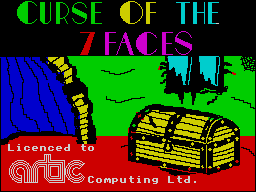
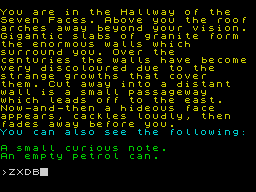
Discussion
Nobody has started a thread about this yet.
Publication
The Artic Computing release probably never happened. There are reviews for that version, but in Personal Computer Games in February 1985 there is a STOP PRESS announcement indicating that Imperial Software was going to publish the title instead. Micro Adventurer #17 explains in a News article that all Artic adventures are receiving a price reduction, and any title that does not conform to that change is going to be released under the Imperial Software label, with "Curse of the Seven Faces" as the first title affected by this decision.
Releases
- Jun 1984Classic Computing
- Jan 1985Artic Computing Ltd Sold as Curse of the 7 Faces, The Curse of the Seven FacesPound sterling 8.95
- 1985Imperial Software Sold as Curse of the Severn FacesPound sterling 8.95
Play
- cursesevenfaces.rzxRZX playback file
- CurseOfTheSevenFaces.tzx.zipTape image English23 KB
- CurseOfTheSevenFaces.tap.zipTape image English25 KB
- CurseOfTheSevenFaces(ImperialSoftware).tap.zipTape image 24 KB
- CurseOfTheSevenFaces(ImperialSoftware).tzx.zipTape image 24 KB
Documents
- CurseOfTheSevenFaces(ImperialSoftware).txtInstructions 2 KB
- CurseOfTheSevenFaces.txtInstructions 2 KB
Files and rights
No permission is on record either way. Screens and pictures are copied here on a take-down basis: if you hold the rights and want something removed, say so and it goes.
Credits
- Alan McDonaldcredited
- Peter Galbavycredited
Sign in to credit somebody, or say what these people did.
Scores
In the magazines
- Sinclair User #371985 · Gilbert Factor5/10
- Crash #131985 · Overall Value7/10
- C&VG (Computer & Video Games) #461985 · Personal Rating7/10
- Personal Computer Games #151985 · Overall6/10
Elsewhere on the web
- WorldOfSpectrum 6 votes5.83
In the magazines 14
C&VG (Computer & Video Games) #46Aug 1985 · p.1007/107/10
Personal Rating 7/10
Keith Campbell 7/10
After recently playing Clues 'O from Imperial Software ( C&VG June, Personal Rating 5), I was none too keen to load a second offering from the same source, in a similarly plain looking inlay. One shouldn't be influenced by the packaging of course, but it's difficult. The game started by telling me about yet another evil wizard and how I must get his spell book, staff, hat and cloak, and what little hope I still held vanished! It returned very quickly as I got into the game. A variety of original locations, and some surprise ways of finding new exits, combined with well-written and fairly lengthy descriptions to make an interesting game. My journey took me through a room of seven mirrors into a forest and a magic garden, whilst other routes led to the troll king rest room, from where his castle could be explored. Eventually I came across the troll king himself, standing by a rickety bridge and demanding the return of his crown before he would allow me across! Well, I didn't have it for sure! The input can be the usual two words most of the time, but longer phrases are supported, increasing the player's options for inventive solutions. Being in machine code, the response is immediate and the replies, although not identifying an invalid word, do give a clue as to whether a command I unrecognised or impossible. I would only fault the game on the fact that, from a number of locations, there are too many exits listed that lead nowhere - in other words, to the room you are already in. This tends to make the text and size look a bit Infocomish and, while some of the text is up to that standard, the size of the game is obviously not. Oh - that and the maze! I HATE mazes! Perhaps a little overpriced at £8.95, Curse of the Seven Faces is for the 48k Spectrum from Imperial Software of [redacted].
Sinclair User #37Apr 1985 · p.325/105/10
Gilbert Factor 5/10
Richard Price 5/10
CURSE OF THE SEVEN FACES Imperial Software Memory: 48K Price: £8.95 Oh, dear. How many more times do us poor adventurers have to find and destroy the evil wizard? Curse of the Seven Faces adopts the same old scenario by asking you to find the various items which comprise the average wizard's equipment. The game is a text-only adventure. Tired story line apart, there are some positive features. The location descriptions are very full. Magic is used a lot and can be used to transport you from one section of play to another. Technically, the program is well produced. Despite that, the game has little excitement as the puzzles are easy to solve. If you try to kill the Troll King with your small knife the screen simply tells you 'Nothing exciting happens'. Well, if I was a troll king I wouldn't take too kindly to being knifed. You begin to wonder whether the long descriptions have taken up space which could have been used for a spot of action. All told, Curse of the seven Faces is disappointing but attractively produced. It could well be regarded as a beginner's adventure.
Your Spectrum #13Apr 1985 · p.26
Clive Gifford
CURSO OF THE SEVEN FACES Imperial Software £8.95 As the software industry becomes dominated by the larger houses, many adventurers welcome releases from individuals and the like. Often the 'smaller' releases can be much more original and thoughtful than products churned out by 'big boys'. Sad to say, this isn't the case with Curse of The Seven Faces. The cassette comes with a photocopied inlay card which is just fine! OK, it's not flashy paper, but who cares? But someone could have corrected some of the spelling mistakes - I mean to say, someone's even mispelt the name of the game! Anyway that said, you begin your life as a 'poor pesant', which I suppose is a humble version of a 'peasant'. I don't mean to go on about the spelling and grammatical errors, but they're there in every location. Believe me, it's difficult to get into the atmosfere I mean atmospher... er... atmosphere! (See what happens when you play too many adventures, Clive? Ed.) The actual story line is pretty unoriginal - you've got to rescue a number of magical items (wands, cloaks and so on) from the forces of evil. Much of the adventure's quite playable, with some reasonable if uninspiring puzzles. However, the error-trapping is very poor. Good adventures should have a number of responses to wrong commands - some to aid the adventurer and others to entertain; needless to say, this adventure fails at both! Once you've read 'You Cannot Do That' and 'Nothing Exciting Happens' for the umpteenth time in a row, you begin to believe it - nothing ever exciting happens! Of course, you can have some limited fun with this kind of programming - I typed in some commands ordering a hero of the piece to eat a slab of rock! And guess what was flashed up on the screen - yes, you've guessed it - 'Nothing Exciting Happens'. Try it yourself sometime... and see if anything exciting happens to you! But whether you decide to chew rocks or not, it's bound to be more exciting than this collection of bytes. One to be avoided...
A perfect example of a bad adventure. 'Nothing Exciting Happens'!
Crash #13Feb 1985 · p.1029/108/106/1010/107/107/10
Atmosphere 9/10
Vocabulary 8/10
Logic 6/10
Debugging 10/10
Overall Value 7/10
Derek Brewster 7/10
DEREK BREWSTER'S ADVENTURE TRAIL PUBLIC IMAGE You know, when I buy a piece of software, or have it dropped through my letterbox, I expect the packaging and instruction leaflet to inform me on why this game exists and why it should merit my attention. Gilsoft's The Curse has a sparse cover which give more prominence to copyright and warning notices than to the substance of the program. One can only assume there is nothing worth mentioning and so what impression does this give? It hardly augurs well. Indeed, the cover supplies the name of the artist who decorated the inlay but there is no mention of the author of the program itself. Don't get me wrong about artwork, certainly packaging should have good artwork but this must reflect the quality of the program within, and not exceed it. The artistic details of Tower of Despair shows how artwork can add appreciably to the atmosphere and enjoyment of an adventure. But surely the software business has much in common with the music industry; the public will remain loyal to good programmers and seek out quality from whichever quarter it emanates just as loyalties to artists and the unearthing of excellence goes on even in the music world. Packaging and leaflets provide the room for two important aspects, the storyline and instructions. A storyline mustn't be so small as to fit in the window at the back of a cassette casing but should be full and enlightening enough to ensure a substantive background to develop in the player's mind before play begins and to encourage a feel for how the game might be tackled. Alas, I have witnessed so many storylines tagged on to a finished program to round off the marketing exercise. It should, of course, be in existence before coding begins so that the plot and theme are integral parts from the off, ensuring a sense of consistency and credibility pervades the whole. Instructions find a natural home on the cassette cover where browsing in a computer store may tell something of the game and should not reside in the program as this would then represent an unforgivable waste of memory (some Quilled games are guilty here) and neither should they reside on the tape before the game proper as this is then a waste of the game player's time (Knight's Quest, for example). All this brings me round to great and ever-fluctuating debate in software retailing, namely, should the package be large and flamboyant or small and utilitarian. Cynically, a large package is justified by the greater price charged for it, representing a greater capture of the consumer's money for the software business merry-go-round - packaging, printing, publicity. This last is a significant point as a large package is its own advert. Who can forget Valkyrie 17 in all the shops before Christmas? Perhaps there is a deeper message here, playing on the psychology which has it that if a company has gone to all the trouble of producing a large, expensive package, then what is on the tape must be worth something. Alas, I can think of many examples where this reasoning is misleading. What a large presentation can afford is a suitably glossy booklet giving in-depth playing instructions and a greater insight into the complexities therein. Certainly, no one would complain of the extra expense entailed to this purpose in the Midnight Trilogy. But what of the many where the supporting literature is thin on the ground and the cassette wallows in a sea of moulded plastic? It would seem the packaging here is only a precept for charging more. Unfortunately, you can not tell whether a large package has much supporting literature until you buy it, as shops are reluctant to leave anything on the shelves which might tempt petty thieving. Well, here is the crux of the matter; I myself, on the whole, prefer cassette-sized packs because they are easier to carry back home and are more utilitarian in a futuristic way. It is similar to my regard for the Spectrum - there is some fascination in a computer with 48K RAM which takes up just a little more room than a pocket calculator and can be unplugged and carried around with the ease of a book. So with cassettes. A world of adventure packed in to a s mall plastic box with neat, precise artwork, and playing instructions unfolding like a concertina. But if large packages grabbed the attention, and the shelf space, over the festive season one development had them cast as dinosaurs. Not only could you allot the big packs a position with the cassette-sized packs neatly stacked in cassette racks and cases, but, when browsing in shops their absence amongst the chart displays was very noticeable - they just could not fit into displays like the Boots Top Twenty! CURSE OF THE SEVEN FACES Producer: Artic Computing Memory Required: 48K Language: Machine code Author: Alan McDonald I review here a preproduction version (4.0) of Curse of the Seven Faces to be marketed by Artic Computing. If all companies supplied such authoritative maps of their adventures they might receive more sympathetic reviews. It isn't just the detailed map that has coloured my view of this game; the screen provides quite a dash of colour itself using some of the more pleasing Spectrum shades to show off a text adventure to its best. This along with the attractive colours gives the program the edge in presentation. Alas, all is not well though. This is a good game in need of a script writer. As it stands the plot is so weak and thin, vacuous and inconsistent, it could only be used in a second-rate American movie - you know - the type that comes round every school holiday and makes a fortune to the utter bewilderment of anyone who has sat rigid for what seems like hours in front of adverts for choc-ices, and films about pampered poodles who, when tired of strutting and fouling Sunset Boulevard, quite like to windsurf along Venice Beach. Anyway, it is a shame this game hasn't got a credible storyline because otherwise it has many strong points including copious and atmospheric descriptions in what is a very long adventure oiled by a friendly vocabulary. This paragraph is only for those who don't feel queasy when they watch M*A*S*H on television or who feel that long spells of adventuring should be punctuated with contrasting spells of hard-headed reality. Mazes are old hat and this game has two of the wretched things. The EXAMINE command isn't error-checked so EXAM XXX gives the same response as EXAM WALL, and EXAM SHELF gives the wrong response. In a large, dense, deciduous forest you see a garden spade but when you go to pick it up it confusingly becomes a small silver spade. But more to the point, what is it doing in a hole in a tree in the first place? In another location you chance upon some dead adventurers, and searching their bodies turns up absolutely nothing while elsewhere objects are strewn around in the most unlikely places like confetti! if adventures can be compared to novels (and surely text adventures must be) then this adventure clearly falls short of the mark, unless it's a surrealist work. The structure of the plot is a trifle dull also. Nine times out of ten if you find something you'll find out what to do with it in the very next frame. Hence, I'm not giving too much away when I tell you that you'll need the stones in the armoury. Even supplied with this clue you might find the eventual solution to the problem here rather implausible. The adventure has no classic problems but instead relies too much on magic, and why does the wizard's own spell book give details on how to kill the wizard? So much for what is amiss. What about saving grace? The descriptions are really quite impressive. Here is an average paragraph: 'You are at the edge of a large, dense, deciduous forest. As you walk between the trees, the old leaves of last autumn crunch loudly under foot, whilst above you the new buds of spring are blossoming. A small pathway continues to the south-east, whilst to the north a hill slopes down into the peaceful valley.' All eight compass directions are used with NE, SW etc. and the basic competence of the programming is high; the input routine is so sure-footed with a strong beep, and the action is so fast, that you get a tangible sense of pleasure just zipping around at high speed. The magic has you flying around even faster from here, there and everywhere like a demented pantomime fairy. Curse of the Seven Faces is a structurally sound piece of programming but in these days when software is marketed with the sort of coherence and panache shown by the likes of the Midnight Trilogy, is it really enough just to plonk the adventurer into a labyrinth of anonymous wizards, trolls and dragons with a strange admixture of fantasy artefacts such as a staff, hat and cloak alongside futuristic poles inserted into locks, refined petrol and security discs more at home on a spaceship? Since, otherwise, the game is sound with many worthy features, it is to the extent you find such inconsistencies tolerable which will dictate your opinion of this game. To my mind it's' a bit like organic farming with DDT or becoming self-sufficient in video cassette production. COMMENTS Difficulty: quite easy Graphics: none Presentation: very good Input facility: goes beyond verb/noun in places Response: instantaneous
Personal Computer Games #15Feb 1985 · p.836/106/106/106/106/10
Atmosphere 6/10
Complexity 6/10
Interaction 6/10
Overall 6/10
Steve Cooke 6/10
MACHINE: Spectrum, Amstrad PRICE: £8.95 Artic have been busy again on behalf of Spectrum and Amstrad owners. After bringing out Eye of Bain - their first graphics adventure - they've reverted to text-only with Curse of the 7 Faces. Don't let the text-only aspect put you off, since the location descriptions are detailed and reasonably original. Your objective is to achieve Wizard status by finding a spell book, a staff, a hat, and a cloak. I should point out here that in real life you would also have to apply for membership of the National Union of Wizards, normally only granted following payment of a massive fee. For Artic's sake, however, I am content to let the matter rest for the moment. Once you've achieved such elevated status, you must prove your mettle by defeating another (evil) wizard to win the game. There are approximately 150 locations and an average vocabulary, linked together by a number of puzzles, most of which are fairly logical and perhaps not quite so difficult as some of Artic's earlier offerings. Even the obligatory maze gives away most of its secrets by having each room named after a different colour, and you can list the game's vocabulary by typing 'Dictionary'. Like all Artic's games, this is an enjoyable adventure. It doesn't have independent characters wandering about, or enormously complex sentence input, but it does have a hypnotic mirror, a Herculean rabbit, and enough to keep you busy far into the night. STOP PRESS: Curse of the 7 Faces will now be released by Imperial Software (NOT Artic).
Personal Computer News #98Feb 1985 · p.28
Bob Chappell
ARTIC TROLL One of Artic's new adventures, Eye of Bain, it is first with graphics. Bob Chappell compares it with a text-only release, Curse of Seven Faces. Artic has long been respected for its text adventures. Its earlier games Espionage Island, Planet of Death, Inca Curse, Ship of Doom and the highly challenging Golden Apple, have long posed challenges for adventure aficionados. Now it seems to have bowed to the inevitable - adventures with graphics. Perhaps bowed is not quite the right word - nodded might be more apt. For Artic has brought out two new adventures, one with graphics and (hooray) one without. WORD PERFECT First, the text only adventure, Curse Of The Seven Faces (Spectrum and Amstrad), written by Alan McDonald. Like any text adventure worthy of the name, Curse has detailed and literate location descriptions, generating an atmosphere that quickly enthralls. There are a lot of places to explore, (over 140), with plenty of objects and puzzles to stretch your inventiveness. The plot concerns tracking down an evil wizard and takes you through caverns, mountains and forests. While accomplishing your mission, you'll pass through a trolls' lair, the inevitable maze, a castle, the domain of the elves, a mansion and the wizard's realm. Most of the puzzles are not too difficult and, to be honest, are hardly original either, though there are a few really novel twists which should test your mettle. Some of the objects don't sit very easily with the general theme of the adventure - I'd rather not see guns and Microdrive cartridges in an adventure that features magic wands and spell books. Whatever the shortcomings, the presentation and the atmospheric text compensate. You'll certainly get good value for money if you buy it. ART IT ISN'T Now the Eye of Bain (48K Spectrum, £6.95), the one with pics. Mind you, you might not realise it had any graphics, as the adventure kicks off in text mode. Only by typing LOOK or DRAW will the screen clear and a picture of the current location slowly appear. A touch of the Enter key and the text reappears. And a good job too. The pictures are very simple and do absolutely nothing to enhance the game. Although the textual descriptions are fairly spartan, if your own imagination cannot conjure up better images than those provided by the graphics in Bain then you must either be under three or a cabbage leaf. Setting aside that grumble, the adventure itself is pretty good. The eye of the title, if you hadn't already guessed, turns out to be a priceless treasure. It is hidden in a temple and jealously guarded by a somewhat vicious tribe of Alvanians, so beware. POLE POSITION I had arrived at the tribe's camp. My Alvanian, clearly being a trifle rusty, must have said something like 'May mildew strike your grass skirts', instead of saying 'Greetings from the Great White Mother across the water'. I deduced that I must have committed some such minor breach of diplomacy by the fact that I was in a native hut, shackled by one leg to pole. Having parted myself from the pole without having to saw my leg off, I rejoined my hosts, expecting them to be overawed by my Houdini-like escape. I was somewhat taken aback to be executed on the spot. Still smarting, I restarted, tried a different tack and was soon clear of the Alvanian mafia. I later passed a poor wretch tied to a whipping post and also had a fairly traumatic experience with a shapeless black beast down a well. I didn't find a way to get the chain off my leg, but that didn't matter - I died of thirst in the desert. The text is neatly presented and response to the usual two-word input is immediate. When the program cannot understand a word, it tells you whether it's the verb or noun that's the problem. A good adventure with a decent assortment of puzzles. The text descriptions could have been beefed up if the graphics had been given the elbow. BOOK LOOK Room for just a brief mention of two useful books published by Datamost, a division of Prentice-Hall, entitled A Shortcut Through Adventureland, volume one provides detailed solutions to 14 adventures that are probably better known to Atari and Apple owners. The solutions include Sierra OnLine's Ulysses and the Golden Fleece and The Dark Crystal and Sirius' Blade of Blackpool. Volume two is likely to be of greater interest to UK adventurers, as it covers all but the latest Infocom adventures. The books are priced at $9.95 each. DUNGEONADE For all those suffering souls who are bewitched, bothered and bewildered by Scott Adams' superb Sorcerer of Claymorgue Castle. The Dungeon Master takes pity on lesser mortals who do not possess a brilliant enough mind (not to mention Adventure International's detailed crib book) to enable them to complete this excellent adventure. The answers are not written in Alvanian, but merely backwards: Can't find the secret of the Plain Room? SNOITCER IDTN EREF FIDN IGNI HSUP DNAG NILL UPYR T Can't open the Stone Door? LLEP SDEE SESU NEHT ELTS ACOT NIYA WREH TONA DNIF More help with Stone Door? TSAE NEHT ECIW TNWO DMIW SHTA ERBD LOHT AOMN I
Assemblage carries this game and has 6 references of its own.
News/Note3
- ZX Computing #19Jun 1985 · p.16
- Personal Computer Games #11Oct 1984 · p.101
- Popular Computing Weekly #33Aug 1984 · p.39
Review2
- Home Computing Weekly #98Feb 1985 · p.38
- Popular Computing Weekly #29Jul 1984 · p.38
Tips1
- Sinclair User #113Jul 1991 · p.30
Solution1
- Sinclair User #110Apr 1991 · p.25
Feature1
- Popular Computing Weekly #2Jan 1985 · p.38
Related
- Compilations
- Assemblage, ZX-Spectrum Vega
- Same entry at
- Spectrum ComputingZXInfo
Reviews from people here
Sign in to write about this, or make an account. It takes a minute and lets you correct the catalogue too.
No tag recorded.
Sign in to correct or add to this.
Hold the rights to this and want it taken down?