
Mikro-Plus
Hardware: Add-on
Mikro-Gen Ltd · 1985
Discussion
Nobody has started a thread about this yet.
Remarks
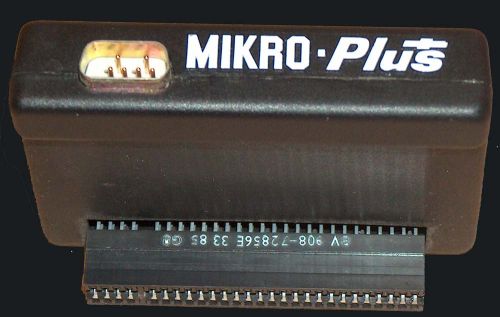
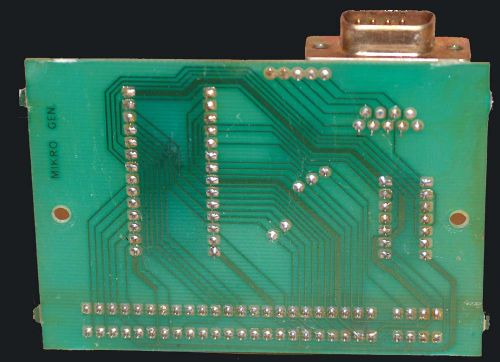
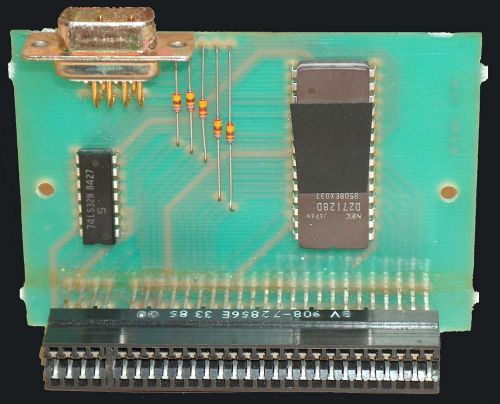
Contains a 16K shadow ROM and joystick port. This interface is strictly used by (and came with) the game {Shadow of the Unicorn|Mikro-Gen Ltd|0004424}.
Not sold separately
Other files
- ShadowOfTheUnicorn.rom.zip? 13 KB
Files and rights
Distribution permission is on record, granted to another archive rather than to this one. Screens and pictures are copied here; everything else links to the archive that holds it.
- AllowedMikro-Gen Ltd → WorldOfSpectrum
In the magazines 1
Sinclair User #46Jan 1986 · p.54
John Lambert
STICKING TO THE BEST Zap in style. John Lambert juggles with joysticks. Joysticks are the most popular add-on for the Sinclair computers, not just for playing games but also for drawing, cursor control in word processing packages and for moving anything around the screen. The keyboard can be used for all of those things but it is so much easier with a joystick. Choosing a joystick from the hundreds available is not an easy decision, but this guide will show you what to look for, and how to connect it to a Spectrum or QL. Joysticks are generally all the same. They may be different shapes and sizes but they all contain a number of simple switches which get turned on or off as the stick is moved. That type of digital joystick was first used on a home computer by Atari and, therefore, is sometimes known as the Atari standard. All Sinclair machines use this type of joystick interface. The switch used can vary a great deal. The cheapest joysticks, such as Quickshot 1, us a bubble which when compressed by the stick makes contact. Those can wear fairly quickly and cannot stand up to heavy use. Next in price and strength are leaf spring switches where the stick causes two pieces of metal to make contact. Finally, the most expensive joysticks use microswitches. Those will last a long time and can easily be replaced should they go wrong. Generally, you should buy the most expensive joystick you can afford as that way it should last a long time. Try to get one with a metal shaft in the handle - plastic ones break - and, if possible, try it out in the shop. The feel of a joystick is very important, some are sloppy and others require a lot of movement before they register. it is within the interface that the complications arise. All interfaces have at least one Atari standard socket where the joystick is plugged in, but those vary in how they tell the computer when the stick has been moved. Which type of interface you buy will depend on what software you want to use with it. The most common method is known as Kempston - named after Kempston Microelectronics who invented it. What that does is to configure the interface as part of the Z80 I/O map so that it can be read - to find what position the joystick is in - using the instruction IN 31. Another method is for the interface to emulate the cursor keys - five to eight plus zero as fire. For obvious reasons that is known as Cursor. The third method is known as Sinclair and emulates the six to nine keys, with zero as fire. That is based on Interface 2 from Sinclair. Why Sinclair wanted to bring out yet another method is anybody's guess! The problem is that until you but the software you have no way of knowing which of those three methods it will use. Many programs give you a choice but unfortunately not all. The way to get round that is to use a programmable interface. Those allow you to let each stick direction and fire represent a key on the keyboard. All games have a keyboard option and you just set the interface to the keys it uses. That also gets round the problem of game that do not use any of the three normal methods - Psion is very bad in that respect. Unfortunately, programmable interfaces tend to be the most expensive, and in some cases can be very difficult to set up. For playing arcade games a Kempston standard interface is the most useful, and the cheapest. Some interfaces combine more than one method in the same box, but the more facilities it has the more expensive it will be. Some joysticks offer extra facilities and you should take care when buying those. Although it is popular to have two fire buttons on a joystick, in many cases they are joined electrically and perform the same function, so it does not matter which one you press. Some joysticks, however, have two, independent, fire buttons and some interfaces can take advantage of this. That type of joystick can also be used with interfaces which normally only expect one fire button, and so are particularly worth considering. Care should be taken, though, as pressing the used button on some interfaces, will cause the computer to crash. Another common extra is auto-fire, giving an auto repeat on the fire button. In order to make their interfaces more attractive some companies add extras which are not related to joysticks. The best known is probably the Nidd Valley Slomo which lets you slow down the computer so that - in theory - the games are easier to play. Two other products, the Opus Discovery 1 disc drive, and the Mikro-Gen Mikro-Plus include Kempston compatible interfaces. As far as the QL is concerned life is much simpler. The two control sockets on the back are already wired to emulate either the cursor keys and space, or the function keys. All you need to plug in a joystick is an adaptor which fits the control socket at one end and a standard joystick at the other. Joysticks are available which plug straight into the QL - ones that have a QL style plug rather than the Atari standard. The problem with those is that when you upgrade to a different computer you will have to buy another joystick, as it is unlikely it will fit the new machine. Buying a joystick and interface can be a harrowing experience. Don't be afraid to try out half a dozen in a shop - and don't buy from a shop which won't let you experiment. Ask your friends and, of course, read the reviews in Sinclair User. PROTOCOL 1 Company: AGF Telephone: [redacted] Price: £9.95 Kempston compatible interface which contains a through port. PROTOCOL 2 Company: AGF Telephone: [redacted] Price: £14.95 Kempston, cursor interface. Contains a through port. PROTOCOL 3 Company: AGF Telephone: [redacted] Price: £19.95 Programmable interface. As Protocol 4 but not Kempston compatible. PROTOCOL 4 Company: AGF Telephone: [redacted] Price: £29.95 Programmable, Kempston compatible interface. Top of the range interface which uses a system of preprogrammed cards. Those clip over a membrane on the interface. Also has a through port, reset switch, and free demo tape. Fiddly to program but one of the few which allows auto-fire. It also allows a second interface to be plugged into the back for a second player. COMCON Company: Frel Telephone: [redacted] Price: £19.95 Programmable interface which, although it may not look too good, is easy to program using leads plugged into a matrix. Can run joysticks with two fire buttons. GAMES ACE Company: Datel Telephone: [redacted] Price: £10.99, £17.99 (with Quickshot II) Kempston compatible interface. Allows the use of auto-fire joysticks and outputs sound through the television. SWITCHABLE JOYSTICK INTERFACE Company: Datel Telephone: [redacted] Price: £12.95, £19.99 (with Quickshot II) Kempston, cursor, Sinclair compatible interface. Switchable interface which covers all the main joystick standards. Can be used with auto-fire joysticks. TURBO ACE Company: Datel Telephone: [redacted] Price: £15.99, £22.99 (with Quickshot II) Kempston, cursor, Sinclair compatible interface. Top of the range model which includes all the features of the Games Ace and the Switchable interface. Well priced for the wide range of facilities. DUAL PORT Company: DK'tronics Telephone: [redacted] Price: £13.00 Kempston and Sinclair compatible interface. Interface includes two sockets, one for Kempston and one for Sinclair. PROGRAMMABLE Company: DK'tronics Telephone: [redacted] Price: £22.95 Programmed by loading software from tape. FORMULA 1 Company: Kempston Telephone: [redacted] Price: £16.95 Large joystick with two - not independent - fire buttons. It uses micro switches and has a metal shaft so it should last a long time. Good value. FORMULA 2 Company: Kempston Telephone: [redacted] Price: £11.95 Three fire buttons and plenty of movement for the careful enthusiast. PROGRAMMABLE Company: Fox Telephone: [redacted] Price: £28.95 Programmable interface holding the details of which keys to use for 16 games in a battery backed RAM. Can also be used as a Psuedo ROM. Good operation and value for money. FLIGHTLINK HOTSHOT Company: Frel Telephone: [redacted] Price: £10.50 Small hand held joystick with a very good precise, action and two independent fire buttons. JOYSTICK INTERFACE Company: Kempston Telephone: [redacted] Price: £9.95 Kempston interface made by the inventors of the standard. KEMPSTON PRO Company: Kempston Telephone: [redacted] Price: £16.95 Kempston, cursor, Sinclair compatible interface with three sockets and a slot for games ROMs. Covers all the main standards including two Sinclair sockets, one to five and six to zero. TRISTATE Company: Kempston Telephone: [redacted] Price: £12.95 Kempston, cursor, Sinclair compatible interface. Two sockets cover all the main standards. MIKRO-PLUS Company: Mikro-Gen Telephone: [redacted] Price: £14.95 Kempston compatible interface. Sold as part of the Shadow of the Unicorn game and has 16K of EPROM onboard which will be used in subsequent MikroGen games. Expensive for just a Kempston compatible interface but good value - if you like the game. PACESETTER Company: Nidd Valley Telephone: [redacted] Price: £14.95 Kempston interface with through port and Slomo. PROGRAMMABLE PACESETTER Company: Nidd Valley Telephone: [redacted] Price: £29.95 Tape programmable with Slomo built in, and the ability to use two independent fire buttons. Good range of features. QUICKSHOT 1 Company: AGF Telephone: [redacted] Price: £7.95 Basic joystick which has been overshadowed by the II. QUICKSHOT II Company: AGF Telephone: [redacted] Price: £9.95 Popular joystick, rather fragile and hence, tends to wear out quickly. RAT Company: Cheetah Telephone: [redacted] Price: £19.95 Infra-red remote control joystick and interface. The recently reduced price is good for a complete system and it is the only remote control joystick for the Spectrum. The joystick is a pressure pad which takes a while to master. If possible try one out before buying. TURBO Company: RAM Telephone: [redacted] Price: £18.50 Kempston, cursor, Sinclair compatible interface. All the main standards including two sockets for Sinclair, one to five and six to zero. Also included are ROM slot, full width through port and a reset button. SCOREBOARD Company: Kempston Telephone: [redacted] Price: £19.95 Joystick housed in an enormous consol which is bigger than the Spectrum. Fine if you want to pretend you are in an arcade but a bit over the top. SPECTRUM INTERFACE Company: RAM Telephone: [redacted] Price: £9.95 Standard Kempston interface without through port. SPECTRUM KC Company: Nidd Valley Telephone: [redacted] Price: £8.95, £9.95 (with through port) Kempston compatible interface. Good price for a Kempston with a through port. SUPREME JOYSTICK Company: Cookridge Computer Supplies Telephone: [redacted] Price: £15.95 SURE SHOT JOYSTICK Company: Cookridge Computer Supplies Telephone: [redacted] Price: £12.95 - QL, £15.95 - Atari ZIPSTICK Company: Cookridge Computer Supplies Telephone: [redacted] Price: £12.95 Joystick which is guaranteed for two years' wear and tear.
Mikro-Plus: contains extra memory.
Reviews from people here
Sign in to write about this, or make an account. It takes a minute and lets you correct the catalogue too.
Everything ZXDB can hold about this is here.
Sign in to correct or add to this.
Hold the rights to this and want it taken down?