
Demon Lord
Adventure Game: Text/Illustrated · ZX-Spectrum 48K · 1 players · English
Mansfield Computers & Electronics · 1984 · Pound sterling 5.50
Also known as Serpent from Hell (English)
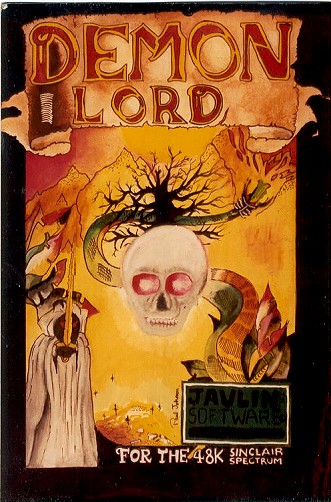
(ScorpioGamesworldLtd).jpg)
(ScorpioGamesworldLtd)_2.jpg)
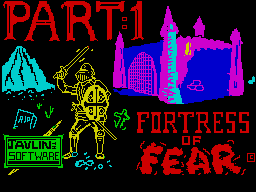
(ScorpioGamesworldLtd).png)
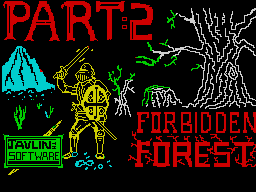
(ScorpioGamesworldLtd).png)
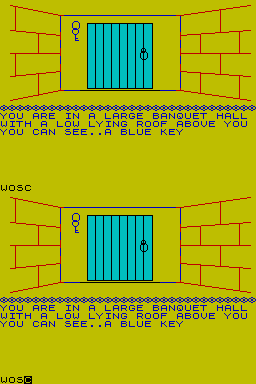
Discussion
Nobody has started a thread about this yet.
Remarks
part 1: Fortress of Fear; part 2: Forbidden Forest (needs code from part 1)
Releases
- 1984Mansfield Computers & ElectronicsPound sterling 5.50
- 1985Scorpio Gamesworld Ltd Sold as Serpent from Hell
Play
- demonlord.zipRZX playback file
- DemonLord.tzx.zipTape image English32 KB
- DemonLordPart1.tap.zipTape image English19 KB
- DemonLordPart2.tap.zipTape image English19 KB
- DemonLord(different)(SerpentFromHell)(ScorpioGamesworldLtd).tzx.zipTape image English33 KB
- DemonLord(SerpentFromHell)(ScorpioGamesworldLtd).tzx.zipTape image English27 KB
- DemonLordPart1(SerpentFromHell)(ScorpioGamesworldLtd).tap.zipTape image English19 KB
- DemonLordPart2(SerpentFromHell)(ScorpioGamesworldLtd).tap.zipTape image English20 KB
Documents
- DemonLord.pdfInstructions English56 KB
- DemonLord(SerpentFromHell)(ScorpioGamesworldLtd).txtInstructions English1 KB
Files and rights
No permission is on record either way. Screens and pictures are copied here on a take-down basis: if you hold the rights and want something removed, say so and it goes.
Credits
- Richard ShirleyCode
- Paul Johnson [2]In-game Graphics
- Paul Johnson [2]Inlay/Poster Art
Sign in to credit somebody, or say what these people did.
Scores
In the magazines
- Sinclair User #241984 · Gilbert Factor5/10
- Personal Computer News #581984 · Overall Value2/5
- Crash #161985 · Overall Value3/10
- C&VG (Computer & Video Games) #461985 · Personal RatingAvoid at all costs!
Elsewhere on the web
- WorldOfSpectrum 2 votes4.00
In the magazines 6
C&VG (Computer & Video Games) #46Aug 1985 · p.105Avoid at all costs!
Personal Rating Avoid at all costs!
Simon Marsh
Why do I always get the worst games to review? The grave error of judgement I was forced to play this month is called Serpent from Hell. The plot printed on the cassette inlay has a very suspect feel about it. The main idea is that the world is about to be destroyed by an evil force called Goroth, the Serpent from Hell. You, being the last remaining Knight of the Round Table, have to find the sword Excalibur and destroy Goroth. It may be a good idea to quote from a legend, but when you get two of them muddled up and then produce a bad game, it's asking for trouble! The program is written in a mixture of Basic and machine code, so the responses are quite fast, but the vocabulary lets the game down. Graphics are to be found in the game, but to me these were so slow and boring that they seemed a complete waste of time and memory. Serpent from Hell is for the 48k Spectrum, priced £1.99, but only worth the cassette it is recorded on.
Crash #16May 1985 · p.1182/102/105/108/103/103/10
Atmosphere 2/10
Vocabulary 2/10
Logic 5/10
Debugging 8/10
Overall Value 3/10
Derek Brewster 3/10
DEREK BREWSTER'S ADVENTURE TRAIL THE COMMON MARKET The other week I was looking around town for a piece of software to buy as a present for a young friend. I dug out past issues of Crash and checked all the smashes, and one or two not-so-smashing just to be on the safe side. Having spotted a small number which particularly interested me, I trekked off around the over-heated megastores and the smaller computer shops and, I know I've said this before, it was a shock to find out how difficult it was to buy the software I wanted. In the past I've kept an eye on adventure stocks in the shops - it was a surprise indeed to find arcade games, supposedly much more commercial, similarly afflicted by the mysterious discrepancy between what the public wants now and what's on offer. On my travels I wondered just how many Crash readers had trekked dispirited round these stores with little or no sign of the entertainment they were after. It is true that Crash reviews some games so quickly that time must pass before they reach the shelves, but I did notice one or two very average new games which had somehow dodged the inherent delay in the buying system only to clog up the shelves reserved for the best. In the end the only ones I could spot were the cheaper games from British Telecom traded under the name of Firebird, and I used the change from my purchase to help pay for an evening eating out. SERPENT FROM HELL Producer: Scorpio Gamesworld Retail Price: £1.99 Language: BASIC & Machine code Author: Richard Shirley &Paul Johnson Everyone in modern civilisation is vulnerable to the consumerist kick a strong desire to buy something (anything) before heading home convinced the trip was worthwhile. In Aldous Huxley's Brave New World it was a crime not to consume and indeed, despite media warnings of the credit boom, modern society would collapse were we all to decide to stop consuming tomorrow (that would give the chancellor something to think about next budget). Some companies choose to prey on our susceptibilities by offering goods at knock down for knock about) prices, but the truth is such purchases often only delay the consumerist craving. On the other hand, if you are struggling to get to grips with a more pricey complex strategy game, you'd be far too busy to make it to the shops in any case (even for food)! Don't get me wrong, some cheap games are indeed good value for money, but most, alas, prove the notion behind the saying 'you gets what you pays for' (explaining the universal unpopularity of poverty). This game is one of the many, and what you get is worth approximately £1.99. Enough of modern society and back to noddy land (my favourite tourist destination). According to the ancient books of the great monks, an evil force shall devour the land, 'before you the earth will open and from within an evil power shall erupt' . Now this prophesy has been fulfilled and the land is gradually wasting. As the last remaining Knight of the Round Table it is your duty to King and country to escape from your ambushed castle, find the legendary Excalibur, and destroy the source of all evil, Goroth the Serpent of Hell. As if one program for a pittance wasn't enough, this game has two parts, one on either side of the tape. On the cassette cover six helpful hints (eg 'remember your manners' and 'don't be greedy'!) follow a short list of useful words. You find yourself trapped within a banquet hall in the first frame but it looks and feels far more like a prison cell and it's hard not to think of it as such. The picture is very simple a locked door stands in front of you. The colours are particularly awful. Graphics, when as poor and simple as they are here, are responsible for the view that graphics add nothing to adventures and worse, actually min what little atmosphere has been built up by the text. The vocabulary it uses is awkward and unfriendly, made worse by the dumb computer; the program literally ignores all commands except those it chooses as necessary for your progress. And we are back to old nuts when a program only accepts TAKE and not GET. Abbreviations are too sophisticated for this one everything must be spelled out with no I or even INV options on INVENTORY. EXAMINE KEY in the first frame brings no reply, quite a surprise after seeing the replies invoked by examine in Emerald Isle. Whenever you try something the program does not accept, the picture is redrawn, even if it's just a case of picking up an object as objects are depicted in the location picture. Text is printed slowly across the screen in a manner, and with a sound, similar to the labouring sportsnews teleprinter. Just to prove the program's obstinacy, there is no DROP. This all takes us back through three years of adventuring, but even that long back many adventures had much more sophistication than this one. Serpent from Hell follows Ruby Runaround as another very cheap adventure from Scorpio. The response is reasonably fast and the input routine solid with an accompanying bleep. The game offers minimal graphics and a confused scenario. Where it really falls short is in the area of communicating with the computer you are often left wondering where the program has gone. COMMENTS Difficulty: difficult due to lack of response and awful vocabulary Graphics: yes, but lacking in detail and colour Presentation: printing of text is slow Input facility: verb/noun, I think the instructions do not concern themselves with such trivia Response: most of the time it doesn't have one and simply ignores you
Personal Computer News #58Apr 1984 · p.341/53/54/52/5
Lasting Appeal 1/5
Playability 3/5
Use Of The Machine 4/5
Overall Value 2/5
Barry Miles
Bob Chappell
Geof Wheelwight
John Lettice
Kevin Bergin
Russel Jones
Simon Williams
Tony Harrington
PCN MICROPAEDIA VOL 21 PART 1 GAMES COMPENDIUM Atari Arcade Action BBC Blast-off Commodore 64 Cavalcade Spectrum Spectacular Dragon Digressions Welcome to gameplayers' heaven. This week sees the beginning of our two part Micropaedia devoted exclusively to games reviews. We have collected together a large selection of arcade, adventure and educational games for six of the most popular micros: the BBC B, Electron, Sinclair Spectrum, Dragon, Commodore 64 and Atari. NAME: Demon Lord SYSTEM: 48K Spectrum PRICE: £9.95 PUBLISHER: Javlin Software, [redacted] FORMAT: Cassette LANGUAGE: Basic OTHER VERSIONS: None OUTLETS: Mail order/retail This cassette contains the first half of four-part Demon Lord: Fortress of Fear and Forbidden Forest. There's a simple picture for each location. Set in England at the time of King Arthur, your task is to infiltrate Perilous Castle, lair of the vile Demon Lord, where Arthur himself is 'held in chains of finest steel, tempered in hell.' The graphics occupy the top half of the screen, with a description underneath, including exits and visible objects (still worth having a look for others) and room for your responses at the bottom. The drawings are adequate, and you have to wait for the picture to be drawn even if you're just passing through a location. As the author has chosen to include his objects in the picture, it has to be drawn each time you take an object. What's more, some locations have several objects yet you are allowed only single entry commands. Your tasks require careful planning though, and you often have to decide whether discretion or violence is preferable. Do you stay and fight the head hunters, run away, hide, or what? The customary healthy dose of magic is involved. A help feature in each location suggests what line of thought you ought to be following; you also need to uncover secret words at different stages, as these are needed to go through doorways and past an Elf in Section Two who gives you a grilling worthy of Magnus Magnusson. At Demon Lord has good points, and taxes the brain at times but the clumsy text isn't especially evocative. Your commands are read as strings, so unless you have it spot on within the two or three possibilities you get the standard response: "Sorry not acceptable."
Sinclair User #24Mar 1984 · p.65/10
Gilbert Factor 5/10
Memory: 48K Price: £5.50 Adventure games tend to have certain things in common, points which the experienced adventurer takes for granted. N, S, E and W usually move a character north, south, east and west respectively; commands take the form verb, noun. Once one adventure game has been played, those points become self-evident, but they are battling for a beginner, and Demon Lord makes no provision for a beginner. The game is recorded in two 48K parts on two cassettes, which are sold separately. The players task is to find and rescue King Arthur from Perilous Castle and to kill the Demon Lord who has taken him prisoner. Each Location through which the player passes is drawn painstakingly in such detail that a scene containing a key will be re-drawn without it following the command TAKE KEY. That makes progress slower than it might be, while adding little to the game. In fact, as the game progresses and more and more commands are rejected as being NOT ACCEPTABLE, it becomes obvious that too much memory has been allocated to the graphics and not sufficient to vocabulary. To be enjoyable, an adventure game should have a number of responses. Demon Lord repeatedly produces the response SORRY NOT ACCEPTABLE. That can produce the wrong impression. TAKE THE BLUE KEY is labelled as unacceptable, whereas other games would indicate by a formula such as TAKE WHAT? that the problem lay with the limited program vocabulary. Demon Lord is produced by MCE, [redacted].
Sinclair Programs #17Mar 1984 · p.9
June Mortimer
SOFT FOCUS New this month. Softfocus will be a regular feature, providing short reviews of the newest software for the Sinclair Computers. This month the focus is on the way ahead for software. Late last year, programs produced for the Spectrum Christmas market pointed the way for software in 1984. Ant Attack by Quicksilva and Android 2 by Vortex both included stunning animated graphics routines, setting a new standard for other programmers. Artic Computing has now produced Bear Bovver for the 48K Spectrum, a shining example of animated graphics, which are used in an arcade-style game. Satan's Pendulum by Minatron Computing (48K) also includes animated sequences and, for keen programmers, gives a guide to how they were produced in the accompanying booklet. While such excellent original software is being produced, software houses which cling to versions of Space Invaders and Pac-man are looking more and more outdated. The Romik Galactic Trooper and 3D Monster Chase are competent and bug-free games but do not have sufficient new ideas to make them attractive in 1984. Realistic screen displays are becoming more and more common. Wheelie, from Microsphere for the 48K Spectrum, sends the player hurtling past obstacles and through caverns in search of the ghost rider. In the program, crash sequences are very graphic and tend towards the tasteless, while in Deathchase from Micromega - 16K Spectrum - the view from a motorcycle is shown in realistic detail but the death of another rider is not depicted at all. Problems as to how players should be made to suffer for the misdeeds of their on-screen persona, whether they should watch deaths in graphic detail or miss them completely, are resolved in the new Automata game for the 48K Spectrum, Pi-Eyed. The hero, the Pi-man, wanders from pub to pub, drinking beer and avoiding obstacles. Wandering into other buildings for safety results in the telling of very bad jokes, a fate far worse for the player than any graphics representation could be. With programs such as the Legend Valhalla (48K) and Melbourne House Hobbit (48K) on sale, other adventures fade into insignificance. The Island, produced by Virgin Games for the 48K Spectrum, is an enjoyable adventure, with added sound effects and short games contained in it. Demon Lord by Javlin Software is an enormous adventure, made up of four 48K adventures on two separate cassettes. Pictures are given, in painstaking detail, of each location, but the vocabulary is small, making it extremely difficult and very frustrating to play. Computer magazines receive a constant stream of letters enquiring about software other than games for computers. Mansfield Park and Nineteenth Century England, both by Sussex Software for the 48K Spectrum, act as secondary-school-level revision aids. Their subjects are those suggested by the titles and each subject is divided into different areas, for which questions and detailed answers are given on which the user can be tested. New ZX-81 games, so plentiful a year ago, are becoming rarer and rarer. Contrast Software has produced Fort Apache, a 16K strategy game, in which the player takes the part of a general with 300 men to command, laying siege to an Apache fort. It is a game involving thought and forward planning rather than fast reactions. Cyborg Wars, by Stratagem Cybernetics, is a more complex 16K strategy game involving up to four players in an imaginary galactic conflict between four nations of androids. The game relies more strongly on the instruction booklet than could be expected from a computer program but it is a carefully-thought-out and exciting game. Three games for the ZX-81 are included on the cassette accompanying the book ZX-81/TS-1000 Programming for Young Programmers, published by McGraw Hill. Bomb Run, written in machine code for the 1K ZX-81, is a version of the popular City Lander type of program in which the player must bomb buildings from an aircraft to avoid running into them. Mazer, also for the 1K ZX-81, is a simple maze game in which the aim is to avoid the ghost for as long as possible. More complicated is Golems, on the same cassette, for the 16K ZX-81, a strategy and fantasy adventure in which the aim is to outwit the Lord of the Black Tower. More detailed reviews of all these games, together with their respective Gilbert Factors, can be found in Sinclair User.
News/Note1
- Sinclair Programs #17Mar 1984 · p.9
Related
- Same entry at
- Spectrum ComputingZXInfo
Reviews from people here
Sign in to write about this, or make an account. It takes a minute and lets you correct the catalogue too.
No tag recorded.
Sign in to correct or add to this.
Hold the rights to this and want it taken down?