
Hobbit 8030
Hardware: Computer · 1 players
Discussion
Nobody has started a thread about this yet.
Remarks
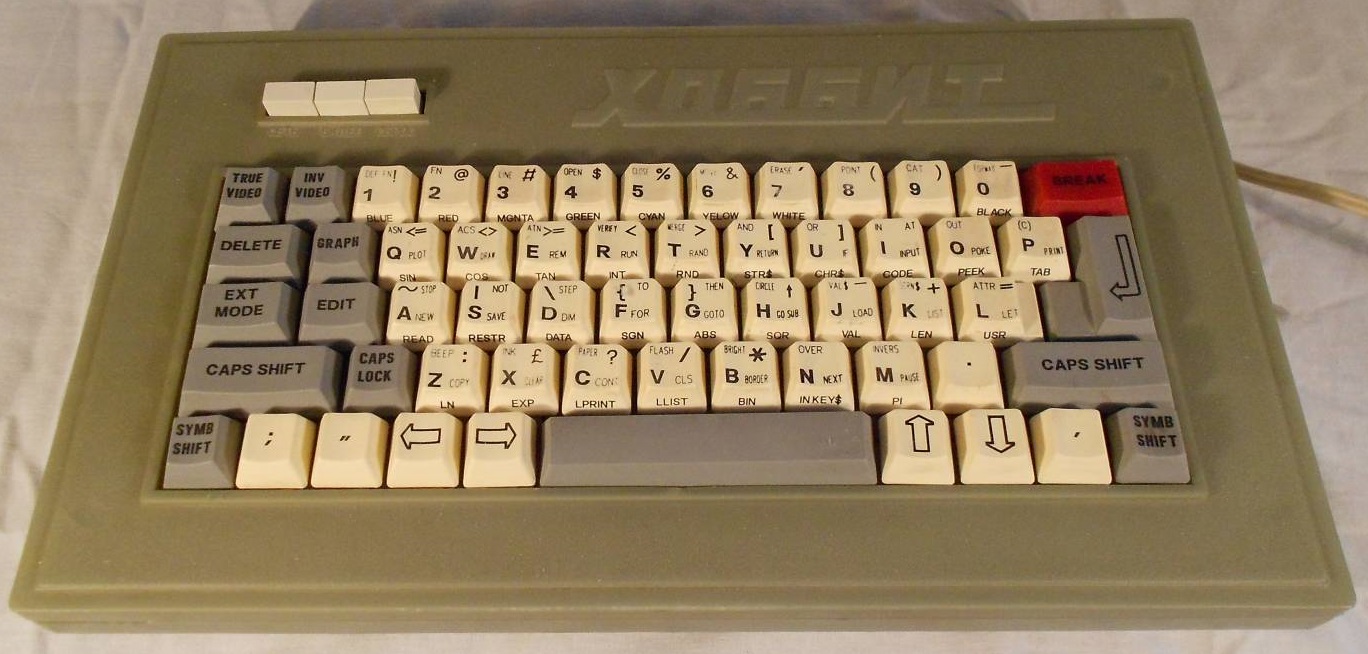
A Russian clone of the {ZX Spectrum 48K|Sinclair Research Ltd|1000486} featuring BASIC extensions (CP/M, TR-DOS, networking and internationalization), LOGO and FORTH.
Files and rights
No permission is on record either way. Screens and pictures are copied here on a take-down basis: if you hold the rights and want something removed, say so and it goes.
In the magazines 11
Sinclair User #127Sep 1992 · p.23
Specman
THE HOBBIT - TESTED In order to get a full appreciation of what the Hobbit can do we thought it would be a good idea to pass it on to everyone's favourite Speccy Techie - Specman. He tried to kill it by throwing it around (and it tried to kill him by giving him an electric shock) but they ended up best of friends... SPECMAN SPEAKS: The package arrived from Big Al one bright and airy Wednesday morning with the note, "Have a look at this computer and see what you think". The computer was the Hobbit. The manual says it's 100% Spectrum 48K compatible (which I was a bit dubious about) and it has loads at other things to tempt you with as well. These include a built in CPM mode, Forth and Sinclair Speccy, and a whacking great disk drive which accepts standard PC format disks. Being a bit sceptical I thought nah! Not possible, an improvement on the Speccy! And still eight bit? Al said play with it but if you want to find out what a computer does then you gotta take it apart, right?! What amazed me was the sheer build of the machine, the CIS (or the former Soviet Union) didn't have an active computer market abroad and at one time a big lack of available technology (except to the military I believe) so the amount that's actually inside on the board is amazing. There is a 64K ROM, some 64K of RAM, disk drive interface, RGB, full expansion port using the Euro Connector (bit like a SAM), joystick port, built-in TV modulator and built-in power pack. The whole thing looks amazingly solidly built, and by solid I mean solid! UPON POWER-UP: You are greeted by a select menu of 1) FORTH. 2) CPM and 3) BASIC. There is also a DOS option when you connect up an approved drive. Maybe a fifth option at Assembler wouldn't have gone amiss? These are, however a no-fuss way of swapping between the different modes of the computer. Time to load a game, I think. Let's see just how compatible it really is! There was one game in my collection that I was sure wouldn't load, but the Hobbit went ahead and loaded it! It certainly didn't disappoint - it ran them all, including the SU Covertapes. In a way it's a pity it's only 48K and not 128K compatible, there could have been even more possibilities from a gaming point of view. It also accepted my assembler, monitor and SoftRom, so it really does score massively in the compatibility stakes (beat that, Mr. Coupel). I couldn't find one thing it wouldn't run. Despite it's 128 incompatibility even games which select whether you have a 48 or 128 and alter themselves accordingly performed perfectly yet effortlessly. The CPM mode supports all of the standard and hi-level CPM requestors and requirements, and it's built-in!!! A friend of mine who understands Forth checked out the Forth compiler that's also built-in. He then asked me how much it was for the Forth program on its own as he would be willing to pay a fortune for it, it was that good! WHAT IT ALL ADDS UP TO: The Hobbit has Built-in modes coming out of its ears (or whatever the computer equivalent is), printer port, tape socket, disk drive port, TV modulator, power pack, joystick port, COMPLETE Speccy 48 compatibility, Forth, CPM, Logo, RGB socket, BASIC, massively expandable and it's under 100! If the Hobbit had been released instead of the SAM over here it would have made a killing. This is what the Speccy should have evolved into. It fits the gap between the Spectrum and 16-bits perfectly. The SAM was an excellent attempt at a Super Speccy, but it is an indigenous design with software compatability problems, not an upgraded Spectrum like the Hobbit. Overall this is a more of a techy computer, but it really is what people wanted and what they should have been given as a Speccy follow up. My only regret is that Big Al had to take the Hobbit back off me again! I don't have it any more and there is now a vacant gap under my TV that needs filling.
Your Sinclair #61Jan 1991 · p.73
Keith Pomfret
RAGE HARD! Remember the Hobbit, the Soviet Spectrum clone we wrote about a few months ago? Well, they're so proud of it over in Leningrad they asked us to pop over and have a look! "Okay," said big KEITH POMFRET (who doesn't need asking twice), "I'm on my way!" When the jet bounced onto the cracked concrete at Leningrad airport and ground to a halt two miles from the terminal buildings I wondered if I was in the right place. All I could see out of the porthole was a huge expanse of concrete and flatlands, interrupted only by (eek!) huge military aircraft parked out by chequered hangers! What on earth was going on? it was with some trepidation that we all filed off into an articulated lorry (there wasn't an airport bus to be seen) and were driven off towards some low buildings. Actually, the story gets a bit more boring at this point, because all the lorry did was take us straight to the terminal (which I'd somehow failed to spot before) where we collected our luggage, smiled for the nice KGB man, and hoped that he couldn't smell all the chocolate I'd smuggled in inside my duffel bag. The chap who'd come to meet me bundled me into one of the thousands of Ladas lined up in the overgrown car park (how do they all find the right car?) and off we zoomed (if that's the right word) towards the city. The Soviet Union has an excellent way of enforcing the speed limit - instead of employing hundreds of traffic policemen, they just place deep potholes randomly along the roads. Anyway, to cut a long story short. I avoided having anything to do with Russian computers for as long as possible, and instead spent a pleasant couple of days enjoying Soviet culture (ballet, art and all that other stuff on the postcards). Very nice it all was too. Eventually though I had to resign myself to my fate, so off I trotted over to InterCompex (the company that'd invited me there in the first place) for a look at what I'd really come to see - the new, updated Hobbit. SO WHAT'S IT LIKE? Well, when Mikhail Ossetinski and Dmitri Mikhalov (the two guys who originally came over to England to show us the Speccy-based Hobbit) first demonstrated the original version to me it left me speechless. I can only say his new one left me gobsmacked. It's got all the amazing features of the machine they brought to England - the multi-language keyboards, built-in networking and so on - and retains its full Spectrum compatibility, but refines the hardware techniques used to construct it massively. A disk drive (3.5 inch) lives under the side in the same place they do on the Amiga and ST, the video outputs are standardised to RGB and TV and (perhaps most importantly) it's now being finished in a much more pleasing shade of cream. The most radical new development though is the addition to the Hobbit range - a console! Fully Spectrum compatible, there are inputs for tape and cartridges planned and a couple the craziest joysticks being run up that you've ever seen! (Sega and PC Engine bods, watch out - the Ruskies are going to blow you away!) The console won't be limited to just working with cartridge games though - it can run all existing Spectrum joystick software via a tape port at the back. It uses a truly open system which means that if anyone develops a series of cartridge games they could load from ROM cartridges. Another alternative is 'blowing' existing games on to ROM. HACK IN THE USSR While we were at InterCompex's offices, a lanky guy with long hair and a palid complexion from months at the keyboard came in. 'Keith, meet Nicolas Rodinov, Leningrad's greatest hacker," they said. I chilled a bit - I'm not mad on guys who steal from other programmers - but I needn't have worried. Far from being a monster, he was quite a nice guy. "Show me the software for sale and I'll buy it - but there simply isn't any," seemed to be his argument. He showed me a wad of roubles. "The problem isn't money, it's just that there's nowhere to buy software in the Soviet Union." Hardware designer Dmitri explained the situation - "You see, what happened is that these guys started by altering the few games we had so that the instructions were in Russian and we could play them more easily. In this country, if you need something and it's available you can have it - it isn't regarded as theft." And he's right. There aren't actually any laws to protect copyright in the Soviet Union at all, so hacking isn't illegal. You can't really get too miffed with someone when they're not actually breaking any of their own laws. But this may all be about to change - they're welding some new laws into the Socialist Constitution to protect western firms' copyright and patents in 1991 - so, with a bit of luck, that'll tempt software companies to export to the Soviet block, and may even allow guys like Nik and his team to produce some saleable software of their own. (After all, it's high time we saw than just Tetris come out of the Soviet Union.) KEYBOARDS AND CONSOLES So there we have it - things are starting to look pretty rosy so far as Soviet home computing is concerned, and the really good news is that the Speccy is stuck right in the middle of it! The Hobbit console was an especially exciting development, I thought, and could have great relevance in this country - especially when, just as I was about to leave, Dmitri and Mikhail drew me to one side, pulled back a drape and revealed... a plug-in keyboard for the Hobbit Console! Price - less than a fiver! (Bet you Alan Sugar couldn't do that!) And that was it really. A few more days of caviar and culture and it was back to that horrible empty airport and a British Airways flight to Blighty. I had a good old time in Russia, though I must admit I was quite pleased to get home (I'd troughed all the chocolate I'd smuggled in, you see). The final word I guess must go to Marek Kar, the Polish Editor of a joint Polish/Soviet computing mag who I met on a snatched trip to Moscow. "In our first issue we ran a survey of our 25,000 or so readers to see what machine they'd got. Ninety percent owned Spectrums or Spectrum clones." Pretty remarkable figures really, and it means one thing is certain - it's going to be worth keeping our eyes rather sharply peeled for whatever the Russians come up with next for the Speccy. Who knows - some of it may filter over here yet!
Above: Meet Dmitri Mikhalov, one of the Hobbit's two inventors. (Er, say cheese, Dmitri.)
Left: The Hobbit was developed on this machine.
Your Sinclair #57Sep 1990 · p.37
Keith Pomfret
RAGE HARD! The Hobbit is a Soviet Spectrum clone that does everything Uncle Clive built into the original Speccy, plus a lot of the things he forgot - and it'd only cost you 13 years'salary to buy one! Join big KEITH POMFRET for... The other week we had a phone call - there were a couple of Leningrad computer designers in London showing off their brand-new Spectrum-compatible machine, and did we want to see it? Well, of course we blooming well did! Come down to Bath, we said, and let us take it through its paces. The very next day Michail Osetinskij and Dmitri Michailov climbed on the back of Perestroika (well, a British Rail London-to-Bristol loco actually) so we could bring you a report on this powerful new machine. FROM LENINGRAD WITH LOVE In the Soviet Union there are no copyright or royalty laws so if you want something you just make or copy it. When Michail and Dmitri needed to produce a computer for the Soviet educational market they chose the Spectrum, but instead of simply cloning it they added a list of features that could show up some western PCs. Dmitri explained - "In Leningrad, many people get out their soldering irons and make their own computers. It's the only way. The Spectrum is the most well-documented computer in the Soviet Union, so that is where most people start - there are now at least 20 different Spectrum clones in Leningrad alone, so when we wanted to build an educational computer it was the obvious place to start. "A western PC costs 60,000 roubles to buy in the Soviet Union, you see, and even a Spectrum costs 40,000! At 250 roubles a month, that's just too much." As to why the Spectrum is so well-known in the Soviet Union, well, just think of the size of it (especially one of our rubber-keyed chums). What would you want to smuggle through customs - a C64 or something you could hide in the lining of your jacket? (It's quite obvious really.) SCHOOL PRIZE Over 15,000 Hobbits have been produced so far and they are used exclusively in schools. The basic machine comes with two 5.25 inch disk drives, networking and more ports than the south coast. Games players will be chuffed to know that there are three joystick ports on the back. One is Kempston-compatible and the other two are Sinclair. A built-in ROM routine allows the transfer of tape programs to disk, and any TV or standard PC monitor can be plugged straight in. The memory is 64K (though you can switch to 48 mode if you want). SO WHAT'S IT LIKE TO USE? Well, we powered it up in the YS office to take a look. Right, switch it on and... a-ha! There's the familiar Spectrum screen... but (of course) it's in Russian! A single key-press and you can put it back to Uncle Clive's more familiar English message. In fact, to make it easy for any country to use, the single key-press can take the Hobbit from the Russian Cyrillic script to the Western Roman alphabet or anything else you fancy (once you've loaded it in). Another key-press and we could be in Arabic! The full-sized 74-key keyboard is as comfortable to type on as any conventional PC (and far better than the crappy little things that most Speccies are lumbered with) though the dual Roman/Cyrillic markings on the keys were quite confusing to use. Still, that's only a problem if you're a crappy typist like most of us lot - a touch typist wouldn't look at the keys anyway! As for what the computer looks like, well, you can see for yourself from the photo. It's sort of off-white, a bit plasticy and rather basic-looking, but it still manages to look a lot more sophisticated than most Speccies! in fact, it's all a bit reminiscent of a Lada really - an old (but perfectly good in its time) western design, spiced up and improved a bit in the Soviet Union. Of course, with Ladas they then brought the thing full circle and sold it back to us! Could the same thing happen with the Hobbit? (Read on!) BUT HOW COMPATIBLE IS IT WITH SPECTRUM PROGRAMS? Well, the Hobbit claims full compatibility with all Speccy stuff, legally programmed or otherwise (though of course in the amount of time we had to spend with it we couldn't really judge how true this is). There's no real reason to doubt it though - a quick look at the workings inside show that there's a good deal of Uncle Clive's original bits and pieces in there! The Hobbit comes with a built-in diagnostic program monitor and assembler disassembler that will make life simple for those who like to interfere with their programs Spectrum Basic is supported (of course) and there's a Soviet version of CP/M (called Beta) included too, which should open up a whole world of business software to the Hobbit. The educational theme is continued with the inclusion of the graphic and list-processing language, LOGO, and provision for including Pascal, C, and Forth on plug in ROMs. In Leningrad, where the Hobbit is used in many of the schools, the networking abilities mean that students can do their work and hand it into the teacher's' master' Hobbit or PC via the network. The teacher can also monitor what is going on on any other machine, and in the event of one crashing any other Hobbit on the net can be used to 'revive it' and recover files from it. It's a feature that is especially useful in program development because it allows a teacher to examine the crashed machine to see the state of the various registers. HOW ABOUT GAMES AND MAGAZINES THOUGH? IF THE THING'S MAINLY USED IN SCHOOLS, IS THERE ANY INTEREST IN THAT SORT OF THING? The ability to write and develop software is important behind the iron Curtain. With few western games, peripherals, or magazines getting through, home grown software is valuable currency. The quality and quantity of computer publications in the USSR is next to zero. Michail said, "The one computer magazine published in the USSR is dry and corporate. We would like a magazine like Your Sinclair that has more life in it." But is this all really just of curiosity value, or will we ever see the Hobbit actually sold in this country? Well, maybe. Michail confirmed that though they do actually hope to launch the Hobbit in Europe and the Third World, another important reason for coming to the UK was to visit YS and show us what's capable behind the (slightly parted) iron curtain! (Sweet of him, eh?)
Lumme, call this a Spectrum? It's too sleak and slinky by far!
FAX BOX Anyone wanting to contact Intercompex, the company who manufacture The Hobbit, should write to Intercompex, [redacted].
TECH SPEC THE HOBBIT Keyboard and processor in a single unit Twin 5.25 floppies Power supply unit Built-in TV monitor colour card PROCESSOR Z80A running at 3.5MHz 64K of addressed memory Operating system ROM 116/8/0K RAM used depending on configuration) 64K RAM (48, 54, or 64K including 6.5K screen memory) INTERFACES System bus (accessible) Parallel port (Centronix) RS232 serial port Three joystick ports (two Sinclair, one Kempston) KEYBOARD 74 keys including 33 reprogrammable (soft) keys Support of Cyrillic Roman, Arabic alphabets DISK CONTROLLER All types of SS/DD and DS/DD drives (maximum of four on each machine). Hard disk supported by patching disk-operating system. POWER SUPPLY UNIT Independent 5v at 1.5A on 220-240v 50/60 Hz mains power (consumption 7.5 watts) VIDEO ADAPTER CARD 256 x 192 pixels 24 x 32 characters in text mode 15 colours 80 column by 24 lines emulating CP/M supports colour/mono TV TTL PC monitor PERIPHERALS Up to four disk drives, including two supplied with each Hobbit Cassette recorder Printer (serial or parallel) Joystick Lightpen Mouse SOFTWARE Inbuilt BASIC/LOGO Network drivers (100K Baud) BETA (CP/M clone) Sockets for ROM operating systems (Pascal, Forth, C) Fully Spectrum software compatible
Feature4
- Sinclair User #127Sep 1992 · p.23
- Sinclair User #126Aug 1992 · p.19
- Your Sinclair #61Jan 1991 · p.73
- Your Sinclair #57Sep 1990 · p.37
News/Note3
- Sinclair User #130Dec 1992 · p.8
- Sinclair User #128Oct 1992 · p.8
- New Computer Express #85Jun 1990 · p.4
Letters1
- Sinclair User #130Dec 1992 · p.24
Reviews from people here
Sign in to write about this, or make an account. It takes a minute and lets you correct the catalogue too.
No year, publisher recorded.
Sign in to correct or add to this.
Hold the rights to this and want it taken down?