
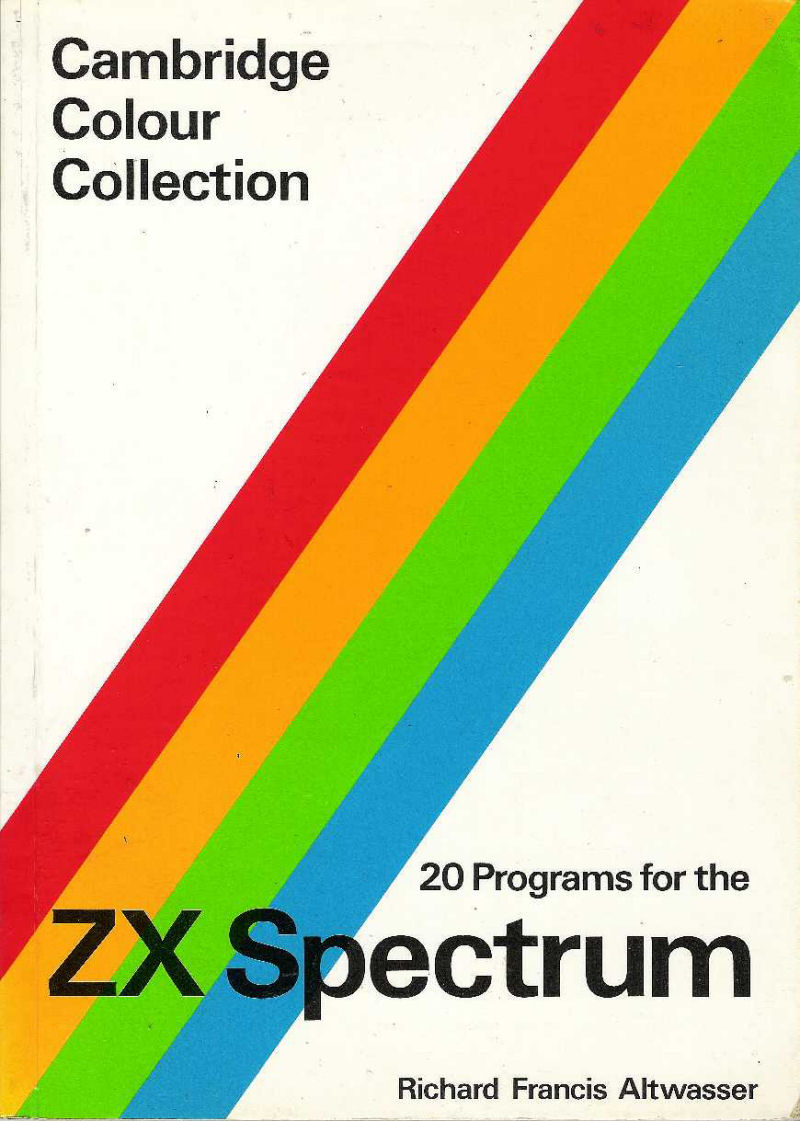
Cambridge Colour Collection
Book: Paperback · English
Richard Francis Altwasser · 1982 · Pound sterling 6.95 · 64 pages · ISBN 0-9507658-2-1
Also known as 20 Programs for the ZX Spectrum (English)
Discussion
Nobody has started a thread about this yet.
Remarks
A tape containing all 20 programs ({Cambridge Colour Collection|Richard Francis Altwasser|0012340}) was sold separately, for £2.95
SPOT: book + program cassette
Documents
- CambridgeColourCollection.pdfComplete book 33,738 KB
- cambridge-colour-collection.pdfComplete book English
Files and rights
No permission is on record either way. Screens and pictures are copied here on a take-down basis: if you hold the rights and want something removed, say so and it goes.
Credits
- Richard Francis Altwassercredited
Sign in to credit somebody, or say what these people did.
In the magazines 22
Your Spectrum #6Aug 1984 · p.47
Mike Turner
Phil Cornes
GAMES PEOPLE PLAY In pursuit of the definitive games book, Phil Cornes and Mike Turner corner a selection of tomes, getting to grips with them all, be they good, bad or just plain ugly. Many years ago, when you could still buy 16K of dynamic RAM for approximately £240, I drove all the way from my home town of Stoke-on-Trent (which didn't have a computer shop) to Liverpool (which did), simply because Microdigital was selling a book of games listings. The title was, as I recall, What To Do After You Hit Return and, for my money, the star listing was a version of Wumpus. To be asked, then, to review some eleven books of games for the Spectrum (with its super Hi-res colour screen and Z80A processor) should have been little short of a pleasure. Little did I know! I found that not only did the games frequently take little advantage of the startling advances in video presentation, but - worse - often had no 'meat' about them at all. DOWN TO BUSINESS First off the pile came Games To Play On Your ZX Spectrum by Martin Wren-Hilton. The listings have been typeset and may therefore contain syntax errors, but your Spectrum will tell you about these when you try to type them in. There's nothing actually exciting in the book and, indeed, the author even admits that one of the listings is the first game he ever wrote! One consolation is that at £1.95 you'll have wasted the least possible amount of money. The Spectrum Book of Games by Mike James and various others has listings printed on a reasonable quality dot matrix printer. However, these appear to have been word-processed and so the same comments as above apply regarding syntax errors. Once more there is nothing outstanding in the selection of games (Fruit Machine, Noughts and Crosses and a dice simulator, for example) although the presentation is good. Objectives for all the games are clearly detailed, together with advice on how to play them, typing-in tips and a list of the main subroutines and details. All well and good but the whole thing is wasted on a poor selection of games. At £5.95 I really can't describe it as particularly good value for money. 60 Games and Applications for the ZX Spectrum by David Harwood is split approximately 50/50 between the author's two groupings. The utilities vary from an eleven line idiot's remember routine (which only changes program line numbers, ignoring GOTOs and GOSUBs, etc) to a correlation/regression program which produces a value for Pearson's Correlation Coefficient and the linear regression equation, but which requires you to enter all the X co-ordinates followed by all the Y co-ordinates, rather than the more usual X, Y pairs. Equally the games range from a version of Breakout with ZX80 style graphics and a ludicrously complicated set of instructions for running and typing-in, to a version of noughts and crosses which "unlike many... allows you to win"(!) and forces you to start on the centre square. At £4.95, and despite a reasonable Draughts program by Tim Hartnell, this book again represents dubious value for money. ALL KINDS OF EVERYTHING Spectrum Spectacular by Roger Valentine has 50 programs, fewer than 20 of which are games. There are some useful machine code routines given as both Basic programs and as assembly listings, although these are poorly documented and contain errors. For instance, in one perfectly good left and right scroll routine, the author suggests a couple of modifications for 'fun' effects. One of these, using the SRA instruction to clear the screen with a 'Venetian blind' effect, will not work in all cases. Replacing the SRA with an SRL (203,62 in decimal) cures the problem. At £4.95 this seemed fair value for money. Instant Arcade Games for the ZX Spectrum by Jean Frost at £3.95 is indeed good value. It's not, however, a book of games listings in the more conventional sense. Take the 'control program listing' for a typical space arcade game; each individual subroutine (producing the backdrop - stars, night skyline and so on - calculating fuel reserves, laser status, and checking for the game endings) is formulated. Then add to this a collection of user-definable spaceships, aliens and tanks with both Basic listings and pictures. Not bad, eh? Following chapters are on writing your own games and designing your own characters. It's a publication that caters for the two mainstreams of games playing and it definitely comes as recommended reading. Also highly recommended is Sixty Programs for the Sinclair ZX Spectrum by Robert Erskine and friends. It's a larger format book, making it easier to read than most; on the other hand one or two of the games are of questionable taste... like Exocet - Let's Play Falklands. This really is the only aspect that lets down an otherwise excellent collection of games of varying length and complexity. They range from Countabout, a counting game for two-to-five-year olds, to such substantial offerings as Asset Stripper and Evolution 1, 2 and 3. All in all at £4.95 this takes the top spot for best value for money of the pure listings books. FREE EYE-STRAIN WITH EVERY COPY Next up we find Creating Arcade Games on your ZX Spectrum by Daniel Haywood, a book let down by the variable quality of its listings. These appear to have oozed out of one of the poorer ZX Printers and in parts they're so faint as to constitute a source of severe eye-strain - particularly when struggling with long multi-statement lines. But one or two of the games are of a reasonable standard, explained in depth and supplied with lists of the variables used - together with the functions they serve in the game: this is the book's strongest point. Typical of the contents are ICBM, a version of missile command, and Scramble. Now let's don protective clothing and really plumb the depths. By any standards, a 64-page book containing 20 trivial programs at just under £7 cannot be classed as good value. Richard Attwasser's Twenty Programs for the ZX Spectrum is, unfortunately, just such a book. Old chestnuts such as Breakout, Android Man and Mastermind are typical of the contents. There's even a program for storing telephone numbers - always a questionable use for cassette-based micros which are switched off most of the time or even dismantled; sorry, but a card index is still far more efficient. A cassette of the games in the book is available for an additional £2.95, so at a combined price of £9.90 for both book and cassette, this comes close to robbery with violence. Back in the land of thick tomes with lots of listings, 49 Explosive Games for the ZX Spectrum by Tim Hartnell et al proves to be another victim of the ZX Printer. The listing of Frog on a Log (starting on page 133) is surely the worst example of random pixel plotting in any of the eleven books; novice programmers will have little chance of entering it without errors. There are several mammoth adventure listings - Doors of Doom stretches over twenty-four pages (no, I didn't test it!). There are Space games, two-player games, mazes and arcade games, as well as two sections of utility programs in machine code and Basic. One of these is a tape copy program and one has to question the ethics of publishing this, even if it does lack sophistication and will only work with certain machine code programs. EVERY PICTURE... Over the Spectrum (edited by Philip Williams) contains 30 programs; two-thirds of which are games - colour screen photographs are included showing most of them in action. The assortment is varied... In fact, if anything, it attempts to cover too much ground. Freeway Frog, Fruit Machine and Alien Invaders vie for space with Sales Analysis, Payroll and Block Line Delete. It is not entirely clear who this book is aimed at. Still, some of the games have excellent graphics, including Draughts (which has a machine code routine for sorting out the computer's move) and Chess. The latter is not very intelligent and plays quite slowly; in fact, the author even suggests amending the program so it can be used as a human versus human game. There's also a 30-location, eight-problem adventure for those with the patience to type it all in, plus solutions for those who lack the wherewithal to play it. At £6.95 this book leans towards being over-priced. Finally, reasonably priced at a mere £2.95 is Games for your ZX Spectrum by YS's own Peter Shaw. Twenty-four games are included, all rolled out from yet another temperamental ZX printer (somebody must have the good one, surely?). The games are all fairly short, although some are quite interesting. Pontoon has good graphics, as does Ascot, a horse race program. However, by far the best section of this book is a detailed chapter entitled 'How to write better programs'. Here you'll find some good material on writing a fairly complex strategy that uses as an example a game called Dome Dweller. In a similar manner to the Jean Frost opus, series editor Tim Hartnell gives a listing for the main control loop, a collection of things the program has to do and a fairly detailed description of the variables to be used. This alone is almost worth the cover price. In addition, there's a glossary and bibliography - which aren't necessary and don't appear to bear any relation to the rest of the book. With these two rogue sections exorcised and 50-75p off the price, Shaw's book would represent excellent value for money. PICK OF THE BUNCH Looking back over the eleven books for this month, they would seem to fall into four quite distinct groups. Top of the bill, and living up to all my expectations are: instant Arcade Games for the ZX Spectrum and 60 Programs for the ZX Spectrum. These are the two that no Spectrum owner should be without and they represent the modern equivalent of the ideal tome I yearned for many moons ago. The next four books, represent good value for money. They are: 49 Explosive Games for the ZX Spectrum, Spectrum Spectacular, Creating A rcade Games on your Spectrum and Games for your ZX Spectrum. The third block includes Games to Play on your ZX Spectrum, The Spectrum Book of Games, 60 Games and Applications for the ZX Spectrum and Over the Spectrum. These four come into my 'lukewarm' category. The reason for their downgrading are varied, ranging from 'good game presentation wasted on poor games' to 'generally good but overpriced'. The final category contains only one entry. I doubt that anyone could seriously challenge the fact that the one remaining title is just a waste of paper at the asking price. I stoop to mention the title again.
ZX Computing #4Dec 1982 · p.55
SPECTRUM RULES THE WAVES Every publisher in the UK seems to have discovered the Spectrum, so there is sure to be a bumper crop of reading matter for Spectrum owners in the coming months. Our review panel have been looking at a selection of the Spectrum books and finds that the standard is uniformly high (both in terms of content and presentation), with each book representing value for money in its own way. There are four books we'll look at which are collections of programs for the Spectrum. The first, 'The Cambridge Colour Collection' is by Richard Altwasser, the designer of the Spectrum. The book costs £6.95 and contains just 20 programs. The games include 'Maze', 'Lunar Landing' and 'Android Nim', with more serious programs including 'Home Accounts' and 'Calendar'. Andrew Hewson (who answers reader's problems in Sinclair User) has '20 Best Programs for the ZX Spectrum' for £7.95. The 'best programs' include 'Machine code editor', 'Index File' and 'Duckshoot'. Shiva has the cheapest book, the £2.50 'Computer Puzzles for Spectrum and ZX81', from the Stewart/Jones PEEK, POKE team. The many entertaining 'puzzles' include 'The wolf, the goat and the cabbage', 'Queens dominant' and 'The Magic Forest'. David Harwood (who writes the 'Young Stuff' column in the users' club magazine Interface) has produced 'The Spectrum Software Library - 60 Games and Applications for the ZX Spectrum' for £4.95. Although the emphasis is on games (including 'Checkers', 'Zap' and 'Galaxy Patrol'), the 'applications' include a 'Renumber' in BASIC and 'Chequebook'.
Your Computer #9Sep 1982 · p.28
Boris Allan
SURVEY SPECTRUM SOFTWARE Boris Allan examines the first software offerings designed specially for your Spectrum. Although the Spectrum was announced in April the machine has only become available in large numbers recently. For software suppliers it is still early days. We were therefore relieved to find that most of the programs we received worked first time and reasonably well even if some of them lacked originality. Most of the software we sampled was based on ZX-81 or arcade games but we also tried out some educational and utility programs. Loading the Spectrum was far less frustrating than the ZX-81. The machine performed well, producing particularly good colours but disappointing sound. The limitations of the internal speaker can at least be bypassed by taking the cassette out of the recorder, connecting the two Mic sockets and switching on the recorder. Tone and volume can then be controlled with the recorder's own controls. Games programs are strange things. Long complex programs can be much less enjoyable than a short snappy one incorporating a good idea. So long as the programs are relatively bug-free, as most of these Spectrum games were, then evaluation of any particular cassette is bound to be subjective. To give as objective an assessment as possible we tried out the games on all age groups - even a class of five-year olds. Both Bug-Byte's Spectral Invaders and Quicksilva's Space Invaders approach the standard of real arcade games. Spectral invaders is almost an exact copy of Space Invaders, complete with four different colours for invaders, a flying saucer and high score. Some effects are slightly slower than the Atari original but the graphics quality and the use of colour and sound is excellent. Quicksilva's Space Intruders also had a mutant invader that wobbled and was worth extra points and a hold facility to allow you to stop the game at any point. While the invader programs were written in machine code, Alien Command was written in Basic and was too slow and crude for a space game. Winged Avengers from Work Force is a Galaxian-type game in which waves of attackers move down the screen towards the player's missile firer, break formation, circle about and then attack again. Six speeds are offered and the action is fast. But with the exception of a formation of birds, which appear in the second attack phase flapping their wings very effectively, the display is a little dull. Chromasoft's three programs varied from the sublime to the ridiculous. Worm is a simple but clever idea. A worm on the screen has four segments, and the player has to direct the worm around the screen, eating up numbers. Each time a number is eaten, they flash up randomly, the length of the worm increases by that amount. As the worm gets longer, it becomes more difficult to navigate, because you are not allowed to leave the screen or to cross over yourself. One player reached about 125 segments, and could not find any space. The program is as simple as the display but the idea worked. Defined colours and graphics for the segments would be improvements but only cosmeticBomber is an uninspired rendering of Blitz. Golf is not only unexciting but bug-ridden. Amongst other things the game was unwilling to play the right number of holes. AVC's Fortune could be a useful stand-in for the crystal ball at children's parties. The company's Tables has a more educational objective. The tests of multiplication tables are quite competent but the program would be more useful as a means of generating interest and enthusiasm for mathematics rather than for teaching the tables themselves. Whoever designed it has a keen appreciation of the minds of primary school children, although AVC is stretching a point when it claims the program can be used to the age of 16. One clever ploy to generate interest was the use of the ZX-Printer to give each child a permanent record of its achievement. One kid described it as 'space-age paper'. This theme is reinforced by a countdown to the launch of a rocket each time you play. Time Bandits from Newsoft comprises six separate games on side 1 all combined in an Adventure-style game on side 2. Most of the games have pretty graphics but are rather elementary. Minotaur's Labyrinth is a matter of collecting objects in a maze and Napoleon's army is similar - but without the maze. In Titanic you rely on luck to avoid being sunk by an iceberg while Tower of London is at least distinguished by the appearance of random Beefeaters. Combination is just a matter of remembering a number but Castle of Evil is a little more out of the ordinary. You have to work out the best strategy to cross a web with hostiles converging on you - rather like the Adventure game which used to be shown on BBC 2. Most of the games had not been carefully thought out. It was sometimes possible for instance to offer bribes of minus amounts of money, and thus become richer. Backgammon from Keith Archer worked well enough but was easy to beat and again vulnerable to cheating. There was nothing to prevent you putting more than five counters on a point for instance. Richard Altwasser's Cambridge Colour Collection costs £9.90 for a book of 64 pages and a cassette. Though some of the programs are original, in that they use specific features of the Spectrum, many are not: Maze is marred by a poor algorithm. There is also Breakout, Nim, and most others, including a version of King called Kingdom. The cassette was unfortunately unloadable - the company has had to replace many of the cassettes. We reviewed two graphics packages. Phantasmagraphics plots 2D and 3D patterns and allows you to modify the patterns by entering height, width, perspective and distortion variables. The program is written in Basic and takes up to six minutes to draw a shape. The program contains a bug which causes it to be interrupted by an 'integer out of range' error message for large height and width values. Superdraw 16 is an exceptional program. For £5 you are supplied with an instruction booklet, a pad of screen design pads, and a cassette with a spoken commentary on one side, all in a polythene bag. No other program gave such value for money. The program is written in Basic and allows the user to design screens which can then be saved for incorporation in other programs, which make use of high- and low-resolution graphics, text, and user-designed alphabets of large letters. The 'slide-show' option automatically toads successive screens. High-resolution pictures of a bicycle and southern England among others flash up in turn very much like a slide-show for the unemployed. Two simulation games are available from Case Computer Simulations. Autochef allows you to work your way up as manager of a small catering company. At first you have to avoid being taken over by Trust House Forte - later if you survive you can try to take over Forte yourself. Airline is exactly the same as Autochef except that you are running a small airline.- The two assemblers were useful because they save you money by not buying at inflated prices books which disassemble the Spectrum ROM. Of the two the Campbell version is more attractive as it is written in Basic, and one can learn from studying the program listing - warts and all. The Artic version was difficult to follow, as the documentation had not been prepared, but if the Spectrum documentation is as good as the ZX-81 documentation then it will be terrible. Given the incomplete nature of both offerings, the cheaper price, and the ability to convert from hex to dec and vice versa, sometimes with amusing results, the Campbell Systems offering may be better value.
Advert17
- Your Computer #12Dec 1982 · p.122
- Your Computer #11Nov 1982 · p.102
- Personal Computing Today #4Nov 1982 · p.15
- Sinclair User #7Oct 1982 · p.12
- Your Computer #10Oct 1982 · p.114
- C&VG (Computer & Video Games) #12Oct 1982 · p.96
- C&VG (Computer & Video Games) #11Sep 1982 · p.87
- Sinclair Programs #3Sep 1982 · p.4
- Your Computer #9Sep 1982 · p.108
- Sinclair User #6Sep 1982 · p.44
- Your Computer #8Aug 1982 · p.45
- Popular Computing Weekly #16Aug 1982 · p.2
- Popular Computing Weekly #18Aug 1982 · p.2
- Sinclair User #5Aug 1982 · p.17
- Sinclair User #4Jul 1982 · p.17
- Popular Computing Weekly #14Jul 1982 · p.6
- Your Computer #7Jul 1982 · p.34
News/Note1
- ZX Computing #4Dec 1982 · p.83
Review1
- Your Computer #9Sep 1982 · p.30
Programs listed in this book
- Calendarp.5
- Mazep.7
- Lunar Landingp.9
- Android Nimp.12
- Morsep.15
- Mathsp.20
- Biorhythmsp.22
- Telephonep.25
- Home Accountsp.29
- Mastermindp.34
- Breakoutp.38
- Defenderp.40
- Othellop.42
- Kingdomp.46
- Fighterp.51
- Millionairep.53
- Rotatep.57
- Red Crossp.59
- Graphicsp.61
- Patternsp.64
Reviews from people here
Sign in to write about this, or make an account. It takes a minute and lets you correct the catalogue too.
Everything ZXDB can hold about this is here.
Sign in to correct or add to this.
Hold the rights to this and want it taken down?