
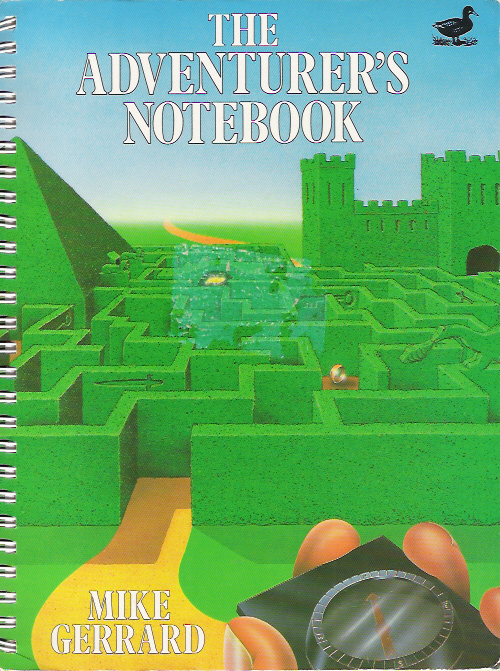
The Adventurer's Notebook
Book: Spiral bound · English
Duckworth Educational Computing · 1984 · Pound sterling 3.95 · 124 pages · ISBN 0-7156-1892-X
Discussion
Nobody has started a thread about this yet.
Documents
- Duckworth%20-%20The%20Adventurer%27s%20Notebook.pdfComplete book English
Files and rights
No permission is on record either way. Screens and pictures are copied here on a take-down basis: if you hold the rights and want something removed, say so and it goes.
Credits
- Mike Gerrardcredited
Sign in to credit somebody, or say what these people did.
In the magazines 17
Big K #7Oct 1984 · p.48
John Conquest
BOOKS DO FURNISH A GAME There are books, computer books and - increasingly - computer adventure books. John Conquest put on his lorgnettes and had a good squint at some latest examples of this rapidly-growing literary genre. By far the best writer of the adventure game crowd is Mike Gerrard, so it's a pity he doesn't have a proper book of his own. His THE ADVENTURER'S NOTEBOOK (£3.95) is a playing aid, and a good one. The bulk of it is pages of ready-made skeleton maps and pages for entering locations, objects found, actions tried and results, recognised words and general notes. The idea is to do away with that awful mess of bits of paper, covered in scrawls, cryptic notes and crossings out, incomprehensible even to their maker (you, sunshine) and collect them all into one convenient package. I love the idea and up to a point it works very well, but it would have been even better in a ring binder rather than spiral bound. Gerrard's introduction which is a great read, covers hints, history, recommended adventures (by machine), useful addresses and synonyms.
Personal Computer News #77Sep 1984 · p.16
Leah Batham
'The Adventurer's Notebook' by Mike Gerrard, published by Duckworth at £3.95 (paperback, 123 pages). Mike Gerrard, known to most of our readers as the author of the PCN Adventures column, has produced the ideal tool for adventure addicts. Throw away all those messy bits of paper. Here you have a scrapbook with pre-drawn map templates to keep all that vital information at our fingertips. The 'fill it in as you go along' section makes up more than half the book: 78 pages to be precise. It consists of blank tables with columns marked Location, Objects Found, Action Tried and Result, as well as the pages and pages of squares that make up the map templates. The rest of the book is made up of an introduction to adventuring, some hints and general advice, a history of adventures and three appendices. The hints section is aimed at both the beginner and the seasoned player. Sprinkled with a liberal helping of examples from a variety of games, the various pitfalls and tricks that can overcome them are described. Adventures tell a story, in much the same way that storytellers of yore did - or so Mr Gerrard would have us believe. He also sees the role-playing games such as Dungeons and Dragons as a major influence on computer adventures. The appendices contain Mr Gerrard's recommendations as to which adventures are worth playing, a list of useful addresses (of software houses) and a glossary of synonyms for when you get stuck for words. My main criticism of the book is the limited range of adventures mentioned in the recommended section. A table of adventures with some kind of rating would have been more useful, and why on earth aren't Apple games mentioned at all? Some of the first adventure implementations were on an Apple. Apart from this minor gripe, it is an excellent book which will make any ardent adventurer's life a lot easier.
Personal Computer Games #10Sep 1984 · p.69
Steve Cooke
ADVENTURERS' GUIDEBOOK Another useful publication from the Duckworth stable, produced by Mike Gerrard, is the Adventurer's Notebook, a slim spiral-bound volume designed to aid the player in any quest he may choose to undertake. The book falls into two parts. The first contains general notes and hints on playing adventures and a survey of the current scene. The second section contains a series of blank adventure 'maps', laid out in grid form, which you can use to map out whatever game you are playing. At first sight, this book seems like a great idea, but I have a few reservations about it. The first is that some of the information is very incomplete. To say, for example, that the Dragon is 'a machine that doesn't rate very highly for adventure players' is rather wide of the mark - no mention, for example of the Dan Diamond series. My other reservation is about the maps. More and more adventures these days are not mappable on a simple grid lay-out. This doesn't mean, of course, that the grids are useless, just that sometimes you will find yourself having to resort to all sorts of symbols to make sense of your wanderings. That said, Mike Gerrard's book is a neat package, and at £3.95 it isn't going to burn too big a hole in your pocket.
Micro Adventurer #11Sep 1984 · p.38
Tony Bridge
GERRARD BROS - PROBLEM SOLVERS AUTHOR: Mike Gerrard, Peter Gerrard PUBLISHER: Duckworth Home Computing PRICE: £3.95 The Gerrard Brothers make a formidable team - writing almost without stop in such disparate and august organs as Popular Computing Weekly, Honey, The Daily Mail and Micro Adventurer, they form an adventure Mafia. Peter has an admirable series of "Exploring Adventures on the..." (fill in the dots with just about any micro that you can think of), although these two books are the first effort of brother Mike to appear in print. The more interesting of the two, for the general reader, is Mike's solo effort. The Notebook contains 5 pages of "What is an Adventure", 11 pages of hints (such as type LOOK and EXAMINE at every available opportunity, map mazes and so on), and 11 pages of historical background. These sections are followed by a quick look at various machines and the range of adventures available for them, a short list of synonyms and a list of books and magazines catering for the growing number of adventurers. This is all pretty routine, but it is the second half of the book that will prove to be very useful - it takes the form of a series of "scratch-pads", on which the adventurer can keep track of the various games he may be in the process of solving. Thus, there is a column in which the description of each location is recorded, along with a column for objects found in that location, actions tried and the results of those actions. Then there are columns in which recognised verbs and nouns can be recorded, and finally a network of boxes which can be built into a map of the adventure. This format is repeated for up to 10 adventures, and if you use a pencil, then the book can be used indefinitely. As the book is spiral-bound, it can lie flat beside the micro and as a dedicated dedication-reader, I loved Mike's: "to my Nan". All together: Aaahh! The Adventurer's Companion is just as useful in helping the player keep track of his adventure, but it is concerned with just four games, and is nothing less than a crib sheet! No room, here, for the history of computer adventures, or overviews of available software. Instead, there is nothing but the complete solutions to The Hobbit, Scott Adams' Pirate Adventure and Adventureland, and as well as the grand-daddy of them all, Crowther and Woods' Colossal Cave Adventure, in the Level 9 incarnation. Rather than working through the solution move-by-move, the Gerrards offer instead a list of all the problems, directing the player to a numbered paragraph in which that particular problem is fully explored. At the end of the book are maps pertaining to each adventure. For anyone stuck in The Goblin's Dungeon, or who is having trouble recovering his treasure from the Pirate's Chest, The Adventurer's Companion should prove to be just that - if you are weak-willed, however, and can't resist peeking, then beware!
C&VG (Computer & Video Games) #35Sep 1984 · p.118
Keith Campbell
A HANDFUL OF BOOKS As a change from slaving away over a hot keyboard, I sat down and relaxed for a while with a batch of recently released books on Adventure. Graphics Adventures for the Spectrum 48k is by Richard G. Hurley and contains listings for seven graphics Adventures. They are reproduced (presumably from printer output) in greater clarity than I have seen before in print. Having said that, there is no point in buying the book unless you intend to sit down and type - or should I say "rubber pad"? - at least one of the listings in to your Spectrum. Looking through them, it is not a job I would fancy, since some have over two pages of numeric data. Make an error and... Each game is preceded by hints on typing in the listing, saving the game - some non-routine saving methods are used - plus tips and instructions on how to play. The blurb says that to help you write your own Adventures, the techniques used in writing the programs are explained. This is true, but only as brief preambles, so you should not expect to learn how to write such programs from scratch. If Graphic Adventures are your thing, and you are adept at entering listings, then this book could represent very good value for money, although I can't vouch for the quality of the games, as I have not keyed them in myself. Graphics Adventures for the Spectrum 48k is by Richard G. Hurley and published by Micropress at £5.95. Beyond the Arcade must be a title to appeal to Adventure fans, who can usually be relied on to have an interest in most games requiring thought and strategy, as opposed to fast reactions and manual dexterity. By Nicholas Palmer, the book starts off with a useful discussion of the characteristics of most current popular micros from the gamer's point of view. This takes into account the software available, graphics capability and so on. If you are about to buy a computer, and unashamedly admit that it's mainly for gaming, then here's a useful comparison. The book then takes the reader through the whole range of strategy games, from Adventures, through war and resource games, to play by mail games. In fact, almost half the book is devoted to the latter and it's the most complete rundown on the subject I have come across. Pure Adventurers, though, should peruse it before buying, as not an awful lot of it is about Adventure games. Beyond the Arcade, by Nicholas Palmer, is from Mosaic Publishing, priced £6.95. Finally, I came to The Adventurer's Notebook by Mike Gerrard. This is presented with a metal ring spine and is intended to be a working notebook for the Adventurer. The main bulk of it consists of sheets of dummy maps and blank tables for writing in objects, locations and actions, for use as an aide-memoire during play. It's an excellent idea, but what happens when the pages run out? The idea might have been better presented as a proper loose-leaf folder, with replacement forms readily available, rather than as a book. Some 38 pages of text precede the notebook section and comprise the history of Adventure, hints on playing and a list of currently available software. There is even a sort of abridged thesaurus included and a chapter on Recommended Adventures. Interestingly, Artic's series is included in this list, contrasting with the views of Nicholas Palmer (see Beyond the Arcade above) who finds Planet of Death "amazingly dense" and the others little better. Yes. The text part of the book continues with recommended books and I was pleased to see The Computer & Video Games Book of Adventure being the only one named as non-machine-specific. Obviously C&VG is not thought by the author to be worthy of true Adventurers, whilst PCN(?) is! And who's this Bridge fellow he mentions? Only joking, Tony! The Adventurer's Notebook is by Mike Gerrard and is published by Duckworth, priced £3.95.
Advert11
- Personal Computer Games #13Dec 1984 · p.144
- ZX Computing #15Oct 1984 · p.116
- Micro Adventurer #11Sep 1984 · p.27
- Sinclair Answers #1Sep 1984 · p.89
- Personal Computer Games #9Aug 1984 · p.99
- Micro Adventurer #9Jul 1984 · p.40
- Popular Computing Weekly #25Jun 1984 · p.26
- Popular Computing Weekly #24Jun 1984 · p.43
- Popular Computing Weekly #23Jun 1984 · p.43
- Personal Computer News #65Jun 1984 · p.46
- Personal Computer News #63Jun 1984 · p.30
News/Note1
- ZX Computing #15Oct 1984 · p.17
Reviews from people here
Sign in to write about this, or make an account. It takes a minute and lets you correct the catalogue too.
No description recorded.
Sign in to correct or add to this.
Hold the rights to this and want it taken down?