
The Art of Programming the 16K ZX81
Book: Paperback · English
Bernard Babani Publishing Ltd · 1982 · Pound sterling 2.50 · 125 pages · ISBN 0-85934-089-9
Also known as ZX81: 16K: Leren Programmeren (Dutch)
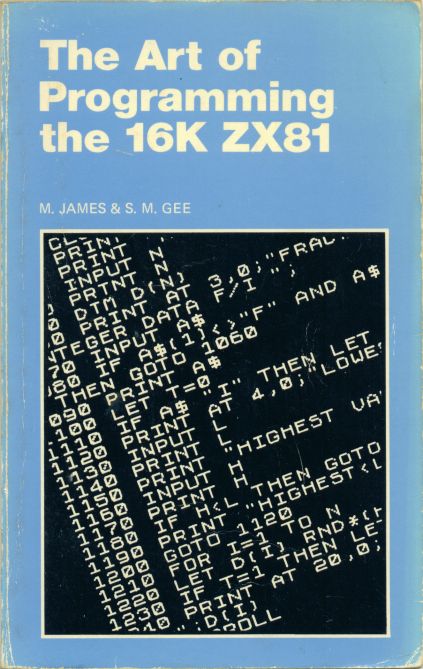
(DeMuiderkringB.V.).jpg)
Discussion
Nobody has started a thread about this yet.
Releases
- 1982Bernard Babani Publishing LtdPound sterling 2.50
- 1983De Muiderkring B.V. Sold as ZX81: 16K: Leren Programmeren
Documents
- ArtOfProgrammingThe16KZX81The.pdfComplete book English66,925 KB
- ArtOfProgrammingThe16KZX81The(ZX81-16K-LerenProgrammeren)(DeMuiderkringB.V.).pdfComplete book Dutch
Files and rights
No permission is on record either way. Screens and pictures are copied here on a take-down basis: if you hold the rights and want something removed, say so and it goes.
Credits
- Mike Jamescredited
- S.M. Geecredited
Sign in to credit somebody, or say what these people did.
In the magazines 2
ZX Computing #6Apr 1983 · p.68
Patrick Cain
PATRICK CAIN TAKES LONG, HARD LOOK A THE LATEST PUBLICATIONS FOR YOUR ZX LIBRARY. Adding memory to a computer adds to the power and potential of the computer. Efficient use of the new potential often requires more advanced approaches to programming. M James and SM Gee, authors of 'The Art Of Programming the 1K ZX81', have written a follow-on book, not surprisingly called The Art Of Programming The 16K ZX81', which looks at the enlarged scope of the '81 with a RAM pack and at programming techniques beyond those required for the unexpanded machine. Although the ZX81 has many functions available, its capability is greatly hampered by its lack of memory. Similarly, if your only user experience has been with a 1K machine, your own programming ability may be equally restricted. The authors have attempted to increase the reader's skill in programming now that the extra memory has provided the opportunity, a task which I think they have successfully met in this pocket-sized edition. Chapter one is an unnecessary justification for writing the book and a wishy washy commentary on the printer and RAM pack. Chapter two looks at what extra memory the RAM pack gives, what is stored where and how to manipulate these memory locations for better effect. Three utility programs Memory Use, Variable Use and Line Remember are included in the following chapter to provide the necessary knowledge and assistance in putting larger programs together and subsequently into operation. In the fourth chapter, there is an interlude from the more serious applications providing four good Quality games programs. 'Depth Charge' a missile and target game exemplifies practical methods for moving graphics characters around the screen. The others draw to notice techniques like screen PEEKing and POKEing, scrolling and paged graphics, with simple explanations of where they might be put to good use. Understanding fancy techniques may be fine, but it is certainly of little use unless you know how to incorporate them into your own programs. Thankfully, this wide ranging little book has taken this too into consideration and later pages deal with designing larger programs. Equally well dealt with is storing and recalling data from tape and methods for improving the range of the printer. Finally, to whet your appetite further after putting the RAM pack to good use, there is a chapter that introduces machine code. The information about formatting machine code routines is small but as a guide to just what is capable with machine code on a ZX81, it is complete. The Art Of Programming The 16K ZX81 is published by Bernard Babani, written by SM Gee and M Jones, costs £2.50 and as a guide to the larger '81 it is an excellent compliment. ISBN 0859340899.
Sinclair User #10Jan 1983 · p.41
John Gilbert
LEADING CHILDREN INTO MICRO WORLD John Gilbert on the growing bookshelf. The emphasis in the Sinclair book market is now on teaching young people about the uses of modern technology, and computers in particular. Usbourne Publishing Ltd has just produced a series of four books on microcomputers. Two of them consist of listings of programs for various microcomputers, including the Spectrum and ZX-81. There is usually only one listing of each program but symbols at the side refer the reader to conversion notes for their computers. The two, Computer Space Games and Computer Battle Games, are full of colourful drawings which will appeal to young children. The books cost £1.99 each and are a good idea, for they will coax children into work with computers, something with which some adults still seem to have difficulty. The function of the books is to catch the interest of the young so that they have no difficulties copies with technology in later life. The other two books in the Usbourne range are introduction to Computer Programming and Understanding the Micro. Both explain their subjects. using diagrams and colour drawings as an aid to understanding. Each costs £1.65. The range will be available from most bookshops, including W H Smith. The ZX-81 is still featuring strongly in the Sinclair publishing market. Following The Art of Programming the 1K ZX-81, Babani Publishing has The Art of Programming the 16K ZX-81. The book provides one of the most comprehensive introductions to the ZX-81 available. It takes the reader through the possible uses of the expanded machine and then explains advanced subjects such as machine code and programming techniques. It even includes a chapter on advanced randomness with methods of selecting random numbers using Chi squares, poission and binomial distribution. Chapters include graphics, designing programs, games and programming techniques. It costs £2.50. Ivor Killerbyte is obviously a pseudonym but the man who has produced Write Efficient ZX-81 Basic does not use the name because he does not want to be associated with the book. The book is very informative and well worth £5.95. It starts with the premise that the reader has a 1K machine and some of the things Killerbyte manages to squeeze from it are amazing. Included is a series of programs, such as full screen pattern generators, a giant character maker and some interesting graphics games. Killerbyte also provides a series of 36 rules of programming, spread through the book. They include using REM statements to describe programs where possible and making programs as user-friendly as possible. The book is published privately. Several books concerning the Spectrum appear every week. Even Clive Sinclair has extended into the market with the Sinclair Computer Guides. He has written the foreword to the first guide, which was written by Tim Hartnell. The ZX Spectrum Explored covers a large range of areas of Spectrum usage. There are chapters on the use of the computer in business and education, as well as games. There is also a short tour of the three-dimensional graphics capabilities of the Spectrum and a 10-page introduction to machine code. The techniques explained are illustrated with program listings, including a diary program and database. It costs £5.95 and is available from Sinclair Browne. The quality of books about Sinclair computers has improved but authors still seem to concentrate games program listings and books on Sinclair Basic. Many areas, such as machine code and programming techniques, could be better-explored. Usbourne Publishing, [redacted]. Bernard Babani (Publishing) Ltd, [redacted]. Ivor Killerbyte, [redacted]. Sinclair Browne Ltd, [redacted].
A detail from Introduction To Computer Programming, one of the Usborne Electronics range of books.
'The quality has improved but is still mainly listings'
Reviews from people here
Sign in to write about this, or make an account. It takes a minute and lets you correct the catalogue too.
No description recorded.
Sign in to correct or add to this.
Hold the rights to this and want it taken down?