
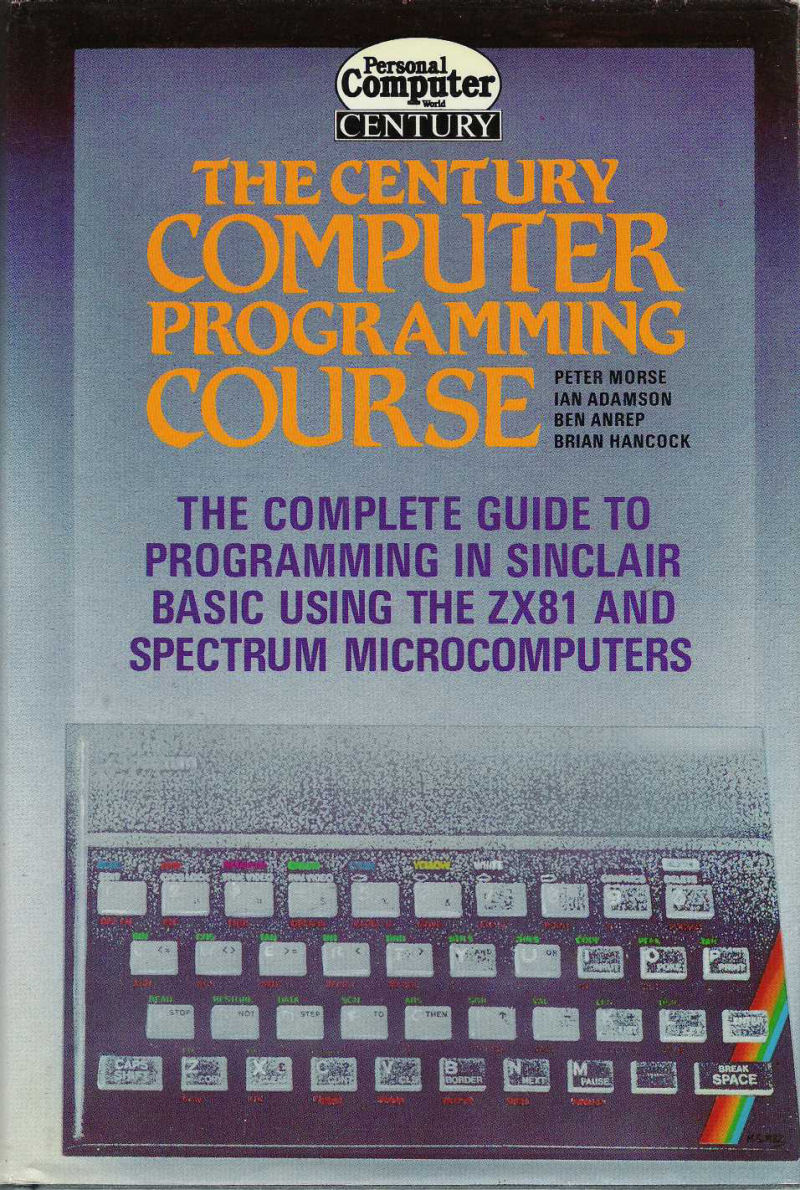
The Century Computer Programming Course
Book: Hardcover · English
Century Communications Ltd · 1983 · Pound sterling 9.95 · 525 pages · ISBN 0-7126-0072-8
Also known as The Complete Guide to Programming in Sinclair BASIC Using the ZX81 and Spectrum Microcomputers (English)
Discussion
Nobody has started a thread about this yet.
Remarks
Also available in paperback, on ISBN 0-7126-0073-6
Documents
- TheCenturyComputerProgrammingCourse.pdfComplete book English
- The_century_computer_programming_ZX81_Spectrum%28acme%29.pdfComplete book English
Files and rights
No permission is on record either way. Screens and pictures are copied here on a take-down basis: if you hold the rights and want something removed, say so and it goes.
Credits
- Peter Morsecredited
- Ian Adamsoncredited
- Ben Anrepcredited
- Brian Hancockcredited
Sign in to credit somebody, or say what these people did.
In the magazines 7
Your Spectrum #1Jan 1984 · p.77
Alan Jowett
PAPERDATA It's easy to feel that the glut of computing books forgo the rudiments of the craft and settle for lots of games for the frogger freak. But, asks Alan Jowett, could it be that the authors of these texts ignore a rather vital question. What is a book? Anthony Burgess, the Clockwork Orange man, described books in a recent colour supp ad as "boxes of organised knowledge". But too many of the micro volumes sitting in the racks round at the dealers are really collections of old magazine programs, writ large and often writ fast. No worse for being collected, but no better either. "The first rush of books on the Sinclair machines has been, to put it kindly, disappointing. Certainly none can be considered a serious text on Sinclair Basic. We felt that a book was needed which gave the first time user a worthwhile home tutor on computing," so say the authors of Century's new Computer Programming Course. Perhaps they're right. Have you or your kids been up at night furrowing over fuzzy repros from a defunct ZX printer... are you wasting your time on books that aren't worth the paper they are printed on? And it's sobering to consider just how many Sinclairs are listed in the 'Swaps and For Sale Cheap' columns because the owners have got fed up with the turgid prose of their books. The majority of the tightly crammed pages are in their way as unreadable as the 60's underground magazines that used to print green ink on purple pages. Indeed, one unmentionable guide went for four pages before introducing a new paragraph! The impression is that many are written by scientists or science teachers 'on the make'. True fans of everything that Clive Sinclair originally begat will want to invest the full £9.95 on the aforementioned Century Programming Course, a massive 525 pager that takes you right through every nook and cranny of the ZX81 and Spectrum. If you believe that your interest in Sinclair Basic is going to persist for the next few months, let alone years, then probably this is the one. It might have been more logical, however, to have brought in the Spectrum system and keyboard at an earlier stage than page 439 in section W, as if assuming that everybody is progressing from a ZX81 first. A BETTER MANUAL There's far less about programming in Ian Sinclair's The ZX Spectrum and how to get the most from it (Granada, £5.95). It's probably the best of the general guides and it seems to aim towards being more readable than the manual that accompanies the machine itself. This Sinclair must have made a mint from those who assume that he has kinship with our great Mensa sage, but I wouldn't begrudge a penny of it. Sinclair Minor actually tries to make a few jokes - nothing actually very funny, but enough to make things more readable and any attempts at whimsy are worthwhile. Sinclair doesn't make the pedagogic mistake of thinking that lack of knowledge equals lack of intelligence. But he does provide welcome diagrams for newcomers to the art, and a breakdown checklist. Advanced readers of this column may quietly sigh, but they were once beginners, and not that long ago either. The computer clubs are full of people wondering why their Spectrums won't work, and most of the answers will be found here. Actually, for those truly at the starting gate, for my money the best book to buy is First Steps with your Spectrum - my fave rave for any Sinclair computing course. Authoress Carolyn Hughes ran computer courses at her sons' school. She has provided a manual that sensible dealers could pop in with the Spectrum as a goodwill gesture (it only costs £1.25 from Armada) and one that should have any reader from eight to eighty programming in half an hour. Tim Hartnell, who has not been slow off the mark in dashing off a few million words of his own, adds in a foreword "There are lots of books written about the Spectrum. They were not written with you in mind." The point is, were they written with anyone in mind? Apart from the bank manager that is. Is it beyond the wit of publishers to attract a real writer to investigate the world of programming - and compose a book that is enjoyable to read, to handle and to program from? If you think that Fleet Street journalists spend all their time making up stories and muck-raking, cast an eye at The Sunday Times book on Skiing, mostly written by Harold Evans. Technical material is superbly illustrated and magnificently described and it has the reader almost leaping on the next plane in a mad urge to be out there on the slopes. Hands up all those who've ever had a thrill like that from reading a programming book. GOON-CRACK IT! Watching the hordes in W H Smith clutching at books geared to their own machines leaves you wondering how wide their view of the world is. Because buying a Spectrum doesn't mean you've started using your brains yet - the box can't actually do anything on its own. Few programming books tell you that one of the most important skills is patience; knowing how to debug is all about mind over matter most of the time. Walking the dog, reading poetry, listening to Brahms might help, but the books don't contradict the idea that the micro is what's all important. It's easy enough to pick up a smattering of Basic and learn how to doodle a bunch of pixelated munchkins all over the screen, but the books don't encourage you to ask any of the global questions. The best programming book I've seen over the past two years had not a single program in it and was nothing to do with the Spectrum or any other machine. But Design and Memory (McGraw Hill - John Wiley, £8.50) is the one I'd take to that desert island. Full of wisecracks aimed at programmers in big corporations it's still highly relevant to Spectrum users - after all, a lot of us have 48K at our fingertips and that was more than mainframe power only a few years ago. Peter Huyck and Nellie Kremenak urge programmers to get themselves to think of people as being useful, and to discover how the machine can help in their own lives. Too many Spectrum owners get their value out of the machine as a quick thinking toy, never seeing it as a way of helping to develop themselves. OK, so you don't want to learn archaic algebraic formulae. But, as the book points out, a good programmer is much like a jackleg carpenter - and they don't read philosophy either. And snippets of Reader's Digest aphorisms filtered through MAD magazine keep cropping up, telling you to summarise the condition of humankind in 25 words or less, or to cycle down to Kitty Hawk and feel the breeze coming from the South. Find one aspect of programming that inhibits innovation, they urge. Their approach is that there are only four billion of us at the moment and you can't assume that somebody else is asking those vital questions. We're all getting the benefit of immensely clever chaps like Sir Clive and his Mensa friends. But let's not pretend there aren't holes in our ways of looking at the world. Logic is flexible but too many programmers are too rigid and impatient to try trial and error methods. Librarians are just the same. Huyck tells the parable of how titles of books in Oriental languages are transliterated into the Roman alphabet and filed by the ordering rules for English titles. The rules are devised by Westerners but most people looking for books in Oriental languages are Orientals, so no one can find anything in the Oriental collection. Logic, philosophy and programming are all useful to each other. Bits of informed approaches will rub off on micro programmers over the years, but not if we just stay put in front of the same half dozen reliable guides. Don't just look under the safe old Dewey code of 001.642 in the library stack - let your fingers walk a few inches on both sides. After all, life is a bit of an adventure.
Sinclair User #16Jul 1983 · p.81
John Gilbert
GUIDES FOR BEGINNERS John Gilbert reviews the latest titles on the bookshelf. Publishers are beginning to realise that there are few general introductory books to computers on the market. Several new titles have been released in the last few months and they have steered clear of introductions to specific machines. The Pre-computer book by F A Wilson is published by Bernard Babani. The book has an odd title but that is the only strange thing about it. Wilson provides an introduction for the complete beginner. The concept of the computer is examined, together with such diverse subjects as number bases, hardware and simple programming. As a result it covers a great deal in very few pages. The book will satisfy your curiosity if you want to know what a byte is or where to find the ROM of a machine, but if you are looking for very detailed information, this general guide is not for you and does not pretend to be. The Pre-computer Book costs £1.95 and is one of the least expensive books which have been reviewed to date. Another book for the complete beginner is Programming for Real Beginners from Shiva Publishing. The author is Philip Crookall. It is a general introduction to computers and does not stay on the theme of programming. It may be useful to someone who is beginning a course in computer studies and would suit anyone doing CSE or O level. It is available for £2.95. For people who want to go a few stages further, Century Books thinks that it has provided the definitive text on Sinclair machines with its Century Computer Programming Course. What it has done is to publish a massive tome of text which is not indexed in any way. The book contains some interesting information on both machines but there is no way to find the information quickly. A proper index would, most probably, occupy another 10 pages. While the expansion into the general sector of the market has been taking place, more Spectrum books have appeared. The state of play seems to be that anyone will do anything for a Spectrum. The Century Computer Programming Course is written by Peter Morse, Ian Adamson, Ben Anrep and Brian Hancock. It costs £9.95 and is well worth the money. The recent release of the Complete Spectrum ROM Disassembly, by Dr Ian Logan and Dr Frank O'Hara, must be a great relief to many machine code programmers who want to get to grips with the Z-80A processor inside the machine. The book is published by Melbourne House and gives a detailed breakdown of all the routines in the ROM, including information on I/O routines, arithmetic and floating point calculations and the re-start routines at the beginning of the ROM. The Complete Spectrum ROM Disassembly costs £9.95. It is slightly overpriced, although the information is worth having. A book on machine code, Spectrum Machine Code, has been published by Shiva. The authors are Ian Stewart and Robin Jones and their handling of the subject is excellent, so far as it goes. The book is very thin, although it provides a great deal of information. The chapters on the display and attribute files of the Spectrum are very interesting and will be of immense value to anyone who wants to use machine code graphics within programs. Spectrum Machine Code is part of the Shiva Friendly Micro series and costs £5.25. Advanced Graphics with the Sinclair ZX Spectrum by I O Angell and B J Jones is published by Macmillan Press. The authors are obviously academics, as the book seems to be aimed at those with a great technical understanding of the Spectrum and also a knowledge of Cartesian Co-ordinate geometry. It is written rather like a treatise, with many references to other books in the main text. It is well-presented and provides plenty of technical information. The authors show how to develop arcade-quality graphics and also go into the realms of three-dimensional animation. The problem is that many Spectrum users would lose their way in the book, not because of any failing on their part but because of the authors' narrative style. Advanced Graphics with the Sinclair ZX Spectrum costs £9.95. The ZX Spectrum - Your Personal Computer is published by Prentice/Hall International and written by Ian McLean, Simon Rushbrook Williams and Peter Williams. The first third of it is taken-up by drawings of the Spectrum keyboard with marks showing the relevant key positions. Some readers may regard that as an insult to their intelligence, as all of those key functions are marked clearly on the Spectrum. There are, however, several redeeming features. The text is clearly set out and the examples are excellent. The chapter on loading and saving programs is useful but merely repeats the one in the Spectrum manual. It is a useful adjunct to the Spectrum manual and costs £5.95. Melbourne House (Publishers) Ltd, [redacted]. Bernard Babani (Publishing) Ltd, [redacted]. Shiva Publishing Ltd, [redacted]. Macmillan Press, [redacted]. Prentice/Hall International, [redacted].
Full-page ad5
- Sinclair User #14May 1983 · p.43
- Your Computer #5May 1983 · p.109
- ZX Computing #6Apr 1983 · p.136
- Personal Computer News #6Apr 1983 · p.49
- Popular Computing Weekly #17Apr 1983 · p.8
Reviews from people here
Sign in to write about this, or make an account. It takes a minute and lets you correct the catalogue too.
Everything ZXDB can hold about this is here.
Sign in to correct or add to this.
Hold the rights to this and want it taken down?