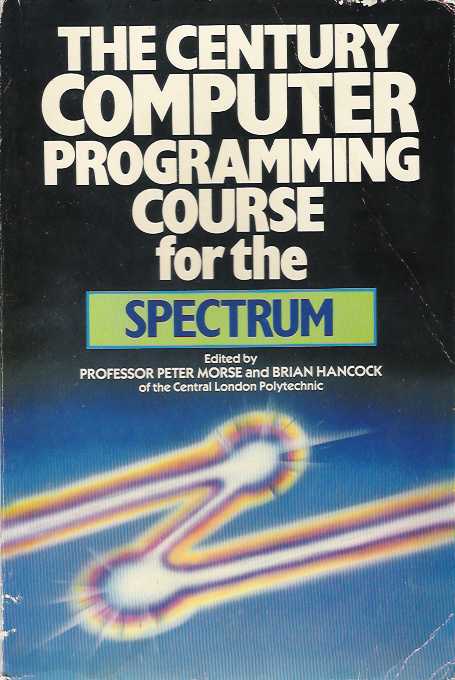
The Century Computer Programming Course for the Spectrum
Book: Paperback · English
Century Communications Ltd · 1985 · Pound sterling 12.95 · 544 pages · ISBN 0-7126-0380-8
MIA Missing in action. This is known to have existed, and no copy has ever been found. If you own one, the archives would like to hear from you.
Discussion
Nobody has started a thread about this yet.
Remarks
Also available cased, on ISBN 0-7126-0384-0.
Files and rights
No permission is on record either way. Screens and pictures are copied here on a take-down basis: if you hold the rights and want something removed, say so and it goes.
Credits
- Peter Morsecredited
- Brian Hancockcredited
Sign in to credit somebody, or say what these people did.
In the magazines 4
Your Spectrum #16Jul 1985 · p.10
Tony Samuels
Century Communications £12.95 Tense, nervous headache? Have you just acquired a shiny new Speccy but found your first bash at learning Basic has proved a brain-numbing experience? Well, there are always alternatives to struggling with the Speccy's manual. Have you thought about joining a computer club or evening classes or perhaps you'd rather sit down with a book... The Century Programming Course for the Spectrum is a new book from Century Communications that alms to teach you all there is to know about Sinclair Basic, as well as instilling in you the best programming techniques. To get the best out of it as a course, the book suggests that you should restrict yourself to reading an hour's worth a night. Now this mightn't sound very much but there's so much info here, you'd soon be overwhelmed if you attempted more. The really gutsy part of the book is split into four sections. The first covers the relatively simple aspects of Spectrum programming like cursor modes, graphics modes, the PRINT statement, the LET command and simple arithmetic. OK, so far! Part two just about wraps up all the other commands, with full details of how each is arranged. Here you'll find IF THEN, FOR TO, STEP and NEXT plus the finer points of PRINT when using ink, paper and AT or TAB controls. Between them, parts three and four go over all the really heavy programming techniques, like bubble, binary and ripple shorting. And although the book sets out to comprehensively cover Basic, it doesn't avoid all mention of machine code matters. My only qualm is with the free 'n' easy use of flow-charts throughout the book - I'm just not convinced that they add clarity, not confusion. Still, there's no doubt that this is a pretty encyclopaedic tome (as it should be for £12.95!) that can be used as a reference book even if you don't need to begin right back at the basics. But be warned, it's full of jargon and often expects you to have an IQ in excess of Sir Clive's! So if you're a real beginner a better suggestion might be to splash out on a somewhat less technical book. (How about a plug for the Capital Radio Book of Computers and Simple Programming? Troubleshootin' Pete). Once you've mastered that, you'll be ready to have a crack at the Century course.
Sinclair User #39Jun 1985 · p.119
John Gilbert
THE LAST WORD IN BASIC Publisher: Century Price: £12.95 It was with a sense of deja vu that we picked up the Century Computer Programming Course for the Spectrum. We have reviewed the course before but this book edited by Professor Peter Morse and Brian Hancock, is a revised version of 544 pages. There are eight pages of contents which show that the book is split up into Basic programming, advanced Basic programming, and a series of applications programs, all of which are neatly explained using flowcharts and words. For all its size the book only refers to Basic, so if you want to learn about machine code programming on the Spectrum then you should look elsewhere. That said the book contains just about everything you are ever likely to want to know about Basic structure and its usage. The editors have even included sections on different types of sort and search methods and one of the most understandable explanations of Spectrum graphics and screen displays ever to be published. The two sections which really catch the eye are Memory Organisation and The Microdrive. The former gives a thorough explanation of how Basic programs are stored and manipulated in memory. The section on microdrives gives a simple explanation of how they work with Interface One using examples every step of the way. As well as all the explanations of its usage full documentation on both microdrives and Interface One is included. The book's style is lucid, although not particularly sparkling, and there are enough programs to break up the text into manageable chunks.
News/Note1
- ZX Computing #20Aug 1985 · p.13
Review1
- Sinclair User #16Jul 1983 · p.81
Reviews from people here
Sign in to write about this, or make an account. It takes a minute and lets you correct the catalogue too.
Everything ZXDB can hold about this is here.
Sign in to correct or add to this.
Hold the rights to this and want it taken down?