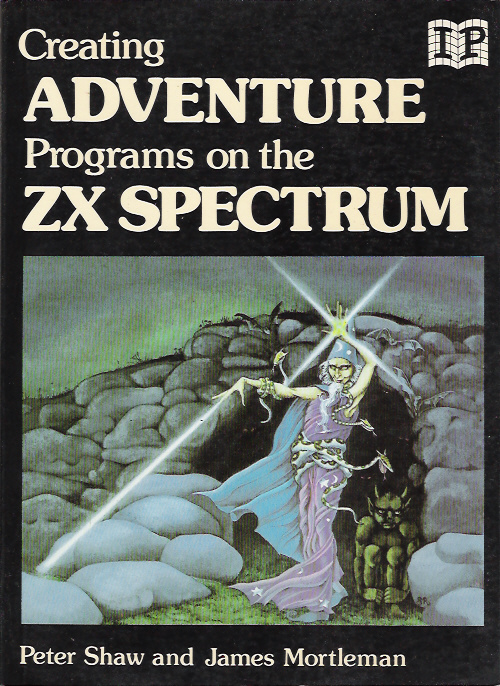
Creating Adventure Programs on Your ZX Spectrum
Book: Paperback · English
Interface Publications Ltd · 1983 · Pound sterling 4.95 · 124 pages · ISBN 0-907563-58-9
Also known as Creating Adventure Programs on the ZX Spectrum (English), Fantastische Avonturen voor je ZX Spectrum deel 1 (Dutch), Novas Aventuras no Seu ZX Spectrum (Portuguese)
(TemposLivres).jpg)
Discussion
Nobody has started a thread about this yet.
Releases
- 1983Interface Publications Ltd Sold as Creating Adventure Programs on the ZX SpectrumPound sterling 4.95
- 1985Uitgeverij Luitingh Sold as Fantastische Avonturen voor je ZX Spectrum deel 1
- 1985Tempos Livres Sold as Novas Aventuras no Seu ZX Spectrum
Documents
- NovasAventurasNoSeuZXSpectrum.pdfComplete book Portuguese
- CreatingAdventureProgramsOnTheZXSpectrum.pdfComplete book English
Files and rights
No permission is on record either way. Screens and pictures are copied here on a take-down basis: if you hold the rights and want something removed, say so and it goes.
Credits
- Peter Shawcredited
- James Mortlemancredited
Sign in to credit somebody, or say what these people did.
In the magazines 29
Micro Adventurer #11Sep 1984 · p.28
John Fraser
ADVENTURE PROGRAMS BROUGHT TO BOOK John Fraser leafs through a selection of books on how to design your own adventures. Next month sees the start of a regular book review section, covering computer books, game books, and related topics. ADVENTURE PROGRAMS BROUGHT TO BOOK John Fraser leafs through a selection of books on how to design your own adventures. Next month sees the start of a regular book review section, covering computer books, game books, and related topics. Despite the growing popularity of commercial adventures, many enthusiasts prefer to draw on the worlds of their own imagination, rather than someone else's. But, sometimes, the sheer size and complexity of the task is enough to deter them altogether, with the result that they never progress beyond playing prepackaged scenarios. If you happen to be one of these frustrated adventurers, there is no longer any need to despair, because now experienced programmers have recognised your plight and set down on paper their accumulated wisdom with the express aim of teaching you the art. It must be said, however, that this wealth of literature on how to write your own wonderful mind-bending adventures, is not going to solve your problems overnight. Furthermore, the very concept of such books raises a number of questions which ought to be considered before you unplug your micro and rush into the nearest branch of W H Smith. Firstly, there is nothing quite so tedious as being hunched over a keyboard (particularly the Spectrum's) for several hours in an attempt to translate your brilliant idea into seemingly endless screenfuls of code. Unless you can afford an adventure-generating program such as The Quill or Dungeon Builder, that's exactly what you are in for - and not even the books will remove that drudgery. Not surprisingly, few adventure enthusiasts write a game just for something, to do on a rainy afternoon. Generally, the motivation is at least partly financial: the thought of earning a living from one's hobby, perhaps even of tax havens or a yacht in the Mediterranean. Whatever your ultimate ambition, do not be misled by those blurbs which promise that "you'll soon be creating magnificent games of your own." No book can teach you to do that, but what they can provide you with are the necessary techniques and concepts; the rest depends on the power of your own imagination. Secondly, the programming techniques used in writing adventures are much the same as those used in writing other programs. Once you know how to input data into an array, manipulate strings and so on, you will be well on the way to being able to write one. On the other hand, if such things only induce anxiety, you would do better to buy one of the numerous introductory books available and get to grips with the fundamentals of Basic first. Finally, ask yourself what you really want a book for, because if it's just to key in someone elses listing, you'll have a pretty good idea of how to solve the game before you even run it. Almost certainly, it will take you much less time to solve than it did to key in, which makes all those hours of toil seem rather pointless. After what I've written so far, you may have reached the conclusion that all these hefty volumes crammed with unbelievably long listings are nothing more than publishing gimmicks created to enlarge the bank accounts of struggling authors and publishers. Well, this is not entirely true; there is a range of books to suit most tastes, and some are genuinely useful. Most of these titles follow an, almost identical pattern: explanation, historical introduction, worked example. They differ widely, however, in the amount of information they contain and the number and type (i.e, text or graphic) of adventures which they describe. Some offer several listings for each micro; others offer several versions of the same listing; and a few even fail to specify which machine was used to produce them. Hopefully, by the time you've read this article, you'll be in a better position to decide which is the book for you - or even whether you need one at all. To begin with, let's examine a couple of books which are not machine-specific, but which nevertheless contain listings that can easily be adapted for the Spectrum. The first of these makes a radical departure from the standard format. Andrew Nelson's Creating Adventure Programs on your Computer is - or so the blurb proclaims - "another great book from Interface Publications." Instead of beginning with the usual explanation of what an adventure game is and how they developed, it launches straight into a mini-adventure similar to those in Penguin's Fighting Fantasy Gamebook series; this is then used as the author's first computer adventure. Unfortunately, my copy of the book appears to have met with a disaster in the printing works, and sorting out the text is itself something of an adventure. However, no one else seems to have had the same problem. Interface first published the book in October 1983, and have received no other complaints about it. SOPHISTICATION For all that, the book is quite useful. Andrew Nelson has provided three games of increasing sophistication, with both a basic and an elaborated version of the first offering, Werewolves and Wanderers. He's also generously included a print-out of the screen displays which shows you what the game is like actually running. Only Werewolves and Wanderers is described in any detail, although this doesn't matter very much as the second game, a space adventure, demonstrates how it can be used as the foundation for totally different scenarios, without having to start from scratch. All you do is load the first game and work through the listing, changing the lines where appropriate. The final game consists of over forty locations and demands rather more brawn than brain, as there's plenty of monster bashing. Despite this limitation, and a small vocabulary, you are able to control your attributes and so the game is not the same every time you play it. There are also helpful appendices, including a character name generator, a section on further reading, and a list of games manufacturers and distributors. Chapter 21 (which, incidentally, has been printed twice) offers suggestions for enhancing the appeal of your games and, though brief, gives some advice worth considering. As far as I can discover, the book makes no mention of which machine was used to produce the listings, but converting them for the Spectrum should be no problem. At least with Keith Campbell's Computer and Video Games Book of Adventure you don't get lost trying to sort out the pages. It's a well produced and readable book, but because it's not machine-specific it may well cause some annoyance to those who want value for money - and who doesn't these days? Only one game is described, and there are listings for the BBC, Spectrum and Commodore 64. This means, inevitably, that if you only have one machine much of the book will be of no use to you. Add to that the demonstration program which was written on a TRS 80 and the conversion notes, and you may well be disappointed. According to no less an authority than Scott Adams, who has written the foreword, the book contains "a wonderful recipe for baking your own adventures." Maybe so, but I expect some readers will take that with a pinch of magic potion. It's one thing to have the right ingredients, but quite an other to turn those ingredients into a commercial product. The game itself is notably lacking in complexity. With only ten locations it nowhere near matches the scale of those in some of the other books reviewed here. Nevertheless, it's likely to appear rather less daunting to the newcomer and the text is clearly written, with each stage of the programming covered in easily digested portions. Most Spectrum users, however, will naturally want a book that is machine specific, and there are three which can be recommended. Which is the better book is really a matter of personal preference, how familiar you are with Basic, whether you like text or graphic adventures, and what your expectations are. Of the three, one stands out as being more of a collection of listings to key in and run. In fact Creating Adventure Programs on the ZX Spectrum, written by those teenage whizz-kids Peter Shaw and James Mortleman, offers no less than seven adventures for £4.95. The first half of the book looks at the necessary techniques - creating locations, adding graphics and so on - but the explanations are minimal, which is no bad thing as you're likely to learn more by following a listing through to see how it works. One book which covers both text and graphic adventures is Noel Williams' invent and Write Games Programs for the Spectrum. Although the word adventure appears nowhere in the title, adventures are the author's main concern, and he provides three examples, together with many more useful routines. The first game, The Throne of Camelot, is a traditional puzzle adventure with over sixty locations. Then there is The Mines of Merlin, a role playing type game in which your attributes and possessions are continually updated as you battle with monsters and wander through dark caverns. Finally, in Treasure Trove, you use the cursor keys to manoeuvre a little man around the screen to pick up jewels before your time runs out. The adventure element of the last program is debatable, but the game is thoroughly explained and illustrates techniques for those who wish to incorporate arcade action into their adventures. Noel Williams has done his best to cater for every interest. He can't obviously devote an equal amount of space to everything, so you don't get a highly elaborate graphic adventure, for instance. Even so, the book is remarkably comprehensive and will no doubt gain a wide readership not only among adventurers, but also among those interested in other games who recognise the universal value of the techniques used. The final book reviewed is perhaps the one most likely to appeal to the uninitiated, even though the author (if we are to believe his introductory remarks) does have to sustain himself with large quantities of alcohol when playing adventures! Peter Gerrard's Exploring Adventures on the Spectrum 48K contains three text adventures which only accept simple verb-noun inputs, but are nevertheless far more substantial offerings than those in similar books. One of the games, Underground Adventure, contains no less than one hundred locations and is fully explained, section by section. Only the listings are presented for the other two, but if you have followed Underground Adventure, this should be no handicap.
Your Spectrum #4Jun 1984 · p.67
Peter Jackson
NOVEL ADVENTURES Obsessed by adventure, Peter Jackson girds his loins and boldly goes where few reviewers have gone before - to the shelves of the local bookstore. His mission? To discover what goes to make a prime adventure tutor for the Speccy. Adventure n. - Remarkable happening: enterprise; risk; bold exploit; commercial speculation. - Collins Gem English Dictionary. To start with, here's a small competition for adventure game players: spot the bit of the above definition that rarely crops up in the dungeons. Correct. Part two: spot the bit that has brought us so many books on Spectrum adventures. Correct again. But the commercial speculation in the adventure book world is more subtle than the usual bandwagon-jumping that's done by authors and publishers, though that is certainly going on (note Melbourne House's tome explaining The Hobbit 'help' messages, for one). No, these books are also an appeal to reader's commercial interests. You won't find this group of Spectrum users rubber-keying its way through multi-K adventure listings in Basic just out of curiosity - or just to play the resulting game when all the answers are in the listings anyway. What these readers want is to learn how to produce adventures that they can sell for vast amounts of money. Take the final few paragraphs of Keith Campbell's Computer and Video Games Book ofAdventure for example. "If you now have a game popular with friends and family, you might consider the possibility of getting it published," says Campbell. And a few lines later: "I... look forward to playing and possibly reviewing your adventures in the future!' (Campbell, like many other writers in the adventure field, is addicted to exclamation marks. It gives some ersatz excitement to the prose, like this!!!) At least his book gives some useful advice about the real purpose of writing your own adventures. The others under review are a little more coy, with one of them remarking vaguely that the author is "sometimes tempted to think that the mercenary attitude shines through on occasions!" (note that '!'). Perhaps several months should be spent writing an adventure just to amuse family and friends and to impress them with your programming prowess and resistance to boredom? It's interesting to note that Campbell and most of the other authors in this book batch have had adventures published by some games house or other. Peter Gerrard, for example, is described in the blurb of his Exploring Adventures on the Spectrum 48K as the "author of two top-selling adventure games for the Commodore 64" (?). And Roy Carnell, author with Tony Bridge of Spectrum Adventures, has his own eponymous adventure software house. THRILLS FOR SALE To paraphrase Dr Johnson; "Sir, no-one but a fool ever wrote an adventure except for money." So - fair enough - I decided to examine the five books from the point of view of making money; to be honest, I'm by no means immune to the temptation of writing a 'top-selling adventure' myself. One thought struck almost immediately - the programming in adventures is not very difficult. Long, certainly; convoluted, yes; but not actually difficult. The main purpose in adventures is to understand the player's typed input and relate this to stored information about objects, locations and problems in the fantasy world created by the programmer. (At least, that's what I think it is. We'll be coming back to what some of the authors think it is later.) Programming this requires a bit of string slicing, a lot of checking against arrays, some setting and testing of flags, and a whole raft of IF - THEN - GOTOs and ON-GOTOs. The main problem is continuity, the linking together of locations, objects and actions, but that's a debugging and play-testing problem rather than a programming one. What stops people writing adventure programs, then, is not so much difficulty as problems of scale. Adventures are so darn big that they can daunt the beginner, warnings in the books about what you can do if you run out of memory are more frightening when you have 48K than when you only have 16K. All the authors have addressed themselves to this confidence problem in various ways - and with varying degrees of success. THE SHAPE'S THE SAME Despite differing approaches to the actual programming, all the books seem to follow a set pattern. First there is an explanation of fantasy and role-playing games and that's followed by a description of Dungeons and Dragons with all the obligatory copyright and trademark blurb from TSR. Then comes an outline study of the original mainframe adventure, descriptions of the early micro versions, and eventually the author gets into his own programs. About the weirdest candidate for this stock structure comes in Spectrum Adventures by Bridge and Carnell. The usual stuff about Crowther and Woods, Scott Adams et al, is just as expected, and there are descriptions and examples of such classic text adventures as Colossal Cave and Level 9's Dungeon Adventure. There's even a separate chapter on The Hobbit. Then the authors start programming and the game they have chosen to illustrate adventures is a pure graphic, 'move about on the screen and belt monsters', arcade-style thing that bears little relation to the heritage they are claiming. It's called Eye of the Star Warrior, and those fearing the mammoth task of typing it all in will be pleased to learn that it's also available on cassette. Chapter six of Spectrum Adventures offers some self-justification for using a 'graphic adventure' (the phrase is theirs, I'd prefer 'arcade knockabout') to demonstrate adventure programming technique. "In this way we can present the maximum number of techniques", it says. "The second reason is simple - a text adventure, while being a lot of fun to play, is not much of a surprise after being typed in from a listing!", it goes on. Leaving the exclamation mark aside, this seems to me like turning a bug into a feature. The most famous adventure programs ever are all pure text (leaving aside The Hobbit which is a very mediocre adventure indeed without the pictures) and giving the thrill-thirsting public something that isn't really an adventure at all is a bit much. Pardon my continued ranting, but if this book was meant to describe arcade games it should say so in the title. It will not do for the authors to say, as they do in Chapter six, that "the section on generating the room complex will be just as valid in a text game, as will the movement routines", particularly when the 'complex' consists of a three-level array of identical cubicle rooms differing only in their monstrous graphic contents. Similar criticisms, only less spiteful, can be made of a book I haven't mentioned before: Andrew Nelson's Creating Adventure Programs on Your Computer. We're not told whether Nelson has his trotters in the published game trough, only that he has spent "the last 18 months devising, programming and playing computer Adventure games". But it seems safe to assume that he's in it for the moolah, just like the rest of us. Be that as it may. his book is the only one in the stack that doesn't follow the standard pattern. There's no history lesson, but before jumping headfirst into the programming. Nelson does provide one or two interesting sidelines. First he gives a little non-computer adventure game, reminiscent of Penguin's Fighter Fantasy Gamebooks in its programmed learning course layout. This forms the basis of his first game listing, Werewolves and Wanderer, and he also shows a printout of the program actually running - a feature other authors should copy. Nelson gives three games listings, all based on the same techniques and increasing in complexity through the book. Only the first has its programming described in detail, with the code split into short sections and explained. It's left as an exercise to the reader to figure out how these techniques are used in the later games, but there's nothing too difficult. All three have much more in common with the adventure classics than Bridge and Carnell's example. But that's not to say that Nelson's work is entirely kosher. As the sample runs show, the aims of the games are to explore an environment, pick up treasure and kill monsters. True, the room descriptions will be more familiar to the old-timers, but the player's vocabulary is limited to a set of one-letter commands and the puzzle-solving aspect of adventures is sadly neglected in favour of 'slash and bash'. All three games were created on the IBM PC, but since they are text-only there are few problems in converting them to run on the Spectrum (or anything else for that matter), and the largest of them only sucks up around 18K. Nelson's book is published by Interface - which made it quite a surprise to find another Interface book in the stack, and one sporting a similar title: Creating Adventure Programs on the ZX Spectrum. It's writ by our own Peter Shaw along with fellow infant prodigy, James Mortleman. This is the most lightweight of the quintet, the bulk of the book being taken up with the listings of several simple adventures. But these are what I would call real adventures, with puzzles to solve, equipment to figure out, and other stock situations. At least Shaw and Mortleman have resisted overburdening the pages with explanation of the straightforward programming required; the listings tell the story themselves. And the listings are also short enough to run through without fear. THE WINNERS And finally, we come whizzing back to Keith Campbell and his Computer and Video Games Book of Adventure, and Peter Gerrard's Exploring Adventures on the Spectrum 48K. To my mind, these are easily the two best books in the batch. Both written by published game authors, they are traditional in the type of game they describe and they clearly and succinctly explain each stage in the programming of a traditional adventure. Both follow stock format, with history and brief descriptions of published games at the front, followed by programming details for one game on three machines (Campbell), or three games on one machine (Gerrard). But Gerrard's book wins it, and not just because he has the advantage of being able to concentrate on the Spectrum alone. Demo or no demo, Campbell's adventure program is trivial, and if you produced a similar game using the techniques given you'd be laughed out of every software house waiting room in the land. Gerrard's, on the other hand, are the real thing. They're of the right commercial scale and - once again - it's no surprise to find the games available on cassette from the book publisher, with changes in locations and objects you could well have a sellable game on your hands. Gerrard also gets high marks for providing a set of scenarios that the reader could use to get a foot in the door of those mirth-ridden software houses. One final point (and really an admission of prejudice) both Campbell and Gerrard produce 'real' adventures and their books have also proved a few points to my satisfaction. First, lots of the adventure games you come across are nothing of the sort. Second, writing adventure programs is a lot more difficult to start and finish; the actual coding seems a piece of cake. And third, I now know that I could write a wonderful adventure game if I only had the time... or perhaps a good adventure book? One last gripe from someone who is within 'the biz'. Any publisher who allows the sort of production cock-ups that have marred all the five books here - typographical errors, misspellings, misregistered printing, misbound and repeated sections of pages, and mis-just-about-everything-else - would not keep my valued custom. And yet all these books cost more than a reasonably good adventure cassette. 'Commercial speculation' is right, and so, nearly, was Dr Johnson.
WE LOOKED AT... Computer & Video Games Book of Adventure by Keith Campbell Melbourne House ISBN 0-86161-143-8 £5.95 Exploring Adventures on the Spectrum 48K by Pete Gerrard Duckworth ISBN 0-7156-1796-6 £6.95 Spectrum Adventures by Tony Bridge & Roy Carnell Sunshine ISBN 0-946408-07-6 £5.95 Creating Adventure Programs On Your Computer by Andrew Nelson Interface ISBN 0-907563-36-8 £4.95 Creating Adventure Programs on the ZX Spectrum by Peter Shaw & James Mortleman Interface ISBN 0-907563-58-9 £4.95
Personal Computer News #62May 1984 · p.58
John Lettice
GIVE YOUR TYPING FINGERS A BREAK AND LET THEM TURN A FEW PAGES. 'Creating Adventure Programs On The ZX Spectrum' by Peter Shaw and James Mortleman, published by Interface at £4.95 (paperback, 124 pages). 'Spectrum Magic' by Steve Belts, published by W Foulsham & Co at £5.50 (paperback, 95 pages). 'Step by Step Programming - ZX Spectrum' volumes 1 and 2 by Ian Graham, published by Dorling Kindersley at £5.95 each (paperback, 64 pages each). 'An Expert Guide to the Spectrum' by Mike James, published by Granada at £6.95 (paperback, 190 pages). 'ZX Spectrum Astronomy' by Maurice Gavin, published by Sunshine Publications at £6.95 (paperback, 229 pages). Hardly a week goes by without 'another great book from Interface Publications' (© Interface Publications) whacking onto the doormat in the entrance hall of PCN towers. 'Creating Adventure Programs on the ZX Spectrum', by Peter Shaw and James Mortleman, is one of the latest from this stable, and follows Interface's traditional format by having plenty of listings for you to hack in. There are seven complete adventures including 'Elsie the Aadvark (sic, throughout) goes Lunar Surveying.' There are a number of howlers along these lines, including 'Minataurs, Hydra and the Scylla make excellent monsters.' PCN's culture correspondent reveals that Scylla was actually a rock, and while this may be a handy way of dealing with those failed user-defined graphics, the authors here seem to have unintentionally underlined the need for good research when you're writing an adventure. The section on how to write an adventure takes up slightly less than the first half of the book, but there's enough information to show you the techniques to use in programming an adventure. The problem is that the techniques aren't really all that different to those you'd use in other programs. Work out how you store your locations in arrays and how to give the game a vocabulary, then you just zip through PLOT and DRAW and that's that. The only other things you'd need to know would be a little on organising long Basic programs, how to write a script, and how to produce fast complex graphic displays. None of these are covered in any detail. Still, seven adventures for £4.95 can't be bad. 'Spectrum Magic - your first programming book' is a different kettle of fish. Aimed at children from nine upwards, it sports a jolly cover that looks a bit like Gerald Scarfe's impression of Ronald Reagan leading the invasion of Grenada. It starts with the usual 'setting it up' chapter, plus a short homily on the subject of 'butter spoils the works' which indeed it does. The author takes a gently, gently, approach throughout - too gently I'd have thought, as by the time a beginner's reached the end of the book they'll have learned only very basic programming techniques. This makes chapter 31 'Speeding ahead', look a bit bizarre. It presents a sketchily explained piece of machine code, plus its Basic equivalent, to illustrate the difference in speed. Readers that reach chapter 30 thinking they've learned a bit about programming are liable to change their minds when they hit 31. 'Step by Step Programming for the ZX Spectrum', by Ian Graham, comes in two volumes, and is again educational. Both volumes are beautifully presented, and use a screen-shot technique to produce the program listings. The ground covered in Book one is similar to that dealt with by 'Spectrum Magic', but it's a little wordier and the explanations are clearer. Book two follows the same format, but this turns into a disadvantage because program length is limited to one screenful. Also the information included seems a lot less systematic than in the first volume. Mike James' 'An Expert Guide to the Spectrum' turns out to be an interesting book, although its usefulness is limited by an inadequate index. Mr James concentrates on what is going on inside the machine when a program is running, so when you've finished reading it you'll probably have a better understanding of what the Spectrum does, and why it does it. Spectrum Basic is covered, along with the tape system, Microdrives, communications and advanced programming applications, and the book includes enough in the way of machine code routines to whet the beginner's appetite. And finally, what can a non-astronomer say about a book about astronomy? 'ZX Spectrum Astronomy', by Maurice Gavin, isn't aimed at astronomers, but rather at Spectrum owners 'who wish to expand their computing interests into other fields'. It includes routines to allow you to simulate the movement of the stars and to produce star maps, but I think you'd have to have some prior interest in the field for the book to grab and hold your attention.
Advert26
- Sinclair User #37Apr 1985 · p.62
- Your Spectrum #13Apr 1985 · p.24
- Sinclair User #36Mar 1985 · p.118
- Your Spectrum #12Mar 1985 · p.18
- Your Spectrum #11Feb 1985 · p.13
- Sinclair User #35Feb 1985 · p.64
- Sinclair User #34Jan 1985 · p.8
- Sinclair User #33Dec 1984 · p.188
- Your Spectrum #10Dec 1984 · p.11
- Sinclair User #32Nov 1984 · p.36
- Your Spectrum #9Nov 1984 · p.5
- Sinclair User #31Oct 1984 · p.148
- Sinclair User #30Sep 1984 · p.124
- Your Spectrum #7Sep 1984 · p.13
- Sinclair User #29Aug 1984 · p.126
- Sinclair User #28Jul 1984 · p.104
- Micro Adventurer #7May 1984 · p.20
- Your Computer #5May 1984 · p.182
- Your Computer #4Apr 1984 · p.154
- Micro Adventurer #5Mar 1984 · p.42
- Your Computer #3Mar 1984 · p.50
- Micro Adventurer #4Feb 1984 · p.12
- Your Computer #2Feb 1984 · p.106
- Micro Adventurer #3Jan 1984 · p.18
- Your Computer #1Jan 1984 · p.230
Programs listed in this book
Reviews from people here
Sign in to write about this, or make an account. It takes a minute and lets you correct the catalogue too.
No description recorded.
Sign in to correct or add to this.
Hold the rights to this and want it taken down?