
Doomdark's Revenge
Strategy Game: War · ZX-Spectrum 48K · 1 players · English
Beyond Software · 1984 · Pound sterling 9.95
Icemark, 2 of 3
Discussion
Nobody has started a thread about this yet.
Remarks
The audio track came with the C64 version of the game, as well as with the (Spectrum) compilation {The Best of Beyond|Beyond Software|0011210}.
Play
- doomdarks.rzxRZX playback file
- DoomdarksRevenge.tzx.zipTape image English59 KB
- DoomdarksRevenge.tap.zipTape image English46 KB
Documents
- DoomdarksRevenge(EN).pdfInstructions English3,585 KB
- DoomdarksRevenge.txtInstructions English34 KB
Music
- DoomdarksRevenge_TheStory.mp3.zipBonus soundtrack(s) in MP3 format 30,727 KB
Other files
- doomdark-map-editor.zipArchive file 69 KB
- Doomdark's Revenge (1984)(Beyond Software).pokPOK pokes file 0 KB
- contents.htmRemote link
Files and rights
No permission is on record either way. Screens and pictures are copied here on a take-down basis: if you hold the rights and want something removed, say so and it goes.
Credits
- Mike Singletoncredited
Sign in to credit somebody, or say what these people did.
Awards
- PCG HitPersonal Computer Games15 · 1985
- Crash SmashCrash13 · 1985
Scores
In the magazines
- Sinclair User #351985 · Gilbert Factor9/10
- Your Computer #11985 · Overall3/5
- Crash #131985 · Overall Value10/10
- C&VG (Computer & Video Games) #411985 · Personal Rating7/10
- Personal Computer Games #151985 · Overall10/10
- Personal Computer News #931985 · Overall9/10
- ACE (Advanced Computer Entertainment) #31987 · Ace Rating940/1000
Elsewhere on the web
- WorldOfSpectrum 194 votes8.23
Awards and competitions
Crash Readers Awards 1985
- 2Best Graphical Adventure
In the magazines 79
ACE (Advanced Computer Entertainment) #3Dec 1987 · p.874/76/76/75/7940/1000940/1000
ACE (Advanced Computer Entertainment)
Opposition 4/7
Display 6/7
Ease Of Use 6/7
Game Depth 5/7
Ace Rating 940/1000
Andy Smith 940/1000
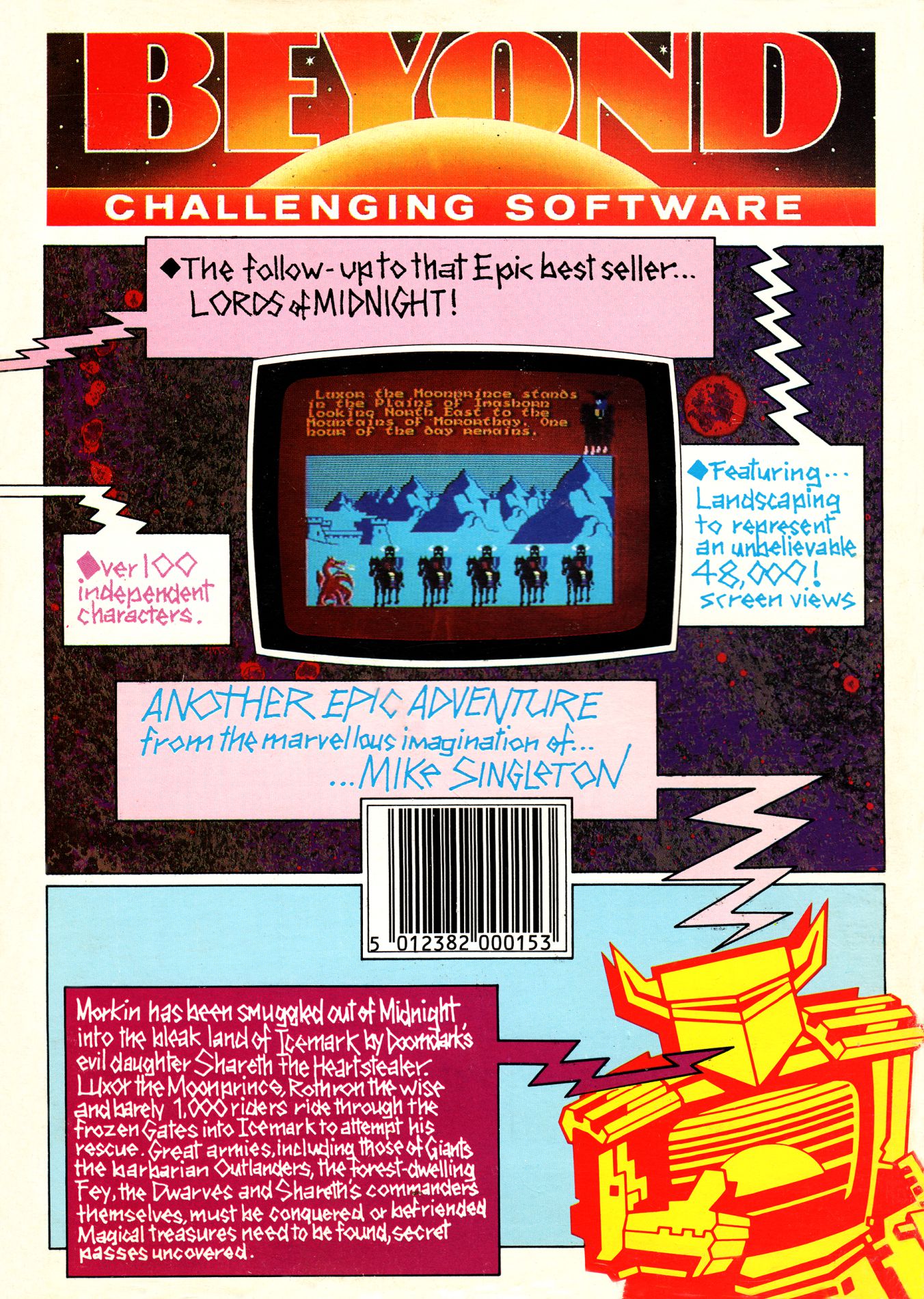
Spectrum, £9.95cs C64/128, £9.95cs Amstrad, £9.95cs The sequel to the classic Lords of Midnight, written by the same author - Mike Singleton. Following the defeat of Doomdark, his daughter (Shareth the Heartstealer) threatened to invade the peaceful lands of Midnight. Luxor set forth to the lands of the Icemark to rescue his son Morkin and defeat the evil Shareth. The ordering system and game concept is the same as used in Lords of Midnight, but the game was greatly enhanced by the addition of several warring factions, from which the player has to recruit his armies. Although you could see a lot of Lords of Midnight in the game mechanics, Doomdark's Revenge plays completely differently and is certainly a worthy successor. All that remains now is to see whether Mike Singleton can ever find the time to write that promised third part of the trilogy Eye of the Moon.
Sinclair User #44Nov 1985 · p.23
Mike Singleton's epic fantasy wargame, Lords of Midnight, was one of the finest games of 1984. The sequel, Doomdark's Revenge, is even more massive with 48,000 views of the landscape and scores of independent characters to deal with. You are Luxor the Moonprince, riding to rescue your son Morkin from Shareth the Heartstealer. Raise armies from races diverse as dwarfs, giants, elves, barbarians and icelords - all have their own interests, and you may need to undertake special quests to win them over. Very complicated, not for novices - but fans of Midnight need no urging.
C&VG (Computer & Video Games) #41Mar 1985 · p.237/107/10
Personal Rating 7/10
Keith Campbell 7/10
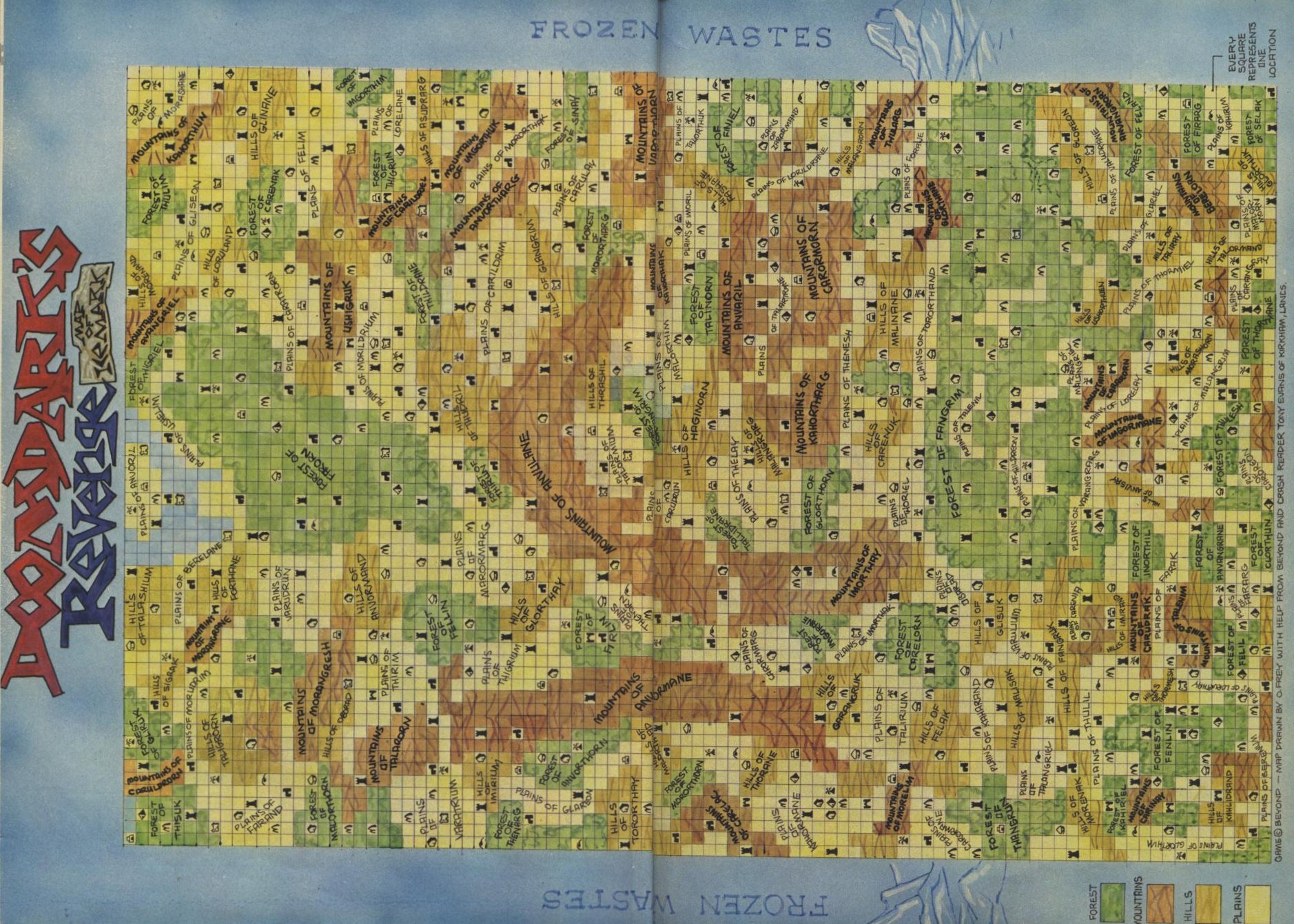
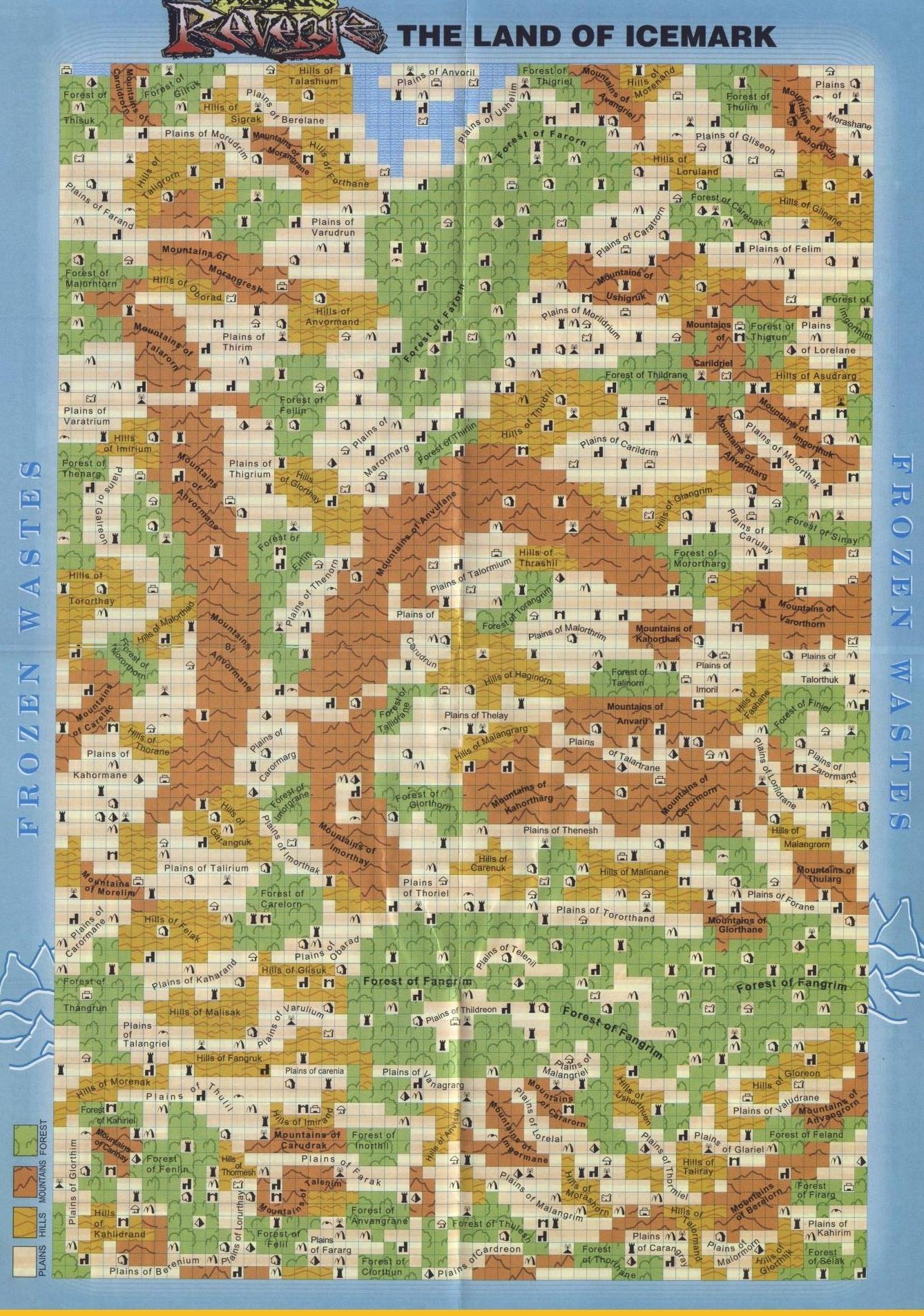
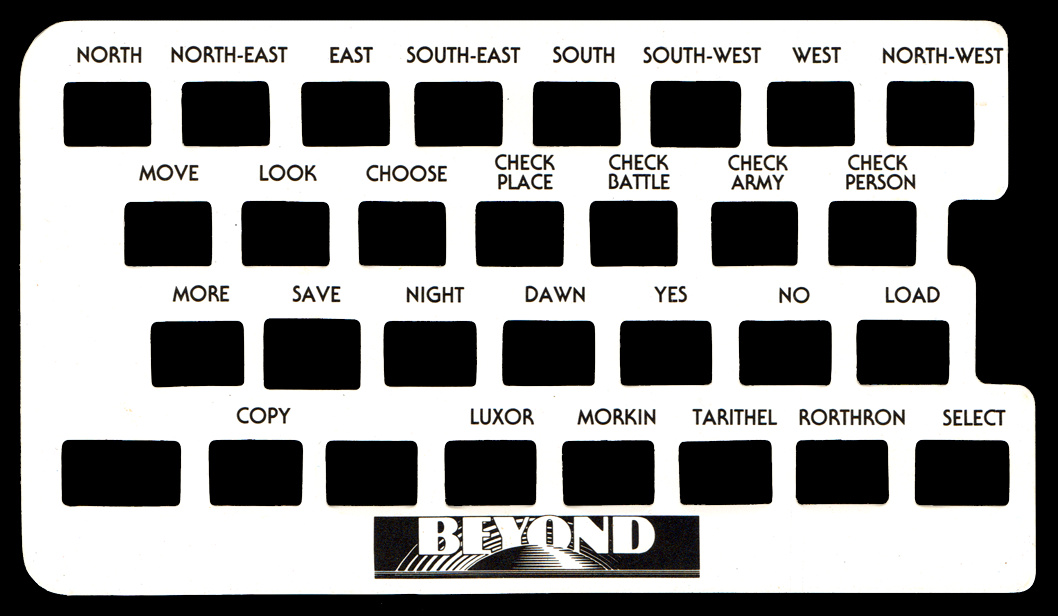
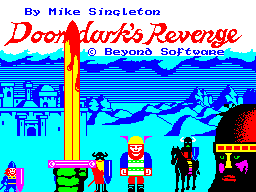
What was the most eagerly awaited sequel to the Adventure of 84, Lords of Midnight? Mike Singleton's Doomdark's Revenge that's what. Here Keith Campbell takes an in-depth look at Mike's latest epic while the rest of the KC team delve into the games we couldn't fit in the other review categories! Read on - you're bound to find something that inspires you. DOOMDARK'S REVENGE If you didn't already know it, Doomdark's Revenge is the follow on from Lords of Midnight. This time, Mike Singleton has gone one better than before and created 6000 locations, each with a view of eight directions. This time you play the part of Luxor the Moonprince, in a battle against Shareth the Heartstealer. Morkin, betrothed to Tarithel, the daughter of the Lord of Dreams, has been imprisoned by Shareth. Initially there are three characters under your control, Luxor, Rorthron the Wise and Tarithel. Morkin is controllable after you have released him. The graphics are slightly different from Midnight. Above the view is printed the commentary on a yellow background and below this is the view of the scene. The views are virtually monochrome pictures - shades of light and dark of a predominant colour, save for a few indoor locations and some foreground figures. As before, each character has a number of moves every day, but in Doomdark the predominant colour changes from red at dawn, through light blue to dark blue at night. Again, a keyboard overlay is provided, with characters, directions and other commands such as choose, move, and so on, assigned a key. The background to the epic is described by the short story "The Icemark Chronicles” in the glossy 24-page instruction booklet. Whereas Midnight had a map on the back of the book, albeit rather too reduced for comfort, what is on the back of the Doomdark book cannot really be described as a map at all. To get a proper one will cost you an extra £1.95 for a giant poster map with wipe-clean surface. On this you can mark up the positions of your forces and spill coffee at will. This is available by post from Beyond, but I feel it is a pity that it is not supplied with the game. Doomdark's Revenge is of the same high standard as Midnight, but it does seem a little "samey" and I can't help wondering if the novelty will have worn off by the time the trilogy is completed. Doomdark's Revenge is for the 48K Spectrum, priced £9.95, from Beyond.
Your Spectrum #12Mar 1985 · p.42
Dave Nicholls
Peter Shaw
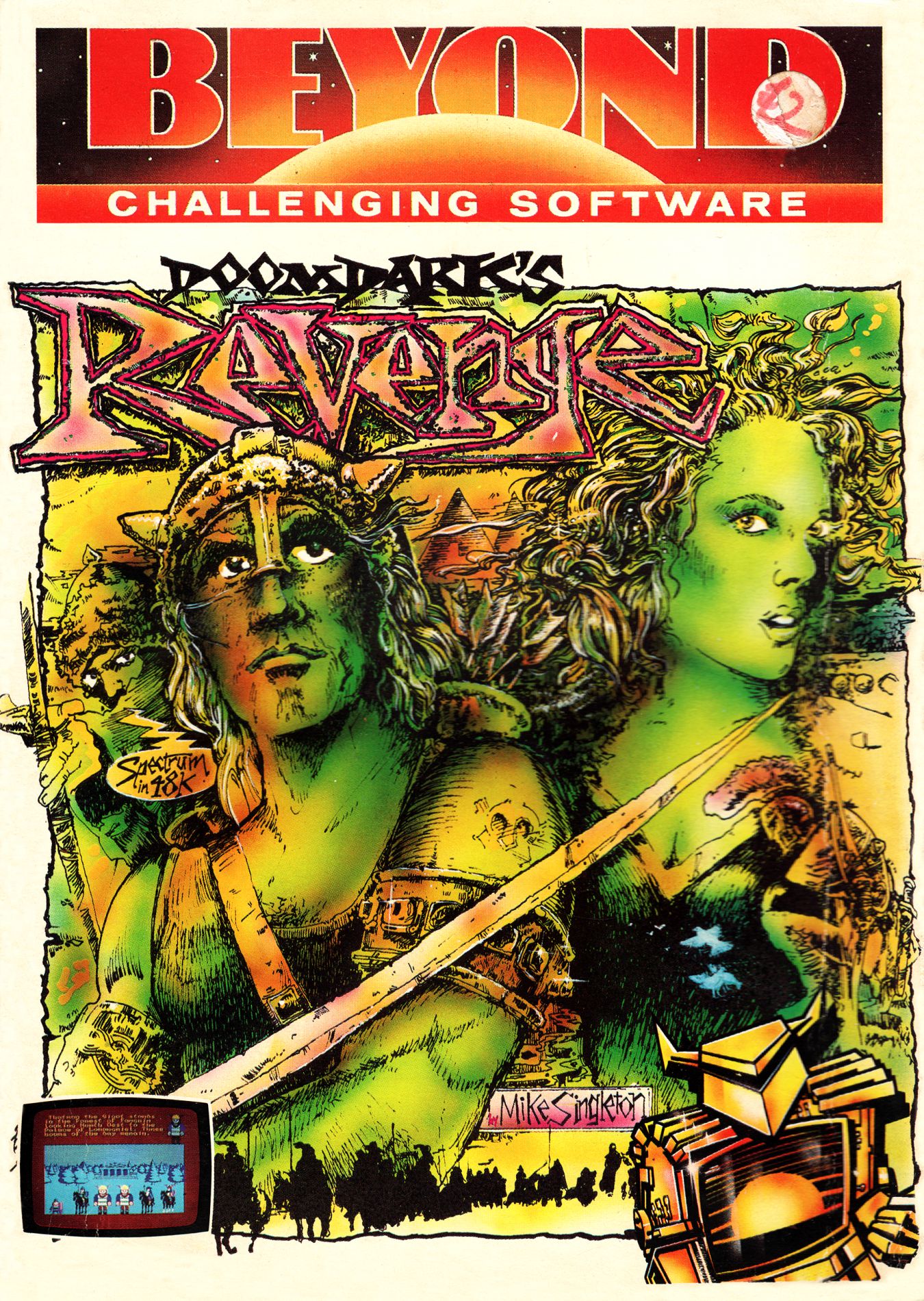
DOOMDARK'S REVENGE Beyond Software £9.95 When Lords of Midnight appeared on the software scene, it immediately carved itself a place in adventuring history - nothing like it had been seen before and many adventurers turned into tacticians overnight in their attempts to defeat the Witchking. Now, with debates about the best way to succeed at LOM still raging, the sequel has arrived and Luxor the Moonprince's problems are far from over! Doomdark's Revenge takes over where Lords of Midnight left off with the Ice Crown destroyed and the Witchking killed. Unfortunately, Doomdark's daughter, Shareth, Empress of the Icemark, swears revenge on Luxor and kidnaps Morkin, Luxor's son, and locks him away in her fortress. At the start of the game, Luxor, Rorthron the Wise and 1,000 Riders have just entered the Icemark to attempt to rescue him; as the player, you get to control all of these characters as well as Tarithel, daughter of the Lord of Dreams and Morkin's newfound love. As the game progresses, other characters may be recruited and controlled by the same 'SELECT key mechanism used in Lords of Midnight. Doomdark's Revenge comes in the same packaging as its predecessor but the keyboard overlay has been changed to accommodate the extra functions offered ; these include four separate keys to perform the functions that the 'THINK' key did in LOM so that the progress of battles and states of health can be checked without reading through all the other information. Movement controls haven't changed with keys '1' to '8' heading you in a certain direction and the 'Q' key actually making the move. The playing area has been expanded and now offers some 48,000 different views to be examined. There are also underground tunnels crossing the land which you can enter via pits and gates. The object of the game is twofold - firstly, Morkin must be rescued, and, secondly, Shareth must be destroyed. It's possible to gain a 'minor' victory by just rescuing Morkin but to find out the 'Watchwords of Midnight' and win the prize of a model of Icemark with figures of the major characters, both parts must be completed. Doomdark's Revenge is a much more difficult and, in a lot of ways, more interesting than Lords of Midnight - save up those pennies and buy it!
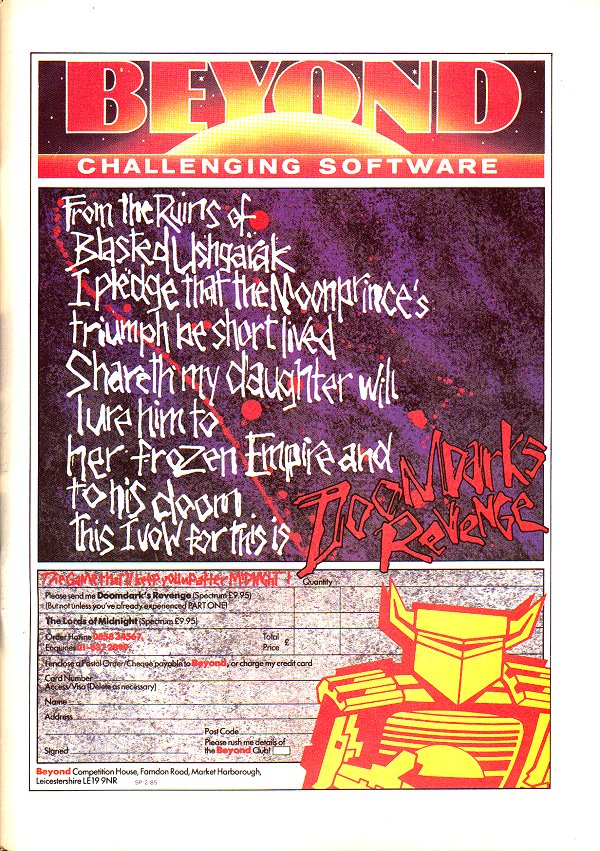
The long awaited follow-up to The Lords Of Midnight has finally arrived... but is it different enough to be a hit?
Personal Computer Games #15Feb 1985 · p.28PCG Hit9/10N/A8/1010/1010/1010/10
Personal Computer GamesPCG Hit
Graphics 9/10
Sound N/A
Originality 8/10
Lasting Interest 10/10
Overall 10/10
Chris Anderson
Peter Connor
Samantha Hemens
Steve Cooke 10/10
MACHINE: Spectrum 48K CONTROL: Keys, Kemp, Crsr, Sinc FROM: Beyond, £9.99 If you've played Lords of Midnight, then you'll have some idea what you're in for here. If you haven't, then stand by for a game with over 48,000 different screens, 128 characters, 128 objects to collect, and an evil witch-king's daughter to defeat. In this, the second of Beyond's 'epic' trilogy, you use single-key commands, as indicated by a keyboard overlay, to control all characters loyal to your cause in your struggle against Shareth the Heartstealer, who has captured Morkin, son of Luxor the Moonprince. Once you've selected a character, you can look through his or her eyes at the surrounding countryside as you march across the Frozen Empire, doing battle with giants, dwarves, and barbarians. The landscape is far more detailed than in Midnight and covered with different features, from mountains to pyramid-like temples. There are 6,144 different locations and in each one you can look in eight different directions. The perspective is faultless and the atmosphere tremendous. Lords of Midnight fans will find Doomdark a far greater challenge than its predecessor. Not only is the country bigger, but each character is much more complex and there are icelords, barbarians, dwarves, fey, and giants to recruit or, if they're hostile, defeat. There are many more options during play. Each character, for example, has a special object, and special options include 'Give' an object and 'Use a special object. You can also enter underground caverns, take rest, or approach other characters (with a view to recruiting them). Recruiting other people is a far more complex process, since each one possesses no less than 11 different characteristics. each of which will influence them in their actions and attitudes towards you. Other ingenious touches include changing weather (watch out for the rolling mist) that follows a 96 day weather cycle and flickering torches to guide you through the tunnels. The display changes colour according to the time of day - red/orange at dawn, blue at midday, and blue/black at night. The biggest difference in Doomdark, however, is in winning the game. There are no less than five different victories, ranging from the simplest one of rescuing Morkin, to the 'overwhelming victory' of rescuing Morkin, killing Shareth the Heartstealer, and returning to the start with Luxor, Rorthron, Tarithel the Fey, and Morkin still alive. At the beginning of the game you control only three characters, Luxor, Rorthron, and Tarithel. Forces usually join in battle almost immediately and what's more the wolves, skulkrin, ice trolls, and dragons don't just stay in one place in this game - they move about, making progress for individual characters more risky. Because of the increased complexity of the program, the game varies tremendously each time you play it, and victory is far, far more difficult to achieve than in Midnight. There's so much one could say about this game, but it all boils down to one thing - go out, buy it, load it up, and spend hours, days, weeks, perhaps even months playing it. You'll enjoy every minute.
Super graphics in over 6000 locations.
Sinclair Programs #28Feb 1985 · p.34
June Mortimer
Last year, adventure enthusiasts reeled when they encountered the Lords of Midnight. A combination of adventure, quest and wargame, the game was remarkable in that it featured 4000 locations from which a total of 32,000 different views could be seen. Detailed pictures of every location, not only clearly drawn but also extremely helpful; such a thing had not been seen on the Spectrum before. Within a matter of months Beyond Software had brought out the sequel, Doomdark's Revenge. Incredibly, they have managed to surpass their first success, producing a program with 48,000 screens, 123 different characters and 128 treasures to be found. Despite the fact that Beyond Software, and the publishers of Sinclair Programs are sister companies it is easy to declare without fear of being accused of bias, that Doomdark's Revenge is the best new program on the market at the moment, and one of the best Spectrum programs ever produced. The story starts where the Lords of Midnight finished. The land of Midnight is left far behind, and your characters move into the hostile land of the Icemark where, although there are many lords and many armies, none are your natural allies, and all must be won over by your skill and prowess. There is no one aim to the game which can be described in detail. The situation is that Morkin, hero of the Lords of Midnight, has been captured by the evil Shareth, Queen of the Icemark. His lover, Tarithel, has ridden into the Icemark to save him and behind her follow Luxor the Moonprince, Morkin's father; his trusted adviser Rorthron the Wise and Luxor's army. The most basic victory which can be won is the saving of Morkin. To win this victory, both Luxor and Morkin must return to the Gate of Varenom, where Luxor began the game. More major victories can be won by returning other major characters, spoils of war, or any of the arcane objects on which Shareth's power depends to the gate. If, by any chance, Morkin is killed, the only way in which the game can be won is to defeat Shareth in battle. Those used to the views in the Lords of Midnight will be impressed by the even greater range provided in Doomdark's Revenge. Features have been extended to include huts and fountains, palaces, gates and underground passages. These last, although initially appearing interesting are probably the least successful of the new features. Underground passages wind for miles across the Icemark, the view within them is unchanging, and the flickering torches, although initially striking, become boring after a week or so spent underground. Another feature of the game is the mist which spreads across the countryside, obscuring the view. Although features can be made out through the mist it is possible, for example, to stand one move away from a major fortress without being able to see it. Other changes in the landscape are the continually moving characters and armies, all or which appear clearly on screen. The range of characters is much broader than it was in the Lords of Midnight, and the strangeness of the surroundings means that none can be identified from the first as definitely good or definitely bad. Luxor enters the Icemark in the land of the Barbarians, which means that three or four Barbarian chiefs and their armies can be found within one or two day's ride. Luxor will find it relatively easy early in the game to recruit Barbarians, but this can only be done at a certain cost, for making alliances with one group means making enemies of their enemies. It may prove better to ride out of Barbarian country and recruit Ice Lords or dwarves, or giants. As the game progresses, recruitment patterns change. In all cases, whenever you approach a commander you may not be able to win him to your side. Approaching commanders must therefore be done with care, for finding yourself in the camp of a strong hostile army after nightfall will often prove fatal. Characters' feelings about you will change depending on whom you befriend, and which armies you fight. It is well to be aware of exactly where your allies' loyalties lie. Some characters, even though they have been recruited by you, will still remain loyal to another commander. Others will judge you by your prowess in battle, and will ignore you if your army is small, or if you have engaged in no battles. Most worrying of all, once you have recruited a character there is no reason to believe that he will henceforth prove unswervingly loyal. If your side is doing badly, and another commander approaches with a better offer, you have every reason to suspect that your allies will leave in the night, or even tum on their friends and kill you during the night. The options open to players have, like every other aspect of adventure, been extended in Doomdark's Revenge. Decisions are still made by single key entry, but the range of choices is much wider than it was in the past. There is the possibility of changing persona from that of one loyal commander to the next. Once a persona has been adopted, that character's army can be reviewed, as can the armies of allies and of those occupying the same area. The area in which the character is standing can be checked, as can the outcome of any battle fought the previous night. It is also interesting to check your persona's own character. Unlike in the Lords of Midnight, where Luxor's allies tended to be utterly brave, noble and strong, in Doomdark's Revenge you often find yourself fighting alongside commanders who are cowardly, mean and greedy. When each of your characters has completed their moves for the day the NIGHT key is pressed, and it is at this time that events controlled by the computer program take place. This results in the strange circumstance that all battles are fought by night, and that everyone, except the characters controlled by the player, moves around at night. It seems hardly surprising that troops seem almost invariably to be slightly tired. The complexity of the game is, strangely enough, its only stumbling point. The map which accompanies the game is pitifully inaccurate, giving you the impression of leading thousands of troops round in circles unless you keep very careful notes concerning your movements. Careful notes are, in fact, essential to every section of this game. Notes of the characters you control, who they are, who they like, to whom they are loyal. Notes on where you last saw characters, notes on where you are, notes on where your allies are, notes on the advice you have been given. Keep your paperwork in order, sharpen up your memory and, ideally, invite all your friends around for a few days. Then you will feel you have the land of Icemark mastered. Until you can do all these things, the quest for Morkin should loom large, and you may have to relegate Shareth's ultimate defeat to some time early in 1986. Finally, for those devotees of the Lords of Midnight who fear for Morkin's safety, fear no longer. Although you have no opportunity to see or control the movements of Morkin until you have found and saved him, the little yellow-haired chap is due back in the third part of the trilogy, which is to be called The Eye of the Moon.
Crash #13Feb 1985 · p.98Crash Smash10/10N/A10/1010/1010/1010/10
Atmosphere 10/10
Vocabulary N/A
Logic 10/10
Debugging 10/10
Overall Value 10/10
Derek Brewster 10/10
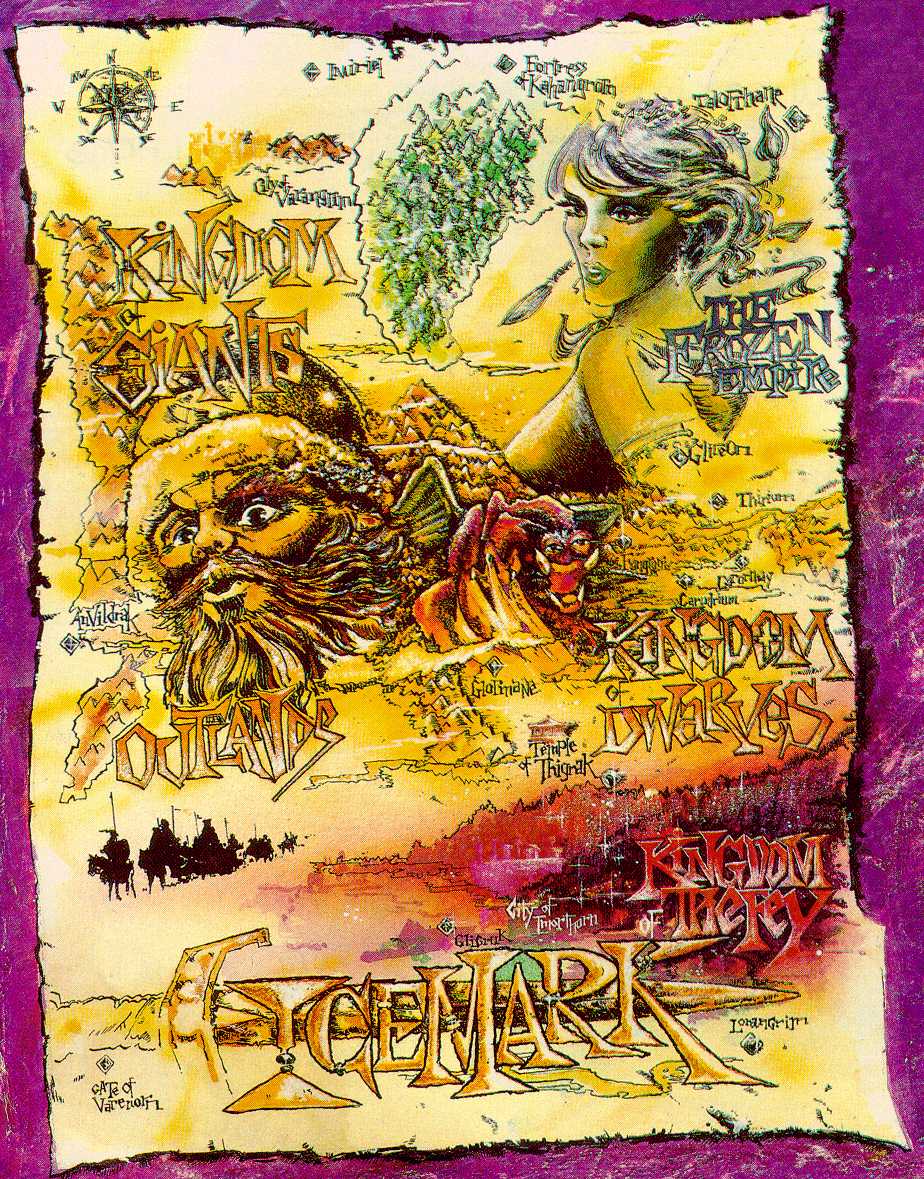
DEREK BREWSTER'S ADVENTURE TRAIL PUBLIC IMAGE You know, when I buy a piece of software, or have it dropped through my letterbox, I expect the packaging and instruction leaflet to inform me on why this game exists and why it should merit my attention. Gilsoft's The Curse has a sparse cover which give more prominence to copyright and warning notices than to the substance of the program. One can only assume there is nothing worth mentioning and so what impression does this give? It hardly augurs well. Indeed, the cover supplies the name of the artist who decorated the inlay but there is no mention of the author of the program itself. Don't get me wrong about artwork, certainly packaging should have good artwork but this must reflect the quality of the program within, and not exceed it. The artistic details of Tower of Despair shows how artwork can add appreciably to the atmosphere and enjoyment of an adventure. But surely the software business has much in common with the music industry; the public will remain loyal to good programmers and seek out quality from whichever quarter it emanates just as loyalties to artists and the unearthing of excellence goes on even in the music world. Packaging and leaflets provide the room for two important aspects, the storyline and instructions. A storyline mustn't be so small as to fit in the window at the back of a cassette casing but should be full and enlightening enough to ensure a substantive background to develop in the player's mind before play begins and to encourage a feel for how the game might be tackled. Alas, I have witnessed so many storylines tagged on to a finished program to round off the marketing exercise. It should, of course, be in existence before coding begins so that the plot and theme are integral parts from the off, ensuring a sense of consistency and credibility pervades the whole. Instructions find a natural home on the cassette cover where browsing in a computer store may tell something of the game and should not reside in the program as this would then represent an unforgivable waste of memory (some Quilled games are guilty here) and neither should they reside on the tape before the game proper as this is then a waste of the game player's time (Knight's Quest, for example). All this brings me round to great and ever-fluctuating debate in software retailing, namely, should the package be large and flamboyant or small and utilitarian. Cynically, a large package is justified by the greater price charged for it, representing a greater capture of the consumer's money for the software business merry-go-round - packaging, printing, publicity. This last is a significant point as a large package is its own advert. Who can forget Valkyrie 17 in all the shops before Christmas? Perhaps there is a deeper message here, playing on the psychology which has it that if a company has gone to all the trouble of producing a large, expensive package, then what is on the tape must be worth something. Alas, I can think of many examples where this reasoning is misleading. What a large presentation can afford is a suitably glossy booklet giving in-depth playing instructions and a greater insight into the complexities therein. Certainly, no one would complain of the extra expense entailed to this purpose in the Midnight Trilogy. But what of the many where the supporting literature is thin on the ground and the cassette wallows in a sea of moulded plastic? It would seem the packaging here is only a precept for charging more. Unfortunately, you can not tell whether a large package has much supporting literature until you buy it, as shops are reluctant to leave anything on the shelves which might tempt petty thieving. Well, here is the crux of the matter; I myself, on the whole, prefer cassette-sized packs because they are easier to carry back home and are more utilitarian in a futuristic way. It is similar to my regard for the Spectrum - there is some fascination in a computer with 48K RAM which takes up just a little more room than a pocket calculator and can be unplugged and carried around with the ease of a book. So with cassettes. A world of adventure packed in to a s mall plastic box with neat, precise artwork, and playing instructions unfolding like a concertina. But if large packages grabbed the attention, and the shelf space, over the festive season one development had them cast as dinosaurs. Not only could you allot the big packs a position with the cassette-sized packs neatly stacked in cassette racks and cases, but, when browsing in shops their absence amongst the chart displays was very noticeable - they just could not fit into displays like the Boots Top Twenty! DOOMDARK'S REVENGE Producer: Beyond Memory Required: 48K Retail Price: £9.95 Language: Machine code Author: Mike Singleton Doomdark's Revenge is the second game in the Midnight Trilogy. The first part, Lords of Midnight, was widely acclaimed as one of the best and most original games to be seen on a Spectrum. Doomdark's Revenge is a very similar style game with few major surprises although, if anything, the sophistication has increased, boasting 6000 map locations and a staggering 48000 panoramic views. One of the strongest points of these superb strategy games are their ability to accommodate two or more players since a set of characters can be shared out to ensure active participation for all. The game is set in the Land of Icemark to the north of the Land of Midnight. The Icemark Chronicles consist of five chapters in the glossy booklet similar to the one which accompanied the first episode of the epic. The burden of the Witchking's cold dominion had lifted from the Lands of Midnight like a sudden waking from a nightmare as Luxor's army made its way from the gates of Ushgarak to the Citadel of Dreams, a stronghold of the Fey. Tarithel, the beautiful daughter of the Lord of Dreams and lady of the Forest since her mother relinquished the title on Solstice Eve, excused herself from the celebrations finding a strange longing to visit a secret glade deep within the forest. Here she sees a boy riding oblivious through the trees and she makes use of her special powers to call the boy's stallion back. Several Mills & Boon stanzas later, Morkin, the young man riding through the forest, and Tarithel are to be wed so that the Fey and the Free can be as one under the protection of the House of the Moon. On the eve of the wedding Morkin travels back at the dead of night to the spot where they first met. Here a great storm brews and crashes lightning about his head causing his stallion to rear, throwing him unconscious to the ground. He has a dream of a voluptuous temptress lying on a silken bed. When he awakes from his disturbed slumber he sets off at once for the source of his vision - Kahangrorn in the far north of the Frozen Empire, home of Shareth the Heartstealer, Empress of Icemark and dread ruler of the Frozen Empire. Seeing the storms gathering in the north, the Fey Lord of Imorthorn sent his swiftest bird, a white falcon, with a warning for their fellow Fey to the south in Midnight. The Lord of Dreams reads out the message: 'My Lord Moonprince, this message hails from lands far beyond our ken, from the cold Icemark which has been severed from Midnight for a thousand moons and more .... It warns of a great storm flying from the North towards Midnight and of the evil designs of one he calls the Heartstealer upon our fair land.' Three days later Tarithel disappears taking with her one of her father's swiftest mounts. The gathering at the Citadel of Dreams disperses, moving southwards to home and kin. Only Luxor remains with one thousand of his Houseguard, waiting for news. It eventually comes from Rorthron the Wise, riding out of the North bearing ill-tidings. Rorthron had heard Shareth's voice from across the wild, 'Tell this to your precious Moonprince: I have his son in my grasp already. The boy is mad with love for me and lies at this moment in one of my less pleasant dungeons.' (it gives some idea of how long this game might prove when she adds, '7 moons from now I ... will ride forth to avenge Doomdark, my beloved father!' It was decided that the Lord of Dreams would remain in Midnight to marshal the Fey and the Free while Rorthron would ride north with the Moonprince to the Frozen Gates, black cavernous tunnels that lead to secret ways beneath the ice. Rorthron with Words of Power and a roaring flame issuing from his staff led the way to the Gate of Varenorn. Meanwhile, far to the north Tarithel had lost Morkin's trail and was now following rumours to the City of Imorthorn in search of news. What you have just been reading is a précis of the Icemark Chronicles and in it you will find many of the facts necessary to succeed in the game. At the beginning of play you have three characters under your control, Luxor the Moonprince, Rorthron the Wise and Tarithel the Fey which have their own keys marked on the keyboard overlay (Morkin's key is not used until later in the game). Characters rallied to your banner can be chosen by way of the SELECT key. How long this list might become is reflected in the need for a MORE key which is similar to Scroll? in BASIC; 123 lords help command the five races of Giant, Dwarf, Fey, Icelords and Barbarians. Recruiting a character to your cause is not as easy as with Lords of Midnight. On one occasion when confronted with three lords who owed allegiance to Lorangrim the only options offered were Rest or Attack; no Recruit option was proffered. Rather odd, but no doubt, indication of some greater twists in plot than were evident in Lords of Midnight. Even when accomplished recruitment can lead to some unforeseen problems, e.g. Tarithel recruited a Lord of the Fey and was then killed by him. There are four commands to control a character, LOOK, MOVE, CHOOSE and CHECK. LOOK: eight compass direction views of the landscape corresponding to what the character sees in the direction he is looking. You cannot move at night, nor into the Icy Wastes that surround Icemark, or when exhausted or frightened. CHOOSE: the options put up on the screen will depend on the situation the character is in but will also reflect the particular personality of the character. CHECK: there are four check keys, Check Place, Check Battle, Check Army (details of your own army, any other army in the same location and any army immediately ahead of your character) and Check Person (some personalities may change as the game progresses). The game begins on the day that the Moonprince rides forth from the Gate of Varenorn into Icemark. During the day, which begins with a rosy dawn giving the screen a deep red colour, you move the characters under your control where the distance a character can move depends on the difficulty of the terrain, his vigour and whether he is riding or walking. Nightfall signals the beginning of movement for the forces of the Heartstealer, plus independent characters. Where this game proves more difficult than its predecessor is in deciding which of these independent characters may be friendly and how to go about recruiting them once you decide they are friendly. An army can either approach or attack an opposing force but the approach option should be used with some caution for if the approach is not fruitful and battle results you will be at a disadvantage. There is only one army in the whole of Icemark who will never rally to Luxor's banner - Shareth's forces, who are his mortal enemy. You, of course, play the role of Luxor the Moonprince. By virtue of the Moonring, which lends you the Power of Vision and the Power of Command, you control those characters in the Land of Icemark who are friendly to your cause, looking through their eyes at the surrounding landscape and guiding them in their many tasks. The Moonprince's victory can result from many different actions, representing a lesser or greater victory, but before any celebrations Luxor must return safely to the Gate of Varenorn. The most basic victory is the rescue of Morkin where the main hope of success lies with Tarithel. In any event, the safe return of both Tarithel and Rorthron is important while the successful retrieval of the Crowns of Icemark and the arcane objects brings greater victories. If Morkin should be slain only one victory remains possible for Luxor, Shareth's complete destruction. But this is no easy task as the grief caused by Morkin's death will greatly sap Luxor's strength. The greatest victory of all is the destruction of Shareth and the safe return of Luxor, Morkin, Tarithel and Rorthron to Varenorn, something you will discover is not easy at all. Glowing letters will flame on the surface of the Moonring revealing to Luxor the ancient Watchwords of Midnight which will protect Midnight for as long as he lives. The computer plays the part of Shareth the Heartstealer and controls the characters and armies under her sway. Independent characters may be persuaded to join her cause and hence quicken a victory for the Empress achieved through the death of the Moonprince. You are only given a very rough schematic map of the Land of Icemark when compared to that given with Lords of Midnight. There are five main realms marked on it. In the north-east is Shareth's Frozen Empire marked by a picture of an icy beauty in the place of more detailed cartography. To the west is the Kingdom of the Giants, in the south-west the Barbarian Outlands, in the east the ancient temples of the Dwarves and in the south-east the forest-dwelling Fey. You quickly leave behind the Frozen Wastes, mile after mile of treacherous ice, sheer drops and inhospitable peaks. As you make your way north, mists sent down from Kahangrorn obscure features of the landscape and hide likely dangers. The super graphic tokens of Lords of Midnight are expanded to include mountains, cities, forests, towers, pits, halls, huts, hills, fortresses, palaces, temples, gates, stones, fountains, icy wastes, mists and armies. Doomdark's Revenge is assured a huge following and deservedly so. It has improved on its predecessor in all the right ways with a more difficult set of tasks and a more sophisticated plot. Enemy and foe are not pictured as such and it is up to you to decide to what extent the widely varying forces can be cajoled to your banner. Of the individual leaders of the five races, each has his own lieges, hatreds and personality reckless or cowardly, greedy or worthy, brave or treacherous. The quirks in both character and plot assures a lively debate on the Land of Icemark for some time to come. COMMENTS Difficulty: varies depending on quest, more difficult than Lords of Midnight Graphics: excellent Presentation: very good Input facility: menu driven
Sinclair User #35Feb 1985 · p.329/109/10
Gilbert Factor 9/10
John Gilbert 9/10
DOOMDARK'S REVENGE Beyond Software Memory: 48K Price: £9.95 The story so far... an icy chill has crept into the hearts of the people of Midnight. It emanates from the black towers of Icemark, domain of Shareth the Heartstealer, daughter of Doomdark and captor of Morkin, son of Luxor the Moonprince. Luxor, with his hundred-fold army, has once again to fight the dread might of Doomdark's wizardry. He passes through the gate of Varenorn, opened by Rorthron the Wise, into the desolation of the chilled lands of Icemark in search of his kin. To the north-west lies the kingdom of the Giants, to the east the Dwarfs and to the south the barbarian lords and the Fey, faithful to Luxor's cause. In the north-east lies Shareth whose reason for revenge is personal. She wanted to murder her father and claim his power but Luxor got there first. At the start of the game Luxor can control the other characters, which include Tarithel, the author's token woman and Morkin's betrothed. Each character moves through the landscape fighting enemies and building armies as in Lords of Midnight. Not much more can be said about the plot of the game but the technical excellence with which it is programmed makes it a cut above its predecessor. You can find more than 128 characters while roaming through the beautifully drawn landscapes. Those may turn out to be friends, treacherous friends, or enemies. Be wary of your loyal subjects - their hearts may have been stolen by Shareth. In the Lords of Midnight one criticism of the game was that you could not enter the citidels and other buildings. In Doomdark's Revenge you can. At first the darkness, illuminated by well animated guttering torches, is sufficiently different to make underground travel interesting but when you have been through several of those passages you may decide to stay above ground no matter what the dangers. The author hopes to give more variety to interiors in the finale of the trilogy but, until then, you will have to put up with danger in the dark. One of the major differences in Doomdark's Revenge again concerns characters. When you call up a character you can see their emotional make-up, loyalty and state of mind. If they are tired they will not move. The speed of the program is impressive. The period between the fall of night and dawn has been shortened and the speed at which the graphics are drawn seems to have miraculously grown. The combination of strategy and adventure which the game provides surpasses everything that has gone before in both markets, and that summing up includes even Lords of Midnight. The author has yet again hit upon a winning combination in a game which should take its place in computer history in record time.
Personal Computer News #93Jan 1985 · p.459/109/10
Overall 9/10
John Lettice 9/10
PRICE: £9.95 PUBLISHER: Beyond Software [redacted] Luxor lolled in his throne and knocked back another goblet of mead. 'Luxor the Moonprince, Lord of Midnight - it's got a nice ring to it,' he thought. And he conic? dine out for the rest of his life on the story of how he stuck his dagger in Doomdark's giblets. Pity about the kid though. He'd sent the little moron up to the Tower of Doom with instructions to smash the Ice Crown, and not only had he done it - he'd come back in one piece. It had to be the truth, Luxor reasoned. There it was in black and white in the manual for Doomdark's Revenge. And he was beginning to find the last couple of chapters disturbing. Morkin, heir to the throne, had suddenly stopped messing around with computer games (smashing Ice Crowns, stomping around being utterly bold and the like)and had taken an interest in girls. First he starts interfering with the Lord of Dreams' daughter, then next morning, if you please, he falls in love with Shareth the Heartstealer and goes running after her. 'I never knew Doomdark had a daughter,' he mused. 'Still, good riddance to the brat - wonder why it's called Doomdark's Revenge?' His question was answered when Rorthron the Wise blew in. Shareth was holding Morkin hostage; Tarithel, the jilted bride, had run off looking for Morkin, and the Lord of Dreams had a funny look in his eye. 'Suppose I'd best go and look for the little swine,' he muttered, and headed north to the Icemark. Doomdark's Revenge uses the same graphics system as Lords of Midnight - you control a number of characters and see the world through their eyes. But the interaction of the characters is much more complex. In Lords of Midnight you started with four characters whose job was to recruit allies, and either the ally would join you or he wouldn't. In Doomdark's Revenge they have more of a mind of their own, so if you aproach the wrong bloke (Badbazza the barbarian, say) he's as likely to tear your head off as join you. The other characters are often off on quests of their own, and initially Shareth isn't nearly as well organised as Doomdark was. You're in the persuasion business and so is she, so you'll find the situation a lot more fluid. Your supporters may change sides, fight among themselves, refuse to cooperate - it's a real bundle of laughs. You've got five tribes to deal with - Giants, Dwarves, Icelords, Barbarians and the Fey, and it maybe helpful if I pass on a few hints. As yet I haven't managed to recruit a Giant, but they haven't attacked me so they're probably neutral. The Dwarfs in general aren't much use. They're shiftless, treacherous and cowardly, and even if you manage to recruit one he's liable to skive off at the first available opportunity, leaving you in the lurch. The Fey are your best bet, although some (watch out for Thigrak) can be troublesome. But even the troublemakers here can be recruited provided you can recruit their liege lord, or keep their sworn enemies out of sight. Initially the Barbarians can seem bad news, but it's a mistake to assume that they're not worth approaching. If you head straight north on entering the Icemark you'll probably run into a bad lot, but run like mad in a north-easterly direction and the immediate danger should pass. Once you've started a game the immediate problem seems to be survival. There's a fairly unpleasant barbarian war band due north, but if you can avoid them and recruit a few followers the danger passes. The armies here seem to have less staying power than in Lords of Midnight, and you get a much clearer advantage by being on the attack, so it can sometimes make sense to go for a superior force, and run for your life the next day. Running off immediately doesn't seem to work - they follow you and catch you off guard, so in the case of the war hand it's best to wear it down with a series of short attacks. So far, the best I've managed in this one is survival. Morkin is probably somewhere up to the north-east, but I haven't got that far, and although there's probably a quest involved as well as a military conflict I haven't managed to identify any structure to it. Once you reach breakthrough point on survival (I reckon recruiting around ten lords) the game could probably go on for some considerable time. So as far as I'm concerned, those long winter nights look much brighter now those nice people at Beyond have given me Doomdark's Revenge. There are only two blots on the horizon. First, my review copy's almost as difficult to load as Lords of Midnight. It uses a fast loader of sorts, and one of those tiresome RAM checks that happily resets the Spectrum two times out of every three - Beyond should get its act together just in case it ever launches a game that isn't worth the extra effort. The other problem is the non-existent map. Beyond is cashing in by charging £1.95 extra for said map, but it wasn't ready at the time of review, so I hope you lot appreciate the hours of scribbling on squared paper that's gone into this review. A better drawing with the manual would definitely have been appreciated.
Micro Adventurer #15Jan 1985 · p.8
Brendon Gore
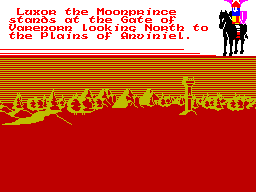
MICRO: Spectrum 48K PRICE: £9.95 SUPPLIER: Beyond The sequel to The Lords of Midnight is here - Brendon Gore braves the dangers and mysteries of the Icemark, home to Doomdark's daughter, Shareth the Heartstealer. Luxor the Moonprince, Rorthron the Wise and one thousand riders of the Houseguard of the Moon stand at the Gate of Varenorn looking north. It is dawn and the uncharted lands of the Icemark are bathed in a reddish glow. Somewhere ahead lies Shareth Heartstealer, Empress of the Frozen Empire and daughter of the late and unlamented Doomdark. Following Luxor's victory over Doomdark at Ushgarak, Shareth swore bloody vengeance, for she had wanted the pleasure of killing her father herself. Accordingly, she enticed away Luxor's son Morkin, destroyer of the Ice Crown, with the aid of some powerful enchantments. Morkin is currently languishing in one of Shareth's less pleasant dungeons, still convinced that he is in love with the Heartstealer. Tarithel the Fey, Morkin's beloved, has already crossed the frozen wastes and entered the lands of the Icemark in search of her knight errant. So starts the tale of Doomdark's Revenge, second in the Midnight trilogy and sequel to the highly acclaimed Lords of Midnight. Mike Singleton's latest game for the 48K Spectrum (or Spectrum +) contains many features of the original, together with a number of new ingredients. There are an incredible six thousand locations in the world of Icemark, each of which can be viewed from eight different directions, yielding some forty-eight thousand scenes. This feat is achieved by the use of 'landscaping', a technique first seen in the Lords of Midnight. At dawn, each of the Icemark's scenes is depicted in red. As the day progresses, the views change from red to light blue until the onset of night is signaled by a dark blue screen. Characters in adjacent locations appear in full colour. There are five main peoples in the world of Icemark. The Men of Shareth's Frozen Empire lie in the North-east and the Kingdom of Giants in the North-west. The Kingdom of Dwarves lies to the East, between the Frozen Empire to the North and the forests of the Fey to the South. The Outlands of the Barbarians occupy the South-west. This area includes the Gate of Varenorn. None of the five races are particularly friendly towards each other, or even their own kind. All manner of feuds and border disputes may set Giant against Giant as easily as against Dwarf or Fey. But the Fey are most likely to be friendly towards Luxor, the Iceguard least likely. If Luxor is to defeat Shareth, he must recruit allies to his banner. To this end, he must search out neighbouring armies and decide whether to attack, approach or avoid them. Approaching a Barbarian, or other character, and his army, may result in his joining Luxor's cause. Equally, it will put Luxor at a disadvantage if the the character decides to fight. Luxor must base his decision on what information he can glean about each character and his army. As characters react to each other differently, Luxor must also decide whether to approach a strange army personally, or to use one of the other characters under his control. A Fey who would reject an approach from a Giant might accept the approach of another Fey. But this could also work in reverse. Only experience will tell Luxor who is most likely to recruit who. A word of warning. Do not attempt to recruit Shareth Heartstealer. She will never rally to your banner. There are a number of ways of winning the game. The simplest victory is to find Morkin and to return to Varenorn. This victory can be improved upon by returning with Tarithel and Rorthron. The Crowns of Icemark are also worth points, as are those objects which form the basis of Shareth's power. But, all of these victories depend upon Luxor's safe return to Varenorn. If Luxor should be killed, Shareth wins automatically. The ultimate victory is to kill Shareth and return to Varenorn with Luxor, Morkin, Tarithel and Rorthron. This will be acknowledged, when you press the Night key, by glowing letters revealing the ancient Watchwords of Midnight. Mike Singleton has obviously learned from the Lords of Midnight - many people were disappointed to defeat Doomdark only to be greeted by the unremarkable message 'Victory to the Free'. Winning a game as absorbing and complicated as Midnight or Doomdark's Revenge deserves some sort of spectacular display. When the game starts, Luxor faces a number of choices. He can journey to the North, through the Outlands, towards the Kingdom of Giants. Alternatively, he can head East towards the Kingdom of the Fey and perhaps attempt to link up with Tarithel. He can even enter the tunnel at the Gate of Varenorn and see where it leads him. However, my first move as Luxor was to head South to the hills of Kahudrand and then South-west towards the forest of Varuleon. Next, South-west again to the plains of Berenium and then West to the fortress of Torinarg. The Check Place key reveals that Torinarg the Barbarian is a good, strong, stubborn and brave fellow, if a little slow and greedy. His liege is Careneon the Barbarian and his foe is Ulformane the Giant. Torinarg commands 1,000 Barbarian riders and his fortress holds another 1,000. The Choose key gives me the option of rest, attack or approach. I chose the approach option and was rewarded by recruiting Torinarg to my cause. My first success. Pressing the Choose key under the guise of Torinarg reveals the options of rest, recruiting riders or posting riders. Recruiting riders twice added another 200 men to Torinarg's command and reduced the garrison's strength to 800. Pressing the Choose key a third time only resulted in the options of resting or posting riders. Rorthron I sent North, via the plains of Anviriel, to the tower of Thirand. Unfortunately, he found nothing, so I sent him North again to the temple of Imelash, which also yielded nothing. At this point, I changed direction and sent Rorthron East into the forest of Fenon. As night fell, Rorthron was standing in the forest looking into a mist which had fallen. Mists are another innovation which Mike has added since Lords of Midnight. These mists, which descend periodically, block the landscape and sap the courage of all except Shareth's Iceguard. They also provide cover for Shareth's armies. Tarithel, in the meantime, was standing in the forest of Fangrim looking North. There being little of interest in any other direction, I duly sent her North to the stones of Imatreon. Needless to say, the stones concealed nothing, but a glance to the East revealed the presence of an army in the distance. With four hours of daylight left, I decided to investigate. A couple of moves East revealed the fortress of the unlikely named Carorthand the Fey. He was good, strong, loyal, brave, etc, and commanded 1,000 Fey riders with another 1,000 inside the fortress. Interestingly, his liege turned out to be Imorthorn the Fey. Those of you who have read the booklet which accompanies Doomdark's Revenge will have noted that it was Imorthorn who sent warning of Shareth's intentions to the land of Midnight in the form of a message tied to a white falcon. Surely any of his subjects would be a good bet for an ally. Consequently, I had Tarithel approach Carorthand, which resulted in my gaining another ally. However, pressing the Choose key in the form of Carorthand turned out to be surprisingly interesting. There were the usual options of rest, recruit riders and post riders. This added another 200 riders to Carorthand's command, leaving 800 in the fortress. But, there was an additional option. Carorthand was offered the chance of taking the Crown of Imiriel whose power is in persuasion. Hoping that this would enable him to recruit even more people to my cause, I decided to take it. At this point, I decided to press the Night key, allowing Shareth to move. When dawn broke, I moved Torinarg North to the hills of Kahudrand where he found trolls and killed them. Torinarg then continued North to the plains of Glorthim and then to the forest of Glangrak without incident. Night then fell for Torinarg. Luxor followed in Torinarg's footsteps and decided to rest in the forest of Glangrak. Rorthron moved North to the tower of Torinak where he found guidance Thelak the Dwarf stands at the fortress of Thelak. Unfortunately, this is not a lot of use unless you know where the fortress of Thelak is located. But, moving North, Rorthron cleared the mist and sighted an army in the distance. Continuing to move North, Rorthron discovered the fortress of Kahudrang the Barbarian with just one hour of daylight left. Kahudrang, however, turned out to be evil and treacherous and his foe to be Luxor. Given that he commanded 1030 riders, with another 1000 in the fortress, Rorthron decided that discretion was the better part of valour and moved North-east to the hills of Morenak in a bid to escape detection. Tarithel and Carorthand, meanwhile, thought they could detect the outlines of an army to the East of Carorthand's fortress. Sure enough, a few moves to the East revealed the city of Imorthorn, Carorthand's liege. He needed little persuading and soon joined the cause with another 1200 men. Only two days and Luxor's forces are growing to a respectable size. But then Shareth has undoubtedly been busy too. Torinarg moves North to the Hall of Dolashang where he decides to rest, as does Luxor. Ahead lies the pit of Morudrane. Rorthron survives the night unscathed. Looking South, back the way he has come, he sees a new army in the distance. Moving South he discovers Careneon the Barbarian who commands 1000 Barbarian warriors. Careneon is good, loyal and brave, but his liege is Kahudrang. Nevertheless, Rorthron tries to recruit Careneon and is slightly surprised to discover he is successful. Flushed with this success, I decide to use Careneon to attempt to recruit Kahudrang. This is a mistake, as Kahudrang rejects Careneon's overtures and attacks him. Rorthron moves North again, to the tower of Malangrash, in an attempt to get out of harm's way. He sees yet another army to the West, but night has fallen and he can make no attempt to recruit another ally who could help Careneon - or Kahudrang. The party at Imorthorn, which consists of Imorthorn, Carorthand and Tarithel, spies a new army to the West at the hall of Glarane. They decide to send out Carorthand to investigate. On his way West, Carorthand discovers the Sword of Thangrang, whose power is in battle. But, when he picks up the sword, he discovers that he has dropped the Crown of Imiriel. Given that he is trying to recruit someone, and that the Crown's power is in persuasion, he decides to keep the Crown. Fortunately, the army to the West is led by Carorthane the Fey whose liege is Imorthorn. Carorthane is easily recruited and picks up the Sword of Thangrang on his way to the city of Imorthorn, where he adds another 200 riders to his existing 1000. Night falls. I won't spoil the game for you by telling you much more of my progress, except to say that Careneon lost 55 warriors in battle but slew 205 of the foe in return. I have travelled from one side of Icemark to the other, discovered Morkin's location but not yet visited it, fought a pitched battle against Shareth and lost. The world of Icemark holds as great a fascination as Midnight and perhaps even greater. It is not without flaws - trying to control eight or more characters starts to become difficult - but it is still far more absorbing and better fun to play than almost any other game around. What the game really needs is some sort of group command, which would enable you to order groups of characters to perform the same action, such as rest, instead of having to laboriously type in the same command eight or more times. It would also be nice to have an overall battle report as well as reports on each individual commander. My overall impression, however, remains one of awe. How Mike Singleton has managed to pack so much into 48K is a mystery. Ah well, back to the fray. Shareth may have won this time, but I can always reload and fight the battle again. Maybe this time I will win.
Mike Singleton, centre, protected from fans by Simon Goodwin and Warren Foulkes of Beyond.
Your Computer #1Jan 1985 · p.653/53/5
Overall 3/5
Lee Paddon 3/5
Spectrum 48K Beyond Adventure £9.95 So you thought Lords of Midnight was difficult? This, the latest in the series makes its predecessor look like a bunfight in a Brighton tea-room. The game is a graphics adventure featuring the unique "landscaping" feature which very quickly draws in the features in front of your character. There are 6,000 locations altogether and over a hundred characters, making it vastly more complex than Lords. Obviously, Mike Singleton has decided that having whetted your appetite, he must now give the punters a real run fur their money. For a start, you only have the bare outlines of the map given to you and the characters are far more complex than before. Every character you meet, instead of being simply friend or foe is trogging around the place bent on his own little scheme, and if you go up to him suggesting he might like to join your merry band, he may either join you, ignore you or turn on you. The plot is that after the defeat of Doomdark, his daughter is bent on revenge and seduces Luxor's son Morkin and takes him off to her castle in the frozen empire. Luxor rides off in pursuit to rescue his son. The politics of the place are far more complex than Midnight, there are five kingdoms, each of which dislikes the other to a certain degree. These rivalries must be exploited by Luxor. This game is a worthy successor to Lords of Midnight. Mike Singleton hasn't just revamped the plot and changed all the names, he has given us a logical extension of the LOM system with many improvements and refinements. The player has a whole set of new problems and victory conditions to achieve and I'm sure all LOM fans will want to add this one to their collection.
The Best of Beyond carries this game and has 8 references of its own.
News/Note12
- C&VG (Computer & Video Games) #56Jun 1986 · p.9
- ZX Computing #26Jun 1986 · p.5
- Popular Computing Weekly #15Apr 1986 · p.5
- C&VG (Computer & Video Games) #40Feb 1985 · p.17
- Your Computer #2Feb 1985 · p.43
- Crash #12Jan 1985 · p.171
- TV GamerJan 1985 · p.6
- Personal Computer News #90Dec 1984 · p.42
- Popular Computing Weekly #48Nov 1984 · p.1
- Sinclair User #31Oct 1984 · p.7
- Micro Adventurer #11Sep 1984 · p.7
- Micro Adventurer #10Aug 1984 · p.7
Full-page ad11
- Crash #14Mar 1985 · p.89
- Sinclair User #36Mar 1985 · p.135
- Sinclair User #35Feb 1985 · p.92
- Sinclair Programs #28Feb 1985 · p.54
- Micro Adventurer #16Feb 1985 · p.43
- Sinclair User #34Jan 1985 · p.47
- Sinclair User #33Dec 1984 · p.193
- Crash #11Dec 1984 · p.113
- Micro Adventurer #14Dec 1984 · p.5
- Micro Adventurer #13Nov 1984 · p.5
- Crash #10Nov 1984 · p.112
Tips10
- Sinclair User #128Oct 1992 · p.16
- Crash #98Apr 1992 · p.37
- Your Sinclair #29May 1988 · p.86
- Your Sinclair #26Feb 1988 · p.80
- Crash #41Jun 1987 · p.90
- Your Sinclair #3Mar 1986 · p.77
- C&VG (Computer & Video Games) #50Dec 1985 · p.23
- Sinclair Programs #34Aug 1985 · p.30
- Crash #19Aug 1985 · p.64
- Crash #13Feb 1985 · p.86
Feature9
- Crash #54Jul 1988 · p.61
- ACE (Advanced Computer Entertainment) #3Dec 1987 · p.85
- C&VG (Computer & Video Games) #40Feb 1985 · p.101
- Sinclair Programs #28Feb 1985 · p.34
- Popular Computing Weekly #2Jan 1985 · p.38
- C&VG (Computer & Video Games) #39Jan 1985 · p.134
- C&VG (Computer & Video Games) #38Dec 1984 · p.110
- Popular Computing Weekly #48Nov 1984 · p.23
- Sinclair User #31Oct 1984 · p.72
Letters5
- Crash #48Jan 1988 · p.56
- Crash #40May 1987 · p.57
- Sinclair Programs #33Jul 1985 · p.7
- Crash #14Mar 1985 · p.106
- Personal Computer News #95Jan 1985 · p.7
CompoEntry5
- Your Computer #5May 1986 · p.79
- C&VG (Computer & Video Games) #40Feb 1985 · p.30
- Micro Adventurer #15Jan 1985 · p.45
- Sinclair User #31Oct 1984 · p.72
- Sinclair User #30Sep 1984 · p.63
Hack/Poke4
- Crash #63Apr 1989 · p.42
- Popular Computing Weekly #4Jan 1988 · p.6
- Crash #48Jan 1988 · p.56
- Crash #45Oct 1987 · p.95
Map3
- Die Speccy CDJan 1996
- C&VG (Computer & Video Games) #41Mar 1985 · p.41
- Crash #14Mar 1985 · p.90
CoverGame2
- Sinclair User #122Apr 1992 · p.4
- Crash #93Oct 1991 · p.6
CompoResult2
- C&VG (Computer & Video Games) #43May 1985 · p.120
- Sinclair User #34Jan 1985 · p.12
Review2
- Games ComputingFeb 1985 · p.32
- Popular Computing Weekly #48Nov 1984 · p.68
Information1
- SSD-IISep 1999
Advert1
- White Dwarf #60Dec 1984 · p.16
Preview1
- Personal Computer Games #11Oct 1984 · p.35
Licensed from
- Lord of the RingsBookunofficialJ.R.R. Tolkien
Remakes
- Doomdark's Revenge PC1999PC/DOS
Chris Wild
- LOMJAR2004-2009Java
Keith Jones
- Midnight/MU2005HTML
Jean-Yves Rouffiac
Related
- Compilations
- The Best of Beyond, Crash issue 93: Presents 29, Sinclair User issue 122: Great Eight 11, 4 Adventure Games, The Spectrum
- Ports
- (Amstrad CPC), (Commodore 64), (Commodore Plus/4)
- Elsewhere
- Hardcore Gaming 101WikipediaCentre for Computing HistoryMobyGamesRZX ArchiveThe TipshopUVLRZX Archive - YouTubeSpectrum Computing RZX - YouTubeModern ZX-Retro Gaming
- Same entry at
- Spectrum ComputingZXInfo
Reviews from people here
Sign in to write about this, or make an account. It takes a minute and lets you correct the catalogue too.
Everything ZXDB can hold about this is here.
Sign in to correct or add to this.
Hold the rights to this and want it taken down?