
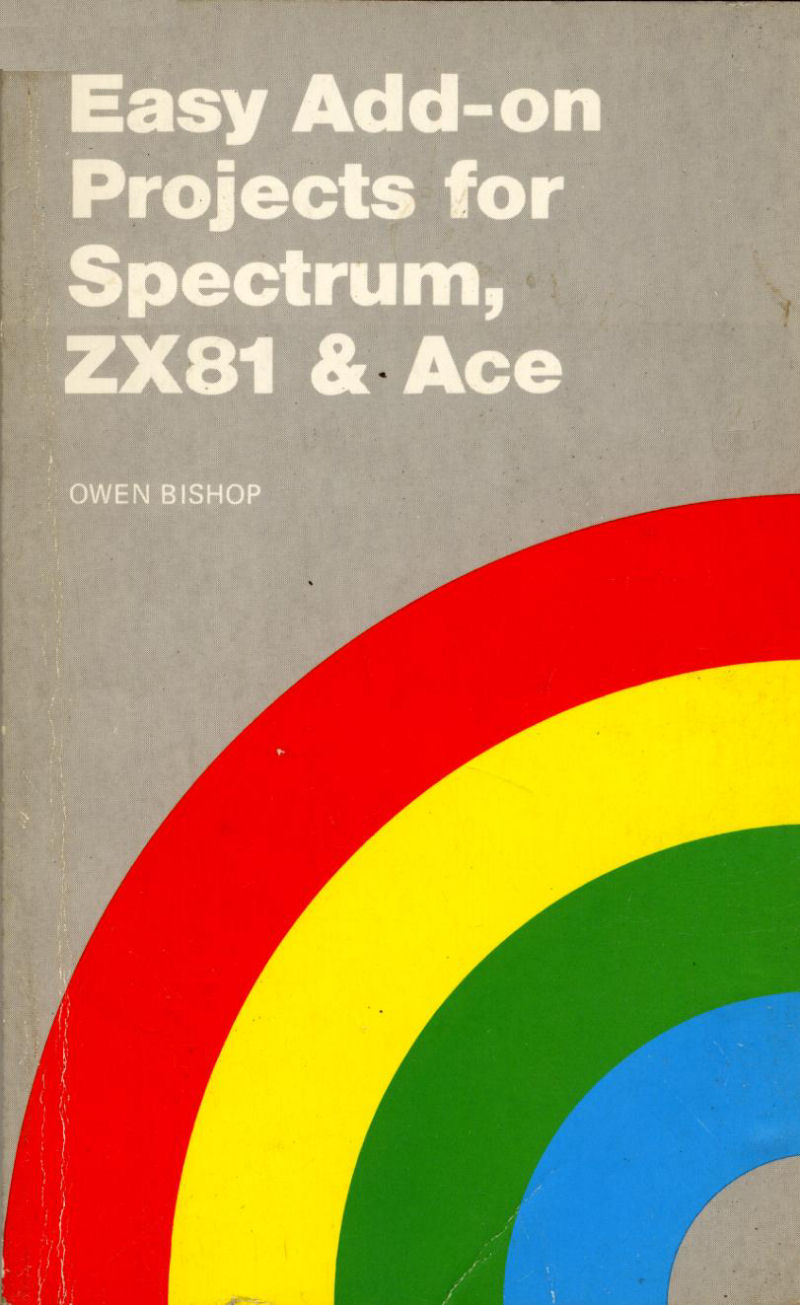
Easy Add-on Projects for Spectrum, ZX81 & Ace
Book: undetermined · English
Bernard Babani Publishing Ltd · 1983 · Pound sterling 2.75 · 180 pages · ISBN 0-85934-099-6
Also known as Einfache Zusatzgerate fur ZX Spectrum, ZX81 und Jupiter Ace (German)
(BirkhauserVerlag).jpg)
Discussion
Nobody has started a thread about this yet.
Releases
- 1983Bernard Babani Publishing LtdPound sterling 2.75
- 1984Birkhauser Verlag Sold as Einfache Zusatzgerate fur ZX Spectrum, ZX81 und Jupiter Ace
Documents
- EasyAdd-OnProjectsForSpectrumZX81Ace.pdfComplete book 24,238 KB
Files and rights
No permission is on record either way. Screens and pictures are copied here on a take-down basis: if you hold the rights and want something removed, say so and it goes.
Credits
- Owen Bishopcredited
Sign in to credit somebody, or say what these people did.
In the magazines 5
Your Spectrum #5Jul 1984 · p.69
John Flenley
HARD LINES Software might be the success story of the 'eighties, but without the hardware boffins just think where microcomputing would be. John Flenley, logic and software designer, examines the bookshelves to see just how much encouragement there is for the potential hardware freak. Sir Clive Sinclair has a lot to answer for. Apart from bringing the world digital watches and introducing a new word into the English language - 'computer window' - he's also been indirectly responsible for the publication of literally thousands of different books and magazines, examining every possible aspect of ZX computers. Someone rumoured that half the trees in the Amazon rain forests disappeared into paper mills the day the QL was announced - and I believe it! But let's look at this paper mountain again. I said earlier, that every aspect of ZX computing had been covered, but... perhaps that's not quite true, for there does seem a distinct lack of books on the subject of DIY computing. The increase in availability of sophisticated hardware has not been matched (apparently) by an equivalent increase in understanding of how that hardware works. Arthur C Clarke once said, "Any sufficiently advanced technology is indistinguishable from magic", and I guess that's how a lot of people view computers - as magic boxes. So, at the behest of our trusting editor, I decided to take a look at what books are available on the subject. SPECTRUM SPECIFICS To kick off, there's Adrian Dickens' Spectrum Hardware Manual published by the prolific Melbourne House. At £5.95 it has to be one of the best. The book itself is printed on good quality paper and, even better, I only found two printing errors - both of which were obvious and unlikely to mislead. Mr Dickens has a very easy-to-understand style of writing and also uses illustrations to good effect where needed. The book covers every aspect of Spectrum hardware in minute detail - what it does and how it does it. Circuit diagrams of the part under discussion are included in each chapter. Both issue 1 and 2 machines are discussed and illustrated, and I imagine that the Mark 3 was still undergoing frantic development when this book was being written; no matter, it's just as valid for issue 3. Another chapter is devoted to fine tuning of the video circuit, something that every Spectrum probably needs. This should enable you to get rid of those stubborn colour tinges in your whites, or those striations around the edges of characters. You're also provided with a circuit diagram of a 32K upgrade, which should provide you with enough information should you decide to build your own. Other projects to be found at the end of the book include the addition of a PIO chip, a large keyboard, a Spectrum-compatible joystick interface and an eight channel analogue-to-digital convertor. These are all well presented and ought not give any problems to the soldering iron wielder. You'll also find a complete parts list, a chapter on fault diagnosis and a full logic circuit of the Spectrum. THE HOWS AND WHYS The second tome I examined was Easy Add-on Projects For Spectrum, ZX81 And Ace by Owen Bishop. While not discussing the hardware of the Spectrum, it does outline several different build-it-yourself projects. All require you to build a separate address decoder to the circuit design given in the book. And it's here that I find my first criticism. If you're trying to teach a beginner about a subject, surely it's essential that you explain not only how you do something, but also why. The address decoder is the basic building block of any hardware project, and the choice of address used is very important if you wish to avoid interfering with other devices attached to the micro. This is especially true for a machine like the Spectrum, where the misuse of an address line can cause havoc. The book explains very well how to build the decoder - no complaints there - but it doesn't give any insight into the way the author arrived at the choice of address lines. And it seemed to me that the design of the decoder itself was perhaps a little too complex, considering the fairly simple job it had to do. Anyway, on to the actual projects. From the way the author makes good use of household items to build the various bits and pieces I get the impression that someone must be an avid fan of Blue Peter. The first few projects were interesting - a pulse detector (a simple device that you would find in any hobbyist kit and a good one for starting with), a small keypad, a bleeper, a model controller, a crude picture digitiser and a light pen - but as I got further into the book, I somehow felt they began to get, how can I put it, a little silly. It was as if the author had got so fed up with people saying, "Nice micro you've got there, but what does it actually do?", that he'd written everything he could possibly think of to build. And around this point, he seems to run out of good ideas. The magnetic catch (that could be used to let the cat out in the morning) and the lap sensor for Scalextric cars raised a smile, the 'Heath Robinson' barometer and anemometer caused a chuckle or two - and by the time I reached the sunshine recorder and rain detector, I was rolling in the aisles. Next time someone asks you what your micro can do, tell them that with the addition of some extra hardware and a few yards of wire trailing across the garden, it can convey the news that it's raining... then see if they're convinced of the usefulness of a micro. Honestly, I think that the last few projects could be classified under 'Inane uses of high technology', however much they may inject a spark of humour into the book. To be fair to the author though, all the projects are well presented, with circuit diagrams and drawings that help with the construction of associated hardware. But although enough information is given for the beginner to build a project, it would have been helpful to have included hints on what to do if the thing doesn't work when completed. SAFETY FIRST The third publication I looked at was Stephen Adams' 20 Simple Electronic Projects For The ZX81 & Spectrum. Here, all the projects are interesting and have the added advantage of being ones that the hobbyist might actually want to build (may be I ought to have a go at that rain detector!). Full marks to Mr Adams for his inclusion of a section on the dos and don'ts of soldering; 98 per cent of all damage caused to ICs can be attributed to faulty soldering technique and it's good to find an author stressing the point. He goes into details on addressing, explaining what lines are safe to use and why. And each project is well covered, with adequate circuit diagrams and explanations, plus a photograph of the finished article - giving you a reasonable idea of what you're supposed to end up with. Particular projects included are: a tape recorder control; an A/D convenor; a light pen; a shift lock for keyboards; and a very useful device for turning lights on and off around the house while you're out (see, all you doubters out there... that's what a micro can do!). Then there's the mandatory burglar alarm; although no details are given on how to connect it up to a siren or alarm and, somehow, I don't see burglars fleeing in panic at the sound of the Spectrum BEEP! There are also details on a digital voltmeter, even if the range provided - between -5v and + 3.5v - gives it a rather limited use. A logic probe and standby power supply round up a goodly selection of projects. Overall, it seems an excellent book for both the beginner and the slightly more advanced hobbyist. COLLECTIVE CIRCUITS I'm not really sure what the next book is all about. Sinclair Spectrum & ZX81 Add-ons by Natasha Graham and Michael Roberts should perhaps be re-titled The Best Of Thurnall Electronics Instruction Leaflets, because that seems to be the amount of it. The 'projects' included are actually programs that you can run only by using one or more (usually more) add-on units manufactured by a Manchester-based company called Thurnall Electronics. It says at the beginning that details are given on how to build the units yourself, but I'd suggest that no beginner could build anything from such sketchy information. OK, so let's assume that you are fairly knowledgeable on the subject of electronics and can actually build one of these units. What delights await you? Well, how about the 'Disco light show', that turns eight LEDs on and off in random patterns? No? Well, then there's the visual metronome where four LEDs are turned on and off? Oh dear, you're still not impressed. Sadly, nothing much changes during the rest of the book, just chapter after chapter offering program listings enabling you to do similarly astounding things with a Variety of Thurnall units. The advertising blurb on the back cover says, "This book shows you all you need to know as an introduction to hardware design and microcomputer interfacing" - it must be talking about another publication! At £5.95, I cannot really see it making any kind of significant impact on DIY computing. Next in the queue came Interfacing Microcomputers To The Real World by Murray Sargent III and Richard L Shoemaker (what makes you think they're American?). A real epic of nearly 300 pages, it's packed with highbrow electronics and computer-based witticisms along the lines of "the trouble with computers is that they do what you tell them to, and not what you want them to do". Really, it's an excellent book, though not one for the beginner. It covers everything you could possibly want to know about digital logic and has extensive sections on the Z80 chip - including programming it - video circuitry, raster scanning, disk operating systems, and soon. If you already know the basics and are thirsting for some advanced circuitry, this is definitely the book for you. REFERENCE READING Finally, for those heavily into electronics there's An Introduction To Digital Logic by A Potton - a good, basic guide. But for minute detail of processor chips and powerful support chips, then take a look at the designer's 'Bible', the Usborne series of books titled An Introduction To Microcomputers. A trip to the library is recommended for these - or else you may have to sell your micro to pay for them! And you'll get similarly detailed information on most common TTL chips from the TTL Data Book from Texas instruments. Texas also publishes books on linear circuits and memories. Most of these titles can be obtained from university or polytechnic bookshops, or if you're not that dedicated (or just a cheapskate) try the libraries again. To summarise, for the beginner I would honestly recommend the Adrian Dickens and Stephen Adams books and, as you start to get more advanced - or start suffering from insomnia - the Sargent-Shoemaker tome. DIY computing is still in its infancy, but things are slowly changing and I've no doubt that sooner or later, the bookshelves of high street shops will be crammed with suitable publications. Try a little DIY... it's as much fun as programming! Can anyone tell me if it's raining outside...?
WE LOOKED AT... Spectrum Hardware Manual by Adrian Dickens Melbourne House ISBN 0 86161 1152 £5.95 Easy Add-on Projects For Spectrum, ZX81 & Ace by Owen Bishop Bernard Babnni ISBN 0 85934 099 6 £2.75 20 Simple Electronic Projects For The ZX81 & Spectrum By Stephen Adams Interface Publications ISBN 0 907563 112 £6 45 Sinclair Spectrum And ZX81 Add-ons by Natasha Graham and Michael Roberts Sigma Technical Press ISBN 0 905104 641 £5 95 Interfacing Microcomputers To The Real World by Murray Sargent and Richard L Shoemaker Addison Wesley ISBN 0 2010077 36 An Introduction To Digital Logic by A Potton MacMillan Press ISBN 333 14679 4 An Introduction to Microcomputers Usborne Press TTL Data Book Texas instruments
ZX Computing #10Dec 1983 · p.127
Paul Cain
LOOKING FOR SOMETHING TO COMPLEMENT YOUR BOOKSHELVES FOR CHRISTMAS? PATRICK CAIN TAKES A LOOK AT A SELECTION OF THE LATEST TITLES... Easy Add-On Projects for Spectrum, ZX81 & Ace by Owen Bishop is one of those little pocket size books by Babani Publishing that I have often raved about in this column. Like the rest, this one is packed from cover to cover with really useful information, presented in a fashion that is enjoyable to read and not too demanding. The aim of the book is to extend your micro - Spectrum, ZX81 & Ace, each is catered for equally well - beyond the level of running games programs to a small real time computer unit with practical applications. Each project covers the building of peripheral apparatus, interfacing, application programs - each is well explained and all the projects, 'Lightpen' to 'Rain Detector', should be within the grasp of anyone who has mastered BASIC programming. Easy Add-On Projects for Spectrum, ZX81 and Ace is a 180 page reader of computer applications. It is published by Bernard Bambani and costs £2.75. ISBN 85934 099 6
Sinclair User #15Jun 1983 · p.83
John Gilbert
PUBLISHERS FIGHT IT OUT FOR BEST NAMES The market for technical information is growing. John Gilbert assesses the new names which are adding computer titles to their lists. The microcomputer book market has turned into a battlefield. Companies already established in the market are fighting to acquire the best names and a number of companies are trying desperately to enter this area of publishing. At the London Book Fair it was apparent by the number of new technical titles on display that publishers which have, until now, been in the arts field have begun to find their way into the technical side of the business. Penguin is one such company. Until recently it had been best-known for its wide range of general interest books, especially in the field of the arts. Now Penguin has decided to put a series of computer books on to the market. They will have a standard format and provide an introduction to the Sinclair machines, as well as to other microcomputers. Although some publishing companies which entered the race when the ZX-81 was launched have now disappeared, many names are still in the running. One of them is Bernard Babani Publishing. Michael Babani, managing director of the company, thinks that the collapse of some companies was the result of lack of technical experience. He says: "These companies have jumped on to the bandwagon. The people who work for them are editors who have no technical expertise. They may have some good outlets but if a book is not good in the first place, it will not sell." Babani also thinks that many of the books which are being produced are too costly. "What we want to see is a situation where books are being sold for £1.95 or £1.50 and not at some of the prices being quoted now," he says. Babani's company is already established in the electronics field and that should give it a firm base when it launches its next computer book, Easy Add-on Projects for the Spectrum, ZX-81 and Ace. All those machines use the Z- 80 processor, so the add-ons should be compatible between them. A company which is no stranger to the technical book world but which has just discovered the Sinclair machines is W Foulsham. Most people remember the name of the company because of the Old Moore's Almanack which it produces annually. Now it is publishing a series of machine-specific books. Foulsham is one of the first publishers to launch a book on computer programming specially for children. It is called Spectrum Magic and is levelled at the very young. The company is also producing a book for ZX-81 users called Family Fun on the ZX-81 - Top 20 Programs. It is aimed at all the family and not just one enthusiast at home. It contains programs which will interest children and adults alike and is trying to popularise family use of the machine, something which has been neglected by other publishers. A series of books on computers with the general name of Up and Running Today is also being launched by Foulsham. The series has been designed specially so that all the books will allow the user to switch on a machine and do something with it immediately. The books will again be machine-specific and cover most of the popular machines on the market. Shiva Publishing is a company which has made its name in the microcomputer market. It has produced several books on the ZX-8l and Spectrum, including Peek, Poke, Byte and RAM by Ian Stewart and Robin Jones, and has started to produce software. Stephen Bishop, Shiva editor, says: "The software came into existence because of our computer books. Two of our authors improved on programs which they had put into their books and we started to sell them. Obviously the programs had to be better than those in the book, or no-one would bother to buy the tape. On the other hand, nobody would type-in programs from the books if they were available on cassette, so we have had to make them different." The company has a series of educational titles which it plans to launch this month but Bishop sees its policy of producing introductory books to new machines as something with which it will stay. He says: "Obviously this part of the market will reach saturation point at some time but we will continue to produce books for new machines as they reach the market. We have a good relationship with most manufacturers, so usually we can produce books more quickly than some of the other larger publishing houses. That gives us an advantage over most other publishers in this field." Shiva policy seems to be working well, as the company has just moved offices and doubled the number of people it employs. That is a general reflection of the publishing scene at the moment in 3 sellers' market. The growth of the market will continue unless publishers start to panic and publish anything they acquire. If that becomes the case, the computer book business could take a turn for the worse so far as publishers are concerned and become a buyers' market.
Advert1
- Sinclair Projects #6Oct 1983 · p.7
Feature1
- Sinclair User #15Jun 1983 · p.83
Reviews from people here
Sign in to write about this, or make an account. It takes a minute and lets you correct the catalogue too.
No description recorded.
Sign in to correct or add to this.
Hold the rights to this and want it taken down?