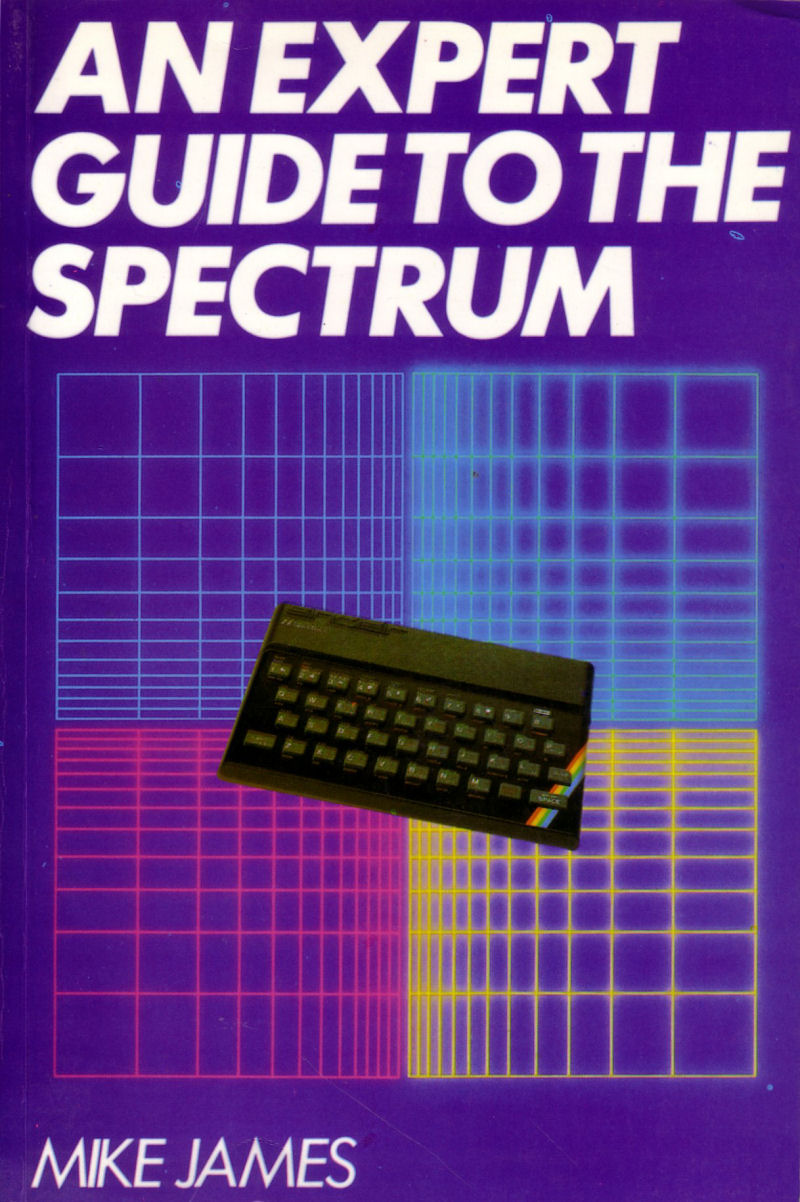
An Expert Guide to the Spectrum
Book: Paperback · English
Granada Publishing · 1984 · Pound sterling 6.95 · 190 pages · ISBN 0-246-12278-1
Also known as Der Weg zur ZX-Spectrum-Meisterschaft (German), Guia Avancado para o Spectrum (Portuguese)
(Verbo).jpg)
(Vogel).jpg)
Discussion
Nobody has started a thread about this yet.
Remarks
Spectrum Hardware, Inside ZX Basic, Graphics, Tape, Sound, Printer, Interface I with Microdrives. Translated into German in 1985, on ISBN 3-8023-0810-7 Republished in Slovenia in 1985 (in English)
Releases
- 1984Granada PublishingPound sterling 6.95
- UnknownVogel Buchverlag Sold as Der Weg zur ZX-Spectrum-Meisterschaft
- UnknownMladinska Knjiga
- UnknownVerbo Sold as Guia Avancado para o Spectrum
Documents
- ExpertGuideToTheSpectrumAn.pdfComplete book 43,859 KB
- ExpertGuideToTheSpectrumAn(GuiaAvancadoParaOSpectrum)(Verbo).pdfComplete book 89,146 KB
Files and rights
No permission is on record either way. Screens and pictures are copied here on a take-down basis: if you hold the rights and want something removed, say so and it goes.
Credits
- Mike Jamescredited
Sign in to credit somebody, or say what these people did.
Scores
Elsewhere on the web
- WorldOfSpectrum 3 votes10.00
In the magazines 3
ZX Computing #15Oct 1984 · p.125
Patrick Cain
If your bookshelves are already almost full of "Instructions to..", "Beginners Courses in.." and other elementary texts for better Spectrum use, then I suggest that you may well find an "Expert Guide to the Spectrum" by Mike James a worthwhile addition to make. Of course books for Spectrum users at all levels proliferate and there is nothing new in books for more advanced reading, but maybe its because this one says what the best part of most of them do that I found it such a good read. Mike James is the author of several very successful books on programming and many more to come I'm sure. Why am I being quite so generous with the praise? My temperature feels all right. I don't think I need a holiday I must confess I would be getting worried if it wasn't for the blatant fact that Mr. James is a very good writer and deserves any praise - at least for this book, let's not get carried away - that I might lavish. He doesn't mess around prattling on about this, that and the other before finally making a stab at the topic in question. I get the feeling that he now knows his subject so well that he didn't need to use any notes. His familiarity with the subject shows. As a result the text doesn't labour; moving quickly from point to point while at the same time being aware of the reader and possible areas of difficulty. The text is concise; but accurate and clear and a stimulating read. 1.8 million Spectrum users can't be wrong (figures approx. correct at time of writing i.e. 6.45pm), the Spectrum is a remarkable machine and as such enables programmers to do remarkable thing with it. Logically an investigation of these remarkable features will enable programmers to put them to good use, The reader is required to have no more than a working knowledge of basic to undertake this investigation. Chapter one, an overview of computer hardware in general, examines buses, addresses, data and bit patterns and effectively establishes the fundamental, relationship that exists between them - Ah! so that's why the highest address is 65535. Chapter two is more specific to the Spectrum, the intention being that a knowledge of the hardware will influence the readers approach to software, and to this end the memory, the video display, input and output devices and the U.L.A. are discussed. Much of the material of the first two chapters is used and developed further in later chapters dealing with more specific topics. As important as the hardware, the software: the ZX Basic is looked at in chapters 3, 4, and 5. In all there are twelve chapters covering the above, the video display, video applications, tape, sound and printer, interface and microdrives, communications and advanced programming applications. Readers may well have to turn back a few pages sometimes, indeed the author recommends that the reader I should read from front to back and then from back to front. That can only be because of the complexity of the subject and not its treatment on the pages. And even if subsequent readings and necessary then that should require little effort for this is one of the most valuable books I have read this year. "An Expert Guide to the Spectrum" is written by Mike James, published by Granada and costs £6.95. ISBN 0-246-12278-1.
Personal Computer News #62May 1984 · p.58
John Lettice
GIVE YOUR TYPING FINGERS A BREAK AND LET THEM TURN A FEW PAGES. 'Creating Adventure Programs On The ZX Spectrum' by Peter Shaw and James Mortleman, published by Interface at £4.95 (paperback, 124 pages). 'Spectrum Magic' by Steve Belts, published by W Foulsham & Co at £5.50 (paperback, 95 pages). 'Step by Step Programming - ZX Spectrum' volumes 1 and 2 by Ian Graham, published by Dorling Kindersley at £5.95 each (paperback, 64 pages each). 'An Expert Guide to the Spectrum' by Mike James, published by Granada at £6.95 (paperback, 190 pages). 'ZX Spectrum Astronomy' by Maurice Gavin, published by Sunshine Publications at £6.95 (paperback, 229 pages). Hardly a week goes by without 'another great book from Interface Publications' (© Interface Publications) whacking onto the doormat in the entrance hall of PCN towers. 'Creating Adventure Programs on the ZX Spectrum', by Peter Shaw and James Mortleman, is one of the latest from this stable, and follows Interface's traditional format by having plenty of listings for you to hack in. There are seven complete adventures including 'Elsie the Aadvark (sic, throughout) goes Lunar Surveying.' There are a number of howlers along these lines, including 'Minataurs, Hydra and the Scylla make excellent monsters.' PCN's culture correspondent reveals that Scylla was actually a rock, and while this may be a handy way of dealing with those failed user-defined graphics, the authors here seem to have unintentionally underlined the need for good research when you're writing an adventure. The section on how to write an adventure takes up slightly less than the first half of the book, but there's enough information to show you the techniques to use in programming an adventure. The problem is that the techniques aren't really all that different to those you'd use in other programs. Work out how you store your locations in arrays and how to give the game a vocabulary, then you just zip through PLOT and DRAW and that's that. The only other things you'd need to know would be a little on organising long Basic programs, how to write a script, and how to produce fast complex graphic displays. None of these are covered in any detail. Still, seven adventures for £4.95 can't be bad. 'Spectrum Magic - your first programming book' is a different kettle of fish. Aimed at children from nine upwards, it sports a jolly cover that looks a bit like Gerald Scarfe's impression of Ronald Reagan leading the invasion of Grenada. It starts with the usual 'setting it up' chapter, plus a short homily on the subject of 'butter spoils the works' which indeed it does. The author takes a gently, gently, approach throughout - too gently I'd have thought, as by the time a beginner's reached the end of the book they'll have learned only very basic programming techniques. This makes chapter 31 'Speeding ahead', look a bit bizarre. It presents a sketchily explained piece of machine code, plus its Basic equivalent, to illustrate the difference in speed. Readers that reach chapter 30 thinking they've learned a bit about programming are liable to change their minds when they hit 31. 'Step by Step Programming for the ZX Spectrum', by Ian Graham, comes in two volumes, and is again educational. Both volumes are beautifully presented, and use a screen-shot technique to produce the program listings. The ground covered in Book one is similar to that dealt with by 'Spectrum Magic', but it's a little wordier and the explanations are clearer. Book two follows the same format, but this turns into a disadvantage because program length is limited to one screenful. Also the information included seems a lot less systematic than in the first volume. Mike James' 'An Expert Guide to the Spectrum' turns out to be an interesting book, although its usefulness is limited by an inadequate index. Mr James concentrates on what is going on inside the machine when a program is running, so when you've finished reading it you'll probably have a better understanding of what the Spectrum does, and why it does it. Spectrum Basic is covered, along with the tape system, Microdrives, communications and advanced programming applications, and the book includes enough in the way of machine code routines to whet the beginner's appetite. And finally, what can a non-astronomer say about a book about astronomy? 'ZX Spectrum Astronomy', by Maurice Gavin, isn't aimed at astronomers, but rather at Spectrum owners 'who wish to expand their computing interests into other fields'. It includes routines to allow you to simulate the movement of the stars and to produce star maps, but I think you'd have to have some prior interest in the field for the book to grab and hold your attention.
Review1
- Sinclair Answers #1Sep 1984 · p.107
Reviews from people here
Sign in to write about this, or make an account. It takes a minute and lets you correct the catalogue too.
Everything ZXDB can hold about this is here.
Sign in to correct or add to this.
Hold the rights to this and want it taken down?