Exploring Spectrum BASIC
Book: Paperback · English
Timedata Ltd · 1982 · Pound sterling 4.95 · 191 pages · ISBN 0-907892-03-5
Also known as Alla Scoperta del BASIC Spectrum (Italian), Aprofundar o BASIC do Spectum (Portuguese)
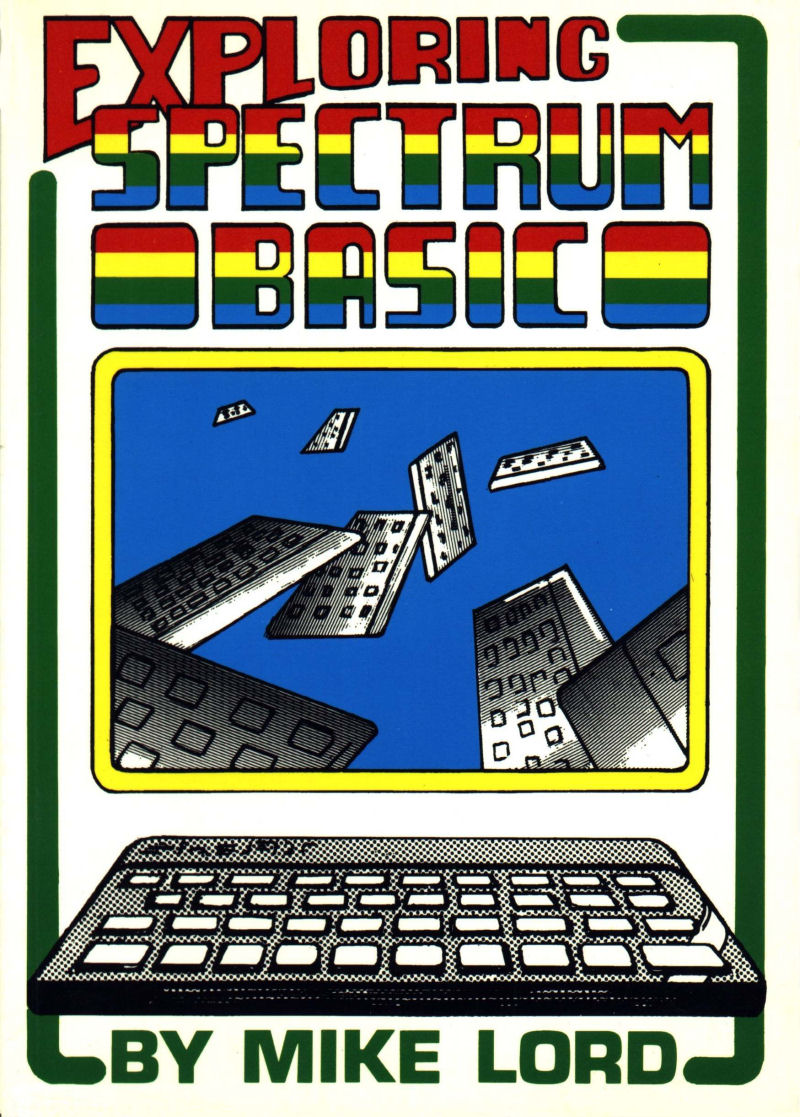
(Verbo).jpg)
Discussion
Nobody has started a thread about this yet.
Releases
- 1982Timedata LtdPound sterling 4.95
- 1985Gruppo Editoriale Jackson Sold as Alla Scoperta del BASIC SpectrumItalian lira 34000.00
- UnknownVerbo Sold as Aprofundar o BASIC do Spectum
Documents
- ExploringSpectrumBASIC(AllaScopertaDelBASICSpectrum)(GruppoEditorialeJackson).pdfComplete book 12,311 KB
- ExploringSpectrumBASIC(AprofundarOBASICDoSpectum)(Verbo).pdfComplete book 42,986 KB
- Alla%20scoperta%20del%20BASIC%20Spectrum.pdfComplete book Italian
Files and rights
No permission is on record either way. Screens and pictures are copied here on a take-down basis: if you hold the rights and want something removed, say so and it goes.
Credits
- Mike Lordcredited
Sign in to credit somebody, or say what these people did.
Scores
Elsewhere on the web
- WorldOfSpectrum 2 votes9.00
In the magazines 37
Personal Computer News #19Jul 1983 · p.82
John Lettice
'Exploring Spectrum Basic' by Mike Lord, published by Timedata £4.95 (paperback, 191 pages). Down at the British Library there must be consternation over the structural soundness of the shelves housing books of the 'Beginner's Guide to the X Micro' variety. Exploring Spectrum Basic slips neatly into this category, and fortunately is one of the better of the genre. It starts off in the now traditional 'what is a computer?' mode, but this is thankfully clear and concise, with little of the gosh-woweries we have come to expect from books of this type. Mr Lord then takes us through the terms and commands encountered when using the Spectrum - the explanations here are particularly detailed, and presuppose no prior knowledge. The next step is an introduction to programming. Mr Lord produces annotated listings of programs for graphics, games and practical purposes, interspersed with technical information. The programs themselves are by and large original. You get the ubiquitous Biorhythms and Moon Landing - although I looked in vain for Hangman - but what about Elephants Dropping and Vogon Haiku Hacker? Clearly there is a fertile imagination at work here. Haiku Hacker, on the other ,hand, writes meaningless four-line verses in the Haiku style. But with the number of program listings available nowadays, one of the most useful sections of the book will be the guide to other Basics. This deals with the Spectrum equivalents of commands used by other machines, and will be a handy aid for would-be converters. My only grouse is the fact that the book has no index.
ZX Computing #5Feb 1983 · p.104
WITH SO MANY PUBLICATIONS BEING WRITTEN FOR THE SPECTRUM WHICH ONE SHOULD YOU LOOK AT FIRST? OUR REVIEW PANEL TAKE A BRIEF LOOK AT TEN OF THE NEW TITLES TO HELP YOU MAKE YOUR CHOICE. The first six chapters of this book introduce the reader to the ZX Spectrum, the various commands and functions available on the machine, and some of the programming features which can be used such looping, arrays and data handling. There is also a chapter describing the creation of a program - Calendar - and the subsequent debugging of the listing. Then, once you have presumably got the hang of manipulating simple programs, you are provided with over 50 full programs together with detailed explanations. As new techniques are used within the programs provided, some explanatory text is given to show the reader what is going on. Numerous short routines are also included within the text for illustrative purposes. The listings are all clear and easy to read, and the Spectrum keywords are printed in a bold typeface. Screen display dumps are used throughout the book to illustrate the text. The last two chapters of the book are called 'Applications', containing such programs as Linear Programming, Simultaneous Equations, Pearson's Correlation, and a General Purpose Graph Plotter; and 'Utility programs, quirks, and useful routines', which contains programs to test the ROM and RAM, Renumber routines, etc. Three appendices are included entitled 'Places to PEEK & POKE'; 'Speeds', which you can use to speed up the rate at which the program runs; and 'Other BASICs', which explains some of the difference between Sinclair BASIC and the rest. Exploring Spectrum BASIC, written by Mike Lord, is published by Timedata Ltd. The book has 191 pages and is priced at £4.95. IS8N 0 907892 03 5
Advert35
- Popular Computing Weekly #3Jan 1986 · p.16
- Your Spectrum #15Jun 1985 · p.44
- Your Spectrum #14May 1985 · p.32
- Sinclair User #37Apr 1985 · p.97
- Your Spectrum #12Mar 1985 · p.70
- Your Spectrum #11Feb 1985 · p.61
- Your Spectrum #10Dec 1984 · p.20
- Your Spectrum #9Nov 1984 · p.33
- Your Spectrum #8Oct 1984 · p.58
- Your Spectrum #7Sep 1984 · p.14
- Your Spectrum #4Jun 1984 · p.20
- Popular Computing Weekly #19May 1984 · p.42
- Your Computer #1Jan 1984 · p.74
- Your Computer #11Nov 1983 · p.112
- Your Computer #6Jun 1983 · p.182
- Sinclair User #15Jun 1983 · p.104
- Computing TodayMay 1983 · p.14
- Your Computer #5May 1983 · p.186
- Sinclair User #14May 1983 · p.26
- Your Computer #4Apr 1983 · p.113
- ZX Computing #6Apr 1983 · p.110
- Sinclair User #13Apr 1983 · p.79
- Sinclair User #12Mar 1983 · p.92
- ZX Computing #5Feb 1983 · p.98
- Your Computer #2Feb 1983 · p.74
Programs listed in this book
- Mazep.135
Reviews from people here
Sign in to write about this, or make an account. It takes a minute and lets you correct the catalogue too.
No description recorded.
Sign in to correct or add to this.
Hold the rights to this and want it taken down?