
Graphic Adventures for the Spectrum 48K
Book: Paperback · English
Micro Press · 1984 · Pound sterling 5.95 · 194 pages · ISBN 0-7447-0013-2
Also known as Aventuras Graficas para O Spectrum 48K (Portuguese), Juegos Graficos de Aventura: Tecnicas de Diseno (Spanish)
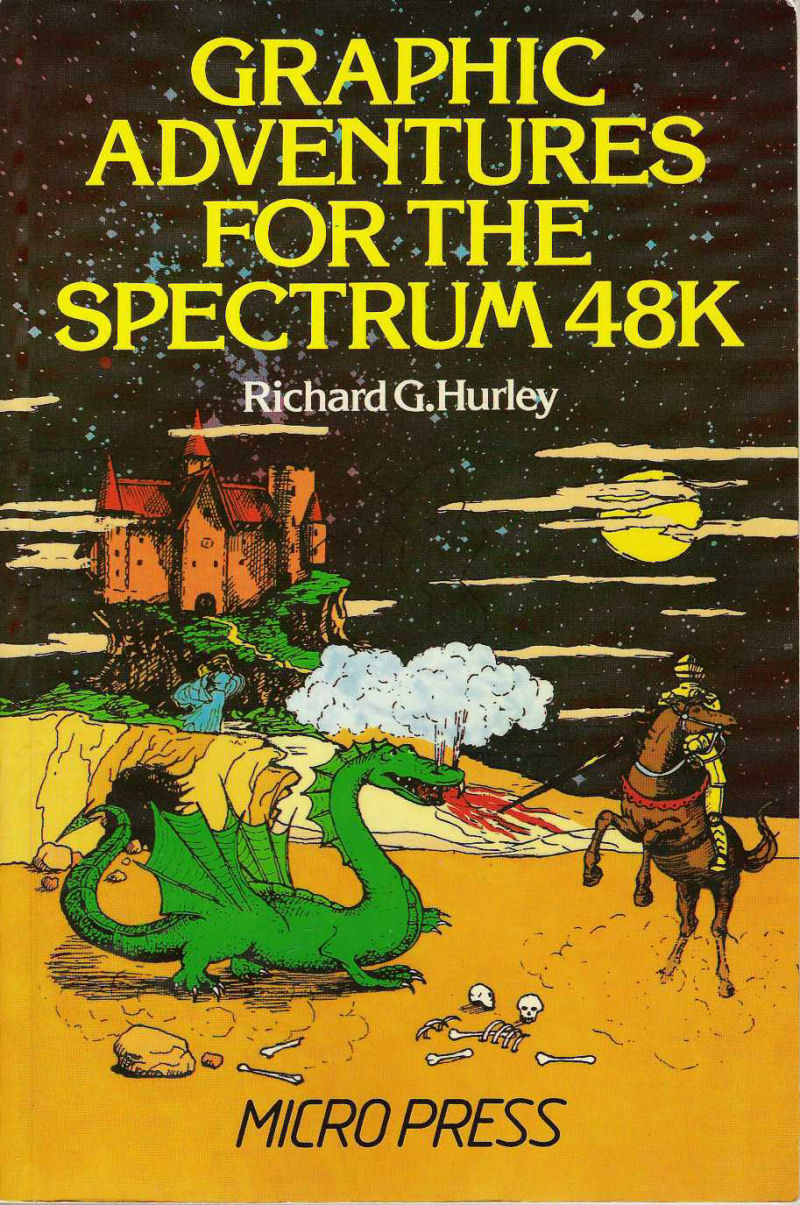
(TemposLivres).jpg)
(EdicionesAnayaMultimediaS.A.).jpg)
Discussion
Nobody has started a thread about this yet.
Releases
- 1984Micro PressPound sterling 5.95
- 1984Ediciones Anaya Multimedia S.A. Sold as Juegos Graficos de Aventura: Tecnicas de Diseno
- 1986Tempos Livres Sold as Aventuras Graficas para O Spectrum 48K
Documents
- GraphicAdventuresForTheSpectrum48K(AventurasGraficasParaOSpectrum48K)(TemposLivres).pdfComplete book Portuguese5,060 KB
- GraphicAdventuresForTheSpectrum48K.pdfComplete book English
- Juegos_Graficos_de_Aventura.pdfComplete book Spanish
Files and rights
No permission is on record either way. Screens and pictures are copied here on a take-down basis: if you hold the rights and want something removed, say so and it goes.
Credits
- Richard G. Hurleycredited
Sign in to credit somebody, or say what these people did.
In the magazines 4
Micro Adventurer #13Nov 1984 · p.52
John Fraser
AUTHOR: Richard Hurley PUBLISHER: Micro Press PRICE: £5.95 On the face of it, seven Spectrum graphic adventures for under six pounds must be a bargain, even if you do have to do the work of entering all the listings yourself. Unfortunately, the games are mediocre. If the book is lacking in quality of programming, it is certainly not deficient in quantity, since there are reams of basic listings, with all but thirty of nearly two hundred pages in total being devoted to listings. This would be impressive if the programs were good, but the standard is low, with most of the predominantly single-statement lines involving printing to the screen or setting up the many User Defined Graphics. In purely programming terms, the only interest in the seven games is the machine code routine given for the fast generation of a 3D line drawn maze. The best thing about the book is in its formal structure, with each of the seven listings introducing a different technique of game programming - alternate character sets, to increase the number of UDG's, pseudo-arrays, machine-coding for the essential fast drawing required for the maze, and so on. It must be said, though, that most of the techniques highlighted in this way are familiar to all but the absolute novice in Basic.
C&VG (Computer & Video Games) #35Sep 1984 · p.118
Keith Campbell
A HANDFUL OF BOOKS As a change from slaving away over a hot keyboard, I sat down and relaxed for a while with a batch of recently released books on Adventure. Graphics Adventures for the Spectrum 48k is by Richard G. Hurley and contains listings for seven graphics Adventures. They are reproduced (presumably from printer output) in greater clarity than I have seen before in print. Having said that, there is no point in buying the book unless you intend to sit down and type - or should I say "rubber pad"? - at least one of the listings in to your Spectrum. Looking through them, it is not a job I would fancy, since some have over two pages of numeric data. Make an error and... Each game is preceded by hints on typing in the listing, saving the game - some non-routine saving methods are used - plus tips and instructions on how to play. The blurb says that to help you write your own Adventures, the techniques used in writing the programs are explained. This is true, but only as brief preambles, so you should not expect to learn how to write such programs from scratch. If Graphic Adventures are your thing, and you are adept at entering listings, then this book could represent very good value for money, although I can't vouch for the quality of the games, as I have not keyed them in myself. Graphics Adventures for the Spectrum 48k is by Richard G. Hurley and published by Micropress at £5.95. Beyond the Arcade must be a title to appeal to Adventure fans, who can usually be relied on to have an interest in most games requiring thought and strategy, as opposed to fast reactions and manual dexterity. By Nicholas Palmer, the book starts off with a useful discussion of the characteristics of most current popular micros from the gamer's point of view. This takes into account the software available, graphics capability and so on. If you are about to buy a computer, and unashamedly admit that it's mainly for gaming, then here's a useful comparison. The book then takes the reader through the whole range of strategy games, from Adventures, through war and resource games, to play by mail games. In fact, almost half the book is devoted to the latter and it's the most complete rundown on the subject I have come across. Pure Adventurers, though, should peruse it before buying, as not an awful lot of it is about Adventure games. Beyond the Arcade, by Nicholas Palmer, is from Mosaic Publishing, priced £6.95. Finally, I came to The Adventurer's Notebook by Mike Gerrard. This is presented with a metal ring spine and is intended to be a working notebook for the Adventurer. The main bulk of it consists of sheets of dummy maps and blank tables for writing in objects, locations and actions, for use as an aide-memoire during play. It's an excellent idea, but what happens when the pages run out? The idea might have been better presented as a proper loose-leaf folder, with replacement forms readily available, rather than as a book. Some 38 pages of text precede the notebook section and comprise the history of Adventure, hints on playing and a list of currently available software. There is even a sort of abridged thesaurus included and a chapter on Recommended Adventures. Interestingly, Artic's series is included in this list, contrasting with the views of Nicholas Palmer (see Beyond the Arcade above) who finds Planet of Death "amazingly dense" and the others little better. Yes. The text part of the book continues with recommended books and I was pleased to see The Computer & Video Games Book of Adventure being the only one named as non-machine-specific. Obviously C&VG is not thought by the author to be worthy of true Adventurers, whilst PCN(?) is! And who's this Bridge fellow he mentions? Only joking, Tony! The Adventurer's Notebook is by Mike Gerrard and is published by Duckworth, priced £3.95.
Personal Computer News #75Aug 1984 · p.15
John Lettice
'Graphic Adventures for the Spectrum 48K' by Richard Hurley, published by Micro Press at £5.95 (paperback, 194 pages). Richard Hurley is a dangerous man. His previous book, Making the Most of your Spectrum Microdrives, showed a tendency to present the reader with monstrously long listings, but his latest work shows that was merely a curtain-raiser. Graphic Adventures for the 48K Spectrum is mainly listing, and if you divide 194 pages by seven (the number of adventures included) you'll get an idea of the complexity of the adventures. In the first of the batch, Mr Hurley even resorts to space-saving techniques, proudly boasting that he's saved 6K of memory. The flip side of this is that he uses expressions like VAL "1" instead of 1, which may not sound too bad to you until you meet the three pages of DATA statements that all use VAL "32" etc. If you can face hacking it in, you should wind up with a pretty complex adventure. There's not a lot of overtly educational stuff in the book, and the techniques used generally aren't frontiers of Basic material, but there are a few useful tips, such as how to design a full alternative character set and how to save space by using pseudo arrays stored above RAMtop. Personally I'd tend to the view that a few more radical programming techniques, such as storing and amending whole screens for graphics, might have been more welcome than endless PLOT and DRAW and DATA statements. Still, if it's cheap and cheerful adventures you want, and you don't mind wearing your fingers down to the elbow, you won't find much better value.
Advert1
- Sinclair User #30Sep 1984 · p.143
Programs listed in this book
- Quadrilandp.111
- Dungeons and Demonsp.158
Reviews from people here
Sign in to write about this, or make an account. It takes a minute and lets you correct the catalogue too.
No description recorded.
Sign in to correct or add to this.
Hold the rights to this and want it taken down?