
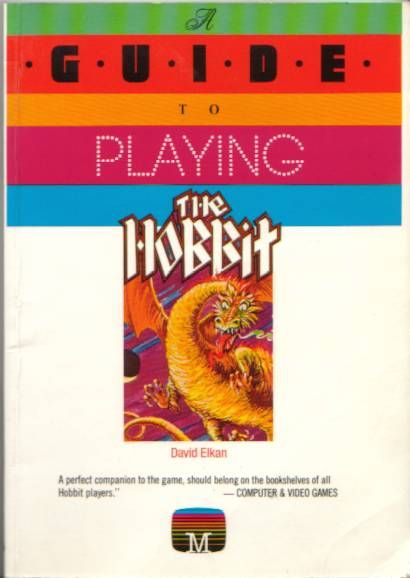
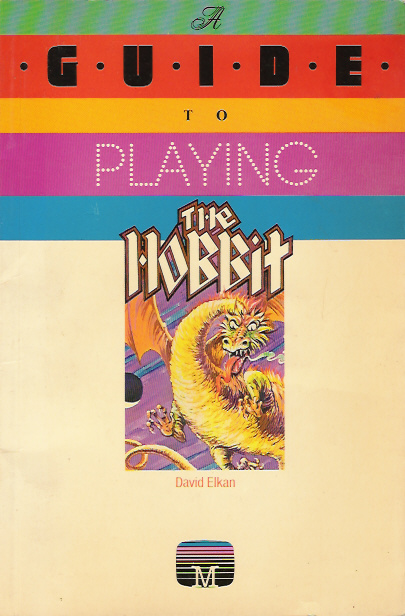
A Guide to Playing the Hobbit
Book: Paperback · English
Melbourne House · 1984 · Pound sterling 3.95 · 76 pages · ISBN 0-86161-161-6
Discussion
Nobody has started a thread about this yet.
Documents
- GuideToPlayingTheHobbit.pdfComplete book English
Files and rights
No permission is on record either way. Screens and pictures are copied here on a take-down basis: if you hold the rights and want something removed, say so and it goes.
Credits
- David Elkancredited
Sign in to credit somebody, or say what these people did.
In the magazines 25
ZX Computing #14Aug 1984 · p.130
Patrick Cain
HOBBIT HABIT Probably the most frequently written about or discussed or discussed (and cussed) program is the Hobbit from Melbourne House. Quick to recognise a good thing they have now published a book called "A Guide to Playing the Hobbit" by David Elkan at £3.95. Although only a slim volume it contains much valuable information information and, such is the nature of the program, the solution given is only one of many and Melbourne House emphasise that it is not THE solution.
Micro Adventurer #8Jun 1984 · p.24
John Fraser
HELP ON THE HOBBIT IS AT HAND PRICE: £3.95 SUPPLIER: Melbourne House Publishers If you've had enough of blundering aimlessly along the dark stuffy passages of the Goblin's Dungeon or being killed by loathesome creatures in the early stages of the Hobbit, then this book by David Elkan may be just what you need. It's divided into three sections, each of which is slightly more revealing. The first is a general introduction, with strategies and hints on mapping, the rules of Inglish and so on. Much (though not all) of this is also contained in the instruction booklet provided with the game and should be familiar to you. The next section though is rather more useful. It offers a sample route while expanding on the hints already available with the HELP facility and providing them when there are none in the game. Extra hints are coded, but it's tempting to jump straight to the last section where complete solutions are given. The final section describes all locations in alphabetical order, listing visible exits and guiding you painlessly through every conceivable hazard. If you follow the recommended route, checking the visible exits before going into them, you'll avoid the worst of the pitfalls, which all too frequently bring the game to an abrupt end. Fortunately the Hobbit is not a fixed adventure with only one solution so the book does not spoil the fun of playing it. There remains an element of uncertainty and sometimes you won't be able to do what the book advises. I've been captured in the most unlikely places and frequently ignored by those who are supposedly my allies. On one occasion I had to make do without Bard who ought to have slayed the dragon, but must have decided he didn't like the idea because he made off in the opposite direction and never returned. But it was the goblins' caves in which I found the most tantalising problem of the game, and here the book proved to be invaluable. But there's one dilemma: you're specifically advised not to wear the ring until you are clear of the caves, so that Thorin doesn't lose you and yet, if you don't you're recaptured time and time again. I decided to wear it, and, while I lost Thorin for good, I nevertheless succeeded in raising my score from a mere 20% or so to 72.5%. I did come across one error. In the route from the dark winding passage to Beorn's house the second direction is given as 'down' whereas the game tells you that you can't go down. The result was that I got hopelessly lost and had to start all over again. What the book cannot do is to predict which way the game will proceed each time you play it. You must be continually alert to the dangers and may have to abandon some suggestions, but it's still a real boon for anyone who feels lost in the early part of the game, as the dramatic increase in my own score shows. Copyright: John Fraser.
C&VG (Computer & Video Games) #32Jun 1984 · p.159
Keith Campbell
GUIDE FOR BILBO I have always found that The Hobbit stands alone above all other adventures, in the degree of difficulty I have answering readers letters for help. Despite having a check list of many tips, I find myself struggling to answer some of the questions I receive. Other adventures have a set answer to a given problem - Hobbit problems have different solutions according to the circumstances of the game. Hobbit players will be delighted, then, to hear that there is now a book available to help them in their quest, A Guide to Playing The Hobbit, by David Elkan, takes the Hobbit player through the adventure at three different levels. The first part of the book, entitled Through the Green Door, explains Inglish Language, gives advice collecting treasures a describes doors a passageways, a characters encountered in the game. There are also tips on mapping and scoring. Part two is a Hobbit Helpline and divides the game up into seven sections, such as The Goblins' Caves and The Liven King's Halls. Each section is introduced with a general discussion on tactics and objectives, followed by a number of tips categorised as HELP, HINT, FURTHER HINT and EXTRA HINT. The last two levels of hint are written in a simple code and give fairly direct clues. The aim of the section is not to give a solution, but to help the reader help himself through the game. The final part the book goes through the game location by location (there are 50 in all), with a detailed commentary on what to do, what might happen and how the player should proceed. By following this section, the player should no doubt able to complete the game without too much difficulty. Having perused the book very thoroughly. I decided to put it to the test, and what better way to use it, rather than take me through the game, but to answer some the varied Hobbit problems of writers to the Adventure Helpfine? The exercise proved invaluable, allowing me to give far clearer answers very quickly. Although not overlong - some 60 pages in all - the book is logically arranged, written in a clear, easy to follow style and being the perfect companion to the game, should belong the bookshelves all Hobbit players. A Guide to Playing The Hobbit, by David Elkan, is published Melbourne House at the modest price of £3.95.
Your Spectrum #4Jun 1984 · p.7
HOBBIT HACKERS For all of you who bought The Hobbit, avidly read the book, tried to play the game and were still confused, Melbourne House has published a new book that could well answer your prayers (or may alternatively bring on a few nightmares). A Guide To Playing The Hobbit splits up into three sections. The first offers the reader a broad outline of the general strategies and tactics involved, and the second and third sections give an increasing amount of guidance and detailed solutions to the problems encountered while playing the game. Melbourne reckons that the guide won't spoil the fun of it all because the solution is only offered among many other possibilities. The Hobbit may have won the Golden Joystick Award for 'Strategy Game of the Year' in 1983, but it's really saying something when companies have to publish the Guide to the Game of the Book just so that people can play it properly! A Guide To Playing The Hobbit is published by Melbourne House, written by David Elkan and costs £3.95; it should be available from bookshops now.
Personal Computer Games #7Jun 1984 · p.108
Steve Cooke
HELP FOR HOBBITS Melbourne House have just brought out a 75-page guide to playing The Hobbit. If you're still tearing your hair out in the Goblin's Dungeon, or just want to get more out of the program, then this looks as if it could be a good buy. 'A Guide to Playing The Hobbit' is beautifully produced with numerous screen-shots from the game. The book is divided into three sections - an introduction, help section, and a guide to locations. Unfortunately the introduction doesn't tell you much that you won't find out by reading the instructions that come with the program and playing the game. By the time you're ready to fork out £3.95 for the book you'll probably already have found out that Thorin is useless in the second half of the game and that attacking Gandalf is not a good idea. The second section isn't much better and gives only some rather obvious hints, but the final part of the book is more impressive. Almost all the locations are listed, together with the appropriate commands to enable the player to get out of most difficulties. Dragon owners might like to browse through 'Creating Adventure Games on your Dragon 32' by Clive Gifford. Just out from Interface Publications at £4.95 this book takes the reader through three adventure listings, each one slightly more complex than the last. At the beginning of the book the author points out that he has included comprehensive REM statements in the programs, and goes on to say that 'you should easily be able to glean all that you need to know about the programming from the listing'. The programs are well annotated however and you don't need a degree in computer science to follow them through. My main reservation with this book is that if you are already familiar with Basic then you won't learn much that you don't know already. On the other hand, if Basic is still Greek to you then you won't be able to make much sense of what's going on. However there are some useful tips on setting up locations, using arrays, and other Basic routines. The only other drawback with this book is that once you've typed in the listing you'll almost certainly be able to solve most of the puzzles! 'A Guide to Playing The Hobbit', Melbourne House, [redacted]. 'Creating Adventure Games on Your Dragon 32'. Interface Publications. [redacted].
Personal Computer News #64Jun 1984 · p.57
John Lettice
'A guide to playing the Hobbit' by David Elkan, published by Melbourne House at £3.95 (paperback, 76 pages). Having dealt in detail with the film of the book, computer adventures have now begun treading the territory of the book of the film. This book, inspired by JRR Tolkien's myths, is the answer to every frustrated Hobbit fancier's dream, and will also be useful to help out the odd computer journalist struggling under the weight of unintelligible adventure queries. Whichever way you look at it, you have to take your hat off to Melbourne House. First the company designs a game complex enough to leave most people stuck at some point inside it, then Melbourne produces a book telling them how to get out of the holes they're stuck in. Naturally, this raises the purist's hackles. After all, what exactly is the point in buying an adventure that'll give you weeks of amusement if you're then going to buy something else that will allow you to solve it in a matter of hours? It's a nice way to make money, but is it ethical? That said, there is a market for a book of this sort, although ethical considerations would make me feel that it would be better to invest in a guide to playing adventures in general, rather than just a guide to one game. I feel this would smack less of cheating. By paperback standards the book is also quite expensive. The mere £3.95 may seem cheap for a computer book, but if you think in terms of what you'd pay for a major work of literature (such as War and Peace), it's diabolical. On top of this, the bulk of part three of the book, A Tourist's Guide to Wilderland, is taken up by blank space. Still, if you need help, you'll probably find you can afford it. But take it from me, you can hang in there, do the Hobbit the honest way, and fight the urge to buy this book.
News/Note7
- ZX Computing #14Aug 1984 · p.130
- Your Spectrum #4Jun 1984 · p.7
- Sinclair User #27Jun 1984 · p.13
- Crash #4May 1984 · p.43
- Popular Computing Weekly #17Apr 1984 · p.43
- Popular Computing Weekly #14Apr 1984 · p.49
- Home Computing Weekly #54Mar 1984 · p.6
Advert6
- Popular Computing Weekly #32Aug 1984 · p.15
- Sinclair User #28Jul 1984 · p.23
- C&VG (Computer & Video Games) #32Jun 1984 · p.65
- Your Computer #6Jun 1984 · p.164
- Sinclair User #26May 1984 · p.45
- Popular Computing Weekly #19May 1984 · p.33
CompoEntry3
- Crash #5Jun 1984 · p.78
- Popular Computing Weekly #17Apr 1984 · p.43
- Popular Computing Weekly #16Apr 1984 · p.47
CompoResult2
- Crash #7Aug 1984 · p.83
- Popular Computing Weekly #19May 1984 · p.43
Review1
- Popular Computing Weekly #15Apr 1984 · p.70
Related
- Versions
- The Hobbit (Document about)
- Same entry at
- Spectrum ComputingZXInfo
Reviews from people here
Sign in to write about this, or make an account. It takes a minute and lets you correct the catalogue too.
No description recorded.
Sign in to correct or add to this.
Hold the rights to this and want it taken down?