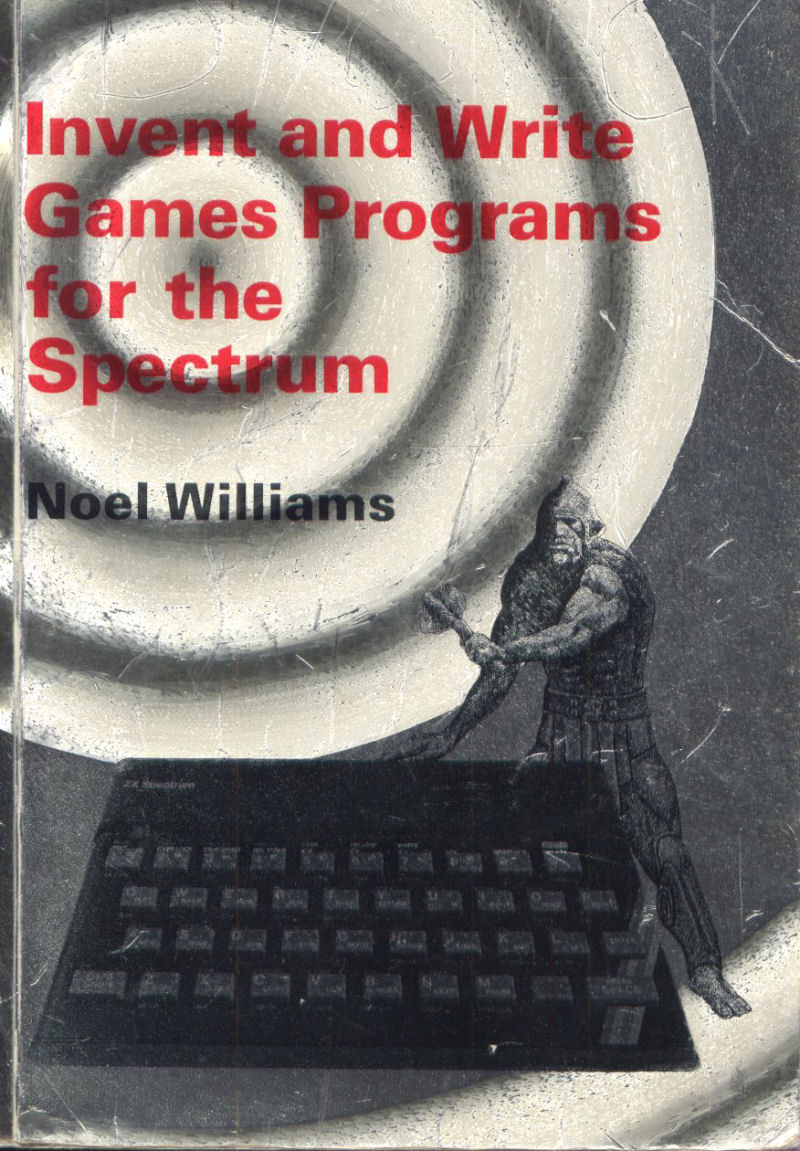
Invent and Write Games Programs for the Spectrum
Book: Paperback · English
McGraw-Hill Book Company UK Ltd · 1983 · Pound sterling 6.95 · 198 pages · ISBN 0-07-084719-3
Also known as ZX Spectrum (TS 2068) Diseno y Programacion de Juegos (Spanish)
DisenoYProgramacionDeJuegos)(McGraw-HillES).jpg)
Discussion
Nobody has started a thread about this yet.
Remarks
Came with a software tape {Spectrum Adventures|McGraw-Hill Book Company UK Ltd|0017435} with slightly modified versions of all ('Anagrams' replaced with 'Tongues') programs on it.
Releases
- 1983McGraw-Hill Book Company UK LtdPound sterling 6.95
- 1984McGraw-Hill [ES] Sold as ZX Spectrum (TS 2068) Diseno y Programacion de Juegos
Documents
- InventAndWriteGamesProgramsForTheSpectrum.pdfComplete book 86,079 KB
Files and rights
No permission is on record either way. Screens and pictures are copied here on a take-down basis: if you hold the rights and want something removed, say so and it goes.
Credits
- Noel Williamscredited
Sign in to credit somebody, or say what these people did.
Scores
Elsewhere on the web
- WorldOfSpectrum 2 votes8.00
In the magazines 5
Big K #7Oct 1984 · p.41
Steve Keaton
Of course some of you lot might actually prefer to write an Adventure the traditional way, with honest-to-goodness code. None of these nancy-boy generators for you! If such is the case then you'll probably be looking for a book to help you on your way. In which case the choice is dazzling! A plethora of softbacks litter the stands and all promise wonders beyond belief. Unfortunately most fail to deliver. An exception is the rather poorly titled Invent And Write Games For The Spectrum written by Noel Williams and published by McGraw-Hill at £6.95. Although you'd be forgiven for passing over it (whoever thought of the moniker should be put to the blade) William's book is something of a gem. Everything you'll need to know is here and it's written with immense humour. Something of a rarity. The book contains history, help and two BASIC listings which once used can be easily cannibalised. All in all a great read for DIY Dorkslayers.
Micro Adventurer #11Sep 1984 · p.28
John Fraser
ADVENTURE PROGRAMS BROUGHT TO BOOK John Fraser leafs through a selection of books on how to design your own adventures. Next month sees the start of a regular book review section, covering computer books, game books, and related topics. ADVENTURE PROGRAMS BROUGHT TO BOOK John Fraser leafs through a selection of books on how to design your own adventures. Next month sees the start of a regular book review section, covering computer books, game books, and related topics. Despite the growing popularity of commercial adventures, many enthusiasts prefer to draw on the worlds of their own imagination, rather than someone else's. But, sometimes, the sheer size and complexity of the task is enough to deter them altogether, with the result that they never progress beyond playing prepackaged scenarios. If you happen to be one of these frustrated adventurers, there is no longer any need to despair, because now experienced programmers have recognised your plight and set down on paper their accumulated wisdom with the express aim of teaching you the art. It must be said, however, that this wealth of literature on how to write your own wonderful mind-bending adventures, is not going to solve your problems overnight. Furthermore, the very concept of such books raises a number of questions which ought to be considered before you unplug your micro and rush into the nearest branch of W H Smith. Firstly, there is nothing quite so tedious as being hunched over a keyboard (particularly the Spectrum's) for several hours in an attempt to translate your brilliant idea into seemingly endless screenfuls of code. Unless you can afford an adventure-generating program such as The Quill or Dungeon Builder, that's exactly what you are in for - and not even the books will remove that drudgery. Not surprisingly, few adventure enthusiasts write a game just for something, to do on a rainy afternoon. Generally, the motivation is at least partly financial: the thought of earning a living from one's hobby, perhaps even of tax havens or a yacht in the Mediterranean. Whatever your ultimate ambition, do not be misled by those blurbs which promise that "you'll soon be creating magnificent games of your own." No book can teach you to do that, but what they can provide you with are the necessary techniques and concepts; the rest depends on the power of your own imagination. Secondly, the programming techniques used in writing adventures are much the same as those used in writing other programs. Once you know how to input data into an array, manipulate strings and so on, you will be well on the way to being able to write one. On the other hand, if such things only induce anxiety, you would do better to buy one of the numerous introductory books available and get to grips with the fundamentals of Basic first. Finally, ask yourself what you really want a book for, because if it's just to key in someone elses listing, you'll have a pretty good idea of how to solve the game before you even run it. Almost certainly, it will take you much less time to solve than it did to key in, which makes all those hours of toil seem rather pointless. After what I've written so far, you may have reached the conclusion that all these hefty volumes crammed with unbelievably long listings are nothing more than publishing gimmicks created to enlarge the bank accounts of struggling authors and publishers. Well, this is not entirely true; there is a range of books to suit most tastes, and some are genuinely useful. Most of these titles follow an, almost identical pattern: explanation, historical introduction, worked example. They differ widely, however, in the amount of information they contain and the number and type (i.e, text or graphic) of adventures which they describe. Some offer several listings for each micro; others offer several versions of the same listing; and a few even fail to specify which machine was used to produce them. Hopefully, by the time you've read this article, you'll be in a better position to decide which is the book for you - or even whether you need one at all. To begin with, let's examine a couple of books which are not machine-specific, but which nevertheless contain listings that can easily be adapted for the Spectrum. The first of these makes a radical departure from the standard format. Andrew Nelson's Creating Adventure Programs on your Computer is - or so the blurb proclaims - "another great book from Interface Publications." Instead of beginning with the usual explanation of what an adventure game is and how they developed, it launches straight into a mini-adventure similar to those in Penguin's Fighting Fantasy Gamebook series; this is then used as the author's first computer adventure. Unfortunately, my copy of the book appears to have met with a disaster in the printing works, and sorting out the text is itself something of an adventure. However, no one else seems to have had the same problem. Interface first published the book in October 1983, and have received no other complaints about it. SOPHISTICATION For all that, the book is quite useful. Andrew Nelson has provided three games of increasing sophistication, with both a basic and an elaborated version of the first offering, Werewolves and Wanderers. He's also generously included a print-out of the screen displays which shows you what the game is like actually running. Only Werewolves and Wanderers is described in any detail, although this doesn't matter very much as the second game, a space adventure, demonstrates how it can be used as the foundation for totally different scenarios, without having to start from scratch. All you do is load the first game and work through the listing, changing the lines where appropriate. The final game consists of over forty locations and demands rather more brawn than brain, as there's plenty of monster bashing. Despite this limitation, and a small vocabulary, you are able to control your attributes and so the game is not the same every time you play it. There are also helpful appendices, including a character name generator, a section on further reading, and a list of games manufacturers and distributors. Chapter 21 (which, incidentally, has been printed twice) offers suggestions for enhancing the appeal of your games and, though brief, gives some advice worth considering. As far as I can discover, the book makes no mention of which machine was used to produce the listings, but converting them for the Spectrum should be no problem. At least with Keith Campbell's Computer and Video Games Book of Adventure you don't get lost trying to sort out the pages. It's a well produced and readable book, but because it's not machine-specific it may well cause some annoyance to those who want value for money - and who doesn't these days? Only one game is described, and there are listings for the BBC, Spectrum and Commodore 64. This means, inevitably, that if you only have one machine much of the book will be of no use to you. Add to that the demonstration program which was written on a TRS 80 and the conversion notes, and you may well be disappointed. According to no less an authority than Scott Adams, who has written the foreword, the book contains "a wonderful recipe for baking your own adventures." Maybe so, but I expect some readers will take that with a pinch of magic potion. It's one thing to have the right ingredients, but quite an other to turn those ingredients into a commercial product. The game itself is notably lacking in complexity. With only ten locations it nowhere near matches the scale of those in some of the other books reviewed here. Nevertheless, it's likely to appear rather less daunting to the newcomer and the text is clearly written, with each stage of the programming covered in easily digested portions. Most Spectrum users, however, will naturally want a book that is machine specific, and there are three which can be recommended. Which is the better book is really a matter of personal preference, how familiar you are with Basic, whether you like text or graphic adventures, and what your expectations are. Of the three, one stands out as being more of a collection of listings to key in and run. In fact Creating Adventure Programs on the ZX Spectrum, written by those teenage whizz-kids Peter Shaw and James Mortleman, offers no less than seven adventures for £4.95. The first half of the book looks at the necessary techniques - creating locations, adding graphics and so on - but the explanations are minimal, which is no bad thing as you're likely to learn more by following a listing through to see how it works. One book which covers both text and graphic adventures is Noel Williams' invent and Write Games Programs for the Spectrum. Although the word adventure appears nowhere in the title, adventures are the author's main concern, and he provides three examples, together with many more useful routines. The first game, The Throne of Camelot, is a traditional puzzle adventure with over sixty locations. Then there is The Mines of Merlin, a role playing type game in which your attributes and possessions are continually updated as you battle with monsters and wander through dark caverns. Finally, in Treasure Trove, you use the cursor keys to manoeuvre a little man around the screen to pick up jewels before your time runs out. The adventure element of the last program is debatable, but the game is thoroughly explained and illustrates techniques for those who wish to incorporate arcade action into their adventures. Noel Williams has done his best to cater for every interest. He can't obviously devote an equal amount of space to everything, so you don't get a highly elaborate graphic adventure, for instance. Even so, the book is remarkably comprehensive and will no doubt gain a wide readership not only among adventurers, but also among those interested in other games who recognise the universal value of the techniques used. The final book reviewed is perhaps the one most likely to appeal to the uninitiated, even though the author (if we are to believe his introductory remarks) does have to sustain himself with large quantities of alcohol when playing adventures! Peter Gerrard's Exploring Adventures on the Spectrum 48K contains three text adventures which only accept simple verb-noun inputs, but are nevertheless far more substantial offerings than those in similar books. One of the games, Underground Adventure, contains no less than one hundred locations and is fully explained, section by section. Only the listings are presented for the other two, but if you have followed Underground Adventure, this should be no handicap.
Advert3
- Your Computer #10Oct 1983 · p.75
- ZX Computing #9Oct 1983 · p.91
- Popular Computing Weekly #33Aug 1983 · p.6
Programs listed in this book
- The Throne of Camelotp.75
- The Mines of Merlinp.106
- Beeperp.150
- Anagramsp.154
- Cypherp.156
- Treasure Trovep.177
- Numbersp.183
- Generatorp.185
Reviews from people here
Sign in to write about this, or make an account. It takes a minute and lets you correct the catalogue too.
Everything ZXDB can hold about this is here.
Sign in to correct or add to this.
Hold the rights to this and want it taken down?